Remote: remote nurse practitioner jobs - Land Flexible Roles Fast
Explore remote nurse practitioner jobs and learn how to land flexible roles, ace interviews, and negotiate salaries with our concise guide.

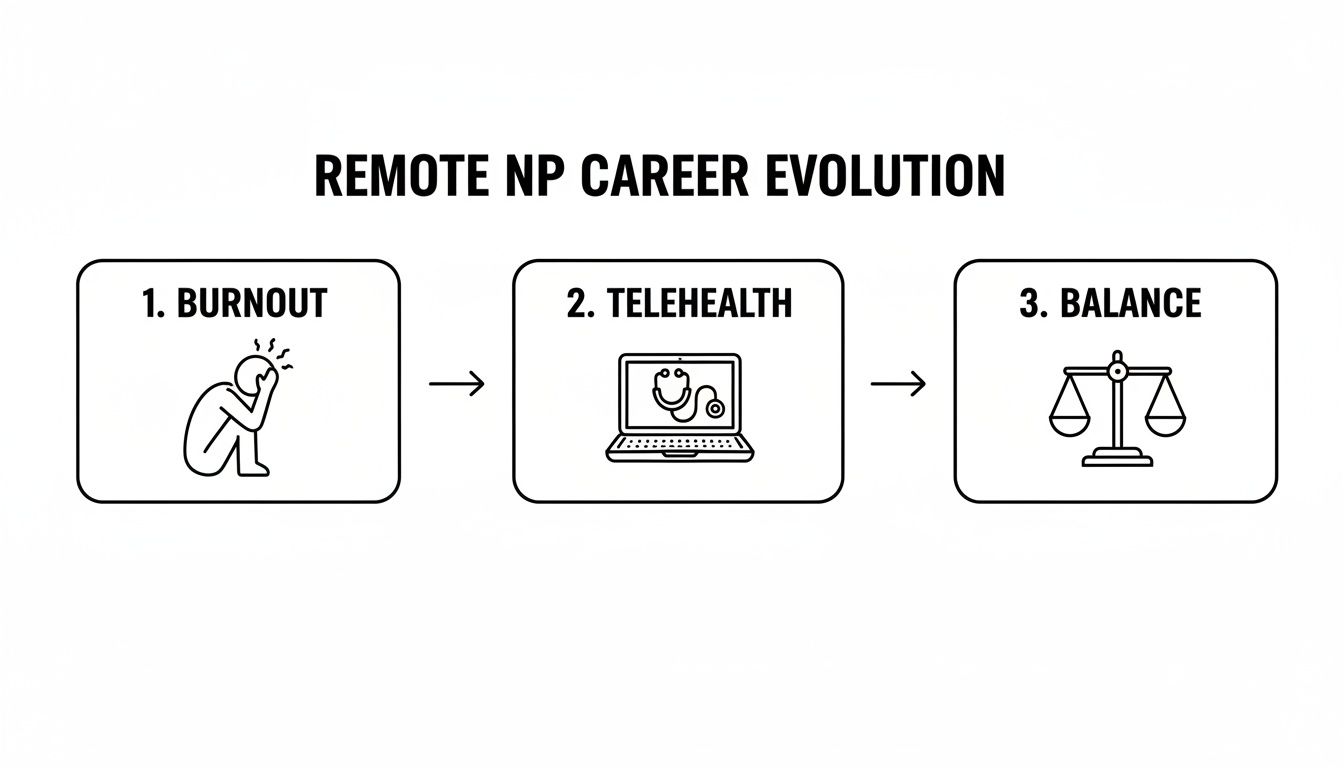
Tired of staring at yet another soul-crushing on-call schedule? If you're feeling the burnout, you're not alone. But there’s good news: remote nurse practitioner jobs have officially moved from a temporary pandemic fix to a legitimate, sustainable career path.
This isn't just a trend. It's a fundamental shift giving NPs a real chance to reclaim work-life balance without sacrificing high-quality patient care. It’s about leaving the grind of weekend rounds and late-night pages behind for good.
The New Era of Remote NP Careers
The ground is shifting in healthcare, and telehealth is right at the epicenter. What started as a crisis response has blossomed into the preferred way of receiving care for millions of patients—and a career lifeline for countless clinicians like us. Patients love the convenience, and that demand has cemented virtual roles as a permanent part of modern medicine.
This means remote NP jobs aren't some niche opportunity anymore; it's a rapidly expanding field. For any NP feeling the weight of clinical burnout, this is your path toward a more sustainable professional life. These roles often strip away the most draining parts of in-person work, like hellish commutes, chaotic clinic environments, and rigid schedules.
Why the Telehealth Boom Is Here to Stay
The initial telehealth surge was born out of necessity, sure. But its staying power comes from something much more fundamental: it just works. Virtual visits have proven incredibly effective for managing chronic conditions, handling follow-ups, and providing routine primary care consultations.
The numbers don't lie. Demand for nurse practitioners is projected to explode by an incredible 46% between 2023 and 2033. That’s about 135,500 new jobs. A massive chunk of this growth is driven by the telehealth expansion that became essential when in-person care hit its limits.
The ability to deliver compassionate, high-quality care without being chained to a physical office is completely changing the NP profession. It gives us more flexibility and opens up access for patients, especially those in underserved areas who need it most.
What This Means for Your Career
For NPs, this shift blows the doors wide open to a world of possibilities beyond the clinic walls. This is your chance to redesign your career on your own terms, focusing on what actually leads to long-term satisfaction. The appeal is so much bigger than just working from your couch.
Think about what this kind of change could really mean:
- Real Autonomy: You can often manage your schedule with a flexibility that makes integrating work and life actually possible.
- Less Burnout: Ditching the commute and the constant physical drain of a busy clinic dramatically lowers your daily stress.
- Focused Patient Time: Many remote jobs allow for more direct, one-on-one patient interaction, free from the constant interruptions of a typical clinic.
- Wider Opportunities: Telehealth tears down geographic walls, letting you work with patient populations and organizations you’d never have access to otherwise.
This guide is built to give you the actionable steps you need to land a role that fits both your professional skills and your personal goals. Ready to see what's out there? You can start exploring your options with our guide on finding telehealth jobs.
Finding Quality Remote NP Jobs Without the Noise
Let’s be honest: scrolling through massive job boards for a decent remote NP role feels like digging for gold in a sandbox. You’re buried under irrelevant listings, sketchy “opportunities,” and job descriptions that are maddeningly vague about the things that actually matter—like call schedules and weekend hours.
To find the real gems, you have to get strategic. Forget the big aggregators and start focusing on platforms that actually get what a burnout-proof clinical job looks like. The game-changer is targeting curated job sites where you can filter for specifics like “No Call” and “No Weekends.” It’s a simple shift, but it takes you from mindlessly scrolling to actively hunting for roles that fit the life you want to build.
This isn’t just about working from home; it’s a deliberate career move away from the grind and toward a more sustainable, balanced professional life.
Go Niche or Go Home
While the mega-sites have sheer volume, they’re terrible at quality control. The best remote NP roles are almost always found on specialized healthcare platforms and professional networks. These are places built for clinicians, by clinicians, with filters that make sense for us.
For example, a niche site might have a “Burnout-Friendly Score” on its listings. This isn’t just fluff—it’s an objective metric that pulls together data on patient loads, admin support, and on-call demands into one clear rating.
A job description might say it offers “flexibility,” but a high Burnout Score proves it. That’s the difference between a company’s marketing pitch and a real commitment to your well-being.
To help you choose the right platform, here’s a quick comparison of the two main types of job sites you'll encounter.
Job Search Platform Comparison for Remote NPs
| Platform Type | Best For | Key Features | Potential Downsides |
|---|---|---|---|
| General Job Boards | High-volume, broad searches for common roles. | Massive number of listings, brand recognition, alerts for many industries. | Overwhelming number of irrelevant jobs, lack of clinical-specific filters, often promotes low-quality roles. |
| Specialized Platforms | Finding high-quality, pre-vetted remote and lifestyle-focused NP jobs. | Curated listings, burnout-prevention filters (no call, no weekends), salary transparency, smaller applicant pools. | Fewer total listings, may not cover every niche sub-specialty. |
While general boards cast a wide net, specialized platforms are where you'll find the roles that truly align with a sustainable career. They do the initial filtering for you, saving you countless hours.
Tap Into Your Professional Circles
Your network is one of the most powerful—and most overlooked—tools you have. Specialty-specific professional organizations are absolute goldmines for high-quality remote NP jobs that never even get posted publicly.
Think about these channels:
- Psychiatry: Mental health organizations often have exclusive career centers with remote psych NP positions at companies that truly support their providers.
- Women's Health: Networks for women's health NPs are fantastic for finding telehealth roles in GYN, OB, and women-focused primary care.
- Dermatology: Teledermatology is exploding. Check the professional derm associations for remote opportunities that are often posted there first.
Get involved in these groups, join the forums, and connect with your colleagues. You’ll get the inside scoop on great openings. For an even more direct path, platforms like WeekdayDoc are built specifically to connect clinicians with the best nurse practitioner jobs that put work-life balance first.
Master Your Search with Smart Filters and Alerts
Once you’ve found the right platforms, put them to work. Setting up job alerts is non-negotiable if you want to be efficient. Let the right opportunities come to you instead of wasting time checking sites every day.
You have to get granular with your search filters. Don’t just type "remote nurse practitioner." Use the advanced search to zero in on exactly what you’re looking for.
Actionable Filter Combinations to Try:
- Role + Specialty + Remote:
Nurse Practitioner+Psychiatry+Fully Remote - Schedule + Keywords:
Part-Time+"No Weekends"+"No Call" - Company Type + Location:
Startup+Telehealth+[Your State License]
A search for “remote psychiatric nurse practitioner part-time no weekends” will give you a list of highly relevant jobs, while a generic query will leave you sorting through hundreds of duds. By refining your search this way, you can stop wasting time and focus your energy on applying for the roles that are actually a great fit.
Crafting an Application That Actually Gets a Response
Your clinical resume is probably packed with years of impressive, hands-on patient care. That’s great, but for remote nurse practitioner jobs, it might as well be written in a different language. Hiring managers for telehealth roles aren't just looking for clinical chops; they're scanning for specific virtual care skills your standard CV could easily miss.
To get noticed, you have to reframe your experience. It's all about translating your in-person skills into the language of remote care. Every single bullet point on your resume needs to answer the recruiter's unspoken question: "Can this NP deliver outstanding care without being in the room?"
Translate Your Clinical Skills for the Telehealth World
The trick is to pivot from describing physical actions to highlighting digital outcomes. A hiring manager for a remote role needs to see proof of your tech-savviness, your virtual communication skills, and your ability to work independently. You have to spell it out for them.
Instead of just listing clinical duties, show how you performed them using technology. Every remote NP role runs on a stack of digital tools. Demonstrating you're already familiar with them gives you a massive advantage.
Here are the non-negotiables to highlight:
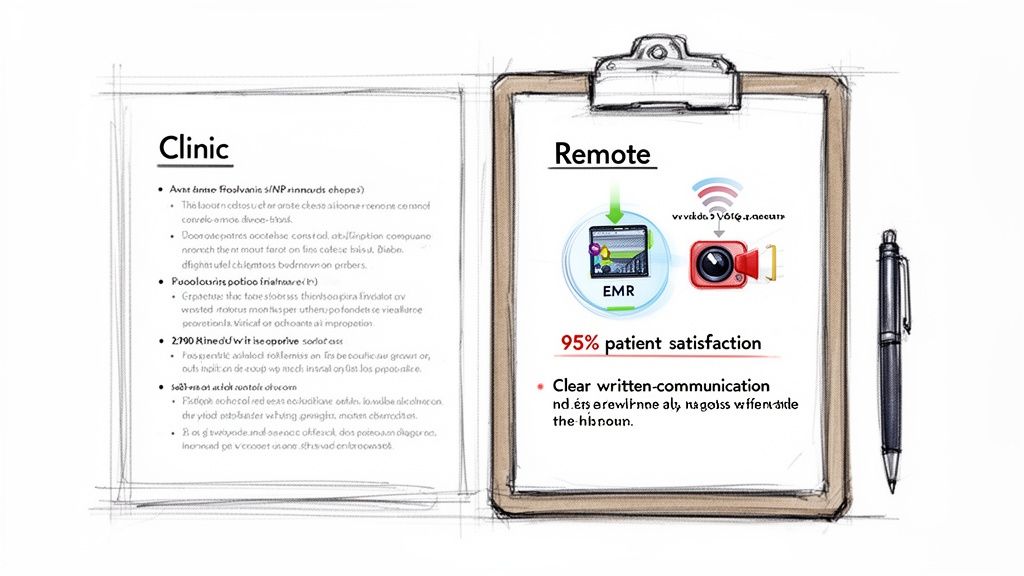
- EMR Proficiency: Get specific. Name the systems you've mastered, like Epic, Cerner, or eClinicalWorks. But don’t just list them—describe how you used them for charting, e-prescribing, and communicating with the care team.
- Virtual Communication Platforms: Have you used telehealth software like Doxy.me or Teladoc? Mention it. Even experience with secure platforms like Zoom for Healthcare shows you can handle the primary patient interface.
- Digital Patient Engagement: Talk about your experience with patient portals for asynchronous messaging, sending educational materials, or managing follow-ups without picking up the phone. This is a core workflow in telehealth.
Put Numbers on Your Digital Impact
"Provided excellent patient care" is a throwaway line. It means nothing on a resume. For remote roles, you absolutely must quantify your achievements to prove you're effective in a virtual setting. Numbers tell a powerful story.
Think about the metrics that matter in telehealth: efficiency, patient satisfaction, and treatment adherence. You probably have this data from your past roles; you just need to frame it for a remote context.
A resume that shows you increased patient portal message response efficiency by 20% is infinitely more powerful than one that simply says you "managed patient communications." One is a specific, measurable achievement; the other is just a job duty.
Let's break down a real-world example. Here’s how to transform a standard clinical resume into a telehealth powerhouse.
Before (Clinic-Focused):
- Conducted patient assessments and managed treatment plans in a busy primary care clinic.
- Educated patients on chronic disease management.
- Maintained accurate patient records.
After (Telehealth-Optimized):
- Managed a panel of 200+ primary care patients entirely via telehealth, achieving a 95% patient satisfaction score for virtual visits.
- Used the Epic MyChart portal to deliver digital care plans, resulting in a 15% improvement in patient medication adherence.
- Proficient in Doxy.me and AthenaHealth EMR, consistently maintaining chart closure rates of 98% within 24 hours.
See the difference? The "after" version is loaded with keywords like "telehealth," "virtual visits," and specific software names. More importantly, it uses hard numbers to prove your impact—and that’s exactly what grabs a recruiter’s attention.
Spotlight the Soft Skills That Matter Most in Remote Care
Technical skills are only half the battle. Your application needs to scream that you have the soft skills essential for a successful remote practice. When you can’t rely on body language or physical presence, certain traits become even more critical.
These aren't just buzzwords; they are core competencies for remote work.
- Digital Empathy: You have to show you can build rapport and convey compassion through a screen. Mention specific techniques, like using active listening to validate patient concerns during video consults.
- Crystal-Clear Written Communication: A huge chunk of telehealth is written—portal messages, emails, digital instructions. Highlight your ability to write clear, concise, and jargon-free communication that patients actually understand.
- Proactive Autonomy: Remote work is a paradise for self-starters and a nightmare for those who need constant supervision. Frame your experience to show you can manage a patient panel, prioritize tasks, and solve problems on your own.
When you weave these technical skills, quantified wins, and essential soft skills into your resume, it stops being a boring list of duties. It becomes a compelling story about why you’re the perfect fit for a remote NP role.
Navigating the Virtual Interview with Confidence
The virtual interview is often the final hurdle before you land that remote NP job. It’s a completely different beast than meeting in person. This isn't just about what you know clinically; it’s a live test of your tech-savviness, your "webside manner," and your ability to project confidence through a screen.
Getting this right is non-negotiable. Your performance starts long before you ever click "Join Meeting." A grainy camera, terrible lighting, or choppy audio immediately distracts from your expertise and makes you look unprepared, no matter how sharp your answers are.
Mastering Your Virtual Environment
Think of your interview space as your personal broadcasting studio. Everything the hiring manager sees and hears is a reflection of your professionalism. Your one and only goal is to create a clean, quiet, distraction-free bubble that lets your skills shine.
- Test Your Tech: At least a day ahead of time, do a full run-through. Check your camera, test your microphone, and make sure you know how to use the interview platform (Zoom, Teams, etc.). Never assume it will just work.
- Find Your Light: The simplest trick is to face a window. If you don't have good natural light, a simple ring light works wonders. Whatever you do, don't sit with a window or bright light behind you—you'll turn into a silhouette.
- Curate Your Background: Keep it simple and professional. A neutral, uncluttered wall or a tidy bookshelf is perfect. Steer clear of virtual backgrounds; they can be glitchy and often look unprofessional when they start to pixelate around your head.
- Ensure Great Audio: Your laptop’s built-in mic can pick up every echo and background noise. A headset with a microphone or even a basic external mic will provide much clearer audio.
Your ability to run a smooth virtual interview is a direct audition for a telehealth role. If you can’t manage your own tech for a 30-minute call, how can they trust you to manage a full day of virtual patient encounters?
As a pro-tip, knowing how to transcribe Zoom meetings can be a fantastic way to review your own performance afterward. Reading back your answers helps you see where you were strong and where you can tighten up your delivery for the next one.
Anticipating Telehealth Specific Questions
Your clinical expertise got you in the door, but now they need to know if you can actually apply it in a remote setting. Expect questions that dig into your comfort with technology, your ability to build rapport through a screen, and how you handle diagnostic uncertainty without a hands-on exam.
Be ready with specific, concrete examples that prove your telehealth chops.
Scenario-Based Questions to Expect:
- "Describe a time you had to build trust with a new patient during a video visit. What specific techniques did you use?"
- "What's your plan when a patient's internet connection is unstable and keeps interrupting the consultation?"
- "Walk me through how you'd assess a patient with vague abdominal pain when you can't perform a physical exam."
- "How do you plan to stay engaged and collaborate with a remote care team you might never meet in person?"
Answering these questions well requires more than theory. Pull from your actual experiences, even from a hybrid role. Talking about how you used specific EMR chat features to collaborate or how you adapted your communication style for the screen shows you’ve already made the mental shift to virtual care.
Asking the Right Questions to Spot Red Flags
Remember, the interview is a two-way street. This is your chance to peek behind the curtain and figure out if this company truly supports a sustainable, burnout-friendly work environment. Vague, fluffy answers to your pointed questions are a massive red flag.
Don’t be timid. You need to dig into the day-to-day realities of the job. The quality and specificity of their answers will tell you everything you need to know about their commitment to their providers.
Here are the non-negotiable questions you must ask:
- Productivity and Patient Load: "What are the exact productivity expectations? How many patients are NPs scheduled to see per day, and is there dedicated administrative time blocked on the schedule?"
- Onboarding and Training: "What does the onboarding and training process look like for new remote NPs? Will I have a dedicated preceptor or mentor for the first few months?"
- Remote Support Systems: "If I run into a technical problem or need an urgent clinical consult during a patient visit, what’s the protocol? Who is available to help me in real-time?"
- On-Call and After-Hours Work: "Could you clarify the on-call responsibilities? Is there a separate team that handles after-hours patient messages, or does that fall on the primary provider?"
If an interviewer dodges a question about patient quotas or gives you a generic line like, “Oh, we have a very supportive team,” press them for specifics. A great employer will have clear, structured answers ready. A company that doesn't is probably a place where you'll end up overworked and flying solo.
Negotiating Your Salary and Total Compensation
Talking about money is uncomfortable for a lot of us. But here’s the thing: walking into a salary negotiation unprepared is one of the most expensive mistakes you can make in your career. For remote nurse practitioner jobs, your compensation isn’t just a simple annual figure. It’s a complex equation based on your state licenses, specialty, years of experience, and even the company's funding model.
Your goal is to show up to that conversation armed with data, not just hope. Before you even think about throwing out a number, you need to know your market value inside and out. Researching what NPs with your background are actually earning in similar remote roles is your single most powerful tool.
Understanding the Remote NP Salary Landscape
The great news is that remote NP roles aren't just flexible—they're financially rewarding. Demand for virtual care has kept salaries competitive. In many cases, they’re on par with, or even better than, traditional in-person jobs, especially when you factor in the money saved on commuting, scrubs, and lunches out.
Recent salary data from ZipRecruiter.com shows that remote nurse practitioners command an impressive average salary of $130,295 annually. That breaks down to about $62.64 per hour, putting remote NPs in a strong position. The salary distribution is also encouraging: 23% of these jobs fall in the $128,000-$142,499 range, and top earners are pulling in over $168,000 a year.
Remember, the first offer is rarely the final offer. It's the starting point of a conversation. Companies expect you to negotiate, and failing to do so can leave thousands of dollars on the table over the life of your career.
Knowing these benchmarks gives you a solid foundation. If an initial offer comes in low, you have objective data to back up your request for a higher base salary.
Strategies for a Successful Salary Negotiation
Confidence in negotiation comes from preparation. Once you have that offer in hand, it’s time to build your case. Don't just ask for more money—you need to explain why you're worth it, tying your value directly back to the role's requirements.
A simple, professional framework for your counteroffer can make all the difference.
- Start with enthusiasm. Always thank them for the offer and express your genuine excitement about the opportunity. It sets a positive, collaborative tone.
- Make your case. Briefly mention your key qualifications again. Highlight your telehealth experience, specific EMR proficiencies, or any specialty certifications that make you the perfect fit for this job.
- Present your number. Be clear and specific. Instead of a vague range, state the number you want. For example, "Based on my experience and the market data for this role, I would be more comfortable with a salary of $138,500." It shows you’ve done your homework.
- Keep the door open. End by showing you’re willing to work with them. A simple phrase like, "I'm confident we can find a number that works for both of us," keeps the conversation moving forward.
This structured approach transforms the negotiation from an awkward demand into a professional discussion about your value.
Looking Beyond the Base Salary
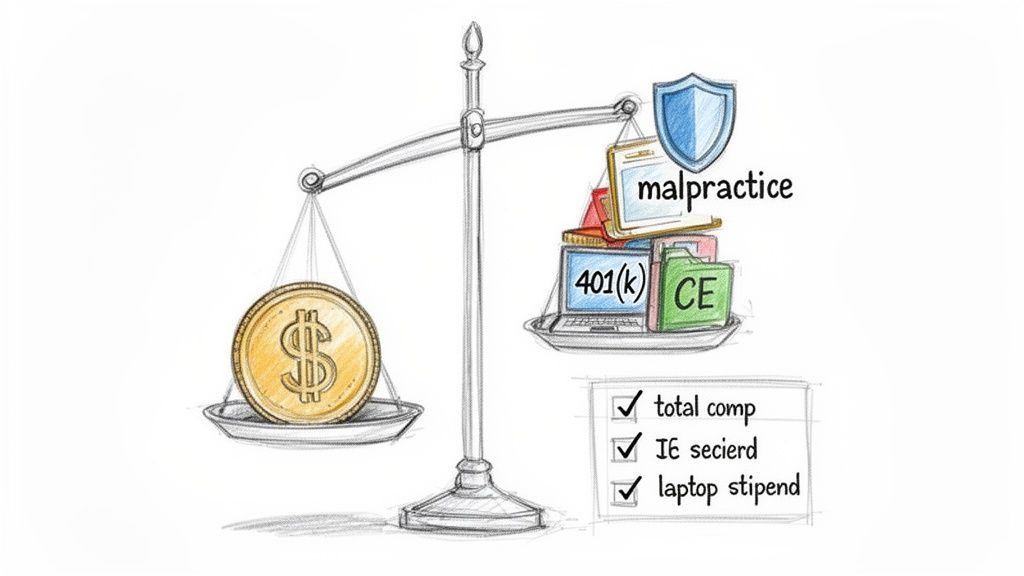
A strong offer is about the total compensation package, not just the paycheck. This is especially true in the remote world, where benefits can add huge financial value and contribute to a sustainable career. A slightly lower base salary might actually be a fantastic deal if it comes with exceptional benefits.
Before you accept anything, you have to weigh the entire package.
Key Compensation Components to Evaluate:
- Health Insurance: Dig into the details. What are the premiums, deductibles, and co-pays? A great plan with low out-of-pocket costs can be worth thousands per year.
- Retirement Savings: Do they offer a 401(k) or 403(b)? Even better, do they offer a match? A 4% match is essentially a 4% salary bump.
- Malpractice Insurance: This is a big one. You need to confirm they provide "tail coverage." Without it, you could be on the hook for your own insurance if you ever leave the company.
- Continuing Medical Education (CME): Ask for the specific dollar amount and the number of paid days off for CME. This is a non-negotiable for maintaining your license.
- Home Office Stipend: Many remote-first companies offer a stipend for internet, equipment, and supplies. It's a direct, often tax-free, benefit.
- Paid Time Off (PTO): How many vacation, sick, and personal days are offered? A generous PTO policy is a cornerstone of a burnout-friendly job.
To help you get a clearer picture of what to expect, here are some typical salary ranges for popular remote NP specialties.
Sample Remote NP Salary Ranges by Specialty
| Specialty | Average Annual Salary Range | Key Responsibilities |
|---|---|---|
| Psychiatric-Mental Health (PMHNP) | $135,000 - $165,000+ | Conducting virtual psychiatric evaluations, therapy sessions, and medication management. |
| Family Nurse Practitioner (FNP) | $115,000 - $140,000 | Providing primary care for common acute and chronic conditions via telehealth platforms. |
| Dermatology NP | $120,000 - $150,000 | Performing virtual skin assessments, diagnosing conditions via images, and prescribing treatments. |
| Women's Health (WHNP) | $110,000 - $135,000 | Offering remote consultations for contraception, prenatal advice, and gynecological issues. |
| Urgent Care NP | $125,000 - $145,000 | Triaging and treating non-emergency conditions through video visits, often with varied shift schedules. |
These figures are a great starting point, but remember they can shift based on your location, experience, and the specifics of the role.
By carefully evaluating every part of the offer, you can calculate its true value. For a deeper dive into your potential earnings and long-term financial goals, our Salary & FIRE Calculator can provide personalized projections. Making a decision based on the full picture ensures your next role supports both your career and your financial future.
Common Questions About Remote NP Careers
Making the jump from a bustling clinic to a fully remote role brings up a ton of questions. I get it. Beyond the obvious perks of a better schedule, you’re probably wondering about the real-deal practical stuff—licensing, what a day actually looks like, and how you’re supposed to connect with patients through a screen.
Thinking about this career shift means looking at how you practice medicine in a whole new way. You need to get comfortable with the nuts and bolts of telehealth, from legal requirements to mastering the art of "webside manner." Let’s break down some of the most common questions I hear from NPs weighing the move.
How Does State Licensing Work for Remote NP Jobs?
This is probably the biggest logistical headache, but the rule itself is simple: you must be licensed in the state where the patient is physically located at the time of the visit. That’s the golden rule. If you live in Texas but your patient is vacationing in Florida during your virtual visit, you need an active Florida NP license. Period.
Because of this, you’ll see many telehealth companies requiring or preferring NPs with multiple state licenses. It just makes you a more versatile hire. While the Nurse Licensure Compact (NLC) is a huge help for RN licenses, it doesn't solve the puzzle for NP practice authority, which is still handled state by state.
My advice? Pay close attention to the job description. Reputable telehealth companies are very clear about what licenses they need you to have upfront. Many will even help you get licensed in additional states after you’re hired.
What Does a Typical Day Actually Look Like?
Forget the chaos of a packed waiting room. One of the best parts of most remote NP jobs is the structure and predictability. Your day is built around scheduled patient appointments, not constant interruptions.
A typical daily flow might look something like this:
- Morning Prep: You log in, pull up your schedule, and do some quick chart review for your first few patients. No commute means you can do this with a cup of coffee in hand.
- Virtual Visits: You'll see patients in scheduled blocks, usually back-to-back. Most appointments are between 15 and 30 minutes long.
- Admin Time: The good companies—the ones that actually care about burnout—build dedicated admin time right into your schedule. This is your time for charting, reviewing labs, and answering patient messages without feeling rushed.
- Team Huddle: You’ll likely connect with your care team (MAs, collaborating docs) through a platform like Slack or Microsoft Teams. It's different, but the collaboration is still there.
The biggest game-changer is the lack of "doorway medicine." You can finally focus on one patient at a time without constant distractions.
The autonomy is incredible, but it requires discipline. You're in charge of managing your time and creating your own workflow. It’s a trade-off that gives you immense control over the pace of your day.
Can You Really Maintain Strong Patient Relationships?
Absolutely. This is a huge, valid concern for caring clinicians, but building rapport through a screen is 100% possible. It just requires a different set of skills—more intentional communication and less reliance on physical presence.
Mastering your "webside manner" comes down to a few key things:
- Look at the camera, not just the patient's image on your screen. This creates the feeling of direct eye contact.
- Practice active listening. Verbally summarizing what your patient tells you shows you’re locked in.
- Use your tone of voice and facial expressions to convey the empathy you’d normally show in person.
Many patients actually prefer telehealth, especially for managing chronic conditions. They’re more relaxed in their own homes, which can lead to more open and honest conversations. It’s all about being fully present for them, even from a distance.
This shift toward remote work isn’t just about flexibility; it’s backed by competitive compensation. Recent data from ZipRecruiter's remote NP salary guide shows remote telemedicine NPs earn an average of $130,295 annually. Even better, 13% of these roles pay over $171,000. These numbers reflect the growing demand for NPs in weekday-only telehealth roles designed specifically to avoid the nights, weekends, and on-call duties that drive burnout.
Ready to find a role that respects your time and expertise? On WeekdayDoc, we curate the best burnout-friendly remote and hybrid jobs that explicitly avoid call, weekends, and overnight shifts. Find your next great opportunity at https://www.weekdaydoc.com.