What Is Healthcare Credentialing Your Guide for 2026
Unsure what is healthcare credentialing and how it impacts your career? This guide breaks down the process, timelines, and how to get your ideal job faster.
So, what exactly is healthcare credentialing? Think of it as the ultimate background check for your medical career—a painstaking process of verifying every single one of your qualifications.
It’s how hospitals, clinics, and insurance networks confirm that you are who you say you are and that you’re fully licensed, trained, and legally cleared to care for patients. This isn't just paperwork; it's the fundamental system that safeguards patients.

Why Credentialing Is Your Career Gatekeeper
Before a pilot ever steps into a cockpit, the airline meticulously verifies their training, flight hours, and safety record. Credentialing is the exact same concept for your clinical career.
Before you can see a single patient or get paid for your work, an organization must confirm every last detail of your professional history. This isn't bureaucratic red tape. It's the essential process that protects patients, reduces legal risk for employers, and upholds the integrity of our profession. For you, it's the official gateway to practicing medicine.
To give you a clearer picture, here’s a quick breakdown of what credentialing involves.
Healthcare Credentialing At a Glance
| Component | What It Is | Primary Goal |
|---|---|---|
| Verification | A deep dive into your education, training, licenses, and work history. | To confirm you meet the required professional and legal standards. |
| Privileging | The process of granting you permission to perform specific procedures at a facility. | To ensure you only perform services you are qualified for. |
| Payer Enrollment | Getting you "in-network" with insurance companies so you can be reimbursed. | To enable billing and payment for the care you provide. |
In short, this process is what builds the bridge of trust between you, your employer, the insurance payer, and the patient.
The Growing Importance of an Efficient Process
The scale of this system is massive. The global market for healthcare training and credentialing was valued at around $15 billion in 2025 and is projected to keep climbing. In fact, North America accounted for over 39.5% of this market back in 2023, a share driven by strict insurance rules and the constant pressure to get providers onboarded quickly and accurately.
Credentialing is the 'trust but verify' system of healthcare. It builds a verifiable bridge of confidence between a clinician, their employer, the insurance payer, and ultimately, the patient who relies on their expertise.
When this process goes wrong, it hurts. A slow or mismanaged credentialing application can mean weeks or even months of lost income while you wait for approval. A single missing document or a tiny data error can freeze the entire process, delaying your start date.
For clinicians trying to escape burnout by finding better work-life balance—like the weekday, no-call jobs we feature on WeekdayDoc—these delays are a major roadblock. Understanding the system is the first step to taking back control.
Mastering Credentialing for Your Career
Knowing the ins and outs of what is healthcare credentialing is no longer just an admin problem—it’s a critical career skill. When you understand the steps, documents, and common pitfalls, you can navigate the system with confidence, avoid costly delays, and start your ideal job faster.
This guide will walk you through everything you need to know. We’ll cover the basic definitions and dive into advanced strategies you can use to speed up your approval. If you're looking for more career resources, check out our other guides for clinicians.
The Four Parts of Credentialing
Healthcare credentialing isn’t a single, monolithic task. It’s actually a series of four distinct processes, each with its own purpose. Getting a handle on how they all fit together is the key to navigating the system without getting bogged down.
Think of it like building a house. You can’t just start putting up walls. First, you have to lay a solid foundation. In credentialing, that foundation is Primary Source Verification (PSV).
Part 1: Primary Source Verification
This is the “show me the receipts” part of the process. Primary Source Verification is all about confirming your history by going directly to the original sources that issued your credentials. No one is just taking your CV at face value; they are double-checking every important detail.
This means the credentialing team will be:
- Contacting your university registrar to confirm your medical degree.
- Reaching out to program directors to verify your residency and fellowship training.
- Checking with state licensing boards to confirm your medical licenses are active and in good standing.
- Verifying your board certifications directly with your specialty board.
PSV ensures the paper trail you provide is 100% accurate. It’s the bedrock of the entire process, and everything else depends on this verified information.
Part 2: Privileging
Once your basic qualifications are locked in, the next step is privileging. If PSV confirms who you are and what you’ve learned, privileging determines what you’re actually allowed to do at a specific hospital or clinic.
Privileging is how a healthcare facility grants you permission to perform a specific list of procedures and services. It’s not a blanket approval—it’s a carefully defined scope of practice you're considered competent to perform.
For instance, a board-certified general surgeon will easily get privileges for routine procedures like appendectomies. But to get privileges for highly complex cardiac surgeries, they'd need to show proof of additional, specialized training. This critical step protects patients by making sure clinicians only work within their proven area of expertise at that facility.
Part 3: Payer Enrollment
Your background is verified and the hospital has granted you privileges. Great. But you still need to get paid. That's where Payer Enrollment comes in. This is the process of getting you set up as an "in-network" provider with insurance companies.
Also called provider enrollment, this involves sending all your verified documents to insurance networks like Medicare, Medicaid, and private payers (think Aetna or Cigna). Every single payer has its own application, its own process, and its own timeline for approving you as a participating provider.
If you skip this or get it wrong, any services you provide to patients with that insurance will be billed as out-of-network. It creates a nightmare of billing issues and lost revenue for both you and your employer.
This stage is notoriously slow and filled with administrative traps. A shocking 85% of credentialing applications are initially rejected because of simple mistakes. These rejections can trigger payment holds and compliance reviews that delay a provider’s start date by an average of 90 days. For physicians and NPs on WeekdayDoc looking for jobs that respect their time, these delays can sink a promising opportunity, as you can learn more about the risks healthcare organizations face on Team Med Global.
Part 4: Recredentialing
The final part isn't a one-and-done task—it's an ongoing cycle called recredentialing. The best way to think about it is like renewing your professional license to prove you're still in good standing.
Most facilities and insurance payers require clinicians to go through recredentialing every two to three years. The process re-verifies your most important credentials to make sure nothing has changed.
Recredentialing confirms that:
- Your medical license is still active and unrestricted.
- Your board certifications are up to date.
- No new disciplinary actions or malpractice claims have been filed against you.
This ongoing checkup ensures that every clinician continues to meet the high standards required for patient care long after they were first hired. It’s a vital quality-control loop that protects patients, the facility, and you.
Navigating the Credentialing Timeline and Process
Knowing the different parts of credentialing is a good start, but understanding how they fit together in the real world is how you take back control. Think of the credentialing process less like a sprint and more like an endurance race—one that demands patience, preparation, and a clear map of the road ahead.
The first question every clinician asks is, "So, how long is this actually going to take?" While it's different for everyone, you should budget for 90 to 120 days for initial credentialing. It's critical to set this expectation from day one. Some places might promise faster turnarounds, but this 3-4 month window is a realistic buffer for the many moving parts and potential snags that are often out of your hands.
Your application is like a baton in a long relay race. It gets passed from the credentialing team to primary sources, then to the medical staff office, and finally to the insurance payers. A fumble at any point slows the entire race down.
The Key Players and Your First Steps
The clock starts the moment you accept a job offer and hand in your application packet. From there, your file enters a sprawling verification ecosystem. You'll quickly get familiar with two major players: CAQH and the NPDB.
CAQH ProView: The Council for Affordable Quality Healthcare (CAQH) runs a centralized database where you can upload and store your professional information. This is a huge time-saver, as it lets different organizations pull your verified data without making you fill out dozens of separate applications. Keeping your CAQH profile obsessively updated is the single most important thing you can do to speed things up.
NPDB Self-Query: The National Practitioner Data Bank (NPDB) is a confidential federal database of malpractice payments and professional sanctions. As part of your application, you’ll have to run a self-query and give the report to your new employer.
Once your packet is in, the credentialing team starts the tedious work of primary source verification. They will literally contact every single institution on your CV—from your medical school to your last job. This is often where the first big delays crop up.
Common Delays and How to Get Ahead of Them
Frustrating delays are a feature, not a bug, of the credentialing process. The good news is that many are predictable and can be avoided with a little prep work. A delay isn't just an annoyance; it's lost income and a stalled career move.
The most common bottlenecks I see are:
Incomplete or Sloppy Applications: A single typo in a license number or an unexplained gap in your work history can boot your application to the back of the line.
Slow-to-Respond Verifiers: Your former supervisors and colleagues are busy. If they don't answer verification requests quickly, your file just sits there, incomplete.
Mismatched History: If your CV says you left a job on June 30th but your old HR department says it was June 15th, that's a red flag that requires extra investigation.
The single biggest factor you can control in the credentialing timeline is the quality of your initial application. A flawless, complete packet is your best defense against delays.
Get proactive. Give your references a heads-up that a verification request is headed their way. Keep a master CV that you regularly fact-check, and make sure every gap in time—even for a vacation—is clearly explained. This level of detail is especially crucial if you're pursuing competitive remote healthcare jobs, where speed and efficiency can make all the difference.
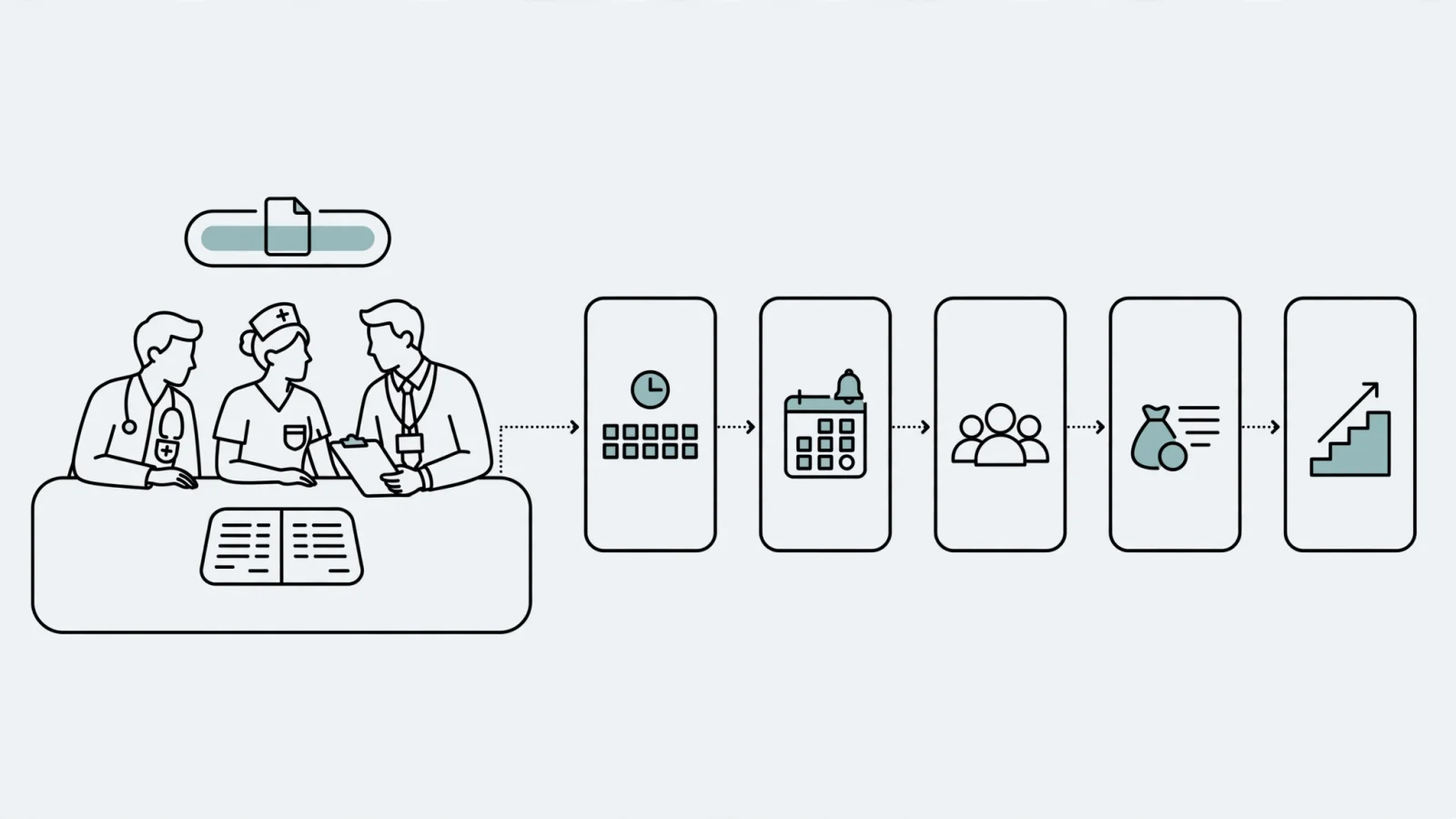
This diagram breaks down the process into its three core pillars: verification, privileging, and enrollment.

You can see how each step builds on the last, systematically turning your professional history into a verified, billable provider status.
Your Ultimate Credentialing Document Checklist

If there’s one step that trips up more clinicians than any other during a job change, it’s getting the paperwork right for credentialing. An incomplete application is the number one cause of frustrating delays that can push your start date back by weeks or even months.
Getting your documents in order before you even apply is the single most powerful thing you can do. It flips the script, putting you in control of the timeline instead of just waiting for someone else to tell you what’s missing.
An incomplete document packet is the primary cause of payer rejections, with rejection rates hitting as high as 85%. Meticulously organizing your files is your best defense against this common pitfall, helping you get on insurance panels faster.
Think of your credentialing packet as a single, comprehensive professional portfolio. Having everything scanned, organized, and ready to go in a digital folder will save you countless hours of stress. For a deeper dive into creating this system, check out this guide to modern healthcare document management.
Essential Documents for Your Credentialing Packet
Here’s a clear checklist of every document you’ll need to have ready. We’ve broken it down by category and included some pro tips from years of experience to help you avoid common mistakes.
| Document Category | Specific Items Required | Pro Tip for Preparation |
|---|---|---|
| Identification | Government-Issued Photo ID (Driver's License/Passport) Social Security Card Copy National Provider Identifier (NPI) Number Updated Curriculum Vitae (CV) | Your CV must be in a MM/YYYY format with no unexplained time gaps since you graduated from medical school. Account for everything. |
| Education & Training | Medical School Diploma Residency/Fellowship Certificates ECFMG Certificate (for IMGs) | Make sure you have high-quality digital copies. Credentialing teams will verify these directly with the institutions. |
| Licensure | State Medical License(s) (all active) DEA Certificate Controlled Dangerous Substances (CDS) Certificate (if applicable) | Check expiration dates! An expired license will bring the entire process to a screeching halt. |
| Certifications | Board Certification Certificate | Have proof of your current board status ready. If you’re board-eligible, have documentation of your exam date. |
| Professional History | Malpractice Insurance "Facesheet" Peer References (at least 3) Malpractice Claims History | Your malpractice facesheet should show current and past coverage. For references, give them a heads-up so they expect the call. |
Gathering these documents is the most tedious part of the process, but doing it once and keeping it updated makes every future job application exponentially easier.
Even with perfect paperwork, the process itself can feel slow, especially since 76% of credentialing is still done manually. This reliance on old-school methods means errors are common, which is why your organized packet is so important.
For psychiatrists and other specialists finding remote roles on WeekdayDoc, a complete packet is your ticket to quickly accessing thousands of wellness-focused telehealth jobs.
Once you’ve nailed down the job and your documents are in, don’t forget to review your contract carefully. You can use free online tools like the WeekdayDoc Contract Scanner to help analyze the terms before you sign.
How to Accelerate Your Credentialing and Avoid Delays

Knowing what credentialing is and how to get through it quickly are two different things. Instead of just waiting for the phone to ring, you can take control and shave weeks—or even months—off your timeline. It’s the difference between being a passenger and being the pilot.
The goal is to sidestep the common holdups that push back start dates and delay your first paycheck. A fast, clean credentialing process is your ticket to a better role, especially in the competitive telehealth market where every day counts.
Proactive Strategies for Clinicians
You have far more influence over the credentialing timeline than you might realize. The secret is preparation. By anticipating what the credentialing team needs, you can clear roadblocks before they even pop up.
Here’s how you can keep your application moving:
Maintain a "Master CV" and Digital Folder: Your CV is the master key to your entire application. Keep one meticulously updated version using a MM/YYYY format, and make sure there are absolutely no unexplained time gaps since graduation. Store it in a dedicated digital folder with high-quality scans of every document on your checklist.
Become a Reference Concierge: Don’t just list your references—actively manage them. Give your former supervisors a heads-up that a verification request is coming their way. This small courtesy can make a huge difference in how quickly they respond.
Fact-Check Your Own History: Before you hit submit, call the HR departments of your past employers to verify key dates, job titles, and locations. A tiny mismatch between what you list and what they have on file can trigger a frustrating and lengthy investigation.
Treating your application like a mission-critical project is how you avoid the small mistakes that cause the biggest delays.
The Employer's Role in a Fast-Track Process
While your own prep work is vital, a good employer plays a huge part in speeding things up. Organizations that are serious about hiring top clinicians invest in the people and systems needed to get you working faster.
These employers often use dedicated credentialing software to automate verification requests and track everything in real-time. This replaces tedious manual follow-ups with instant digital pings, cutting down on human error and accelerating the whole workflow.
Many also have credentialing specialists on staff whose entire job is to cut through the red tape. These experts know exactly who to call and how to solve problems, turning a potential 120-day nightmare into a much smoother process. When you’re interviewing, always ask about their credentialing process—it speaks volumes about their efficiency.
Your goal is to submit a "zero-question" application. When the credentialing team has everything they need, perfectly organized and error-free, your file moves from the "to-do" pile to the "approved" pile in record time.
To manage the sheer volume of documents and speed up signatures, modern tools like e-signature solutions for healthcare are a game-changer. They allow you to securely and instantly sign attestations and forms, cutting out the old-school print, sign, and scan routine.
Ultimately, a streamlined approach to what is healthcare credentialing is a win for everyone. You start your ideal job sooner, the employer fills a critical need, and patients get the care they need without delay. It turns a bureaucratic hurdle into a smooth on-ramp for the next chapter of your career.
Your Top Credentialing Questions, Answered
Even with a clear roadmap, credentialing always brings up some practical, real-world questions. I've been there. Let's tackle the most common ones so you can plan your next career move without any surprises.
How Long Does Healthcare Credentialing Really Take?
Forget the official 60-day estimates you might hear. Based on my experience and what we see across the industry, a more realistic timeline is 90-120 days.
Don't be shocked if it stretches to 180 days, especially if you have a complex work history or are waiting on a particularly backlogged insurance panel. The process is only as fast as its slowest part.
The most common hold-ups are almost always the same:
- A single missing document or an unexplained gap in your CV can stall everything.
- Slow-to-respond references or verification sources (like old residency programs) are a major bottleneck.
- Payer enrollment backlogs at the major insurance companies can add weeks or months.
If you're looking at a telehealth job that involves getting licensed and credentialed in multiple states, plan for the timeline to be on the higher end of that range. Patience is key.
Can I Start Working While My Credentialing Is in Process?
Unfortunately, the answer is a hard no. You cannot legally see patients or bill for services until you are fully credentialed by the facility and enrolled with the necessary insurance payers.
Starting patient care prematurely creates huge legal and compliance risks for both you and the organization. It's just not worth it.
Some larger health systems might let you start non-clinical work, like HR onboarding or system training. But any activity involving direct patient interaction is strictly off-limits until you get that final green light.
What Is the Difference Between Being Licensed and Credentialed?
This is a point of frequent confusion, but the distinction is critical. I like to use this analogy:
Your state medical license is like your driver's license. It’s the basic, government-issued proof that you meet the minimum legal standards to practice medicine in that state.
Credentialing is the deep background check the rental car company (the hospital) and its insurance provider (the payer) run before they hand you the keys to their brand-new car.
Your license gets you in the door, but it's just the first step. Credentialing is a far more exhaustive process where an organization verifies your entire professional background—training, experience, and competency—to ensure you meet their specific standards for safe, high-quality patient care.
How Does Credentialing Work for Telehealth Jobs?
Telehealth adds a significant layer of complexity. The number one rule to remember is this: you must be licensed in the state where your patient is physically located, not where you are.
For many remote clinicians, this means acquiring and maintaining several active state medical licenses at once.
On top of that, you must also be individually credentialed and enrolled with the specific insurance payers that are relevant in each state where you plan to treat patients. As you can imagine, this can draw out the credentialing timeline considerably.
Navigating multi-state credentialing is a major headache, which is why finding an employer who has this process down to a science is so important. WeekdayDoc focuses on curating remote and hybrid jobs from employers who get it, giving you access to burnout-friendly roles without the administrative drain. Find your next balanced role at https://www.weekdaydoc.com.