Patient Satisfaction Healthcare: Boost Outcomes 2026
Discover key drivers and tools for patient satisfaction healthcare. Get actionable strategies to improve outcomes and address clinician burnout in 2026.
You finish clinic late, clear the inbox, and then open a patient satisfaction report that reduces a hard week of medicine to a handful of scores. One patient praises the team. Another is angry about the parking garage, the delay in radiology, and a discharge process you didn't control. The numbers land on your desk anyway.
Most clinicians have lived that disconnect. We're told patient satisfaction matters, and it does. But when the metric gets detached from staffing, workflow, and the reality of a full panel, it starts to feel less like feedback and more like surveillance.
That's the wrong frame. In practice, patient satisfaction in healthcare is best understood as a downstream signal. It reflects communication, trust, access, coordination, and the condition of the people delivering care. If a system exhausts its clinicians, fragments handoffs, and overloads the schedule, the patient experience will show it. If a system supports clinicians well, patients usually feel that too.
Beyond the Scorecard What Is Patient Satisfaction Really
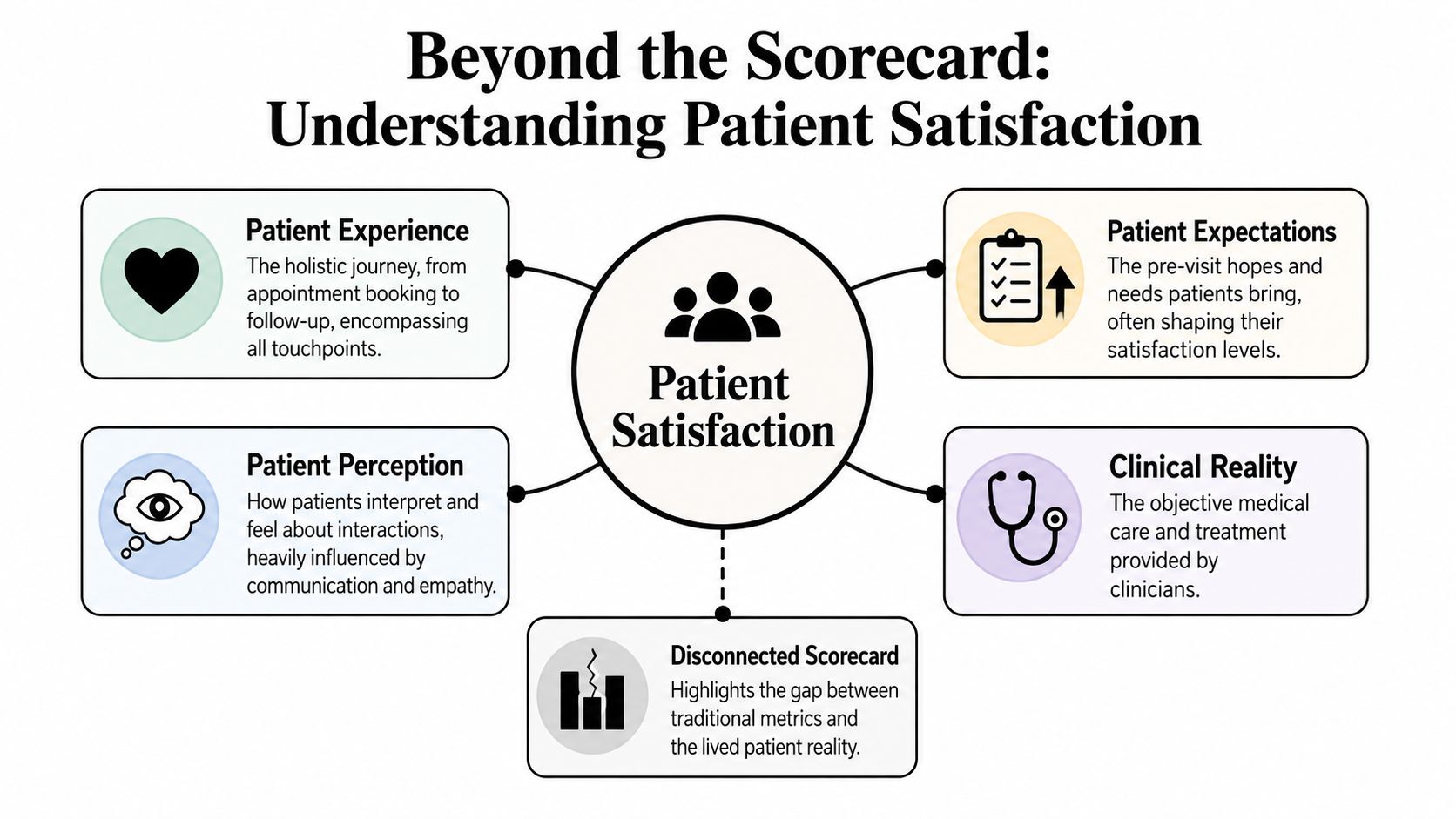
A lot of frustration starts with using one phrase for two different things. Patient satisfaction is about whether a patient feels their expectations were met. Patient experience is about whether certain parts of care were delivered, such as receiving understandable discharge instructions or clear medication communication.
That distinction matters at the bedside. A patient can receive technically appropriate care and still feel dissatisfied if no one explained what was happening. Another patient can feel satisfied even during a complicated visit if the team communicated clearly and set expectations well.
Satisfaction and experience are related, not identical
In everyday clinical work, this is the difference:
| Term | What it asks | Why clinicians should care |
|---|---|---|
| Patient satisfaction | Did this feel acceptable, reassuring, respectful, or better than expected? | It captures trust, perception, and whether the patient felt heard |
| Patient experience | Did key processes happen, and did they happen well? | It points to concrete workflow gaps that teams can fix |
When organizations blur those terms, the message clinicians hear is usually, “Be nicer.” That's too shallow to be useful. Expectations are shaped by fear, prior care experiences, health literacy, wait times, billing stress, and the story patients tell themselves before we even walk in the room.
How the score became formalized
Patient satisfaction in healthcare didn't become important because administrators suddenly liked surveys. A major turning point came with the launch of HCAHPS, which CMS describes as a standardized survey designed to allow objective, meaningful hospital comparisons based on patients' perspectives of care. That shift turned satisfaction from anecdotal feedback into a formal national metric across U.S. hospitals, as described by CMS in its HCAHPS overview.
That history is worth knowing because it explains why the metric exists at all. HCAHPS was meant to create consistency, transparency, and comparability. Whether that goal is always achieved cleanly on the ground is another question.
Clinical reality: A low score doesn't always mean poor medicine. But repeated low scores often mean something in the care environment is breaking down.
What the scorecard misses
A satisfaction report can flatten complexity. It often combines what happened in the room with what happened at the front desk, on the phone, in the hallway, and after discharge. That's why many clinicians feel judged for factors outside their control.
Still, dismissing the metric entirely is a mistake. Patients remember whether the team explained delays, whether someone closed the loop before discharge, and whether they felt like a person rather than a throughput problem. Those aren't cosmetic details. They're part of the care itself.
Patient satisfaction matters most when we stop treating it as a branding exercise and start treating it as evidence about the health of the care system.
How Patient Satisfaction Is Measured and Why It Matters
Most clinicians see the final number, not the machinery behind it. That's a problem, because the method shapes the meaning. If you don't understand how the score is built, it's easy to overreact to noise or blame the wrong person.
The first practical point is sample size. For strong statistical validity, the industry standard is at least 200 aggregated responses per provider to achieve a 95% confidence interval, according to this patient experience and outcomes guide. Below that threshold, the score can swing too easily.
The score is weighted, not just averaged
A common misconception is that survey results are simple averages. In reality, standard composite scoring often uses weighted values:
- Excellent: weighted as 5
- Very Good: weighted as 4
- Good: weighted as 3
- Fair: weighted as 2
- Poor: weighted as 1
That weighted approach matters because it preserves the shape of the responses. A cluster of negative ratings shouldn't disappear just because enough people selected “good.”
There's also a practical lesson here for clinicians. One unhappy patient doesn't define your practice. But patterns across enough responses can reveal whether patients consistently experience confusion, poor handoffs, or weak communication.
Team-level measurement usually tells the truth better
Satisfaction is rarely produced by one clinician alone. Patients move through reception, nursing, imaging, labs, billing, discharge, portal messages, and follow-up calls. That same guide reports that evaluating entire care teams has a 40% higher correlation with improved clinical outcomes than evaluating individual providers.
That lines up with real life. If the check-in process is chaotic, messages sit unanswered, and discharge instructions are rushed, the physician alone can't fix the downstream effect with a warm bedside manner.
A patient rates the whole experience. Healthcare leaders often grade the individual. That mismatch creates a lot of bad policy.
A useful comparison is how clinicians think about productivity. Most of us know an RVU total can hide complexity, panel mix, and support gaps. The same thing happens with satisfaction metrics. If you want a refresher on how another healthcare metric can distort reality when stripped from context, this guide on RVU meaning for clinicians is a helpful parallel.
Why the measurement still matters
Even when the tools are imperfect, they still influence the healthcare environment. They affect reputation, internal evaluations, and what organizations choose to prioritize. Used well, they can point to actual care problems. Used badly, they can push clinicians toward script-reading and defensive service behaviors that feel performative and don't improve trust.
The healthiest organizations don't ask, “How do we make the number go up?” They ask, “What in our workflow makes patients feel lost, rushed, or ignored?” That question leads somewhere useful.
The True Drivers of a Positive Patient Experience
Healthcare organizations spend a lot of energy chasing operational fixes. Shorter waits. Faster room turnover. Smoother intake. Those things matter. But they are not the strongest lever.
The strongest lever is still how we talk to people.
A global meta-analysis found that communication ranked as the top criterion for patient satisfaction, explaining over 60% of variance in scores and outperforming waiting time. It also found that clinics with excellent communication maintained high satisfaction even with longer waits, as reported in this meta-analysis on patient satisfaction determinants.

Why communication beats logistics so often
Patients rarely experience a delay as a neutral event. They interpret it. Silence makes it feel careless. A brief explanation makes it feel understandable. The same delay can produce very different satisfaction outcomes depending on whether the patient feels informed.
That's why “soft skills” is such a misleading label. Clear communication is not decorative. It changes how patients process uncertainty, risk, and inconvenience.
A few high-yield behaviors matter more than many clinicians realize:
- Narrate the visit: Tell the patient what you think is going on and what comes next.
- Name the uncertainty: If you don't know yet, say what you're ruling out and when they'll hear more.
- Acknowledge the friction: Long waits, repeat questions, and delays feel less hostile when someone recognizes them plainly.
- Close the loop: End with a simple recap and one clear next step.
What doesn't work
What fails is scripted friendliness without substance. Patients can tell when a clinician is trying to sound empathic while clearly rushing, multitasking, or not answering the actual question.
It also doesn't work to treat communication as a physician-only task. If registration is confusing, if the portal message is written in jargon, or if no one explains a medication change, the entire experience weakens.
Privacy and trust belong here too. Patients are more likely to engage when they believe their information is handled carefully and their questions are taken seriously. For practices tightening those workflows, a role-based overview of the HIPAA Privacy Officer can be a useful operational reference because privacy breakdowns often damage trust before a clinician ever enters the room.
The patient usually forgives an inconvenience faster than they forgive feeling dismissed.
The takeaway is simple. If your organization wants better patient satisfaction in healthcare, don't put all your effort into shaving minutes off a queue while ignoring communication habits. The better return usually comes from helping teams communicate clearly, consistently, and like human beings.
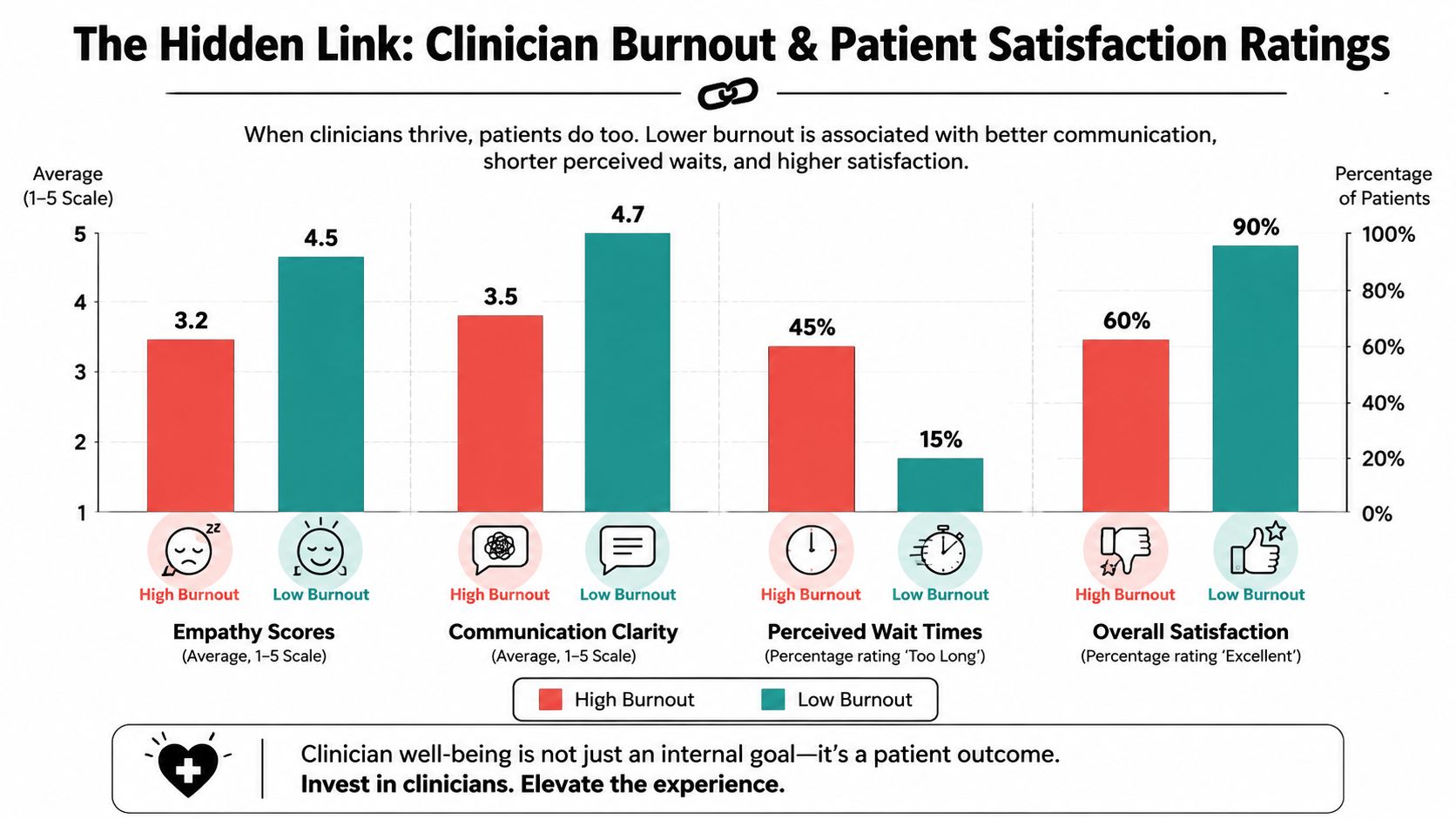
The Hidden Link Between Clinician Burnout and Patient Ratings
Low patient ratings are often treated like a bedside performance problem. In reality, they're frequently a workforce problem that patients can feel.
Burnout changes how care lands. It narrows attention, shortens patience, blunts empathy, and makes every interruption feel heavier. Even excellent clinicians sound different when they're depleted. They explain less, listen less well, and miss chances to reassure because they're trying to survive the day.
That's why patient satisfaction in healthcare should be read as a lagging signal of clinician working conditions, not just an isolated service metric.
Structural strain shows up in the patient experience
Post-pandemic data made this harder to ignore. Independent analysis found that positive online reviews for U.S. healthcare facilities fell significantly after COVID-19, with the sharpest declines in rural areas, according to the Penn LDI analysis on post-pandemic review declines. The important point isn't just the reviews. It's what they imply. Structural strain, access problems, and continuity failures are shaping patient perception.
When staffing is thin, clinicians absorb the gap. They become scheduler, social worker, prior authorization navigator, and emotional shock absorber on top of actual clinical work. Patients don't always see that machinery. They only feel the rushed room entry, the delayed callback, or the unclear discharge.
Why burnt-out clinicians get blamed for system failures
Healthcare has a habit of individualizing system defects. We tell clinicians to improve communication when the barrier is a schedule with no recovery space, no admin support, and too many inbox tasks after hours.
That doesn't excuse poor behavior. It does explain why remediation aimed only at the individual often fails. You can't coach your way out of a broken workflow.
Here's what clinicians commonly recognize before administrators do:
- Understaffing reduces presence: even kind clinicians become transactional when the day is overloaded
- Documentation burden steals attention: the patient can tell when the screen is winning
- Unstable access damages trust: delays and reschedules erode goodwill before the encounter starts
- Moral fatigue changes tone: patients hear it, even when we think we're hiding it
What patients call poor communication is often exhausted communication.
This is one reason many clinicians start evaluating jobs differently after a few hard years. Call burden, weekend coverage, message volume, and staffing ratios don't just affect personal life. They shape the sustainability of empathic care. Tools that surface those realities early can help. For clinicians weighing whether their current setup is distorting both care quality and satisfaction, WeekdayDoc's Burnout Index offers a structured way to assess the work environment.
The deeper trade-off
Organizations often demand warmth, patience, and responsiveness while normalizing conditions that make those qualities difficult to sustain. That's not a professionalism problem. It's a design problem.
If leadership wants stronger ratings, it has to protect the conditions that make strong human interaction possible. That means realistic schedules, functioning support staff, fewer unnecessary clicks, and recovery time that isn't treated like laziness. The patient experience improves when the clinician experience becomes survivable.
Actionable Strategies for Improving Patient Satisfaction
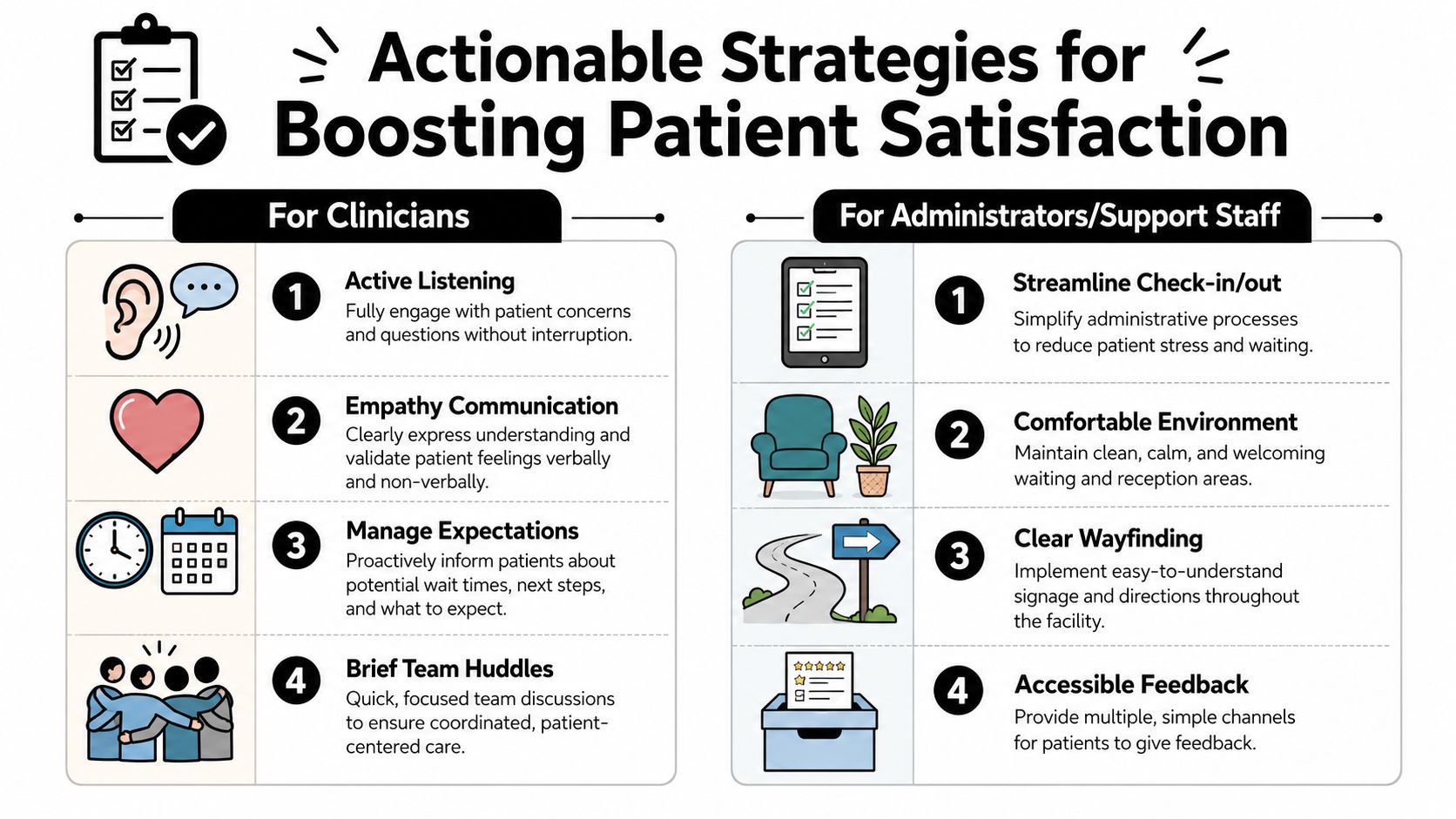
The most effective improvements are usually small, repeatable, and embedded in workflow. Grand campaigns tend to fade. A few disciplined habits, practiced by the right people, hold up better.
A useful starting point is this: don't chase generic niceness. Fix the moments where patients predictably feel confused, abandoned, or uncertain.
For clinicians
A recurring weak point in patient experience is handoff communication. One U.S. study reported overall hospital experience scores of 88.18 and willingness to recommend at 87.41, but lower scores for medication communication at 76.88 and discharge information at 87.30, as detailed in this study on patient experience gaps in medication and discharge communication. That pattern should feel familiar. The trouble is often not generalized dissatisfaction. It's the transition points.
Use that insight at the bedside.
- Set the agenda early: Open with what you need to accomplish and invite the patient's top concern before the visit drifts.
- Translate the plan: Replace jargon with plain language. “Your CT is negative” is less useful than “We don't see a bleed or another urgent cause for the headache.”
- Prepare for the wait: If labs or imaging will take time, say so before the patient starts wondering whether they've been forgotten.
- Treat discharge like treatment: Explain medications, warning signs, and the next step as if those instructions are part of the intervention, because they are.
- Use teach-back selectively: Ask the patient to repeat the plan in their own words when the medication change or follow-up is critical.
A brief script can help without sounding canned. “Before you go, I want to make sure the plan makes sense. What will you tell your family is happening next?” That question catches confusion fast.
Here's a training resource worth browsing if your practice is trying to improve outreach outside the room. These proven patient engagement tactics are useful because they focus on practical communication channels rather than vague culture slogans.
For employers and administrators
Leaders often ask clinicians to repair patient dissatisfaction encounter by encounter. That approach misses the source. Many complaints are generated before the rooming process starts and after the patient leaves.
Focus on friction points the organization controls:
| Operational area | Better question to ask |
|---|---|
| Scheduling | Are patients waiting in confusion, or are delays explained before frustration builds? |
| Inbox and follow-up | Who owns the callback, and how often does it get dropped between roles? |
| Discharge workflow | Is there protected time and clear accountability for instructions? |
| Staffing model | Are clinicians doing clerical recovery work after hours that should be handled upstream? |
A few interventions consistently help in real settings:
- Tighten handoffs: Build a standard discharge checklist that includes meds, return precautions, and who contacts the patient next.
- Reduce front-end uncertainty: Signage, check-in clarity, and realistic delay messaging calm patients before they escalate.
- Protect team huddles: Even brief pre-clinic alignment reduces contradictory messaging.
- Cut avoidable admin burden: If the physician is doing tasks that a better workflow could absorb, patient connection time shrinks.
- Measure teams, not heroes: Satisfaction is usually produced by systems of care, not lone high performers.
Work design matters. Platforms that show role details such as schedule structure, call expectations, and work-life fit can help organizations recruit clinicians into more sustainable environments. WeekdayDoc, for example, lists burnout-related job details such as no-call and no-weekend markers, which is relevant when staffing design affects the patient experience.
A short training video can also help teams reset around shared behaviors before they launch another survey initiative.
Good patient satisfaction work is rarely flashy. It's usually clear expectations, better handoffs, and a team that isn't running on fumes.
What to stop doing
Some tactics consume effort without fixing much:
- Don't punish isolated low scores when the broader pattern points to access or staffing problems.
- Don't rely on scripts alone if discharge, scheduling, and callbacks remain fragmented.
- Don't launch courtesy campaigns while clinicians are drowning in inbox work and overtime charting.
- Don't assume speed solves everything if patients still leave confused.
The strongest gains come from pairing bedside communication habits with operational cleanup. Either one without the other leaves value on the table.
Building Sustainable Healthcare Systems for Patients and Providers
The most useful way to think about patient satisfaction in healthcare is as an outcome of system health. It is not created by posters in the break room, mandatory smile training, or pressuring clinicians to sound cheerful while the underlying job becomes less livable.
Patients respond to what they experience. They notice whether the team is coordinated, whether communication is clear, whether follow-up makes sense, and whether the people caring for them seem present rather than depleted. Clinicians can influence some of that directly. Systems determine much of the rest.
The metric improves when the work improves
If organizations want durable improvement, they need to build care environments where clinicians can still think, listen, and recover. That means staffing models that fit demand, support roles that absorb work, and schedules that don't depend on unpaid spillover into nights and weekends.
The same logic applies to career decisions. Clinicians who move toward sustainable roles are not stepping away from quality. They are protecting the conditions that make quality repeatable. For groups trying to improve retention and the patient experience at the same time, these healthcare staffing solutions for sustainable hiring are worth considering because staffing design and care experience are tightly linked.
Better patient ratings are often the visible result of an invisible decision. Someone chose to build a workplace where clinicians could function like humans.
That's the central reframing. Work-life balance is not separate from patient care. In many settings, it's one of the prerequisites for it. When healthcare systems stop treating clinician well-being as a perk and start treating it as operating infrastructure, patients benefit too.
If you're rethinking what kind of role lets you practice well without giving everything away to the schedule, WeekdayDoc can help you evaluate burnout-friendly options with transparent details on call burden, work style, salary, and schedule fit. For clinicians who want better balance and better conditions for patient care, that's a practical place to start.