RVU Meaning: How rvu meaning Impacts Pay, Burnout, and Career Growth
Discover rvu meaning and how RVUs affect pay, workload, and burnout, with practical tips to negotiate a better role.

At its core, an RVU—or Relative Value Unit—is simply a standardized way to measure the resources needed to perform any given medical service. Think of it as a universal "points system" for everything a clinician does, from a simple office visit to a complex surgical procedure.
What RVUs Actually Mean for Your Medical Career
For most of us in medicine, RVUs aren't just some abstract metric buried in a spreadsheet. They're the engine that drives our compensation, shapes our daily schedules, and can ultimately determine our career satisfaction.
Getting a handle on what RVUs are and how they work is the first real step toward taking back control of your professional life. It turns a confusing, often opaque payment system into something you can actually understand and act on. This knowledge is what empowers you to fairly evaluate job offers, negotiate better contracts, and avoid the burnout traps that are so common in this field.
This system has been around for a while. RVUs first showed up in the late 1980s as a way for Medicare to bring some order to its chaotic reimbursement process. By 1992, they had a standardized fee schedule that assigned RVU values to over 7,000 different physician services. Fast forward to today, and RVUs are the foundation of productivity-based pay in 70% of U.S. physician contracts. This often puts clinicians on a treadmill, pushing them to hit targets that eat into their evenings and personal time, a trend well-documented in the history of RVUs.
The Three Core Components of a Total RVU
Every medical service that gets billed has a Total RVU value, which is built from three distinct components. Each one represents a different piece of the effort and cost that goes into providing patient care.
Let's break down these building blocks.
| RVU Component | What It Represents | Typical Percentage of Total RVU |
|---|---|---|
| Physician Work (wRVU) | The clinician's direct effort: time, technical skill, mental energy, and stress. | ~51% |
| Practice Expense (peRVU) | Overhead costs: rent, equipment, supplies, and non-physician staff salaries. | ~45% |
| Malpractice (mpRVU) | The cost of professional liability insurance for a given service. | ~4% |
As you can see, the Physician Work component, or wRVU, makes up the biggest slice of the pie. It’s also the part you, as a clinician, have the most direct influence over through the care you provide.
When you add these three pieces together—Work, Practice Expense, and Malpractice—you get the Total RVU for a service. This creates that standardized value for nearly every single patient interaction in the healthcare system.
From Code to Compensation: How the RVU Formula Works
Knowing what an RVU is in theory is one thing. Watching it turn into actual dollars on your paycheck? That’s where it gets interesting.
Think of the total RVU formula like a recipe. The core ingredients are the three RVU components we just covered: work, practice expense, and malpractice. But these values aren't used raw. They're first adjusted by a critical variable called the Geographic Practice Cost Index (GPCI). This modifier is what balances the books between practicing in rural Nebraska versus downtown Manhattan, accounting for the vast cost-of-living differences across the country.
Once those geographically adjusted values are added up, there's one final step: applying the Conversion Factor (CF). This is a national dollar amount set by the Centers for Medicare & Medicaid Services (CMS) that multiplies the final RVU total, converting the abstract "units" into a concrete payment.
This flowchart shows exactly how those pieces fit together.
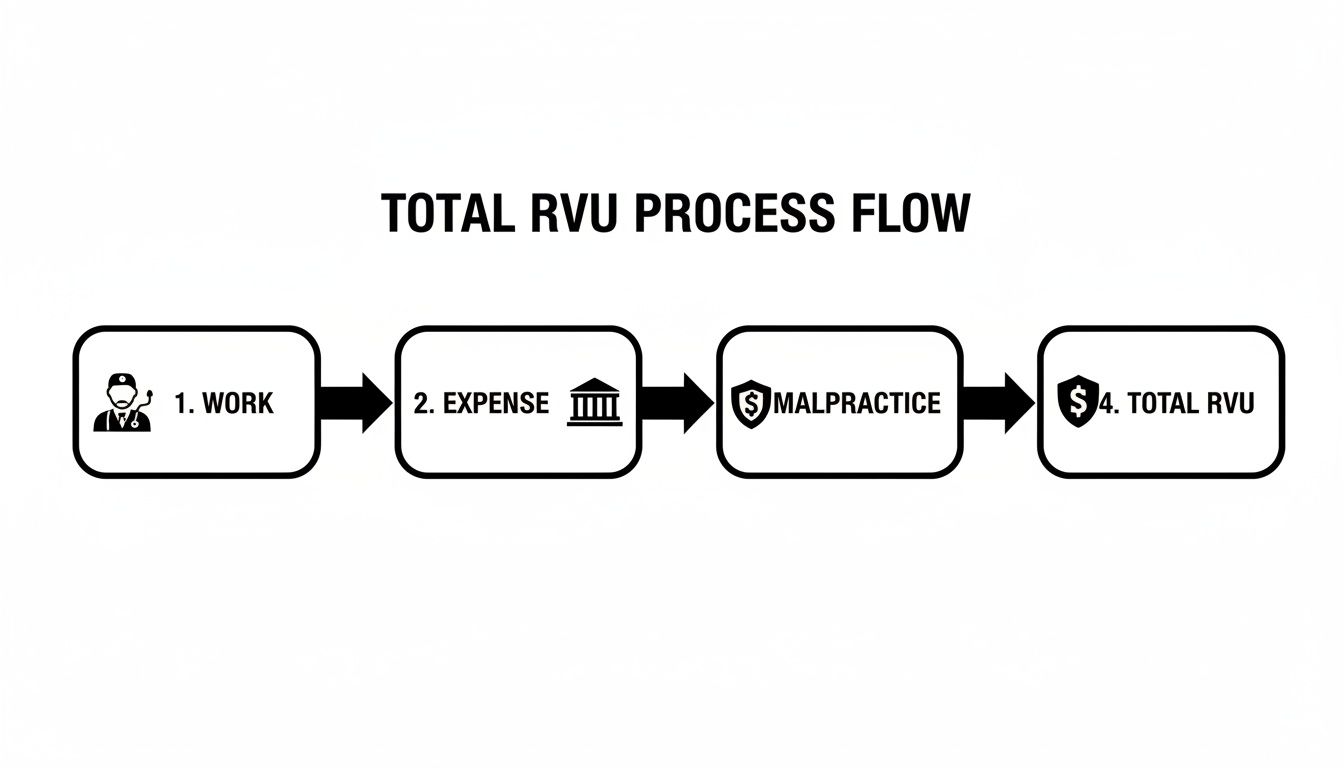
As you can see, it’s a clear progression from the three core components to a single, unified Total RVU value that ultimately determines what gets paid for a service.
Putting the Formula into Practice
Let's plug in some numbers and see how this plays out in the real world.
The official formula for calculating the geographically adjusted Total RVU is:
(wRVU x wGPCI) + (peRVU x peGPCI) + (mpRVU x mpGPCI)
That final sum is then multiplied by the national Conversion Factor to get the reimbursement amount.
For example, a standard evaluation and management (E/M) visit might have a Total RVU of 2.5. At a typical national CF, that single visit would pay out around $85.
While the system creates a standard, it also fuels an environment where chasing volume can quickly lead to burnout. In fact, clinicians in high-volume, RVU-driven roles face 45% higher attrition than those in more balanced positions. You can dig deeper into these industry findings and how RVUs impact provider retention in this detailed healthcare article.
Why Location and Setting Matter So Much
This formula is the key to understanding why the exact same work can result in wildly different paychecks depending on your practice location. A higher local GPCI can give your earnings a significant boost without you having to see a single extra patient.
On the flip side, a lower GPCI means you’re on the hook for generating more RVUs just to match the income of a colleague in a higher-cost area.
This is a non-negotiable detail to analyze when you're comparing job offers in different states—or even different cities in the same state. Mastering this formula isn't just academic; it's the key to understanding the true financial reality behind any physician job description.
Why Work RVUs (wRVUs) Dominate Compensation Models
While a Total RVU has three distinct parts, the one that truly shapes your day-to-day clinical reality is the work RVU (wRVU). It has become the undisputed king of productivity metrics for one simple reason: it’s the only component you can directly control.
Think of the wRVU as the pure value of your personal effort—your time, technical skill, mental energy, and clinical judgment all rolled into a single number.
Unlike the other two components (practice expense and malpractice RVUs), which are tied to overhead and insurance costs, the wRVU is a direct measure of the care you provide. This makes it an incredibly powerful tool for employers. They use wRVU targets to build compensation plans, often structuring contracts with a base salary plus a bonus for exceeding a certain threshold.
This structure effectively turns your clinical work into a clear-cut performance metric, creating a high-stakes environment where productivity is everything.
The Financial Incentive Structure
The dominance of wRVUs in compensation is no accident. Since Medicare first rolled out this system back in 1992, the wRVU has consistently made up the biggest slice of a service's total value, representing about 52% of the Total RVU.
Today, an estimated 70% to 80% of physician contracts use wRVUs as a primary lever for calculating pay, often dangling bonuses for exceeding annual targets. You can discover more insights about these models and their impact on practice management. This creates a powerful incentive system where your income is directly tied to your volume.
- Base Salary: Usually corresponds to hitting a specific annual wRVU target.
- Productivity Bonus: You get paid extra for every wRVU you generate above that target.
- Deficit: On the flip side, falling short of the target can sometimes mean a pay deficit or even a lower base salary the following year.
This approach makes wRVUs the undeniable cornerstone of most performance-based pay models in medicine.
wRVUs and Variable Compensation
This entire system is a classic example of performance-based pay. Because your earnings fluctuate based on productivity, wRVUs are a key form of variable compensation. Learning about What Is Variable Compensation in a broader sense can give you a better grasp of these models.
Essentially, a significant chunk of your income isn't guaranteed—it rises and falls based on the volume and complexity of the services you deliver.
This direct link between work performed and income earned is why understanding your wRVU target is non-negotiable. It’s the clearest indicator of a job's expected pace and intensity.
Recognizing these pressure points in a job offer is critical. An unrealistically high wRVU target is a massive red flag for a role that will almost certainly demand long hours and lead to rapid burnout. By comparing these targets against specialty benchmarks, you can spot unsustainable expectations before you sign a contract, protecting both your financial future and your well-being.
How to Benchmark Your RVU Performance by Specialty
Understanding RVUs in theory is one thing. Knowing if a job offer's productivity target is actually realistic is what really matters.
So, how can you tell if an employer's annual wRVU goal is a fair expectation or just a fast track to burnout? The key is to benchmark everything against real-world data from your specific medical specialty.
Without that context, a number like 6,000 annual wRVUs is completely meaningless. Is that a heavy load for a family medicine doc? What about for a cardiologist? Benchmarks give you the context to translate an abstract number into a real-world patient load and daily grind. They're your best defense against signing on for a job with totally unsustainable expectations.
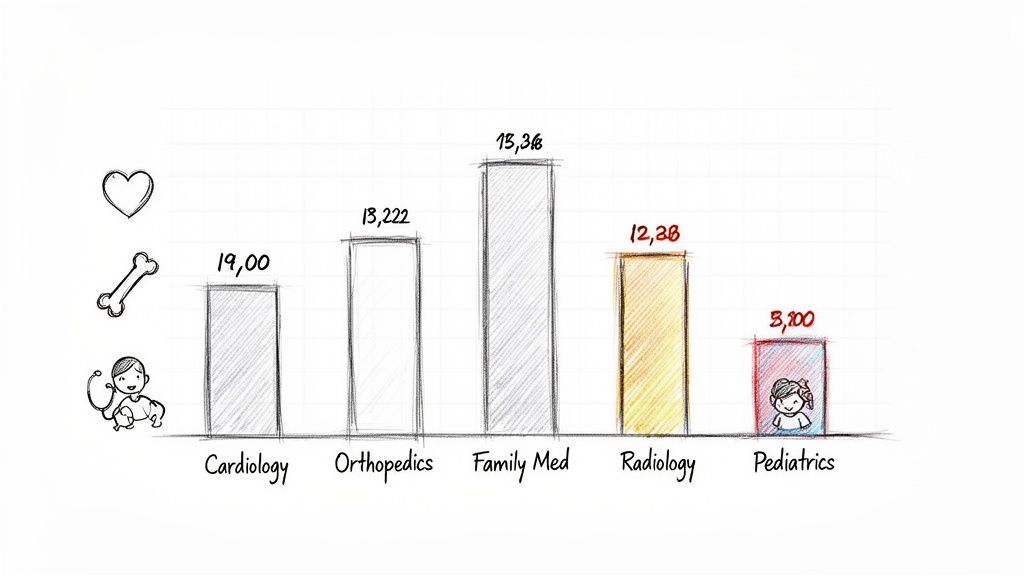
Comparing wRVU Benchmarks Across Specialties
Productivity expectations swing wildly from one field to the next. A surgical specialty packed with high-value procedures will naturally rack up far more wRVUs than a primary care practice focused on office visits. The data shows just how wide that gap can be.
For instance, a family medicine physician might generate around 4,800 wRVUs in a year, while a non-invasive cardiologist could be expected to produce over 8,000 wRVUs in that same period.
This huge difference is exactly why you need specialty-specific data. It’s not about the raw number; it’s about how that number stacks up against what your peers are actually doing. Wondering how your own numbers might translate into salary? You can get a clear picture using our physician salary calculator for proactive insights.
A job offer with a wRVU target that’s way above the 75th percentile for your specialty is a major red flag. It almost always points to a high-volume, churn-and-burn environment where burnout is a real risk.
Annual wRVU Benchmarks and Compensation Rates by Specialty
To give you a clearer picture, let's look at some representative industry benchmarks. The table below pairs the median annual wRVUs with the typical compensation paid per wRVU for several specialties. It’s a great way to see how both productivity and reimbursement rates differ across the board.
| Specialty | Median Annual wRVUs | Median Compensation per wRVU |
|---|---|---|
| Family Medicine | 4,815 | $55.10 |
| General Pediatrics | 4,520 | $51.75 |
| Psychiatry | 3,950 | $68.50 |
| Non-Invasive Cardiology | 8,100 | $59.80 |
| Orthopedic Surgery | 9,450 | $72.30 |
Data reflects recent industry surveys and may vary based on location and practice type.
Think of these numbers as your starting point for analyzing any job offer. By comparing a potential employer’s targets and pay rates to these benchmarks, you can objectively gauge whether the offer is fair. This data-driven approach takes the guesswork out of the equation, empowering you to find roles that promise a sustainable pace and fair market value for your hard work.
How to Negotiate a Better RVU-Based Contract
Once you get how RVUs really work, you can walk into any negotiation with confidence. Remember, a job offer isn't a final verdict—it's the start of a conversation.
Your goal is to land a contract that pays you fairly for your work without sacrificing your time and sanity. It all comes down to asking the right questions and knowing where you can push for better terms.
First things first: you need data. Don't be shy about asking for key information that shows you what the job is really like day-to-day. A transparent employer won't have a problem sharing this with you.
Key Questions to Ask
Before you even think about signing on the dotted line, you need clear, honest answers to these questions:
- Productivity History: "Can you share the anonymized wRVU data for the clinician who previously held this role for the last one to two years?" This is the single best way to see what's actually possible in that specific job, with that specific support staff and patient population.
- Support Staff Ratio: "What is the ratio of support staff—like MAs, schedulers, or nurses—to clinicians?" Efficient support is everything. Without it, you’ll be doing their job and yours, making it nearly impossible to hit targets without burning out.
- Ramp-Up Period: "Is there a guaranteed salary or a reduced wRVU target for the first 6-12 months while I build my patient panel?" This is a completely standard and reasonable request. You shouldn't be penalized while you're still getting up to speed.
These questions shift the conversation from abstract numbers to the concrete reality of the position.
It's a classic mistake to focus only on the compensation-per-wRVU rate. A sky-high rate means nothing if the clinic is so inefficient you can't generate enough wRVUs to earn it.
Strategic Negotiation Points
With the data in hand, you can start talking specifics. Think beyond just the base salary and look for ways to build a contract that’s more sustainable in the long run.
One of the most powerful moves you can make is to propose a hybrid compensation model. This might look like a higher base salary paired with a more modest productivity bonus, which gives you a much stronger financial safety net and reduces the pressure to constantly chase volume.
And yes, you should absolutely be ready to negotiate the compensation-per-wRVU rate itself. Use the specialty benchmark data as leverage to argue for a rate that reflects the fair market value for your skills and region.
Don't be afraid to make a data-backed counteroffer. By using a tool like our comprehensive physician job offer analyzer, you can evaluate every single component of the contract to make sure it aligns with both your financial and lifestyle goals.
Finding Burnout-Friendly Roles in an RVU-Driven World

When you get right down to it, understanding RVUs isn’t just about the money. It's about taking back control and building a career that doesn’t demand you sacrifice your personal life.
The relentless pressure to hit ever-higher RVU targets is one of the biggest drivers of the burnout epidemic we're seeing across medicine. This non-stop focus on productivity metrics slowly eats away at your personal time, strains relationships, and leads to a deep, profound sense of exhaustion.
When your compensation is tied directly to volume, the system itself encourages a pace that is simply not sustainable. The unfortunate result is a workforce where dedicated professionals are forced to choose between their well-being and their paycheck.
The good news? Your knowledge of how this system works is your single most powerful tool for finding a better path.
Leveraging RVU Knowledge for Work-Life Balance
Once you truly understand how RVUs are calculated and applied, you can shift from being a cog in the machine to an architect of your own career. You gain the power to critically analyze job offers, spot red flags in productivity expectations, and negotiate terms that actually protect your time.
This means you can start actively seeking out employers who offer:
- Reasonable RVU Targets: Goals that reflect a standard 40-hour workweek, not a grueling 60-hour one.
- Fair Hybrid Models: Compensation structures with a strong base salary, which immediately reduces the pressure of a purely production-based model.
- Transparent Data: A willingness to share anonymized productivity data from clinicians previously in the role, giving you a real-world preview of the job's demands.
By making these factors a priority in your job search, you can find a role that delivers financial security and the work-life balance necessary to build a long, satisfying career.
Your expertise lets you identify forward-thinking organizations that value clinician well-being just as much as they value productivity. For those specifically looking for roles that protect evenings and weekends, exploring options like part-time physician jobs can be a fantastic way to start building a career that fits your life, not the other way around.
Frequently Asked Questions About RVUs
Even after you get the hang of the basics, some practical questions always seem to pop up about what RVUs actually mean for your day-to-day work. Here are some of the most common ones I hear from other clinicians.
Can I Earn RVUs for Non-Patient-Facing Work?
Usually, no. Standard wRVUs are tied directly to the CPT codes you generate from patient encounters. Things like administrative duties, teaching residents, or research don't have wRVU values attached to them.
But that doesn't mean that work isn't valuable. This is a huge point to bring up during negotiations. Smart contracts will include "protected time" or a separate stipend for these essential tasks. A fair agreement should always compensate you for your entire contribution, not just the billable parts.
Is a Higher Compensation per wRVU Rate Always Better?
Not always. In fact, an unusually high comp rate can sometimes be a red flag. It might be a sign that the practice has terrible support staff, an ancient EMR, or a mountain of administrative work, forcing you to grind much harder just to hit your targets.
You have to look at the whole picture—the base salary, the annual wRVU target, the pay rate, and the overall work environment. A slightly lower rate at a clinic that's well-run and efficient could easily translate to higher earnings with way less stress.
Look at the entire ecosystem of the job, not just one number. A supportive environment is often worth more than a few extra dollars per wRVU, as it directly impacts your ability to work efficiently and avoid burnout.
How Do RVUs Work for Telehealth Appointments?
Telehealth visits are billed with their own specific CPT codes, and thankfully, most of these now have wRVU values that are either identical or very close to their in-person equivalents. This change, which really took off a few years ago, is what has made remote and hybrid clinical jobs so much more financially viable.
If you're looking at a telehealth role, make sure you ask how they track productivity. You want to see that the wRVU credit for virtual visits is transparent and just as fair as it is for in-person care.
What Is a Good RVU Target for a Part-Time Position?
This is simple: a part-time RVU target should be a direct, prorated amount of a full-time role in the same practice.
For example, if a full-time (1.0 FTE) doctor has an annual target of 5,000 wRVUs, then someone working 0.6 FTE (three days a week) should have a target right around 3,000 wRVUs.
Always get this confirmed in writing during your contract talks. It ensures the expectations are fair, realistic, and match the part-time schedule you're looking for.
At WeekdayDoc, we believe you shouldn't have to choose between a fulfilling career and a balanced life. We curate burnout-friendly roles with no nights, no weekends, and no call, so you can practice medicine on your own terms. Find your next sustainable job at https://www.weekdaydoc.com.