Occupational Medicine Physician Employment in 2026
Your 2026 guide to occupational medicine physician employment — employers, salaries, no-call roles, and how to land one.
Only 14% of occupational medicine job listings disclose pay, while historical workforce estimates identified an OEM physician deficit of 3,100 to 5,500 doctors. That combination tells you more about occupational medicine physician employment in 2026 than another generic “stable specialty” summary. Employers need specialized coverage, yet candidates often have to negotiate without knowing whether an attractive weekday schedule compensates for a lower salary.
The market is therefore less about finding any job and more about separating real lifestyle value from disguised underpayment. Base salary, call burden, documentation expectations, geography, employer type, and long-term financial independence all need to be evaluated independently.
Where Occupational Medicine Physician Employment Stands in 2026
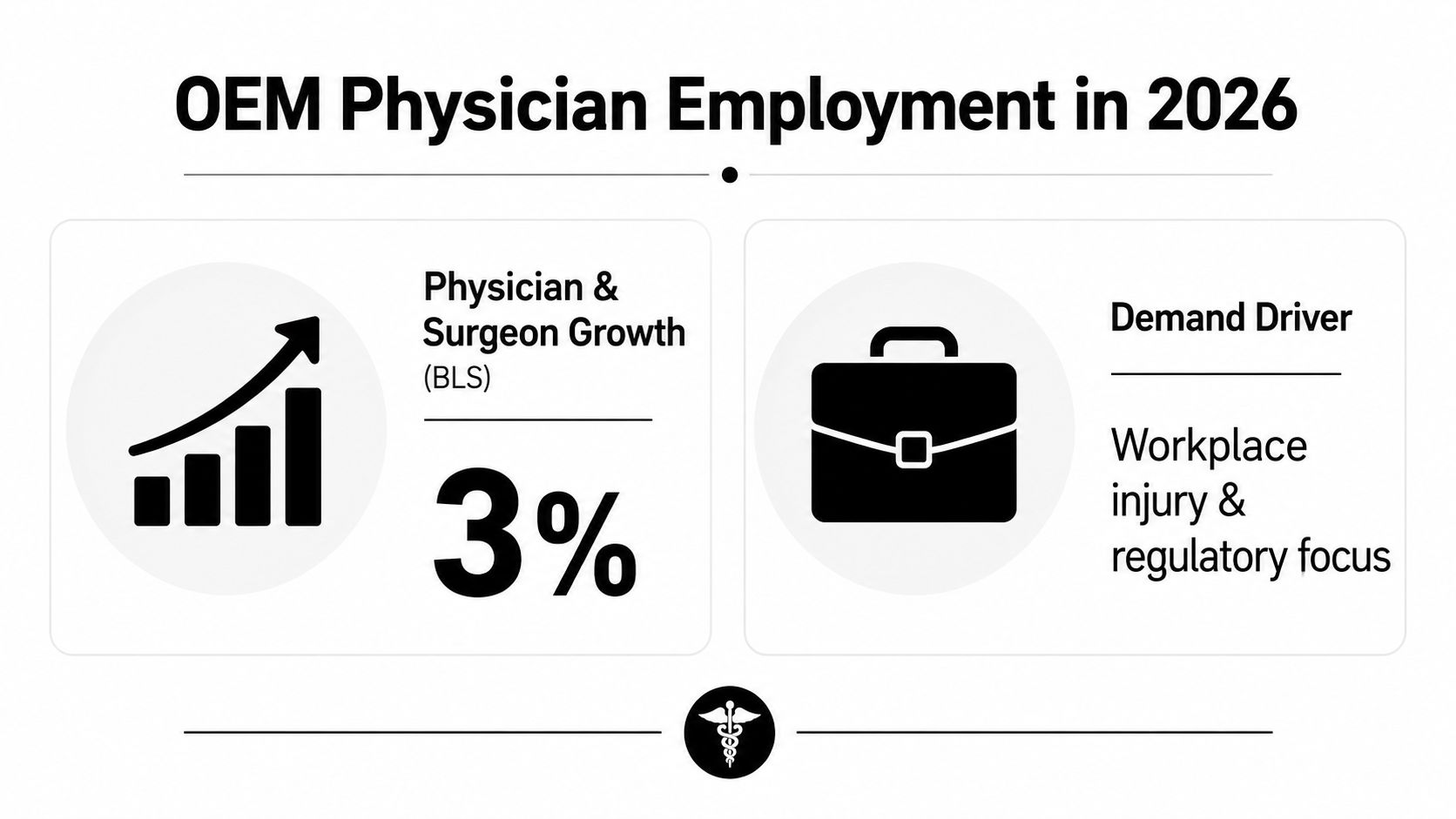
The broad physician labor market is steady, not explosive. The U.S. Bureau of Labor Statistics projects 3% employment growth for physicians and surgeons from 2024 to 2034, about as fast as the average for all occupations, with approximately 23,600 openings per year over that period. Occupational medicine physicians are frequently grouped into broader labor categories, so that projection doesn't describe OEM demand with precision, but it establishes the surrounding labor market in which the specialty competes. BLS physician and surgeon projections provide the correct macro context.
The specialty's more important signal is scarcity. An ACOEM policy brief frames the workforce challenge around 167.89 million workers and employers, while historical NCBI estimates placed the need for 4,600 to 6,700 OEM physicians against a supply of 1,200 to 1,500, implying a deficit of 3,100 to 5,500 physicians. The historical estimate also argued that training capacity would need to expand substantially to meet demand. ACOEM's workforce policy brief and the NCBI review of occupational medicine workforce needs show why open roles can persist even when the overall physician market looks stable.
Why a small specialty still has vacancies
Occupational medicine is a small, clearly defined physician niche inside a much larger workforce. It competes for doctors who may also consider primary care, emergency medicine, hospital employment, utilization review, medical leadership, or other non-procedural paths. A general physician-growth figure can therefore coexist with a shortage of clinicians who have the training and documentation fluency required for OEM work.
Geography adds another layer. State-level workforce data identify major concentrations in New York, California, Pennsylvania, Texas, and Florida, which means opportunity isn't evenly distributed. A physician willing to relocate, maintain licenses across multiple jurisdictions, or work remotely may see a very different market from someone searching within one local commuting radius.
The practical premise: The question isn't whether occupational medicine jobs exist. It's which employer, schedule, and compensation structure deserves your time.
That distinction matters because a no-call role can be financially attractive even when its base salary trails a higher-paying position with weekends, travel, or after-hours documentation. Conversely, a “lifestyle” listing can transfer value back to the employer through aggressive productivity targets, unpaid administrative work, or broad availability language.
The Four Employer Types That Actually Hire OEM Physicians
Occupational medicine physician employment becomes easier to assess when you classify the employer before evaluating the salary. Four employer groups dominate the practical search.

Corporate and health-system programs
Large manufacturers, energy companies, logistics organizations, and hospital systems may operate employee health, workplace injury, surveillance, or medical director programs. These roles reward physicians who can connect clinical decisions with exposure assessment, toxicology, surveillance, disability management, and regulatory documentation.
The work may be clinically lighter than acute care, but that doesn't make it administratively light. Ask whether the position includes policy ownership, employee case review, travel between sites, vendor oversight, or responsibility for safety committees. A corporate title can describe a focused clinical role, or it can conceal a broad operational mandate.
Independent occupational health clinics
Clinics often combine work-injury care with physical examinations, drug screening, Department of Transportation evaluations, functional assessments, and return-to-work documentation. They favor physicians comfortable with musculoskeletal complaints, minor acute care, injury triage, and rapid documentation.
The key risk is productivity design. A clinic may advertise predictable daytime hours while measuring visits, chart closure, employer communication, and referral patterns tightly enough to recreate the pressure of urgent care. The schedule is only lifestyle-friendly if the volume and inbox expectations support it.
Government and public-sector employers
Federal agencies, the VA, the Department of Defense, and state workers' compensation programs typically reward experience with disability evaluation, policy interpretation, impairment documentation, and public-sector processes. These positions may appeal to clinicians who value institutional stability and clearly defined responsibilities.
The trade-off can be slower hiring, formal credentialing, and less flexibility in role design. Read the position description closely. Government work may offer strong boundaries, but the physician could still inherit significant review, reporting, or policy obligations.
Telehealth-first and review platforms
Remote IME, utilization review, virtual return-to-work, and second-opinion roles depend less on physical examination and more on record review, concise writing, clinical reasoning, and defensible documentation. They fit physicians who want location flexibility or a portfolio career.
Remote work doesn't automatically mean low stress. The employer may track turnaround time, assign large document sets, or expect availability across time zones. Before accepting, request the expected case mix, payment model, deadlines, and rules for revisions.
Compensation Reality and the Drivers Behind OEM Pay
Published compensation estimates disagree sharply, which is exactly why generic salary averages deserve skepticism. ACOEM's 2026 compensation summary reports a median total compensation near $290,000, based on 332 data points, with most physicians between $250,000 and $350,000. Staff OEM physicians average approximately $262,000 in that summary. ACOEM's 2026 OEM compensation summary is the more useful reference when comparing standard employment structures.
SalaryDr's 2026 verified submissions report a $370,000 median, with a 25th percentile of $350,000, a 75th percentile of $380,000, base pay around $297,593, and average bonuses of $71,071. SalaryDr's occupational medicine compensation data presents a materially different sample. The gap doesn't prove that either source is wrong. It shows that role design, sample construction, geography, and bonus treatment can change the apparent market dramatically.
OEM compensation by source and band in 2026
| Source | Median | 25th Percentile | 75th Percentile | Notes |
|---|---|---|---|---|
| ACOEM | Near $290,000 | Not stated | Not stated | Most physicians reported between $250,000 and $350,000 |
| SalaryDr | $370,000 | $350,000 | $380,000 | Verified submissions, with base pay and bonus reported separately |
A compensation comparison should include more than annualized pay. Use a tool such as the RVU calculator to test whether productivity expectations support the advertised total compensation, especially when an employer uses a clinical-plus-administrative formula.
Four variables that move the offer
Role design is usually the first variable. Pure clinical work, mixed medical-director duties, IME review, and corporate leadership shouldn't be placed in one salary bucket.
Geography matters because employment is concentrated in major markets such as New York, California, Pennsylvania, Texas, and Florida. Local competition, cost of living, and employer density can all affect the offer.
Employer type changes the balance between salary, benefits, autonomy, and administrative load. Hospital systems, private clinics, government agencies, and corporate employers may price the same clinical expertise differently.
Schedule is the variable candidates undervalue. No call, no weekends, and predictable weekdays can represent substantial economic value even when they don't appear as a salary premium. A lower base may still be rational if it eliminates nights, commute burden, unpredictable callbacks, and schedule disruption. But don't assume that trade is favorable until you quantify the workload and compare the full contract.
Work Styles That Protect and Erode Work-Life Balance
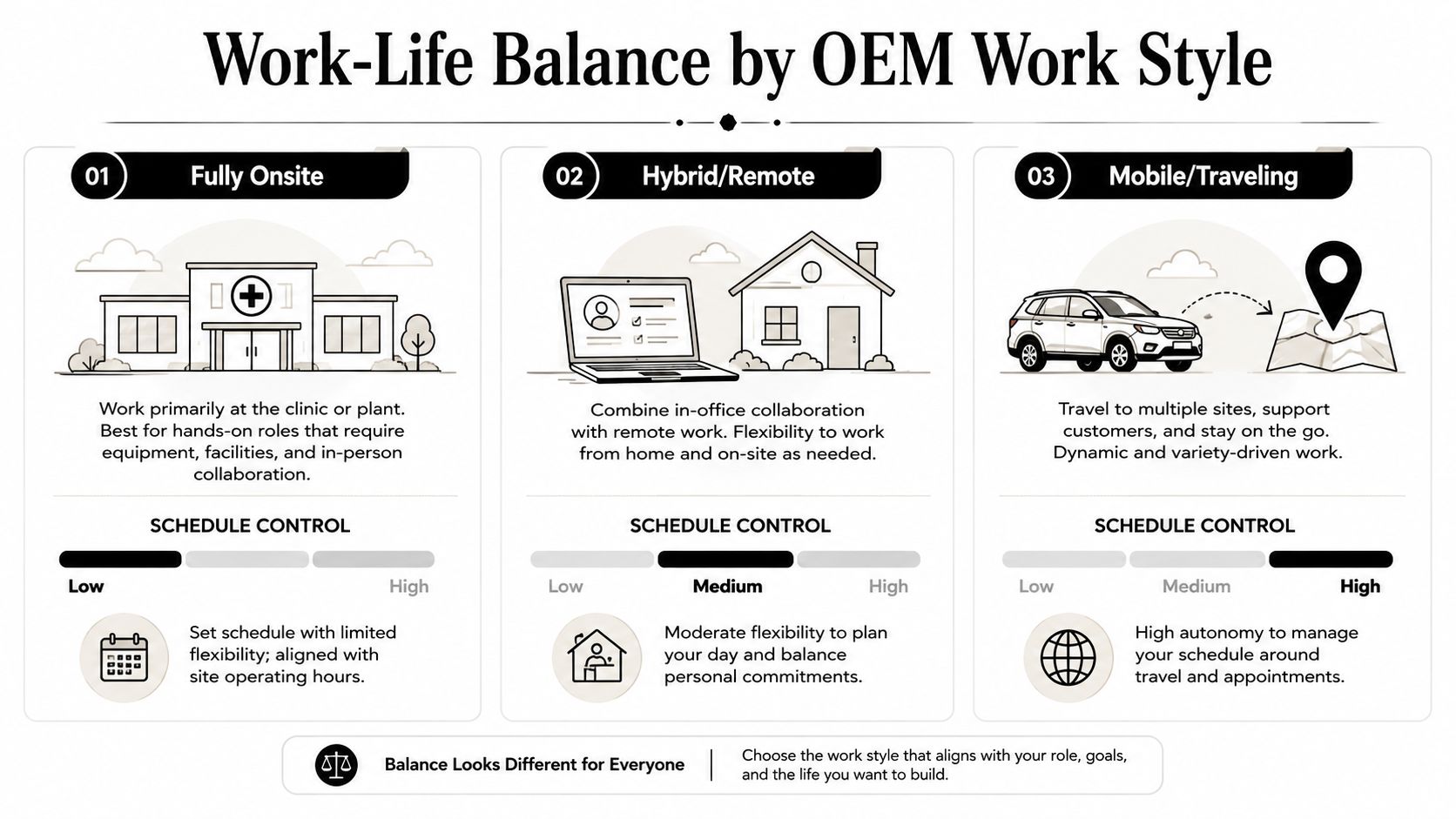
A listing that says “flexible” has limited value until you identify who controls the schedule, where the work happens, and what happens after the clinic closes. Three broad work styles appear repeatedly in occupational medicine physician employment.
Fully onsite roles
Clinic, plant, and hospital employee-health positions usually provide the clearest physical boundaries. When the workday ends, the physician can leave the workplace, and direct access to staff may simplify urgent questions.
The weakness is that onsite work can hide schedule intensity. A clinic may have no formal call while still expecting late employer reports, walk-in injuries, or same-day documentation. Plant roles may add travel across facilities or require visibility during operational hours.
| Work-style marker | Fully onsite |
|---|---|
| No call | Often possible, verify explicitly |
| No weekends | Common in some settings, not universal |
| Predictable hours | Depends on injury volume and employer coverage |
| Inbox control | Varies with documentation ownership |
Hybrid roles
Hybrid corporate and telehealth arrangements can offer the strongest balance when the employer separates scheduled clinical time from meetings, reviews, and administrative work. A physician might spend selected days onsite and complete case review or employee consultations remotely.
The danger is boundary leakage. Without a written allocation of administrative time, hybrid work can turn into onsite clinical work plus a remote evening inbox. Ask whether travel time is paid, whether remote days are protected, and whether meetings occur outside scheduled hours.
Fully remote roles
Utilization review, contract-review telemedicine, virtual case management, and second-opinion platforms can provide the highest location control. They can also offer the clearest no-call structure because work arrives through queues rather than through a facility phone.
Remote roles still need workload limits. Ask how cases are assigned, whether turnaround times are fixed, whether revisions are compensated, and whether the physician must remain continuously available. A remote job with uncontrolled queue volume can erode work-life balance faster than a modest onsite role.
A reliable lifestyle test: No call and no weekends matter only when the contract also limits after-hours documentation and defines a manageable workload.
In practical terms, corporate medical director roles, contract-review telemedicine, and structured second-opinion work are often the most promising places to investigate weekday-only schedules. Independent clinics may offer the same schedule on paper but require closer scrutiny of productivity targets.
Why the Question Is Not Whether Jobs Exist but Why Open Roles Persist
“Are there jobs in occupational medicine?” is an outdated screening question. The more revealing question is why a specialty associated with stability and professional satisfaction continues to show vacancies.
One workforce analysis cited a projected 33% net workforce reduction from 2015 to 2025, driven largely by retirements, while ACOEM has warned that retirements are outpacing training. The PracticeMatch occupational medicine workforce overview summarizes this tension alongside the specialty's persistent need for formally trained physicians.
Scarcity has several causes
The training pipeline is narrow relative to employer need. Physicians also enter the market at different points, and some transition into administrative, corporate, or nonclinical roles rather than replacing retiring clinicians directly.
Employers compound the problem when they rely on broad physician labor data. A general projection for physicians and surgeons can suggest adequate supply even when a specific market lacks doctors with OEM certification, workers' compensation knowledge, surveillance experience, or return-to-work expertise.
Geography then determines whether scarcity creates an advantage. A market with concentrated industrial employers and limited specialist supply may leave roles open longer than a region with many competing physicians. Remote review work can widen the candidate pool, but licensing, credentialing, and documentation requirements still shape who can accept the role.
What this means for candidates
Open roles aren't automatically evidence of a bad employer. They may reflect a legitimate shortage, an unattractive location, an overly broad job description, or compensation that fails to recognize administrative responsibility. Candidates should separate those explanations before assuming that every vacancy represents negotiating power.
Scarcity does improve the case for asking direct questions about compensation, schedule protection, and scope. It also makes specialization more valuable. Experience with surveillance, disability evaluation, IME work, regulatory programs, and employer-facing communication can distinguish a candidate from a generalist physician applying to the same posting.
How to Find OEM Jobs and Read the Listing Data
Start with the role, not the employer name. A recognizable health system can still offer a poor schedule, while a smaller clinic may provide a clearly bounded weekday position. Search across physician, DO, NP, and PA roles only when the clinical scope fits your training and credentialing.
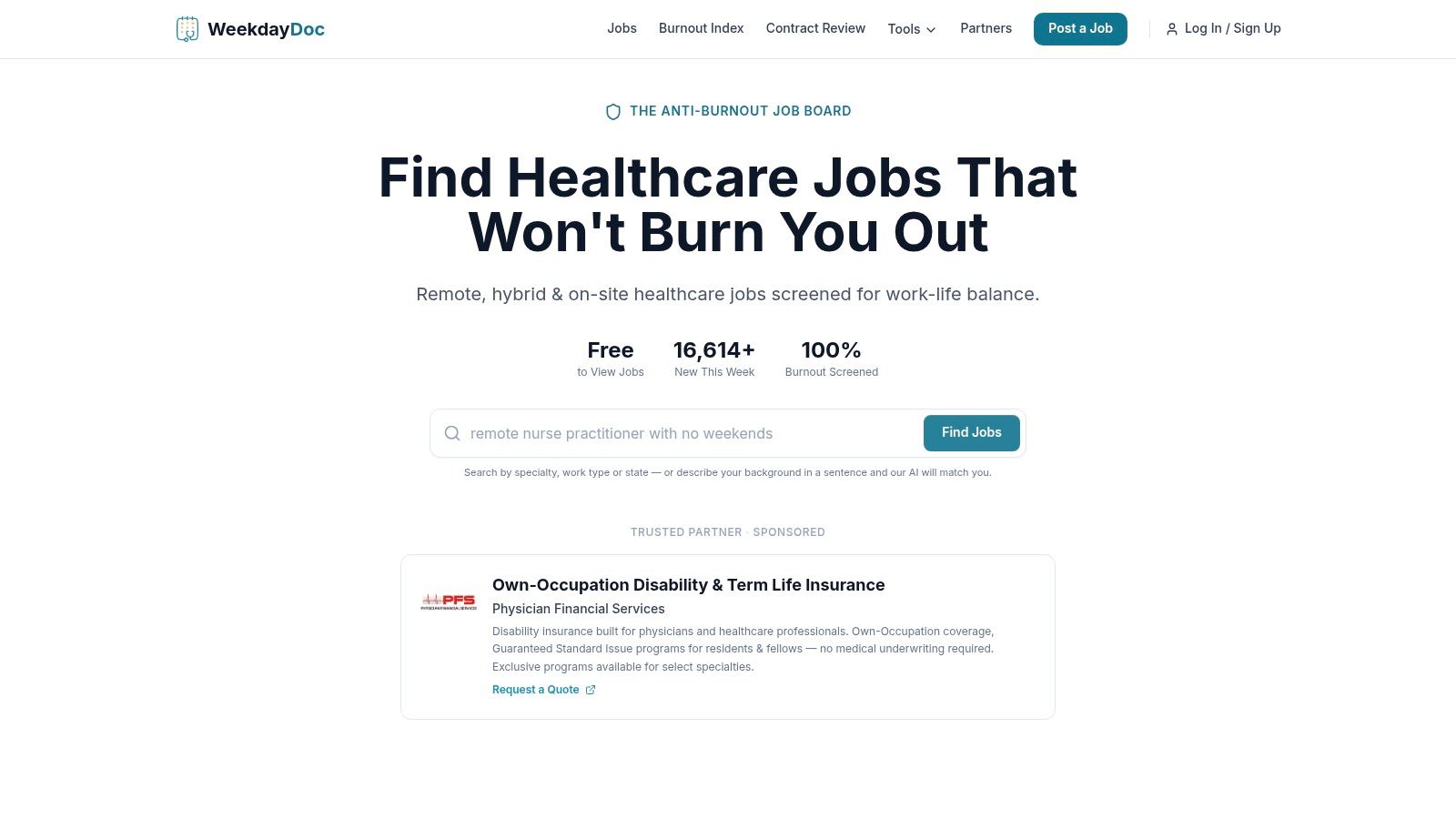
WeekdayDoc's occupational medicine listings can be evaluated alongside other sources using filters for specialty, work style, salary information, no-call markers, and no-weekend requirements. Its listings also include a Burnout-Friendly Score and state-based FIRE projections, which help frame schedule quality and long-term financial outcomes as separate decisions from headline salary.
A practical listing audit
Confirm the work pattern. Look for written definitions of call, weekends, overnight coverage, travel, and after-hours documentation. “Flexible” is not a schedule.
Separate base from total compensation. Identify bonus triggers, RVU thresholds, administrative stipends, signing payments, and benefit eligibility. If the listing discloses no pay, treat the first recruiter conversation as a data-gathering exercise, not a commitment.
Check the state variables. Licensure portability, compact eligibility where applicable, malpractice terms, and cost of living can change the practical value of an offer. A remote role may still require licenses in the states where patients or workers are located.
Model the lifestyle adjustment. Compare a no-call role with a higher-paying job that requires heavy call or hospital coverage. A FIRE projection can reveal whether the larger base produces a better financial outcome after taxes, commuting, relocation, and lost personal time.
Review the contract. Use the occupational medicine jobs search as one input, then inspect restrictive covenants, termination terms, scope, documentation obligations, and compensation formulas.
Continuing education can also support a transition into employer-facing work, particularly for clinicians building expertise in workplace injury, disability, or compliance. Accredited CE for physicians is one resource to evaluate alongside specialty-specific training and credentialing requirements.
Resume, Interview, and Negotiation Tactics That Move the Offer
Your resume should lead with population health, surveillance, return-to-work planning, disability evaluation, IME experience, and employer communication, not only acute-care volume. Show how you make defensible functional decisions and document them clearly.
In interviews, ask who owns the inbox after hours, whether call includes informal phone coverage, how productivity is measured, what percentage of time is administrative, and whether the employer pays for travel between sites. Request the compensation formula in writing before treating a bonus as income.
The low disclosure rate is an advantage. A 2026 salary report found pay in only 7 of 49 listings, or 14%, with disclosed ranges from approximately $240,000 to $355,000. The 2026 PhysEmp salary transparency report supports a simple negotiating rule: when an employer hides the range, don't assume the offer is competitive.
Use compensation negotiation in 2026 for broader negotiation preparation, then compare the proposed base, schedule, call, administrative time, and FIRE outcome through salary negotiation tactics. Treat disclosed salary as a starting point, not proof of value, and make weekday-only terms contractual rather than verbal.
WeekdayDoc helps clinicians compare occupational medicine roles by specialty, work style, salary information, no-call and no-weekend markers, Burnout-Friendly Scores, and state-based FIRE projections. Visit WeekdayDoc to evaluate available roles against both your schedule requirements and your long-term financial goals before you negotiate.