A Clinician's Guide to the RVU Calculator
Master the RVU calculator to understand your compensation, evaluate job offers, and take control of your career. Learn how to calculate and leverage your wRVUs.
At its core, an RVU calculator is simply a tool that translates the work you do—every consult, procedure, and patient visit—into a standardized value. This lets employers measure productivity and, more importantly, determine your compensation. It's built on a formula that assigns a Relative Value Unit (RVU) to every CPT code, attempting to create an objective measure of the effort, resources, and risk involved in patient care.
Demystifying the Numbers That Shape Your Paycheck
Think of an RVU calculator as the key to understanding the language of physician payment. It’s not just about crunching numbers; it’s about getting a clear window into how your clinical effort is valued and, ultimately, how you get paid. For too many clinicians, pay stubs feel like a black box. This is how you open it.
Whether you're a resident nervously comparing your first job offers or a seasoned physician looking for a more sustainable pace, getting a handle on RVUs is non-negotiable. The entire system is built on a few key pillars that come together to create a "Total RVU" for everything you do.
The Three Core Components of an RVU
When you perform a service, the RVU assigned to it isn't just one number. It's actually a combination of three distinct parts, each representing a different piece of the healthcare delivery puzzle.

Here's how those three components break down and what they really mean for your paycheck.
| RVU Component | What It Represents | Average Weight |
|---|---|---|
| Physician Work (wRVU) | The time, skill, mental effort, and stress involved in a service. This is your contribution. | ~52% |
| Practice Expense (PE) | The overhead. This covers rent, equipment, supplies, and non-physician staff salaries. | ~44% |
| Malpractice (MP) | The cost of professional liability insurance premiums associated with the service. | ~4% |
As you can see, these elements are far from equal. The "work" component, or wRVU, is the part most clinicians focus on because it's the metric that most directly reflects your labor. It makes up just over half of the total RVU value.
Your wRVU (work RVU) is the metric that most directly reflects your clinical effort and is the number most commonly tied to your productivity-based salary and bonuses. Understanding it is the first step toward controlling your compensation.
So, how do these abstract units become actual dollars? That’s where two other critical variables come in: the Geographic Practice Cost Index (GPCI) and the Conversion Factor (CF).
The GPCI is a multiplier that adjusts RVUs to account for cost-of-living differences. A procedure done in Manhattan will have a higher GPCI adjustment than the same one in rural Nebraska. The CF is a national dollar amount that converts the final, geographically-adjusted RVU value into a Medicare payment.
An RVU calculator takes all of these inputs—wRVU, PE, MP, GPCI, and the CF—and spits out the final number. A standard office visit (CPT 99213) might be worth 1.39 RVUs on its own, but after adjusting for a high-cost area like North Jersey, that could jump to 1.57 RVUs, translating directly into a higher payment for the same work. You can explore the history of these units to see how the system has evolved.
How to Calculate Your wRVUs in the Real World
Okay, let's move past the theory. Understanding what an RVU is is one thing, but knowing how to calculate your own is where the power lies. This is the skill that lets you double-check your pay stub, accurately compare job offers, and see how your productivity stacks up.
To get started, you really only need three pieces of information:
- The CPT Codes for the services you’ve provided.
- The official wRVU value for each of those codes.
- Your specific Geographic Practice Cost Index (GPCI).
Think of these as the basic ingredients. Once you have them, running the numbers is straightforward.
Finding Your Key Data Points
Getting your CPT codes should be easy—they're logged in your billing records or EHR. For clinicians who need to track this data consistently, most modern healthcare practice management software acts as a central hub for all this information.
Next, you'll need the official wRVU values and GPCI modifiers. The Centers for Medicare & Medicaid Services (CMS) is the definitive source, publishing these numbers every year in the Physician Fee Schedule (PFS). You'll want to go straight to the source—the official CMS website—to avoid using outdated figures.
Here’s what the CMS Physician Fee Schedule search tool looks like. It’s your go-to for the most current data.
Using this tool, you can plug in a CPT code and your location to get the exact wRVU and GPCI values you need for an accurate calculation.
It’s a bit of a historical footnote, but the system we use today—the Resource-Based Relative Value Scale (RBRVS)—came out of a Harvard study in the late 1980s. President George H.W. Bush signed it into law in 1989, and it completely reshaped how physician work was valued when it went live on January 1, 1992.
A Practical Example, Step-by-Step
Let's walk through a real-world scenario. We'll calculate the total wRVUs for a Family Medicine doc in Chicago, Illinois, who just saw an established patient for a visit coded as CPT 99214.
First, you need the base wRVU for that code. A quick lookup in the current PFS shows a CPT 99214 is worth a base of 1.92 wRVUs.
Next, we look up the geographic adjustment. The specific "Work GPCI" for the Chicago area is 1.018. This modifier accounts for the slightly higher cost of physician labor in a major city like Chicago.
Now for the simple part: multiply the two numbers.
Calculation: 1.92 (Base wRVU) x 1.018 (Work GPCI) = 1.955 wRVUs
So, that single visit generated 1.955 geographically-adjusted work RVUs. You just repeat this process for every single patient encounter and procedure to find your total wRVUs for a day, a week, or a pay period. This final number is what drives your productivity-based pay.
From RVUs to Reality: Your Salary and Benchmarks
Once you've tallied up your total wRVUs, you’re holding a critical piece of your financial puzzle. This number bridges the gap between your day-to-day clinical work and your paycheck. But to see the full picture, you need one final variable: your dollar conversion factor.
This number, which should be clearly spelled out in your employment contract, is the exact dollar amount your employer agrees to pay for every single wRVU you generate.
The math from here is refreshingly simple. Just multiply your total annual wRVUs by your conversion factor to get your potential gross income. For instance, if you produce 5,000 wRVUs in a year and your contract specifies a rate of $55 per wRVU, your productivity-based pay comes out to $275,000. It creates a direct, transparent line from your effort to your earnings.
Benchmarking Your Productivity and Pay
Knowing your own numbers is the first step, but context is everything. Are you a workhorse in your specialty? Is your compensation package actually competitive? To answer those questions, you need to benchmark your performance against reliable industry data.
Organizations like the Medical Group Management Association (MGMA) and SullivanCotter are the gold standard here. They publish comprehensive annual surveys detailing median wRVU production and compensation figures for nearly every medical specialty imaginable.
By comparing your wRVU output and total compensation to these national benchmarks, you gain objective evidence to support your value. This isn't just about satisfying curiosity; it's about building a data-driven case for your next contract negotiation.
Let's say you're an orthopedic surgeon who generated 8,500 wRVUs last year. If you pull up the MGMA data and see the median for your field is 8,200 wRVUs, you now have proof that your productivity is above average. That single data point gives you powerful leverage when it's time to talk money.
The process of getting to that final wRVU figure is a methodical one, starting with the right CPT code and adjusting for geography before your contract's conversion factor is even applied.
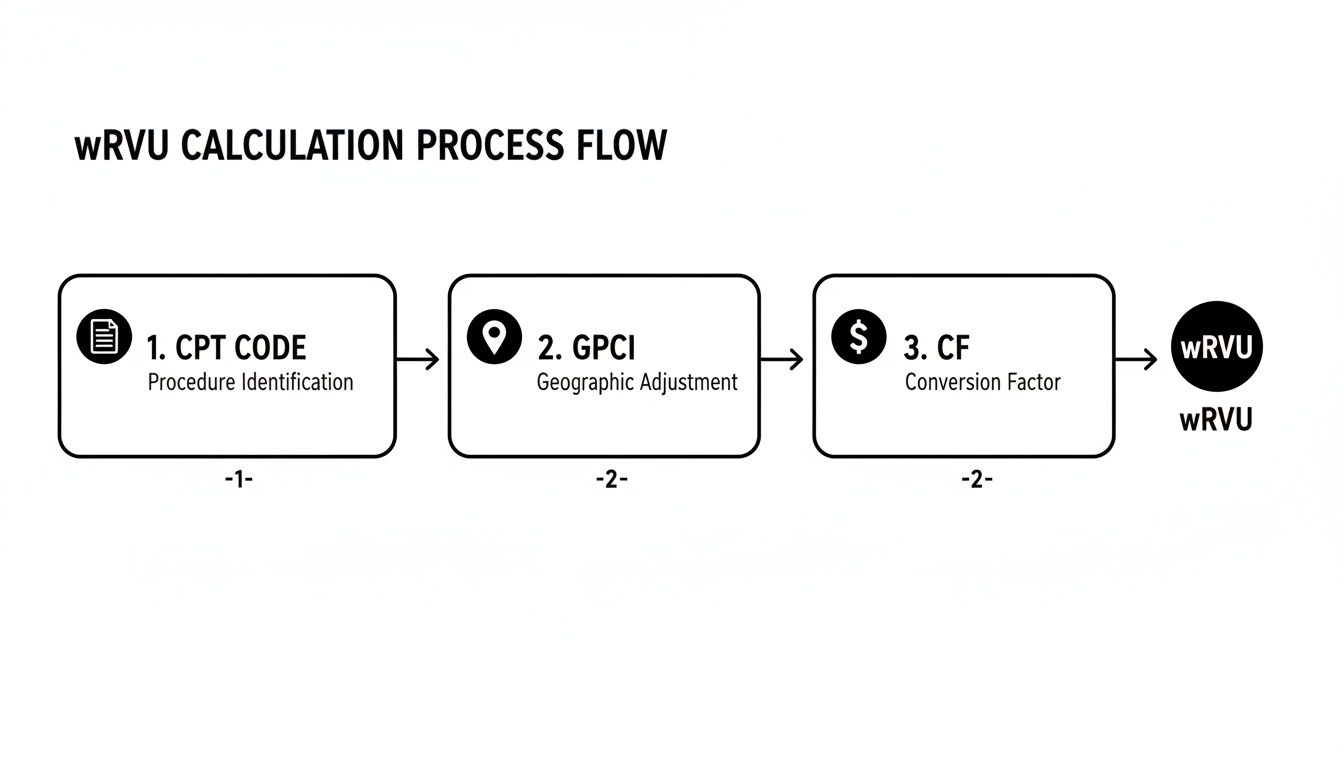
Each step builds upon the last, translating a specific clinical service into a standardized value that determines your compensation.
To give you a clearer idea of what these benchmarks look like across different fields, here’s a sample table based on national survey data.
Sample RVU Benchmarks and Compensation by Specialty
| Specialty | Median Annual wRVUs | Typical Compensation Range |
|---|---|---|
| Family Medicine | 4,950 | $230,000 - $285,000 |
| General Surgery | 7,800 | $400,000 - $520,000 |
| Cardiology (Non-Invasive) | 8,500 | $450,000 - $600,000 |
| Orthopedic Surgery | 8,200 | $550,000 - $750,000 |
| Psychiatry | 4,200 | $250,000 - $310,000 |
Note: These are illustrative figures. Actual benchmarks and compensation can vary significantly based on location, practice setting, and specific contract terms.
Putting It All Together for Negotiations
When you walk into a contract negotiation armed with your personal wRVU totals and comparative industry data, the entire dynamic shifts. You’re no longer relying on feelings or what you think you’re worth. You’re presenting a factual, undeniable case for your contribution.
Here’s how you can frame the conversation:
- Demonstrate your high productivity: "My wRVU production of 6,200 last year was 10% above the national median for family medicine."
- Pinpoint underpayment: "Based on my wRVU output, the compensation you've offered is in the 40th percentile, while my productivity is at the 65th percentile."
This transforms the discussion from a subjective debate into an objective business meeting. When your numbers are solid, your requests for a higher salary or a better conversion factor are no longer just "asks"—they are justified claims backed by proof of your value.
To take this a step further and see how different compensation models might affect your long-term financial health, check out our guide on the WeekdayDoc Salary & FIRE calculator.
Decoding Job Offers and Avoiding RVU Traps
An RVU-based contract can be a ticket to high earnings, but it can also be a fast track to burnout. The real skill is learning to spot the difference before you sign. The numbers in a job offer might look impressive on the surface, but the real story is almost always hidden in the fine print of the productivity model.

These traps are rarely obvious. They show up as seemingly reasonable wRVU targets, confusing bonus structures with moving goalposts, or a low dollar-per-wRVU rate that just doesn't value your work properly. And a bonus that requires you to hit the 90th percentile of national productivity isn't a bonus; it's a carrot you'll probably never reach.
Scrutinizing the Key Contract Variables
When an offer lands in your inbox, your eyes should immediately jump to a few key areas. An RVU calculator is great for modeling your potential earnings, but it’s useless if you don't understand the contract's mechanics first. The most common red flags pop up where expectations and reality don't align.
For instance, a pure RVU model often ignores all the critical, non-billable work you do. Time spent wrestling with the EMR, handling admin tasks, taking call, and sitting in mandatory meetings generates exactly zero wRVUs. If your contract doesn't account for this “invisible” labor, you are, quite literally, working for free.
A healthy RVU model rewards your clinical work without penalizing you for the unavoidable, non-revenue-generating tasks that are part of being a doctor. If an offer doesn't mention protected administrative time or a base salary to cover it, proceed with extreme caution.
Before you even think about negotiating, you need to get crystal-clear answers to a specific set of questions. These aren't just for your own curiosity—they are crucial for protecting your financial future and your sanity.
Your Pre-Signature Checklist
Arm yourself with these questions for any potential employer. They're designed to cut through the jargon and uncover the truth behind their RVU model.
- What is the exact dollar conversion factor per wRVU? Get this number in writing. No vague answers allowed.
- Is there a minimum wRVU threshold before I start earning bonuses? This is a classic "gotcha" that can make bonus tiers completely unattainable.
- How is "unproductive" time handled? Ask point-blank about compensation for administrative duties, call schedules, and required committee meetings.
- Are the wRVU targets and conversion factors adjusted annually? You have to know if the goalposts can move, potentially making it much harder to earn the same income next year.
- Can I see anonymized productivity data for the physicians currently in this role? This is the ultimate reality check. It tells you if the proposed targets are even possible given the existing patient load and support staff.
Getting solid answers to these questions is non-negotiable. For a deeper dive, our comprehensive physician job offer analyzer can help you benchmark the fine print against industry standards to see if you're getting a fair deal.
Aligning Your RVU Strategy with Financial Goals
So, you’ve run the numbers. You know your RVU potential. What now? This is where the real work—and the real power—of an RVU calculator comes in. That output isn't just a number; it's a direct line connecting your day-to-day clinical work to your long-term financial independence.
It’s time to turn those income projections into an actual roadmap.
Think about a classic physician crossroads: you're staring at two job offers. Offer A is a high-volume gig with massive RVU potential but a brutal call schedule that screams burnout. Offer B has a more humane pace with slightly lower, but still solid, compensation. We’ve all been there. Making the right call means looking far beyond the next paycheck.

This decision is the heart of the matter: do you chase the highest possible income, or do you prioritize your own well-being? By modeling both scenarios, you can clearly see how each choice affects not just your salary next year, but your entire timeline to financial freedom.
Modeling Your Financial Future
This is the moment your RVU analysis transforms from a simple calculation into a strategic life-planning tool. Let's break down how to compare these offers with a data-driven mindset. You can model each one to see how it stacks up against your personal goals—whether that's obliterating student debt, retiring early, or just finally having a decent work-life balance.
For the high-RVU, high-stress role:
- Project your max earnings based on those aggressive RVU targets.
- Plug that higher income into your savings and investment forecasts. What does that growth look like?
- Now, be brutally honest about the burnout risk. Can you really sustain that pace for one year? Five years?
For the sustainable, balanced role:
- Calculate your income based on a more manageable patient load.
- Model a slightly longer path to your financial goals, but factor in greater career longevity.
- Consider the invaluable non-financial perks: more time with family, for hobbies, for your own mental health.
The point isn't just to max out your income; it's to optimize your life. An RVU calculator quantifies the financial trade-offs, giving you the power to choose a career path that serves both your bank account and your well-being.
Once you've nailed down an RVU strategy that boosts your earnings, the next step is managing that income effectively. You can dive deeper into this with expert advice on financial planning for high income earners.
Ultimately, choosing the right path is about aligning your work with what you truly value. The clarity you get from an RVU calculator helps you build a career that's not just profitable, but one you can actually live with. For more data on how different jobs and specialties align with financial goals, check out our WeekdayDoc Market Pulse.
Common Questions About RVU Calculators
Even after you get the hang of the basics, the real world of RVU-based pay brings up some tricky situations. This is where the theory hits the pavement of your daily workflow and, most importantly, your contract. Let's walk through some of the most common questions I hear from other clinicians.
What Is the Real Difference Between Total RVUs and wRVUs?
This is the big one. While every CPT code has a "total" RVU value, your paycheck is almost always tied only to the wRVU (work RVU) piece of it.
Remember, the total RVU is a bundle: work, Practice Expense (PE), and Malpractice (MP). The PE and MP components are there to reimburse the facility for its overhead—the lights, the staff, the insurance. That money isn't for you.
So, when you see a job offer with a dollar rate, make absolutely sure it specifies "per wRVU." If a contract is vague, an employer could technically base your pay on the much larger total RVU number, which would make your effective pay rate for the work you actually do deceptively low. Always, always clarify this.
Key Takeaway: Your personal productivity and your compensation are measured in wRVUs. The other parts, PE and MP, are for the hospital's or clinic's expenses. Keep your focus squarely on the work component.
How Do I Handle New or Unlisted CPT Codes?
Medicine is always evolving, and sooner or later you’ll perform a procedure so new it doesn’t have its own CPT code or RVU value yet. When this happens, you'll need to use an "unlisted procedure" code from the right section of the CPT manual.
This is where your documentation becomes critical. You have to provide a detailed report explaining exactly what you did, its complexity, and the time and skill it required. Often, the best approach is to benchmark it against an existing procedure of similar difficulty to propose a fair wRVU value to the payer or your own administration.
Yes, it's more administrative legwork, but it's the only way to get credit for doing innovative work.
What Are Some Proven Negotiation Strategies for RVU Contracts?
Negotiating an RVU contract is about so much more than just the dollar-per-wRVU rate. A smart strategy protects your income and your sanity.
Here are a few tactics that work:
- Benchmark Everything: Don't walk in blind. Arrive with data in hand—specifically, the MGMA median wRVU production and compensation data for your specialty and region.
- Negotiate for a "Ramp-Up" Period: This is especially important if you're new to a practice. Ask for a guaranteed salary for the first one to two years. This gives you time to build a patient panel before you have to switch over to a pure productivity model.
- Insist on an Annual Review: The Medicare conversion factor and wRVU values can, and do, change every year. Your contract needs a clause that guarantees an annual review to adjust your compensation structure to reflect these updates.
A strong negotiation is built on data, foresight, and clearly communicating the value you bring to the table.
Ready to find a role where your work is valued and your well-being is protected? At WeekdayDoc, we curate burnout-friendly jobs that fit your life. Start your search for a better career today.