Physician Burnout Rate by Specialty A Comprehensive Comparison
Explore the latest data on the physician burnout rate by specialty. Learn why some fields struggle more than others and discover practical, proven strategies.

The truth is, physician burnout rates by specialty are all over the map. Some fields, like Emergency Medicine, consistently see burnout rates top 60%. At the other end of the spectrum, you have specialties like Plastic Surgery and Psychiatry, where rates can dip below 40%. That’s a massive gap, and it’s driven by very real differences in the work environment, patient acuity, and how much control a doctor has over their day.
Analyzing the Physician Burnout Landscape
Physician burnout isn't a one-size-fits-all problem. Its intensity is deeply connected to the unique demands of each medical specialty. While virtually every field is feeling the pressure, the data clearly shows a spectrum of risk. For medical students picking a direction, residents mapping out their careers, or practicing physicians thinking about a pivot, understanding this landscape is the essential first step.
At its core, the problem often boils down to a mismatch between the demands of the job and a physician's autonomy. High-stakes, high-volume environments are breeding grounds for emotional exhaustion. It's no surprise that roles with more predictable schedules and a greater sense of control tend to be far more sustainable long-term.
What creates these massive disparities? A few key factors are almost always at play:
- Administrative Burden: The sheer volume of EHR clicks and paperwork is wildly different from one specialty to the next.
- Work-Life Integration: Unpredictable hours, crushing on-call duties, and constant weekend shifts are major burnout drivers.
- Emotional Toll: Specialties that regularly deal with high mortality or severe chronic illness carry a unique and heavy emotional weight.
- Patient Acuity: The intensity of patient encounters—and how many critical decisions you have to make per hour—directly cranks up daily stress.
Comparing High and Low Burnout Specialties
The contrast between specialties on opposite ends of the burnout spectrum is stark. An Emergency Medicine physician navigates a relentless pace filled with life-or-death decisions, while a Plastic Surgeon often manages elective procedures in a highly controlled, outpatient setting. This highlights a crucial point: the practice environment—not just the medicine itself—is what shapes career satisfaction and longevity.
If you’re trying to figure out where you stand, exploring tools like the WeekdayDoc Burnout Index can offer some valuable personalized perspective.
This chart really puts the gap into perspective.
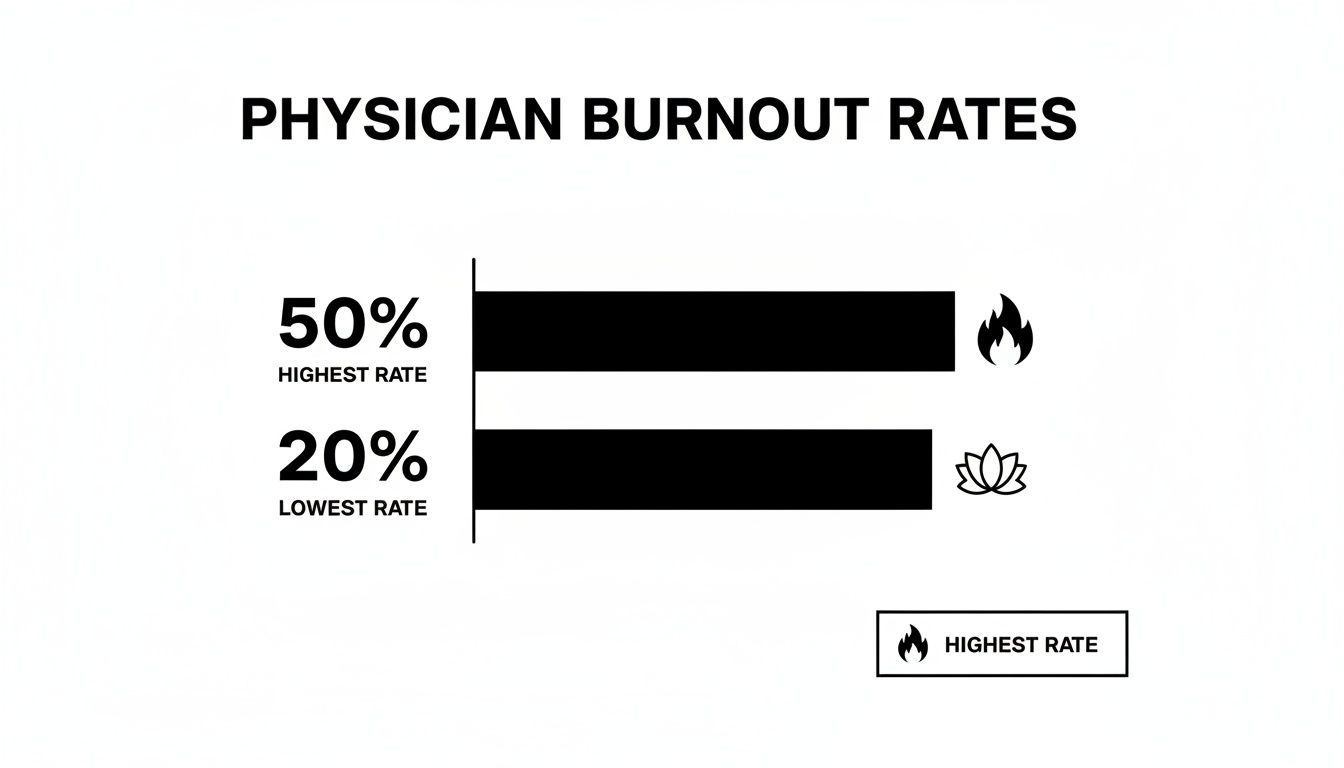
As the data shows, your choice of specialty can literally double your risk of burning out.
Specialty Burnout Rates at a Glance
Here’s a quick look at how a few specialties stack up, based on the latest data. Notice how the primary environmental driver directly correlates with the burnout rate.
| Specialty | Burnout Rate (%) | Primary Environment Driver |
|---|---|---|
| Emergency Medicine | ~63% | High-stakes, unpredictable volume |
| Obstetrics/Gynecology | ~53% | High emotional toll, demanding call schedules |
| Family Medicine | ~51% | High administrative burden, patient volume |
| Psychiatry | ~39% | Increased schedule control, telehealth options |
| Plastic Surgery | ~37% | Elective procedures, high autonomy |
These numbers tell a story. Fields with less control, higher stakes, and more administrative sludge consistently rank higher on the burnout scale. In contrast, those with more autonomy and predictable work environments offer a more sustainable path.
Why High-Stakes Specialties Face the Highest Burnout
While physician burnout is a system-wide problem, some specialties are consistently on the front lines of the crisis. It’s no surprise that fields built on intense pressure, deep emotional investment, and sheer unpredictability report the highest rates of exhaustion. These are the specialties where life-or-death decisions are just part of another Tuesday.
To really get why, you have to look past the numbers and into the daily grind of these roles. The common denominator is a brutal mix of incredibly high stakes and vanishingly little control—a perfect recipe for burnout. For doctors in these fields, the work isn't just a job; it's a relentless test of endurance.
Emergency Medicine: The Epicenter of Unpredictability
Emergency medicine is almost always at the top of the burnout list, and for good reason. The ER is a state of controlled chaos, throwing a constant barrage of high-acuity cases, diagnostic puzzles, and crushing time pressure at physicians. There’s no such thing as a "typical day," which attracts adrenaline junkies but also grinds them down over time.
EM docs have to pivot from a minor cut to a multi-trauma code in a split second, all while the waiting room keeps filling up. That constant context-switching is cognitively exhausting. Add to that the immense weight of making critical calls with incomplete information, where any mistake has immediate, devastating consequences.
The Medscape 2024 Physician Burnout and Depression Report puts a number on this crisis: a staggering 63% of emergency medicine physicians report burnout. That figure, based on responses from over 9,200 doctors, puts EM in a league of its own. You can see the full findings on burnout rates by specialty to see how others compare.
The Emotional Weight of OB/GYN and Oncology
While EM is defined by its chaotic pace, specialties like OB/GYN and Oncology are defined by profound emotional labor. Physicians in these fields walk with patients through life's most intense moments, from the joy of childbirth to the devastation of a cancer diagnosis.
For an OB/GYN, the miracle of bringing a new life into the world is shadowed by the constant, terrifying risk of a catastrophic outcome for mother or baby. A perfectly normal delivery can turn into a life-threatening emergency in an instant, forcing a state of hyper-vigilance that's impossible to switch off. This emotional whiplash, paired with brutal on-call schedules, makes any semblance of work-life balance feel like a fantasy.
“In fields like oncology and OB/GYN, physicians are not just treating a disease; they are managing hope, fear, and grief. This deep emotional labor, performed daily, is a significant and often overlooked contributor to burnout.”
Oncologists carry a similar, though different, emotional load. They guide patients and their families through harrowing diagnoses, grueling treatments, and end-of-life conversations. The sheer weight of constantly delivering bad news and witnessing suffering is immense. While the bonds they form are deep, the cumulative toll of losing patients so frequently is a heavy burden that directly fuels their 53% burnout rate.
Amplifying Factors Across High-Stakes Fields
On top of the inherent clinical pressures, a few systemic issues act as burnout accelerators in these specialties. These aren't unique problems, but they hit a lot harder when stress levels are already maxed out.
Three key amplifiers pop up again and again:
- Bureaucratic Tasks and EHR Overload: For physicians in fast-paced or emotionally draining roles, administrative work is infuriating. Every minute spent wrestling with a clunky EHR or fighting an insurance company for a prior authorization is a minute stolen from patient care or their own recovery.
- Perceived Lack of Respect: A huge complaint among doctors, especially those in hospitals, is feeling like administrators don't value their clinical expertise. When you're on the front lines and feel like a replaceable cog in a machine, your sense of purpose quickly erodes.
- Systemic Inefficiencies: Understaffing, a lack of resources, and poorly designed workflows create constant friction. For a doctor already running on fumes, these systemic failures add another layer of stress that feels impossible to overcome, pushing them ever closer to the edge.
The Unique Pressures of Primary Care Burnout
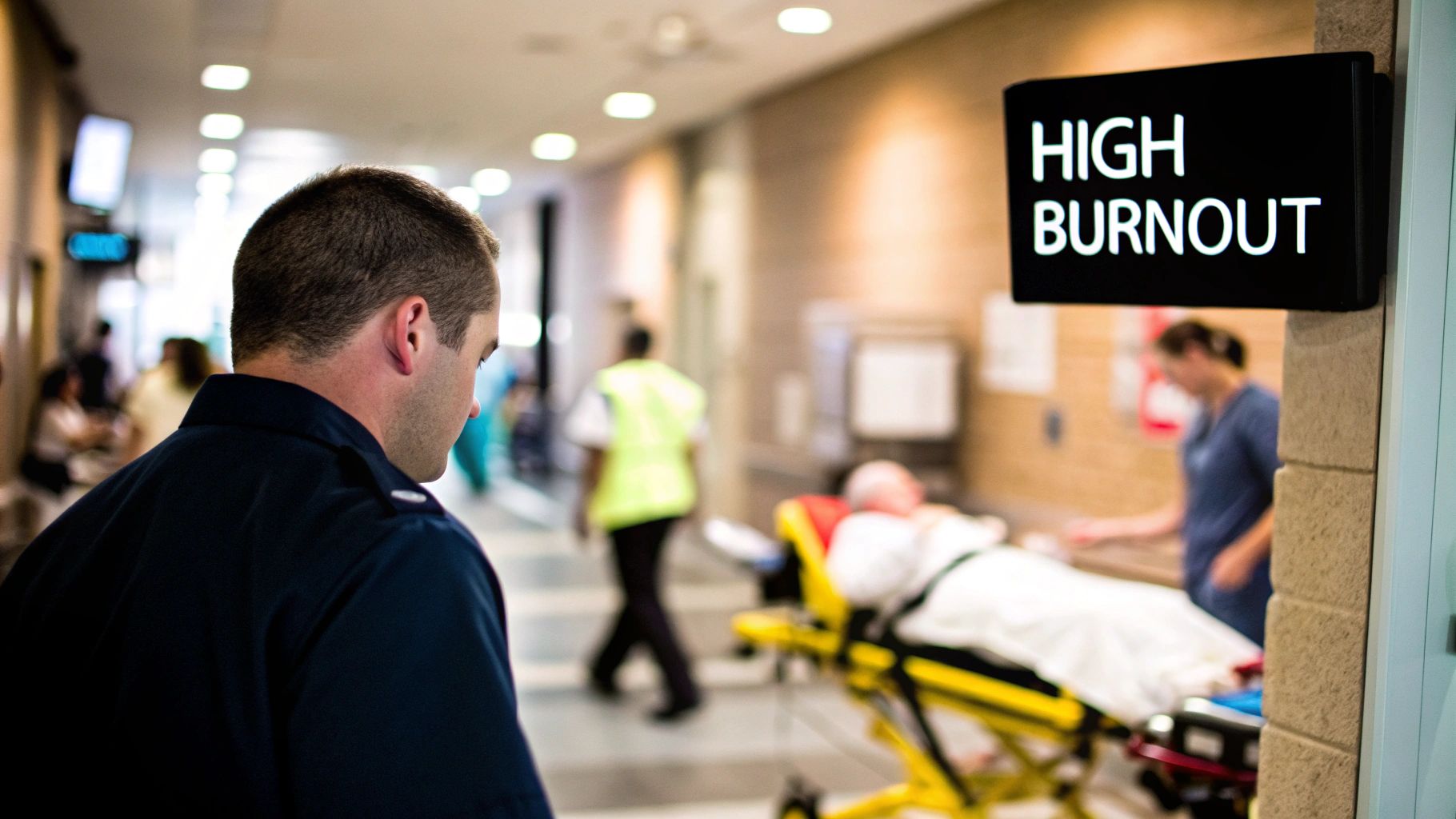
While high-stakes specialties grapple with intense, life-or-death moments, primary care physicians face a different kind of war—one of attrition. This is the world of Family Medicine and Internal Medicine, where the crisis isn't a sudden explosion but a slow, grinding erosion of professional purpose.
The burnout here is insidious. It’s born from being the perpetual first line of defense for the entire healthcare system. You’re expected to manage everything from a simple cold to a complex, multi-system chronic illness, all while juggling shrinking appointment times and dwindling resources.
The Crushing Weight of Administrative Tasks
At the very core of primary care burnout is an avalanche of administrative work. The sheer volume of non-clinical tasks required just to keep your head above water is staggering. This isn’t just about charting; it's a relentless flood of insurance paperwork, prior authorization battles, referral coordination, and an inbox overflowing with EHR notifications.
A single task seems harmless enough. But multiply that by a 30-patient day, and it becomes a suffocating force that pushes actual patient care to the fringes of the workday. Doctors are clocking hours long after the last patient has gone home, just to close charts and clear messages. This is the unpaid, soul-crushing "pajama time" that drains you before the next demanding day even begins, and it's a huge reason the physician burnout rate by specialty stays so high here.
The data backs this up. Primary care fields like family and internal medicine consistently hover around a 50-51% burnout rate. A major driver is the administrative load, with doctors spending an average of 1.84 hours daily on EHR tasks alone—a burden that directly fuels exhaustion and cynicism. You can dive deeper into these burnout and documentation trends.
Managing Chronic Disease and Emotional Exhaustion
Unlike specialties that often see a clear beginning and end to a medical problem, primary care is the long game. You’re managing chronic conditions like diabetes, hypertension, and heart disease for decades, a responsibility that carries a unique emotional weight.
Progress can feel glacially slow, setbacks are common, and social determinants of health—poverty, poor health literacy, lack of access—often feel like insurmountable barriers. It takes immense patience and empathy, but over time, it can lead to a sense of futility and deep emotional exhaustion. Being a trusted provider for entire families means you share their joys, but you also bear witness to their prolonged suffering. That burden adds up over a career.
“Primary care burnout is a slow burn. It’s the feeling that no matter how hard you work or how much you care, the system is designed to make your job impossible. The endless paperwork and systemic hurdles chip away at your sense of purpose until you’re just trying to survive the day.”
Key Drivers of Primary Care Burnout
The pressure on primary care physicians comes from all sides—clinical, administrative, and emotional. A few core factors are consistently to blame for the sky-high burnout rates:
- High Patient Volume: Schedules are packed, often double-booked, leaving mere minutes to address complex issues, build rapport, and somehow get the documentation done.
- 'Pajama Time' Documentation: The reality of spending hours on EHR tasks after hours, stealing time away from family, friends, and sleep.
- Inadequate Support Staff: Not enough MAs, nurses, or admin support means more non-physician work gets dumped squarely onto the doctor's plate.
- Reimbursement Pressures: Low reimbursement rates force practices into a volume-based model, creating a vicious cycle of overwork just to stay afloat.
When these factors combine, they create a work environment where physicians feel perpetually behind and completely undervalued. For anyone looking to escape this cycle, finding a role with better support and a manageable pace is non-negotiable. Exploring dedicated family medicine jobs that truly prioritize work-life balance can be the first step toward building a career that’s actually sustainable.
What Lower-Burnout Specialties Do Differently

While some medical fields are defined by chaos and attrition, others offer a blueprint for professional sustainability. Specialties like plastic surgery, psychiatry, and ophthalmology consistently report the lowest burnout rates, providing a stark contrast to their high-stress counterparts.
Understanding what these fields do differently is crucial for any physician looking for a more balanced and fulfilling career. It's not that the medicine is "easier," but that the entire structure of the practice is fundamentally different. These specialties offer powerful lessons in how a work environment can either protect or erode a clinician's well-being over time.
Recent data paints a clear picture. In Medscape's 2024 report, plastic surgery and psychiatry shine as oases, with rates as low as 37% for plastics, 39% for both psychiatry and ophthalmology, and 41% for pathology. These numbers are a world away from the 63% peak in emergency medicine and the 49% overall average. Orthopedics (44%), neurology (44%), and surgery (45%) also fare better, highlighting a clear pattern. You can explore more of the research behind these physician burnout statistics.
Autonomy and Control Over the Workday
One of the biggest protective factors in low-burnout fields is professional autonomy. Physicians in specialties like plastic surgery or dermatology often work in private practices or outpatient clinics, giving them far more control over their schedules, patient volume, and daily workflow.
This is a sharp contrast to the hospital-based chaos of emergency medicine or the crushing patient loads in primary care. When you can decide how many patients you see and when you see them, you reclaim a sense of agency—something that’s often the first casualty of burnout. This control directly pushes back against the feeling of being a cog in an unyielding, inefficient machine.
The Power of Predictable Hours
Predictability is a powerful antidote to exhaustion. Many lower-burnout specialties operate on a more structured, nine-to-five-like schedule with minimal on-call duties, if any.
Think about ophthalmology or pathology. The work is largely scheduled, procedures are planned, and true emergencies are rare. This structure allows physicians to actually build a life outside of medicine—to be present for family, pursue hobbies, and just disconnect. It's a world away from the OB/GYN who is constantly on edge, waiting for a call that could come at 3 a.m.
A sustainable career is often built on a foundation of predictability. Knowing that your workday has a clear beginning and end allows for the mental and emotional recovery necessary to prevent long-term exhaustion and cynicism.
This separation between work and life isn't a luxury; it’s a non-negotiable for career longevity. Fields that protect evenings, weekends, and holidays are inherently offering a more sustainable path.
Tangible Outcomes and Professional Satisfaction
The nature of the work itself is another key differentiator. Many low-burnout surgical subspecialties, like plastics or orthopedics, are procedure-based and deliver clear, tangible results. A surgeon can fix a fracture or complete a reconstruction and see a direct, positive impact on a patient's quality of life.
This creates a powerful feedback loop of professional satisfaction that can be harder to find in fields managing chronic, often incurable diseases. In a similar vein, psychiatry has seen a surge in sustainability with the rise of telehealth. The ability to work from home, cut out the commute, and have greater schedule flexibility has been a game-changer for many, reducing daily friction and improving work-life integration.
By examining the physician burnout rate by specialty, it becomes clear that the secret to a sustainable career often lies in these core principles:
- Greater control over your schedule and patient load.
- Predictable hours with limited on-call duties.
- Work that provides clear, positive feedback and a sense of accomplishment.
These aren’t specialty-specific luxuries; they are the fundamental building blocks of a burnout-resistant medical career.
Finding a Sustainable Role in Any Specialty
Looking at the physician burnout rate by specialty can be disheartening, especially if your field is at the top of the list. But those numbers don't tell the whole story. The truth is, a sustainable career often has less to do with the specialty itself and far more to do with the specific structure of your job.
Even the most demanding roles can become manageable with the right boundaries in place. It’s absolutely possible to practice emergency medicine, primary care, or any other high-stress specialty without sacrificing your well-being. It just requires a more strategic, proactive approach to how you find your next role.
The key is to shift your focus from what you practice to how you practice.
Redefining Your Job Search Criteria
For decades, the physician job search has revolved around a few core pillars: compensation, location, and the prestige of the institution. To find a role that’s actually burnout-proof, you need to add a new layer of criteria that puts your work-life integration first.
This means actively prioritizing the factors that protect your time, energy, and mental health.
At WeekdayDoc, we built our entire platform around this exact principle. Our tools are designed to help you cut through the noise and zero in on opportunities that genuinely respect your boundaries. It starts with simple but powerful filters that immediately weed out the most common burnout drivers.
- 'No Call' Filter: Instantly removes any position requiring you to be on-call. This protects your evenings, weekends, and personal time from being hijacked by work.
- 'No Weekends' Filter: Guarantees your search results only include jobs that run on a standard Monday-to-Friday schedule, safeguarding your weekends for rest and recovery.
- 'Remote' or 'Hybrid' Options: Gives you the flexibility to cut down on commute time or eliminate it entirely, offering more control over your day and your environment.
When you start your search with these non-negotiables, you turn a reactive process into a deliberate one—one focused squarely on your long-term sustainability.
Using Data to Assess Burnout Risk
Beyond the basic filters, finding a truly sustainable role requires a more objective way to size up potential jobs. Vague promises of "a great work-life balance" in a job description are meaningless without something concrete to back them up. This is where data-driven tools become non-negotiable for making an informed decision.
We created WeekdayDoc's proprietary Burnout-Friendly Score to solve this problem. Every single job listed on our platform is assigned a score based on objective factors known to impact physician well-being, like schedule demands, on-call requirements, and administrative load. This score gives you an at-a-glance assessment of how a role stacks up against criteria that actually prevent burnout.
A job’s title or its salary tells you nothing about the toll it will take on your mental health. The Burnout-Friendly Score provides a standardized metric to compare opportunities based on what truly matters for career longevity—your time, your autonomy, and your well-being.
This data-first approach lets you compare different roles on a level playing field. A job with a slightly lower salary but a high Burnout-Friendly Score might be a far better long-term investment in your health and happiness than a high-paying role that will have you exhausted and looking for an exit in a year.
Aligning Career Moves with Life Goals
A sustainable career isn't just about avoiding burnout from one day to the next. It’s about making sure your professional life actually supports your personal and financial goals. This is especially true for physicians who are pursuing Financial Independence, Retire Early (FIRE) or just want more financial freedom and flexibility.
To connect these dots, WeekdayDoc integrates tools like our Salary & FIRE Calculator directly into the job search. This allows you to see how a potential salary in a specific state translates into your long-term financial picture. You can project your savings rate, estimate your retirement timeline, and make career moves that truly align with the lifestyle you want to live.
Think about a real-world scenario:
An ER physician is getting crushed by erratic overnight shifts. She uses WeekdayDoc to find a remote telehealth position. The role has a slightly lower salary, but it comes with no call, no weekends, and a high Burnout-Friendly Score. Using the calculator, she realizes that with no commuting costs and less stress-related spending, her actual savings rate goes up, keeping her FIRE goals on track while dramatically improving her quality of life. Exploring alternatives like these, including the wide variety of part-time physician jobs, can open up entirely new paths to a balanced career.
This integrated approach shows that finding a sustainable role is possible in any specialty. It's all about using the right tools to find a job that fits your life, not forcing your life to fit your job.
Frequently Asked Questions About Physician Burnout

Drilling down into the physician burnout rate by specialty always seems to bring up more questions. It’s a thorny issue, tangled up in everything from our career choices to our daily well-being and the very future of medicine. I've compiled answers to the most common questions I hear, hoping to give you some clear, actionable insights, no matter where you are in your career.
To get ahead, you need more than just raw data. You need to understand the real-world factors that make or break a sustainable career. The goal here is to clarify the trends and give you the knowledge to make smarter decisions about your own path.
Which Medical Specialty Has the Lowest Burnout Rate?
Year after year, Plastic Surgery comes out on top with the lowest reported burnout rate, recently hitting as low as 37%. It's not hard to see why. The specialty is built around high professional autonomy, serious control over work schedules, and a practice model that’s heavy on elective, outpatient procedures. All of this adds up to a more predictable and often less emotionally draining workday.
A few other specialties share similar protective qualities and post impressively low numbers:
- Psychiatry: With a burnout rate around 39%, this field has been transformed by telehealth. The shift offers flexibility and work-from-home options that were unthinkable a decade ago.
- Ophthalmology: Also sitting at 39%, this specialty is defined by scheduled procedures and predictable hours. After-hours emergencies are rare, which makes a huge difference in work-life balance.
- Pathology: At 41%, pathologists work in highly structured environments with minimal direct patient-facing stressors, shielding them from the emotional toll common in so many other fields.
These specialties really give us a blueprint for what makes a medical career sustainable in the long run.
Are Physician Burnout Rates Improving?
It's a real mixed bag. The short answer is yes and no. On one hand, overall burnout rates have fallen slightly from the astronomical highs we saw at the peak of the pandemic. For instance, some primary care fields saw burnout drop from an unbearable 60% down to around 50%. That's an improvement, sure, but it's still a crisis.
The thing is, the core systemic problems that got us here haven't gone anywhere. We're still drowning in administrative burdens, fighting chronic understaffing, and wrestling with clunky EHR systems day in and day out.
Any downward trend is a good sign, but let's be clear: the current burnout rates are nowhere near acceptable. These slight improvements shouldn't feel like a victory. They should feel like proof that real change is possible if we finally address the systemic pressures.
So while the fire may have died down from a raging inferno to a steady blaze, the fuel is still there. This requires continued advocacy for system-wide change and smart, individual strategies to protect your own career.
How Does Administrative Work Contribute to Burnout?
Excessive administrative work is, without a doubt, the single biggest non-clinical driver of physician burnout. It’s a "death by a thousand clicks"—a slow, relentless erosion of professional satisfaction that steals time from patient care and our own recovery. This kind of work feels completely disconnected from why we became doctors in the first place, breeding cynicism and deep exhaustion.
The main culprits are no surprise to any practicing physician:
- EHR Documentation: We spend hours every single day charting, often during "pajama time" long after the last patient has gone home. This is unpaid work that directly eats into our personal lives.
- Insurance Paperwork: The endless battles with insurance companies for prior authorizations and approvals are infuriating. They delay patient care and add a layer of stress that benefits no one.
- Inbox Management: The constant barrage of patient messages, lab results, and administrative pings creates a cognitive load that never shuts off, extending far beyond the 9-to-5.
These tasks strip away our sense of autonomy and control, effectively turning highly trained clinicians into data-entry clerks. It's a huge factor in the high physician burnout rate by specialty.
Can Changing My Practice Setting Reduce Burnout?
Absolutely. In fact, changing your practice setting is one of the most powerful moves you can make to combat burnout—often even more effective than switching specialties entirely. A doctor's work environment—the how and when of their practice—is a far bigger predictor of well-being than their clinical focus.
Think about it: an emergency medicine doctor who moves from a chaotic, high-volume urban trauma center to a lower-acuity suburban urgent care clinic will experience a night-and-day difference in daily stress. Or a family medicine doctor who leaves a fee-for-service factory with 30-patient days for a direct primary care model can finally reclaim their time and build real relationships with patients.
Making key environmental shifts can be transformative:
- Moving from an inpatient hospital role to an outpatient clinic.
- Finding positions that have zero on-call or weekend duties.
- Transitioning into a telehealth or remote role to kill the commute and gain total schedule flexibility.
These changes directly tackle the root causes of burnout by giving you back control, predictability, and a healthier balance. They prove that a sustainable career is possible in any specialty—if you find the right setting.
Finding a job that fits your life—not the other way around—is the key to a long and fulfilling medical career. At WeekdayDoc, we curate burnout-friendly roles with clear markers for "No Call" and "No Weekends," each with a data-driven Burnout-Friendly Score. Start your search for a sustainable role today at https://www.weekdaydoc.com.