Physician Burnout Rates by Specialty A Comprehensive Comparison
Explore our data-driven guide on physician burnout rates by specialty. Understand the key drivers and discover strategies for a more sustainable medical career.

The crisis of physician burnout isn't about individual doctors lacking resilience. It's a systemic problem, and the numbers are staggering. In specialties like emergency medicine, burnout rates have soared to as high as 63%. The unique pressures of each medical field create wildly different risk profiles, which means a one-size-fits-all approach just won't cut it.
Understanding the Physician Burnout Crisis
Physician burnout is more than just feeling stressed after a tough week. It’s a distinct occupational syndrome defined by three core symptoms: emotional exhaustion, depersonalization (feeling detached and cynical about patients), and a lost sense of personal accomplishment. This isn't the kind of stress that fades after a long weekend; it's a chronic state that chips away at a doctor's well-being and ability to deliver compassionate care.
Recent data paints a pretty grim picture, showing that almost half of all physicians are dealing with at least one symptom of burnout. This isn't happening in a vacuum. It's the result of a mix of factors that change dramatically from one specialty to the next. The first step toward building a sustainable career is understanding why that is.
Why Burnout Varies So Drastically by Specialty
The huge gaps in burnout rates between specialties aren't random. They're driven by the specific, day-to-day realities of each field. A few key factors are responsible for most of the variation:
- Administrative Burden: The sheer volume of EHR charting, insurance paperwork, and other bureaucratic hoops disproportionately crushes specialties like primary care.
- Emotional Intensity: Fields like emergency medicine and oncology require constant high-stakes decisions and exposure to profound patient suffering, which leads to immense emotional fatigue.
- Work-Life Integration: Specialties built around frequent on-call hours, unpredictable schedules, or grueling shifts make a healthy work-life balance feel almost impossible to achieve.
- Lack of Autonomy: When you can't control your schedule, patient load, or even your clinical decisions, it fosters a sense of helplessness that is a major driver of burnout.
Burnout is a direct result of the work environment, not a lack of resilience in the individual physician. The key is to recognize that the system, not the person, often needs fixing.
To get a clearer sense of your own risk level, you can use interactive tools that measure how your current job stacks up. For a personalized assessment, try using a tool like the WeekdayDoc burnout calculator to see your specific risk factors.
The table below breaks down the core differences between high-risk and lower-risk work environments. Think of this as the foundation for the detailed specialty comparisons that follow.
| Factor | High-Burnout Environment | Lower-Burnout Environment |
|---|---|---|
| Schedule Control | Unpredictable shifts, frequent on-call | Set clinic hours, no weekends or call |
| Patient Acuity | High-intensity, life-or-death cases | Routine, low-acuity consultations |
| Admin Tasks | Heavy EHR documentation, complex billing | Streamlined administrative support |
| Work Pace | High patient volume, time pressure | Manageable patient load, adequate time |
Comparing Burnout Rates Across Medical Specialties
Not all medical specialties are created equal when it comes to burnout. While the overall physician burnout rate hovers around a troubling 49%, digging into the data reveals a starkly divided landscape. Understanding these differences is more than just an academic exercise—it's critical for career planning and for seeing the systemic pressures that shape modern medicine.
The wide variation in burnout rates isn't random. It’s driven by the fundamental nature of the work. Factors like patient acuity, emotional load, administrative drag, and your level of control over your own schedule create vastly different day-to-day realities for physicians.
This chart breaks down the core factors that consistently fuel burnout across the board.
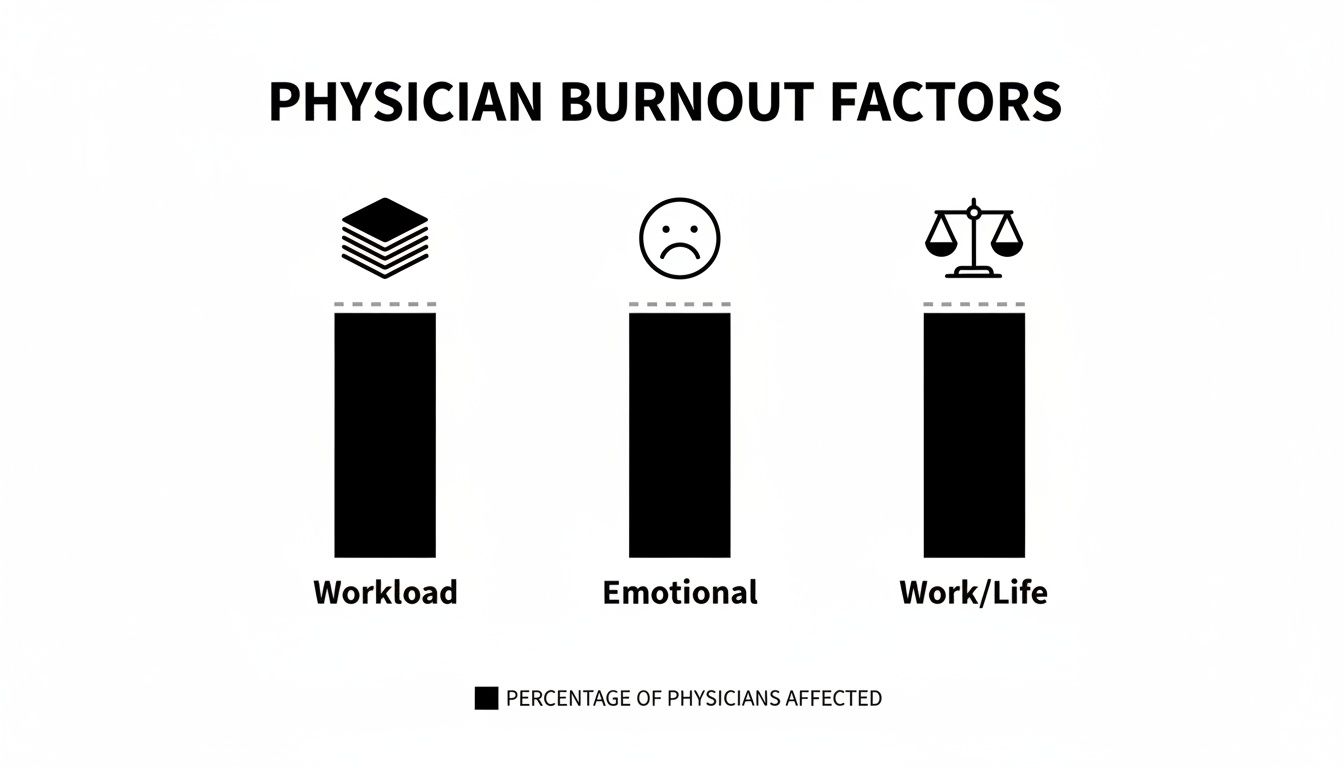
It’s clear: an overwhelming workload, emotional exhaustion, and a broken work-life balance are the three pillars of this crisis.
High-Risk Specialties: The Front Lines of Burnout
Some fields consistently top the burnout charts. These are the specialties defined by intense, high-stakes environments and crushing bureaucratic demands. Think unpredictable hours, life-or-death decisions, and relentless patient loads—a perfect storm for physical and emotional exhaustion.
Emergency medicine, not surprisingly, leads the pack. Medscape's Physician Burnout and Depression Report, which surveyed 9,226 doctors, found that a staggering 63% of EM physicians report burnout symptoms. While this is a slight dip from previous years, it’s still alarmingly high.
Other specialties right there in the high-risk zone include:
- Family Medicine: These doctors often face an impossible administrative burden, high patient volume, and the emotional weight of managing chronic illness across entire families.
- Internal Medicine (General): Much like family medicine, general internists are buried in documentation while coordinating complex care for patients with multiple comorbidities.
- Pediatrics (General): The emotional toll of caring for sick children, combined with heavy administrative tasks and often lower compensation, firmly places general pediatrics in this category.
Moderate-Risk Specialties: A Constant Balancing Act
Physicians in this middle tier still face significant stress, but it's often offset by other factors like a greater procedural focus, more predictable schedules (in some settings), or different kinds of patient interactions. Burnout is still a major problem here, but the drivers can be more nuanced.
Specialties like OB/GYN and General Surgery are good examples. Both involve high-stakes procedures and brutal on-call schedules, but the work itself can provide a different kind of professional satisfaction that sometimes buffers against the worst effects of burnout. The long hours and high-pressure moments, however, remain potent stressors.
The key difference for moderate-risk specialties is often the presence of a "release valve"—whether it's the satisfaction of a successful surgery, the joy of delivering a baby, or a practice model that allows for more autonomy.
Lower-Risk Specialties: Where Sustainability Is Possible
On the other end of the spectrum, you’ll find the specialties that consistently report the lowest physician burnout rates. These fields are typically known for more controllable lifestyles, fewer emergencies, and a much greater degree of control over their practice and schedule.
Fields that usually land in this lower-risk tier include:
- Dermatology: Often held up as the gold standard for work-life balance, dermatology typically involves outpatient clinics, predictable hours, and very few life-threatening emergencies.
- Ophthalmology: This specialty blends clinical and surgical work in a highly focused area, often with better hours and less administrative hassle than primary care.
- Plastic Surgery: While surgically demanding, many plastic surgeons have significant control over their schedules and patient selection, especially in elective and cosmetic practices.
Physician Burnout Rates Ranked by Specialty
The table below offers a clear, at-a-glance comparison of burnout rates across several key specialties, highlighting the main factors contributing to their risk level.
| Rank | Specialty | Burnout Rate (%) | Key Burnout Drivers |
|---|---|---|---|
| 1 | Emergency Medicine | 63% | High patient acuity, shift work, emotional trauma |
| 2 | Family Medicine | 55% | Administrative burden, high patient volume, emotional strain |
| 3 | Anesthesiology | 53% | High-stakes environment, lack of control over schedule |
| 4 | General Surgery | 51% | Long hours, on-call demands, high-pressure cases |
| 5 | Radiology | 49% | High workload, diagnostic pressure, isolation |
| 6 | Ophthalmology | 42% | High patient volume, surgical precision demands |
| 7 | Dermatology | 37% | High patient demand, administrative tasks |
| 8 | Plastic Surgery | 36% | High patient expectations, surgical complexity |
Understanding where your field stands is the first step in taking control. From there, you can start assessing your own work environment and identify the specific factors driving stress. For a more personalized look at workplace risk factors, you can also check out our WeekdayDoc Burnout Index.
Why Emergency Medicine Faces the Highest Burnout Risk
It’s no surprise that emergency medicine consistently ranks at the top for physician burnout. The specialty is a perfect storm of intense pressure, emotional drain, and systemic problems that chip away at even the most dedicated clinicians. It's a field defined by a grueling pace and the constant demand to make life-or-death decisions, often with very little information to go on.
This environment is more than just stressful—it’s a structural driver of burnout. Unlike a scheduled clinic, the emergency department (ED) is completely unpredictable. Physicians have almost zero control over patient volume, acuity, or workflow. This lack of autonomy is a known major contributor to the emotional fatigue and depersonalization that signal severe burnout.
The Daily Reality of High-Stakes Decisions
An ER doctor's shift is a mental marathon of context-switching. One minute you're intubating a trauma patient, the next you're suturing a simple cut, and then you’re breaking devastating news to a family. All the while, the waiting room keeps filling up. The cognitive load is immense and never lets up.
Think about a typical hour: you could be managing a suspected MI, a child in anaphylactic shock, and an elderly patient with sepsis—all at the same time. Every case requires immediate, razor-sharp focus under extreme time constraints. There’s no margin for error, yet the resources and information are often scarce, which just compounds the stress.
The central conflict in emergency medicine is the demand for perfection in a system that is inherently imperfect. Clinicians are held to an impossibly high standard while simultaneously battling hospital overcrowding, staffing shortages, and barriers to specialist consults.
This relentless pressure to be flawless in the middle of chaos takes a heavy toll. Over time, the adrenaline rush of saving a life gets buried under the crushing weight of responsibility and the constant fear of missing something critical in the noise.
The Emotional and Administrative Toll
Beyond the clinical work, the emotional labor in the ED is staggering. ER physicians are on the front lines of every societal crisis, from gun violence and the opioid epidemic to the fallout from a lack of primary care. They are witnesses to daily trauma and suffering, often with no time or institutional support to process any of it.
This emotional burden is made worse by a mountain of administrative tasks. Fighting with clunky EHRs, chasing down insurance pre-authorizations, and arranging difficult patient transfers add layers of frustration to an already overstretched role. These non-clinical duties steal time and energy from actual patient care, feeding a growing sense of cynicism and futility.
A day in the life often means:
- Constant Interruptions: Juggling multiple critical patients at once while being pulled in every direction by calls from consultants, nurses, and family members.
- Unpredictable Shift Work: The non-traditional hours wreck sleep patterns and make it incredibly difficult to maintain a personal life, isolating physicians from their support systems.
- High Patient Volume: Seeing dozens of patients per shift, each with urgent and complex needs, inevitably leads to profound decision fatigue.
This combination of factors makes it painfully clear why emergency medicine leads all specialties in burnout rates. For many, the traditional model of ER work is simply not sustainable in the long run, underscoring the critical need for alternative career paths that offer more control, predictability, and a healthier way to practice medicine.
Analyzing the Key Drivers of Burnout Variation
While the data shows a clear gap in burnout rates across specialties, the why is what really matters. These numbers aren’t random; they’re a direct reflection of the day-to-day realities baked into each field. Certain systemic pressures are like burnout accelerants, and they hit some specialties way harder than others.
At the heart of it are four major drivers: crushing bureaucratic tasks, a vanishing sense of autonomy, poor institutional support, and the sheer emotional toll of the job. These factors create a tangled web of stress that explains why an emergency physician’s burnout risk looks nothing like a dermatologist’s.
The Crushing Weight of Bureaucratic Tasks
Ask any physician what drains them, and you'll probably hear about the mountain of administrative work. It’s often called "pajama time"—those extra hours spent finishing charts at home after a full day in the clinic. Electronic Health Records (EHRs), meant to make our lives easier, have become a primary source of this pain.
For a primary care doctor, the onslaught is relentless. They’re documenting complex chronic illnesses, managing dozens of prescription refills, battling prior authorizations, and coordinating care with specialists. Each patient visit triggers a cascade of clicks and paperwork that can easily swallow up more time than the actual face-to-face interaction.
Now, think about a radiologist. They have administrative work, sure, but their world is different. Their focus is almost entirely on diagnostic interpretation. While they have to document their findings, they are largely shielded from the constant, patient-facing administrative churn that defines primary care.
The difference in burnout often comes down to the nature and volume of non-clinical work. When bureaucratic tasks overshadow direct patient care, professional satisfaction plummets, and the risk of emotional exhaustion soars.
This administrative drag isn't just an annoyance; it's a direct attack on a physician's sense of purpose and a key reason some specialties have it so much worse.
Autonomy and the Illusion of Control
Having control over your schedule, your workload, and your clinical decisions is a powerful shield against burnout. Unfortunately, that sense of autonomy is eroding fast in many areas of medicine. A lack of control breeds helplessness, making you feel like just another cog in the machine—a classic recipe for burnout.
The contrast between practice models tells the story:
- Hospital-Employed Physician: An internist working for a massive health system often has their schedule dictated by top-down productivity targets. They have little say over how many patients they see or how long each visit can be.
- Private Practice Physician: A dermatologist running their own practice, on the other hand, has significant control. They can set their own pace, choose the types of patients they see, and design their clinic's workflow.
This stark difference in autonomy helps explain the huge variance in physician burnout rates by specialty. Fields where physicians maintain more control over their work environment—like many subspecialties with strong private practice models—tend to report much lower levels of exhaustion and depersonalization. When you feel empowered to shape your professional life, you're far more resilient.
The Role of Institutional Support
A supportive workplace can make or break a physician's well-being, yet so many feel like they’re practicing in a vacuum. When support from hospital administration or practice management is lacking, every other stressor gets amplified. We're talking about everything from chronic understaffing and broken equipment to a culture that punishes you for taking time off.
Think of a general surgeon operating in a hospital with constant nursing shortages and outdated surgical tools. Their daily friction is exponentially higher than a colleague's in a well-funded, well-run institution. This isn't just frustrating; it creates a layer of moral injury when physicians feel they can't provide the standard of care their patients deserve. Meaningful support from leadership isn’t a perk—it’s a basic requirement for a sustainable career in medicine.
How to Find Roles That Combat Burnout

Knowing the burnout rates for your specialty is one thing. Actually finding a job that doesn't burn you out is another challenge entirely. It requires a fundamental shift in how you look for work—moving from just finding any job to proactively designing a sustainable career.
The goal isn't just about a new title or a bigger paycheck. It's about aligning the structural reality of a role with what you need to thrive personally and professionally. For most of us, that means finding positions that eliminate the common culprits of burnout, like chaotic schedules and zero personal time.
A targeted job search is your best tool for this. By using platforms built for clinicians who prioritize work-life balance, you can make it a non-negotiable from the very beginning.
Using Filters to Build Your Ideal Role
Think of job search filters as your first line of defense against another bad role. Instead of sifting through hundreds of listings that promise more of the same, you can cut straight to the opportunities that fit a healthier model of work. Specificity is your best friend here.
First, pinpoint your biggest stressors. Is it the pager going off at 3 AM? Is it the soul-crushing feeling of another weekend spent in the hospital? Let those pain points guide your search.
Look for filters that let you target:
- "No Call" or "No Nights" to finally get some uninterrupted sleep.
- "No Weekends" to reclaim that essential time for family, friends, and yourself.
- "Remote" or "Hybrid" if you need more flexibility and less time stuck in traffic.
- "Part-Time" if a lighter clinical load is what it will take to find your balance.
This strategy completely flips the script on the typical job hunt. You're not trying to contort your life to fit a demanding job; you're finding a job that fits the life you want to live.
A sustainable career is built by design, not by default. Proactively searching for roles with built-in work-life balance isn't a compromise; it's a strategic necessity for long-term professional fulfillment and personal health.
Real-World Scenarios for a Targeted Search
Let’s look at how this plays out for different clinicians. Everyone's path away from burnout looks a little different, depending on their specialty, career stage, and what they value most.
Scenario 1: The Orthopedic Surgeon Trading the OR for a Desk
An ortho surgeon is physically and emotionally exhausted from the brutal on-call demands and the OR grind. Instead of looking for yet another surgical gig, she starts searching for non-clinical roles where her expertise is still valuable. By filtering for "remote," "physician advisor," and "utilization review," she uncovers jobs with predictable Monday-to-Friday schedules and no after-hours emergencies.
Scenario 2: The Family Doc Looking for a Sane Schedule
A family medicine physician loves her patients but is drowning in pajama time with the EMR every night. She filters her job search for "outpatient only" and "no call" positions. This leads her to a direct primary care (DPC) practice with a smaller patient panel, allowing her to truly connect with patients without the administrative overload.
Many physicians are also finding that part-time physician jobs are the key to regaining control. This allows them to keep practicing medicine but on their own terms, making space for other passions and priorities.
Finding the right job is about more than just escaping a bad one. It's an intentional move toward a professional life that actually supports your well-being, so you can keep doing the work you love without sacrificing yourself in the process.
Answering Your Questions About Physician Burnout
Digging into the burnout data can bring up a lot of questions, whether you're a med student trying to choose a path or a veteran physician wondering if the grass is greener elsewhere. Let's tackle some of the most common ones.
The goal here is to give you clear, straightforward answers to help you understand the landscape and protect your own career longevity.
What Are the Earliest Warning Signs of Burnout?
The first whispers of burnout are easy to ignore. You chalk it up to a bad week or a tough rotation. But catching these signals early is the key to stopping a downward spiral before it really takes hold.
Keep an eye out for these three classic red flags in yourself and your colleagues:
- Emotional Exhaustion: This is more than just being tired. It’s a bone-deep weariness, the feeling that you have absolutely nothing left to give—not to your patients, not to your work, and certainly not to your family when you get home.
- Depersonalization (aka Cynicism): You start feeling detached, even callous, toward your patients. That empathy you once had gets replaced by a cynical shield. It's a defense mechanism, but a corrosive one.
- A Lost Sense of Accomplishment: You're working harder than ever, but it feels pointless. The feeling that you’re not making a real difference starts to creep in, eating away at your motivation and professional pride.
Spotting these signs isn’t a mark of weakness. It's an act of professional self-preservation. Remember, burnout is an occupational hazard, not a personal failure.
Does Burnout Affect MD and DO Physicians Differently?
While there isn't a mountain of research comparing MDs and DOs head-to-head on burnout, the data we do have points to a shared struggle. The big burnout drivers—crushing administrative loads, impossible hours, EHR headaches—don't care what letters are after your name. It’s far more about your specialty and your specific job environment.
That said, there's a nuance. DOs are disproportionately represented in primary care fields like family medicine, which consistently rank among the most burned-out specialties, with some studies showing rates approaching 60%. This means a huge chunk of the DO workforce is on the front lines, absorbing the worst of the system's pressures.
Ultimately, the degree type is far less predictive of burnout than the day-to-day realities of the job itself.
How Does Workplace Culture Impact Burnout?
Workplace culture is the elephant in the room. It’s a massive, often invisible force that can either buffer you from stress or pour gasoline on the fire. A toxic work environment will amplify every other pressure you face.
Here’s what really moves the needle:
- Leadership and Support: Does your administration have your back? Or do you feel like you’re shouting into the void about staffing shortages or broken equipment? Feeling unsupported and undervalued is a fast track to burnout.
- Your Peer Community: Having colleagues you can trust and vent with is a powerful antidote to stress. In contrast, a cutthroat, isolating culture leaves you feeling completely alone.
- Value Alignment: This one is huge. When your organization prioritizes profits over patient care, it creates a deep sense of moral injury. That clash between your values and your employer's actions is profoundly disillusioning.
Finding a job with a healthy, supportive culture is just as critical as finding one with a manageable schedule. It's the foundation of a career you can actually sustain for the long haul.
Ready to find a career that prioritizes your well-being? WeekdayDoc curates burnout-friendly roles with no nights, no weekends, and no call, so you can build a sustainable career without sacrificing your personal life. Explore your options at WeekdayDoc.