Remote Pharmacist Jobs: Roles, Pay, and Work-Life Fit
Explore remote pharmacist jobs by setting, with practical guidance on licensing, pay, work arrangements, schedules, and evaluating offers.

Pharmacists seeking alternatives to retail counters or traditional hospital shifts frequently look for remote positions to gain more control over their schedules. Escaping a high-volume dispensing environment often sounds like an automatic path to better work-life balance, but the day-to-day reality of a remote role depends entirely on the employer’s operational structure, the required clinical services, and the volume of patient interactions or administrative tasks.
Finding a sustainable position requires looking past the location. You have to evaluate the schedule expectations, patient contact methods, queue volumes, and licensing requirements before accepting an offer. WeekdayDoc helps clarify these details by attaching structured decision data, including schedule visibility and burnout risk, directly to job listings, allowing you to compare the operational realities of different roles.
What “Remote” Means for Pharmacists
Remote describes a work arrangement, not a specific pharmacy specialty. Job descriptions use the term to cover several different operational setups, and assuming a posting means you will work from a home office can lead to mismatched expectations.
A fully home-based arrangement allows you to work from a personal residence, subject to the employer’s location and security policies. Hybrid roles combine this home-based work with required on-site days for training, team meetings, or specific clinical duties. Conversely, a remote pharmacy service position may mean the work is performed away from the patient’s immediate location, requiring you to sit inside a licensed centralized pharmacy or designated corporate site rather than at home.
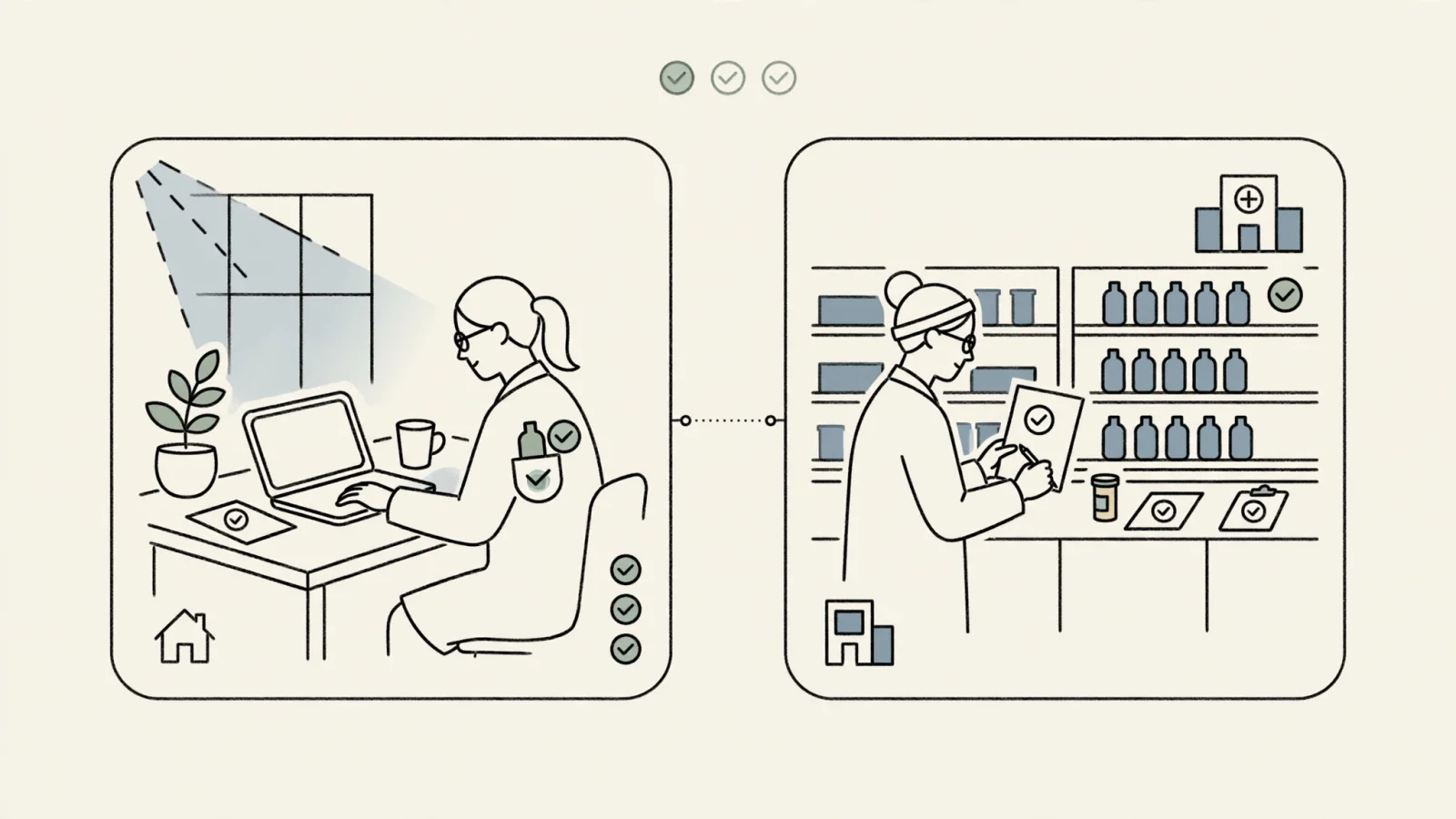
Telehealth and telepharmacy describe how patient care is delivered. The ASHP Telehealth Resource Center describes telehealth as an umbrella term encompassing the remote delivery of medication management and complex patient care. Working in telehealth dictates how you interact with patients, but the service modality alone doesn’t tell you whether you’ll log in from your living room or a hospital call center.
ASHP’s Clinical Workflow Integration guidance advises that remote medication management requires clear service eligibility, defined protocols for in-person escalation, dedicated time for chart review, and rigorous documentation workflows. A concrete example appears in an ASHP CareerPharm listing for a Pharmacist, Remote Pharmacy Services role. The posting explicitly states that work takes place inside the licensed pharmacy facility rather than at home, requiring a seven-on, seven-off overnight schedule. This listing represents one employer’s model, illustrating the need to verify location and shift details.
The WeekdayDoc platform lets you compare concrete location, schedule, and compensation details side by side. Evaluating these factors upfront prevents the assumption that off-site work automatically provides flexibility.
Which Pharmacist Roles Can Be Remote?
The following categories represent career lanes to investigate rather than a ranked list of available openings. The employer and the clinical service determine the actual work arrangement. Because pharmacy skills translate across patient care, administrative review, and systems management, your background may fit several of these paths.
Managed Care, PBM, and Health-Plan Pharmacy
AMCP describes managed care pharmacists working in settings such as health plans and PBMs, and notes that PBM activities can include benefit plan design, claims processing, drug utilization review, formulary management, prior authorization, and disease management.
In a prior authorization or appeals role, you review clinical documentation submitted by prescribers against established health plan criteria to approve or deny coverage. This work requires strong clinical judgment and the ability to process information efficiently. A useful first step is to ask about queue volume and turnaround targets, then clarify the balance between provider calls and independent chart review, along with your decision-making authority for complex cases or peer-to-peer reviews.
Medication Therapy Management (MTM) and Telehealth
MTM pharmacists focus on optimizing therapeutic outcomes for individual patients. The work involves comprehensive medication reviews, patient counseling, targeted medication interventions, education, and follow-up.
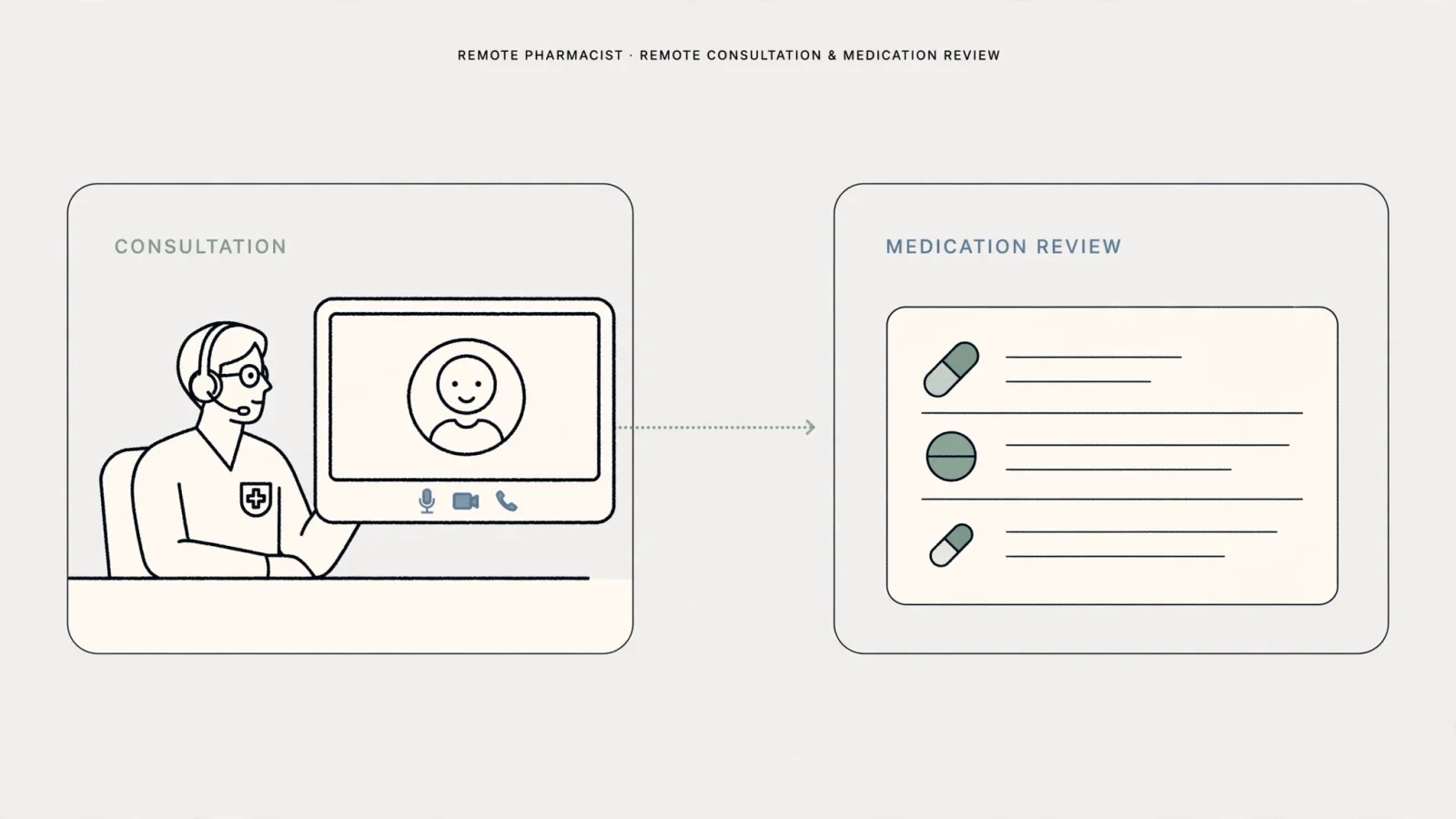
These positions are patient-facing and frequently involve continuous phone or video interactions. Ask employers how patient contact is scheduled, whether your day has fixed appointment blocks or an asynchronous queue of outbound call targets, and how much protected time is available for charting after each interaction. It also helps to understand the clinical escalation protocols for patients who present with acute medical issues during a remote consultation.
Specialty, Mail-Order, and Centralized Pharmacy
Specialty and mail-order pharmacies handle complex, high-cost medications for chronic conditions or manage high-volume maintenance drug dispensing. Pharmacists in these roles perform medication review and verification, provide patient support, coordinate with prescribers, and manage adherence programs.
For these roles, clarify whether the position is home-based, hybrid, or based at a centralized dispensing facility. Because mail-order and specialty pharmacies serve large geographic areas across multiple time zones, ask about expected shift hours and phone volume targets. It’s also helpful to know whether the role includes physical dispensing or focuses on clinical review and coordination.
Hospital Remote Verification and Telepharmacy
Many health systems use remote pharmacists to manage order entry, order verification, clinical consultation, and medication monitoring. This setup allows hospitals to maintain 24-hour pharmacy coverage without staffing every physical facility overnight, or to manage high order volumes during peak shifts.
Remote verification roles require deep familiarity with inpatient clinical workflows, dosing protocols, and electronic health record systems. Clarify whether the role allows you to work from your house or requires reporting to a centralized health-system office. Because hospitals operate continuously, these positions frequently involve evening, night, weekend, or rotating shifts. Assess how you will communicate with on-site nursing staff and physicians when an order requires clarification.
Informatics, Consulting, and Industry Roles
Pharmaceutical-industry roles are one non-dispensing career path for pharmacists. The U.S. Bureau of Labor Statistics notes that pharmaceutical-industry pharmacists work in areas such as marketing, sales, or research and development; their work includes designing or conducting clinical trials of new drugs, and they may help establish safety regulations and ensure quality control for drugs.
Informatics pharmacists design, implement, and maintain the electronic systems that govern medication ordering and dispensing. Although much of this work involves software and systems configuration, many organizations still require informatics pharmacists to be on-site to support system go-lives, train clinical staff, or collaborate with hospital IT departments. Confirm the location rules and the specific credential requirements for specialized industry positions.
Check Licensing and State Eligibility
Every state requires practicing pharmacists to hold an active license. A single home-state license does not automatically cover every cross-border patient-care, counseling, or telepharmacy arrangement. When you provide clinical services across state lines, you typically fall under the jurisdiction of both the state where you sit and the state where the patient is located.
Telehealth rules vary by jurisdiction. Some states maintain specific waivers or virtual practice rules, while others enforce physical licensure for any pharmacist providing care to their residents. The NABP Electronic Licensure Transfer Program helps already licensed pharmacists apply for licenses in additional jurisdictions to streamline the application process, though the relevant state licensing authority makes the final decision.
During interviews, clarify which states require licensure before you start, which states the employer allows staff to work from, and whether the role serves patients across state lines. It also helps to know whether the employer pays for or provides administrative support for additional state licenses, and whether it enforces in-state residency requirements for fully home-based positions.
What Do Remote Pharmacist Jobs Pay?
Evaluating compensation requires comparing accurate market data rather than relying on assumptions about work-from-home premiums or discounts. The Bureau of Labor Statistics reports a $140,910 national median annual wage for pharmacists as of May 2025. Across major industries, these figures range from $132,940 in pharmacies and drug retailers to $157,290 in hospitals. These numbers reflect all-setting occupational wages, not off-site pay alone.
To provide specific market context, a snapshot from the WeekdayDoc platform on October 18, 2026, showed a median advertised pay of $166,000 and a 75th percentile of $189,000 among 181 remote pharmacist listings that disclosed a salary. These figures represent posted ranges for available roles on that date, not accepted offers or a validated national estimate.
When you evaluate a specific offer, look beyond the base salary. Compare guaranteed hours and determine if the role pays an hourly rate or a fixed salary. Hourly roles might offer overtime for high-volume queues, while salaried positions could expect unpaid extended hours to clear a backlog. Factor in shift differentials for nights or weekends, performance bonuses, health benefits, and paid time off. Account for contract status, noting whether you are a W-2 employee or a 1099 independent contractor. Identify whether the employer covers the costs of required multiple-state licenses, home office equipment, and secure internet connections.
Reviewing remote pharmacist careers on WeekdayDoc provides salary comparisons and market percentiles, helping you contextualize an offer against similar positions nationwide.
Evaluate Schedule and Work-Life Fit
Working from home changes your commute, but it does not guarantee a flexible schedule or protect you from clinical burnout. An off-site position can still involve rigid shift requirements, constant phone coverage, overwhelming queues, and substantial administrative documentation.

Understanding the daily workflow prevents you from trading retail exhaustion for a different kind of fatigue. A sustainable workload relies on clear expectations around chart review, follow-up, and escalation responsibilities. A role demanding 40 patient consultations a day leaves minimal protected time for clinical documentation, which forces pharmacists to complete charts off the clock.
A listing posted by The Cigna Group on October 7, 2026, for a Staff Pharmacist, Overnights/Weekends, illustrates how demanding these schedules can be. The posting outlined possible evening, overnight, weekend, and holiday hours, alongside requirements for multiple state licenses. While one listing does not prove a universal industry standard, it demonstrates that telepharmacy frequently involves intense scheduling demands.
These questions can help uncover the true nature of the job:
- What is the true worksite, and which specific states are employees eligible to work from?
- What are the exact hours and expected time zone?
- Are there required nights, weekends, holiday rotations, or on-call coverage expectations?
- What is the exact mix of patient-facing contact, inbound/outbound phone work, queue management, and documentation?
- How does the company measure productivity, clinical quality, and review turnaround times?
- How much clinical autonomy does the pharmacist have, and what is the exact escalation path for appeals or complex cases?
- Does the role require on-site travel for training or onboarding?
WeekdayDoc addresses these questions by assigning a 0-to-10 work-life score to each listing. This score functions as a comparison measure, evaluating factors such as call coverage, nights, weekends, schedule flexibility, clinical autonomy, and administrative burden. By placing this schedule data next to compensation metrics, the platform helps you assess the real trade-offs of a position before you apply.
Find and Prepare for a Suitable Opening
Mapping out the different career lanes helps you conduct a targeted search. Instead of relying solely on broad queries like remote pharmacist jobs remote, use specific phrases that align with your clinical background. Searching for remote clinical pharmacist jobs, remote prior authorization pharmacist jobs, managed care pharmacist jobs remote, remote MTM pharmacist jobs, telepharmacy pharmacist jobs, or remote specialty pharmacy pharmacist jobs will return more relevant results. Searching for open roles by state can also help filter out listings that restrict applicant locations.
When you transition from a retail or hospital practice into a telepharmacy setting, tailor your application by matching your relevant experience to the specific needs of the role. If you are applying for an MTM position, highlight your background in patient counseling, comprehensive medication reviews, and clinical documentation. If you are targeting a managed care role, emphasize your familiarity with formulary compliance, prior authorization, or health-system protocols.
Expect transparent employers to state whether the work is home- or site-based in their job descriptions. They should disclose state eligibility rules, required licenses, exact hours and rotations, call or weekend coverage, and clear compensation ranges. If a posting lacks these details, use your interview to extract them.
WeekdayDoc helps clinicians find sustainable roles by making schedule expectations, burnout risk, and compensation transparent. Search open listings on WeekdayDoc to compare work-life scores and market pay percentiles across different employers. When you find a strong match, use our AI-matched alerts, negotiation scripts, and contract scanner to evaluate the offer and secure a fair agreement. Visit WeekdayDoc to start your search.