Average Med Student Debt: A 2026 Repayment Guide
See the 2026 average med student debt and learn how to manage it. Explore repayment models, FIRE timelines, and burnout-friendly jobs to accelerate freedom.
The average medical school debt for indebted graduates in 2025 was $216,659, and when undergraduate loans are included, the total rises to about $246,659. That effectively serves as the starting line for many physicians, not the finish line after Match Day.
Six figures gets the headlines, but the number that changes your life is the monthly payment. A resident can survive a large balance if the cash flow is manageable. A new attending can still feel trapped with a strong salary if the job is structured around call, weekends, and burnout because every dollar is already spoken for.
That's why average med student debt matters less as a trivia fact and more as a design problem. You need a repayment plan, yes. But you also need a career plan that protects income, sanity, and optionality at the same time.
Your Guide to Medical Student Debt in 2026
Most young physicians don't need more alarm. They already have it. What they need is a clean way to think about debt without letting it dominate every career decision.
The first useful shift is this. Stop treating debt as a moral failure or a reason to panic. Treat it as a fixed financial reality that has to be managed with the right combination of repayment structure, earnings strategy, and schedule design.
A lot of doctors make the mistake of focusing only on the balance. They obsess over the total, then jump at the highest-paying role they can find, even if it comes with chronic call, unstable hours, or a pace they can't sustain. That often creates a worse problem. They can service the loan, but they can't tolerate the life.
Why cash flow matters more than headline debt
A physician's early career has two very different phases. Residency is a cash-flow problem. Attending life is a planning problem. Those are not the same thing, and they shouldn't be managed the same way.
During training, the goal is usually to keep payments affordable, preserve federal protections when they matter, and avoid making a desperate career choice just because the balance looks frightening. After training, the question becomes whether to accelerate repayment, pursue forgiveness, refinance, or use a hybrid plan that still leaves room for investing and personal time.
Practical rule: Don't choose a repayment plan in isolation. Choose it alongside the kind of job and schedule you actually want to keep for years.
The average med student debt number is useful because it gives you a benchmark. But a benchmark alone doesn't tell you whether you can take a weekday-only position, whether you need a nonprofit employer for forgiveness, or whether a no-call role is financially viable. Those answers come from matching your debt strategy to your work strategy.
The 2026 Average Med Student Debt Landscape
The average med student debt discussion gets muddy because people often mix together different kinds of borrowing. That's where confusion starts.
According to EducationData's medical school debt analysis, the average medical school debt balance among new indebted graduates in 2025 was $216,659, and when undergraduate debt is included, the total rises to about $246,659. The same analysis also reports that among students who had medical school debt, the Class of 2024 owed an average of $212,341.
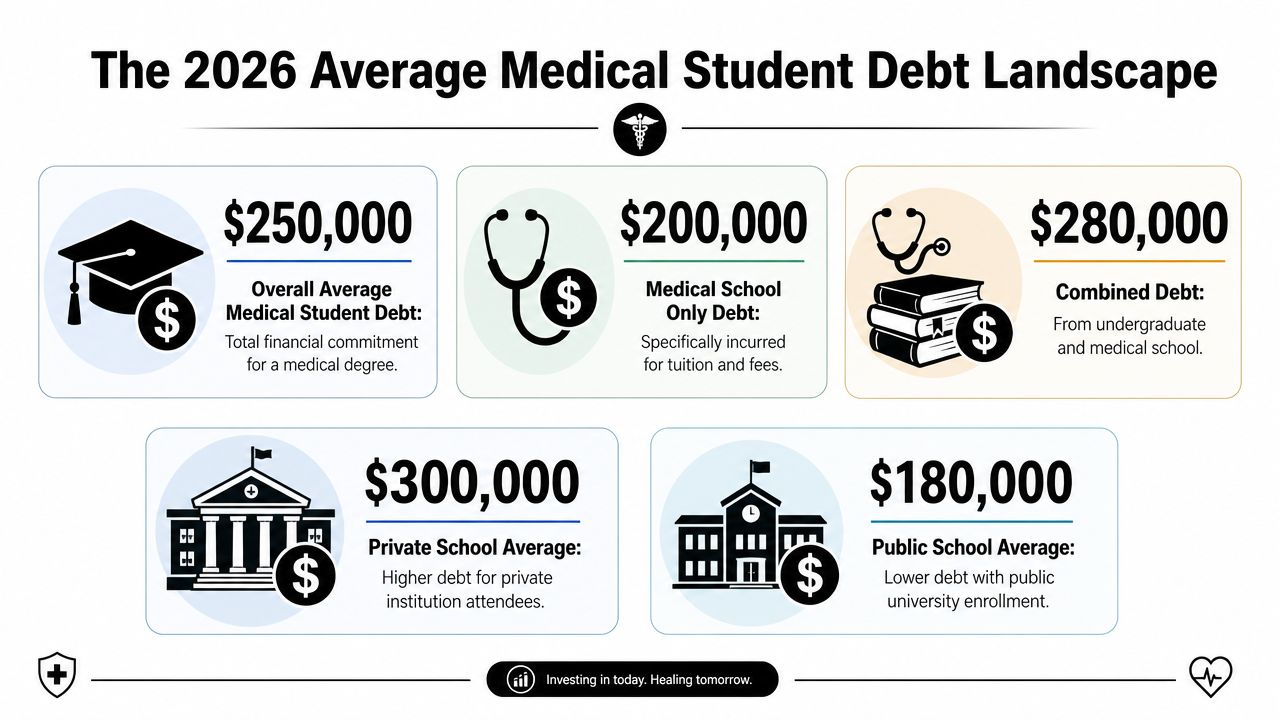
That distinction matters. “Medical school debt” is not always your total education debt. If you borrowed before med school, your repayment burden begins higher than the headline figure most articles quote.
What the average really represents
An average is a reference point, not a promise. Some graduates come out below it. Many come out above it. But even as a benchmark, it tells you something important. A large share of physicians begins practice with a balance close to a quarter of a million dollars before interest and repayment costs fully play out.
That changes behavior. It can affect specialty decisions, moonlighting pressure, geographic flexibility, and how much schedule control you feel you can “afford.”
Why 2026 feels different from prior generations
Debt hasn't just been high. It has been rising for a long time. The American Medical Student Association's overview of medical student debt notes that average medical school debt increased by 48.5% between 1998 and 2019. It also cites figures showing $87,020 for the class of 1999–2000 compared with roughly $264,519 in total education debt for the class of 2024 when premedical and medical-school borrowing are combined. The same overview reports that educational debt affected over 86% of graduates in an older AAMC estimate, with median debt exceeding $119,000 at public institutions and nearly $150,000 at private ones.
The emotional trap is comparing your debt to what an older attending remembers paying. The better comparison is to the current repayment environment you actually live in.
This is why passive advice doesn't work. Telling a resident to “just live frugally” ignores the scale of the starting balance. Frugality helps. Structure helps more.
How Debt Varies by School and Degree
The national average is useful, but it hides a lot. School type changes the repayment path before you even sign your first attending contract.
AAMC data cited in SoFi's review of average medical school debt show average medical school debt of $227,839 at private schools versus $203,606 at public schools. The same review notes that the Education Data Initiative estimates 31% of indebted medical graduates also carry premedical debt.

That spread doesn't just change your total balance. It changes your margin for error.
Public versus private isn't just a tuition question
A physician who starts lower has more flexibility. That can mean more freedom to choose a nonprofit role, a lower-intensity specialty path, a geographically desirable market, or a job with fewer schedule penalties.
A physician who starts higher often needs a tighter plan. Not always, but often. That could mean leaning harder on forgiveness, staying in federal repayment longer, delaying lifestyle expansion after training, or avoiding jobs that pay less but offer better quality of life.
Here's the practical way to look at it:
| Starting situation | Likely pressure point | Common response |
|---|---|---|
| Lower balance, less layered borrowing | Faster decision-making after training | Pay down aggressively or invest alongside repayment |
| Higher balance from private school | Monthly payment sensitivity | Keep flexibility and protect cash flow |
| Medical school debt plus premedical debt | Total balance fatigue | Use a plan that accounts for training income and job stability |
Degree path and debt composition both matter
Two physicians can both say, “I have average med student debt,” and mean very different things. One may have only medical school loans. Another may have undergraduate borrowing layered underneath, with different rates, servicers, and emotional baggage attached to each account.
That layered borrowing is where many new attendings get blindsided. They model repayment around one large federal balance, then realize there's additional debt competing for the same monthly cash flow. Suddenly the “good salary” doesn't feel good.
Decision lens: Where you trained matters less after graduation than how your debt structure affects the jobs you can reasonably keep.
The key lesson isn't that one school choice was right and another was wrong. It's that every extra dollar of starting debt narrows your first few years unless you actively build flexibility back in.
Modeling Your Repayment and FIRE Timelines
Most doctors don't need another article telling them their debt is “high.” They need to know what the payment feels like on the first of the month.
That's why this part matters more than the average balance itself. According to AAMC's financial aid guidance for medical students, most coverage says the average medical graduate owes about $200,000 to $215,000, but it often skips the practical question of what monthly payment is realistic during residency versus after training. The same guidance notes that on a standard 10-year plan, $200,000 at about 7% interest is roughly $2,322 per month, while income-driven repayment during residency can start around $300 to $500.
What those numbers mean in real life
A $2,322 monthly payment is not just a line item. It can determine where you live, whether you feel forced to moonlight, whether you delay family plans, and whether a lower-intensity job is even thinkable.
By contrast, a payment in the $300 to $500 range during residency can preserve breathing room. It may not feel satisfying because the total balance can still grow or stay stubbornly high, but it can keep the rest of your life functioning while your income is limited.
Here's a simple comparison:
| Repayment approach | Career stage | Typical monthly effect based on verified data | Main trade-off |
|---|---|---|---|
| Standard 10-year repayment | New attending or anyone paying aggressively | About $2,322 per month on $200,000 at about 7% | Faster payoff pressure, less room for schedule flexibility |
| Income-driven repayment | Residency | Can start around $300 to $500 | Lower short-term pressure, slower balance reduction |
| Hybrid approach | Transition from residency to attending | No fixed universal number | Balances flexibility with faster cleanup later |
How this affects FIRE planning
The debt plan and the FIRE plan are connected. If you send every spare dollar to loans immediately after training, you may become debt-free sooner, but you may also crowd out retirement investing, emergency reserves, and the ability to choose a sustainable job.
If you keep payments lower for too long without a reason, the opposite problem appears. You preserve short-term comfort but stretch the psychological burden and total cost of debt across more of your career.
The answer usually isn't ideological. It's operational. Use the repayment method that fits your current phase.
- During residency: Keep cash flow survivable. A payment that technically fits but leaves you one bad month away from panic is too high.
- At your first attending job: Re-run the numbers before inflating your lifestyle. The first attending paycheck makes a lot of bad debt decisions look affordable.
- If your goal is early financial independence: Model debt payoff and investing together, not as separate projects.
- If you're evaluating flexible roles: Compare the job against your actual payment structure, not against a vague fear of “having too much debt.”
For a more detailed planning framework, review this medical student loan guide for clinicians, then run your own repayment scenarios before accepting a job.
A loan strategy should buy time, not steal your future. If your payment plan forces you into a job you can't sustain, the math isn't as good as it looks.
How Debt Shapes Career Choices and Burnout
Debt subtly changes behavior. A resident starts saying yes to every extra shift. A fellow narrows career options to whatever pays fastest. A new attending takes a job with a schedule they already know they won't tolerate because the salary feels like the safest answer.

That's how debt becomes more than a balance sheet issue. It becomes a burnout multiplier.
The high-pay trap
A demanding job can look rational on paper. More income. Faster repayment. Bigger annual progress. But if the role relies on chronic call, weekends, staffing chaos, or a pace that drains you, the hidden cost is durability.
I've seen physicians make a common mistake here. They assume the “financially responsible” move is always the most intense role they can tolerate. Often it's the role they can tolerate for one or two years, not the one they can practice in for a decade without resentment or collapse.
A sustainable physician keeps earning. A burned-out physician starts cutting hours, changing settings under pressure, or leaving income on the table because they waited too long to protect their bandwidth.
Why well-being belongs in the debt plan
Health systems and groups that care about retention increasingly pay attention to clinician support, workload, and managing employee mental well-being. That matters because your financial plan only works if your work environment remains livable.
The safest financial plan is not always the one with the biggest payment. It's often the one that keeps you clinically functional and psychologically intact.
A burnout-friendly role can still be financially smart even if the salary isn't the absolute top of market. Fewer recovery costs. Less impulse spending to compensate for misery. Lower odds of abrupt career change. Better odds that you'll stick with the plan.
This short discussion captures the idea well:
Strategic job choice is the strongest lever
Budgeting matters. Refinancing matters. Forgiveness planning matters. But job design remains the most powerful lever because it touches income and lifestyle at the same time.
A role with predictable weekdays, no call, and fewer recovery days can make debt easier to carry even if the gross salary isn't the highest option available. You're more likely to keep the job. You're more likely to maintain side goals like investing, family time, sleep, and exercise. And you're less likely to make panicked financial decisions because you hate your schedule.
That's the part many debt conversations miss. You don't repay loans with spreadsheets alone. You repay them with a career you can stay in.
Concrete Strategies to Reduce Your Debt Burden
Good debt strategy is rarely dramatic. It's usually a series of boring decisions made early and made well.
The first step is matching the tool to the loan type and the job path. If you may use forgiveness, keep that front and center. If you know you won't, then efficiency matters more. If your cash flow is the current problem, solve that first before chasing an ideal long-term payoff story.
The practical playbook
Use forgiveness deliberately: If you're on a path where federal protections matter, study the rules before refinancing away those options. This overview of physician loan forgiveness pathways is a useful starting point for comparing service-based and public-sector routes.
Refinance only when the trade-off is clear: Refinancing can make sense for physicians with stable income, strong credit, and no reason to preserve federal benefits. It usually works best when you're simplifying a plan you already understand, not when you're acting out of frustration.
Live like a resident after residency: This still works. Not forever, and not performatively. But delaying lifestyle inflation for a defined period gives you an advantage. It can help you clean up high-interest obligations, build reserves, and avoid locking yourself into a paycheck-dependent life.
Negotiate the whole job, not just salary: Debt gets easier when compensation aligns with schedule quality. Signing bonus, loan support, PTO structure, remote days, call burden, and protected time all affect what your paycheck actually does for your life.
Tools help when they change decisions
A calculator is useful if it changes behavior. It's not useful if it just confirms that debt is large.
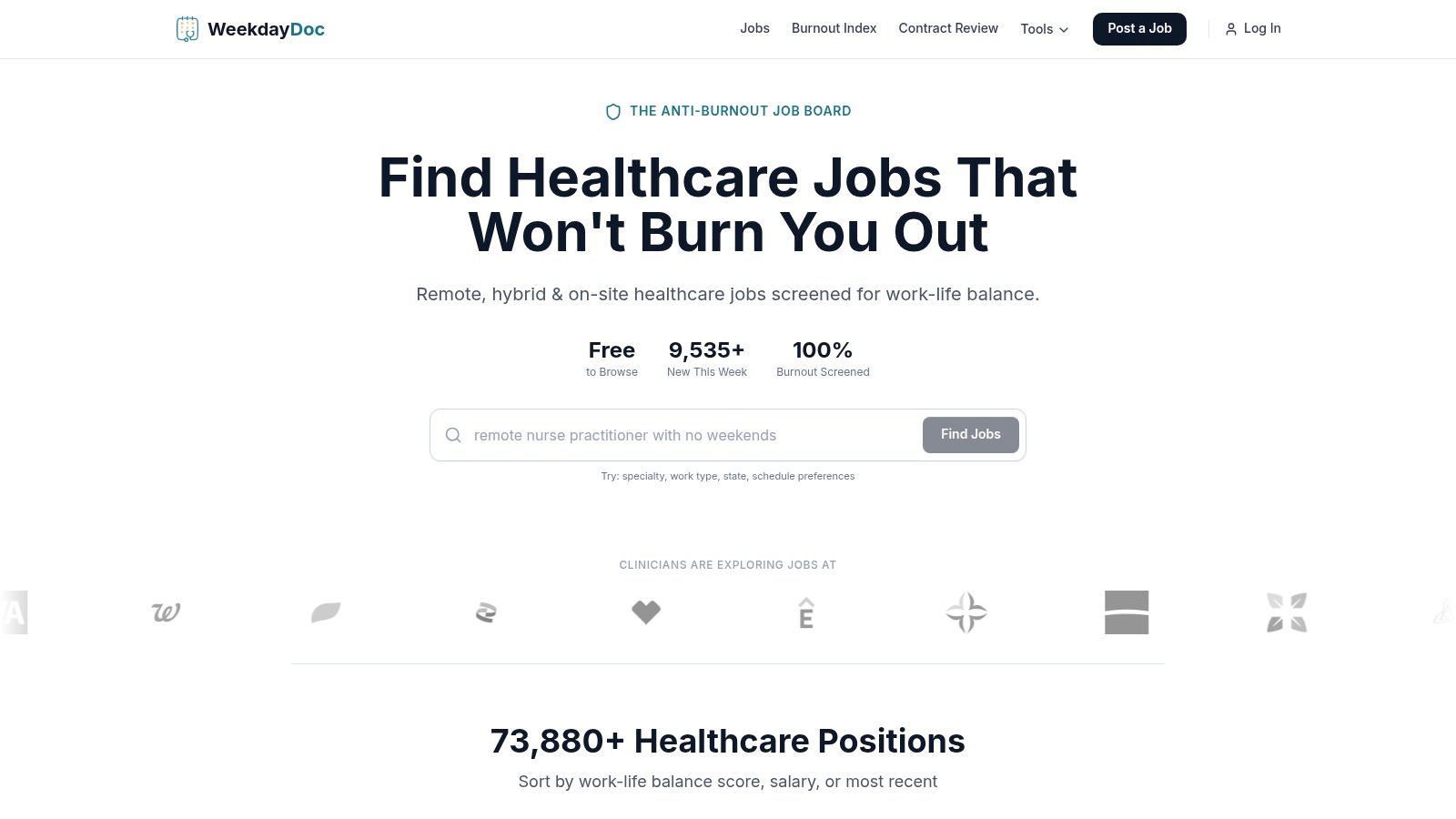
One practical option is WeekdayDoc, which lets clinicians compare burnout-friendly roles with salary data, no-call and no-weekend markers, and FIRE projections by state. That matters because the same debt burden feels very different depending on your schedule and cost of living.
If you want another plain-English checklist, LifeBack Law Firm's debt repayment tips cover several common payoff habits in a way many borrowers find approachable.
What usually works and what usually doesn't
Here's the short version:
| Usually works | Usually backfires |
|---|---|
| Preserving cash flow during low-income years | Forcing aggressive payments too early |
| Re-evaluating repayment after each income jump | Setting one plan and ignoring it for years |
| Negotiating job structure along with pay | Taking a punishing job because the number looks bigger |
| Temporary lifestyle restraint with a clear end point | Permanent deprivation that leads to rebound spending |
The best repayment strategy is the one you can execute consistently while still liking your life.
Conclusion Building a Sustainable Career Beyond Debt
Average med student debt matters because it tells you the starting pressure many physicians carry. It does not tell you how trapped you have to feel.
Effective approach comes from understanding cash flow, choosing the right repayment structure for your stage of training, and protecting the kind of work life that lets you stay in the profession without constant depletion. Debt is a long problem. It needs a durable solution.
That's why the smartest financial moves often look less dramatic than people expect. Keep residency payments manageable when income is tight. Reassess the plan when attending income arrives. Don't confuse a high-salary, high-burnout job with a superior long-term strategy. And don't build a repayment plan that depends on suffering.
For clinicians who want a broader framework, this guide to financial planning for medical professionals is a sensible next read.
A good debt plan should expand your options over time. It should make room for better work, better boundaries, and a career you can still recognize as your own.
If you want roles that support repayment without wrecking your schedule, explore WeekdayDoc. It's a physician-founded platform for clinicians looking for burnout-friendly jobs with clear salary data, weekday-focused options, and tools that help you connect career decisions to long-term financial freedom.