Telehealth nurse practitioner jobs: Find High-Paying Opportunities
Discover telehealth nurse practitioner jobs with flexible options, competitive pay, and expert tips to tailor your resume and ace virtual interviews.

Telehealth nurse practitioner jobs are quickly moving from a niche side gig to a mainstream career path, and for good reason. With an average annual salary now hitting $165,094 per year, it's clear this isn't just a temporary trend. It's a fundamental shift in how healthcare is delivered, driven by patient demand for convenience and a growing need for accessible care.
For many NPs, it's a chance to build a career that's both financially rewarding and personally sustainable.
The Growing Demand for Remote Nurse Practitioners
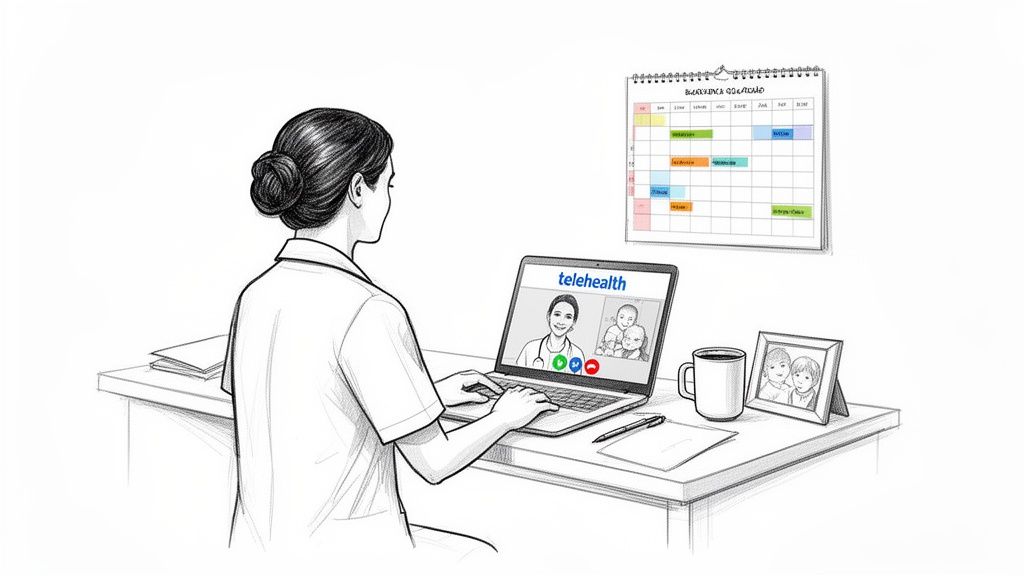
The appeal of remote work for nurse practitioners has exploded. What was once a rare opportunity is now a core part of the healthcare system. This isn't just a lingering effect of the pandemic; patients now expect the same on-demand convenience from their healthcare as they get from every other service.
Telehealth has become the perfect answer for meeting the rising demand for specialized care, especially in mental health and chronic disease management. It allows NPs to reach patients in underserved communities, finally breaking down the geographic barriers that have long limited access to quality care.
A More Sustainable Career Path
Let's be honest: burnout in traditional clinical settings is real. The relentless pressure of long hours, rigid schedules, and a mountain of administrative tasks has pushed countless NPs to look for an off-ramp. Telehealth provides one.
By cutting out the daily commute and giving you control over your work environment, these roles tackle the root causes of professional stress. Many telehealth jobs are intentionally designed to protect your personal time, often with features like:
- Strictly defined weekday hours—no weekends.
- A complete end to on-call duties or overnight shifts.
- More predictable, manageable patient loads.
This structure creates a clean break between your work and your life, which is absolutely critical for long-term career satisfaction. You can find a wide range of remote healthcare jobs built around this very principle.
The real win with telehealth isn't just working from home. It's about reclaiming your schedule and getting back to focusing on patient care, free from the operational chaos of a busy clinic.
The Financial and Professional Upside
Moving to telehealth doesn't mean taking a pay cut. In fact, it's often the opposite. The market for telehealth NPs is booming, and the compensation reflects that demand. The average annual salary has climbed to an impressive $165,094, a significant jump that shows just how valuable these roles have become.
This proves you can build a more balanced career without sacrificing your financial goals. For many, it's a significant financial step up.
Telehealth vs. Traditional NP Roles: A Quick Comparison
To put it all in perspective, here's a quick look at how the lifestyle and professional demands of a telehealth role stack up against a traditional in-person position.
| Factor | Telehealth NP Role | Traditional In-Person NP Role |
|---|---|---|
| Schedule | Highly predictable, often M-F, 9-5 | Variable, often includes evenings, weekends, holidays |
| On-Call Duties | Typically none | Frequently required, impacting personal time |
| Work Environment | Controlled, quiet home office | High-traffic, often chaotic clinical setting |
| Autonomy | High degree of schedule and workflow control | Limited; subject to clinic's operational demands |
| Commute | Eliminated | Daily requirement, adds time and stress |
| Administrative Burden | Often streamlined with integrated tech | Can be significant, with manual charting and paperwork |
While both paths are vital to patient care, the differences in day-to-day reality are stark. The choice often comes down to what you value most for your long-term well-being and career satisfaction.
Where to Find the Best Remote NP Opportunities
Let's be honest: scrolling through giant, generic job boards is a terrible way to find a great telehealth job. Sites like Indeed or ZipRecruiter are a firehose of listings, mixing truly flexible NP roles with "remote" jobs that still demand nights, weekends, or on-call coverage.
To find a genuinely burnout-friendly role, you have to get strategic. It means skipping the noise and going directly to the platforms and networks where the best, most sustainable jobs are hiding.
Think of it less like a blind search and more like targeted intelligence gathering. You need to know where the clinicians who value work-life balance are looking.
Ditch the Megasites for Specialized Platforms
The fastest way to improve your search is to use job boards built specifically for clinicians. These niche platforms understand the difference between just "working from home" and having a truly sustainable career. They do the heavy lifting for you.
Instead of wading through hundreds of irrelevant listings, you can start with a curated pool of opportunities. The key is finding sites where filters like "No Call" and "No Weekends" are front and center, not buried in the fine print.
Here’s a quick look at the WeekdayDoc platform, which is built around this very idea.
See how the filters are designed for a clinician's real-world needs? That level of focus is something you'll never get from a general-purpose job aggregator. It's a total game-changer.
Your Network Is Your Secret Weapon
Some of the absolute best telehealth opportunities, especially with innovative startups, never even make it to a public job board. They're filled through referrals and word-of-mouth. This is where your professional network becomes your most powerful asset.
You have to be visible where recruiters and telehealth leaders are active. That means treating your online presence like a core part of your career strategy.
- Make LinkedIn work for you. Think of it as your living, breathing resume. Optimize your profile with telehealth-specific skills and keywords. Join groups focused on telemedicine and your NP specialty to plug into the conversation.
- Don't just lurk—engage. Follow telehealth companies and influential people in the space. A thoughtful comment on a post or sharing a relevant article does more than you think. It signals to recruiters that you're an engaged, knowledgeable professional who's serious about virtual care.
A sharp, active professional profile is a magnet for opportunities. If you want to see what kinds of roles are out there to better tailor your profile, check out this breakdown of different telehealth jobs.
Leverage Your Specialty Organizations
Don't forget about the resources right under your nose. Your professional specialty organization—whether it's for PMHNPs, PNPs, or FNPs—is a direct line to employers looking for your exact skillset.
Employers love posting on niche specialty boards because they get a pre-screened, highly relevant pool of candidates. These job listings are often far less competitive than what you’ll find on the massive sites.
Make it a habit to check their websites and, more importantly, sign up for their job alert emails. These organizations exist to support your career, making them an incredibly efficient place to find high-quality roles.
Set Up Smarter Job Alerts
Once you've zeroed in on the right platforms, it's time to put your search on autopilot. But I'm not talking about a generic "telehealth NP" alert that will flood your inbox. Get specific.
Use precise keyword combinations to filter out the noise before it ever reaches you. Try setting up alerts for things like:
- "Remote PMHNP no call"
- "Work from home FNP weekday"
- "Telemedicine nurse practitioner flexible schedule"
This simple tweak turns your job search from a reactive, time-consuming chore into an efficient, proactive system. You'll be one of the first to see the roles that actually fit your criteria, giving you a huge head start.
Crafting Your Telehealth-Ready Resume and Profile
A generic nurse practitioner resume just won’t get you noticed for the best telehealth jobs. Recruiters are drowning in applications and spend only a few seconds on each one. Your goal is to make it instantly clear that you're not just a great NP, but a remote-ready NP.
This requires a mental shift. Stop just listing your clinical duties and start reframing every single experience through the lens of virtual care. Your resume and online profiles need to scream "telehealth" from the very first line.
Highlighting Your Digital Proficiency
The first thing a telehealth recruiter looks for is proof you can handle the tech. They need to see that you can hit the ground running without a ton of hand-holding on day one. Your resume has to show off your comfort with the tools of the trade.
Don't just write "proficient with EMRs." That’s too vague. Get specific by creating a dedicated "Technical Skills" or "Digital Health Proficiencies" section. This is where you list the exact systems you've mastered.
- EMR Systems: List them by name. Think Epic, Cerner, AthenaHealth, or DrChrono.
- Telehealth Platforms: Have you used Doxy.me, Teladoc, Amwell, or Zoom for Healthcare? Put them on the list.
- Communication Tools: Include any experience with secure messaging apps like Spruce or OhMD, and team collaboration software like Slack or Microsoft Teams.
This isn't just a boring list; it's tangible proof. It tells a hiring manager you can slide right into their existing digital workflow, which is a massive plus for any remote team.
Translating Clinical Skills for Virtual Care
Your clinical expertise is obviously critical, but you have to translate it into the language of telehealth. How does your experience in a chaotic clinic or hospital floor prove you can provide amazing care through a screen? You have to connect those dots for the recruiter.
Think about the key skills for remote practice—autonomy, crystal-clear communication, and quick decision-making—and back them up with hard examples.
For instance, instead of this:
- "Managed a panel of patients with chronic conditions."
Reframe it to highlight your remote-friendly abilities:
- "Independently managed a panel of 200+ patients with complex chronic conditions, utilizing asynchronous secure messaging and virtual visits to ensure continuity of care and improve medication adherence by 15%."
See the difference? This version shows off your autonomy ("independently managed"), your tech skills ("asynchronous secure messaging"), and your focus on results ("improve medication adherence").
Your resume has to answer the question every recruiter is thinking: "Can this NP build rapport and make solid clinical judgments without being in the same room as the patient?" Every single bullet point should be a loud and clear "yes."
Optimizing Your LinkedIn Profile as a Recruitment Magnet
Your LinkedIn profile is way more than just an online resume—it's your personal marketing machine. Recruiters are on there every single day hunting for qualified candidates, and a sharp, optimized profile can bring the best opportunities right to your inbox.
Your headline is prime real estate. Don't waste it with just your title. Pack it with the keywords recruiters are actively searching for.
- Standard Headline: "Family Nurse Practitioner at ABC Clinic"
- Optimized Headline: "Family Nurse Practitioner (FNP-C) | Telehealth & Virtual Care Specialist | Proficient in Epic & Teladoc | Seeking Remote Opportunities"
That optimized version instantly signals your specialty, your focus on telehealth, and your technical skills. It makes you way more visible in searches.
Your "About" section is your chance to tell your story. Write a short, engaging narrative about your passion for virtual care, your experience with remote patient management, and your excellent "webside manner."
Finally, start asking for recommendations from colleagues or supervisors who can speak to your remote work skills. A recommendation that specifically mentions your clear virtual communication or efficient digital charting is pure gold. To give your application the best possible shot, you need to learn how to unlock resume success with AI tools for ATS perfection, making sure you can get past those automated screening systems.
Navigating Multi-State Licensure and Credentialing
Let's talk about one of the biggest logistical headaches in telehealth: licensure. In a brick-and-mortar clinic, you need one state license. Easy. But in telehealth, the game changes completely—you need to be licensed wherever your patients are. It sounds daunting, I know, but it’s absolutely manageable with the right strategy.
It really boils down to two paths: leveraging the Nurse Licensure Compact (NLC) or going for individual state-by-state licenses. Which one you take depends on your home state and where the job requires you to practice.
The Power of the Nurse Licensure Compact (NLC)
By far, the most efficient way to practice across state lines is with a multi-state license through the Nurse Licensure Compact (NLC). Think of it as a passport for your NP license. If you live in a participating state, this single compact license lets you practice—in-person or virtually—in all other NLC member states.
If your primary residence is in an NLC state, getting your compact license should be your #1 priority. It instantly puts you at the top of the pile for a huge number of multi-state telehealth roles.
- How it Works: Your home state issues the compact license, granting you the "privilege to practice" in other NLC states. The catch? You must follow the practice laws of the state where your patient is located during the visit.
- Check Your Status: The NLC is always expanding. You can see the most up-to-date map and check any state's status on the official NLC website.
Having that compact license opens up a world of opportunity and makes your job search infinitely simpler. Many telehealth companies specifically filter for NLC-licensed NPs to speed up their hiring and onboarding.
Tackling Non-Compact State Licensing
So, what happens if you live in a non-NLC state? Or what if that perfect job requires you to see patients in a state that isn't part of the compact? This is where you have to roll up your sleeves and apply for individual licenses. It takes organization and a healthy dose of patience.
Every state board of nursing has its own unique process, fees, and timelines. You can generally expect to provide:
- Application and Fees: The standard starting point.
- Verification of Existing Licenses: Proof that your current NP license is active and in good standing.
- Background Checks: Standard state and federal checks are required.
- Continuing Education: Some states have very specific CEU requirements, like courses on substance abuse or local prescribing laws.
Pro Tip: Create a master digital folder with all your core documents scanned and ready to go. I’m talking transcripts, board certifications, current licenses, and your CV. Having everything in one place will save you hours of frustration.
Credentialing and Prescribing Authority
Licensure is just the first hurdle. You also have to think about getting credentialed with insurance panels and handling your DEA registration for remote prescribing.
- Insurance Credentialing: The good news is that most large telehealth platforms have entire teams dedicated to handling this for you. But if you’re joining a smaller practice or striking out on your own, you'll need to navigate the process of getting paneled with major players like Aetna, Cigna, and Blue Cross Blue Shield.
- DEA Registration: If you'll be prescribing controlled substances, a DEA registration is non-negotiable. For telehealth, the general rule is that you need a separate DEA registration for each state where you prescribe. There are some exceptions, but you should always double-check the rules with each state's board of pharmacy.
This whole process is why tailoring your application is so critical. A generic resume won't cut it.
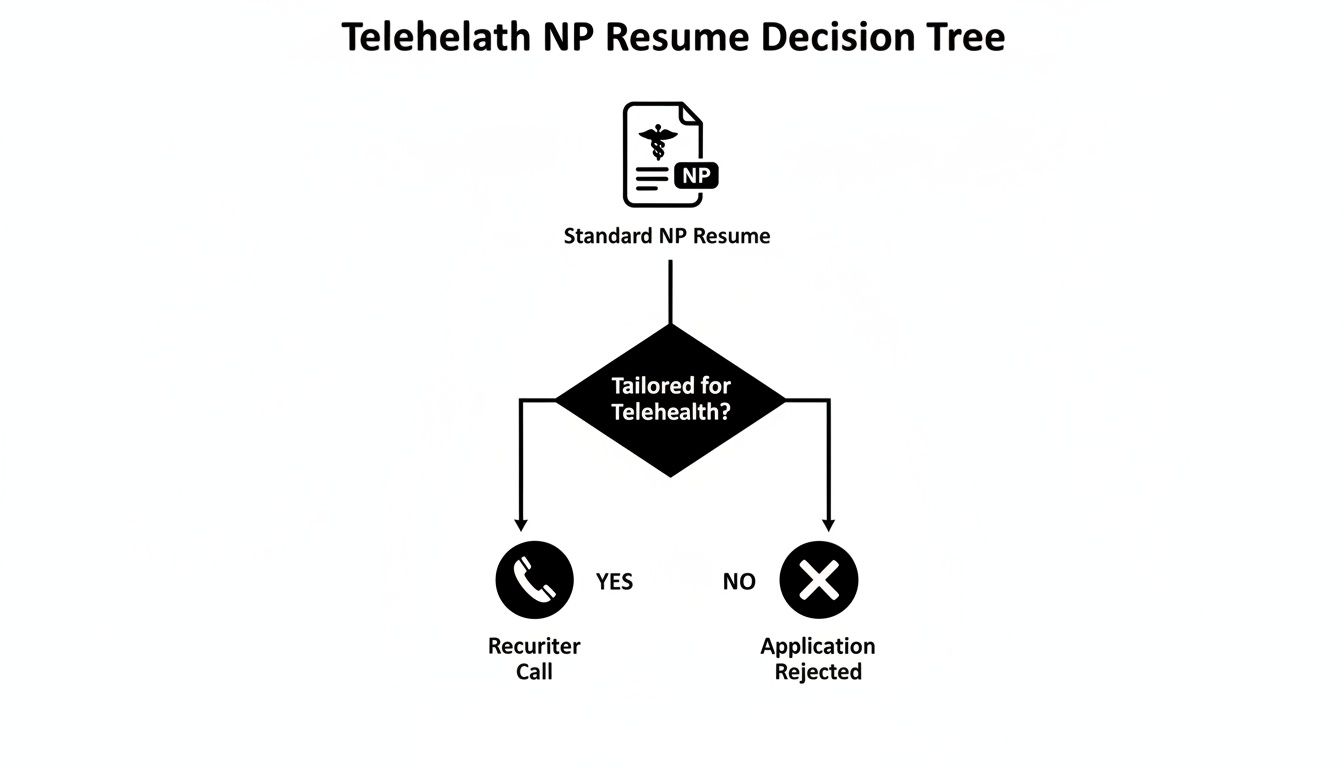
As the decision tree shows, a resume that clearly highlights your telehealth-readiness—including all your active state licenses—is what gets you past the initial screen and into an interview. A generic one often ends up in the "no" pile.
Mastering the Virtual Interview and Remote Workflow

A telehealth interview isn't your typical sit-down chat. It's really a live-fire exercise—a real-time test of your remote clinical skills. From the second you log on, they’re evaluating your tech-savviness, your professionalism, and what I call your “webside manner.”
Think of it as your first clinical simulation. Every little detail counts, from the stability of your Wi-Fi to the quality of your microphone. I always tell NPs to do a full tech rehearsal with a friend to test the camera, audio, and the specific video platform the employer uses. Don’t skip this.
Nailing the Virtual Interview
Your environment speaks volumes before you say a word. Find a quiet, private space with a simple, professional background. A bookshelf or a neutral wall beats a cluttered kitchen any day. Good lighting is critical—put a lamp or window in front of you so you aren't sitting in shadows.
Get ready for telehealth-specific questions designed to see if you're truly prepared for this kind of role. You'll likely hear things like:
- "How do you build patient rapport through a screen?"
- "Walk me through a time you handled a difficult remote patient encounter."
- "What are your strategies for staying focused and organized in a home office?"
Your goal here is to go beyond textbook answers. Pull specific examples from your clinical experience and frame them for a virtual setting. Talk about how you use active listening and deliberate pauses to build connection, or how you’ve used digital charting tools to manage a hectic patient load.
Structuring Your Day for Remote Success
Once you’ve landed the job, the game shifts to building a daily workflow you can actually sustain. The freedom of working from home is amazing, but it requires serious discipline. You have to create the structure that a physical clinic normally provides.
I’m a big fan of “time-blocking.” Schedule everything—not just patient appointments, but dedicated blocks for charting, lab reviews, and responding to messages. This is how you stop administrative creep from eating into your personal time. And as you set up your home practice, make sure your tools are secure. Using things like HIPAA compliant dictation software is non-negotiable.
The single biggest mistake I see new remote NPs make is being “always on.” You have to set firm start and end times. When your day is done, shut the laptop and walk away from your workspace.
That mental separation is what keeps you from burning out. The best telehealth jobs are built to support this. Current data shows that a manageable caseload is typically 12-16 patients per day. These roles often come with generous appointment times—around 60 minutes for new patients and 30 for follow-ups.
Better yet, many of these telehealth nurse practitioner jobs have no on-call or weekend requirements, sticking to a standard Monday-Friday, 8am-5pm schedule. You can find plenty of roles with this kind of work-life balance on job boards that let you filter for those criteria.
Negotiating Your Telehealth Salary and Benefits
Let’s be honest: talking about money is uncomfortable. But in your career, it’s one of the most critical conversations you’ll have. Telehealth NP compensation isn't a one-size-fits-all number; it swings wildly based on your specialty, the company's funding stage, and most importantly, where you're located. You absolutely cannot go into this conversation without data.
The goal here isn't just about chasing the highest possible salary. It's about crafting a total compensation package that actually supports your life, gives you professional peace of mind, and builds a foundation for financial freedom. That means looking well beyond the sticker price of an hourly rate or annual salary.
Know Your Market Value Before You Talk
Before an offer even hits your inbox, you need a firm grasp of what you’re worth. We’re not talking about a small difference, either—salaries can vary by tens of thousands of dollars from one state to the next, or even between two cities in the same state. This is where getting specific with regional data becomes your secret weapon in any negotiation.
Take Texas, for example—it’s a hot market for telehealth NPs. The statewide average salary hovers around $121,390 a year, but it gets more interesting when you zoom in. An NP role based out of Dayton, TX, might pull in $127,566, while a similar job in Wichita Falls could be closer to $126,825. Knowing these local numbers gives you a realistic, defensible starting point. You can dig deeper into Texas telehealth NP salary trends on ZipRecruiter to see for yourself.
It's About More Than the Base Salary
A great offer is a complete package. The benefits and perks are where you can often find significant value, and these items are frequently more negotiable than the base salary itself. Once you have an offer, it’s time to analyze every single component.
Here are the key areas to zero in on during your negotiation:
- Home Office Stipend: Don't settle for working from your kitchen table. An allowance for a proper desk, ergonomic chair, and monitor is becoming standard. It’s completely reasonable to ask for $500-$1,000 to set up a professional and comfortable workspace.
- Continuing Education (CEU) Funds: This is a must. Ask for a dedicated annual budget to cover conferences, certifications, and license renewals. It signals your commitment to professional growth and keeps you from paying for it yourself.
- Malpractice Insurance Details: This is a non-negotiable. You need to confirm the policy is "occurrence-based" or includes "tail coverage." This is what protects you from any claims that might be filed after you’ve already left the company.
- Scheduling Flexibility: Get the details on this. Can you block your schedule for a doctor's appointment without a hassle? Are there productivity targets that will force you into hours of unpaid charting time just to keep up? Get clarity now, not later.
A bigger salary is always nice, but a rock-solid benefits package that cuts down your personal expenses and protects your license is what delivers real, long-term value.
Making the Ask
Okay, you've done your homework. You have your market data and you’ve picked apart the benefits package. Now you’re ready to formulate your counteroffer.
Frame your request around the specific value you bring to the table—mention your skills, any licenses you hold in high-demand states, and the market data you found. This isn't a confrontation; it's a professional conversation. By anchoring your requests in solid research and a clear view of the total compensation picture, you present yourself as a thoughtful, serious candidate.
For a more granular look at what you could be earning, check out our in-depth guide and use our Salary Calculator Pro tool to see how your unique skills and location add up.
Your Top Questions About Telehealth NP Careers, Answered
If you're thinking about moving into a telehealth role, you probably have a lot of questions. That’s completely normal. Getting straight answers is the first step toward making a confident career move and avoiding any surprises later on.
The good news? The path into virtual care is much clearer now than it was a few years ago. Let's tackle some of the most common questions NPs have when they're starting out.
Do I Really Need a Special Telehealth Certification?
Short answer: No. A "telehealth certification" isn't a requirement to get a great remote NP job. What employers really care about are your active NP license, national board certification, and the right state licenses for the role.
While you might see some optional certificate programs out there, they're more of a "nice-to-have" than a "need-to-have." Honestly, hands-on experience is far more valuable. Proving you’re comfortable with EMR systems and can communicate effectively through a screen will put you way ahead of someone with a certificate but no practical skills.
How Does Malpractice Insurance Work for Remote Jobs?
This is a big one. Most legitimate telehealth companies will provide full malpractice coverage for their NPs. It's a standard part of the benefits package.
But here's a pro tip: during your contract negotiation, make sure you ask specifically if the policy includes tail coverage. This is critical—it protects you from any claims that might pop up after you've already left the company.
A quick heads-up: If you're working as an independent contractor (a 1099 role), you'll almost certainly need to buy your own malpractice policy. Make sure it covers you in every single state where you're licensed to practice.
Can New Grad NPs Land a Telehealth Job?
It’s not totally impossible, but it is very, very rare. The overwhelming majority of telehealth jobs require at least one to two years of direct clinical experience. Think about it from the employer's perspective—these roles demand a ton of clinical autonomy. You need to be able to make confident decisions on your own, without a preceptor down the hall.
That kind of confidence comes from hands-on experience in a traditional clinic or hospital. Build that solid clinical foundation first. It will make you a much stronger, more successful candidate for the best remote jobs when the time is right. Most companies see that prior experience as non-negotiable.
At WeekdayDoc, we only list burnout-friendly telehealth nurse practitioner jobs that respect your work-life balance. Ready to find your next role without call or weekends? Start your search here.