Your Guide to Finding High-Paying Physician Remote Jobs
Discover the best physician remote jobs that offer better work-life balance. This guide covers telemedicine, UR, salaries, and how to find your ideal role.
The idea of a doctor working from home used to sound like a fantasy.Not anymore. Remote physician jobs have become a real, mainstream career path for doctors looking for an alternative to the relentless pace of traditional clinical practice.
These roles are about so much more than video calls. They span a huge range of opportunities in utilization review, medical writing, and health-tech advisory, creating sustainable careers that finally put work-life balance within reach.
The Rise of the Remote Physician
This isn't just a fleeting trend born from the pandemic; it’s a fundamental shift in how medical expertise is delivered and valued. For countless physicians, going remote is a direct response to the staggering rates of clinical burnout. It’s a chance to take back control of their schedules and their lives.
And the market is responding.
Demand for physician remote jobs has exploded. Right now, somewhere between 16,000 to 25,000 physicians in the U.S. are already in remote or hybrid industry roles. Experts predict that by 2030, remote work will make up 40-50% of all industry physician jobs.
Beyond Telemedicine: A New Professional Landscape
When most doctors hear "remote work," their minds jump straight to telemedicine. While virtual patient care is a huge piece of the puzzle, it's really just the tip of the iceberg. The remote landscape is a rich ecosystem of non-clinical and "clinic-adjacent" roles where your MD is your greatest asset.
Think about what your career could look like:
- Utilization Management: Instead of treating patients, you could be reviewing cases for insurance companies, ensuring care is appropriate and necessary. It’s a classic 9-to-5 desk job, just from your home office.
- Medical Writing: Your deep clinical knowledge is perfect for creating educational content, regulatory documents, or journal articles. You get to translate complex science for different audiences, on your own time.
- Health Tech Consulting: Your frontline experience is invaluable to startups building the next EMR, health app, or AI diagnostic tool. You can shape the future of medicine without the daily grind of seeing patients.
The core idea is simple but powerful: Your medical expertise is an asset that can be applied in countless ways beyond the clinic walls. These roles offer a clear path to a more sustainable, balanced career.
To help you navigate this new landscape, we've broken down the most common remote physician roles into a simple overview. This table highlights what each job typically involves and what kind of physician profile is the best fit.
At-a-Glance Overview of Top Remote Physician Roles
| Role Type | Primary Responsibilities | Ideal Physician Profile |
|---|---|---|
| Telemedicine | Conducting virtual patient visits for diagnosis, treatment, and follow-up care via video or phone. | Physicians seeking direct patient interaction with more schedule flexibility; comfortable with technology. |
| Utilization Review | Reviewing medical records to determine the necessity and appropriateness of care for insurance payers. | Detail-oriented physicians with strong clinical judgment who prefer structured, non-patient-facing work. |
| Medical Writing | Creating clinical trial documents, regulatory submissions, educational materials, or journal articles. | Clinicians with excellent writing skills and a knack for translating complex medical information clearly. |
| Pharmaceutical/Biotech Advisory | Providing clinical expertise for drug development, medical affairs, or marketing strategy. | Physicians with a strong interest in research, industry, and the business side of medicine. |
| Health Tech Consulting | Advising startups and tech companies on product development, clinical workflow, and usability. | Tech-savvy doctors who are passionate about innovation and improving healthcare systems. |
| Medical-Legal Consulting | Serving as an expert witness, reviewing legal cases, or providing medical opinions for legal matters. | Physicians with deep specialty knowledge who enjoy analytical thinking and objective case evaluation. |
This table is just a starting point, but it shows the sheer variety of opportunities available once you start looking beyond traditional practice.
Platforms like WeekdayDoc were built specifically to help you find these burnout-friendly positions. By curating roles with clear markers like “No Call” and “No Weekends,” we make it easy to find a job that actually fits your life.
For those looking for even more flexibility, many of these roles can be done on a part-time basis. If that sounds appealing, you might want to check out our complete guide on part-time physician jobs. The bottom line is that you now have a clear path to building a fulfilling career on your own terms.
Exploring Your Remote Career Options
When physicians hear "remote work," their minds usually jump straight to video calls with patients. But the world of physician remote jobs is so much bigger and more varied than that. It’s a fundamental shift, offering a whole spectrum of roles that fit different personalities, clinical skills, and what you’re looking for in life.
Whether you want to keep seeing patients or leave direct care behind entirely, there’s likely a remote path that fits.
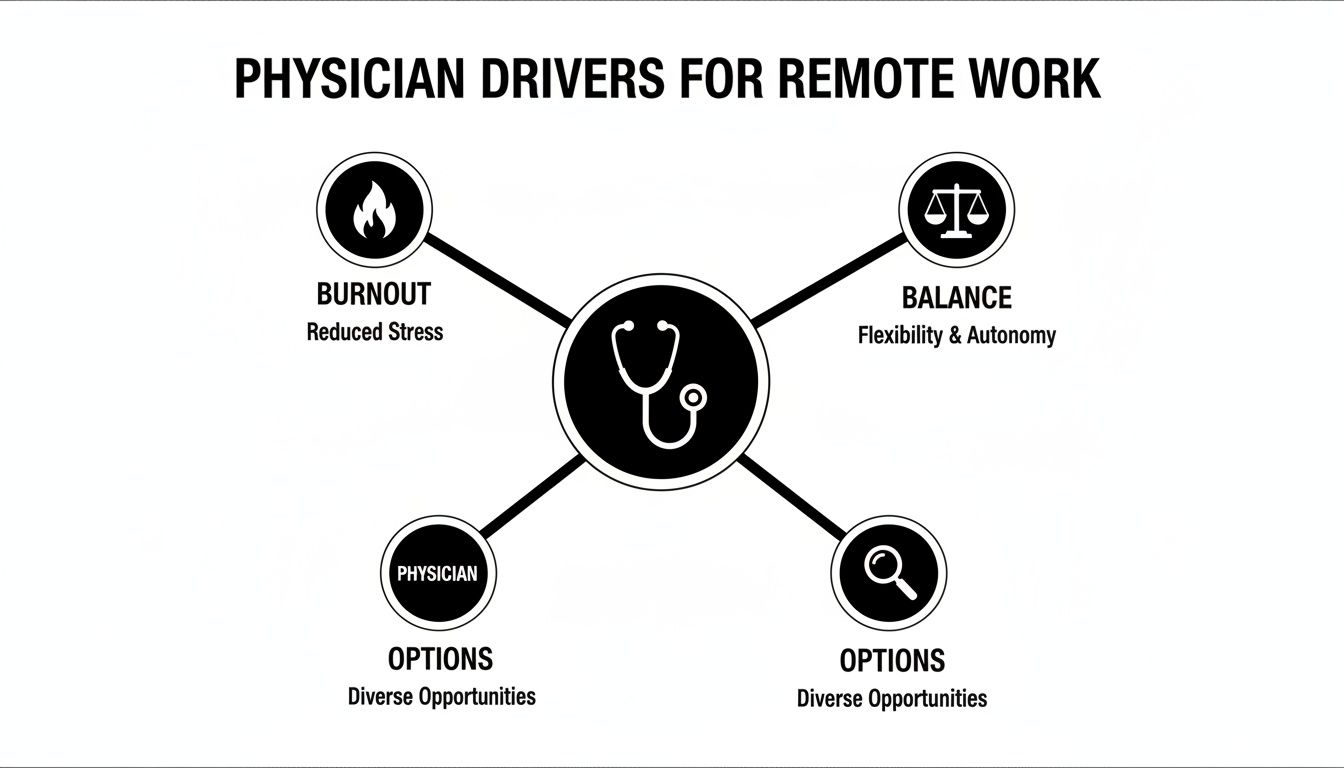
So, what’s driving this movement? It’s a perfect storm of burnout, a desperate need for balance, and the simple desire to use a medical degree in a new way. These are the powerful forces pushing physicians out of the traditional clinic and pulling them toward roles with more control and sustainability.
The Two Faces of Telemedicine
Telemedicine is the most well-known path, but it’s not a monolith. It breaks down into two main models, each with a completely different feel and workflow.
Synchronous Telemedicine: This is the live, real-time video or phone call everyone pictures. It’s the closest digital equivalent to a traditional office visit. This model works great for urgent care, routine follow-ups, and specialties like psychiatry or neurology where that direct, back-and-forth conversation is essential.
Asynchronous Telemedicine: This is often called "store-and-forward," and it’s a game-changer for flexibility. Here, you receive patient information—like photos, messages, or lab results—and review it on your own time. A classic example is a dermatologist reviewing a patient-submitted photo of a rash. It decouples your work from the patient's schedule, offering maximum freedom.
And this isn't some niche corner of medicine anymore. A recent study shows 71.4% of physicians use telehealth on a weekly basis. Psychiatry is leading the charge, with 85.9% of psychiatrists conducting video visits. You can discover more insights about these specialty-specific trends on AMA-ASSN.org.
Comparing Remote Physician Career Paths
To make sense of the options, it helps to see them side-by-side. This table breaks down some of the most common remote physician roles, highlighting the key differences in patient contact, schedule demands, and the specialties that are a natural fit.
| Remote Role | Patient Interaction | Schedule Flexibility | Common Specialties |
|---|---|---|---|
| Synchronous Telemedicine | High (Direct, Real-Time) | Moderate (Scheduled appointments) | Psychiatry, Primary Care, Neurology |
| Asynchronous Telemedicine | Indirect (Reviewing data) | High (Work on your own time) | Dermatology, Radiology, Pathology |
| Utilization Management | None | High (Predictable 9-5) | Internal Medicine, Family Medicine, Hospitalists |
| Medical Writing | None | Very High (Project/deadline-based) | Any specialty, especially with research background |
| E-Consults | Indirect (Peer-to-Peer) | High (Respond within set timeframe) | Cardiology, Endocrinology, Rheumatology |
| Advisory/Startup Role | None | Varies (Can be demanding) | Any specialty with business/tech interest |
Thinking through these factors—how much you want to interact with patients, and how much control you need over your day—is the first step in finding the right remote career path for you.
Utilization Management: Predictable and Non-Clinical
For physicians who are well and truly done with direct patient care, Utilization Management (UM) or Utilization Review (UR) is a major destination. In this world, you work for an insurance company or hospital system, acting as a clinical reviewer.
What does a typical day look like? As a UM physician, you log into a queue of cases. You'll spend your day reviewing patient charts and physician notes against established clinical guidelines to determine if a requested procedure, test, or admission is medically necessary. It's predictable, analytical work.
Your decisions directly influence patient outcomes and healthcare spending on a macro level, all from the comfort of a reliable 9-to-5 schedule. It’s a perfect fit for anyone craving an evidence-based role without the emotional weight of clinical practice.
Medical Writing: Translate Science into Stories
Got a knack for clear communication? Medical writing offers a creative and flexible remote career where you can put that talent to work. You become the bridge between complex clinical data and the people who need to understand it.
Your day-to-day could involve:
- Regulatory Documents: Helping draft submissions for new drugs or medical devices.
- Educational Content: Creating CME materials for other clinicians or easy-to-understand guides for patients.
- Marketing Materials: Developing accurate, ethical content for pharmaceutical companies.
- Journal Articles: Working with researchers to get their findings published.
This path keeps you deeply connected to the science of medicine, but on a project-based schedule that you largely set yourself. If this sounds interesting, our list of remote healthcare jobs often includes medical writing and similar communication-focused roles.
High-Impact Niche Roles
Beyond the most common paths, there's a fascinating landscape of specialized roles where your M.D. is incredibly valuable.
E-Consults (Peer-to-Peer): As a specialist, you can offer your expertise to primary care physicians remotely. A PCP with a complex case might send you a secure message with their question, and you provide guidance without ever seeing the patient. It’s a powerful way to scale your knowledge and improve care quality.
Medical Director for Startups: The health tech scene is booming, and these companies desperately need clinical expertise. You could help a startup build a better EMR, guide the development of a new diagnostic tool, or shape clinical strategy. This is one of the most dynamic physician remote jobs out there, putting you at the forefront of innovation.
Each of these avenues offers a unique way to apply your hard-earned medical degree. The real opportunity here is to find the one that aligns with your skills, your interests, and the kind of life you actually want to live.
How to Find and Vet Remote Opportunities
Finding the right remote physician job isn't about luck. It's about a targeted, strategic search. The digital job market can feel like an ocean, but knowing where to look—and what to look for—turns a frustrating chore into a focused mission.
This means getting off the massive, generic job boards and onto platforms that actually understand what a physician seeking balance needs. It’s about learning to read between the lines of a job description to spot the roles that offer genuine sustainability, not just a new flavor of burnout.
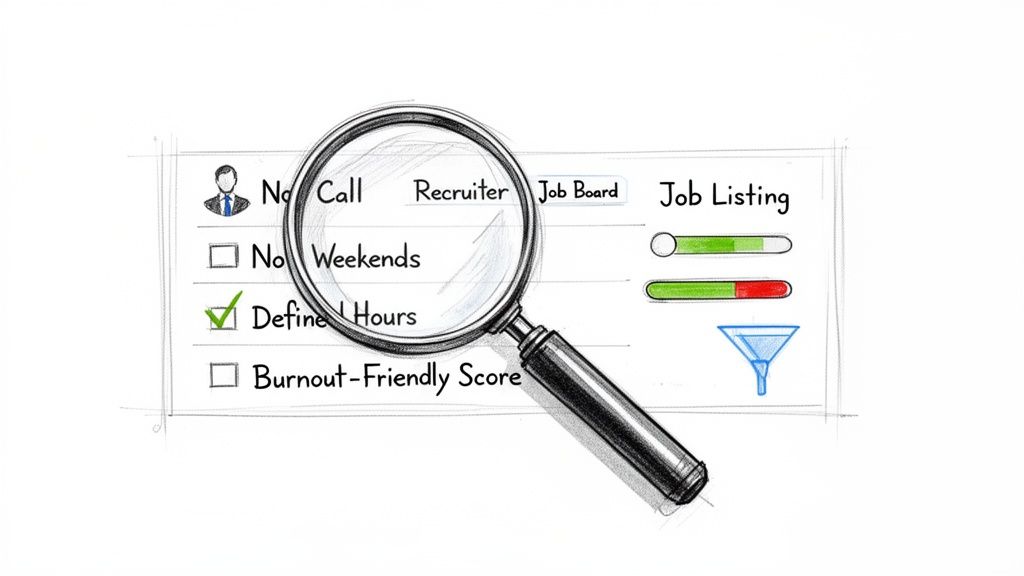
This screenshot from WeekdayDoc is a perfect example. Specialized platforms let you apply filters that zero in on burnout-friendly criteria. By instantly selecting "No Weekends" or "No Call," you cut through the noise and only see roles built for a real work-life balance.
Where to Find Quality Listings
Your time is your most valuable asset. Don't waste it sifting through thousands of irrelevant listings. Focus your energy on channels that do the first round of filtering for you.
- Niche Physician Job Boards: Platforms like WeekdayDoc were built specifically for clinicians who want burnout-friendly work. They curate physician remote jobs and flag them with explicit markers like “No Call” and “No Weekends,” which saves you the headache of trying to decode vague job posts.
- Physician-Focused Recruiters: A great recruiter who lives and breathes physician placement can be a powerful ally. They have deep relationships with employers and often get the inside scoop on roles that are never publicly advertised. Just be crystal clear with them about your non-negotiables.
- Direct Company Websites: If you already know you’re interested in a specific field like utilization review or telemedicine, go straight to the source. Major telehealth players (like Teladoc or Amwell) and the big insurance payers (like UnitedHealth Group or Cigna) all have dedicated career pages with remote physician openings.
The timing is right. While only 9-11% of healthcare jobs are currently remote, a projected 30% surge in demand for healthcare professionals is forcing employers to get more flexible to attract the best doctors. As Morningstar.com reports, this is a significant shift in the employment landscape that works in your favor.
How to Decode Job Descriptions
Once you've found a promising listing, the real work begins. A job description is a sales pitch, but it’s also packed with clues about the company culture and the day-to-day reality of the role. Your job is to look for the green flags that signal a real commitment to physician well-being.
A truly burnout-friendly job description focuses on outcomes and autonomy, not just a list of tasks. It will clearly define expectations around your schedule, patient or case load, and communication, giving you a concrete picture of what your life will actually look like.
Keep an eye out for specific language that tells the true story.
Green Flags to Look For:
- Clearly Defined Hours: Phrases like "Monday-Friday, 9 AM - 5 PM EST" or "flexible hours outside of core meeting times" are golden. They signal a deep respect for your personal time.
- Manageable Workload Metrics: Vague promises like a "fast-paced environment" are often a red flag. What you want are specifics, like "12-15 utilization reviews per day" or "2-4 patients per hour." These numbers suggest a predictable and manageable workload.
- Emphasis on Physician Autonomy: Look for language about "clinical judgment," "physician-led teams," or "autonomy in decision-making." These phrases point to a culture that trusts its doctors, not one that micromanages them.
Red Flags to Avoid:
- Vague Schedule Requirements: Be very cautious of phrases like "flexible schedule" without any defined hours or "availability as needed." This is often corporate-speak for "you're on call 24/7."
- High-Pressure Buzzwords: Descriptions that lean heavily on words like "hustle," "grind," or "rockstar physician" are usually a sign of a culture that prioritizes productivity over well-being.
- Lack of Support Structure: If the post says nothing about team collaboration, administrative support, or a clear reporting structure, you could be walking into a role where you're left to handle everything on your own.
By approaching your job search with this kind of analytical mindset, you can effectively vet opportunities and find the physician remote jobs that will truly support a sustainable, fulfilling career.
Understanding Your Financial Landscape
Making the jump from a traditional clinic to a remote physician job means getting acquainted with a whole new financial world. The way you're paid, how much you can earn, and even your long-term strategy for building wealth can look completely different. Getting a handle on this new landscape is the key to making a move that's not just good for your well-being, but also for your wallet.
Remote physician pay is all over the map, depending heavily on the type of role, your specialty, and how the company structures compensation. Forget the straightforward salary-plus-bonus model you see in most hospital systems. Remote work brings much more variety to the table—you'll find salaried gigs, hourly rates, and per-consult fees, each with its own trade-offs between income stability and flexibility.
Common Compensation Models
So, what can you actually expect to earn? Let's break down the typical pay structures for the most common remote physician jobs.
Telemedicine: Pay here is often tied to how much you work. You might get paid per visit (think $25-$40 per consult for basic urgent care) or an hourly rate that can range from $100 to over $200 per hour for specialists. Some of the bigger telehealth companies offer a straight salary, which gives you more predictable income but might cap your earning potential.
Utilization Review: These roles are almost always salaried. A physician advisor just starting out can expect to bring in between $180,000 and $220,000 a year. With experience or a move into leadership, that number climbs significantly. The big draw here is the rock-solid, predictable income and standard business hours.
Medical Writing: This field is the wild west of flexibility, with most work done on a freelance or contract basis. You could be paid hourly (anywhere from $100-$300+ per hour) or on a per-project basis. A physician drafting regulatory documents for a big pharma company will naturally command a much higher rate than someone writing blog posts for patients.
The financial trade-off in remote work often boils down to this: predictability versus flexibility. A salaried UR job gives you that steady paycheck you can count on. On the other hand, patching together a few per-diem telemedicine shifts and freelance writing projects could lead to higher overall earnings, but it demands more active self-management.
Connecting Remote Work to Your Financial Goals
The money side of remote work is about more than just the paycheck. For a growing number of physicians, the big-picture goal is achieving Financial Independence, Retire Early (FIRE). A remote career can be a massive catalyst on that journey for a few powerful reasons.
First, your day-to-day costs drop off a cliff. Think about what you're not spending on: gas for your commute, professional clothes, and grabbing lunch out every day. That money can go directly into your investments, seriously cutting down the time it takes to build wealth.
Second, the tax game often changes in your favor. Many remote jobs are set up as 1099 independent contractor roles. This unlocks some serious tax advantages, like writing off business-related expenses and opening a Solo 401(k), which lets you save way more for retirement than a typical 401(k).
As you step into this independent role, building your own financial safety net becomes crucial, starting with solid self-employment health insurance. Taking care of these details is what makes a freelance career sustainable for the long haul.
Finally, the inherent flexibility of remote work lets you create a "portfolio career." You could hold down a stable, part-time salaried job and layer on higher-paying, short-term consulting gigs. This not only boosts your income but also diversifies it, creating a stronger financial base. To really see how different income streams could fast-track your journey, our physician salary calculator for FIRE projections lets you model out various scenarios. It's all about strategically designing a career that funds the life you actually want to live.
Mastering the Remote Application Process
Landing a great remote physician job isn't like applying for a traditional clinical role. The whole game is different. You have to tailor your CV, cover letter, and interview style to prove you're ready for a virtual environment where autonomy is king.
Think of the application process as an audition. They’re not just looking at your clinical chops; they’re testing your self-discipline, your tech-savviness, and how well you communicate through a screen. You have to show them you can deliver top-tier results without someone looking over your shoulder.
Reframe Your CV for Remote Success
Your standard clinical CV is probably a highlight reel of your hands-on patient care and procedural skills. That’s great, but for a remote job, it needs a serious reframe. Your goal now is to spotlight the experiences that show you can thrive without in-person supervision.
Instead of just listing your hospital affiliations, you need to emphasize skills that matter for remote work:
- EHR Proficiency: Don't just say you're "proficient." Name the specific systems you’ve used, like Epic or Cerner. This tells them you can get up to speed on new software quickly, which is a daily part of most remote jobs.
- Virtual Communication: Did you use telehealth platforms? Secure messaging systems? Lead virtual case conferences? Mention it. This is hard evidence that you’re already comfortable working and collaborating online.
- Time Management: Highlight roles where you managed your own patient schedule or had significant autonomy over your panel. This is a direct signal that you’re a self-starter who can manage your own time effectively.
And here’s a pro tip: most companies use Applicant Tracking Systems (ATS) to screen applications before a human ever sees them. Taking a few minutes to learn about understanding why resumes fail ATS can make a huge difference in whether you even get a call back.
Crafting a Compelling Cover Letter
This is where you connect the dots for the hiring manager. Your cover letter is your chance to tell a story and explain exactly why your skills are the perfect fit for their remote position. Don’t just repeat what’s on your CV.
Focus on the "why." Why this remote role? A powerful answer often ties into a desire for better work-life balance, a real interest in healthcare innovation, or a passion for expanding patient access to care. These are all things an employer wants to hear.
Tackle the big remote-work questions head-on. Give a quick example of how you've worked autonomously in the past or explain why your communication style works well for distributed teams. It shows you’ve put real thought into what it takes to succeed in this kind of role.
Nailing the Virtual Interview
The virtual interview is the final boss. It's not just about what you say, but how you show up in a digital setting. Getting the tech and your environment right is non-negotiable.
Virtual Interview Best Practices:
- Test Your Tech: Seriously, do a dry run. Check your camera, mic, and internet connection ahead of time. Nothing screams "unprepared" like a technical glitch derailing the first five minutes.
- Create a Professional Backdrop: Find a quiet, well-lit spot. Make sure the background is clean and uncluttered. It shows you’re a professional who respects the interviewer’s time.
- Prepare for Key Questions: Be ready to talk about how you stay motivated without colleagues around, how you manage your day without direct oversight, and how you build relationships with a team you've never met in person.
When you answer, use specific examples. Don't just say you're autonomous. Describe that time you managed a complex patient case with minimal input or coordinated a project across different departments virtually. Stories are far more powerful than simple claims.
Navigating Contracts and Licensing
Switching to a remote physician job isn't just about learning a new workflow. You've got to nail the administrative details, too. The contract you sign and the licenses you hold are the absolute foundation of a successful remote career, so taking the time to get this right will save you a world of headaches later on.
Before you even think about accepting an offer, treat that contract like the blueprint for your new professional life. It's not just a formality—it’s the single most important document spelling out expectations, responsibilities, and protections for both you and your employer. Trust me, a misunderstood contract can turn a dream job into a logistical nightmare fast.
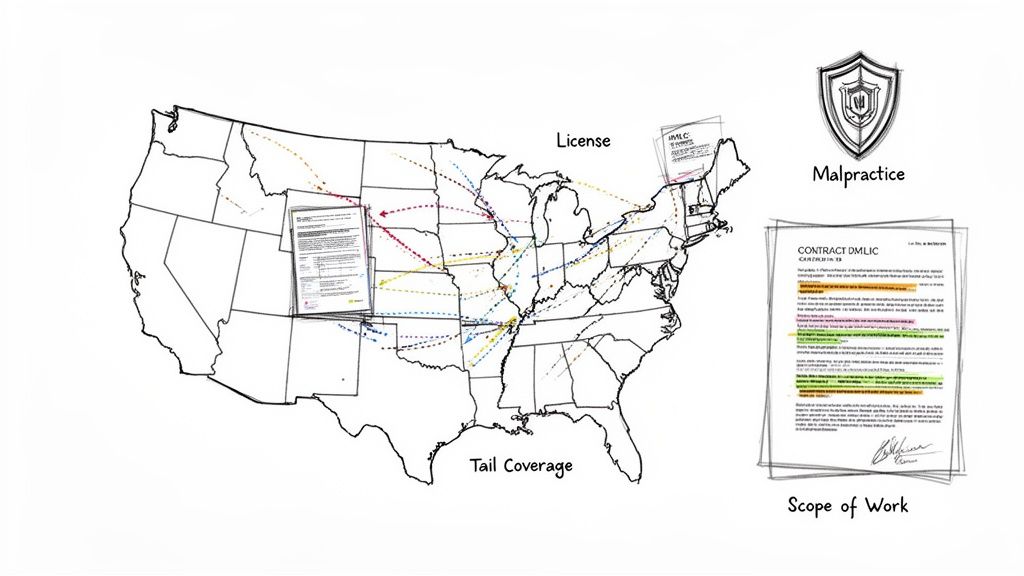
Deconstructing Your Remote Physician Contract
A remote contract has unique clauses you won't see in a traditional hospital agreement. You need to read the fine print with a magnifying glass, especially in these three areas.
- Scope of Work: This part should spell out your duties with crystal clarity. Look for specifics on patient or case volume, expected work hours (including the time zone), and any on-call or weekend shifts. Vague language here is a huge red flag.
- Non-Compete Clauses: Be extremely careful here. A broad non-compete could handcuff you, preventing you from taking on other remote work or side gigs—one of the biggest perks of this career path. Make sure the clause is reasonable in its geographic reach and duration.
- Malpractice Insurance: For W-2 employees, the company usually handles malpractice coverage. The critical question you must ask is if this includes tail coverage. That’s the insurance that protects you from claims filed after you've left the job. Without it, you could be on the hook for a massive bill down the road.
If you’re a 1099 independent contractor, the responsibility for malpractice insurance—tail coverage included—almost always falls on you. This is a significant expense that has to be factored into your budget before you sign anything.
Tackling Multi-State Licensing and Credentialing
For many docs going remote, licensing is the biggest administrative mountain to climb. In telemedicine, you have to be licensed in the state where the patient is located. As you can imagine, this can get complicated and expensive, fast.
Thankfully, the Interstate Medical Licensure Compact (IMLC) makes this much easier for physicians in participating states. It’s a streamlined process that helps you get licensed in multiple states much more efficiently than applying to each one individually. If you plan on seeing patients across state lines, checking your IMLC eligibility should be your first step.
Finally, while the credentialing process for remote roles is often quicker than at a hospital, it’s just as rigorous. You’ll need to have all the usual documents ready: your medical license(s), board certifications, DEA registration, and a full work history. My advice? Get digital copies of everything organized and ready to go. It’ll speed up your onboarding and get you to work that much sooner.
Common Questions About Remote Physician Jobs
Making a career shift always kicks up a few questions. When you're a physician thinking about moving into remote work, those questions usually get right down to the practical stuff: lifestyle, career trajectory, and what it all actually looks like day-to-day.
Let's clear up the most common ones.
Can I Work a Remote Physician Job Part-Time?
Absolutely. In fact, a huge number of physician remote jobs are built for part-time or flexible schedules. This makes them a perfect fit if you're looking to supplement clinical income or just dip your toe into a new field without leaving the clinic entirely.
Roles in telemedicine, utilization review, and medical writing are especially good for this. You can build what's called a "portfolio career," blending traditional patient care with a remote gig. Just be sure to read the fine print in any contract for exclusivity clauses that might get in the way of your other work.
What Is the Biggest Challenge of Working Remotely?
The thing that comes up most often is professional isolation. You lose those spontaneous hallway consults and breakroom chats that happen organically in a clinic. When you work from home, you have to be much more intentional about connecting with colleagues.
The physicians who thrive remotely are the ones who proactively schedule virtual coffee chats, get active in online professional groups, and show up for virtual conferences. The other big hurdle is drawing a firm line between your work life and your home life when your office is ten feet from your living room.
The autonomy of remote work is its greatest strength and its primary challenge. Thriving requires self-discipline to both stay on task during work hours and completely disconnect when the day is done.
What Technology Do I Need for Remote Work?
The tech setup is usually pretty simple. The must-haves are a reliable high-speed internet connection, a modern computer with a decent webcam, and a quiet, private workspace that is 100% HIPAA compliant.
Most companies will provide access to their own software, like a specific EMR or telehealth platform. Some will even offer a stipend for home office gear like an extra monitor or an ergonomic chair. You almost never have to buy your own specialized medical equipment.
How Is Malpractice Insurance Handled?
This is a critical question, and the answer depends entirely on how you're employed.
- For W-2 employees, the company almost always provides your malpractice insurance. It's part of the package.
- For 1099 independent contractors, you're typically on the hook for securing your own policy.
When you're negotiating, you have to ask whether the policy is claims-made or occurrence-based, and—this is crucial—whether it includes tail coverage to protect you after you've moved on. If you're going the 1099 route, make sure you budget for the cost of that policy when you're figuring out your finances.
Finding a remote role that truly fits your life shouldn't be a struggle. At WeekdayDoc, we curate burnout-friendly physician jobs with clear markers like "No Call" and "No Weekends" so you can build a sustainable career on your terms. Explore your options today at https://www.weekdaydoc.com.