Your 2026 Guide to Physician Jobs Pharmaceutical Industry
Our 2026 guide helps you find physician jobs pharmaceutical industry, map skills, rewrite CVs, & negotiate a balanced career.

You wake up already behind. The inbox filled overnight. A patient portal message turns into an hour. Lunch disappears. You finish clinic, then chart until evening, then wonder if this is what the next decade looks like.
That's the moment many physicians start searching for physician jobs in the pharmaceutical industry.
Not because they've stopped caring about patients. Usually it's the opposite. They're tired of practicing in a system that turns clinical judgment into throughput, inbox management, and constant recovery from the workday. They want a role that still uses medicine, still respects scientific rigor, and doesn't demand that every ounce of attention be spent in fifteen-minute blocks.
The problem is that most guidance on pharma careers stays shallow. It names role categories, but it rarely answers the harder question: which jobs can a physician realistically get without prior pharma experience? That gap is real, and it matters. As this physician-side career guide notes, many employers describe ideal candidates as physicians with subspecialty training and research experience, which makes the funnel narrower than generic career advice suggests.
If you're still deciding whether you need a full career pivot or a strategic reset first, it helps to review practical ways to reduce physician burnout at work. But if you already know the clinical model is no longer sustainable for you, pharma is one of the few exits that can preserve both your medical identity and your earning power.
From Clinical Burnout to a Sustainable Pharma Career
A lot of burned-out physicians make one early mistake. They treat pharma like an escape hatch.
That mindset leads to scattered applications, weak interviews, and a resume that reads like someone trying to leave medicine rather than someone bringing high-value medical judgment into a new setting. Pharma companies aren't hiring you to recover from burnout. They're hiring you to solve medical, scientific, safety, and communication problems.
The strongest candidates don't say, "I need out of clinic." They say, "I'm moving toward evidence generation, safety, and strategic medical work."
That shift sounds small, but it changes everything.
A sustainable pharma career works best when you understand the trade-off clearly. You may gain more predictable hours, fewer acute interruptions, and work that is often more project-based than visit-based. You may lose some of the immediate human feedback that comes from direct patient care. Some physicians miss that. Others feel relief almost immediately.
What the move actually fixes
Pharma won't fix every professional frustration. It won't remove deadlines, matrix politics, or high expectations. What it can change is the shape of your day.
Common differences physicians notice include:
- Less fragmented work. You're often working on documents, strategy, data review, meetings, or scientific communication instead of being interrupted every few minutes.
- Greater impact. Your work may affect a study, a safety process, or medical education at scale.
- More control over time. Many roles are built around projects and deliverables, not packed clinic templates.
- Different stress. The pressure shifts from immediate bedside decisions to cross-functional accountability, deadlines, and stakeholder management.
Where people get stuck
The hardest part isn't deciding to leave. It's figuring out where to enter.
If you have no formal industry background, you need a narrower, smarter approach. Not every pharma role is equally accessible from clinical practice. Some functions value direct research, safety review, publication, or external-facing scientific communication more than others. That's why "just apply broadly" usually doesn't work.
The physicians who break in fastest usually do three things well. They target one function, translate their experience into that function's language, and build relationships before they ask for a job.
Decoding Pharma Roles for Clinicians
Before you apply, you need a clean mental model of where physicians fit. Doctors aren't on the periphery of pharma. They're built into the drug-development lifecycle, especially in clinical development, medical affairs, and pharmacovigilance/patient safety, which the ABPI identifies as core physician functions across the path from laboratory to clinic in its guide to pharmaceutical careers for doctors.
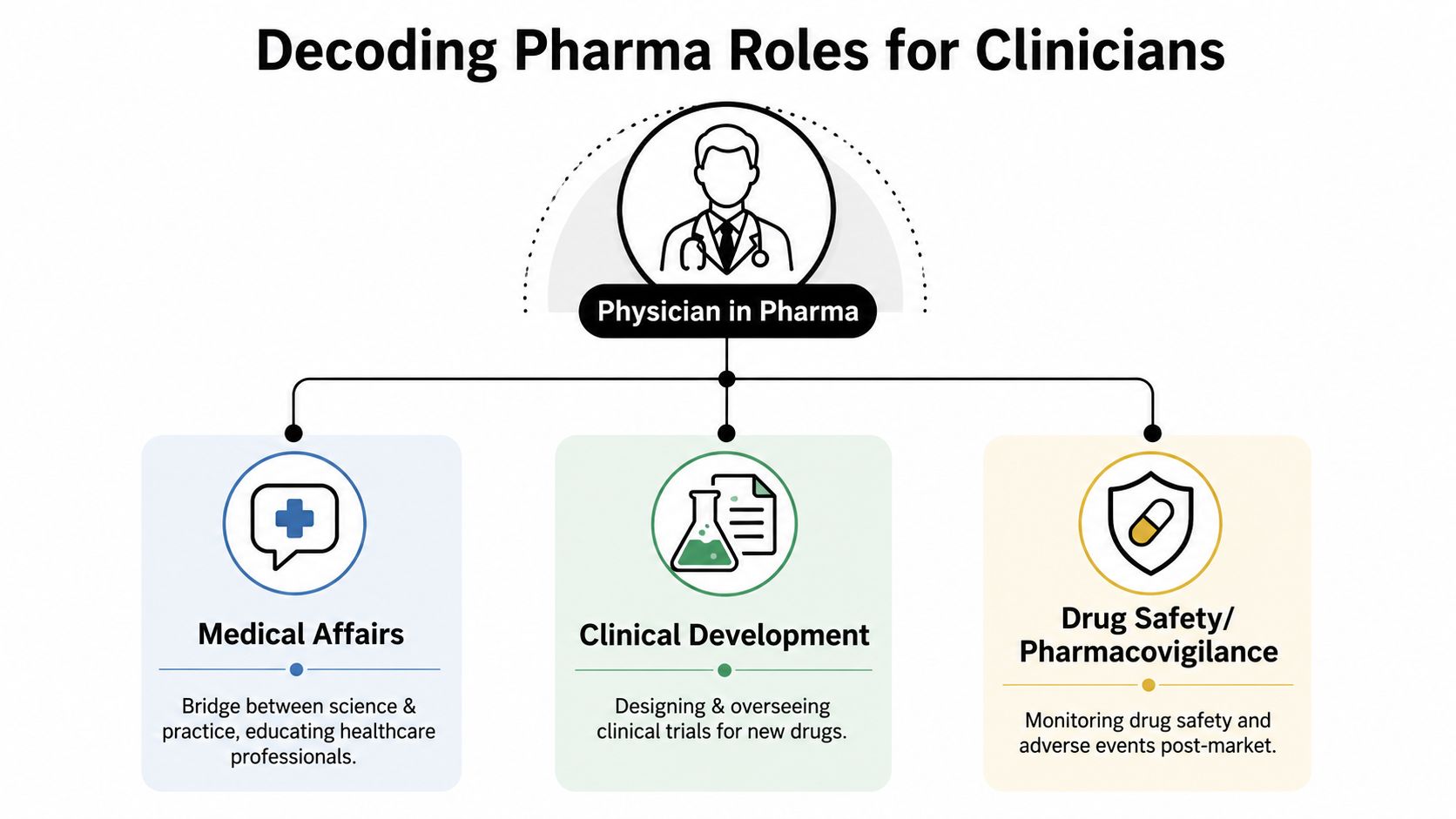
If you want a broader map of nonclinical options first, this roundup of alternative careers for physicians is useful context. But inside pharma, most physician paths still cluster into those three pillars.
Medical affairs
Medical affairs sits at the boundary between scientific evidence and real-world clinical practice.
This is often the best fit for physicians who like explaining data, discussing treatment patterns, presenting to peers, and building credibility with external experts. The work can include medical communications, expert engagement, real-world evidence, and contributions to health economics and outcomes research.
A physician in medical affairs often succeeds because they can do two things at once. They can understand the science in depth, and they can explain it in a way that clinicians, payers, and other stakeholders can use.
Good fit signals include:
- You like presenting. Grand rounds, conference speaking, teaching, and peer education all matter here.
- You enjoy external interaction. Some roles are field-facing, especially MSL-adjacent or field medical work.
- You think in narratives. Not spin. Clear, evidence-based scientific communication.
Clinical development
Clinical development is where physicians help design and oversee trials.
This is the best fit for doctors who enjoy research design, protocol thinking, endpoint logic, inclusion and exclusion criteria, and medical monitoring of adverse events. You're closer to how new therapies move through formal development.
If you've ever looked at a published study and immediately thought, “why did they structure the trial that way?” you're probably wired for this side of pharma.
A clinical development physician may work on:
- Trial design
- Clinical development plans
- Medical monitoring
- Data interpretation
- Regulatory and protocol-facing medical input
Pharmacovigilance and drug safety
Drug safety is where physicians act like medical detectives.
These roles focus on adverse event review, safety reports, medical errors, near misses, signal evaluation, and risk reduction tools such as safety guidelines and checklists. If you're naturally skeptical, systematic, and careful with causality, this function can be a strong fit.
For clinicians moving in, this function often feels more familiar than expected. You're still asking structured medical questions. What happened, when did it happen, what else could explain it, and what action follows?
If you're exploring safety roles, one useful technical primer is understanding CTCAE for data analysis. It helps clinicians get more comfortable with the language used around adverse event grading and trial safety review.
A quick comparison
| Function | Best fit for physicians who like | Typical output |
|---|---|---|
| Medical affairs | Scientific discussion, teaching, external engagement | Medical communications, expert engagement, evidence translation |
| Clinical development | Trial logic, protocol design, data review | Development plans, trial oversight, medical monitoring |
| Drug safety | Causality assessment, pattern recognition, patient safety | Safety reviews, signal analysis, risk mitigation tools |
The mistake is treating these as interchangeable. They're not. The hiring logic, interview questions, and daily work differ enough that you should pick one primary lane before you market yourself.
Translating Clinical Skills into a Pharma-Ready Profile
Most physicians underestimate what they already know how to do. They look at a pharma job description, see unfamiliar terminology, and assume they're unqualified.
That's backward.
The issue usually isn't lack of value. It's lack of translation. Pharma employers often prefer physicians with prior industry exposure, so new applicants need to show relevant strength in trial oversight, data interpretation, and leadership, not just clinical competence, as discussed in White Coat Investor's overview of pharmaceutical careers.
Your clinic experience already contains industry skills
Think about the work beneath the work.
When you run a busy service, you're not just seeing patients. You're triaging incomplete information, prioritizing risk, documenting clearly, communicating across roles, and making defensible decisions under time pressure. Pharma uses those same muscles. It just calls them something different.
Here's the translation in plain English:
- Patient history and synthesis becomes medical assessment and signal evaluation. You already know how to build a coherent picture from messy inputs.
- Grand rounds and case presentations become scientific communication. You've been explaining evidence to professional audiences for years.
- Supervising trainees or APPs becomes cross-functional leadership. You know how to guide work without always having formal authority.
- Managing complex chronic disease panels becomes project and stakeholder management. You're coordinating moving parts, competing priorities, and long timelines.
- Quality improvement work becomes process thinking and risk reduction. That's highly relevant in safety and development environments.
What doesn't translate automatically
Some physicians make the opposite mistake. They assume any clinical experience will be interpreted as obviously relevant.
It won't.
Recruiters and hiring managers won't infer that your ICU work means you can review safety narratives, or that your academic talks mean you can support medical communications. You need to say it directly.
Practical rule: Don't describe what you did only in clinical terms. Describe the judgment, analysis, communication, and leadership inside the work.
The profile shift that gets attention
A pharma-ready profile usually reflects three changes.
First, it becomes function-specific. You stop branding yourself as a generic physician and start branding yourself as a physician targeting medical affairs, clinical development, or drug safety.
Second, it becomes evidence-oriented. Instead of saying you're “hardworking” or “compassionate,” you show examples of protocol work, data review, publications, trial involvement, presentations, formulary work, committee leadership, or adverse event awareness.
Third, it becomes commercially literate without becoming commercial. You don't need to sound like a salesperson. You do need to show that you understand regulated environments, stakeholder alignment, and why scientific accuracy matters beyond individual patient encounters.
If you've participated in research, served as a site investigator, reviewed cases for a committee, written educational content, or spoken at specialty meetings, that material belongs front and center. Those are not side activities anymore. They are proof that your transition is credible.
Rewriting Your CV and Optimizing LinkedIn
Your clinical CV is built to impress academic departments, credentialing offices, and hospital committees. Pharma usually wants a different document. It wants a focused resume and a LinkedIn profile that quickly signals fit.

If you need a starting template, review examples of a physician curriculum vitae, then strip it down for industry use. The goal isn't to erase your medical history. It's to stop burying the relevant parts under everything else.
Stop listing duties and start showing relevance
Clinical CVs often read like inventories. Pharma resumes need to read like evidence.
Here's what that looks like in practice:
| Before | Better for pharma |
|---|---|
| Managed outpatient panel with complex chronic disease | Synthesized longitudinal clinical data across a complex patient panel, identifying care gaps and treatment patterns relevant to real-world evidence thinking |
| Presented at departmental conferences | Delivered evidence-based presentations to physician audiences, translating clinical literature into actionable recommendations |
| Served on hospital committee | Contributed physician judgment in a multidisciplinary decision-making environment, balancing safety, policy, and operational constraints |
| Supervised residents and APPs | Led cross-functional clinical teams, aligning stakeholders around care plans, documentation standards, and escalation pathways |
None of those bullets invents business impact. They merely make the underlying skill visible.
Build a summary that points to one target
Your headline and summary should answer one question fast. What role are you pursuing?
Weak version: Physician with extensive experience in patient care seeking nonclinical opportunities.
Stronger version: Board-certified physician with experience in clinical decision-making, scientific communication, and cross-functional leadership, pursuing physician roles in medical affairs focused on evidence translation and external scientific engagement.
That works because it is specific. It tells a recruiter where to place you.
LinkedIn matters more than many physicians think
LinkedIn is where recruiters search, peers vet you, and networking starts. A blank or stale profile creates friction you don't need.
A solid profile should include:
- A professional headshot. Not a cropped wedding photo. Not a conference badge shot.
- A target headline. “Physician | Medical Affairs” is better than just “Attending Physician.”
- A keyword-rich About section. Use the terminology of your target function.
- Featured items. Talks, publications, abstracts, poster presentations, committee work, or writing samples.
- Skills section. Include items that match your target role rather than generic clinical labels alone.
If you want a practical framework for polishing how you show up online, this guide on how to build your LinkedIn brand is a useful complement to the resume work.
What to remove or downplay
Not everything needs equal space.
Reduce detail on routine clinical volume, repetitive procedural lists, and broad statements like “excellent bedside manner.” Those may matter clinically, but they rarely drive industry interviews.
Keep what supports the story. Trim what distracts from it.
One more point. Tailoring still matters. A resume for medical affairs should not read exactly like one for drug safety. Same physician, different framing.
Strategic Networking to Secure Interviews
Cold applying has a role, but it's a weak primary strategy for physicians entering pharma without direct experience. Networking is what closes the credibility gap.
Done well, networking doesn't mean begging for referrals. It means gathering signal. You're trying to learn how a function works, what hiring managers care about, and whether your background maps to a real opening.
Start with narrow targeting
Pick one function and one or two likely entry titles. Then search for physicians already doing that work.
Good sources include:
- LinkedIn physician profiles in your target function
- Company medical teams
- Conference speakers
- Former classmates, residents, or faculty
- MSLs or medical directors connected to your specialty
Your message should be short and easy to answer.
Example connection request:
Hi Dr. Patel, I'm a practicing internist exploring a transition into medical affairs. Your path from clinical medicine into pharma caught my attention. I'd appreciate connecting and learning more about how you approached the move.
That works because it is respectful, specific, and low-pressure.
Run informational calls like a professional
When someone agrees to talk, don't waste the call asking vague questions like “what's pharma like?”
Ask focused questions instead:
- Which parts of your clinical background helped most in your current role?
- What experience made you credible when you first applied?
- Where do physicians without industry backgrounds usually misposition themselves?
- What skills are hardest to learn after getting hired?
- If you were making the transition again, what would you do earlier?
Take notes. Patterns matter more than any single conversation.
The point of networking isn't to impress people with your resume. It's to understand how they make hiring decisions.
Later in the process, a concise overview of pharma interview dynamics can help you prepare for the conversations those relationships may facilitate.
How to ask for help without sounding transactional
Toward the end of a good conversation, it's reasonable to ask one of two things.
First, ask whether your background sounds aligned with the function. Second, ask whether there's anyone else they recommend you speak with. Those are easier asks than “can you refer me,” and they often lead there naturally if the fit is real.
Use language like this:
I'm trying to build a realistic picture of where my background fits. Based on what I've shared, does this function sound like a sensible target? And is there anyone else you think I should learn from?
That invites honesty.
The strongest networks are usually small. You do not need hundreds of contacts. You need a handful of people who understand your target role, can tell you the truth, and may flag openings before they're obvious.
Preparing for and Acing Pharma Interviews
A pharma interview is not a fellowship interview with different branding. The company is testing whether you can operate in a structured, cross-functional, regulated environment.
Questions usually probe three areas. How you work with people. How you think through function-specific problems. Why you want this change.
Answer the motivation question without oversharing
You will almost certainly be asked why you're leaving clinical practice.
Do not unload every grievance about your health system, administrators, EHR, or patient volume. Even if all of it is true, it makes you sound reactive.
A stronger answer is forward-looking:
- Start with what you value. Scientific rigor, evidence generation, safety, communication, strategic medical work.
- Connect it to your experience. Research involvement, presentations, committee work, trial interest, literature review, medical education.
- Name the target function. Medical affairs, development, or safety.
- Show continuity. You're not leaving medicine. You're applying it differently.
Example structure:
“I've valued clinical practice, but over time I found I was most energized by work involving data interpretation, scientific communication, and broader medical impact. That led me to focus on medical affairs roles where I can use my physician training to support evidence-based discussions and external scientific engagement.”
Prepare for function-specific questions
Pharma interviews are shaped by the actual work of the function. Clinical development roles may test your comfort with trial design and adverse event monitoring. Pharmacovigilance roles may probe your reasoning around safety reports. Medical affairs roles may focus on scientific communication and engagement with external experts. That alignment between role and interview content is part of how physician work in these functions is described by Non-Clinical Careers.
Use that to your advantage. Study the function, not just the company.
A simple prep checklist:
- Behavioral stories. Prepare examples about conflict, ambiguity, leadership, deadlines, and influence without authority.
- Technical thinking. Review trial basics, safety logic, medical communication principles, or whatever maps to your target role.
- Company familiarity. Know the therapeutic area, current products or pipeline themes, and why the role exists.
- Your value proposition. Have a clear answer for what your clinical background adds.
Use a structure for behavioral answers
The easiest way to sound credible is to stay organized.
For behavioral questions, use a simple sequence: situation, task, action, result.
Keep your examples tight. Pick stories where your judgment changed the outcome, where you collaborated across roles, or where you handled uncertainty calmly.
Interviewers are often listening for three things at once. Can you think clearly, communicate cleanly, and stay steady when the situation is messy?
Practice sounding like someone already in the role
That doesn't mean faking expertise. It means speaking the language of the function accurately.
Instead of saying “I just want better work-life balance,” say “I'm targeting roles where my strengths in medical judgment, data interpretation, and scientific communication are directly relevant.”
One sounds like escape. The other sounds like fit.
Negotiating Your Offer and Designing Your New Life
Getting the offer is a career event. Accepting the right offer is a life decision.
Many physicians often slip back into old patterns. They focus only on title and salary, then ignore travel expectations, manager fit, after-hours culture, location demands, or whether the role truly solves the problem that pushed them out of clinic.
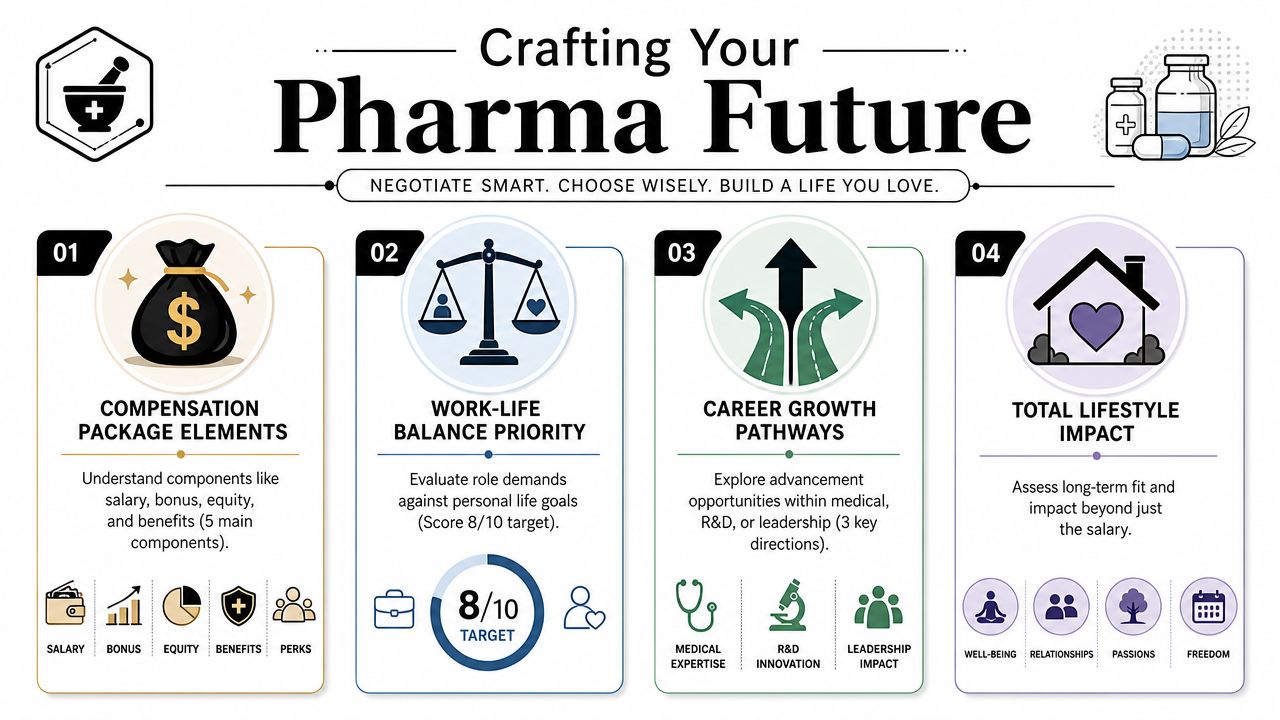
Compensation in pharma can be strong. For example, an Indeed listing for pharmaceutical physician jobs in Philadelphia shows an estimated Medical Science Liaison base salary range of $185,000 to $225,000 per year, plus annual bonus and equity compensation, and that same page lists 396 pharmaceutical physician jobs in the Philadelphia market, which signals a real physician labor market rather than a fringe niche on Indeed's pharmaceutical physician jobs page.
Understand the whole package
Base salary matters, but it's only one part of what you're evaluating.
Look at the package in layers:
- Base compensation. Your fixed income.
- Annual bonus. Often tied to company and individual performance.
- Equity or RSUs. Important if offered. This changes long-term upside.
- Benefits. Health, retirement, leave, CME support if relevant.
- Practical extras. Relocation, sign-on support, equipment, travel policy.
If financial independence is part of your goal, variable compensation matters because it changes how aggressively you can save and invest. A role with a slightly lower base but better bonus structure, equity, and better sustainability may outperform a higher-paying role that burns you out again.
The FIRE question most doctors forget to ask
A pharma job can accelerate financial independence, but only if your lifestyle improves enough for you to keep the job and keep your spending intentional.
That means asking questions beyond compensation:
| Area | What to ask |
|---|---|
| Travel | How often are field visits, conferences, or internal meetings expected? |
| Work model | Is the role remote, hybrid, or office-based, and is that stable? |
| Hours | What do busy weeks look like? When do people log off? |
| Coverage | Is there backup when you're out, or do projects follow you on vacation? |
| Manager style | How are priorities set when multiple stakeholders want different things? |
| Clinical moonlighting | If you want to keep a small amount of practice, is it permitted? |
Those answers tell you more about your future life than the title does.
A good pharma offer doesn't just increase income. It gives you enough control over time and stress that you can actually use the income well.
Negotiate with clarity, not bravado
Physicians new to industry sometimes either avoid negotiation completely or overreach in a way that signals poor judgment.
A better approach is calm and specific. Thank them. Express interest. Ask for time to review. Then discuss the components that matter most.
Reasonable discussion points can include:
- Base salary
- Sign-on support
- Equity
- Title alignment
- Relocation
- Start date
- Remote or hybrid expectations
You don't need to negotiate every line item. Negotiate the ones that affect either your long-term trajectory or your daily life.
Choose the life, not just the role
In this context, I'd tell a burned-out colleague to slow down.
The right pharma move is not the one that sounds most impressive at dinner. It's the one that gives you durable work, enough autonomy, and compensation that supports your next decade. If your goal is to reclaim evenings, reduce cognitive overload, and move faster toward financial independence, then work design matters as much as pay.
One practical tool in that evaluation process is WeekdayDoc, which lists burnout-conscious physician roles and includes salary and FIRE planning context alongside filters like no-call and no-weekends. Used the right way, that kind of tool helps you compare jobs by life impact, not just by title.
A lot of physicians entering pharma think they are choosing between staying clinical and “going corporate.” That framing is too simplistic. You are choosing how you want your medical training to function in the rest of your life.
Choose accordingly.
If you're serious about finding physician roles that support both work-life balance and long-term financial goals, WeekdayDoc is a practical place to start. It was built for clinicians looking for sustainable work, with filters for remote, hybrid, no-call, and no-weekend roles, plus salary and FIRE context that help you judge whether a job improves your life.