Medical Writing Jobs for Doctors: A 2026 Career Guide
Explore medical writing jobs for doctors in 2026. This guide covers roles, salary, skills, and how to find burnout-friendly work for a sustainable career.
The shift usually starts subtly. You finish clinic, clear the last chart, answer the inbox messages that somehow multiplied during the afternoon, and realize the hardest part of the day was not diagnosing, counseling, or deciding. It was everything wrapped around the medicine.
That's why so many physicians start looking at medical writing jobs for doctors with equal parts curiosity and skepticism. Curiosity, because writing seems like one of the few nonclinical paths that still uses your training. Skepticism, because “writing” sounds vague, underpaid, or like a hobby disguised as a career.
I used to think that too. Then I saw what the work looked like.
Done well, medical writing is not an escape from medicine. It's a redeployment of medical judgment. You are still interpreting evidence, spotting weak logic, explaining risk, and translating complexity for a defined audience. The difference is that you can often do it without call, without weekends, and without the low-grade dread of the EMR inbox following you into dinner.
That matters if your real goal is not just to leave clinic, but to build a career that is sustainable. The physicians who do best here usually stop asking, “Can I write?” and start asking better questions. Which niche fits my training? Which roles respect physician expertise? Which jobs are intellectually serious without recreating the same burnout in a different form?
From Clinic to Keyboard An Introduction
A lot of doctors arrive here after a long stretch of functioning on autopilot. You're good at your job, maybe very good, but the daily work no longer feels aligned with the reason you went into medicine. The patient care still matters. The system around it wears you down.
For some, the breaking point is call. For others, it's volume, prior authorizations, inbox management, staffing gaps, or the way every encounter now seems to demand clinical skill plus clerical endurance. You spend years building expertise in physiology, diagnosis, and treatment, then find yourself measured by throughput and documentation habits.
Medical writing offers a different use of the same brain.
Instead of rushing through short visits, you slow down and think. Instead of compressing nuanced reasoning into templated notes, you build a coherent argument from evidence. Instead of using your clinical knowledge only one patient at a time, you may create work that informs clinicians, supports research communication, guides policy, or educates patients at scale.
Medical writing is one of the few nonclinical paths where a physician's training often becomes more valuable as the work becomes more specialized.
That distinction matters. Many doctors picture freelance blog posts or light health content when they hear “medical writing.” Some of that work exists, but it's only one corner of the field. In stronger physician-aligned roles, you're not just producing content. You're synthesizing literature, drafting manuscripts, shaping educational materials, and turning complex evidence into documents that have to be accurate, usable, and defensible.
What makes this career attractive is not just intellectual fit. It's the potential for control. The best setups let you reclaim mornings, evenings, and mental bandwidth. You can build a side income first, move into a salaried role, or combine reduced clinical work with writing in a way that protects both your finances and your sanity.
That doesn't mean every writing job is a good job. Some are glorified content mills. Some underpay physicians badly. Some expect the same urgency and chaos as clinical medicine, only now through Slack and revision cycles.
The goal isn't to become “a writer” in the abstract. The goal is to build a physician-informed, burnout-aware career that uses your expertise well.
Decoding the Different Types of Medical Writing
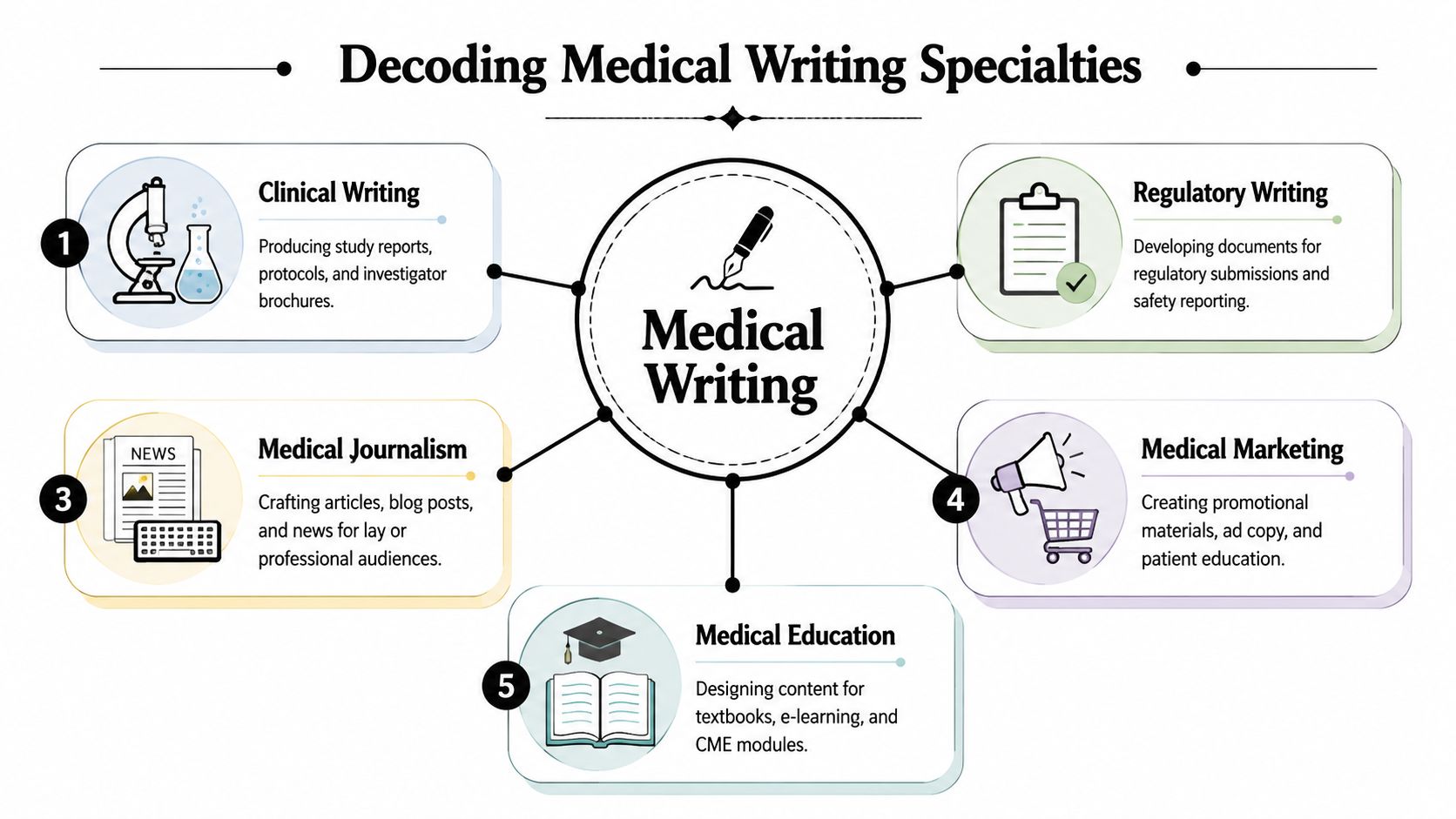
The term medical writing is too broad to be useful on its own. Physicians don't enter one market. They enter several. As Physician Side Gigs notes in its overview of writing paths, doctors may work in consumer health content, CME, regulatory documents, clinical guidelines, grants, ghostwriting, and med-tech collateral, and those niches differ in pay, tone, and credential expectations.
That's why it's comparable to choosing a specialty. The umbrella term is the same. The day-to-day work is not.
Writing for regulators and research teams
This domain offers many high-value physician roles. Regulatory and clinical writing tends to be structured, evidence-heavy, and process-driven. The audience may include sponsors, reviewers, safety teams, or research collaborators. The documents are formal. The tolerances for vagueness are low.
A typical week might include reviewing trial materials, reconciling data narratives, drafting a section of a manuscript, or turning a core evidence package into abstracts, slides, and publication-ready derivatives.
This type of work suits physicians who like:
- Precision over personality: The goal is clarity and compliance, not a distinctive voice.
- Document architecture: You need to organize long, technical material logically.
- Evidence arguments: You are building a case from data, not just summarizing facts.
Writing for clinicians and medical education audiences
CME, medical education, and med comms sit in a different lane. Here, the audience often already knows the medicine. Your job is to make the evidence teachable, relevant, and usable. Tone matters, but not in the same way it does in public-facing writing. You need authority, balance, and good instructional judgment.
If you've ever enjoyed grand rounds, case conferences, or teaching residents, this niche often feels familiar.
Common outputs include:
- Slide decks and speaker materials: Content for peer-to-peer education
- Program summaries and abstracts: Clear takeaways for busy clinician audiences
- Advisory-board support materials: Documents that need both scientific grounding and strategic clarity
A doctor who teaches well often adapts to CME writing faster than a doctor who simply writes elegantly.
Writing for the public and consumer health readers
This is the most visible niche online, and also the one doctors most commonly misunderstand. Public-facing health writing is not easier. It's just different. You have to write in plain language without becoming simplistic, and you need to anticipate fear, confusion, and misinformation.
This path works well if you enjoy translating medicine into everyday language. It's less about sounding scholarly and more about answering the question a thoughtful patient would ask.
A quick fit check
| Niche | Best fit for | Core challenge |
|---|---|---|
| Regulatory and clinical writing | Detail-oriented physicians | Formal standards and process discipline |
| CME and med ed | Doctors who like teaching peers | Balancing depth with usability |
| Consumer health | Doctors who explain clearly to patients | Writing plainly without losing accuracy |
| Grants and guidelines | Academically inclined physicians | Consensus language and evidence framing |
| Med-tech collateral and medical marketing | Clinicians comfortable with industry | Audience-specific messaging within guardrails |
The mistake I see most often is physicians applying randomly. A specialist with strong research literacy may chase low-value consumer articles, while a doctor with a gift for patient education tries to force a fit in regulatory work they'll hate. The smarter move is to pick the lane that matches how you already think.
The Lifestyle Prescription Pros and Cons
Most doctors don't switch because they suddenly fell in love with Word documents. They switch because they want a better life. That's a fair reason. It's also why you should judge medical writing by the lived experience of the work, not just by the title.
What gets better
The biggest benefit is usually control over time. Many writing roles are remote. Many are weekday-based. Many allow focused blocks of work rather than fragmented clinical hours. If your nervous system is tired of constant interruption, that alone can feel restorative.
Then there's the cognitive shift. Clinical medicine can be emotionally intense, physically draining, and administratively noisy. Writing work is demanding in a different way. The fatigue is more often from concentration and revision than from confrontation, crises, or nonstop patient throughput.
Doctors also tend to value the autonomy. You may be able to choose projects, limit your schedule, or keep a reduced clinical role while building something that feels less extractive.
What gets harder
The trade-offs are real. Early on, income may be uneven. You may spend time pitching, networking, revising samples, or learning workflows that no one taught you in residency. If you're used to a paycheck that arrives predictably, the adjustment can feel uncomfortable.
There's also less built-in social contact. Medicine gives you teams, even when the teams are stressed. Writing can be solitary. If you move from a packed clinic to a home office overnight, the silence may feel welcome for a while, then oddly flat.
A few practical downsides show up repeatedly:
- You must manage yourself: No attending, clinic manager, or hospital schedule is structuring your day.
- Feedback can be less immediate: A strong draft may still go through multiple revisions with little emotional reward.
- Your impact feels indirect: You are influencing care, education, or evidence communication, not treating the patient in front of you.
Practical rule: Don't ask whether medical writing is easier than practice. Ask whether its stressors are more compatible with the life you want.
Who usually thrives
I've seen this transition work best for physicians who are burned out by the conditions of practice, not by the intellectual content of medicine itself. If you still like evidence, explanation, and careful thinking, writing can feel like a relief. If you dislike sitting still, working alone, or revising the same paragraph six times, some niches will grate on you.
The key is not to romanticize the move. Medical writing can give you freedom, but only if you choose a structure that protects it. A bad writing job can still consume evenings, create deadline pressure, and blur home and work. The difference is that you usually have more ability to say no.
Building Your Writing Skills and Portfolio
Doctors often underestimate how much of the skill set they already have. They also underestimate what employers mean by “writing experience.” Those two errors cancel each other out in the worst possible way. You feel unqualified for jobs you could learn, then apply to roles without showing the kind of evidence employers actually want.
According to medical writer job listings on Indeed in Dallas, physician-oriented medical writing roles often go far beyond generic content creation. Senior positions may require literature review, data synthesis, manuscript drafting, journal submission standards, and derivative outputs such as white papers, abstracts, slide decks, and funder summaries. Employers also frequently ask for advanced clinical or science degrees plus 5+ years of peer-reviewed writing experience.
Skills you already use in medicine
If you've trained and practiced as a physician, you already do several parts of this work:
- Chart review becomes literature review: You know how to extract signal from a large amount of information.
- Assessment and plan becomes structured argument: You take data, prioritize it, and explain why one interpretation matters more than another.
- Grand rounds becomes educational writing: You already know how to organize evidence for a clinician audience.
- Research or QI presentations become publication workflow exposure: Even limited manuscript involvement helps if you can describe your role clearly.
What you may still need is polish. That includes formatting, audience awareness, citation management, and the discipline to write to spec rather than to your own preferences.
Three portfolio pieces you can build fast
Your first portfolio doesn't need to be huge. It needs to show range, judgment, and reliability.
A clinician-facing trial summary
Pick a recent landmark paper in your field. Write a concise summary for busy physicians. Include the clinical question, the design, the key limitations, and how the results should change practice, if at all.A patient-facing explainer
Choose a condition you discuss often in clinic. Write a plain-language piece that answers what it is, how it's diagnosed, and what treatment decisions commonly involve. This shows you can translate without patronizing.A mini literature synthesis
Take a focused topic and compare several papers. The goal isn't to write a full review article. The goal is to show that you can synthesize competing evidence into a coherent narrative.
What a usable portfolio should include
| Piece | Audience | What it proves |
|---|---|---|
| Trial summary | Clinicians | Evidence appraisal and concise analysis |
| Patient explainer | General public | Clarity, empathy, plain language |
| Literature synthesis | Employers or agencies | Higher-order reasoning and structure |
Presentation matters too. If you plan to package longer educational work or an ebook sample, strong design helps your material look credible. For physicians exploring book-length educational projects, generate non-fiction book covers only after the writing is solid. A polished cover can support a professional sample, but it can't rescue weak thinking.
If your CV still reads like a residency-era document, revise that before you apply. A clinically impressive CV is not automatically a strong nonclinical one. This physician CV guide for nonclinical transitions is a useful starting point for reframing experience around writing, teaching, publications, and project ownership.
Your portfolio should answer one question quickly: can this physician turn medical expertise into a deliverable an editor, agency, or employer can actually use?
The Financial Diagnosis Salary and FIRE Implications
Money is where vague advice becomes dangerous. Physicians considering medical writing rarely need another pep talk about “following your passion.” They need an honest read on whether the work can support a serious life.
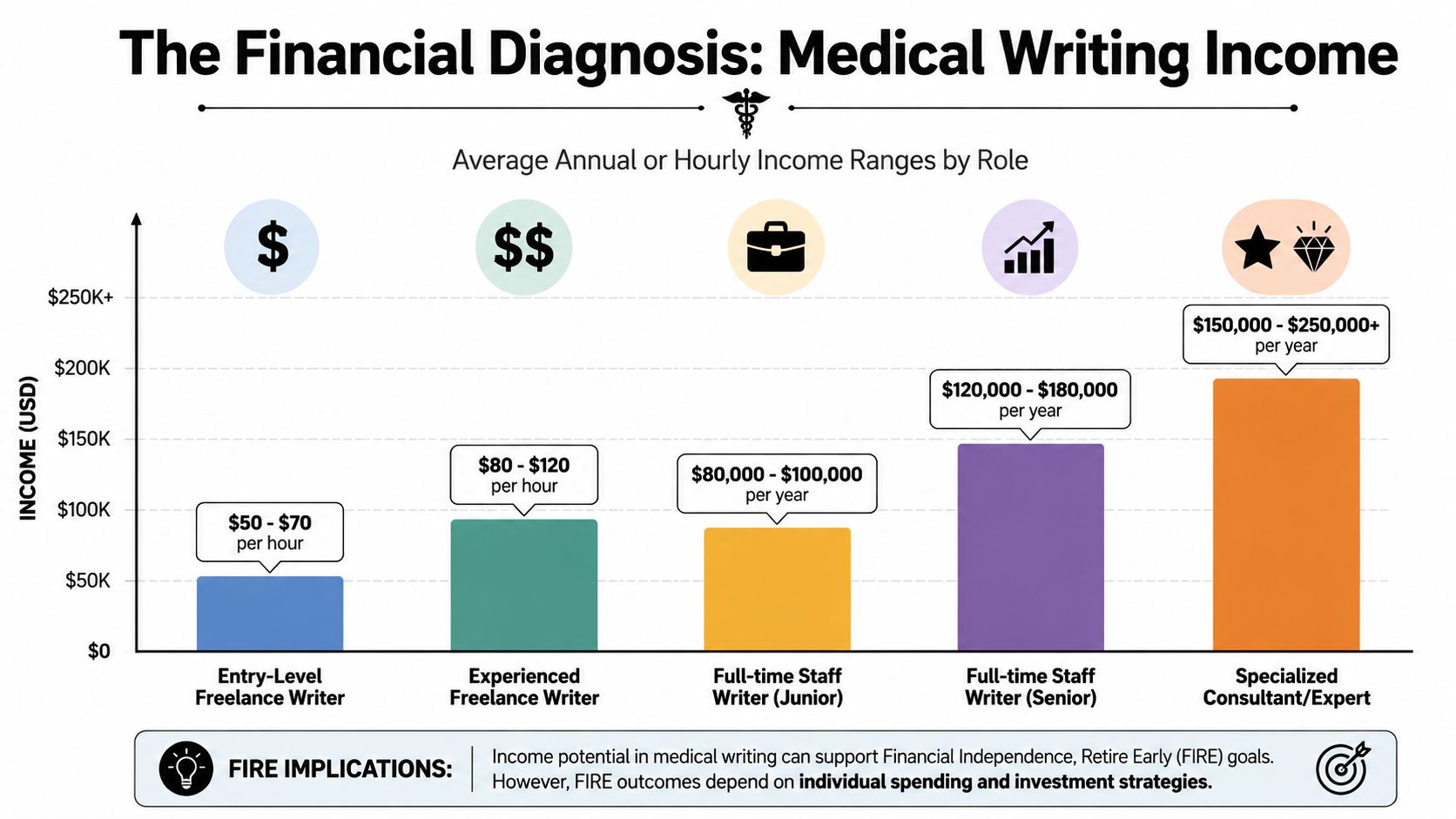
One of the most useful physician-facing summaries comes from Doctors Crossing's guide to getting started in medical writing. It notes that rates vary widely, can reach roughly $150/hour for consumer-health review work, and up to $300/hour or more for large pharma and global healthcare companies. The same guidance also warns new freelancers not to quit their day job because full-time income is hard to achieve early on. It further cites labor-market data showing 31% of physicians reported a nonclinical side gig and 18% reported selling a service such as writing or consulting.
That combination provides an accurate depiction. The upside is meaningful. The ramp can be slow.
What the numbers mean in practice
If you're reviewing consumer health content, advising on accuracy, or taking on physician-review assignments, your income profile may look very different from someone writing for pharma, med-tech, or publication strategy teams. The physician premium tends to be strongest where medical judgment is hard to replace.
That doesn't mean every doctor should chase the highest headline rate. High-paying niches often come with more process, more revision rounds, and higher expectations around publication standards or stakeholder management.
Here's a more practical perspective:
- Side-income path: Start with smaller physician-review or educational assignments while keeping clinical work.
- Hybrid path: Reduce FTE clinically and build writing around protected weekdays.
- Full transition path: Move into agency, pharma, med-ed, or consulting work once your portfolio and systems are strong.
Later in the decision process, it helps to hear other physicians talk through the trade-offs. This video is a useful complement to the written guidance:
Why this matters for FIRE
For physicians interested in financial independence, the better question is not “Can medical writing match my highest clinical income?” It's “Can it support a durable plan with lower burnout risk?”
A sustainable writing career may pair well with:
- Lower overhead living: especially if you work remotely
- Longer earning runway: because the work may be easier to continue than intense clinical practice
- Reduced stress spending: fewer compensatory purchases, travel burdens, or recovery costs from a punishing schedule
You don't need a perfect income replacement if the new career is more sustainable, more flexible, and easier to keep doing for years.
For many doctors, that's the actual win. Not peak earnings. Durable earnings.
How to Find Burnout-Friendly Writing Jobs
Most bad career moves happen at the job-description stage. The title looks promising. The work sounds intellectual. Then you realize the company wants three channels of communication open at all times, endless same-day revisions, and “flexibility” that only runs in one direction.
Medical writing jobs for doctors can be burnout-friendly, but you have to screen for that deliberately.
Read the tools and workflow language carefully
In remote medical writer listings on Indeed, major-market medical education and communications roles often require work across digital, live virtual, in-person, and hybrid programs, while using systems such as SharePoint, Google Drive, Workfront, Box, EndNote, and Tableau. That tells you something important. Many roles are not just about writing quality. They are about execution inside distributed, deadline-driven teams.
If a listing mentions these tools, don't panic. You don't need to present yourself as a software expert. You need to show adjacent competence.
For example:
- Workfront or project systems: Compare them to managing parallel clinic, committee, and documentation deadlines.
- EndNote: Frame any experience with citations, references, or manuscript prep.
- Tableau or dashboards: If you've worked with quality metrics or operational reporting, say so plainly.
- SharePoint, Box, Google Drive: Emphasize version control, collaboration, and document discipline.
Green flags and red flags
A healthy writing role usually signals itself in the language.
Green flags
- Asynchronous collaboration: Fewer constant interruptions
- Clear deliverables: You know what done looks like
- Defined review cycles: Revisions exist, but they're structured
- Audience clarity: Clinician, patient, regulator, or payer. Not everyone at once
Red flags
- Fast-paced in every line: Often means chronic urgency
- Must handle pressure: Usually code for poor planning
- Many hats in a small team: Can be good, can also mean invisible overtime
- Always-on stakeholder management: Writing becomes reactive project firefighting
A simple cover letter frame
Keep your first note short:
I'm a board-certified physician transitioning part of my work into medical writing. My clinical background in [specialty] trained me to interpret evidence, communicate clearly to different audiences, and work accurately under deadline. I'm particularly interested in roles involving [CME, regulatory, clinician education, patient education], and I've included writing samples that reflect that focus.
If your job search is happening during a period of high strain, protect your bandwidth. A good set of anxiety learning resources can help if the uncertainty of a career pivot starts spilling into sleep, concentration, or decision-making.
You'll also save time by broadening the search beyond writing-only titles. Many physician-friendly opportunities sit inside broader nonclinical jobs for doctors categories such as medical communications, clinical content strategy, and education roles.
Your Roadmap from Clinic to First Paid Project
The doctors who make this transition usually don't do it in one dramatic leap. They do it in a sequence. That's good news, because it means you don't need a perfect plan. You need a workable one.
First two weeks
Choose one niche only. Not three. Pick the lane that fits your strengths best, whether that's clinician education, regulatory-style work, or public-facing medical communication.
Then collect examples. Save job descriptions. Highlight repeated terms. Notice what those employers ask for, not what you assume they want.
First month
Build one strong portfolio piece and finish it. A completed sample beats an outline for five different ideas.
At the same time, rewrite your professional narrative:
- Headline: Physician with expertise in evidence synthesis and medical communication
- Experience bullets: Focus on publications, teaching, presentations, protocols, committee work, and any writing-adjacent deliverables
- Online presence: Make your profile consistent with the niche you chose
If industry-facing roles appeal to you, this guide to physician jobs in the pharmaceutical industry can help you understand adjacent paths that overlap with writing.
Months two and three
Start applying selectively. Don't spray your CV across the internet. Aim for a short list of roles that match your niche, your schedule goals, and your tolerance for meetings and revision cycles.
At the same time:
- Reach out to warm contacts: former coauthors, faculty, CME contacts, med-tech colleagues
- Offer a low-friction first service: physician review, educational summary, trial interpretation, manuscript support
- Track every application and pitch: title, company, contact, sample sent, follow-up date
Your first paid project is rarely the ideal project. It is proof that your expertise can cross the border from clinic into a different market.
That proof changes everything. Once someone pays you for your judgment in writing form, the transition stops being theoretical. You are no longer “thinking about” medical writing. You are building it.
The strongest long-term strategy is rarely all-or-nothing. Many physicians create the best outcome by reducing clinical load, building writing income carefully, and only then deciding whether to go fully nonclinical. That preserves your options, protects your finances, and gives you room to find work that improves your life rather than merely changing your job title.
If you're ready to find physician-friendly roles that protect your evenings, weekends, and sanity, WeekdayDoc is built for exactly that search. It curates burnout-conscious opportunities, including remote and weekday-only roles, so you can explore a nonclinical path without digging through generic job boards.