Physician Teaching Jobs: The 2026 Burnout-Friendly Guide
Explore physician teaching jobs in 2026. This guide covers roles, salary, FIRE, and how to find burnout-friendly, no-call teaching positions for clinicians.

If you're reading about physician teaching jobs at the end of a clinic day, you probably aren't chasing prestige. You're trying to figure out whether there's a version of medicine that still uses your training without taking every evening, every weekend, and every ounce of patience.
That's the gap most articles miss. They either treat teaching like a vague academic calling or they dump you into broad faculty listings that don't tell you what the work looks like, how much clinical time is buried in the role, or whether "flexible" means no call or just unpaid work at home.
The practical question is simpler. Can teaching give you a sustainable career with less chaos, more control over your schedule, and income you can live with? In many cases, yes. But the answer depends entirely on which teaching lane you're considering, how your specialty is paid now, and whether you're willing to trade throughput for preparation, mentoring, and institutional work.
Beyond the Clinic Why Physicians Are Turning to Teaching
A lot of clinicians arrive here after trying the obvious fixes first. They cut FTE. They switch groups. They move from hospital-employed to private practice, or the reverse. Sometimes that helps. Sometimes it just changes the flavor of the stress.
Teaching becomes attractive when the core problem isn't medicine itself. It's the operating model. You may still like explaining disease, coaching trainees, building systems, and helping people learn. You may just be done with the parts of clinical work that depend on speed, inbox tolerance, and being constantly available.
What most clinicians actually want to know
The frustrating part is that the market doesn't present physician teaching jobs in a useful way. Neutral career guidance shows that physician teaching can include precepting in clinical settings, lecturing in medical and allied-health schools, simulation and skills instruction, and CME content creation, and that some roles start as volunteer or part-time work, as described in this overview of teaching and educational administration opportunities for physicians.
That matters because those aren't interchangeable jobs.
A preceptor role may still tether you to clinic. A simulation role may be highly structured and weekday-based. CME development may be largely asynchronous. A faculty title may sound academic but still carry service obligations that have nothing to do with teaching. If you don't separate those pathways early, it's easy to apply to the wrong jobs and conclude that teaching isn't a real option.
Practical rule: Don't search for "faculty" first. Search for the work style you want first, then identify which teaching role delivers it.
Why teaching appeals to burned-out clinicians
The attraction usually comes down to a few real changes:
- More predictable time blocks. Teaching runs on calendars, course schedules, and program cycles rather than pure patient demand.
- Different cognitive load. You're still using expertise, but not in the same rapid-fire, interruption-heavy way.
- A broader sense of impact. Some clinicians find that teaching restores meaning because they're shaping how care is delivered by others.
- A plausible bridge, not an all-or-nothing leap. Many people start with guest lectures, precepting, curriculum work, or board review teaching before making a larger move.
If you're still deciding whether this is a side lane or a full transition, this guide to alternative careers for physicians is a useful starting point because it frames teaching as one of several sustainable career paths rather than a niche academic identity.
The Landscape of Physician Teaching Roles
The term "academic medicine" hides too much. The old image was straightforward: clinician, researcher, teacher, all under one roof. That model still exists, but it's not the only one, and for many job seekers it isn't even the relevant one.
The structure of academic medical careers has shifted. Among U.S. physicians, those reporting research as their major professional activity fell from 13,557 in 2011 to 12,289 in 2020, a decline of 1,268 physicians, or 9.4%, while MD faculty in basic science departments increased from 1,824 to 2,051, a 12.4% increase, according to this analysis of physician-scientist workforce trends. That tells you something important. "Teaching jobs" no longer map neatly onto the classic physician-scientist path.
The role categories that matter in practice
Some physician teaching jobs sit inside universities. Others live in hospitals, community training programs, exam prep, simulation centers, or education companies. The day-to-day experience varies more than the titles suggest.
Here is the practical breakdown.
| Role Type | Typical Schedule | Income Profile | Key Qualifications | Remote/Hybrid Potential |
|---|---|---|---|---|
| Tenure-track or research-oriented faculty | Mix of teaching, scholarship, committee work, and often clinical duties | Often tied to academic pay structures, with research expectations affecting advancement | Board certification usually helps, scholarly output often matters, institutional fit is critical | Limited unless work is heavily didactic or administrative |
| Clinical faculty and preceptor roles | Teaching built around learner supervision in clinic or hospital settings | May be blended with clinical compensation or stipend-based arrangements | Active clinical credibility, teaching evaluations, program-specific requirements | Usually low if learners must be supervised in person |
| Allied health or community college instructor roles | More scheduled classroom and lab teaching, less research pressure | Can be steadier but may differ from physician compensation expectations | Subject expertise, strong communication, sometimes prior teaching experience | Moderate for lecture-heavy courses |
| Simulation and skills instruction | Session-based teaching, workshop days, assessment blocks | Often part-time or contract-based, sometimes combined with other work | Procedural expertise, comfort with assessment, debriefing skill | Low to moderate, depending on program design |
| CME and content development | Project-based writing, editing, slide development, recorded teaching | Highly variable, often more flexible than university salary models | Clear communication, subject expertise, reliability with deadlines | High when content creation is asynchronous |
| Corporate medical education | Product, disease-state, or internal education roles | Can differ substantially from academia and may fit nonclinical compensation models better | Clinical experience, presentation skill, comfort with stakeholders | Often moderate to high |
How to narrow the field
Start with your constraint, not your credentials.
- Need true weekday-only work. Focus on classroom instruction, curriculum roles, CME, and some allied health faculty jobs.
- Need to keep one foot in practice. Clinical faculty or precepting can work, but get explicit about how many sessions are clinical.
- Need location flexibility. Didactic teaching and content-heavy roles have better remote or hybrid odds.
- Need a cleaner boundary from patient care. Simulation, online education, and assessment work usually separate more clearly from throughput pressure.
Most physicians don't need "a teaching career." They need a teaching format that matches the life they're trying to build.
A title can mislead you in both directions. "Assistant Professor" may mean heavy committee work and little autonomy. "Medical educator" may be a lean, well-defined role with better control over your week.
A Day in the Life of a Physician Educator

The biggest adjustment isn't the title. It's the tempo.
Physician teaching jobs are structurally different from standard clinical roles. The work centers on curriculum delivery and instruction rather than direct patient throughput, and teaching faculty often have comparatively flexible schedules aligned to the academic calendar, which can reduce exposure to overnight, weekend, and call-heavy patterns, as outlined by the American Association for Physician Leadership on teaching careers for physicians.
What the work week actually feels like
A teaching week is usually less reactive and more front-loaded. Instead of seeing whether the schedule explodes by 10 a.m., you're preparing for known events: lectures, small groups, simulation sessions, office hours, learner remediation meetings, grading, and curriculum updates.
That doesn't mean it's easy. Preparation time is real work. A one-hour lecture can take many hours if you're building something new, updating evidence, or tailoring content to a mixed audience of medical students, NPs, PAs, pharmacists, or psychologists.
A typical rhythm often includes:
- Teaching blocks with lectures, labs, or facilitated discussion
- Quiet work periods for slide revision, assessment writing, and email
- Mentorship time with learners who need career advice or performance support
- Administrative obligations such as committee meetings, accreditation tasks, or course planning
Where people underestimate the job
Clinicians often assume teaching will feel lighter because the patient schedule disappears. Sometimes it does. Sometimes it doesn't.
The pressure just changes form. Instead of a full waiting room, you may carry the responsibility of building a course that has to work for an entire cohort. Instead of charting, you may be editing learning objectives, calibrating exam questions, or documenting learner performance concerns.
The calmer schedule is real. The need for preparation is also real. If you hate building, revising, and repeating educational material, teaching won't rescue you.
For physicians who want to become more deliberate educators, formal training can help. A structured resource like this path to medical education specialist can help you understand the competencies behind curriculum design, learner assessment, and faculty development before you commit to a larger transition.
The lifestyle shift most people notice first
The most immediate benefit is usually predictability. You know when classes are scheduled. You know when exams are coming. You can often see the intense weeks in advance.
That doesn't guarantee a no-call life, because some teaching roles still include clinical coverage. But when the job is primarily educational, your energy isn't being spent on constant patient volume management. For many burned-out clinicians, that alone changes how evenings feel.
Salary Benefits and FIRE Implications
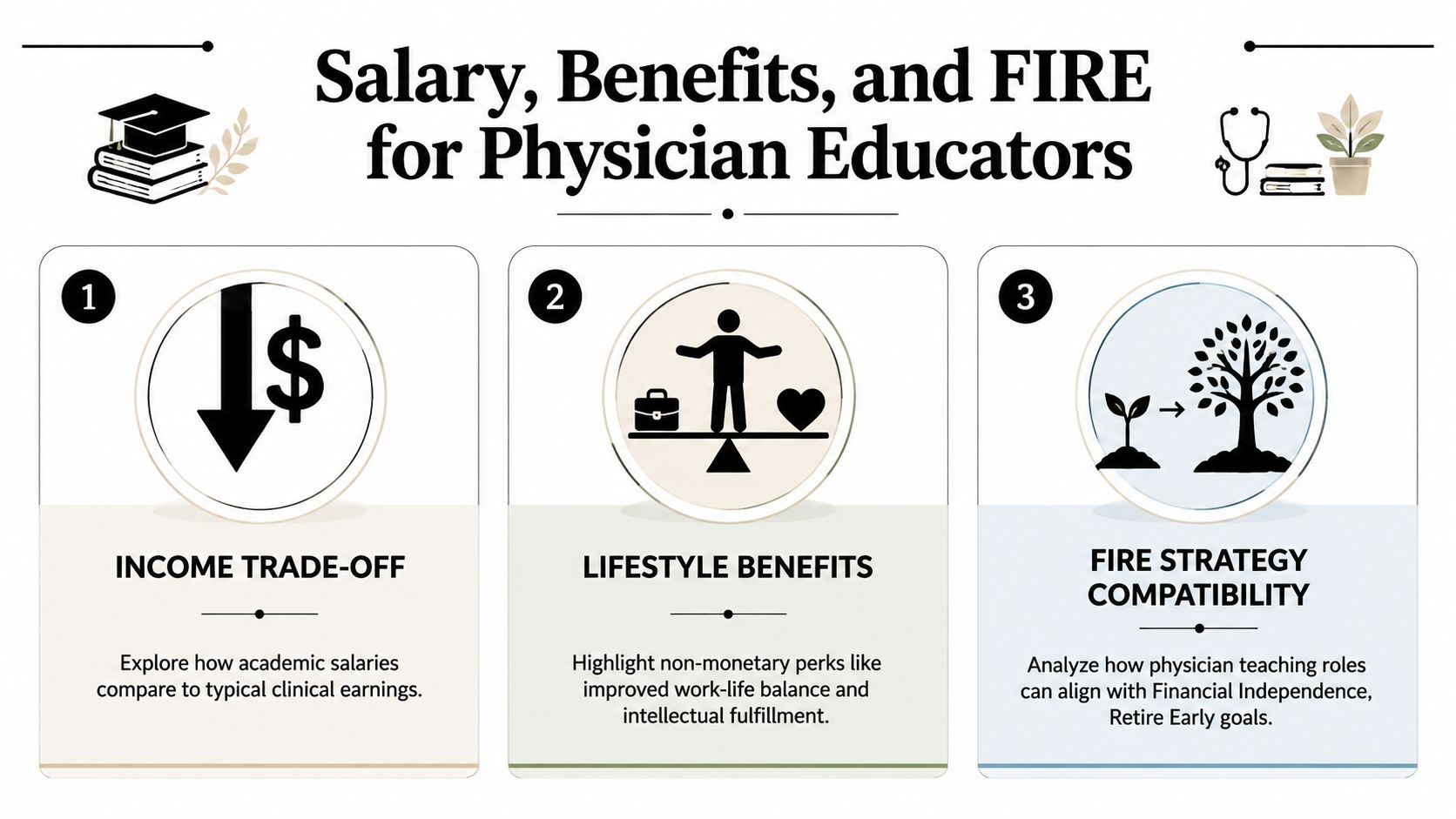
A physician leaving a busy clinical role for teaching usually asks one question first. What happens to my income?
The honest answer is less tidy than many recruiters make it sound. Some teaching roles pay meaningfully less than full-time clinical work. Some are close enough that the difference is smaller than expected once you account for call, weekend coverage, productivity pressure, commuting, and the wear of sustaining that pace for years. Independent career guidance from NEJM CareerCenter makes the same point. Nonclinical and education-focused physician work can pay competitively in some settings, but highly compensated specialists often face a real drop, as discussed in this NEJM CareerCenter article on nonclinical physician work.
The comparison that matters is not your peak earning year. It is your sustainable earning year.
If your current salary depends on extra shifts, procedural volume, overnight call, or a schedule that leaves you too depleted to keep going, that number is a poor benchmark. Compare a teaching offer to your sustainable clinical earnings. For a hospitalist or primary care physician who wants predictability and lower after-hours burden, the pay cut may be modest. For an orthopedic surgeon, interventional cardiologist, or gastroenterologist in a productive private setting, the opportunity cost can be substantial. That does not make teaching a bad financial move. It means the decision has to be made with clear eyes.
Benefits often matter more here than physicians expect. University and health system teaching jobs may include strong retirement contributions, tuition benefits, subsidized health insurance, and more paid time off than a production-based clinical contract. Those items do not erase a salary gap, but they can narrow it. I have seen physicians focus on base pay, then realize later that a lower-stress role with a predictable pension contribution and fewer unpaid recovery days left their household cash flow in better shape than expected.
FIRE planning changes too. A teaching job supports financial independence when it lets you save at a steady rate for longer, not when it merely sounds calmer on paper.
A burnout-friendly teaching role can improve a FIRE plan in a few concrete ways:
- More predictable cash flow. Fixed schedules make budgeting and tax planning easier than compensation tied to fluctuating RVUs or extra shifts.
- Longer earning lifespan. A physician who can work seven more tolerable years may come out ahead of one who leaves a higher-paying role after two exhausted years.
- Room for selective side income. Evenings or nonclinical days can support consulting, expert witness work, board review teaching, locums, or CME development.
- Better spending decisions. Burned-out physicians often spend reactively, paying for convenience, recovery, or escape.
There is a trap on the other side. Some academic roles offer lower pay, heavy committee work, slow promotion, and vague expectations around curriculum, learner remediation, and service. Financially, those jobs can be worse than staying clinical because they cut income without protecting your time.
That is the standard I use. Lower pay is acceptable. Lower pay plus poor boundaries is not.
The practical test is simple. Run the numbers against your own target, your debt load, your retirement timeline, and the amount of clinical work you still want to keep. This guide on how to calculate your FIRE number is a useful starting point if you want to model whether a lower-stress teaching role still gets you where you want to go.
Finding and Evaluating Burnout-Friendly Teaching Jobs
At 9 p.m., the wrong teaching job still feels like the clinical job you were trying to leave. The inbox is full of learner issues, tomorrow's slides are not finished, and a "0.6 FTE teaching role" includes committee work, remediation meetings, and weekend email. Burnout-friendly roles exist, but the posting rarely makes that clear.
Where to look first
A generic search for "faculty physician" pulls in many jobs that are mostly service coverage with a teaching label attached. Search by function, learner type, and schedule instead.
- Use education-specific keywords such as curriculum, simulation, didactic, course director, assessment, remediation, preceptor, instructional design, or CME.
- Search by learner population. Medical students, residents, PA students, NP students, pharmacy trainees, and practicing clinicians all create different rhythms and stress points.
- Screen for schedule terms such as academic calendar, protected teaching time, hybrid, remote, asynchronous content development, no call, and no weekends.
Job boards are only the start. Department chairs, program directors, simulation centers, community-based medical schools, PA and NP programs, and CME companies often hire through their own networks before a role is written clearly enough for a public posting.
How to read a listing like a contract
The title matters less than the operating details. I look for what the institution is trying to solve. If they need a teacher, the job usually names courses, learners, contact hours, and reporting lines. If they need cheap labor, the posting stays vague and piles on broad terms such as faculty support, student affairs, service, professionalism, and other duties as assigned.
These are the details that predict whether the job will protect your time or consume it:
Protected time
"Teaching responsibilities included" is not enough. Ask how many hours or sessions are reserved for prep, feedback, grading, office hours, and meetings. If protected time disappears during staffing shortages, it is not protected.Clinical load
Clarify whether patient care is optional, capped, or expected to expand. Some institutions hire physicians into "education" roles and then use them to patch clinic access problems.Committee burden
Admissions, curriculum review, accreditation prep, learner remediation, and faculty governance can each be reasonable. Combined, they can turn a calm schedule into death by meetings.Promotion and scholarship expectations
If advancement depends on presentations, publications, or educational scholarship, ask where that work fits in the week. Evening writing is still after-hours work.Remote versus remote-friendly
A true remote role can be done from home most days. A remote-friendly role often still requires regular campus presence for labs, OSCEs, student support, or exam administration.
Questions that save you months of regret
Ask these before the second interview, not after you are emotionally committed.
- How many hours each week are live teaching, prep, grading, and learner advising?
- What work regularly spills outside business hours?
- During accreditation, exam blocks, or remediation periods, what changes?
- Who handles struggling learners, documentation, and appeals?
- What percentage of this role has become clinical coverage in the past year?
- Why is this position open?
That last question is underrated. Growth is different from turnover. A new program, a retiring course director, and a team that has kept stable boundaries for years are good signs. A role that has changed hands three times in two years usually has a workload problem, a leadership problem, or both.
Before accepting an offer, use a structured checklist for evaluating physician job offers with burnout risk in mind. Teaching jobs deserve the same scrutiny as clinical contracts, especially when the pay cut is real and the promise is better control of your time.
A vague answer usually predicts a vague job. In physician teaching jobs, vagueness is expensive.
The Transition Resume Interviews and Contracts
A strong clinician already has most of the raw material needed for physician teaching jobs. The issue is translation. Your CV may prove expertise, but it won't automatically show that you can teach, assess, mentor, and build educational systems.
Reframe your experience for education
Your resume should surface work that academic and training leaders value.
- Patient education becomes evidence that you can explain complex ideas clearly to different audiences.
- Resident or student supervision shows direct teaching and feedback experience.
- Grand rounds, conference talks, and workshops demonstrate content development and public speaking.
- Protocol development maps well to curriculum design and standard-setting.
- Committee work can support your candidacy if it involved quality improvement, assessment, recruitment, or learner support.
If you've mentored junior faculty, created onboarding materials, or revised departmental teaching slides, include that. Many clinicians leave out exactly the experience that would make them credible.
Your clinical CV says, "I know medicine." Your teaching resume must also say, "I can help other people learn it."
Interview for the role you want, not the role you're leaving
Teaching interviews often probe identity as much as competence. Expect questions such as:
- How would you describe your teaching philosophy?
- How do you work with a struggling learner?
- How do you adapt teaching for mixed levels of experience?
- What role should assessment play in professional training?
- How would you balance educational quality with institutional constraints?
The wrong answer is polished abstraction. The better answer uses real examples from patient education, trainee supervision, or interdisciplinary teaching and explains what you changed when something didn't work.
Contract terms that deserve more attention
Teaching contracts often look softer than clinical employment agreements, but they can hide risk in different places. Review these carefully:
- Role definition. Are teaching duties specifically named, or can they be diluted by service or clinical demands?
- Intellectual property. Who owns the lectures, modules, and course materials you create?
- Promotion expectations. If rank advancement matters, are the criteria realistic for your workload?
- Outside work rules. Can you moonlight, consult, write CME, or maintain limited clinical practice?
- Termination language. Academic appointments and annual renewals can create uncertainty if terms are loose.
Before you sign, use a structured framework for how to evaluate job offers. Teaching roles deserve the same scrutiny you would give any production-based clinical contract.
Conclusion Building a Sustainable Career Through Teaching
Physician teaching jobs make sense for a specific kind of clinician. Not someone who wants to stop using medical judgment. Someone who wants to use it in a way that is more deliberate, more structured, and less punishing.
For some people, that means full-time faculty work. For others, it means simulation teaching, adjunct lecturing, precepting, or CME development layered onto part-time clinical practice. The right move isn't the most academic one. It's the one that matches your financial reality, your tolerance for institutional work, and the kind of week you want to live inside.
Teaching won't solve every problem. Bad departments still exist. Underpaid roles still exist. Titles still hide vague expectations. But the better physician teaching jobs offer something many clinicians haven't had in years: a job where expertise matters, the calendar is visible, and your energy isn't drained by constant throughput.
If you're burned out, that doesn't automatically mean you need to leave medicine. It may mean you need a different operating model for practicing it. Teaching is one of the clearest examples of that shift. Done well, it's not an escape route. It's a sustainable career design choice.
If you're ready to see what that looks like in practice, explore WeekdayDoc for physician and advanced clinician roles that prioritize work-life balance, including remote, hybrid, and no-call opportunities that are easier to assess than generic job-board listings.