Utilization Review Physician: End Burnout, Go Remote in 2026
Is a utilization review physician your path from burnout? Explore 2026 salaries, remote work, FIRE potential, and land a no-call job with our guide.
You finish clinic late again. The inbox is still full. You've signed refill requests between patients, argued with a payer over a treatment you know is appropriate, clicked through prior auth screens after dinner, and now you're trying to remember whether medicine still feels like medicine.
That's the moment a lot of physicians start looking sideways.
Not because they want to quit working. Not because they've stopped caring. They want control back. They want a job where their judgment still matters, but their schedule doesn't belong to the EHR, the call schedule, or the constant spillover of unfinished clinical work.
A utilization review physician role can be that off-ramp for the right doctor. It isn't glamorous, and it isn't morally simple. But it is real work, it uses actual medical reasoning, and it often gives physicians something clinical practice no longer does: predictability.
The End of a Long Shift and a Different Path Forward
A lot of burned-out physicians don't need inspiration. They need a credible alternative.
The usual sequence is familiar. First, you try to optimize your clinic flow. Then you cut back hours. Then you tell yourself the next staffing change, EHR upgrade, or compensation redesign might help. Sometimes it does. Often it doesn't.
What finally changes the conversation is realizing that your exhaustion may not be a resilience problem. It may be a role problem.
Why many physicians start looking outside traditional practice
A utilization review physician sits in a part of medicine most clinicians only encounter when they're frustrated. That's one reason the role gets dismissed too quickly. From the outside, it looks like paperwork. From the inside, it's closer to structured medical judgment applied in a different arena.
That difference matters because health care already varies a lot by market. In a multi-state review, NCCI reported that 2022 utilization per claim ranged from fewer than 1,000 to slightly above 2,000 physician services per claim, and that physician service intensity explained most interstate differences while surgery rates usually contributed the least, as described in NCCI's interstate physician utilization analysis. A physician moving into utilization review needs to understand that medical necessity decisions don't happen in a vacuum. Standards, documentation habits, and local practice patterns shift.
What the different path actually offers
The appeal isn't just “remote work.” It's fewer surprises.
For many physicians, the first relief comes from basic structure:
- Predictable hours that don't expand because a patient no-show becomes a double-book and then an urgent add-on.
- Defined output instead of endless residual work after clinic closes.
- Reduced emotional whiplash from moving between direct care, documentation, staff issues, and billing friction.
A good non-clinical role doesn't make you less of a doctor. It changes where your judgment gets used.
That said, utilization review is not a fantasy version of medicine. You're still inside a system built around coverage rules, resource use, and defensible decisions. If you want zero conflict, this isn't the answer. If you want a more bounded form of professional responsibility, it may be.
What a Utilization Review Physician Actually Does
Most physicians hear “utilization review” and think remote chart review. That's incomplete.
The actual job is closer to medical necessity adjudication. You review requests for care, compare the clinical facts against written criteria and policy standards, interpret gray areas, and sometimes speak directly with the treating physician before a final determination is made.
The core function
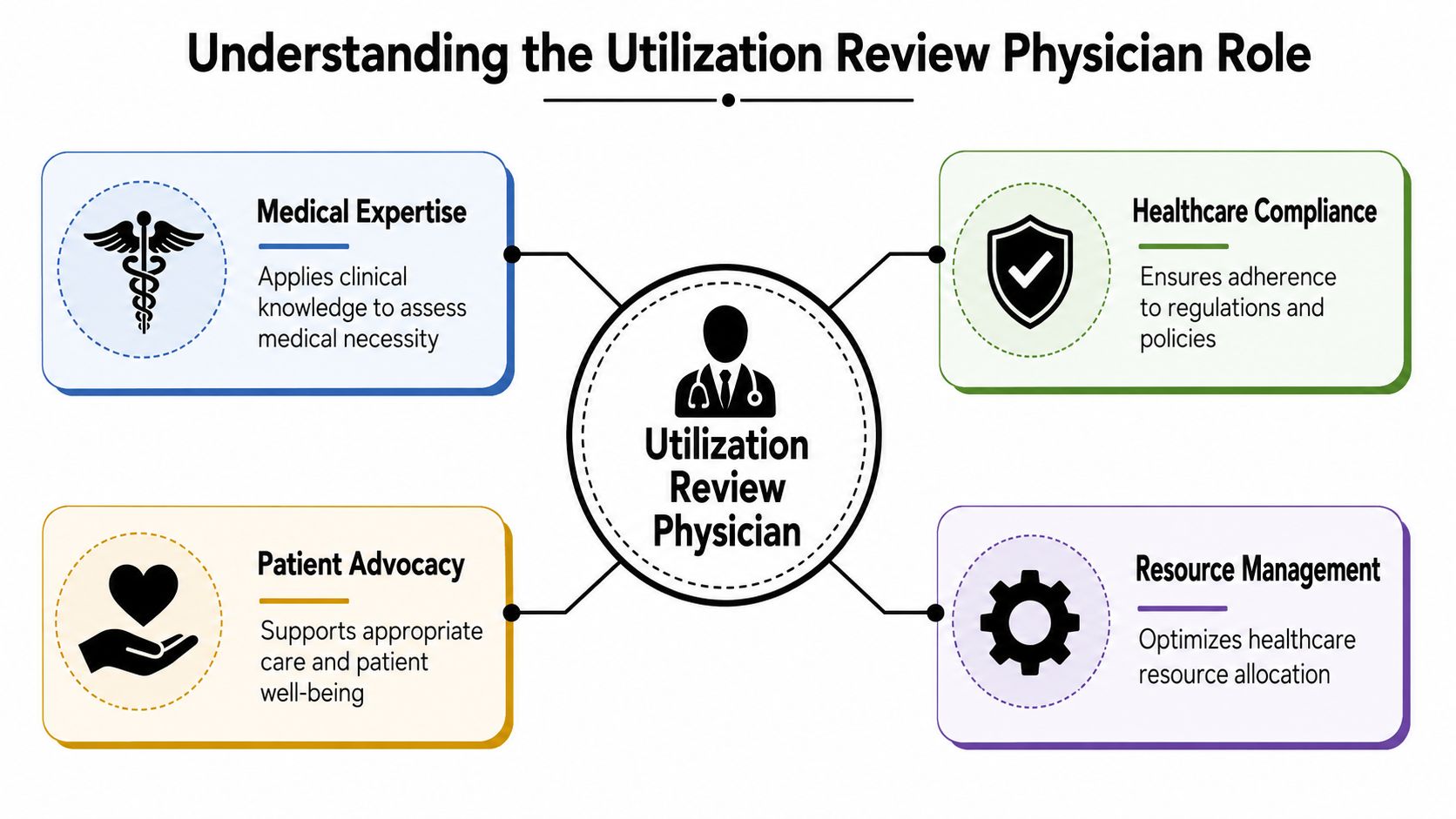
A utilization review physician acts a bit like an air traffic controller for medical necessity. You're not providing bedside care. You're deciding whether the requested service is appropriate at that time, at that level of care, with that documented evidence.
Legal and clinical guidance make an important distinction here. Utilization review physician work often includes prospective, concurrent, and retrospective review, plus peer-to-peer calls and guideline interpretation. It is not just chart reading. It also carries consequences because coverage decisions can affect whether care is approved or financially denied, and denial decisions should be made by licensed physicians using complete clinical information and specialist input when needed, as outlined in this NCBI review of utilization review processes.
The three review types you'll encounter
Prospective review
This happens before a service is delivered.
Examples include requests for advanced imaging, procedures, admissions, or treatment plans that need approval before they move forward. The question is whether the documented clinical picture supports the requested service now.
Prior authorization workflow becomes highly relevant. If you want to understand the operational side from the request-management perspective, tools like RiverAxe prior authorization solutions show the kind of systems organizations use to move cases, records, and status updates through the process.
Concurrent review
This happens during an episode of care.
A patient may already be admitted, receiving treatment, or staying at a certain level of care. The utilization review physician evaluates whether continued hospitalization, monitoring intensity, or service use still meets criteria based on the latest clinical facts.
This is often where doctors with hospitalist, emergency medicine, internal medicine, and behavioral health backgrounds adapt quickly. You're used to asking, “What changed today, and does that justify what happens next?”
Retrospective review
This happens after care has already occurred.
The record gets reviewed to determine whether the service met medical necessity standards based on what was documented at the time. This can feel less clinically satisfying because you can't alter the patient's path in real time, but it still requires careful reasoning and defensible writing.
What the role is not
It's not passive. It's not endless free-form chart reading. It's not merely rubber-stamping denials.
A strong reviewer does four things well:
- Identifies the decision point rather than summarizing the whole chart.
- Applies the right standard for level of care, treatment necessity, or service appropriateness.
- Communicates clearly with treating clinicians during peer-to-peer calls.
- Documents rationale in a way that stands up to appeal or audit.
The worst utilization reviewers sound vague. The strong ones can explain a determination in plain clinical language, tied to the record and tied to the rule.
That's why many burned-out physicians find the work oddly refreshing at first. You use clinical reasoning, but the workday usually has edges.
Responsibilities Metrics and Employer Types
The daily work is more structured than most physicians expect. That's a strength if you're leaving a chaotic practice environment. It's a problem if you need novelty every hour.
What fills the day
Most utilization review physicians work from a queue. Cases arrive after they fail automated rules or earlier review screens. You review the chart, isolate the criterion-relevant facts, compare them against written standards, make a determination, and document the rationale.
The workflow is highly criteria-driven. Physician advisers evaluate cases that fail automated or nurse-review screens using written criteria such as AEP or ISD-A, and those criteria are applied to decisions about hospitalization, continued stay, level of care, and appropriateness of services. In practice, review volume can range from as few as 10 to as many as 200 cases per day, according to this NCBI overview of physician adviser workflow.
That range tells you something important. Not all utilization review jobs are the same. Some involve thoughtful specialty-level review with moderate volume. Others are built around fast triage and relentless throughput.
The metrics that matter
Success in the role usually comes down to a few practical dimensions:
- Turnaround discipline. Cases have deadlines, and missing them creates operational and compliance problems.
- Decision consistency. Two similar charts should not get wildly different outcomes from the same reviewer.
- Documentation quality. Weak rationale creates appeal risk.
- Professional communication. Peer-to-peer calls can either clarify a case or escalate conflict.
If you've worked with case management or hospital utilization teams, you've already seen a parallel role on the nursing side. This overview of remote utilization review nurse work is useful because it shows how closely physician and nurse reviewer workflows intersect, even though the physician role usually carries the final responsibility on more complex determinations.
Employer environments feel very different
A physician can do utilization review for a payer, a hospital, a PBM, or an independent review organization. The title may look similar. The day-to-day experience may not.
| Employer Type | Typical Culture | Compensation Model | Work-Life Balance |
|---|---|---|---|
| Insurance company or payer | Process-driven, deadline-focused, policy-heavy | Usually salaried or structured contract work | Often predictable, but pace can be intense |
| Hospital or health system | More collaborative with case management and bedside teams | Salaried, sometimes tied to physician adviser duties | Often steadier if embedded in one system |
| PBM | Medication-focused, formulary and step-therapy centered | Salaried or contract, depending on role | Can be highly remote, often repetitive |
| Independent review organization | Case-based, more detached from a single system's internal politics | Often contract or per-case arrangements | Flexible for some physicians, less predictable for others |
What works and what doesn't
What works:
- A narrow focus on the decision at hand
- Comfort with written criteria
- Fast but careful reading
- Low ego during disagreements
What doesn't work:
- Writing long narrative summaries instead of determinations
- Treating every peer-to-peer call as a debate to win
- Assuming your personal practice style overrides plan criteria
- Underestimating administrative expectations
Practical rule: Before accepting a role, ask what percentage of your day is review time versus meetings, appeals, calibration, and peer-to-peers. The title won't tell you that. The workflow will.
The Lifestyle Work Patterns and Financial Outlook
The lifestyle shift is usually what gets physicians interested. The income structure is what makes the change sustainable.
A utilization review physician role often appeals to doctors who are tired of clinical volatility. You stop tying your week to no-shows, late patients, procedure add-ons, staffing gaps, and weekend spillover. In many positions, you log in, review your queue, complete your cases, and sign off at a defined time.
Why schedule control matters more than prestige
A lot of physicians spend years chasing the “right” compensation package while ignoring the daily cost of unpredictability. Then burnout forces the issue.
Utilization review can help because it often offers:
- Remote or hybrid work
- Fewer nights, weekends, and call obligations
- A workday with clearer start and stop times
- Less exposure to the physical wear of direct patient care
That doesn't mean every job is easy. Some are metric-heavy. Some have high peer-to-peer volume. Some feel monotonous. But predictability has financial value and psychological value, especially if your bigger goal is FIRE, not just a less painful next job.
How the role can support FIRE thinking
The FIRE connection is straightforward. A stable income with fewer lifestyle disruptions often makes savings and investing easier than a higher but more chaotic clinical paycheck.
What tends to help:
- More consistent workweeks. It's easier to budget and plan when your schedule isn't exploding every third week.
- Lower friction around time. If your evenings are your own again, you can manage the rest of your financial life better.
- Reduced dependency on production-based compensation. Many physicians underestimate how draining volume pressure becomes over time.
If you're comparing options internationally or thinking broadly about income strategy, this guide to Canada's top careers can be a useful benchmark for how compensation discussions vary by market, even though utilization review pathways themselves depend heavily on licensing and employer structure.
The financial trade-off most doctors need to face honestly
You may earn less than peak procedural clinical income. For some physicians, that's the whole analysis and the conversation ends there.
For others, the more important question is this: what is the true value of reclaiming your weekdays, your sleep, and your ability to think beyond the next clinic template? A calmer, durable career path can support long-term wealth building better than a high-income role you can barely tolerate.
That's especially true if you've reached the stage where every extra clinical dollar comes with a disproportionate personal cost.
A Burnout Solution or a Different Kind of Stress
Here, honesty matters most. Utilization review can reduce one kind of burnout while introducing another.
What gets better
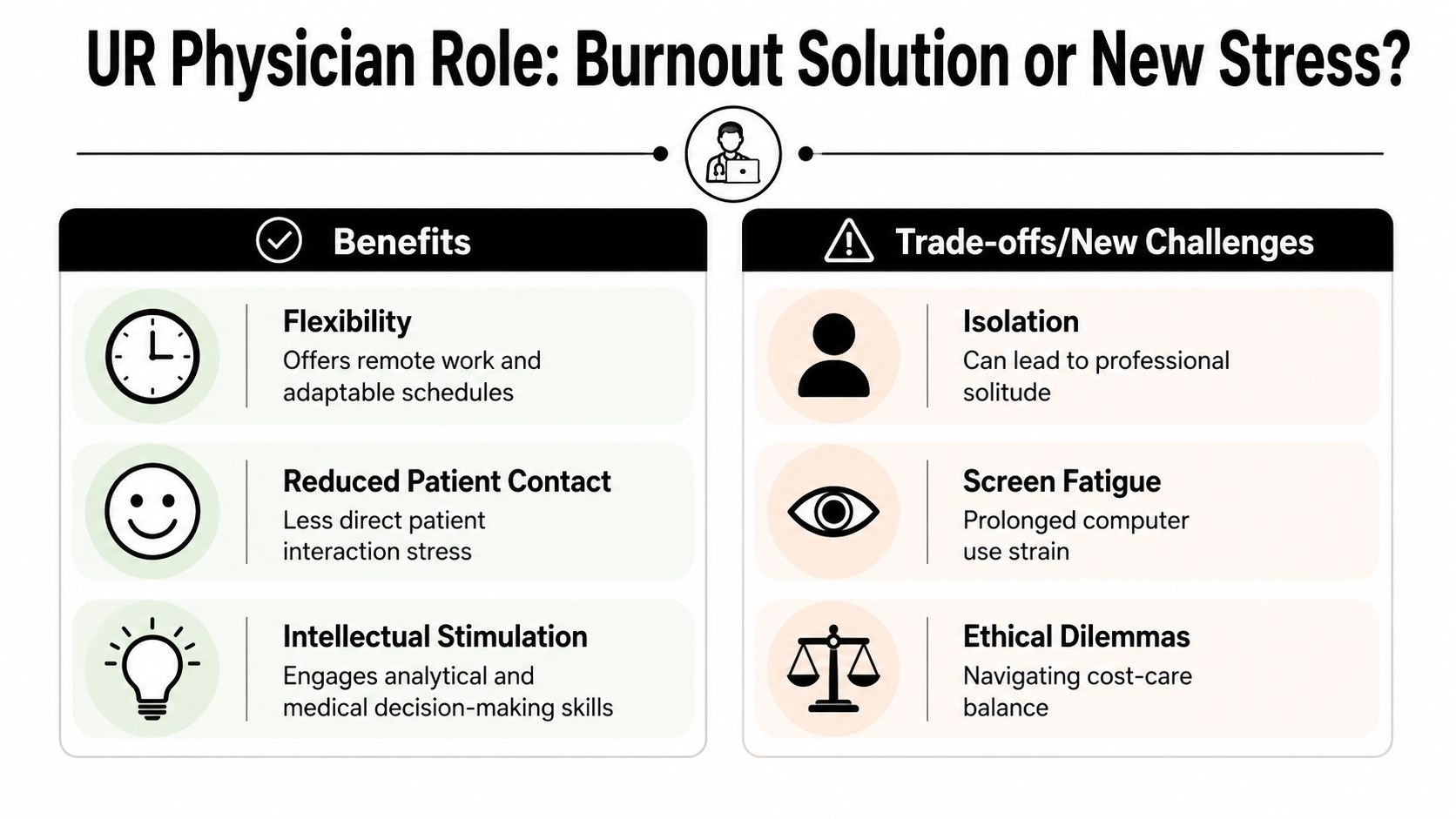
The obvious relief is structural. Fewer crises. Less running behind. Less emotional residue from direct patient care. Less chance that your whole day gets derailed by one staffing failure or one overloaded schedule.
For many physicians, that alone lowers the background stress level enough to think clearly again.
A broader burnout context helps explain why these roles attract attention. A 2023 AJMC survey found that 64% of physicians believed utilization management contributed to their burnout, and 67% had experienced burnout at some point in their careers, according to the AJMC survey on utilization management and physician burnout. That doesn't mean utilization review automatically fixes burnout. It does mean administrative intensity and work-life balance are central to the conversation.
What gets harder
The hard part is ethical tension.
You are working inside a system where determinations affect access, timing, and payment. Some cases are straightforward. Others are uncomfortable. You may review a request you would have handled differently in your own prior practice. You may deny a service because the record doesn't support it, even when you suspect the patient's story is more complex than the chart shows.
That moral friction is real. So is the risk of professional isolation.
- Repetition can wear on physicians who thrive on variety.
- Screen-heavy work can feel sterile after years of patient contact.
- Peer-to-peer conflict can become draining if the culture is adversarial.
- Identity loss can creep in if you tie being a doctor exclusively to bedside work.
Some physicians leave clinic burnout and feel immediate relief. Others discover they miss patient care more than they expected. Both reactions are normal.
If burnout has broader emotional or life-stage dimensions, role change alone may not solve it. For physicians, especially women carrying layered professional and household strain, resources like this article on help for women experiencing burnout can add a useful lens beyond job mechanics.
For a broader set of job-related strategies, this collection of physician burnout solutions is helpful when you're deciding whether you need a new setting, a new schedule, or a full career pivot.
The real test
Ask yourself two blunt questions.
First, do you want less stress, or do you want less uncertainty? Utilization review often delivers the second more reliably than the first.
Second, can you tolerate being part of a system that sometimes says no? If the answer is no, don't force yourself into a role that will leave you morally depleted in a new way.
How to Transition into a Utilization Review Role
The physicians who transition well usually don't start by rewriting their entire identity. They start by reframing what they already know.
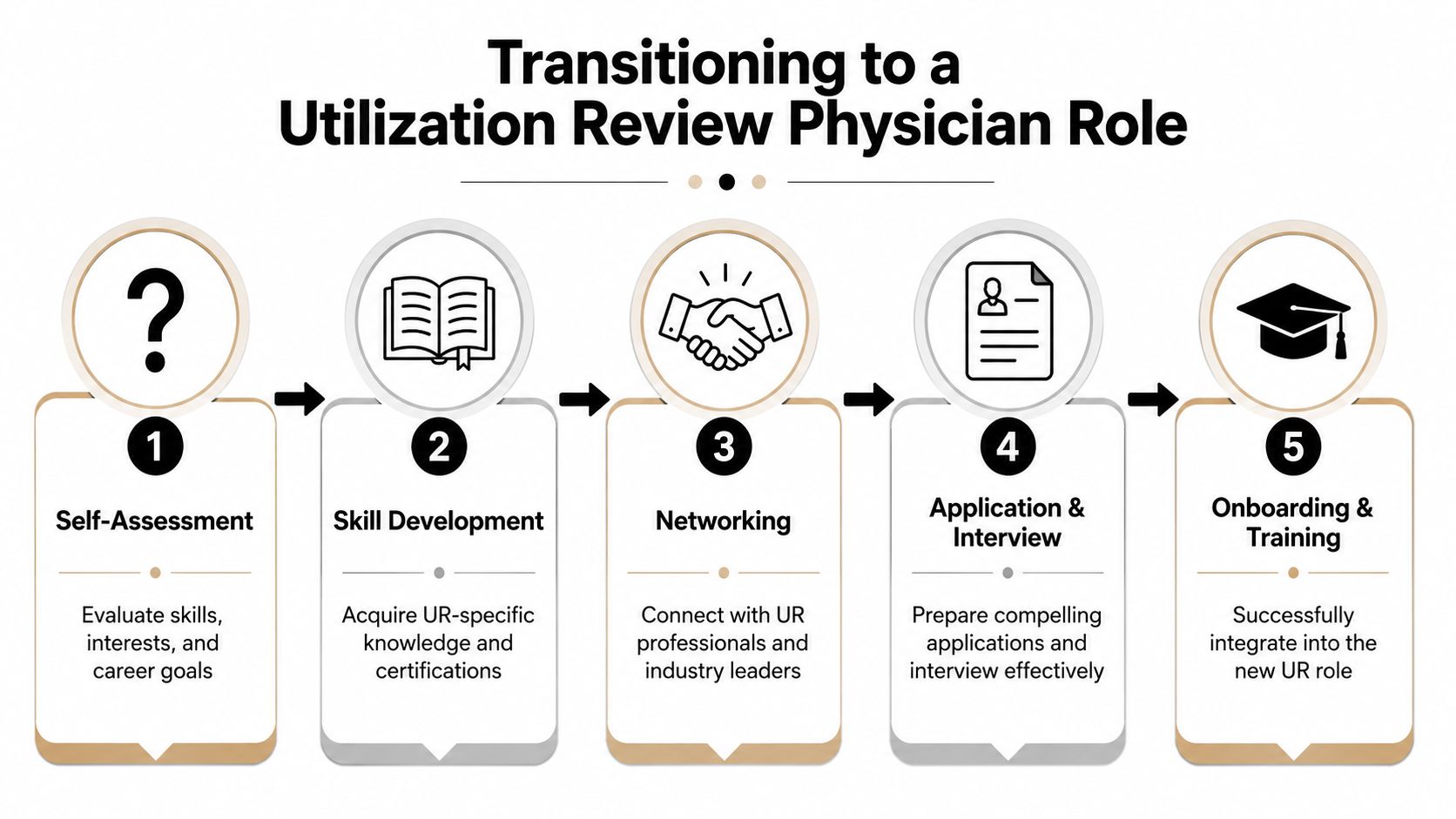
Step one is checking your fit
Most employers want the basics in place:
- Active unrestricted license
- Board certification or clear specialty training
- Current or recent clinical experience
- Clean, professional record
- Comfort with documentation and guideline-based decisions
The less obvious requirement is temperament. You need to be concise, calm under disagreement, and able to make decisions from incomplete but sufficient information.
Step two is translating your CV
Your clinical resume probably emphasizes patient volume, procedures, service lines, and leadership. That's not enough.
For utilization review work, employers want to see evidence that you can:
- Assess medical necessity
- Use evidence-based criteria
- Communicate with specialists across disciplines
- Document decisions clearly
- Manage deadlines and case volume
If you've served on a utilization committee, advised case management, handled denials, reviewed admissions, or participated in CDI or physician adviser work, move that higher on the page.
Step three is learning how strong documentation looks
A lot of physicians lose credibility in interviews because they describe their review style too loosely. Utilization review writing has structure.
A technically strong note should follow an AOP format: Assessment, Objective, Plan, because that separates the level-of-care determination from the supporting data and next-step plan. The Objective section should include only criterion-relevant facts such as labs, imaging, vitals, and interventions, which improves compliance and defensibility, as explained in this AOP framework for utilization review documentation.
That's not just a documentation trick. It signals that you understand the job.
When you write for utilization review, trim everything that doesn't support the determination. Elegant summaries don't win appeals. Specific rationale does.
Step four is preparing for the interview
Expect versions of these questions:
- Why are you leaving clinical practice?
- How do you handle disagreement with a treating physician?
- What do you do when documentation is incomplete?
- How do you balance clinical judgment with written criteria?
Good answers sound grounded, not defensive. You're not “escaping patients.” You're looking for a role where your medical judgment is applied in a structured way that's sustainable long term.
Step five is finding the right entry point
Some physicians start part-time through contract review work. Others move directly into salaried positions with payers, systems, or review organizations. If you want a broad view of nonclinical and remote pathways, this list of physician remote jobs is a practical place to compare role types.
Credentialing and onboarding can still take time. Be patient. Nonclinical jobs often move slower than clinical hiring, partly because compliance, file access, and reviewer calibration matter a lot.
A Day in the Life and Key Recruiting Insights
A typical remote day is less dramatic than clinic, and that's part of the point.
You log in, check your queue, scan the urgent cases first, and start triaging. Some charts are simple. The request meets criteria and the note is quick. Some need a deeper review. One requires a peer-to-peer call because the documentation is thin but the clinical story may be stronger than the initial submission suggests.

By midday, the pattern is clear. Review, decide, document, communicate, move on. The best days have rhythm. The bad days usually come from poor records, unrealistic volume expectations, or a company culture that treats physicians like denial machines instead of decision-makers.
What candidates should look for
- Ask about case mix. Inpatient, behavioral health, imaging, surgery, pharmacy, and disability review all feel different.
- Ask who owns the final determination. The answer changes the stress level.
- Ask how peer-to-peers are handled. Supportive systems train for them. Weak ones just throw doctors into conflict.
- Ask how performance is measured. Fast is not the same as sustainable.
What recruiters and employers often miss
Burned-out physicians rarely need hype. They need clarity.
The strongest role descriptions explain schedule, queue expectations, review type, decision authority, and whether nights, weekends, or call are absent. Employers trying to attract clinicians who value balance should say so plainly. Platforms like WeekdayDoc exist for exactly that reason, helping clinicians filter for roles that fit a lower-burnout work style instead of forcing them to decode vague job posts.
If you're exploring a utilization review physician role because clinic life has become unsustainable, WeekdayDoc is a practical place to start. It's a physician-founded job platform focused on burnout-friendly roles, including remote and no-call opportunities, with tools that help you compare work style, salary, and FIRE implications before you make your next move.