Physician Payback Clause: Model Repayment Risk
Learn how physician sign-on, relocation, loan-repayment, and training clauses work—and model what you could owe before signing.
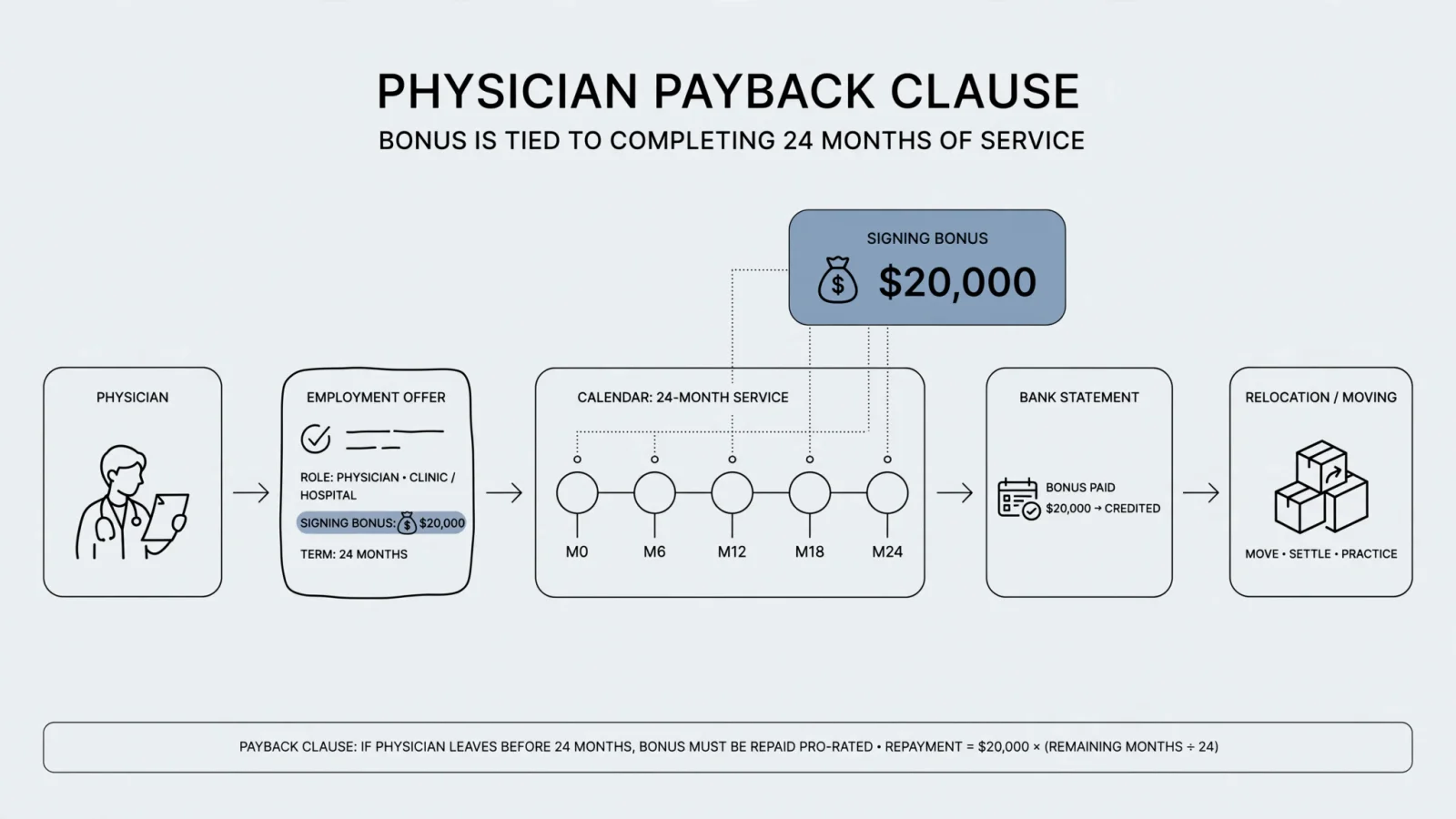
A conditional $50,000 bonus is not the same as $50,000 in guaranteed base salary. When a hospital or practice offers a large upfront payment, that money almost always comes with a service commitment. If the relationship ends early, you often have to return the cash. Learning how a physician payback clause works lets you evaluate an offer based on its risk-adjusted value rather than its headline number.
Before signing any employment agreement, understanding the mechanics of repayment, forfeiture, and forgivable loans helps prevent expensive surprises. WeekdayDoc provides a practical first step for this process. You can upload an employment agreement or addendum to the WeekdayDoc AI contract scanner to flag repayment terms alongside related provisions for call obligations, non-competes, and how tail coverage is funded. Once you identify these liabilities, you can secure professional legal advice for a final review.
What Is a Physician Payback Clause?
Why a Bonus Can Become a Liability
An upfront payment looks attractive, but the contract language dictates whether it remains yours. A physician payback clause creates a conditional liability because the employer advances cash or covers a cost while you agree to work for a specified timeframe in return. Failing to satisfy that timeline transforms the benefit into a debt, which means the money you received during credentialing is not earned until the final day of the service period.
Understanding this liability changes how you budget for a new role. If you apply a sign-on bonus to an existing student loan, you no longer hold the cash, so a sudden departure can trigger a demand for immediate reimbursement you might not be able to afford.
Repayment, Forfeiture, and Forgivable Loans
Contracts use different structures to enforce a service commitment. Direct repayment requires you to return money that has already been deposited, whereas forfeiture applies to unpaid benefits. This means you lose the right to receive a future retention bonus or productivity payout if you leave early.
A forgivable loan functions differently. The employer issues a formal loan, often with an attached promissory note, and forgives a portion of the principal as you complete segments of the service period. If you leave before the loan is fully forgiven, the remaining balance becomes due. Reimbursement provisions focus on actual costs by demanding that you pay back the exact dollar amount the practice spent on temporary housing or certification fees. Alternatively, some agreements include liquidated damages, which assign a fixed penalty for leaving early regardless of the actual expenses incurred.
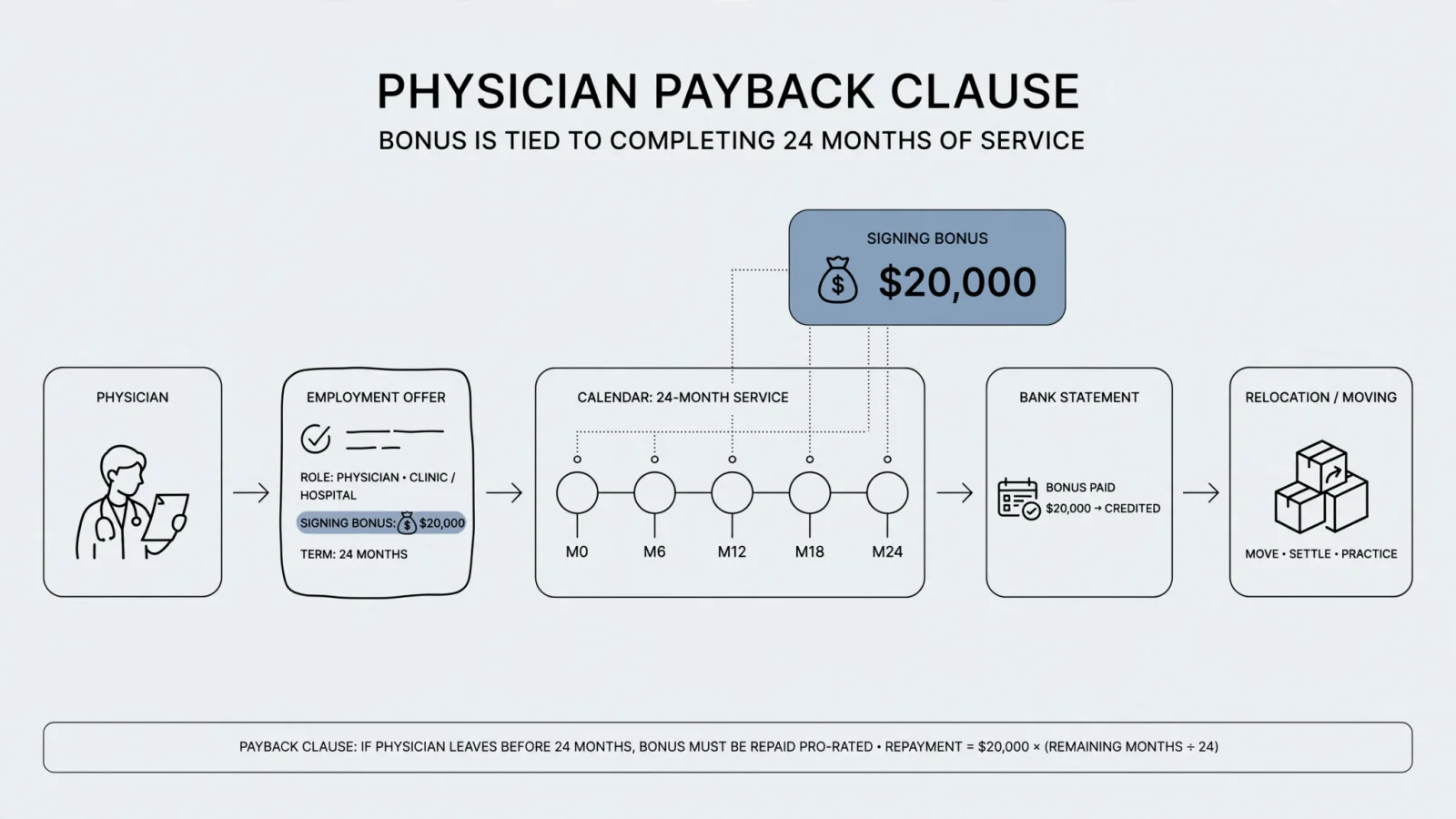
Separate the Four Common Payback Arrangements
Sign-On and Relocation Benefits
Employers combine various incentives into recruitment packages, but each carries distinct risks. A sign-on bonus is a one-time cash payment typically distributed after signing, starting work, or completing the credentialing process. The repayment risk usually involves returning the full amount or a prorated portion if you resign voluntarily.
Relocation assistance takes multiple forms, such as a flat allowance, expense reimbursement, temporary housing, or direct vendor payments. Check whether the contract demands repayment of a flat allowance or a return of the exact, documented costs the employer paid. A $20,000 reimbursement for verified moving trucks has a very different tax and risk profile than a $20,000 cash bonus.
| Benefit Type | What the Clinician Receives | Repayment Risk to Model |
|---|---|---|
| Sign-on bonus | Cash payment at signing or starting | Full or prorated return of the gross amount |
| Relocation assistance | Moving allowance, vendor payments, or expense reimbursement | Recovery of actual costs, taxes, or a flat stipend |
| Loan repayment | Payments made directly to the clinician, lender, or servicer | Recovery of taxable payments, often evaluated per installment |
| Training benefits | Funding for certification, CME, fellowship, or onboarding | Repayment of documented tuition or a fixed penalty |
Loan-Repayment and Training Benefits
When an employer offers student loan assistance, they might send money directly to your loan servicer or write you a check to forward to your lender. It helps to verify whether each payment carries its own separate service clock or if a single overarching commitment covers all installments.
Training and education clauses cover expenses like onboarding, specialized certifications, and continuing medical education. Because the practice wants a return on its educational investment, the contract will usually specify whether you owe the actual cost of the tuition or a predetermined fixed amount.
Government Service Contracts Are Separate
Public programs operate under different rules than private employers. The NHSC Loan Repayment Program uses a separate government service contract that dictates a two-year initial obligation, which exists independently from your employment agreement with the clinical site. Terminating a government service contract triggers specific default damages. For example, federal guidelines state that terminating the initial NHSC agreement can result in a requirement to repay all funds received. These government formulas are unique to public programs and will not automatically apply to a private employer's contract.

Read the Clause for Its Trigger and Formula
Amount, Service Clock, and Work Requirements
Extracting the specific mechanics of a clause prevents surprises later. Start by identifying the exact amount subject to recovery, since the language will clarify whether this total means the gross benefit, the net cash received, actual vendor expenses, employer-paid payroll taxes, loan principal, added interest, or collection fees.
Next, locate the service clock. The required period might begin on the day you sign, receive the payment, clear credentialing, or work your first clinical shift. Contracts often incorporate work requirements by reference, asking that you maintain a minimum full-time equivalent (FTE) status. Moving to a part-time schedule or stepping back from a heavy call rotation could inadvertently extend the service period or even trigger a breach.
Trigger Events and Written Exceptions
The trigger defines exactly which events activate the debt. Common triggers include failing to start the job, voluntary resignation, termination for cause, loss of state licensure, failure to maintain hospital privileges, or a refusal to relocate. Occasionally, a breach of a completely different provision in the employment agreement can accelerate the payback obligation.
Written exceptions protect you when the departure is outside your control. Look for explicit language stating that repayment is waived in cases of termination without cause, layoff, practice closure, or a material breach by the employer. Other standard exceptions cover death, permanent disability, military deployment, and material changes to your compensation, location, or schedule. If an exception is missing from the document, verbal promises that the hospital will act reasonably offer little legal protection.
Cliff, Proration, and Installment Vesting
The forgiveness schedule dictates how the debt decreases over time. A cliff vesting structure keeps the entire amount repayable until the final day of the service period, meaning if you leave one month early, you owe the entire balance.
Straight-line monthly proration provides more stability, as a fixed portion of the debt is forgiven each month you remain employed. Installment-specific vesting applies a separate forgiveness timeline to each individual payout, a method common with quarterly student loan stipends. Conversely, discretionary forgiveness leaves the decision entirely up to the employer and offers no guaranteed protection. The 2025 docket record for O’Holleran v. Iowa Physicians Clinic Medical Foundation illustrates these mechanics in practice, with contract language tying gross sign-on and relocation recovery to a two-year period with specific stated exceptions. It also demonstrates the level of detail standard agreements use.
Model the Repayment Before You Sign
Calculate the Unforgiven Amount
Running the numbers translates abstract legal text into a concrete financial projection. The basic model for an outstanding debt is the unforgiven principal plus contractually included taxes, interest, and permitted collection or attorney fees.
For a contract that expressly outlines straight-line proration, calculating the risk involves multiplying the original amount by the remaining service months, then dividing by the total service months. Assuming a proration schedule applies without explicit confirmation carries significant risk. If the text says "forgiven over two years" without detailing a monthly schedule, the employer might interpret it as a two-year cliff.
Work Through a Nine-Month Exit
Consider an offer with a $50,000 sign-on bonus requiring full return before 24 months, $15,000 of relocation assistance forgiven smoothly over 24 months, and $12,000 of training assistance repayable before 12 months.
Leaving this position after nine months reveals how hard cliff structures hit. The modeled total includes the full $50,000 sign-on amount, while the relocation portion is prorated, leaving 15 months unforgiven ($15,000 multiplied by 15, divided by 24) for a subtotal of $9,375. Because the training assistance also operates on a cliff, adding the full $12,000 brings your total modeled exposure to $71,375.
If the $50,000 sign-on amount were prorated monthly instead, the sign-on recovery drops to $31,250. Adding that to the $9,375 for relocation and $12,000 for training brings the total to $52,625, showing how a single drafting choice between a cliff and a prorated schedule creates an $18,750 difference.
Estimate Risk-Adjusted Value
These figures exclude the added pain of interest, collection fees, and tax complications. To evaluate the offer fairly, calculate a risk-adjusted value by multiplying the probability of leaving before vesting by the amount due at your most likely exit date. Subtracting this expected exposure, along with your own transition costs, from the after-tax value of the benefit reveals the true financial picture.
The probability of leaving depends heavily on the role's operating conditions, as a job with an intense weekend call schedule, unpredictable hours, and high administrative burden carries a much higher risk of early departure. WeekdayDoc helps assess this reality by letting you extract dates and triggers with the AI contract scanner. You can then compare the offer against salary percentiles, dollar-per-RVU economics, and local alternatives to determine if the baseline compensation makes the risk worthwhile.
Understand the Gross-Versus-Net Tax Trap
Why the Deposit May Be Smaller Than the Debt
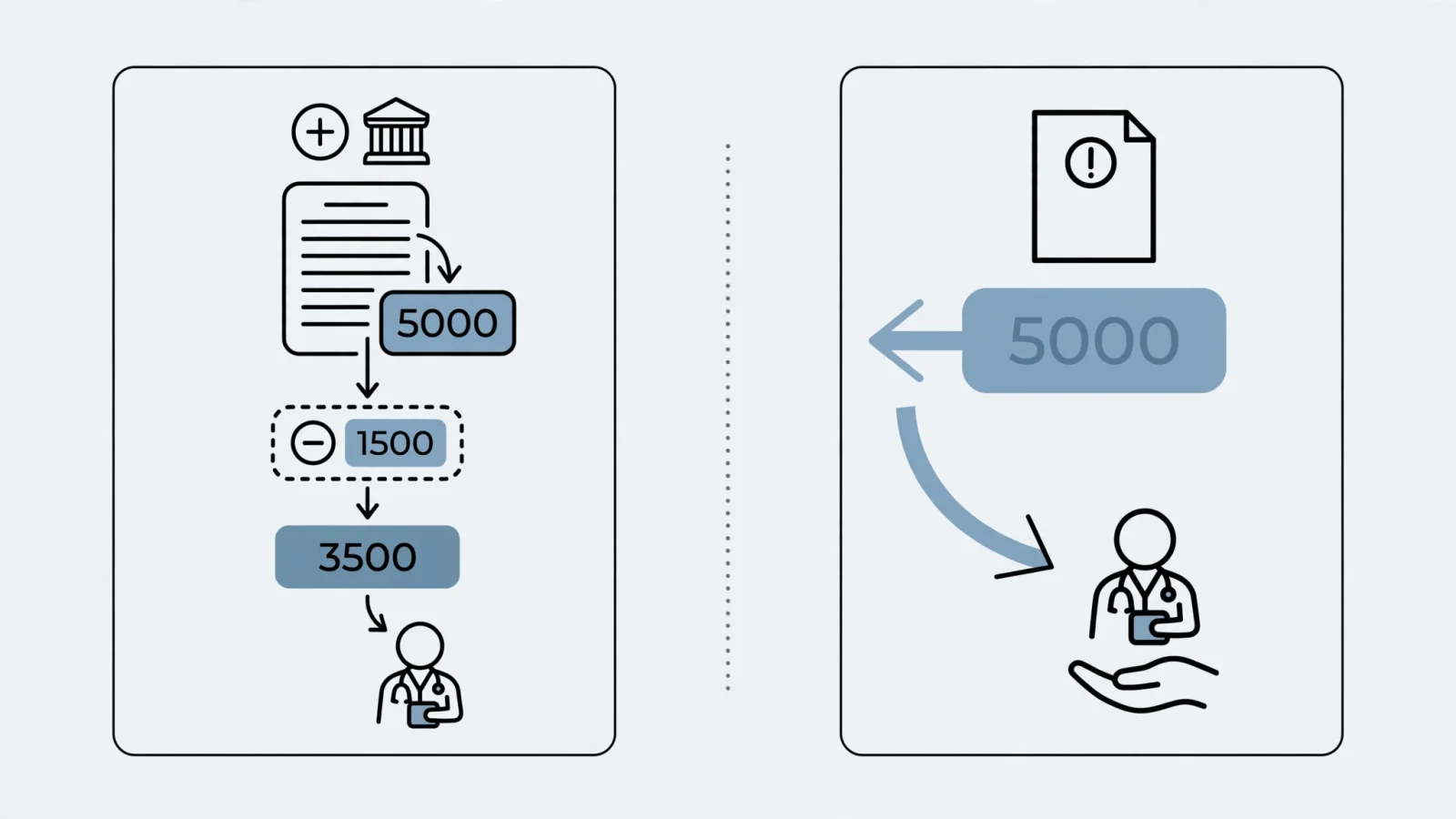
A common shock for departing clinicians is learning they owe more money than they received. A bonus paid for signing an employment contract is generally wage income subject to federal withholding, Social Security, and Medicare taxes, though a separately identified supplemental wage payment may qualify for an optional 22% federal withholding method if specific conditions are met under IRS Publication 15.
Because of this withholding, a $50,000 bonus might result in a $35,000 cash deposit into your checking account, yet the contract usually demands recovery of the gross amount. If you leave early, writing a check for $50,000 forces you to cover the $15,000 tax difference out of pocket while waiting to resolve the overpayment with the government.
Prior-Year Repayments and Loan Assistance
The timing of your departure creates further complications because the IRS handles repayments made in the same year differently than those made in subsequent years. When you repay prior-year wages, the transaction is generally handled on a gross basis. This situation may require the employer to issue a Form W-2c to correct Social Security and Medicare reporting, but federal income-tax wages are not corrected in the exact same manner.
Repaying more than $3,000 of previously reported wages triggers a complex claim-of-right comparison that requires evaluating a deduction versus a tax credit, and it does not guarantee a complete refund.
Employer student-loan assistance operates under different rules. Some educational assistance programs may exclude up to $5,250 in qualifying payments from an employee's income, provided the arrangement meets strict written-plan and nondiscrimination requirements. While this exclusion applies to certain payments of loan principal or interest, routing a taxable cash bonus directly to a loan servicer does not automatically make it tax-free.
Questions to Ask Payroll
Submitting written questions to the payroll department before accepting the money clarifies the tax mechanics early. Ask them to confirm how the payment will be reported on your W-2, whether the contract demands a gross or net return, and who bears the cost of the employer-paid payroll taxes. Requesting confirmation on whether they will provide corrected tax forms if a prior-year repayment occurs is also helpful. Consulting a tax professional evaluates how a potential clawback impacts your specific financial situation.
Know What Happens When the Job Ends
If the Employer Terminates You
Being fired introduces immediate conflict over who broke the commitment, and the precise language in your agreement determines whether an employer-initiated separation activates the debt. If the hospital terminates you without cause due to a budget cut, a well-drafted exception usually protects your bonus.
Termination for cause poses a higher risk because employers often draft "cause" broadly, allowing them to point to minor policy violations or vague behavioral complaints. To limit that risk, layoffs, practice closures, material employer breaches, and unilateral reductions in your compensation or schedule all need to be explicitly listed as events that waive your obligation.
Final Paycheck Deductions and Collection
The existence of a contractual debt does not automatically give the employer the right to deduct it from your final paycheck, as debt collection and wage deductions fall under entirely separate legal frameworks.
Federal wage rules restrict deductions or cash reimbursements that reduce your pay below minimum-wage or overtime requirements. The Department of Labor confirms that employers cannot bypass these restrictions by requiring a cash payment instead of a payroll deduction, as detailed in Fact Sheet #16.
State laws frequently offer stronger protections against unilateral paycheck raiding. For instance, New York Labor Law §193 strictly limits the types of deductions an employer can make from wages and restricts charging an employee via separate payments unless permitted by the statute. Because rules vary drastically by jurisdiction, an employer might be forced to send an invoice, negotiate a payment plan, or file a breach of contract claim rather than automatically docking your final pay.
Recruitment and Government Compliance Layers
Hospital recruitment introduces an additional layer of complexity. When a hospital recruits a physician to join an independent local practice, the arrangement involves multiple documents, requiring a review of the main employment agreement alongside the separate recruitment agreement, income-guarantee addendum, and any promissory notes.
These hospital arrangements are heavily regulated. The Stark law physician-recruitment exception addresses how relocation costs and pass-through payments are handled to prevent illegal referral incentives, but Stark compliance does not override state contract analysis. A legally compliant recruitment package can still contain an aggressive, fully enforceable payback clause that leaves you exposed if you leave the practice early.
Negotiate a Fairer Clause and the Job Around It
Terms Worth Changing Before Signature
Leverage is highest before you sign the document. Requesting straight-line monthly or quarterly proration ensures your debt decreases steadily as you provide value to the clinic, and limiting any repayment to the unvested portion offers clearer financial protection.
Negotiating a precise, narrow definition of voluntary resignation helps prevent disputes. Inserting written exceptions for termination without cause and material employer breaches protects against sudden letdowns, while ensuring the debt is waived if the practice drastically alters your compensation, location, or call schedule guards against unilateral changes. Establishing a clear service start date and a strict definition of your required FTE status removes ambiguity. Asking for an itemized list of any relocation and training costs prevents inflated estimates later. Finally, requesting a cap on interest, collection fees, and a prohibition against unilateral final-paycheck deductions gives you breathing room if things go wrong.
Price the Job’s Operating Conditions
The best defense against a clawback is a sustainable job. Because a massive upfront incentive often signals severe recruitment difficulties, evaluating the operating conditions that cause early departures becomes necessary.
Assessing the frequency of weekend obligations and how the practice structures physician call pay reveals the true demands of the role. Measuring the administrative time required for documentation against your scheduled patient hours also clarifies the workload. After considering the geographic fit, leadership expectations, and how much autonomy you will have, compare the offer against local compensation alternatives. If those alternatives offer higher base pay with a predictable schedule, the risk of taking a high-burnout role with a large conditional bonus increases substantially.
Make the Decision With a Contract Review
Connecting the contract text to the reality of the clinic floor protects your career. A conditional bonus should never distract from the daily operational realities of the role, and WeekdayDoc serves as the decision layer between complex legal language and your daily lifestyle.
By uploading your draft agreement to the WeekdayDoc AI contract scanner, you can quickly identify aggressive repayment triggers. Next, comparing the baseline salary and RVU economics against current market benchmarks adds context. Reviewing the facility's work-life score and exploring permanent, locum, remote, telehealth, or hybrid alternatives frames your final choice. A sustainable role with transparent compensation and a predictable schedule usually provides more long-term financial security than a large, highly restricted bonus. Securing independent legal and tax advice for a binding review ensures you enter your next position fully aware of the stakes.
Ready to evaluate your next career move with full transparency? Compare schedules, compensation, and burnout metrics for clinical roles across the country at WeekdayDoc.