NP Salary by State: Your 2026 Guide to Max Earnings
See the complete 2026 NP salary by state guide. Explore median pay, cost-of-living adjustments, and how to find a high-paying, burnout-friendly NP role.

A nurse practitioner can face more than a $50,000 pay gap depending on the state, and the national median annual wage was $124,680. That alone makes NP salary by state a career-planning issue, not a trivia list.
If you're trying to build a financially strong career without grinding yourself into burnout, geography matters more than many clinicians realize. A bigger paycheck can accelerate debt payoff, savings, and your path toward financial independence. But raw salary alone doesn't tell you whether a role is sustainable, whether the schedule is humane, or whether the money still looks good once housing, taxes, commute, and workload hit real life.
Why State-Level NP Salaries Matter More Than Ever
The most reliable starting point for NP salary by state is the U.S. Bureau of Labor Statistics wage data, and that data shows a wide split between higher-paying and lower-paying markets. A recent synthesis of BLS-based state comparisons places California around $161,540 to $166,610 annually, while lower-paying states such as Tennessee, Alabama, and Kentucky cluster near roughly $103,000 to $111,000, which implies a spread of more than $50,000 between top and bottom markets according to Tebra's summary of BLS-based NP salary benchmarks.
That gap changes how I'd advise any NP to evaluate a job. It affects:
- Relocation decisions because moving for the right market can improve earnings capacity for years
- Negotiation advantage because local benchmarks shape what a fair offer looks like
- Remote role strategy because multistate hiring can widen your options if licensure and employer policies line up
- FIRE planning because salary directly influences savings rate, debt reduction, and timeline to work optionality
Salary is only useful if it protects your life outside work
A high-paying role can still be a bad deal if it buys you constant call, overloaded inboxes, and a schedule that eats every weekend. Clinicians usually don't burn out from one factor. They burn out from a stack of factors. Salary is one of them, but only one.
Practical rule: Don't ask only, “What does this job pay?” Ask, “What does this job require me to give up to earn that pay?”
I've found the most sustainable career decisions happen when NPs use salary data as a filter, not as the finish line. A state with stronger pay may open room for part-time work later. A moderate-paying market with better hours may support a steadier savings plan than a richer market with crushing workload. Both can be smart. The wrong move is ignoring the state-level numbers and accepting a role without context.
National averages can hide bad assumptions
National figures are useful for orientation. They're weak for decision-making if you stop there. A single “average NP salary” number can make an under-market offer look reasonable, or make a costly relocation seem smarter than it is.
Use state data first. Then layer in schedule, specialty, tax situation, family needs, and how much margin you need to stay in practice for the long term.
2026 NP Salary by State Quick Reference Table
A nurse practitioner comparing two states can see a spread of nearly $60,000 a year in the same profession. The BLS reported a national median annual NP wage of $124,680 in May 2022, with a national pay range from $87,340 at the 10th percentile to $165,240 at the 90th percentile. In the same dataset, California reported the highest annual mean wage at $158,130, while Tennessee was among the lowest at $99,330, a difference of $58,800. The BLS figures are available in its nurse practitioner occupational wage data.
Use this table as a fast screening tool, not a final decision tool. It shows the verified numbers available from the source already cited, without padding the chart with estimates that would make state comparisons look more precise than they are.
Quick reference on verified NP salary figures
| Location | Verified Salary Figure | What It Means for Job Search |
|---|---|---|
| California | Mean annual wage: $158,130 | High pay can create more room for aggressive saving, but only if housing costs, taxes, and workload do not erase the advantage. |
| Tennessee | Mean annual wage: $99,330 | Lower average pay raises the importance of benefits, schedule control, and realistic panel expectations. |
| National benchmark | Median annual wage: $124,680 | Useful as a baseline for offer review, especially if an employer quotes a number without local context. |
| National benchmark | 10th to 90th percentile: $87,340 to $165,240 | Shows the spread between lower-paid and higher-paid NP roles across settings, experience levels, and markets. |
Some readers want a full 50-state salary table with state medians, hourly pay, and percentile bands. That would be useful. The verified source in this section does not provide every one of those fields in a clean, state-by-state format, so I am only listing figures that can be supported directly.
That limitation does not make the table useless.
It changes how to use it. Start with the verified benchmark. Then test any job offer against the pay level of the state you are targeting, the schedule being asked of you, and the life you want that income to support. A California salary may speed up debt payoff or a FIRE timeline. A lower-paying state may still be the better long-term choice if the role has lighter call, lower patient volume, and enough margin to stay in practice without burning out.
For quick triage, this is the practical takeaway: if an offer sits well below the national median in a lower-paying state, the employer needs to make up for it somewhere else. That usually means stronger retirement match, better health coverage, CME funding, protected admin time, fewer weekends, or a schedule that supports staying healthy enough to keep earning.
Understanding the Salary Data Methodology and Trends
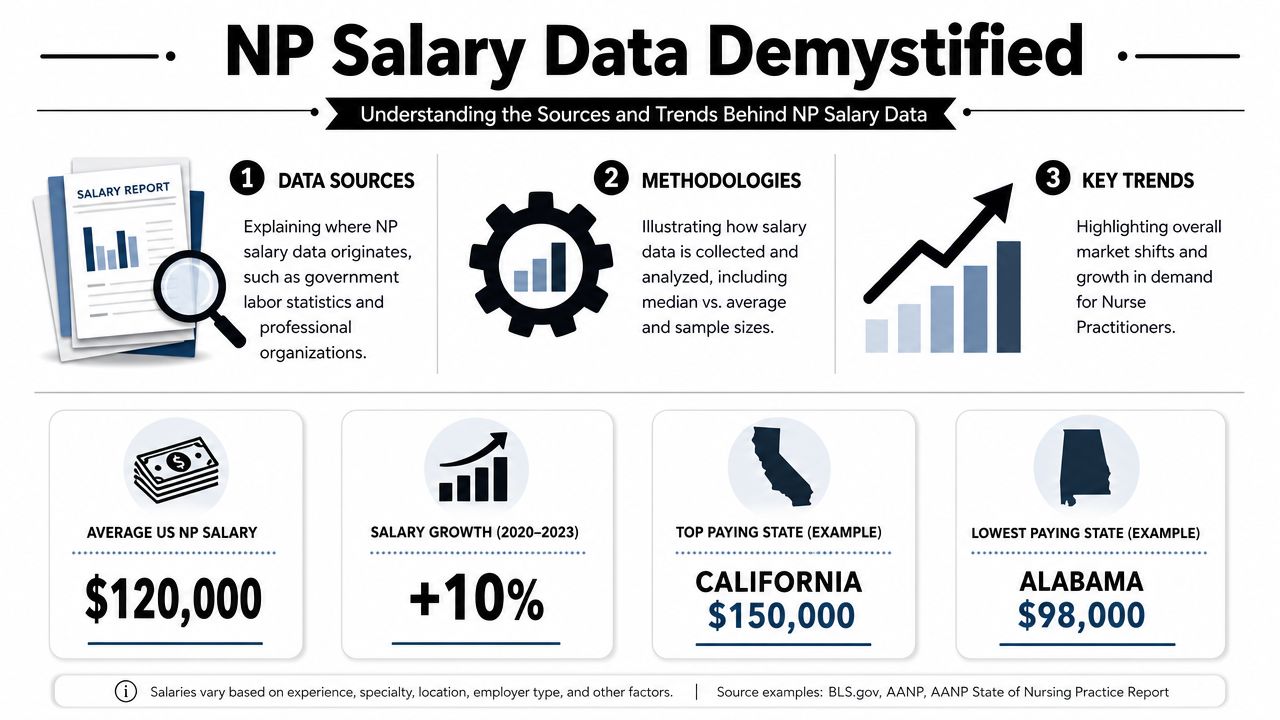
Salary reports disagree for predictable reasons. They may use different time periods, different definitions of NP compensation, and different methods for summarizing the data. Some emphasize median wages, some use mean wages, and some blend salary with broader job-posting or recruiter data.
Why one salary source won't perfectly match another
The BLS remains the cleanest benchmark because it's standardized and widely used. But secondary publications can still be helpful if they clearly state they're drawing from BLS-based comparisons and if you treat them as directional rather than absolute.
A good way to evaluate any salary source:
Check the date
A figure from one year can differ meaningfully from a later update.Check whether it reports median or average
Those are not interchangeable. Averages can be pulled upward by high earners.Check whether it's state-level or job-posting-level
A broad wage series is useful for benchmarking. A posting database is useful for current market feel.Check whether it includes only base salary
Productivity pay, shift premiums, and bonuses can distort comparisons if one source includes them and another doesn't.
What recent movement suggests
NP compensation isn't static. NurseJournal, using BLS-based comparisons, reported that Alaska had the largest percentage increase in average annual NP salary from 2023 to 2024 at 13.26%. In that same analysis, California remained the top-paying state at $166,610, while Alabama ranked lowest at $106,930, a spread of $59,680 according to NurseJournal's state salary analysis.
That matters for two reasons. First, a state that looks average today may be moving faster than expected. Second, compensation planning should be dynamic. If you're signing a multi-year employment agreement, you're not just choosing today's wage. You're choosing a local market with its own momentum, bargaining environment, and replacement pressure.
Don't rely on a single salary number. Build a salary range, then test it against schedule, role scope, and how replaceable your position would be in that market.
Beyond the Paycheck Adjusting Salary for Cost of Living
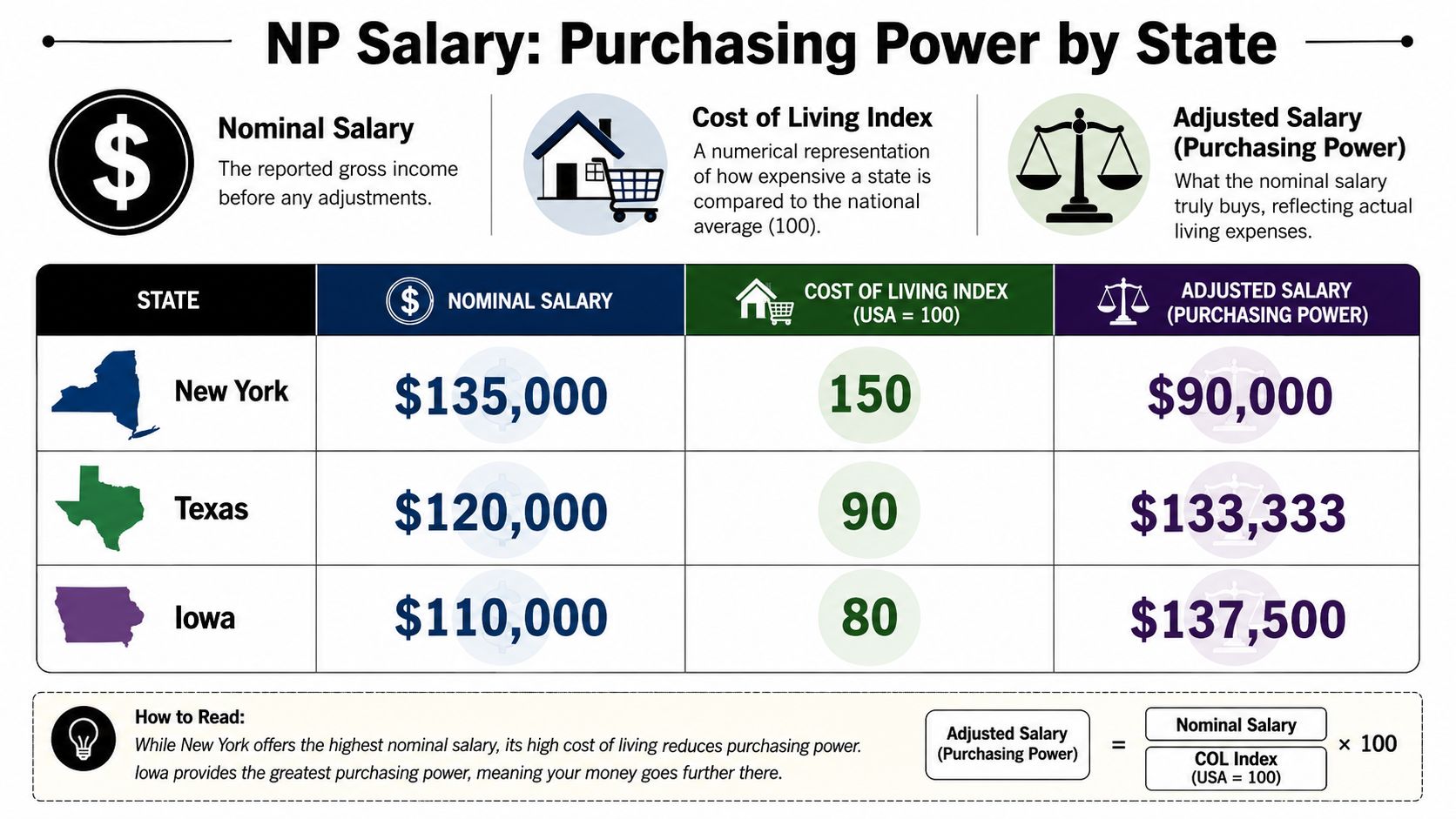
A high nominal salary can flatter a bad financial setup. NPs know this instinctively. The offer looks strong, then rent, childcare, commuting, taxes, parking, and basic daily expenses start draining the difference.
A simple way to think about purchasing power
When comparing NP salary by state, I'd look at three layers:
Base salary What the contract pays before anything else.
Local cost burden
Housing, transportation, food, taxes, and whether you need a long commute to afford the area.Lifestyle strain
Call burden, number of patient touches, inbox volume, and how much unpaid recovery time the job demands.
A salary only counts as “better” if it improves your actual life. That means stronger cash flow after expenses and a schedule you can keep doing.
California versus a moderate-cost market
The verified data shows California at the top of the pay ladder in multiple summaries. It's easy to stop there and conclude that California automatically offers the best financial outcome. Sometimes it does. Sometimes it doesn't.
If you compare California with a moderate-cost state, ask questions like these:
| Comparison point | Higher-cost market | Moderate-cost market |
|---|---|---|
| Housing pressure | Often higher | Often lower |
| Commute burden | Can be substantial | Often more manageable |
| Savings rate potential | Depends on expenses | May be steadier even with lower salary |
| Burnout risk | Depends heavily on role design | Also role-dependent, sometimes easier to buffer |
Salary data and career sustainability meet. A lower headline salary can still produce better monthly breathing room if you keep more of what you earn and don't need to “spend to recover” from the job.
A useful companion framework is to compare broader clinician pay by geography, not just NP wages. This state-by-state physician compensation guide is relevant because it reinforces the same principle. State lines often change the whole compensation picture, not only the base salary.
What works and what doesn't
A strong salary in the wrong cost structure can leave you feeling underpaid anyway.
What works is evaluating an offer through the lens of net lifestyle value. What doesn't work is chasing the largest gross salary without checking whether the role forces expensive housing, difficult scheduling, or constant overtime.
Factoring in Total Compensation and Benefits
Many NPs leave money on the table because they focus too narrowly on salary. A lower base can still be the better offer if the benefit package protects both your finances and your nervous system.

Benefits that carry real value
Here's what I'd review line by line before accepting any NP role:
Health coverage
Premium cost matters, but so do deductible structure and network quality. Cheap insurance that's hard to use isn't much of a benefit.Retirement match
Employer matching changes long-term wealth building, especially if your FIRE goal depends on consistent automated investing.Paid time off and CME support
PTO affects recovery. CME support affects your out-of-pocket professional costs.Malpractice and licensing support
If you're paying for every renewal and credentialing step yourself, the “higher salary” shrinks quickly.
Burnout-friendly terms are compensation too
The hardest lesson for many clinicians is that no call, no weekends, and sane panel expectations have economic value, even if they don't appear as salary. These terms reduce the odds of needing to cut back, switch jobs abruptly, or pay for expensive burnout recovery later.
A role with better boundaries may support:
- More consistent sleep
- Less need for childcare scrambling
- More predictable budgeting
- Enough emotional energy to maintain side income, family time, or a second per diem role
That's part of compensation, even if HR doesn't list it neatly.
Don't ignore payroll details in smaller groups
If you're joining a smaller practice, details around classification, timing, and withholding matter. Problems there can create stress fast. For employers and clinicians reviewing offer structure, this explainer on avoiding payroll penalties is useful because payroll mistakes can affect trust, pay timing, and tax headaches long after the contract is signed.
The right offer isn't the one with the biggest number. It's the one you can live with, save from, and still have a life around.
How Telehealth and Part-Time Roles Impact Your Earnings
Telehealth and part-time NP work can improve lifestyle dramatically. They can also confuse compensation comparisons if you don't know what question to ask.
Telehealth pay depends on the contract logic
In remote roles, compensation may be tied to the employer's market, the clinician's location, the payer mix, or a productivity formula. That's why two telehealth jobs with similar clinical tasks can feel very different financially.
What tends to work well:
- Clear pay model that states whether compensation is salaried, hourly, per-visit, or productivity-based
- Defined admin time for charting, refill requests, and patient messaging
- Licensure alignment so multistate work expands opportunities instead of creating unpaid hassle
What usually goes poorly is accepting a “flexible” remote role without clarity on visit expectations, no-show handling, or whether inbox work is compensated.
Part-time can raise your effective quality of life
A part-time role may reduce annual earnings on paper, but that doesn't mean it's a weaker financial move. If part-time work lowers burnout, preserves your ability to stay in clinical practice, and leaves room for family or side work, it may improve your long-term trajectory.
For NPs exploring this path, these telehealth nurse practitioner roles are useful to study because remote postings often make schedule structure and work style easier to compare than traditional clinic listings do.
A practical way to compare flexible roles
Use this short filter:
How is time paid?
Visits only, hourly, salary, or mixed?Who absorbs no-shows and admin burden?
You or the employer?What does flexibility mean?
Flexible scheduling is different from being available all the time.
If a role gives you control over time but incorporates uncompensated labor, the apparent hourly rate isn't real.
Negotiating Your NP Salary and Projecting Your FIRE Number
Negotiation gets easier when you stop treating it like a personal favor request and start treating it like a market discussion. The employer has a budget, a coverage need, and a replacement cost. You have licensure, training, clinical judgment, and local salary benchmarks.
How to negotiate with state data
Start with a narrow script, not a long speech. You don't need to overexplain.
Try language like this:
“Based on the state market, my experience, and the scope of this role, I'm looking for compensation that better reflects local benchmarks and the responsibilities involved.”
Then support it with specifics:
- State benchmark from credible wage data or current BLS-based summaries
- Role demands such as patient volume, specialty complexity, call, supervision, or travel
- Your advantage including years in practice, specialty fit, procedural skills, and licensure breadth
Where NPs weaken their own position
I see the same mistakes repeatedly.
Accepting the first number too quickly
Employers often expect some discussion.Negotiating base salary only
PTO, admin time, CME, remote days, and schedule protections may be easier to move than base pay.Failing to price the hard parts of the job A “good salary” attached to heavy call or chronic understaffing isn't a good offer.
Tie the offer to your FIRE plan
A contract isn't just employment. It's a cash-flow engine. When you evaluate NP salary by state through a FIRE lens, the right question becomes: how much freedom does this role buy me over time?
That means estimating:
Annual take-home reality
Base salary plus likely extras, minus your recurring costs.Savings rate capacity
Not your ideal rate. Your realistic one.Sustainability of the workload
A role only helps you reach financial independence if you can stay in it.
For clinicians who want to model that more concretely, a FIRE number calculator for clinicians can help connect compensation to long-term optionality instead of looking at salary in isolation. WeekdayDoc also includes salary information, burnout-focused filters, and state-based FIRE projections on listings, which is useful if you want to compare offers through both financial and lifestyle lenses.
A short explainer can help frame the mindset shift:
The best negotiation outcome
The ideal result isn't necessarily the maximum salary. It's the package that improves your net worth trajectory without wrecking your health, family life, or clinical longevity.
If an employer won't move on salary, ask for one of these instead:
- Protected admin time
- Reduced call
- Remote charting days
- More PTO
- License or CME support
Those terms can be worth more than a modest raise if they make the work sustainable.
Frequently Asked Questions About NP Salaries
Does a DNP always increase salary
Not always. A DNP may strengthen your candidacy for leadership, academic, or certain specialized roles, but it doesn't automatically produce a higher paycheck in every market. Employers usually pay for the role's demands, local market pressure, and your fit for the position.
Does specialty affect earnings
Yes, often meaningfully, but the exact amount varies by employer, region, and care setting. Specialty compensation can shift based on patient demand, complexity, call expectations, and whether the role includes procedures, inpatient work, or high-acuity care.
Do full-practice states always pay more
Not automatically. Practice authority can improve autonomy and widen job options, but salary still depends on labor market conditions, payer environment, and employer structure. Autonomy may improve the role even when it doesn't produce the top salary in a raw comparison.
Is the highest-paying state always the best place to work
No. A strong salary can be offset by high living costs, heavy patient loads, or a schedule that's hard to sustain. The best market is the one where compensation, cost structure, and workload fit your long-term plan.
Should I prioritize salary or schedule
If you can, prioritize the combination. If you have to choose, be honest about your season of life. Some NPs need maximum income for debt payoff or savings acceleration. Others need schedule control to stay in practice and avoid burnout. Both can be rational decisions.
A salary number is only “good” if it still feels good six months into the job.
How should I compare two offers in different states
Use a side-by-side approach:
- Base pay
- Benefits
- Schedule protections
- Local living costs
- Commute and housing burden
- How likely you are to stay
That last point matters. The offer you can hold for years often beats the one you leave quickly.
If you're looking for NP roles that don't force you to trade your income for constant call and lost weekends, WeekdayDoc is worth reviewing. It's a physician-founded job platform with remote, hybrid, and in-person listings, salary data, burnout-friendly filters like No Call and No Weekends, and tools that help clinicians compare jobs through both compensation and long-term financial sustainability.