Physician Compensation By State A Guide to Maximizing Your Earnings
Discover the ultimate guide on physician compensation by state. We analyze salaries, cost of living, and specialty trends to help you find the best location.

It’s a common misconception: chase the highest salary figure. But savvy physicians know the number on the offer letter is just the starting point. The real value of your income is shaped by a whole host of factors, from regional demand and cost of living to the specific dynamics of the local healthcare market.
A huge salary in a city like San Francisco might sound great, but it can quickly evaporate. A slightly lower nominal salary in a state with a lower cost of living often translates to far greater financial freedom and a faster path to your goals.
Decoding the Physician Compensation Map
So, why does pay vary so dramatically from one state to the next? It really boils down to a few key drivers:
- Physician Supply and Demand: This is Economics 101. States with significant physician shortages, especially in rural areas, have to offer higher compensation to attract and keep talent.
- Regional Economic Health: A state's overall economy directly impacts healthcare spending, insurance reimbursement rates, and ultimately, what hospitals and practices can afford to pay their doctors.
- Rural vs. Urban Markets: It's counterintuitive, but major metro areas packed with large health systems can sometimes see suppressed wages. There’s more competition. Meanwhile, underserved rural regions might offer premium pay to fill a critical need.
The Stark Reality of Geographic Pay Gaps
The difference between states isn't trivial—we're talking six-figure swings.
Take a look at Iowa, which leads the nation with an average physician salary of $464,000 per year. Right next door, Arkansas is nearly neck-and-neck at $462,000. Compare that to Rhode Island, which comes in at just $305,000 annually. That's a massive difference in earning potential based on geography alone. You can find more state-by-state physician salary data to see how your state stacks up.

This map drives home a critical point: location is one of the single most important factors determining what you'll earn. But as we've said, the raw salary number is only part of the equation.
To give you a clearer starting point, here's a quick look at the top 10 states based purely on average annual salary, before we start layering in other crucial factors like taxes and cost of living.
Top 10 States for Physician Compensation (By Nominal Salary)
| Rank | State | Average Annual Salary |
|---|---|---|
| 1 | Iowa | $464,000 |
| 2 | Arkansas | $462,000 |
| 3 | Wyoming | $459,000 |
| 4 | Kentucky | $456,000 |
| 5 | Mississippi | $453,000 |
| 6 | Alabama | $452,000 |
| 7 | Tennessee | $450,000 |
| 8 | Wisconsin | $449,000 |
| 9 | Indiana | $447,000 |
| 10 | Ohio | $445,000 |
This list gives us a baseline of the highest-paying states on paper. In the next sections, we'll dig deeper to adjust these numbers for real-world financial impact, helping you pinpoint the regions that truly align with both your financial and lifestyle goals.
Of course. Here is the rewritten section, crafted to sound completely human-written and natural, following all your specific instructions and matching the provided expert tone and style.
Physician Salaries By State: A Deeper Dive
The national average physician salary is a useful starting point, but it's just that—a starting point. The real story is in the state-by-state numbers, where geography proves to be one of the biggest factors in your earning potential. A simple ranked list doesn't tell you much, though. You have to understand the local market forces that shape those salaries.
This isn't just a list. We're breaking down why some regions pay so much more and why states with world-famous medical centers often don't top the charts. If you're planning your next career move, this is the context you need.
The Midwest: The Unexpected Compensation Leader
Year after year, the Midwest comes out on top as the highest-earning region for physicians. States like Iowa ($464,000), Wisconsin ($449,000), and Indiana ($447,000) consistently offer salaries well above the national average. This isn’t a fluke; it’s simple supply and demand.
The main driver here is high demand, especially in rural areas that have a tough time recruiting. With fewer doctors per capita than the coasts, hospitals and private practices have to open their wallets to attract and keep talent. It creates a fantastic financial picture for clinicians willing to work outside of the major coastal cities.
You'll also find that many Midwestern states are dominated by large, integrated health systems that have been buying up private practices. This gives them more negotiating power with insurance companies, which often translates into more standardized—and higher—pay for their employed physicians.
Key Insight: Don't sleep on the Midwest. The combination of high demand, lower physician density, and the muscle of large health systems makes it a financial powerhouse. The sticker price on the salary is high, and as we’ll see later, the real value gets even better once you factor in the low cost of living.
The South: A Land of High Opportunity
Right behind the Midwest, the Southern states also post some seriously competitive numbers. Arkansas ($462,000), Kentucky ($456,000), Mississippi ($453,000), and Alabama ($452,000) are all in the top 10 for a reason. Just like in the Midwest, they are dealing with a pressing need for doctors across nearly every specialty.
Many states in the South have growing populations and a large number of communities officially designated as Health Professional Shortage Areas (HPSAs). When patient demand outstrips physician supply, healthcare organizations have no choice but to offer strong financial packages to fill their open roles.
On top of that, a friendlier malpractice environment and lower business taxes in some Southern states can reduce a practice's overhead. That frees up more money to go directly into physician salaries, making the South an incredibly attractive place to maximize your income.
The West Coast: A Complicated Financial Picture
Out on the West Coast, the salary landscape gets a lot more complicated. You've got states like Wyoming ($459,000) ranking near the top nationally because they're rural and desperate for doctors. But then you have the coastal states, which are a whole different ballgame. California and Oregon might offer salaries that look impressive on paper, but they get eaten alive by an astronomical cost of living.
Market saturation is the big problem here. Everyone wants to live the West Coast dream, which means a flood of physicians competing for jobs in cities like San Francisco, Los Angeles, and Seattle. That much competition puts a cap on wage growth because employers have plenty of candidates to choose from.
Still, there are pockets of high opportunity, especially if you look outside the major metro areas or practice an in-demand specialty. Your earning potential on the West Coast really comes down to the specific city and health system you're looking at, so you have to do your homework.
The Northeast: High Prestige, Lower Pay
It always surprises people to learn that the Northeast—home to some of the most prestigious medical institutions on the planet—generally offers the lowest average salaries. States like Maryland, Massachusetts, and Rhode Island ($305,000) are consistently at the bottom of the pay scale. It seems backward, but it makes sense when you look at the drivers.
- High Physician Density: The region's top-tier academic medical centers and training programs pump out a huge supply of physicians, and many of them want to stay in the area after residency.
- Market Saturation: All that talent creates an incredibly competitive job market. Employers simply don't have to offer top-dollar salaries to fill positions.
- Mature Markets: The healthcare markets in the Northeast are old and established. Payer contracts and reimbursement rates are often less generous than in regions that are still growing.
For a lot of physicians, the prestige of working at a world-class academic institution or living in a historic city is worth the pay cut. But if your main goal is financial accumulation, the Northeast is a tough place to make it work, especially with its notoriously high cost of living.
To give you the complete picture, the table below ranks all 50 states, providing a quick-reference guide to physician compensation and the market forces at play in each one.
Full Ranking of Physician Compensation Across All 50 States
This table provides a comprehensive ranking of average physician salaries across the United States. Use it to compare nominal pay and understand the key factors, like rural demand or market saturation, that influence compensation in each state's unique healthcare landscape.
| State | Average Salary | Regional Average | Key Market Drivers |
|---|---|---|---|
| Iowa | $464,000 | Midwest - High | Rural demand, large health systems |
| Arkansas | $462,000 | South - High | Physician shortage, growing population |
| Wyoming | $459,000 | West - High | Rural demand, low physician density |
| Kentucky | $456,000 | South - High | HPSA designations, competitive hiring |
| Mississippi | $453,000 | South - High | Significant physician need, state incentives |
| Alabama | $452,000 | South - High | Rural shortages, tort reform benefits |
| Indiana | $447,000 | Midwest - High | High demand, large system employment |
| Wisconsin | $449,000 | Midwest - High | Strong demand outside major cities |
| Tennessee | $445,000 | South - High | Growing population, no state income tax |
| Oklahoma | $443,000 | South - High | Need for specialists, rural incentives |
| South Carolina | $441,000 | South - High | Population growth, high demand |
| Missouri | $440,000 | Midwest - High | Mix of rural and urban demand |
| North Dakota | $438,000 | Midwest - High | Critical access hospitals, rural need |
| Georgia | $435,000 | South - High | Urban growth, physician shortages |
| Louisiana | $432,000 | South - High | High need in primary and specialty care |
| Ohio | $430,000 | Midwest - High | Large integrated health systems |
| Utah | $428,000 | West - High | Rapid population growth, strong economy |
| Nebraska | $425,000 | Midwest - High | Rural recruitment challenges |
| Kansas | $423,000 | Midwest - High | Shortages in primary care |
| West Virginia | $421,000 | South - High | Significant need in underserved areas |
| North Carolina | $419,000 | South - High | Competitive academic and private markets |
| Texas | $415,000 | South - High | Large metro areas, no state income tax |
| Florida | $412,000 | South - High | High demand from aging population |
| South Dakota | $410,000 | Midwest - High | Rural demand, low physician density |
| Arizona | $408,000 | West - High | Population growth, competitive market |
| Idaho | $405,000 | West - High | Rapid growth, increasing demand |
| Michigan | $402,000 | Midwest - High | Mix of urban systems and rural need |
| Nevada | $399,000 | West - High | High growth, need for specialists |
| Montana | $395,000 | West - High | Rural and frontier medicine needs |
| Minnesota | $392,000 | Midwest - Mid | Competitive market, large health systems |
| Illinois | $388,000 | Midwest - Mid | Saturated Chicago market, high malpractice |
| Alaska | $385,000 | West - Mid | High cost of living, unique practice models |
| Maine | $382,000 | Northeast - Mid | Rural demand, aging population |
| New Mexico | $379,000 | West - Mid | Underserved populations, federal jobs |
| Oregon | $375,000 | West - Mid | Saturated Portland market, high COL |
| Colorado | $372,000 | West - Mid | Desirable location, high competition |
| Vermont | $368,000 | Northeast - Mid | Small state, limited opportunities |
| Washington | $365,000 | West - Low | Saturated Seattle market, high COL |
| Pennsylvania | $362,000 | Northeast - Low | High density of training programs |
| Virginia | $358,000 | South - Low | Proximity to DC, high physician density |
| Delaware | $355,000 | Northeast - Low | Small market, proximity to major cities |
| New Hampshire | $352,000 | Northeast - Low | Proximity to Boston, saturated market |
| Hawaii | $348,000 | West - Low | Extremely high cost of living, limited market |
| Connecticut | $345,000 | Northeast - Low | Proximity to NYC, high density |
| California | $340,000 | West - Low | Extreme market saturation, very high COL |
| New York | $335,000 | Northeast - Low | Highly saturated NYC market, high taxes |
| New Jersey | $330,000 | Northeast - Low | High physician density, saturated market |
| Maryland | $315,000 | Northeast - Low | High physician density, market saturation |
| Massachusetts | $310,000 | Northeast - Low | Academic hubs, intense competition |
| Rhode Island | $305,000 | Northeast - Low | Saturated market, lower reimbursement rates |
As this data clearly shows, the highest nominal salary isn't always in the most obvious place. Understanding these regional dynamics is the first step toward finding a position that truly aligns with your financial and lifestyle goals.
Calculating Your Real Earning Potential
That big salary number on an offer letter looks great, but it’s only half the story. The true value of your income isn't the number itself—it's what that money can actually buy. This is a classic misstep for many physicians, who get fixated on the gross pay while ignoring the two silent killers of earning potential: cost of living and taxes.
To really understand what you're making, you have to look past the top-line number to your net, post-expense income. It's not uncommon for a $450,000 salary in a high-cost state like California to leave you with less cash at the end of the month than a $400,000 salary in an affordable state like Iowa. That difference is what accelerates your journey to financial independence.
The Cost of Living Illusion
The cost of living index is a simple concept: it measures how much you have to spend on essentials like housing, food, and transportation in a particular place. A state with a sky-high cost of living can completely wipe out the advantage of a higher salary, torpedoing your purchasing power.
Think about it this way: a physician earning $400,000 in San Francisco could easily see 50% or more of their take-home pay disappear into a mortgage for a pretty average house. Meanwhile, a colleague earning $375,000 in a Midwestern city might buy a much larger home for a fraction of that cost. That frees up a massive amount of capital for investing, saving, or just enjoying life.
Crucial Takeaway: Don't get seduced by a high nominal salary. Your real income is what's left after the bills are paid. A lower salary in a low-cost area often puts you miles ahead financially.
This is a trend we see playing out across the country. Regional compensation data often highlights where the real opportunities are.
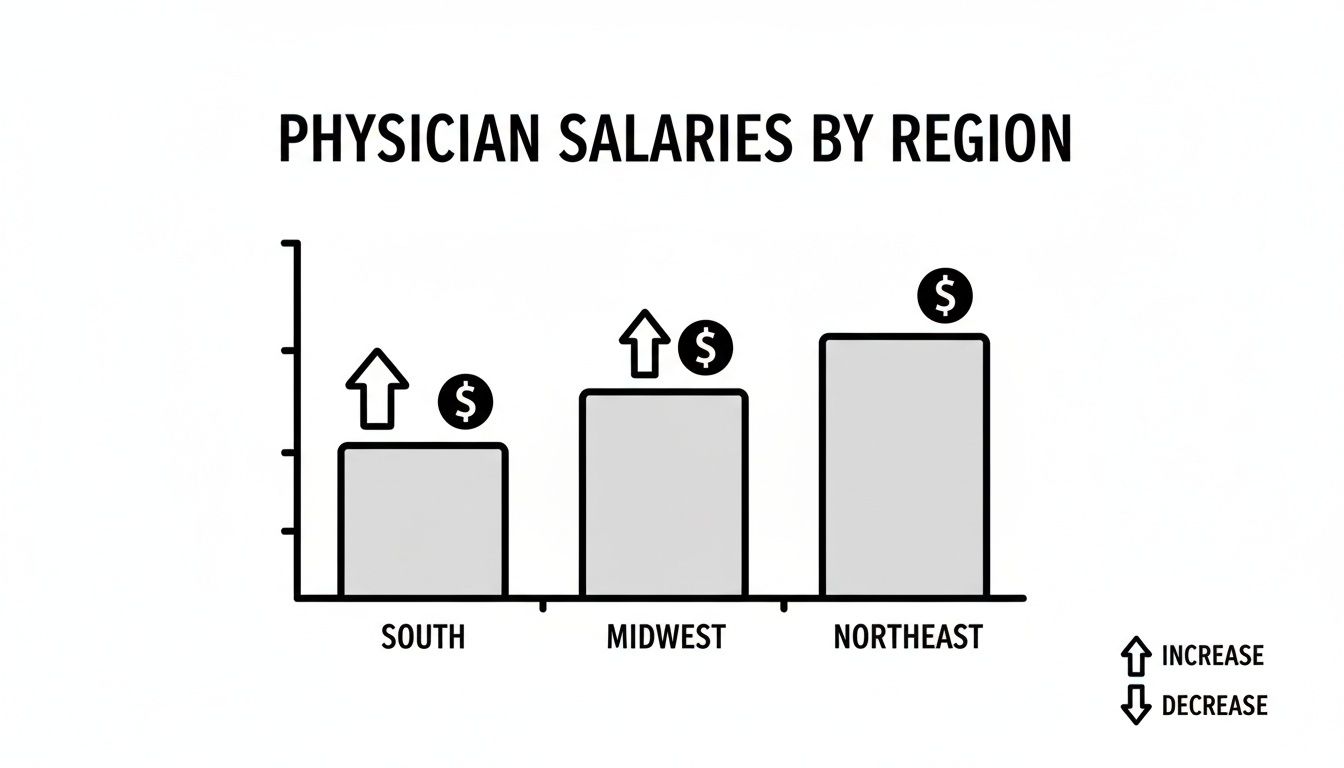
As the data shows, the Midwest and South frequently offer stronger salary packages, while the Northeast often lags. It’s a powerful reminder that the most lucrative jobs aren't always in the traditional coastal hotspots.
State Taxes: The Other Salary Reducer
After cost of living takes its bite, state and local taxes come in for their share. This is another huge variable. Nine states—including heavy hitters like Texas, Florida, and Tennessee—have no state income tax. That alone can mean tens of thousands of extra dollars in your pocket every single year.
On the flip side, states like California, Oregon, and New York impose some of the highest marginal tax rates in the nation. A physician in a top bracket there could watch over 10% of their income vanish into state taxes. It's a direct drain on your earnings that has to be part of any serious job offer comparison.
Putting It All Together: A Real-World Comparison
Let's see how this plays out with two hypothetical offers for a family physician:
- Offer A: California - $340,000 salary in a nice coastal city.
- Offer B: Iowa - $464,000 salary in a major metro area.
The Iowa offer is already much higher on paper. But the real gap becomes staggering once you adjust for reality. The cost of living in that California spot is 60% higher than the U.S. average, while the Iowa city is 10% below it. Add in California's top state income tax rate of over 13% versus Iowa's more manageable 5.7%, and the picture becomes crystal clear.
After running the numbers, the Iowa physician's adjusted income provides dramatically more purchasing power. That means more money for retirement, college funds, and personal goals—all from a job that already paid more to begin with.
This isn't an isolated example. When you adjust for cost of living, big-city salaries often shrink. Cities like San Francisco ($449,830 nominal) and Boston ($390,799) fall way down the list because of their insane expenses. Even places like Providence, RI ($386,788) and Washington, DC ($386,731) rank low in real terms. It proves that a big salary in an expensive city is often just an illusion of wealth.
To make the right call, you have to model your own financial situation. A personalized analysis is the only way to compare offers accurately. Using a tool that accounts for all these variables lets you see the true financial impact of any job offer. Explore our comprehensive physician salary calculator to see how your potential earnings stack up across different states after taxes and cost of living adjustments.
How Specialty and Location Impact Your Income
While state-by-state data gives you a solid starting point, your actual earning potential is far more nuanced. Two factors—your medical specialty and the specific city you practice in—create massive pay variations, even within the same state. Getting a handle on this interplay is the key to a job search that actually lines up with your financial goals.
The gap between specialties is huge and it isn't going away. Procedural and surgical fields consistently pull in the highest compensation, thanks to longer training, higher malpractice insurance, and the sheer revenue they generate for health systems. It's no surprise that specialties like orthopedics, plastic surgery, and radiology regularly top the charts, with average salaries pushing well past $500,000.
On the other side of the spectrum, primary care fields like family medicine and pediatrics, while absolutely essential, tend to average in the $250,000-$287,000 range. This basic dynamic holds true everywhere; a neurosurgeon will always out-earn a pediatrician. The real question is how much the local market widens or shrinks that gap.
Metro Areas: The Power of Local Market Dynamics
Beyond your specialty, the city you choose can have just as much impact as the state. Physician pay is a classic story of local supply and demand. Big, desirable cities like New York or Boston are often saturated with doctors drawn to prestigious academic centers and lifestyle perks, which can actually keep wages down. When employers have a deep pool of candidates to choose from, they don't have to offer top-tier salaries to attract great talent.
On the flip side, some of the most lucrative opportunities are in smaller or mid-sized cities anchored by a major health system. These institutions often become compensation hotspots, driving up local pay as they compete for top clinicians to staff their advanced service lines. You can find some incredible salaries in places you might not expect.
A perfect example is Rochester, Minnesota, which currently holds the title for the highest metropolitan physician compensation at $495,532 in 2024. Fueled by an impressive 8.7% annual growth rate anchored by the Mayo Clinic's world-class ecosystem, this small market punches way above its weight, easily surpassing bigger hubs like St. Louis, MO ($484,883) and Los Angeles, CA ($470,198). You can dive into the full metro-level breakdown in the 2025 Doximity Physician Compensation Report.
Connecting Specialty Pay to Lifestyle Goals
For physicians who are serious about work-life balance, understanding these details is how you find a sustainable, high-paying job. Some specialties are naturally a better fit for predictable schedules. When you combine one of those fields with the right location, you can absolutely achieve both financial freedom and personal well-being.
Think about these scenarios:
- Psychiatry in a High-Demand Metro: A psychiatrist can often find roles with no call or weekends, especially in telehealth. In a mid-sized city with a shortage of mental health providers, the pay can be exceptionally competitive, creating a lucrative career without the burnout so common in other fields.
- Dermatology in a Growing Suburb: This specialty is famous for its lifestyle-friendly hours. A dermatologist practicing in a booming suburb just outside a major city can capture high patient volume and command a strong salary while sticking to a standard workweek.
- Urgent Care in a Rural-Adjacent Town: An EM or family med doc can find high-paying, shift-based urgent care work right outside a rural area. These jobs almost never have on-call duties, giving you a clean break between your work and personal life.
The rise of virtual care has blown these opportunities wide open. Many specialists can now practice from anywhere, completely uncoupling their physical address from their employer’s location. This means you can live in a low-cost area while earning a competitive salary from a health system in a much higher-paying market.
For clinicians chasing this balance, checking out the latest remote physician jobs can reveal positions that offer both great pay and the lifestyle you actually want. By strategically matching your specialty with the right local market, you can find a role that rewards you financially without asking for your entire life in return.
Finding a Role That Aligns With Your Life
Chasing the biggest paycheck is a powerful motivator, but ignoring your own well-being in the process is a surefire recipe for burnout. The best, most sustainable medical careers are built on a foundation of balance—where you don't have to choose between competitive pay and having a personal life. It's about shifting your mindset from pure numbers to finding a role that actually fits.
Analyzing physician compensation state-by-state is about more than just a salary table. It’s about connecting those figures to what your day-to-day life will actually look like. That huge salary in a high-pressure state loses its shine pretty quickly when it comes attached to endless call shifts and mandatory weekend rounds. The real win is finding a great position that respects your time outside of work.

Marrying Great Pay with a Predictable Schedule
The good news? The healthcare job market is more flexible than it used to be. Predictable, weekday-only schedules aren't some mythical unicorn anymore. You just have to know where to look.
These roles are most common in settings that are naturally shielded from the 24/7 chaos of acute inpatient medicine. Think about settings like these:
- Outpatient Clinics: Most specialty and primary care clinics run on standard business hours, which gives you a built-in separation between work and home.
- Urgent Care Centers: These are almost always shift-based. When your shift is over, you're done. No pagers, no on-call responsibilities following you home.
- Telehealth Platforms: The explosion in virtual care has created a ton of remote jobs that often come with fixed daytime hours and incredible flexibility.
This is a real shift in the job market. It's empowering physicians to stop settling and start actively seeking out positions with clear "No Call" and "No Weekends" requirements baked right in.
The Perfect Blend: A Real-World Example
Ultimately, the 'best' job is a deeply personal calculation. It’s a blend of financial security and personal satisfaction—finding the right role, in the right place, where the compensation supports the life you actually want to live.
Let's say a dermatologist is weighing two offers. Offer A is in a high-cost coastal city with a slightly higher salary but crushing competition and a high-stress environment. Offer B is in a growing Midwestern city—a region we know compensates physicians well—with a slightly lower nominal salary, a much lower cost of living, and a guaranteed weekday-only schedule.
Offer B doesn't just give her more real-world spending power. It gives her back her weekends.
The Insight: This is where true career satisfaction is found. It's the moment you realize an extra $20,000 a year isn't worth sacrificing your mental health or every single weekend. A sustainable career is one that energizes your life, not one that consumes it.
When you're looking at a job offer, you have to look past the base salary. You need to evaluate the total package: benefits, schedule, and the priceless value of your own time. Before you sign anything, run the numbers through a physician-focused job offer analysis tool designed to weigh all these crucial factors. It's a strategic move that ensures your next step supports both your finances and your well-being.
Common Questions Answered
When you're digging into physician compensation data, a lot of questions pop up. Here are straight answers to the most common ones we get from doctors trying to map out their next career move.
Which State Really Pays the Most After Cost of Living?
High nominal salaries in states like Iowa grab headlines, but the real value—your actual purchasing power—is almost always found in the Midwest and Southeast. A solid salary in a state like Alabama or Mississippi often lets you live a far better lifestyle than a higher salary in New York or California.
Why? It’s all about the math. Lower housing costs, lighter state tax burdens, and cheaper daily expenses mean your take-home pay simply goes further. Always run the numbers with a cost-of-living calculator when you get an offer. You’ll often find that a $400,000 salary in an affordable state feels a lot richer than $450,000 in a high-cost one.
How Much Does My Specialty Change My Pay From State to State?
Your medical specialty is, without a doubt, one of the biggest factors in your earning potential, no matter where you practice. The gap between procedural fields and primary care is significant everywhere.
- Top Tiers: Surgeons in fields like neurosurgery, orthopedics, and plastics consistently earn the most, often taking home more than double what their primary care colleagues make. It's not uncommon for a neurosurgeon to average over $700,000 a year in a high-demand state.
- Primary Care: Family medicine and pediatric docs typically average around $250,000, though you’ll see this number climb in underserved areas desperate for primary care physicians.
While this earnings gap is universal, the exact numbers shift based on local market dynamics. Things like the number of competing specialists in a city or the leverage local health systems have with insurers can make a big difference.
Will My Practice Setting Really Affect How Much I Make?
Absolutely. The setting you choose to practice in plays a huge role in both your compensation structure and your ceiling for long-term earnings. The trend is clear: fewer and fewer physicians are in private practice, with well under half running their own show now.
Private practice still holds the potential for higher long-term income through equity and productivity bonuses, but it comes with the heavy burden of running a business. On the flip side, hospital employment offers a stable, competitive base salary, great benefits, and frees you from administrative headaches. In recent years, large health systems have gotten very aggressive with their offers, making employed roles a financially compelling path.
The Big Picture: As the industry consolidates, huge hospital systems and corporate groups have more power to negotiate better reimbursement rates from insurance companies. That financial muscle often translates directly into stronger, more predictable salary offers for the doctors they employ.
What’s on the Horizon for Physician Compensation?
All signs point to physician salaries continuing to climb, though maybe not at the breakneck pace we’ve seen in the past. There are a few key forces pushing salaries up:
- The Doctor Shortage: Demand for physicians, especially in primary care and psychiatry, continues to outstrip supply. This forces employers to compete for talent with attractive compensation packages.
- An Aging Population: As the population gets older, the need for complex medical care increases, driving demand across almost every specialty.
- Inflation: Basic economics means nominal salaries will keep rising with inflation, though the real value of those raises will depend on where you live.
Looking ahead, expect to see compensation models tied more directly to productivity metrics like work Relative Value Units (wRVUs), rather than just relying on flat salaries. Specialties with the most critical shortages will likely see the biggest pay bumps as health systems fight to fill those essential roles.
Ready to find a role that offers competitive pay without the burnout? At WeekdayDoc, we curate high-quality, burnout-friendly physician jobs with no call and no weekends. Start your search today.