Telehealth jobs for nurse practitioners: A proven path to landing roles
Learn how to land telehealth jobs for nurse practitioners with actionable steps, resume tips, and interview strategies.

Telehealth roles for nurse practitioners aren't just a niche anymore; they're a massive, fast-growing career path that offers the kind of flexibility and work-life balance that used to be unheard of in medicine. This isn't some temporary fad, either. It’s a permanent shift in how healthcare gets delivered, driven by what patients want and what technology now makes possible. For NPs, that means more diverse and stable opportunities to practice from almost anywhere.
Why Telehealth Is a Smart Career Move for NPs
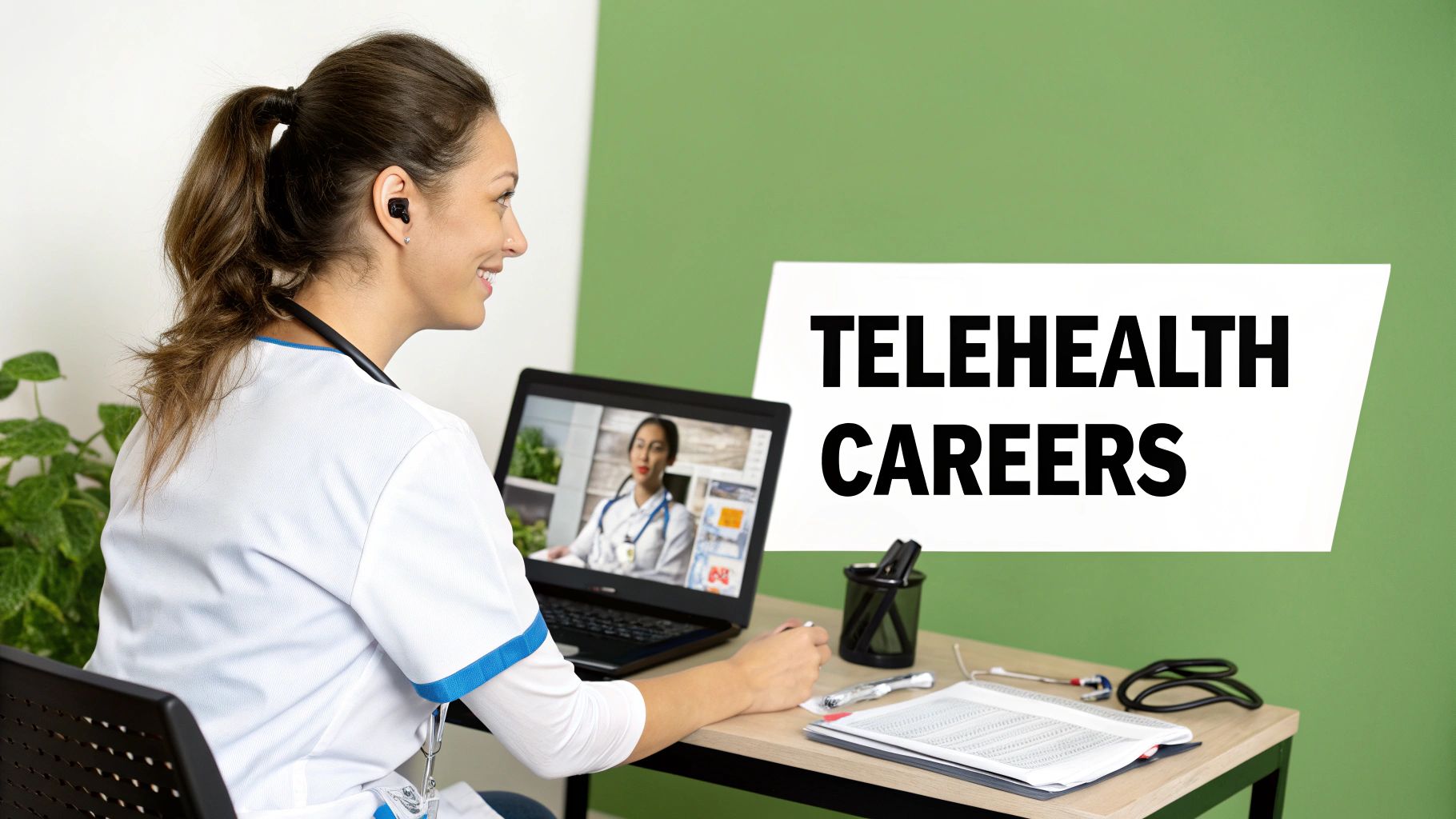 The explosion of virtual care has completely reshaped the healthcare field, creating a huge demand for skilled clinicians who can deliver top-notch care remotely. The pandemic definitely hit the accelerator, but the engine driving this growth was already running.
This expansion is creating a wealth of telehealth jobs for nurse practitioners, making it a solid, future-proof career decision. When you understand the forces behind it, you see why this isn't just a trend—it's now a core part of modern medicine.
The Forces Fueling Telehealth Growth
The demand for telehealth NPs didn't just appear out of thin air. It's a direct result of several powerful, long-term shifts in healthcare and society. These drivers ensure that virtual care roles will keep growing, offering both stability and new paths for professional development.
What’s really pushing this forward?
- An Aging Population: As baby boomers get older, the need for chronic disease management and accessible primary care is through the roof. Telehealth is the perfect solution for regular check-ins and follow-ups.
- Rural Healthcare Access: Millions of Americans live in healthcare deserts, miles away from specialists or even a primary care clinic. Virtual visits close that critical gap, connecting patients to NPs they otherwise couldn't see.
- Proven Clinical Outcomes: Study after study confirms that for many conditions—from mental health and dermatology to routine follow-ups—telehealth is just as effective as seeing someone in person. That clinical validation has cemented its place in standard practice.
Market Stability and Opportunity
The job market data tells the same story. The Bureau of Labor Statistics projects a jaw-dropping 46% increase in nurse practitioner positions between 2023 and 2033. That translates to about 135,500 new jobs.
This explosive growth is heavily tied to the expansion of virtual care. In fact, job postings that mention 'telehealth' or 'remote patient care' have shot up by over 60% in the last year alone. You can dig into more of these career outlook stats over on South University's blog.
This high demand means employers don't see telehealth experience as just a nice-to-have anymore. It’s a core competency. They are actively hunting for NPs who are comfortable with virtual platforms and can build real patient rapport through a screen. You can find more details in our complete guide to telehealth jobs.
Being able to practice medicine remotely is no longer a niche skill—it's a fundamental part of a modern nurse practitioner's toolkit. Gaining this experience sets you up for long-term career resilience and opens the door to roles with a much better work-life balance.
Getting Your Telehealth Credentials in Order
Stepping into a telehealth role isn't just about mastering new tech; it's about navigating a completely different regulatory map. For in-person roles, you generally worry about one state license. But with virtual care, the game changes entirely. The golden rule is simple: you must be licensed in the state where your patient is located at the time of the visit.
This is often the biggest hurdle for NPs transitioning to remote work, but it's far from insurmountable. You just need a clear strategy.
The Secret to Multi-State Practice: The NLC
Your first move should be to figure out the most efficient way to practice across state lines. For most, that’s the Nurse Licensure Compact (NLC).
The NLC is an agreement between states that allows nurses to have one multi-state license, giving them the privilege to practice in all other compact states. As of late 2025, a whopping 41 jurisdictions are part of the NLC. If you live in one of them, getting a compact license is a no-brainer. It will dramatically expand your reach with a single credential.
One critical catch: the NLC only covers your RN license. You’ll still need to get your APRN license squared away in each state you plan to practice in. For states outside the compact, you’ll have to apply for licensure by endorsement with each individual board of nursing. This can get pricey and take time, so focus first on the states where a potential employer has a large patient base.
My best advice? Create a dedicated digital folder for every single state license you hold. Scan and save your application, note renewal deadlines in your calendar, and track any state-specific CEU requirements. This little bit of organization will save you from a world of compliance headaches.
Beyond the License: Board Certifications and CEs
Your state licenses are your ticket to the game, but your national board certification is what proves you can play. Certifications like FNP-BC from the ANCC or PMHNP-BC are non-negotiable for almost any legitimate telehealth job. They’re the bedrock of your credibility with employers, credentialing bodies, and insurance companies.
On top of that, it’s smart to bulk up on continuing education that’s actually relevant to virtual practice. While not always mandatory, having telehealth-specific CEs on your resume shows you’re serious about the field.
Focus on courses covering topics like:
- Telehealth Platforms & Tech: Getting comfortable with the EMRs and video tools you’ll use every day.
- The Virtual Physical Exam: How to conduct a thorough assessment when you can’t physically touch the patient.
- "Webside" Manner: The art of building trust and rapport through a screen is a skill all its own.
- Digital HIPAA & Privacy: Understanding the unique security challenges of remote healthcare is crucial.
Investing in these skills does more than just check a box for your CE requirements—it makes you a much more compelling candidate in a competitive market.
To help you keep track of it all, here's a quick checklist of the essentials.
Telehealth Credential Checklist for Nurse Practitioners
This table breaks down the key licenses and certifications you'll need to have in order before you start applying for telehealth NP roles.
| Credential Type | Key Consideration | Actionable Tip |
|---|---|---|
| State RN License | Is your primary residence in an NLC state? | If yes, apply for a multi-state compact license immediately. This is your biggest leverage for multi-state practice. |
| State APRN License | You need an active APRN license for every state where your patients are located. | Prioritize getting licensed in states where your target employers operate. Ask about licensing reimbursement during interviews. |
| National Board Certification | This is non-negotiable (e.g., FNP-BC, PMHNP-BC). | Ensure your certification is active and in good standing. Display it prominently on your CV and LinkedIn profile. |
| DEA Registration | You'll likely need a DEA registration for each state where you plan to prescribe controlled substances. | Check each state's specific DEA requirements. Some telehealth companies assist with or pay for multiple DEA registrations. |
| Telehealth-Specific CEs | While not always required, these demonstrate commitment and expertise. | Look for CEs on virtual assessment, digital privacy, and telehealth law from reputable providers like the AANP. |
Getting these credentials lined up is the foundational work for building a successful telehealth career. It takes some planning, but getting it right from the start puts you in a powerful position to land the remote NP job you really want.
How to Find Your Ideal Telehealth NP Role
Let's be honest: just typing "telehealth NP jobs" into a search bar is a recipe for frustration. You'll get flooded with a million generic, irrelevant listings. Finding a great remote role isn't about casting a wide net—it's about being a strategic, surgical sniper.
The trick is to use advanced filters and keywords that reflect the job you actually want. When you start thinking like a hiring manager and using their language, you uncover the hidden gems that everyone else scrolls right past.
Master Your Search with Strategic Keywords
To cut through the noise, you need to get specific. Job board algorithms reward precision. Using the right keywords tells the system exactly what you're looking for, filtering out the roles that don't fit your life.
Here are a few of my go-to search terms to add to your arsenal:
- "Asynchronous telehealth": This is the magic phrase for jobs without live video calls. Think secure messaging and chart reviews. If you crave ultimate schedule flexibility, start here.
- "No call" or "no weekends": For many of us, these are non-negotiable. Tacking these onto your search immediately weeds out roles that will bleed into your personal time.
- "Flexible schedule" or "part-time remote": Perfect for finding opportunities that aren't chained to a rigid 9-to-5. These are ideal for NPs juggling family, continuing education, or other commitments.
- Specialty-specific terms: Always combine your clinical focus with telehealth keywords. Searches like "remote PMHNP" or "tele-dermatology NP" will give you much more targeted results.
Don't be afraid to mix and match. A search for
"asynchronous telehealth" "no call"can pinpoint those truly rare, burnout-friendly positions that give you total control over your day.
Look Beyond the Mega Job Boards
Sure, platforms like LinkedIn and Glassdoor are a decent place to start, but they're far from the only game in town. The best opportunities are often found on niche job boards and directly on the websites of telehealth companies. These platforms are built for clinicians and get the nuances of what we do.
Make a point to explore these avenues:
- Telehealth-Specific Companies: Go straight to the source. Check the career pages of companies like Wheel or SteadyMD—they are constantly on the lookout for qualified NPs.
- Professional Networking: Never underestimate the power of your own network. I've seen countless colleagues land great roles through referrals from NP Facebook groups or connections made at virtual conferences.
Before you dive too deep into the search, make sure your credentials are in order. This flowchart breaks down the typical process.
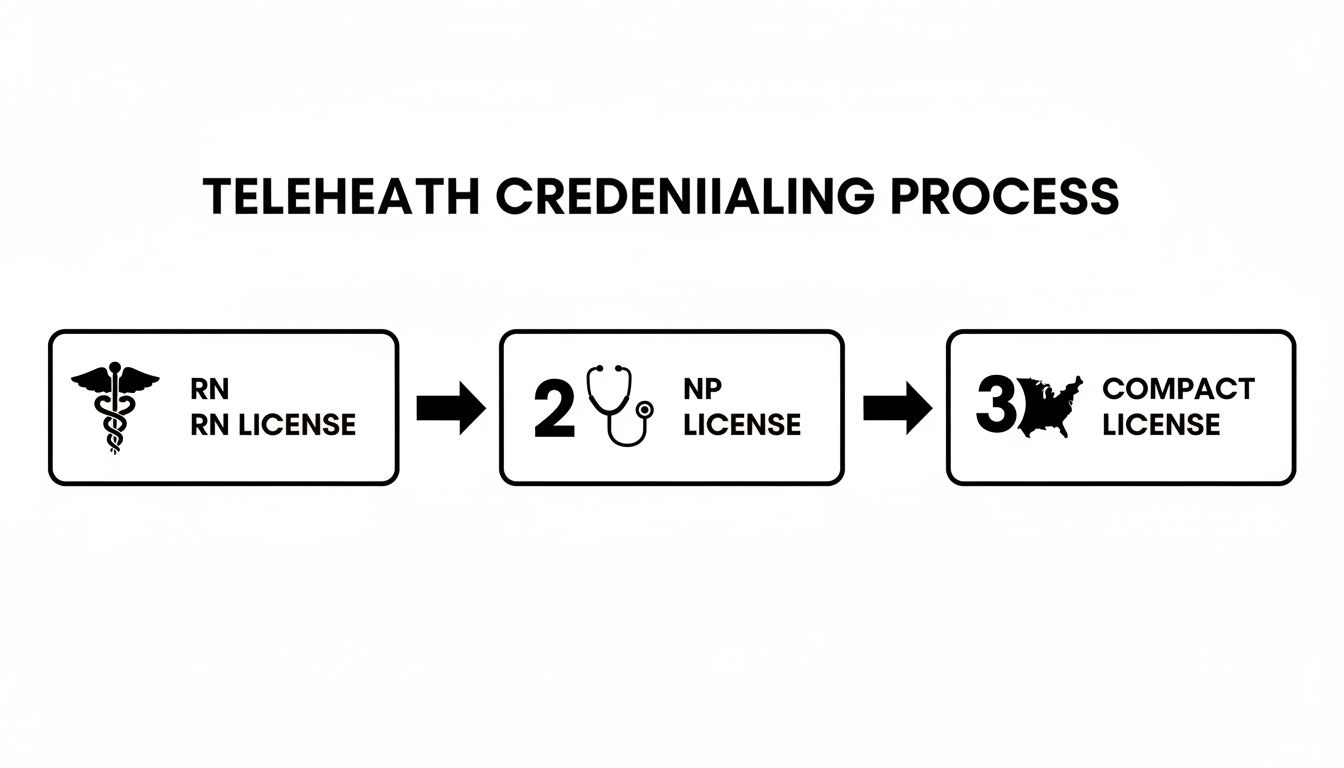
Having your RN, NP, and any compact licenses sorted out is the first step to becoming a top-tier telehealth candidate.
Finally, work smarter, not harder. Set up job alerts on your favorite platforms using your best keyword combinations. This way, the opportunities come directly to you, and you can be one of the first to apply when a perfect-fit role gets posted. For a curated list of high-quality positions, you can also check out the current nurse practitioner jobs on WeekdayDoc, which we pre-screen for work-life balance.
Crafting a Resume That Lands the Interview
Think of your resume as your personal marketing document. For telehealth jobs, a standard CV that just lists your in-person clinical experience is going to fall flat. You have to reframe your expertise to prove you’re a capable, confident, and tech-savvy virtual provider.
It’s a crucial mindset shift. This means translating your hands-on skills into the language of remote care. Before your CV even gets to a real person, it has to get past the Applicant Tracking System (ATS) bots. These systems are programmed to scan for specific keywords, and if your resume doesn't have them, it’s instantly filtered out. You'll be rejected before a hiring manager even knows you exist.
Translating Clinical Skills for Virtual Care
The trick is to directly connect your clinical know-how with telehealth competencies. Think about your daily tasks and describe them with impact, focusing on how they apply to a remote setting. Don't just list your old duties—showcase your accomplishments.
For example, don’t just say you "managed patients with chronic conditions." That's too generic for telehealth.
- Instead of this: "Provided care for diabetic patients."
- Try this: "Managed a panel of 150+ diabetic patients via synchronous video visits and asynchronous messaging, improving A1c levels by an average of 1.2 points over six months through remote monitoring and virtual coaching."
See the difference? This version proves you can handle a remote patient panel, use specific communication tools, and deliver measurable results. Those are the skills telehealth employers are desperate for.
Weaving in Keywords and Tech Proficiency
Go through every job description like a detective, hunting for the specific technologies and skills they mention. Do they use Epic, Athenahealth, or a proprietary EMR? Add your proficiency. Do they list Doximity, Zoom, or another video platform? Put it in your skills section.
Your primary goal is to mirror the language in the job posting. If a listing mentions "asynchronous communication" or "remote patient monitoring" multiple times, those exact phrases need to be in your resume. This is the single most effective way to beat the ATS.
I recommend creating a dedicated "Telehealth Proficiencies" or "Technical Skills" section near the top of your resume. This makes it impossible for a recruiter to miss.
Here’s what to include:
- EMR/EHR Systems: Epic, Cerner, Athenahealth, eClinicalWorks, etc.
- Video Conferencing Platforms: Zoom for Healthcare, Doxy.me, Teladoc, Amwell.
- Secure Messaging Apps: OhMD, Spruce Health, TigerConnect.
- Remote Patient Monitoring (RPM) Tools: Mention any experience with devices for BP, glucose, or weight monitoring.
Crafting a Compelling Cover Letter
Your resume covers the "what"—your skills and experience. Your cover letter needs to explain the "why"—why you are the perfect fit for this virtual role. This is your chance to show you truly understand the nuances of virtual care and can build patient rapport through a screen.
Please, don't just rehash your resume.
Instead, tell a brief story. Maybe describe a time you calmed an anxious patient over a video call or used asynchronous messaging to coordinate complex care with a specialist. This shows you get the unique challenges of telehealth and positions you as an insightful, experienced candidate for the best telehealth jobs for nurse practitioners.
Acing the Virtual Interview and Salary Negotiation
You’ve navigated the job boards and tailored your CV, and now it’s time for the final hurdles. The virtual interview and salary negotiation are where you prove your value and lock in a telehealth role that truly supports your life.
Unlike in-person interviews, a video call pulls double duty—it's a test of your clinical skills and your tech competence. Your environment becomes part of your first impression, so set the stage. Find a quiet spot with a clean, professional background. Good lighting is absolutely critical; make sure the light source is in front of you, not behind, so you're not just a silhouette.
And please, test your tech beforehand. Your camera, mic, and internet connection all need a dry run well before go-time.
Navigating Telehealth-Specific Interview Questions
Hiring managers need to know you can build that crucial patient connection through a screen. They’ll ask pointed questions to see if you can make sound clinical judgments without a hands-on physical exam. Generic answers won't cut it. You need specific, real-world examples that showcase your virtual care abilities.
Be ready for questions like:
- "How do you build rapport and establish trust with a new patient you've never met in person?"
- "Walk me through a complex case you managed completely via telehealth. What was the outcome?"
- "What's your clinical thought process for deciding when a patient needs to be seen in person?"
When you answer, zero in on your communication skills. Talk about how you use active listening and read visual cues to assess a patient's state. Explain how you guide patients through self-palpation or other at-home assessments to get the information you need. The key is showing you have a repeatable, reliable process for virtual exams.
The goal is to prove you're not just a clinician who happens to be on video, but a true virtual care expert. Frame your answers around specific techniques that demonstrate your proficiency in "webside manner."
Unpacking the Compensation Package
Once the offer comes through, it’s time to talk money. Compensation for telehealth NP jobs can look a little different than a traditional clinic role. You might see an hourly wage, a per-visit rate, or a base salary with productivity bonuses. Make sure you understand exactly how you’ll be paid.
The market for telehealth NPs is hot right now. Recent data shows the average annual salary has climbed to $130,295, and top earners are pulling in $180,000 or more. For highly experienced NPs, salaries can even break $200,000. Know your worth before you even get on the call. You can dig into more detailed telehealth salary ranges on ZipRecruiter to see what the market looks like in your area.
When you're looking at an offer, you have to evaluate the whole package. A high hourly rate doesn't mean much if you're on the hook for your own malpractice insurance and state licensure fees. Always ask about benefits, CEU stipends, and whether they provide or reimburse you for equipment.
To get a clearer picture of what you should be earning, our Salary Calculator Pro can help you model different compensation structures. Walking into that negotiation prepared is the best way to secure a package that truly reflects the high demand for your skills.
Common Questions About Telehealth NP Careers
Making the jump to telehealth brings up a lot of questions. Beyond just finding a job, you’re probably wondering what the day-to-day really looks like and what it means for your career in the long run. Let's dig into some of the most common things NPs ask when they're thinking about going remote.
Is Telehealth a Stable Long-Term Career Path?
Yes, absolutely. While the pandemic certainly accelerated its adoption, virtual care is here to stay. This isn’t a temporary bubble.
The telehealth market is projected to skyrocket to over $200 billion by 2025, driven by a fundamental shift in how patients want to access healthcare. It’s bridging critical gaps, especially for people in rural or underserved areas. For a deeper dive into market trends, check out the insights on PracticeMatch.com.
Healthcare systems are making huge investments in the technology and workflows that support remote care. This is creating a stable, growing job market for nurse practitioners who are ready to practice differently.
Do I Need In-Person Clinical Experience First?
For nearly all legitimate telehealth roles, the answer is a firm yes. When you can't perform a hands-on physical exam, you have to lean heavily on your clinical reasoning and history-taking skills. You need the confidence to read subtle cues through a screen and know, without a doubt, when a patient needs to be seen in person.
That’s why most reputable companies look for NPs with at least one to two years of direct patient care experience. That time in the trenches builds the clinical judgment you need to manage patients safely from a distance.
What Does the Day-to-Day Schedule Look Like?
This is where telehealth jobs for nurse practitioners can really differ, and it all comes down to the model of care.
- Synchronous Roles: Think of this as a virtual clinic day. You see patients in real-time via video or phone, working through scheduled appointment blocks. It’s structured, just without the commute or the hassle of rooming patients.
- Asynchronous Roles: This is where you get maximum flexibility. You handle patient cases through secure messaging, chart reviews, or refilling prescriptions on your own time. As long as you meet the company's turnaround times, you control your schedule.
Many NPs find a sweet spot in hybrid roles that mix both models. You get the real-time patient connection of synchronous visits plus the focused, deep-work time of asynchronous tasks. Figuring out which style suits your personality is the key to being happy long-term.
Ultimately, your daily life in telehealth is shaped by the role you choose and the boundaries you set. It’s a career path that lets you build your work around your life, not the other way around—and for many NPs, that autonomy is the biggest draw.
Ready to find a role that respects your time? At WeekdayDoc, we specialize in curating burnout-friendly telehealth jobs with no call and no weekends. Start your search today on WeekdayDoc and discover a better way to practice medicine.