A Clinician's Guide to Finding Physician Jobs Remote and Avoiding Burnout
Discover how to find, evaluate, and land high-paying physician jobs remote. This guide offers real strategies for navigating licensure, salary, and burnout.

The demand for remote physician jobs is exploding, and for good reason. Clinicians everywhere are looking for a way out—an escape from burnout and a path back to work-life balance. These roles aren't some niche corner of medicine anymore; they're a mainstream career path that offers real flexibility, financial freedom, and a sustainable alternative to the relentless grind of traditional practice. This guide is your roadmap to finding and landing one.
Why Physicians Are Embracing Remote Work

This shift isn't just a fleeting trend. It's a fundamental change in how we practice medicine and build our careers. For decades, the default path meant brutal hours, overnight calls, and a constant battle to juggle patient care with our own well-being. The rise of telehealth and other remote opportunities finally gives us another option.
This movement is really about reclaiming autonomy. It's a conscious move away from the rigid, top-down structures that have fueled so much professional dissatisfaction and burnout in our field.
The Search for a Burnout-Proof Career
Let’s be honest: widespread burnout is still a massive problem in medicine. The constant pressure from in-person clinical demands, the mountain of administrative tasks, and the unforgiving schedules have pushed many of us to the breaking point. Remote roles offer a powerful antidote by putting you back in control of your work environment and your time.
The benefits go way beyond just working from a home office. We're talking about:
- Real Schedule Control: Many remote positions do away with mandatory weekends or overnight shifts. You can finally fit your work around your life, not the other way around.
- Less Administrative Hassle: Jobs in areas like utilization management or asynchronous care often strip away the endless, patient-facing admin work that eats up so much of our time in a clinic.
- Location Independence: Imagine being able to work from anywhere. This opens up the possibility of living in a lower-cost-of-living area or moving closer to family without having to sacrifice your career.
The real goal here is to build a career that doesn't demand your health and family time as payment. Remote work gives you the framework to design that career on your own terms.
Financial and Lifestyle Advantages
The financial case for going remote is getting stronger every year. The market for telehealth physicians has grown so much that, as of 2025, compensation packages are now approximately 40% higher than traditional in-person roles. That’s not a small difference.
This salary premium is a direct result of overwhelming demand, with 74.4% of physicians now working in practices that offer telehealth services. It's clear where the industry is heading.
But it’s not just about a higher salary. The financial picture gets even better when you factor in the savings. No more daily commute means saving on gas and car maintenance. Working from home means spending less on work clothes and lunches out.
When you add it all up, these changes can seriously accelerate long-term goals like achieving Financial Independence, Retire Early (FIRE). For a deeper dive into crafting a schedule that works for you, our guide on flexible schedule physician jobs has more strategies.
So What Kinds of Remote Physician Jobs Are Actually Out There?
When you hear “remote physician jobs,” your mind probably jumps straight to a live video call with a patient. That’s definitely a big piece of it, but synchronous telehealth is just one slice of a much bigger, more interesting pie.
The reality is, remote medicine has exploded beyond simple video consults. There’s a whole spectrum of roles out there now, built for different personalities, clinical skills, and even how much you actually want to interact with patients.
Understanding the different categories—synchronous, asynchronous, and non-clinical—is the first real step to finding a job that won’t just pay the bills, but will actually fit your life. It’s surprising how many clinicians don’t realize they can build a fantastic remote career without ever having to be “on camera.”
And this isn't some temporary, post-pandemic fad. Remote and hybrid work are here to stay in healthcare. Polling from June 2023 showed that 52% of medical groups have between 1% and 25% of their staff working remotely at least half the time. That’s building on data from way back in 2021, when nearly 59% of practices had already made remote work a permanent option. These jobs are now part of the mainstream.
Synchronous vs. Asynchronous Clinical Roles
The first major fork in the road is deciding between synchronous and asynchronous care. Your preference here completely changes what your day-to-day will feel like.
- Synchronous Care: This is the live, real-time stuff—video calls, phone consults. Think virtual urgent care, telepsychiatry, or routine primary care follow-ups. It’s the closest thing to a traditional office visit, just done digitally. You have a schedule, you see patients back-to-back, and you have to be “on.”
- Asynchronous Care: This is the “store-and-forward” model. A patient sends information—maybe a photo of a rash, a detailed questionnaire, or a secure message—and you review and respond on your own time (within a certain window, of course). It’s huge in specialties like dermatology and radiology, but it's also used for things like lab reviews or prescription refills in primary care.
Picture this: Dr. Chen works in synchronous tele-urgent care. Her day is a wall of 15-minute video slots. She’s locked into her schedule. Meanwhile, Dr. Lee has an asynchronous gig reviewing patient charts and e-consults. She can block out her work around a dentist appointment or her kid’s soccer game, offering a level of flexibility Dr. Chen just doesn’t have.
To help you visualize where you might fit, here’s a quick breakdown of the most common remote physician roles.
Comparing Remote Physician Job Categories
| Role Type | Typical Daily Tasks | Patient Interaction Level | Schedule Flexibility | Common Employers |
|---|---|---|---|---|
| Synchronous Telehealth | Live video/phone consults, e-prescribing, real-time charting. | High | Low to Moderate | Telehealth platforms, large health systems, private practices. |
| Asynchronous Telehealth | Reviewing charts, images, lab results; secure messaging. | Low to None (Indirect) | High | Specialty groups (Derm, Rad), digital health companies. |
| Utilization Management | Reviewing pre-authorizations and medical necessity cases. | None | Moderate to High | Health insurance companies, third-party review organizations. |
| Health Tech/Pharma | Consulting on product design, medical writing, chart review for AI. | None | High | Startups, medical device companies, pharmaceutical firms. |
| Medical Education | Developing CME content, writing for publications, curriculum design. | None | Very High | Medical education companies, online universities, publications. |
As you can see, your level of patient interaction and schedule control can vary dramatically depending on the path you choose. Many physicians start with one and then pivot to another as their career or life priorities change.
The Growing World of Non-Clinical Remote Work
Beyond direct patient care, there's a massive—and often overlooked—world of non-clinical remote jobs for physicians. These roles are perfect if you want to use your medical degree without the direct pressures of clinical practice.
Your expertise is incredibly valuable in these fields, and they often come with much better work-life balance and schedule control.
Key Non-Clinical Opportunities
- Utilization Management (UM): This is a big one. You’re essentially a medical consultant for an insurance plan, reviewing cases to determine medical necessity based on clinical guidelines. It’s analytical, detail-oriented work with zero patient contact.
- Medical Writing and Communications: Think pharma companies, medical device makers, and health education websites. They all need physicians to create, review, and edit content, from clinical trial reports to patient education pamphlets.
- Health Tech Consulting: Tech startups and big EHR companies are desperate for physicians to provide real-world clinical input on their products. You get to help shape the tools that other doctors will use, ensuring they’re actually functional and clinically sound.
Finding these kinds of jobs means looking in different places. You won’t see many of them on traditional medical job boards. That’s why it pays to broaden your search to general remote job sites. For instance, you might stumble upon a health tech consulting role on a platform like remotefirstjobs.com.
By expanding where you look, you tap into a hidden market of physician jobs remote that go way beyond the standard telehealth model.
Navigating the Logistics of Your Remote Medical Practice
Finding a great remote physician job is only half the battle. The other half is setting up your practice environment so it’s secure, compliant, and efficient. It’s easy to get excited about the clinical work, but ignoring the operational details—like where you practice and how you're licensed—can cause major headaches down the line.
To make a smooth transition, you need to get a handle on three key areas: multi-state licensure, your home office setup, and malpractice coverage. Nail these, and you'll build a remote career that's both sustainable and legally sound.
Demystifying Multi-State Licensure
Here's the number one rule of telehealth: you must be licensed in the state where the patient is located, not where you are. If you’re planning to work for a national telehealth company, that almost always means holding licenses in multiple states.
In the past, this was a nightmare—a slow, expensive, and paper-heavy ordeal for each state. Thankfully, the Interstate Medical Licensure Compact (IMLC) has made this worlds easier. The IMLC is essentially an express lane for qualified physicians to get licensed in participating states.
The real beauty of the IMLC is efficiency. Instead of drowning in dozens of unique, lengthy applications, you complete one primary application. Once that's verified, you can get separate licenses from other compact states much, much faster. It's a total game-changer for a serious telehealth career.
So, how does it actually work?
- Check Your Eligibility: First, you need a full, unrestricted medical license in a participating IMLC "state of principal licensure" (SPL).
- Submit the Application: You’ll send a single application to your SPL's medical board and pay a $700 fee for the initial IMLC verification.
- Get Your Licenses: Once you're approved, you can pick which other IMLC member states you want to be licensed in. You still have to pay each state’s individual licensing fee, but the process is dramatically shorter since they accept your home state's verification.
A quick heads-up: not all states are in the compact, and the list does change. Always double-check the current IMLC map before you start.
This flowchart gives you a sense of the different paths a remote physician job can take, from real-time video calls to completely non-clinical work.
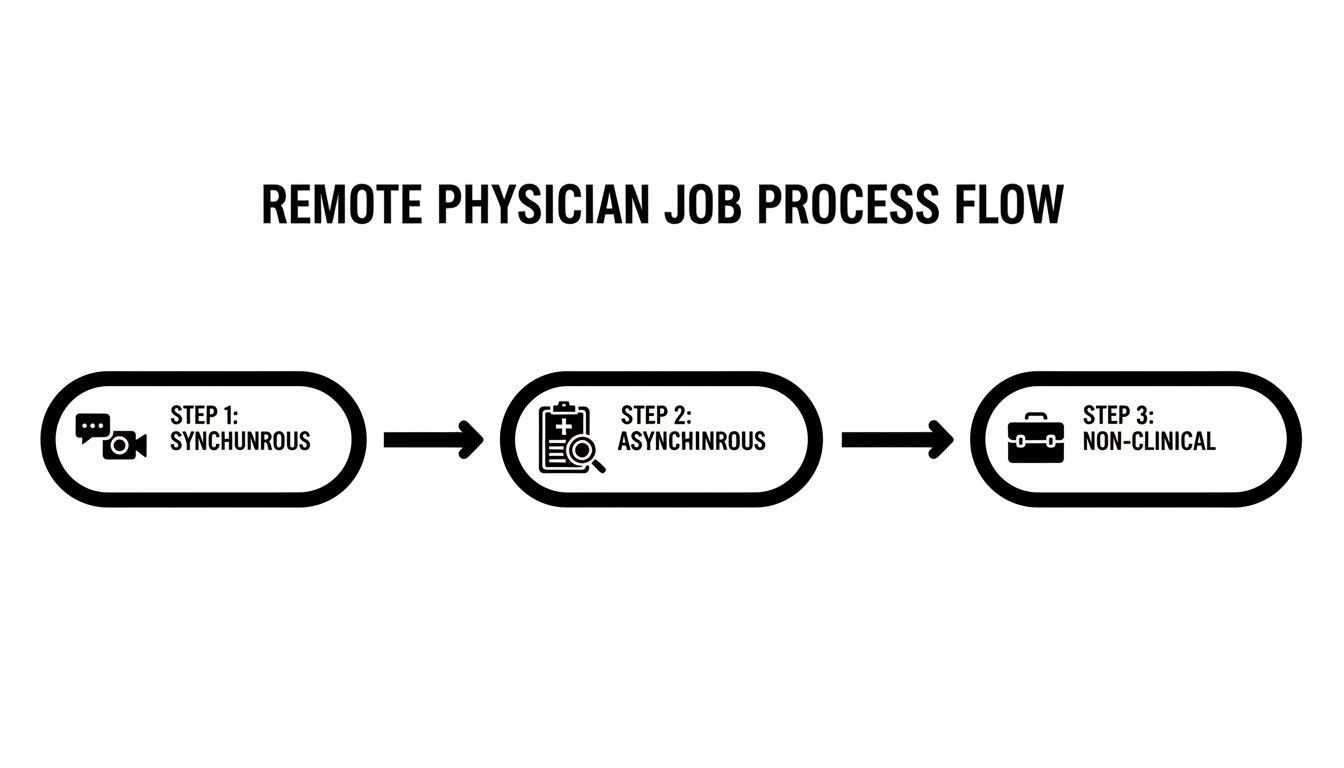
As you can see, each type of role has its own set of logistical demands to consider.
Creating a HIPAA-Compliant Home Office
When you work remotely, your home office becomes your clinic. That means it needs to be a professional space that guarantees patient privacy and data security. A HIPAA-compliant setup isn't just a "nice-to-have"—it's non-negotiable.
Here’s a practical checklist to get your remote headquarters up to snuff:
- A Private, Dedicated Workspace: You absolutely need a room with a door you can close. This prevents family or visitors from seeing or overhearing any protected health information (PHI). For an extra layer of privacy, consider soundproofing or a white noise machine.
- Secure, High-Speed Internet: A reliable, password-protected internet connection is the backbone of your practice. A hardwired Ethernet connection is almost always more stable and secure than Wi-Fi. It's also smart to have a backup, like a mobile hotspot, just in case your main connection goes down.
- Professional Equipment: A high-quality webcam, a noise-canceling headset, and good lighting are table stakes. They ensure you can communicate clearly and build rapport with patients, which signals professionalism and improves their experience.
- Secure Devices: Your work computer should be for work, and work only. Protect it with a strong password and make sure your antivirus and firewall software are always up to date. Never, ever access patient data on personal or shared family devices.
Think of building this environment as a critical investment in your career. It’s what allows you to meet professional standards from the comfort of home.
Understanding Malpractice Insurance for Telehealth
Malpractice insurance is just as critical in virtual care as it is in a traditional clinic, but the rules can be a little different. A question I hear all the time is whether the employer's policy is enough or if a personal policy is needed.
Most reputable telehealth companies will provide malpractice coverage for the work you do for them. The key is to dig into the details. Does it include "tail coverage" if you leave? Does it cover you in every single state where you're licensed to practice? These are vital questions to ask during your contract negotiation.
If you’re working as an independent contractor or juggling a few part-time remote gigs, getting your own malpractice policy is often the smartest move. It gives you direct control and ensures there are no coverage gaps between jobs. When you get an offer, you can use a tool like our comprehensive physician offer analyzer to weigh the value of benefits like malpractice insurance against the salary and other perks. Whatever you decide, always get the policy details in writing.
How to Find and Vet Burnout-Friendly Remote Jobs
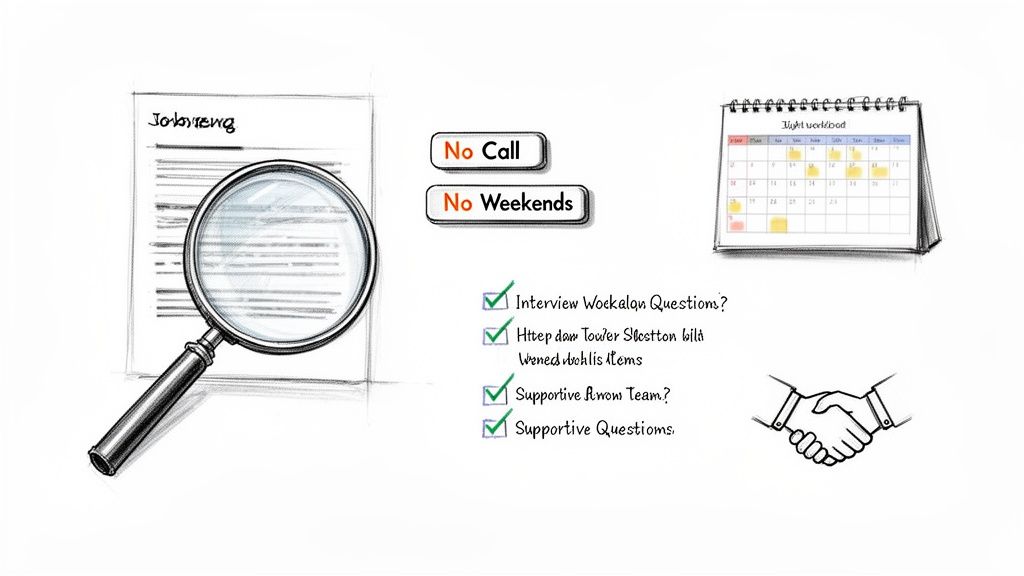
Finding a remote physician job is easy. Finding a good one? That's a whole different ballgame. The last thing you want is to swap your clinic burnout for a digital version, shackled to an insane caseload and a toxic remote culture.
The secret is to become a discerning candidate—someone who can spot the green flags and run from the red ones long before an offer letter ever materializes. This isn't about just blasting your CV everywhere. It's a strategic process of filtering roles, decoding job descriptions for what they aren't saying, and asking pointed questions that reveal the truth about a role.
Where to Find Quality Remote Physician Opportunities
Forget the massive job boards where your application disappears into a black hole. Your search needs to be targeted and efficient. Specialized platforms curated for clinicians will give you a much better signal-to-noise ratio.
Look for sites that let you filter for the things that actually prevent burnout. Focus your search with filters like:
- "No Call" or "No Weekends": This is non-negotiable. Immediately weed out roles that don't respect your personal time.
- "Asynchronous": A golden ticket if you crave ultimate schedule flexibility over live patient calls.
- "Part-time" or "Per Diem": Perfect for easing into remote work or supplementing other income streams. If this is your main goal, we have a whole guide dedicated to part-time physician jobs.
To streamline your search, consider subscribing to a curated weekly job feed that focuses specifically on physician opportunities. These often unearth high-quality roles you'd otherwise miss.
Decoding the Job Description for Red Flags
A job description is your first real glimpse into a company's culture and expectations. You need to read between the lines to sniff out potential stressors. Honestly, a vague or poorly written description is often the first red flag.
Pay close attention to these key areas:
- Patient Load Expectations: "Fast-paced environment" is often code for "unmanageable patient volume." Look for hard numbers—patients per hour, charts per day. If they aren't listed, that's your first question for the interviewer.
- Administrative Support: Do they mention dedicated staff for scheduling, billing, or tech support? If not, you can bet those tasks will land on your plate, piling on the administrative work you’re trying to escape.
- Onboarding and Training: A good employer is proud of their structured onboarding process and will mention it. Silence on this front often signals a chaotic "sink or swim" environment.
A burnout-friendly role will be transparent about its expectations from the very beginning. Ambiguity in a job description often translates to a lack of structure and support in the actual role.
Remember, the high demand for clinicians gives you leverage. With a projected shortfall of up to 86,000 physicians by 2036, employers are competing for talent. This empowers you to be selective and hold out for a role that genuinely fits your life.
Asking the Right Questions During Your Interview
The interview isn't just for them to vet you; it's your chance to put them under the microscope. Your mission is to move past the canned HR answers and get a crystal-clear picture of the daily reality, workload, and culture.
You need to ask sharp, operational questions to get to the truth. The table below outlines some critical questions to help you assess whether a role is truly sustainable or just burnout with a better view.
| Category | Question to Ask | What to Listen For (Green Flag vs. Red Flag) |
|---|---|---|
| Daily Workload | "Can you walk me through a typical day for a physician in this role, from logon to logoff?" | Green: A structured, predictable day with protected breaks. Red: "Every day is different," "It's all hands on deck." |
| Productivity Pressure | "What's the expected patient-per-hour or chart-review quota, and what happens if a complex case requires more time?" | Green: Focus on quality and flexibility for complex cases. Red: Rigid quotas, emphasis on speed over patient care. |
| Performance Metrics | "How is physician performance measured here? What are the key metrics for success?" | Green: Metrics tied to quality of care, patient outcomes, and peer review. Red: Purely volume-based metrics (e.g., number of encounters, RVUs). |
| Company Culture | "What is the physician turnover rate in this specific role over the last year?" | Green: Low, stable turnover with clear reasons for any departures. Red: Evasive answers, high turnover ("We're growing fast!"). |
| Physician Support | "How does the company support physicians with administrative tasks, IT issues, or difficult cases?" | Green: Dedicated support teams, easy-to-access resources, peer collaboration. Red: Vague answers, implying you're on your own to figure things out. |
By asking direct questions like these, you force a practical conversation, not a theoretical one. The answers you get will tell you everything you need to know to confidently decide if a role is a path to a sustainable career or just another fast track to burnout.
Negotiating Your Offer and Planning Your Financial Future
Getting a remote job offer is a huge win, but don't pop the champagne just yet. Now the real work begins. This is where you shift from candidate to strategist, and negotiating a remote role is a different ballgame. It's about so much more than just the base salary.
You're crafting a total compensation package that not only secures your financial future but fiercely protects the work-life balance you've been fighting for. Think of it as a blueprint for your entire professional environment. When your office is your home, the lines blur, and a smart negotiation addresses this head-on.
Look Beyond the Base Salary
Fixating only on the salary number is one of the biggest mistakes physicians make when going remote. The real gold is often buried in the benefits and reimbursements designed to support a work-from-home lifestyle. These perks directly boost your take-home pay and make your day-to-day work life infinitely better.
Once you have that offer in hand, it's time to think bigger. Here are the non-negotiables you should be discussing:
- Home Office Stipend: Are they offering a one-time setup bonus or an annual allowance for essentials? Think ergonomic chair, a great webcam, a standing desk, or a second monitor. These are no longer luxuries; they're your tools of the trade.
- Tech and Internet Reimbursement: Reliable, high-speed internet is the lifeblood of telehealth. It's not optional. Ask for a monthly stipend to cover your internet bill and other critical tech costs.
- Licensure and CME Costs: For national telehealth jobs, maintaining licenses in multiple states is a massive expense. Get it in writing that the company will cover 100% of application and renewal fees. The same goes for your Continuing Medical Education—make sure the allowance is generous enough for top-tier virtual conferences.
- Schedule Flexibility: This is arguably the most valuable non-monetary benefit you can negotiate. Can you lock in a four-day work week? Or get protected administrative time blocked out on your calendar every single week? Defining these boundaries before you sign is non-negotiable for preventing burnout.
Tying Your Remote Job to Your FIRE Goals
For many of us, the shift to remote work isn't just a career pivot; it's a strategic move toward Financial Independence, Retire Early (FIRE). The structure of a remote physician job aligns perfectly with FIRE principles, creating a powerful engine for wealth building.
A well-negotiated remote job isn't just a career move—it's an arbitrage opportunity. It lets you decouple a high physician income from a high-cost-of-living location, which can dramatically accelerate your path to financial freedom.
This strategy is a one-two punch. First, as we've seen, many remote roles offer competitive salaries. But the real game-changer is location independence. It gives you the power to slash your biggest expenses—housing, taxes, transportation—by choosing to live where your money goes further.
The Financial Turbo-Boost of Going Remote
Let’s run the numbers. Picture a physician pulling in $250,000 a year while living in San Francisco or New York City. Between sky-high taxes and a mortgage on a shoebox-sized condo, 60% of their income could evaporate before it even hits their savings account.
Now, imagine that same doctor lands a remote job with the exact same salary but relocates to a state with no income tax and a dramatically lower cost of living. Suddenly, their housing costs are cut in half, and their tax burden plummets.
That simple move could easily free up an extra $50,000 to $70,000 a year. Invested properly, that surplus capital starts compounding at an incredible rate. We're talking about potentially shaving a decade or more off your FIRE timeline. This is how you transform a high income into real, tangible wealth and make the dream of an early, self-directed retirement an achievable reality.
Your Top Questions About Remote Physician Jobs, Answered
Making the leap to a remote physician role is a big career shift, and it’s totally normal to have a ton of questions. You’re stepping away from the familiar rhythms of a clinic or hospital, and that comes with a lot of unknowns.
Let's cut through the noise and tackle the most common concerns I hear from physicians considering this path. This isn't just about the logistics—it’s about the day-to-day reality, the long-term career impact, and the real challenges you might face.
Will My Clinical Skills Get Rusty in a Fully Remote Job?
This is probably the #1 concern I hear, and it’s a valid one. But the idea that remote work automatically dulls your clinical edge is a myth. For many specialties like psychiatry, dermatology, and even complex primary care, the diagnostic and management challenges are just as rigorous as in-person practice.
Think about it: synchronous video visits force you to sharpen your communication and diagnostic skills. You learn to rely more on masterful history-taking and subtle visual cues when you can't fall back on a full physical exam. Many docs also strike a great balance by mixing part-time remote work with occasional in-person locums or volunteer shifts to keep procedural skills fresh.
The key is finding a role that actually engages you clinically. And don't forget that many remote employers offer generous support for virtual CMEs and conferences to keep you on top of your game.
How Does State Licensure Work if I Want to Practice Nationally?
Navigating multi-state licensure is the biggest logistical hurdle for any physician serious about remote work. The most efficient way to tackle this is through the Interstate Medical Licensure Compact (IMLC). It’s a game-changer.
Instead of drowning in paperwork for dozens of states, the IMLC lets you apply once through your home state (if it’s a member) and then get expedited licenses in other compact states. For states outside the IMLC, you’ll have to apply to each medical board directly, which is a much slower slog.
The good news? Most large telemedicine companies know this is a barrier. They often have entire teams dedicated to managing your applications and will even cover the licensing fees as part of your contract. Make sure to ask about this during your negotiations—it can save you thousands of dollars and countless headaches.
What Are the Biggest Unexpected Challenges of Working Remotely?
While the benefits are huge, you need to go in with your eyes open. One of the most common things physicians struggle with is professional isolation. You miss the spontaneous "curbside consults" and the simple camaraderie of seeing colleagues every day. To combat this, you have to be intentional about connecting with peers through virtual communities or professional groups.
The other big one is the blurring of work and home life. When your office is always just a few steps away, it's dangerously easy to let work bleed into your personal time. You have to enforce firm boundaries.
This means:
- Creating a dedicated workspace. A room with a door you can physically close is ideal.
- Sticking to a schedule. When the day is done, it’s done.
- Developing a "log-off" ritual. Something simple to signal to your brain that the workday is officially over.
Finally, getting the hang of a new EHR without an IT person down the hall can be frustrating. A good remote employer will have a responsive and easy-to-reach virtual support system. If they don't, that's a red flag.
Are Non-Clinical Remote Jobs Realistic for Physicians to Get?
Absolutely. Roles in utilization review, medical advising for tech startups, or consulting for pharma companies are competitive, but your clinical background gives you a massive advantage over non-physician candidates.
The trick is to reframe your CV. Instead of listing clinical procedures, you need to highlight your transferable skills. Showcase your ability to perform:
- Critical analysis and evidence-based decision-making
- Data interpretation and synthesis
- Clear communication for a non-clinical audience
Networking is huge in this space. Get on LinkedIn and connect with physicians who have already made the switch. They can be an incredible source of advice and unlisted job opportunities. A great strategy is to start with a part-time "bridge" role, like weekend utilization management, to build relevant experience while you’re still practicing. It proves you're serious and helps you build a track record in the non-clinical world.
At WeekdayDoc, we're dedicated to helping you find a career that fits your life, not the other way around. Explore our curated job board for burnout-friendly roles with no nights, no weekends, and no call schedules. Find your next opportunity at WeekdayDoc.