How to Land a Nurse Practitioner Remote Job You Love
Discover how to find a nurse practitioner remote job that fits your life. Learn proven strategies for your search, application, and interview process.

Forget what you've heard about remote work being a temporary trend. For nurse practitioners, a remote job isn't just a possibility anymore—it's a real, sustainable career path and a powerful antidote to clinical burnout. This guide is your roadmap to finding a role that finally delivers on the promise of work-life harmony.
We’re moving beyond generic advice to give you a practical, boots-on-the-ground playbook. From spotting genuinely burnout-friendly roles to confidently negotiating an offer, you'll get the real story on what it takes to build a fulfilling career in virtual care.
The Reality of a Remote NP Career
The demand for remote nurse practitioners is exploding. We're looking at a projected 35% growth in NP positions between 2024 and 2034. That's a surge five times faster than the average for all other jobs.
What’s driving it? An aging population needs more primary and preventive care, and NPs are stepping up as the frontline providers, especially in underserved rural areas where telehealth is a lifeline.
This roadmap breaks down the entire process into three core stages, taking you from the initial search to landing a job that truly fits your life.
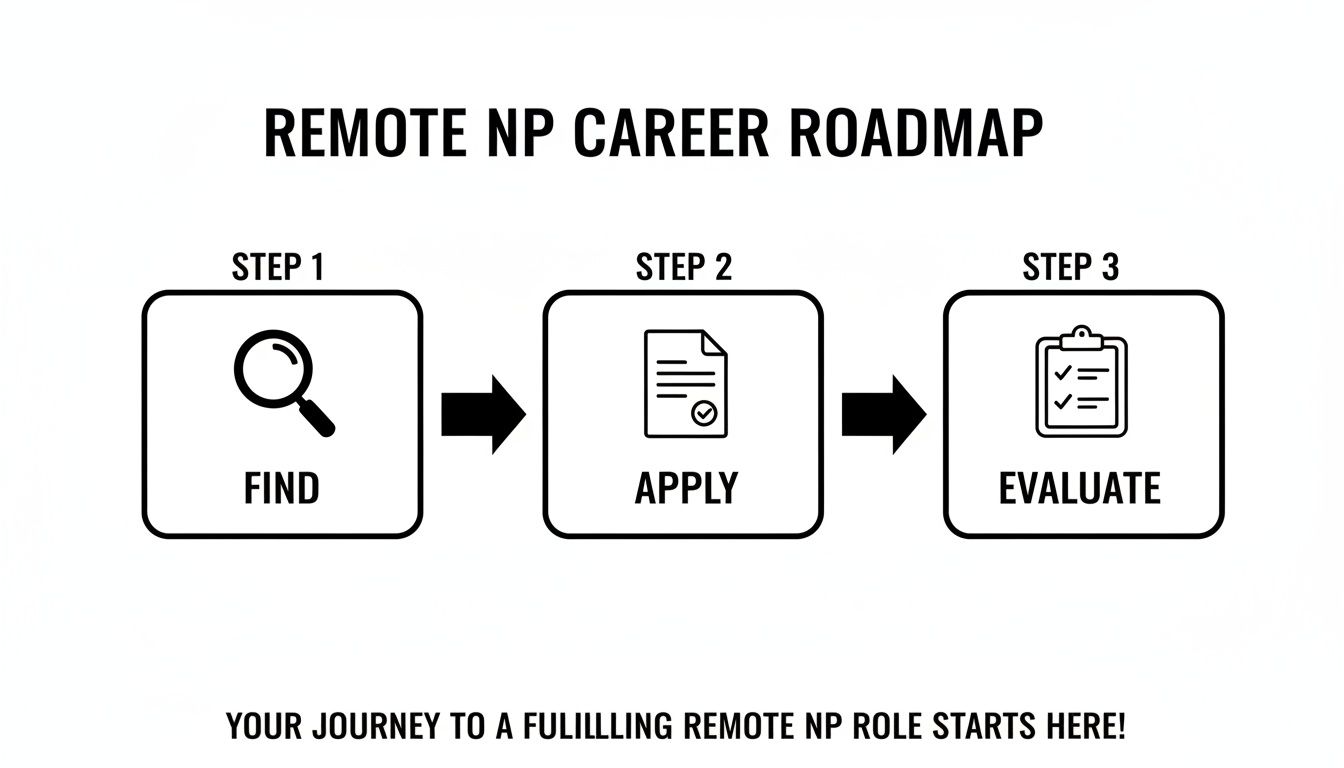
It all boils down to finding the right roles, building an application that gets noticed, and knowing how to evaluate offers for long-term sustainability.
Setting Yourself Up for Success
Shifting to a remote role takes a different kind of discipline. Building solid productive work-from-home habits is non-negotiable if you want to stay effective and avoid burnout. This means carving out a dedicated workspace and drawing firm lines between your professional and personal time.
Success in a remote NP role isn't just about clinical skill; it's about mastering the art of virtual presence, communication, and self-management to deliver exceptional care from anywhere.
To get a feel for what’s out there, a great first step is to see what kind of positions are currently open. You can start by exploring our curated list of remote healthcare jobs right here: https://www.weekdaydoc.com/remote-healthcare-jobs
Here's a quick look at the key stages we'll walk through together, giving you a clear path from search to acceptance.
Your Roadmap to a Sustainable Remote NP Career
| Focus Area | Why It's Critical for Remote Roles |
|---|---|
| Finding the Right Job | We'll show you where to find legitimate, high-quality remote NP roles beyond the massive, generic job boards. |
| Licensing & Credentialing | Navigating multi-state licensing is a huge hurdle. We’ll simplify the Compact License and credentialing process. |
| Crafting Your Application | Your CV and cover letter need a remote-first makeover. Learn how to highlight your telehealth skills and experience. |
| Nailing the Virtual Interview | A video interview is a different beast. We’ll cover the tech, the setup, and the questions you need to ace. |
| Evaluating the Offer | It's not just about salary. We'll break down how to assess a role for schedule flexibility and true burnout-friendliness. |
This table gives you the 30,000-foot view. Now, let's dive into the details of each step so you can land a remote job you love.
Finding High-Quality Remote NP Opportunities
If you're serious about finding a sustainable remote NP job, your first move is to get off the massive, generic job boards. Sites that list thousands of jobs are a classic case of quantity over quality, and you’ll spend hours weeding out irrelevant or low-quality roles.
The best opportunities are almost always on niche platforms or within your own professional circles.
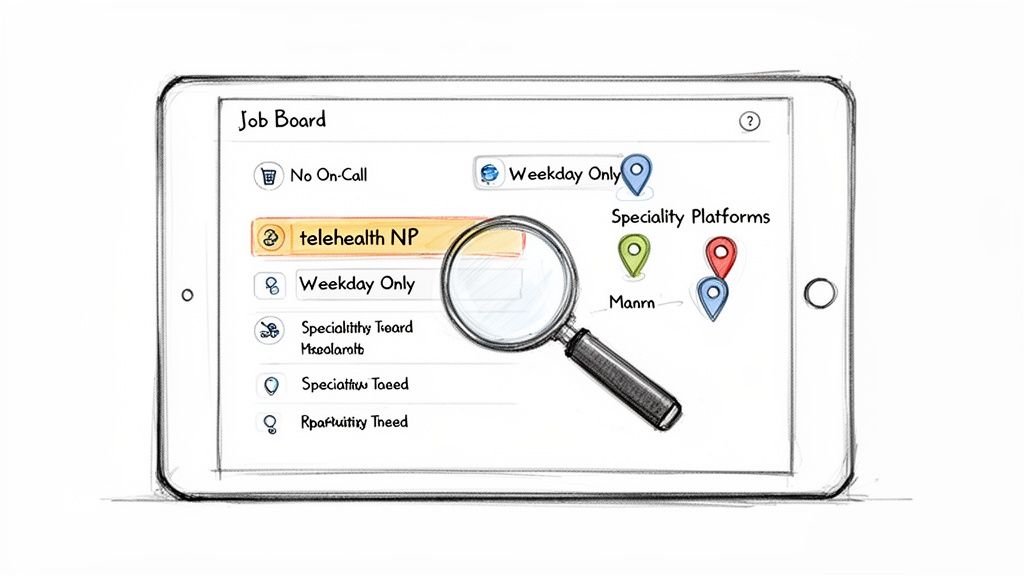
This is where specialized job boards become your best friend. They're built for clinicians by people who understand what a sustainable career actually looks like. For instance, on WeekdayDoc, you can immediately filter for roles with “No On-Call” or “Weekday Only” schedules. That single click cuts through the noise and shows you only the jobs that respect your time.
It’s a targeted approach that saves you from the burnout of the job search itself.
Going Beyond the Job Boards
Don't underestimate the power of your professional network. Organizations like the American Association of Nurse Practitioners (AANP) and other specialty-specific groups have their own career centers. The jobs listed there are from employers specifically looking for NPs, which often means a better, more direct connection.
LinkedIn is another goldmine, but you have to use it strategically. A vague search for a "nurse practitioner remote job" will drown you in results. Get specific with your keywords.
- “Telemedicine NP”
- “Virtual primary care nurse practitioner”
- “Remote psychiatric mental health NP”
- “Asynchronous telehealth NP”
It’s also smart to connect with recruiters who focus on telehealth or virtual care. They know about jobs that are never advertised publicly and can put your CV directly in front of the right people. For a deeper dive, our guide on telehealth nurse practitioner jobs has more strategies.
How to Spot Red Flags in Job Postings
Finding a great listing is one thing; learning to see the warning signs of a high-burnout role is another. A vague job description is your first major red flag. If it’s unclear about your actual responsibilities or doesn’t mention the expected patient load, be wary.
A quality employer will be transparent about expectations from the start. Look for job descriptions that clearly outline daily responsibilities, patient-per-hour expectations, and the administrative support provided.
Pay close attention to the language. Phrases like “fast-paced environment” or “ability to handle a high volume of patients” can be code for an unmanageable workload.
And if the posting mentions a complicated on-call schedule or regular weekend shifts without clearly explaining the compensation for that time, it’s probably not the burnout-friendly role you’re looking for. Trust your clinical gut—if it sounds too demanding on paper, it almost certainly will be in reality.
Crafting Your Application for a Virtual Role
When you're applying for a nurse practitioner remote job, your CV and cover letter have to do more than just list your clinical chops. A generic application built for an in-person gig will get completely lost in the digital pile.
Your application needs to scream "telehealth-ready" from the very first line. It’s your job to show, not just tell, that you have the tech skills and virtual communication style to excel from day one. This means translating your hands-on experience into the language of remote care.
Showcasing Your Tech Proficiency
Hiring managers for remote roles are hunting for proof that you can hit the ground running with their specific tech stack. Simply writing "EMR experience" isn't going to cut it. You have to get specific.
The easiest way to do this is by adding a dedicated "Technical Skills" or "Telehealth Proficiencies" section to your CV. This immediately signals you know what you're doing.
- EMR/EHR Systems: Don't be vague. List the specific platforms you've mastered, like Epic, Cerner, or AthenaHealth. If you've used their telehealth modules, definitely mention that.
- Video Conferencing Platforms: Include any professional platforms you've used, such as Doximity, Doxy.me, or even HIPAA-compliant versions like Zoom for Healthcare.
- Remote Patient Monitoring (RPM) Tools: Have you worked with devices that track vitals or glucose levels from a distance? Name those specific technologies.
This level of detail shows you get the operational side of a virtual practice and won't need a ton of technical hand-holding.
Pro Tip: Don’t bury your multi-state licenses at the bottom of your CV. Put them right up top near your name and credentials, like "Licensed in NY, FL, TX (NLC)." This small change shows you’re already thinking about the logistical needs of telehealth.
Translating Clinical Experience for a Virtual World
This is the most critical part of your application. You need to reframe your in-person wins to highlight your virtual competence. Think about your day-to-day tasks and how they translate to a remote setting. Your goal is to connect the dots for the hiring manager so they don't have to.
Instead of just listing a responsibility, rephrase it to spotlight remote-friendly skills like asynchronous communication, virtual patient education, and digital care coordination.
Here’s how that looks in practice:
| Your In-Person Experience | How to Frame It for a Remote Role |
|---|---|
| Conducted in-clinic patient education on diabetes management. | Developed and delivered virtual patient education materials on diabetes management via secure messaging and video calls. |
| Coordinated care with specialists for complex patients. | Managed complex patient cases through secure digital platforms, coordinating care with a remote, interdisciplinary team. |
| Performed follow-up calls to check on post-op patients. | Utilized asynchronous communication tools and scheduled video follow-ups to monitor post-operative patient recovery and adherence. |
See the difference? This small shift in language has a massive impact. It proves you've thought critically about how your skills fit into a telehealth environment, making you a much stronger candidate for any nurse practitioner remote job. It shows you're not just looking for any job—you're specifically prepared for this kind of job.
Mastering the Remote Interview and Proving Your Telehealth Chops
A video interview for a remote nurse practitioner job is about way more than just having a stable internet connection. It's your first chance to prove you have the clinical expertise, tech-savviness, and ability to build real human connection through a screen.
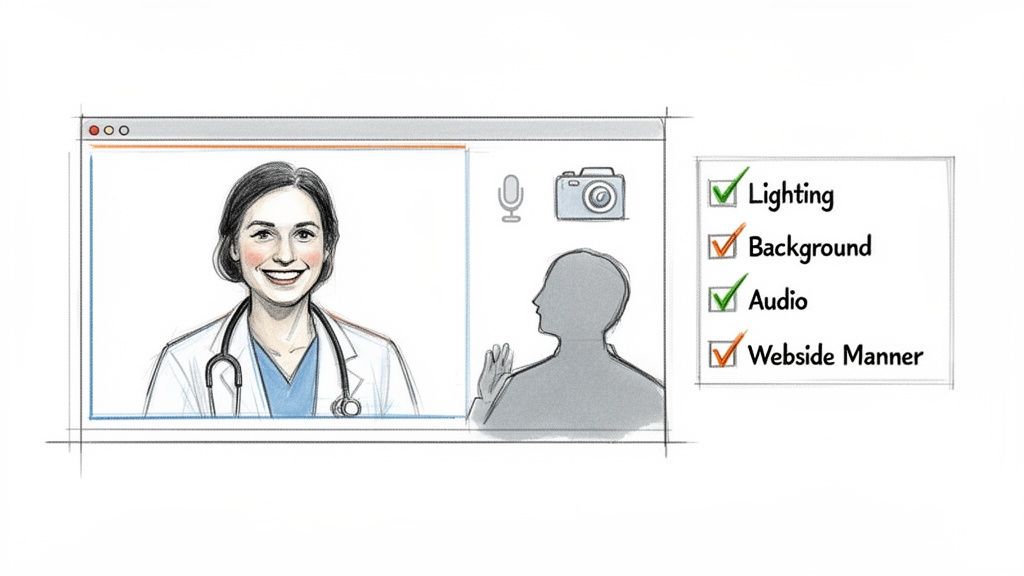
Think of it this way: the interview is your first virtual patient encounter. The hiring manager isn't just listening to your answers; they're watching your entire virtual presence, or your "webside manner," from the second you log on. A flawless technical setup is your first move to build credibility.
Setting Up Your Virtual Clinic
Before you even start prepping for questions, you have to get your environment right. A messy background or bad audio can sink your chances before you’ve said a word. The goal is a professional, quiet space that puts the focus entirely on you.
- Lighting: Always face your light source. Sit in front of a window or use a simple ring light. If the main light is behind you, you’ll look like a silhouette on a witness protection show.
- Background: Keep it clean and uncluttered. A tidy bookshelf, a neutral wall, or a professional virtual background works best. Just make sure there's no personal clutter, open doors, or anything that will distract the interviewer.
- Audio: Use a headset with a microphone. This is non-negotiable. It gets rid of echoes, kills background noise, and makes you sound crisp and clear—unlike the tinny audio from a laptop mic.
Do a full test run with a friend the day before. Check your camera angle (it should be at eye level, not looking up your nose) and make sure your video software is updated and ready to go.
Nailing the Key Telehealth Interview Questions
In a remote interview, you’ll get questions specifically designed to see if you can handle the unique challenges of virtual care. They’re less interested in standard clinical scenarios and more focused on how you communicate and solve problems when you’re not in the same room as the patient.
How you answer questions about building patient trust without a physical exam is often the make-or-break moment. They need to see you've thought deeply about virtual empathy and have a real strategy for it.
Get ready for questions like these:
- "Walk me through a time you delivered difficult news to a patient over video. What was your approach?"
- "How do you build rapport with a new patient you've never met in person?"
- "What specific techniques do you use to make sure a patient understands their plan when you can't rely on physical cues?"
When you answer, show, don't just tell. Instead of saying, "I'm a great communicator," give a concrete example. Talk about how you use active listening, like summarizing a patient's concerns back to them or using intentional pauses to give them space to talk. That's how you prove your empathy translates through the screen.
The Bigger Picture: Why This Interview Matters
Your ability to ace this interview is about more than just one job; it's about positioning yourself for the future of NP careers. Telehealth is exploding, especially with a massive nursing shortage and an expected 194,500 annual RN openings through 2030.
At the same time, 48% of healthcare executives are pushing for digital tools, and 78% of them believe AI will slash the administrative burdens that lead to burnout. This interview is your ticket into that more flexible, sustainable future. If you want to dive deeper, you can explore insights on 2026 nursing trends to see just how much technology is reshaping the field. This is your chance to show you’re ready for it.
How to Evaluate an Offer for Long-Term Sustainability
An offer is so much more than a salary number. It's a blueprint for your day-to-day life, and the right one will respect your time, energy, and career goals. Let's break down how to read between the lines and find a role that’s genuinely sustainable.
First things first: drill down into the patient load. Don't accept vague answers. Ask for hard numbers on how many active cases you'll be expected to manage per shift.
Key Role Metrics to Scrutinize
A few key metrics will tell you almost everything you need to know about the role's intensity and whether it's a good fit.
- Patient Load: Look for a clear threshold. A manageable range is often 100–200 active patients per clinician. Anything more, or if they can't give you a straight answer, is a red flag for potential overwhelm.
- True Flexibility: Does "flexible schedule" just mean you can pick your own 8-hour block between 9-5, or can you genuinely adjust your hours week to week? Is it strictly weekdays, or are there optional weekend shifts? The details matter.
- On-Call Terms: Get crystal clear on after-hours expectations. What are the compensation rates? Is it a rotating schedule for nights or weekends? Don't leave this to chance.
- Licensing Aid: This is a big one for remote work. Does the employer cover multi-state licensing, or at least assist with the process? What about credential renewals and continuing education?
I once saw a colleague accept a role assuming a 100-case limit, only to find herself juggling 180 cases because no official cap was ever put in writing. That misunderstanding quickly snowballed into three unexpected evening shifts a week and a fast track to burnout.
Continuing Education and Growth
Beyond the daily grind, what does professional growth look like? A great employer invests in your development. Ask what their continuing education support entails and if you get protected time to actually use it.
Confirm specifics like:
- CME Allowance: Are there dedicated funds for courses or conference fees?
- Protected Time: Will you get a certain number of hours each quarter allocated to professional development, separate from your clinical duties?
- Mentorship: Is there a formal or informal structure to connect with senior NPs for career guidance?
Questions to Ask That Reveal the Truth
Clarity comes from asking targeted questions. Your goal is to uncover any hidden burdens before you sign on the dotted line.
Here are a few questions that cut through the noise:
- How many video visits are expected per day, and what is the platform’s average session length?
- What protocols are in place for EMR downtime or technical failures? (This tells you if you'll be left scrambling).
- In a remote setting, who provides clinical supervision and peer feedback?
- What is the average turnaround time for getting multi-state license or privileging assistance?
Every answer helps you stack up offers on an apples-to-apples basis.
Evaluating the Total Compensation Package
Salary is important, but benefits often make or break an offer, especially in the long run. Look past the base pay and tally up the value of CME stipends, licensure reimbursements, and retirement matching.
Dig into the fine print on:
- Health Insurance: Check the coverage details, deductibles, and provider networks. How are telehealth reimbursements handled?
- Retirement Plans: What is the employer match percentage, and what's the vesting schedule?
- Wellness Stipends: Do they offer support for things like mental health or setting up an ergonomic home office?
Understanding your benefits is especially critical for remote work. To get a better sense of how the industry is adapting, it’s worth exploring modern health insurance trends affecting remote work.
Sussing Out Burnout-Friendly Elements
By 2026, the demand for nurse practitioners is expected to soar, with a projected 40% growth in employment. Remote roles are becoming central to closing healthcare gaps, but they come with their own challenges, like managing 100–200 patients remotely. A recent Deloitte report found that 33% of healthcare executives are focusing on connected care, which relies heavily on NPs.
The best defense against burnout? Finding a role with built-in protections. That means looking for platforms and employers that specifically curate no-overnight, weekday-only remote NP positions.
Comparing Sample Offers
Let's look at a quick comparison to see how this plays out in the real world.
| Factor | Offer A | Offer B |
|---|---|---|
| Patient Load | 150 active pts | 200 active pts |
| On-Call | No overnight shifts | Rotating weekend calls |
| CME Stipend | $1,000/year | $2,000/year |
| Licensure Support | Multi-state covered | Single-state only |
This simple table shows how even small differences in on-call duties or licensing support can dramatically change your long-term burnout risk.
To really nail down the trade-offs, run every offer you get through the WeekdayDoc Offer Analyzer. It gives you a clear, side-by-side comparison of pay, stipends, and scheduling demands so you can make an informed decision.
The best offers aren't always the ones with the highest salary. They're the ones that balance patient volume with clear policies and robust, meaningful professional benefits.
Common Questions About Remote NP Jobs
Making the leap to a remote NP role can feel like stepping into a whole new world of medicine. You're trading in the familiar clinic setting for a home office, which naturally brings up questions about the nuts and bolts of virtual care. Let's break down some of the most common questions NPs have when they start exploring telehealth.
Do I Need a Special License for a Remote NP Job?
Yes, and this is non-negotiable. The golden rule of telehealth is that you must hold an active, unrestricted license in the state where your patient is physically located when the visit happens. There are absolutely no workarounds for this standard of care.
Because of this, you’ll notice many remote employers are on the hunt for NPs who already have a Compact Nurse Licensure (NLC) or are open to getting licensed in multiple states. This is a great question to bring up in interviews. Ask if the company helps with the cost and administrative legwork of multi-state licensing. The best employers often have a dedicated team just for this, saving you a massive headache.
What Are the Most Common Types of Remote NP Roles?
Telehealth isn't just one thing; it's a surprisingly diverse field. While many roles are what you’d expect—direct patient care—others are focused on things like data, administration, or clinical oversight.
You’ll see a ton of openings in these areas:
- Virtual Primary & Urgent Care: This is the bread and butter of telehealth—handling acute illnesses, routine check-ups, and follow-ups through video calls.
- Mental Health: This specialty has exploded in the virtual space. There's a huge demand for NPs providing therapy and medication management remotely.
- Chronic Disease Management: Think diabetes, hypertension, and heart failure. These roles focus on helping patients manage their conditions through regular virtual check-ins and remote monitoring.
But it doesn't stop there. Opportunities in remote patient monitoring, clinical informatics, and utilization management are also on the rise. This means you can find a remote job that fits your preferred work style, whether that's synchronous (real-time video visits) or asynchronous (like chart reviews done on your own time).
The bottom line is that going remote doesn't mean you have to abandon your clinical interests. From general practice to super-specific niches, you can apply your expertise in a virtual setting—often with far more control over your schedule than you'd get in a traditional clinic.
How Is Salary Determined for a Remote NP?
This is where it gets a little more complex. Remote NP salaries aren’t based on a single national average. Instead, they’re usually a mix of factors: your years of experience, your specialty, how many state licenses you hold, and the company’s unique pay structure.
Some telehealth companies adjust pay based on your geographic location and local cost of living. Others have a standardized national rate, paying everyone the same regardless of where they live.
When you get an offer, it’s critical to look past the base salary. Do your homework on industry benchmarks and evaluate the entire compensation package. Does it include health benefits? A CME stipend? What about direct reimbursement for licensing fees? These things add up.
Finding a role that truly supports your financial goals and your well-being is everything. At WeekdayDoc, we cut through the noise by curating burnout-friendly jobs with clear salary data and realistic schedule expectations. Explore sustainable remote NP roles today.