Remote Medical Technologist Jobs: Your 2026 How-To Guide
Find and qualify for remote medical technologist jobs in 2026. This guide covers role types, salary negotiation, resume tips, and burnout-friendly listings.
34,319 remote medical technology openings were listed on Indeed as of June 2026, according to Indeed's remote medical technology listings. That number changes how you should think about remote medical technologist jobs. This isn't a fringe side path anymore.
But the hype still outruns the truth.
The phrase “remote med tech” often brings to mind full diagnostic work from a home office. That exists, but it's only one slice of the market. The better strategy is to separate true remote diagnostic review from remote-adjacent lab operations, support, and hybrid informatics roles. If you don't make that distinction early, you'll waste time on listings that look remote in the title and turn out to be travel-heavy, partially onsite, or mostly administrative.
I've seen the transition work best for technologists who stop selling themselves as “bench generalists” and start positioning themselves as operators who can protect data integrity, quality systems, and turnaround reliability without constant supervision. That's the shift.
Why Remote Technologist Jobs Are Surging
Remote medical technologist jobs aren't growing because employers suddenly became generous about flexibility. They're growing because labs are under staffing pressure and need experienced people in roles that can be centralized, standardized, and supported through software.
An industry report summarized by Dark Daily notes the U.S. has a shortage of about 20,000 to 25,000 medical technologists, with roughly 338,000 in the workforce and a vacancy rate of 7% to 11% in almost every region, as described in Dark Daily's report on the medical technologist shortage. When departments can't fully staff nights, weekends, specialized benches, and quality-heavy workflows, leaders start asking a practical question: which parts of lab work must stay onsite, and which parts can move?
That's where remote roles come from.
What employers are actually trying to solve
They're not usually trying to create a lifestyle perk. They're trying to stabilize operations.
Functions that depend on LIS review, documentation, quality oversight, exception handling, and communication with clinicians or onsite staff are easier to move offsite than anything involving specimen receipt or direct analyzer interaction. Employers also know that experienced technologists often leave because of schedule strain, not because they want to leave laboratory medicine entirely.
Remote work in lab medicine is often less about “work from home” and more about keeping senior technical judgment in the system.
That provides an advantage for clinicians who want a more sustainable schedule without stepping away from the field. If you want context for why healthcare employers are restructuring roles this way, WeekdayDoc's overview of the healthcare workforce shortage is a useful companion read.
Why this matters for career decisions
The mistake is treating remote work as an escape hatch. The stronger approach is to treat it as a specialization move.
Remote positions tend to favor technologists who already know how to make judgment calls, document cleanly, and catch problems before they become reportable errors. That's why the best opportunities usually go to people who can show they've done more than run instruments. They've managed quality, reconciled discrepant results, supported validation, trained staff, or worked extensively inside an LIS.
If you've built that kind of experience, the current environment gives you more room to negotiate structure, not just a paycheck.
Decoding the Types of Remote Medical Technologist Jobs
A large share of jobs labeled "remote medical technologist" are not remote diagnostic roles at all. That is the first filter that saves time.
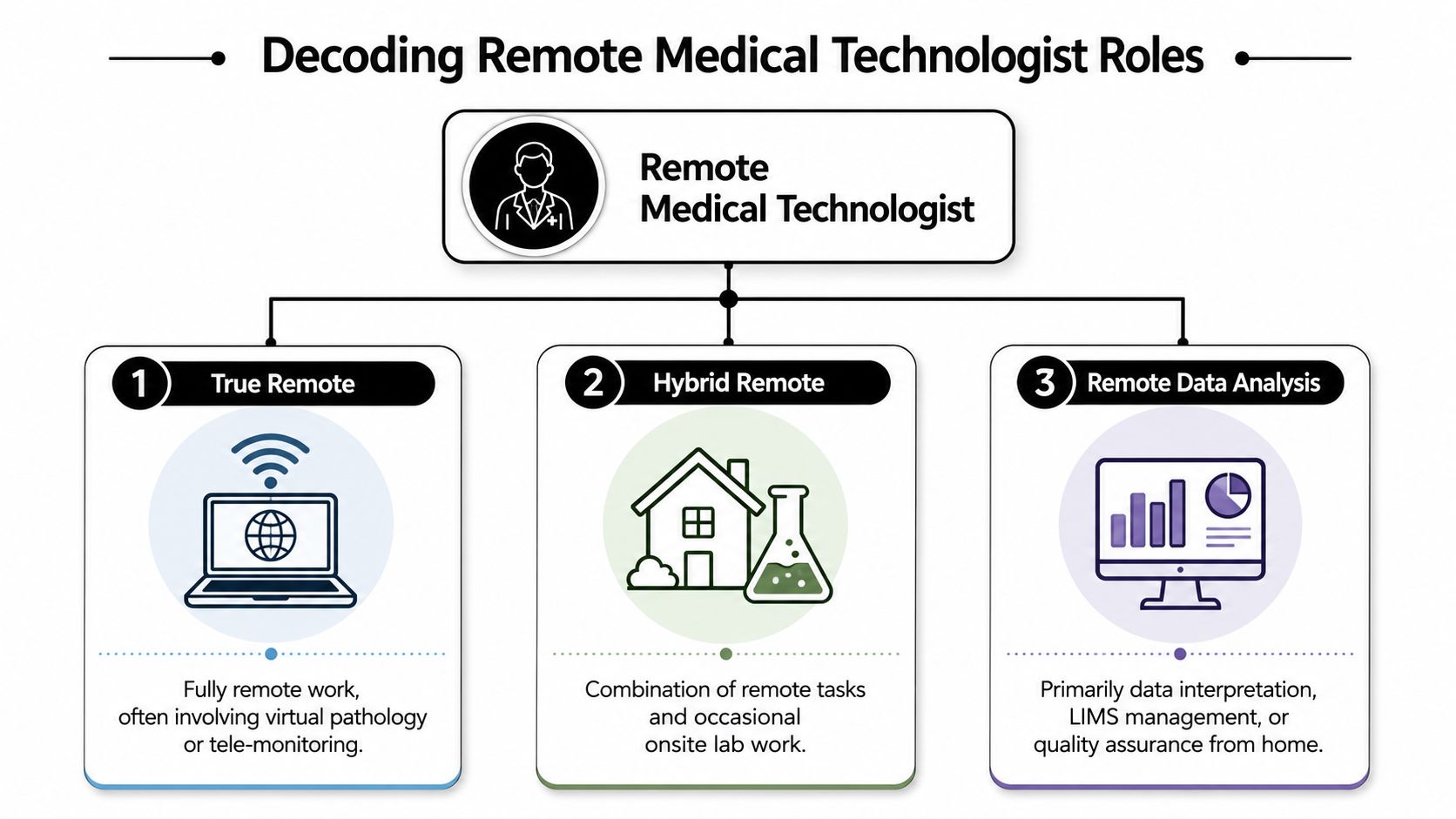
I learned this the hard way. After moving off the bench, I found that employers use "remote" to cover three very different job families, each with a different stress pattern, skill profile, and career ceiling. If you do not separate them early, you can spend hours applying to jobs that have little to do with the work you want.
True remote diagnostic review
These are the closest match to what many technologists picture. The specimen stays onsite. Your work happens inside the LIS or EMR.
Typical duties include reviewing analyzer output, clearing or holding flagged results, checking whether values fit the clinical picture, documenting follow-up, and sending exceptions back to onsite staff. Based on Indeed's remote medical laboratory technologist listings, these roles often ask for experience with Cerner, Epic Beaker, Meditech, or Sunquest, along with working knowledge of CAP, CLIA, and OSHA requirements.
The trade-off is straightforward. You keep using technical judgment, but much more of your day goes to documentation, exception handling, and screen-based review than hands-on testing.
Remote-adjacent laboratory roles
This category is where a lot of real opportunity sits, especially for experienced technologists who know how labs operate.
These jobs support laboratory operations without centering on result verification all day. Common examples include referral coordination, send-out management, documentation review, order issue resolution, charge capture support, platform support, and training tied to lab systems or equipment. For many candidates, these roles are a better long-term fit than remote review because they offer more predictable workflows and fewer high-acuity decision points.
Examples include:
- Referral coordination: Managing send-out testing, tracking delayed or compromised specimens, and fixing paperwork gaps before they affect turnaround time.
- Revenue-cycle-adjacent support: Reviewing charge capture, test mapping, and claim-support documentation connected to lab services.
- Equipment and platform support: Helping sites with workflow questions, connectivity issues, user training, and maintenance documentation.
For technologists comparing broader remote medical job categories for clinicians and allied health professionals, this distinction matters. A remote verification job and a logistics-heavy operations job can share a title keyword while feeling completely different in daily practice.
Hybrid roles that read remote until you inspect the duties
Some listings offer remote charting, training, quality review, or systems support, but still require regular lab presence or regional travel. The title may say remote. The verbs usually tell the truth.
I screen for task words before I read the qualifications. "Verify," "reconcile," "review," "document," and "escalate" usually point toward true offsite review work. "Travel," "support sites," "train teams," "visit locations," or "provide field coverage" usually mean hybrid operations or implementation support.
The title tells you how the role is marketed. The duty list tells you how your week will actually feel.
A practical screen before you apply
Use this filter before you spend time on an application:
| Role type | Best fit for | Common mismatch |
|---|---|---|
| True remote review | Strong LIS users with sound quality judgment and high tolerance for documentation | Bench-focused candidates who want less screen time |
| Remote-adjacent lab operations | Technologists who like process flow, coordination, and troubleshooting across teams | Candidates expecting direct diagnostic interpretation most of the day |
| Hybrid support roles | People comfortable splitting time between systems work, meetings, and onsite coverage | Anyone seeking a fully home-based schedule |
The opportunity is real, but the market is narrower than job titles suggest. Candidates who sort postings by actual workflow, instead of by the word "remote," usually find better-fit roles faster.
The Non-Negotiable Credentials and Skills for Remote Roles
Remote roles usually ask for more trust, not less. Employers are giving you autonomy over high-consequence workflows, so they screen for people who already know how to work without hand-holding.
Practical rule: If a remote job looks easier than your current bench role, you probably haven't read the listing closely enough.
Why employers care so much about systems experience
The center of gravity in many remote positions is the information system. That changes the hiring logic.
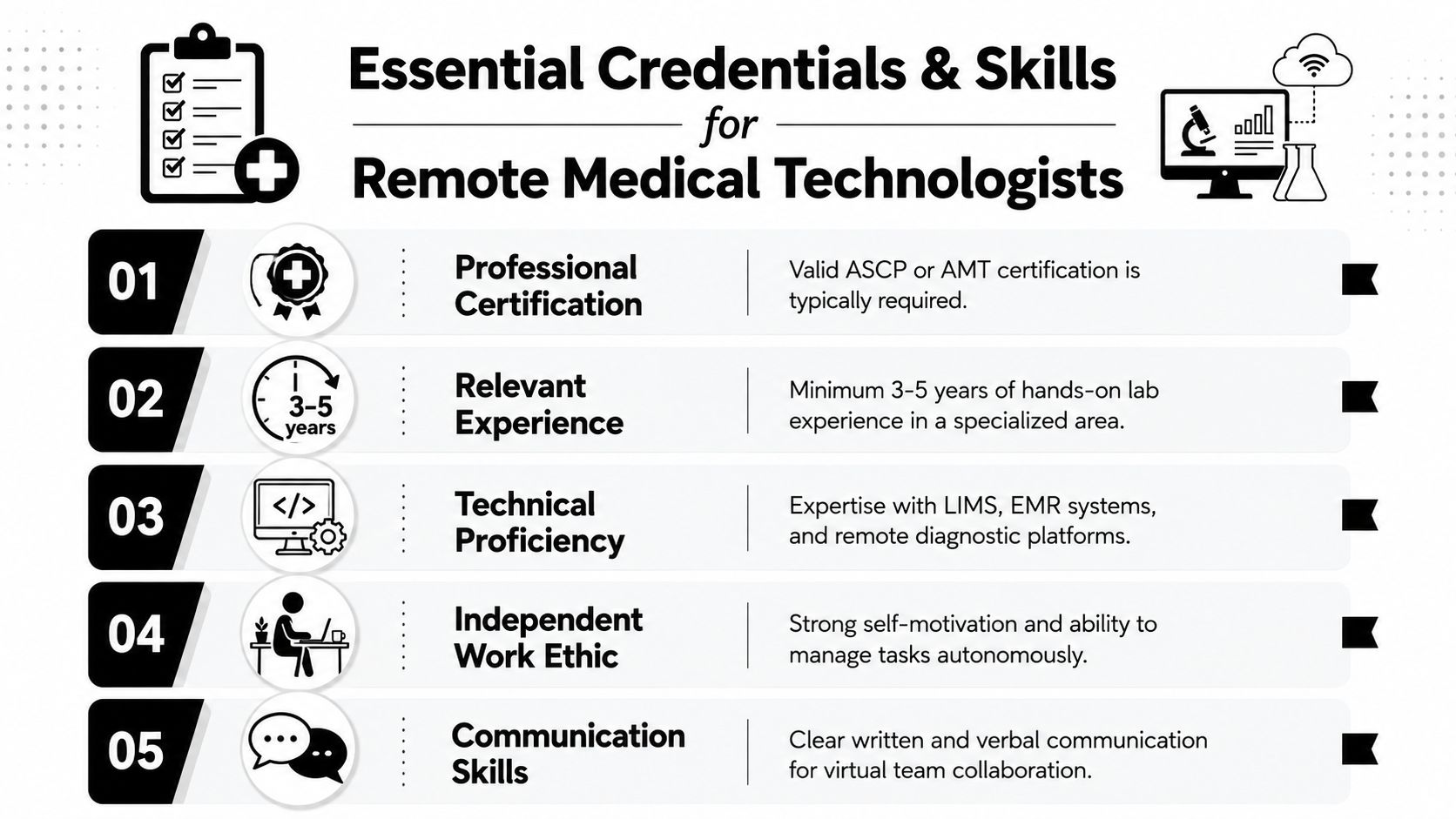
Postings frequently require experience with Cerner, Epic Beaker, or Meditech, along with a strong grasp of CAP and CLIA requirements, because the job often involves result verification, QC review, analyzer documentation, preventive maintenance records, and communication about specimen or reporting issues. Some listings also require at least 2 years in specialized areas such as blood banking, as noted in the earlier-cited remote laboratory listing review.
If your current resume says only that you performed testing, employers can't tell whether you also understand exception handling, result integrity, and compliance documentation.
Credentials still matter
Remote doesn't remove the professional gatekeeping that already exists in lab medicine. In many cases it increases it.
Common expectations include:
- Certification: Employers often prioritize ASCP or AMT credentials.
- Specialty depth: Blood bank, microbiology, chemistry, or molecular experience can matter more than broad but shallow generalist experience.
- Licensure awareness: Some roles still expect state-specific compliance or licensure alignment.
- Independent judgment: Hiring managers want evidence that you can resolve issues without constant escalation.
If you need a straightforward refresher on the broader process, WeekdayDoc's guide to what healthcare credentialing means in practice is worth reviewing before you start applying.
The skills that actually transfer
The remote workflow rewards a different way of describing the same expertise. The strongest transferable skills usually look like this:
- Data integrity thinking: You notice mismatched identifiers, improbable values, or trend breaks before release.
- Clear written communication: A remote team depends on concise notes and clean escalation.
- Software fluency: You're comfortable moving inside an LIS, EMR, ticketing queue, and documentation trail.
- Quality mindset: You understand why a result can't be released, not just that a rule says it can't.
- Autonomy: You don't freeze when a result, flag, or specimen story doesn't line up.
What doesn't translate well
Some otherwise excellent bench technologists struggle because they assume technical skill alone is enough.
It isn't.
If you dislike documentation, resist standardized workflows, or need constant visual confirmation from a supervisor, remote work can feel oddly harder than onsite work. You lose the ease of turning to the person next to you. You have to be deliberate, precise, and calm when the only evidence trail is what's in the system.
That's why employers often set the bar high. They're not trying to be picky for its own sake. They're trying to hire people who can protect the lab's output from a distance.
Crafting Your Application to Pass the Remote Filter
A large share of applicants get screened out before a recruiter ever checks credentials in detail. The usual problem is not lack of lab experience. It is poor targeting. Candidates apply to remote-adjacent jobs that do not match their background, or they submit a resume that reads like a shift assignment sheet instead of proof they can protect quality from a distance.
Rewrite your experience for remote work
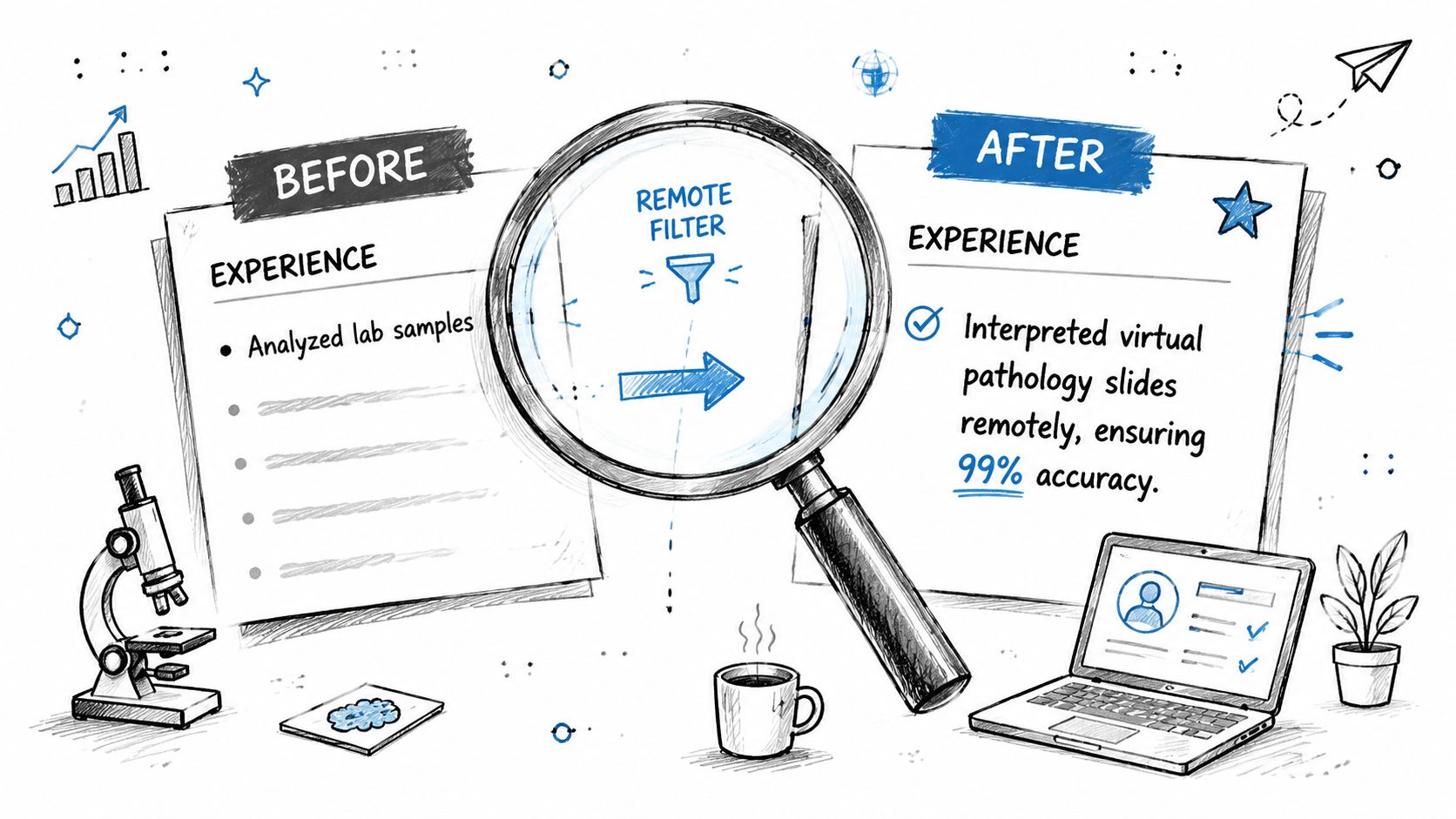
Remote hiring teams look for judgment, documentation discipline, and system fluency. Bench-heavy resumes often hide those strengths because they focus on task volume.
Use your bullets to show what you decided, documented, resolved, or escalated.
| Weak bullet | Better remote-focused bullet |
|---|---|
| Performed daily QC on chemistry analyzers | Reviewed QC trends, documented exceptions, and resolved discrepancies through LIS review to support accurate result release |
| Worked in blood bank and handled complex specimens | Managed exception-prone transfusion workflows, reviewed documentation, and escalated high-risk issues using standard communication pathways |
| Entered results and notified providers of critical values | Verified result accuracy in the LIS, documented abnormal findings clearly, and communicated time-sensitive issues to clinicians and onsite staff |
| Assisted with maintenance | Maintained preventive maintenance records and supported audit-ready documentation for analyzer performance review |
That shift matters. A remote employer is buying reliability in a digital workflow, not just proof that you stayed busy on the bench.
Target the right kind of remote role
Applicants frequently waste the most time.
A true remote diagnostic or technical role usually centers on result review, exception handling, digital pathology workflow, quality documentation, instrument applications, middleware support, referral testing coordination, or LIS-centered problem solving. A remote-adjacent role may sit closer to scheduling, call center support, basic logistics, intake, or general admin work. Those jobs can be legitimate, but they use a different slice of your experience and often lead to a different pay ceiling and career path.
As noted earlier, major health systems post many remote roles that are not direct analogs of bench testing. Read titles skeptically. "Remote medical technologist" can mean technical review, but it can also mean send-out coordination, customer support for lab systems, or workflow support attached to the lab rather than owned by the lab.
A better application starts with that distinction.
If your background includes send-outs, specimen problem resolution, test utilization questions, analyzer troubleshooting, middleware rules, or staff training, say that plainly. Those functions often transfer well. If your resume only lists departments worked and instruments touched, recruiters may sort you into the wrong bucket.
Build a resume around judgment, not volume
I made more progress once I stopped trying to sound broad and started sounding dependable.
For remote roles, breadth helps only if it supports a clear operating pattern. Show where you handled exceptions without hand-holding, kept an accurate documentation trail, and protected turnaround time without cutting corners.
Strong bullets usually answer questions like these:
- What discrepancies did you catch before release?
- Which LIS, EMR, middleware, or ticketing systems did you use every day?
- What compliance or audit documentation did you maintain?
- How did you escalate issues that crossed technical or policy limits?
- Where did your decisions prevent downstream delays, redraws, or reporting risk?
A hiring manager reading for remote fit wants to see controlled judgment. They want evidence that your notes are clear, your escalation threshold is sound, and your work holds up when no one is standing beside you.
Prepare interview answers that reduce employer risk
Remote interviews are less about personality and more about operational trust.
Good answers are specific. They describe how you work inside policy, how you document decisions, and how you handle ambiguity without freezing or freelancing.
Useful talking points include:
- On independent judgment: “I make first-pass decisions within policy, document the reason clearly, and escalate when the issue crosses scope or patient safety risk.”
- On written communication: “I leave enough detail in the system for the next technologist, supervisor, or onsite team member to follow the case without rework.”
- On queue-based work: “I'm comfortable prioritizing structured worklists, time-sensitive exceptions, and critical communication without losing accuracy.”
- On bench-to-remote transfer: “My bench background helps me recognize what creates report delays, specimen confusion, and preventable follow-up.”
If you are interviewing for a remote-adjacent role, ask direct questions. Is the job technical review, operational support, or customer-facing service work? Does success depend on lab judgment, phone volume, or ticket closure speed? Those are very different jobs wearing similar titles.
A short walkthrough can also help if you want to hear how recruiters think about positioning yourself for digital-first clinical work:
Read listings like an operator
Before applying, I would scan for five things.
Workflow language
Terms like verification, discrepancy review, referral coordination, QA documentation, digital case review, or instrument support usually point to real technical ownership.Tool specificity
Named systems such as Epic Beaker, Cerner, Meditech, Sunquest, middleware platforms, or ticketing tools usually signal that the employer has defined the workflow.Boundary clarity
Strong listings explain what stays remote, what gets escalated, and what remains onsite. Weak ones blur everything together.Schedule risk
Vague flexibility language can hide weekend rotation, late callback expectations, or message monitoring that turns a remote job into constant low-grade stress. Burnout is still burnout from home. If that is a concern, material from reVIBE Mental Health is a useful reminder to assess workload structure, not just location.Ownership level
If the role includes audit support, workflow improvement, compliance documentation, or cross-team coordination, it usually has better long-term value than a listing built around pure task throughput.
The best remote applications make one point clearly. You understand the difference between technical remote work and remote-adjacent support work, and you know exactly where your experience fits.
Negotiating Compensation and Evaluating Burnout-Friendly Listings
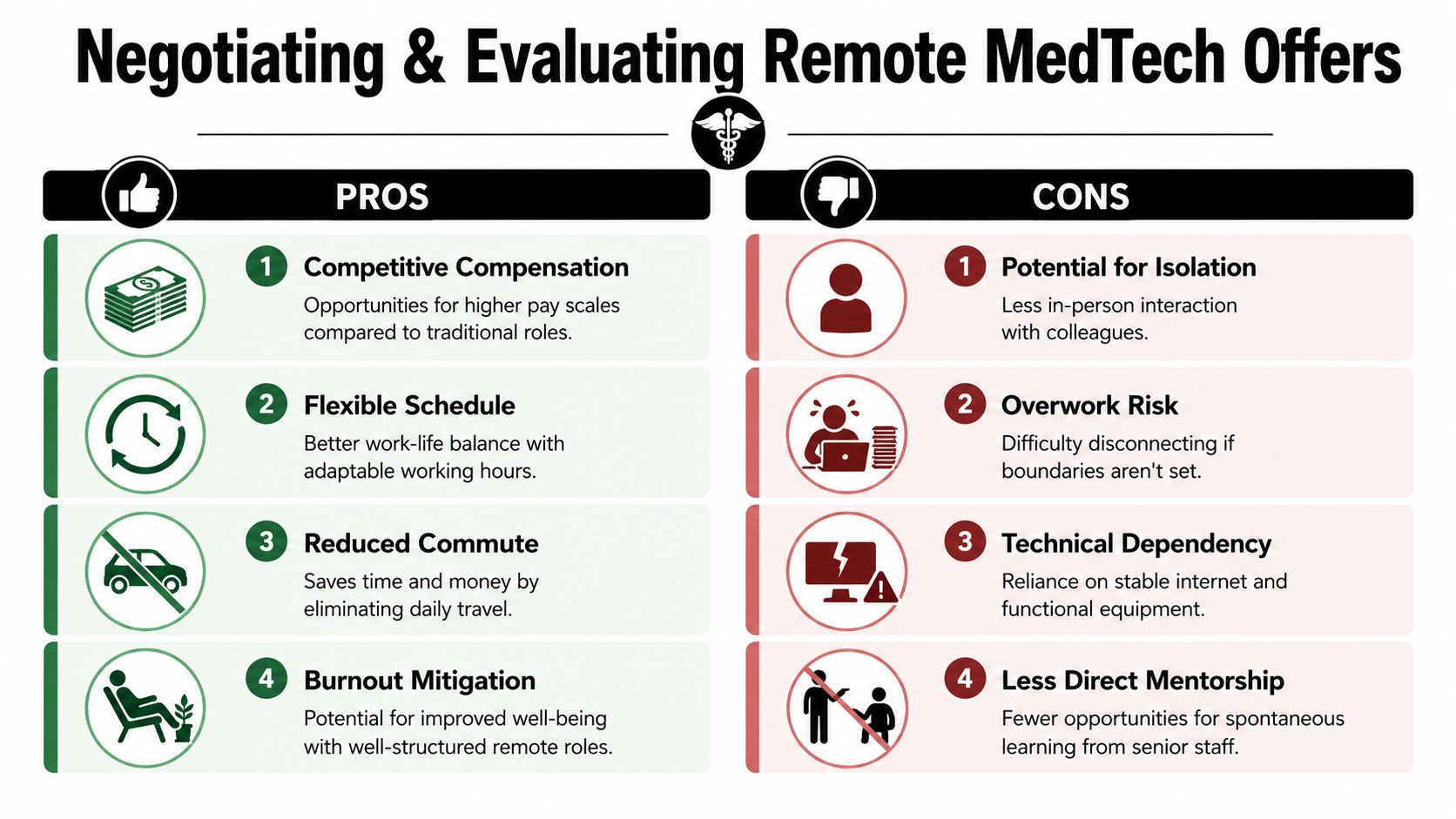
Compensation matters, but it's easy to negotiate the wrong thing. A remote role that pays slightly better can still be a bad trade if it turns your day into constant monitoring, off-hours messaging, or hidden call coverage.
As of June 2026, average hourly pay for remote medical technologist positions is $35.78 in New Jersey and $38.56 in New York City, according to ZipRecruiter's remote medical technologist pay data for New Jersey. Those numbers are useful because they give you a concrete market anchor in two major markets.
Use pay benchmarks the right way
Don't walk into negotiation saying, “I saw a higher number online.” Use the benchmark to frame your value relative to the role structure.
A better approach sounds like this:
- Tie pay to technical scope: If the role expects verification judgment, compliance documentation, and independent issue resolution, say so.
- Tie pay to specialty depth: Blood bank, high-complexity testing backgrounds, and strong LIS fluency should change the conversation.
- Tie pay to schedule burden: If weekends, holidays, or broad queue ownership are part of the role, that belongs in compensation.
If the employer can't move much on hourly rate, push on structure instead.
The real negotiation is workload design
In my experience, this matters more than the posted rate.
A good remote job defines what you own, when you're expected to be online, how handoffs happen, and what counts as urgent. A bad one uses “remote” to blur boundaries and turn every system notification into your problem.
Here are the green flags I'd look for:
- Clear duty boundaries: The listing separates verification, documentation, and escalation responsibilities.
- Defined schedule expectations: You know whether the role is shift-based, queue-based, or flexible within business hours.
- Reasonable communication norms: Teams rely on documented workflows, not nonstop chat pings.
- Specific onboarding: Employers explain training on systems, policies, and exception pathways.
And the red flags:
- Vague availability language: “Must be flexible” often means the role is understaffed.
- Always-on culture: If the interview suggests you should answer everything immediately, expect boundary problems.
- Surveillance-heavy management: Excessive screen monitoring often signals weak operations, not strong leadership.
- Unclear exception ownership: If nobody can explain what gets escalated onsite, you'll inherit chaos.
Salary is the visible part of the offer. Burnout risk is usually buried in the workflow.
Ask better interview questions
These questions uncover more than generic “What's the culture like?” prompts:
| Ask this | Why it matters |
|---|---|
| How is urgent work separated from routine review? | Shows whether everything becomes a fire drill |
| What gets escalated to onsite staff? | Clarifies whether the remote role is set up realistically |
| How is productivity measured? | Reveals whether quality or surveillance drives management |
| What does a normal day look like in the system? | Helps you picture interruption load and queue pressure |
If you're already feeling depleted, it also helps to review practical guidance on how to cope with burnout from reVIBE Mental Health. It's a useful reminder that recovery isn't only about leaving a hard job. It's also about choosing the next one more carefully.
Don't ignore the non-pay terms
Some remote technologists focus so hard on hourly rate that they miss the terms that shape daily life:
- Equipment support: Who provides hardware, software access, and troubleshooting?
- Training runway: Will you get time to learn the workflow, or are they expecting immediate independence?
- Meeting load: Too many standing meetings can make a remote role harder than bench work.
- Coverage creep: Ask directly about weekends, holidays, and after-hours contact expectations.
If a listing can't answer basic operational questions, assume the job is still being figured out in real time. That rarely feels good from inside the role.
Building a Sustainable Remote Career
Plenty of technologists can get hired into a remote role. Fewer stay in one for years without stalling out or drifting into work that barely uses their training.
The people who build durable remote careers usually make a clear shift in how they define their value. Bench skill still matters, but long-term remote work tends to reward technologists who can apply that skill through informatics, quality systems, workflow review, documentation discipline, and precise communication across teams. In practice, that means being known for protecting result integrity and keeping a process stable when you are not physically in the lab.
That distinction matters because many postings with a remote label are not remote diagnostic roles at all. Some are support-heavy jobs tied to client follow-up, instrument coordination, referral routing, utilization review, or vendor-side troubleshooting. Those can be good jobs, but they call for a different work style and a different tolerance for meetings, ticket queues, and indirect ownership of patient testing. Candidates waste a lot of time when they apply to every remote listing as if all of them map cleanly to core lab work.
Remote medical technologist jobs are a viable path, but they are not a shortcut. The strongest long-term fit comes from knowing which part of the operation you can own well from a distance, and choosing roles that match that strength. A technologist with strong LIS judgment may do well in remote review or informatics support. Someone with deep analyzer knowledge may prefer applications, implementation, or technical support. Someone who likes process control may last longer in quality, compliance, or audit-facing work than in a queue-driven production role.
The most sustainable remote career usually comes from specialization, not escape.
It also helps to think beyond the next offer. Remote income can look stable on paper while becoming unpredictable once contract terms, bonus structures, tax setup, or self-funded benefits enter the picture. For clinicians who want guidance specific to healthcare earnings and planning, Everglow Prosperity for medical finance is one resource built around those realities.
If you want a practical way to find burnout-conscious roles without sorting through misleading listings yourself, WeekdayDoc curates healthcare jobs around schedule quality, work style, and sustainability, including remote and hybrid opportunities designed to protect your time outside work.