Healthcare Remote Jobs for Clinicians: Flexible Roles That Fit Your Life
Explore healthcare remote jobs for clinicians and find flexible roles that prevent burnout, balance your life, and protect your financial future.

Picture this: you finish your workday and still have enough energy left for your family, your hobbies, or even just yourself. For way too many clinicians, that sounds like a fantasy. But the quiet rise of remote healthcare jobs is turning that fantasy into a reality for a growing number of us.
These aren't just jobs; they represent a total rethink of what a sustainable medical career can look like—one that prioritizes a healthier way of life.
A New Era of Sustainable Medical Careers
For decades, the story we've been told in medicine is one of sacrifice. Long hours, emotional exhaustion, and a professional life that swallows your personal one whole. It’s a story we all know too well.
Take the classic example of a primary care doc, drowning in paperwork, double-booked, and feeling completely disconnected from her patients. She was on the fast track to burnout. But a switch to a remote telehealth role didn't just free up her schedule; it brought back the reason she went into medicine in the first place. She could finally focus on patient care without the crushing weight of a chaotic clinic.
Her story isn't a one-off. It’s part of a much bigger shift, fueled by better technology and a collective realization that burnout shouldn't be a requirement for a successful career.
To help you get a quick sense of this shift, here's a simple breakdown of what's driving it and how it's impacting clinicians on the ground.
At a Glance: The Shift to Remote Healthcare
| Key Driver | Impact on Clinicians | Example Roles |
|---|---|---|
| Technology Advancement | Enables high-quality, secure patient care from anywhere, reducing the need for a physical clinic. | Telemedicine Physician, Remote Patient Monitoring Nurse, Virtual Psychiatrist |
| Demand for Work-Life Balance | Clinicians are actively seeking roles that prevent burnout and allow for personal well-being. | No-call Radiologist, Part-Time Tele-therapist, Chart Review Physician |
| Patient Demand for Convenience | Patients increasingly prefer the accessibility and ease of virtual consultations for many conditions. | Urgent Care Telehealth NP, Direct-to-Consumer Health Advisor |
| Healthcare System Strain | Remote work helps retain experienced clinicians who might otherwise leave the profession. | Remote Medical Director, Utilization Management Physician |
This table just scratches the surface, but it highlights the core idea: remote roles are a strategic response to the very real problems facing modern medicine, offering tangible benefits for both clinicians and patients.
Defining a Burnout-Friendly Role
So, what does a truly "burnout-friendly" job actually look like? It’s more than just working from home in your sweatpants. It's about specific, measurable factors that actively protect your well-being.
These roles almost always include:
- Schedule Autonomy: You have real control over your hours. Forget mandatory nights or weekends.
- Reasonable Patient Loads: A patient panel that allows for thoughtful, unhurried consultations. No more assembly-line medicine.
- Reduced Administrative Burden: Better EMRs and real support systems that slash your time spent on paperwork.
Opportunities in virtual care, remote patient monitoring, and digital health are opening up a real path for MDs, DOs, NPs, and PAs to build a career they can actually thrive in. Of course, to make the leap, it helps to understand the nuts and bolts of How Does Telehealth Work and how these virtual models are set up.
The healthcare industry is leaning into this model harder than you might think. By 2026, it's estimated that a massive 80% of remote-capable healthcare jobs will be either hybrid or fully remote. That number completely dwarfs the tech industry's 44%.
This isn't just a trend; it's a fundamental change in how healthcare organizations plan to attract and keep top clinical talent. Flexible work is no longer a perk—it's becoming the new standard for a medical career where your professional fulfillment and personal well-being can finally coexist.
Navigating Telehealth Licensure Across State Lines
Practicing medicine remotely tears down the physical walls of an office but puts up a new kind of border—a digital one defined by state licensure laws. It's a simple but critical rule: you need a valid license for every state where you see patients, just as if you were physically there.
Think of each license as a passport. You need the right one to provide care legally. Trying to work without it can land you in serious trouble.
This web of regulations can feel overwhelming, especially when a single remote job might have you seeing patients in a dozen different states. Juggling the applications, fees, and unique continuing education requirements for each one is a massive administrative headache. Thankfully, there are ways to cut through that red tape and make the process manageable for clinicians pursuing healthcare remote jobs.
The journey from burnout to balance often means using technology not just for patient care, but for smart career management, too.
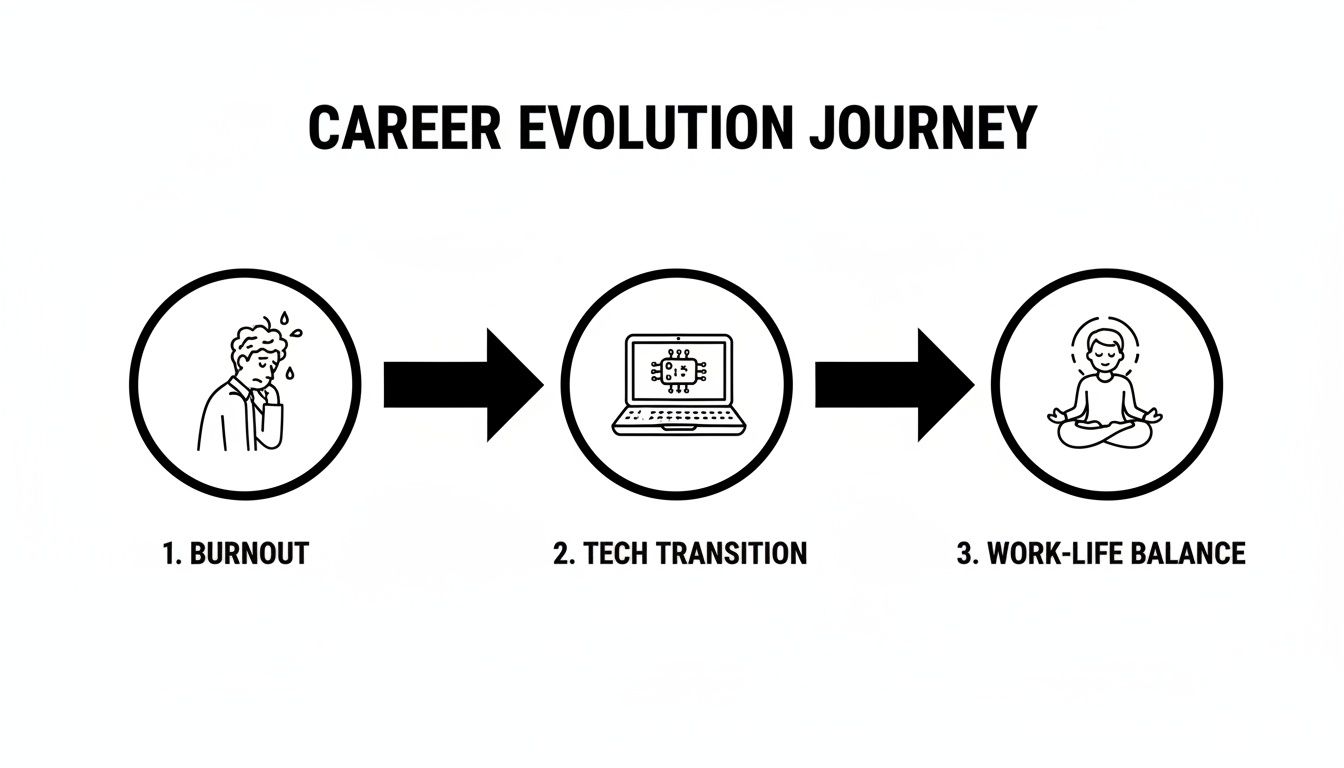
This evolution shows how clinicians are strategically using remote work to build more sustainable, fulfilling careers.
Your Fast Pass to Multi-State Practice
For physicians (MDs and DOs), the single most powerful tool for this is the Interstate Medical Licensure Compact (IMLC). Instead of drowning in separate, lengthy applications for every single state, the IMLC works like a fast pass. Once you're approved, you can get licensed in any participating state through a much faster, streamlined process.
Psychologists have a similar tool called the Psychology Interjurisdictional Compact (PSYPACT), which lets them practice telepsychology and even do temporary in-person work across state lines.
These compacts are absolute game-changers. They dramatically cut down the time and redundant paperwork, letting you build a national remote practice without the bureaucratic nightmare.
Practical Steps for Licensure Management
Even with compacts, staying on top of multi-state licensure requires a plan. Here are the essentials:
- Budget for Fees: Every state license comes with application and renewal fees. They add up fast, so make sure to factor them into your financial planning.
- Track Continuing Education: States have different CME requirements. A simple spreadsheet or an app can be a lifesaver for tracking credits and renewal deadlines for each license.
- Verify Malpractice Coverage: This is non-negotiable. Double-check that your malpractice insurance policy explicitly covers telehealth services in every single state where you're licensed to practice.
Taking these steps isn't just about staying compliant; it's about empowering you to confidently go after the best telehealth jobs available without being tied down by geography.
How to Identify a Genuinely Burnout-Friendly Role
Let’s be honest: not all healthcare remote jobs are created equal. The promise of working from home can easily mask the same old pressures—impossible patient loads, endless charting, and on-call duties that creep into your evenings and weekends.
To find a role that genuinely supports your well-being, you have to learn how to read between the lines of a job description. A common trap is the difference between “asynchronous work” and “flexible hours.” Asynchronous work gives you real autonomy, letting you complete tasks on your own time. “Flexible hours,” on the other hand, often means you’re still tethered to an eight-hour block, just a slightly different one.
Burnout is a full-blown crisis in medicine. As global clinician shortages worsen, the pressure on those still practicing is immense. This is a key reason why over 90% of health executives now see flexible work as essential for keeping their teams productive and intact, according to a report from Deloitte.com.
Your First Line of Defense Against Burnout
The easiest way to start weeding out bad jobs is to eliminate the biggest burnout culprits from the get-go.
At WeekdayDoc, we built simple but powerful "No Call" and "No Weekends" filters. Applying these instantly clears away listings with sneaky after-hours obligations. What’s left is a clean list of opportunities designed to protect your personal time. Think of it as your first, most important step toward finding a sustainable career.
A truly burnout-friendly role doesn't just offer remote work; it offers respect for your time. It’s built on the understanding that clinician well-being is not a perk, but a prerequisite for quality patient care.
These filters are non-negotiable for us because they stop burnout from simply moving from the clinic to your living room. By focusing only on roles without call or weekend requirements, you can find a job that actually fits your life—including options for part-time physician jobs that give you even more control.
Decoding Roles with the Burnout-Friendly Score
Beyond your schedule, the day-to-day reality of a job is what makes or breaks it. Is the patient volume crushing? Is the administrative burden a nightmare? This is where you need more than just filters.
The WeekdayDoc Burnout-Friendly Score is a clear, data-driven metric that helps you see the true nature of a role before you even apply.
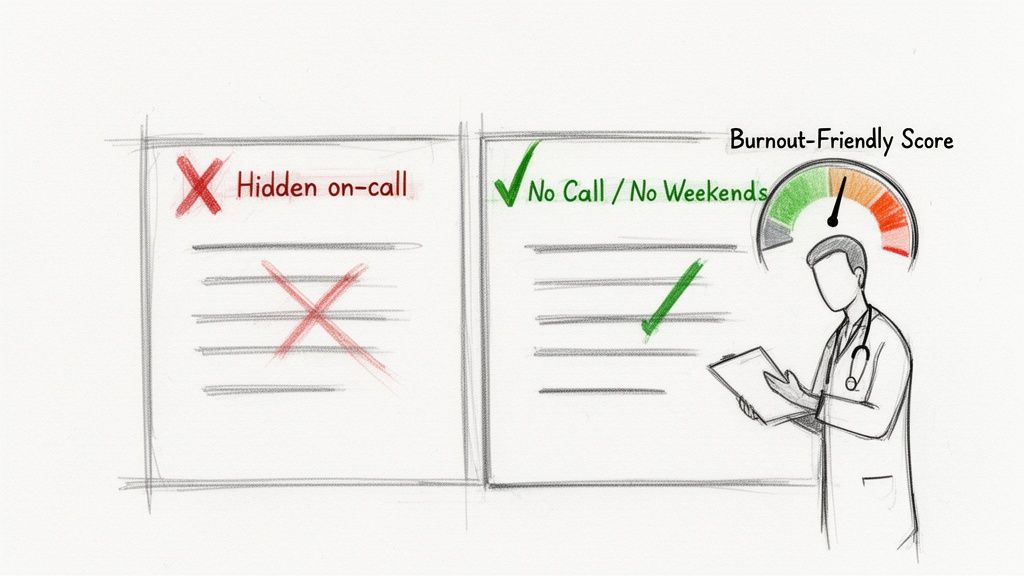
This score isn’t just a random number. We calculate it by analyzing the specific, tangible parts of the job that directly impact your stress levels.
We look at three core pillars for every single role:
- Schedule Autonomy: How much control do you really have over your work hours?
- Patient Load: Is the patient volume reasonable, or is it a recipe for exhaustion?
- Administrative Tasks: Does the role minimize the charting and paperwork that steal your time?
By combining these factors into one simple score, we give you an at-a-glance way to gauge how a job will impact your well-being. It lets you move past vague promises and make decisions based on concrete data.
To make this even more practical, here’s a quick guide to spotting the good, the bad, and the ugly in a job description.
Evaluating Remote Jobs: Red Flags vs. Green Flags
Use this comparison table to quickly assess whether a potential remote job is a sustainable opportunity or a burnout trap in disguise.
| Red Flag (Warning Signs) | Green Flag (Positive Indicators) | Why It Matters |
|---|---|---|
| Vague "Flexible Hours" | "Asynchronous Work" or "Self-Scheduled" | Vague terms often hide rigid expectations, while asynchronous work provides true schedule autonomy. |
| High Patient Volume Metrics | Focus on "Quality of Care" | Emphasizing volume over quality is a classic burnout driver. It pressures you to rush through patient interactions. |
| "Other Duties as Assigned" | Clearly Defined Responsibilities | This catch-all phrase can be a blank check for scope creep and administrative overload. |
| Implicit On-Call Expectations | Explicit "No Call, No Weekends" | If it's not explicitly stated, assume you may be on the hook. Green flags are crystal clear about protecting your time. |
| Emphasis on Productivity Targets | Emphasis on Clinician Well-being | Job descriptions focused solely on KPIs often signal a high-pressure environment with little support. |
Spotting these flags early in your search process is key. A job that respects your boundaries will be proud to state it clearly, while a burnout trap often hides behind ambiguous language.
Understanding Your Earning Potential in Remote Medicine
Let's get right to it and tackle the biggest question most clinicians have about remote work: the money. There’s a stubborn myth floating around that leaving a traditional clinic for a healthcare remote job automatically means taking a massive pay cut.
While some roles do have different pay structures, the reality is a lot more nuanced—and frankly, often much more positive.
Your earning potential is really a puzzle with a few key pieces. Your specialty is obviously a major factor, and so is the geographic market the job serves. A role catering to patients in a high-cost area like New York or San Francisco often pays more, even if you’re working from a lower-cost state.
The compensation model also plays a huge role. A W2 employment role gives you that steady salary and benefits package you're used to. On the other hand, a 1099 independent contractor position might dangle a higher hourly rate, but you're on the hook for your own taxes, insurance, and retirement. Neither is inherently "better"—it all comes down to your personal financial strategy.
Beyond Salary to Financial Independence
True financial health isn’t just about the number on your annual W2. It's about how that income helps you build toward your real long-term goals, like Financial Independence, Retire Early (FIRE). This is where a sustainable, lower-stress remote career becomes an incredibly powerful financial tool.
Think about it: a job that prevents burnout does more than just save your sanity. It ensures your career has longevity. When you aren't constantly one bad day away from quitting medicine altogether, you can keep earning, saving, and investing for many more years. That consistency dramatically speeds up your path to financial freedom. A steady, burnout-free income stream is far more valuable over the long haul than a high-paying job that you can only tolerate for a couple of years before crashing.
This is exactly why we built the WeekdayDoc Salary & FIRE Calculator—to bridge the gap between your job search today and your financial goals for tomorrow.
Financial Independence isn't about some get-rich-quick scheme. It's about designing a career that's sustainable enough to let you build wealth steadily over time, without sacrificing your mental health to do it.
Our calculator helps you actually see how a specific job's salary impacts your journey to FIRE. Below is a sample of how it visualizes this data.
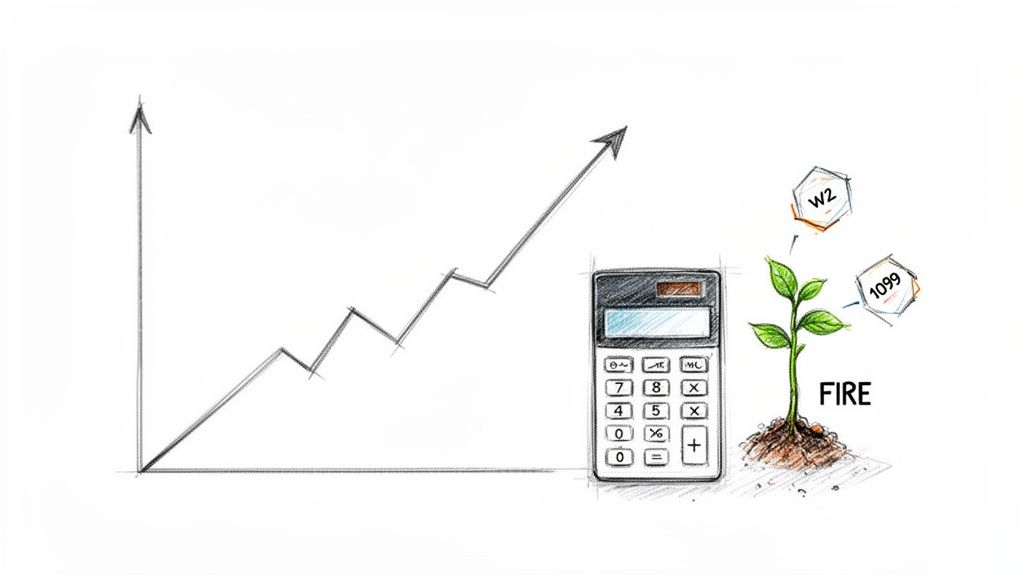
This kind of projection makes it crystal clear how a specific salary, combined with your personal savings rate, maps out your timeline to financial independence. It turns an abstract goal into a tangible plan.
A Practical Tool for Your Financial Future
The calculator isn’t a gimmick; it’s a personal financial planning tool built specifically for clinicians. It uses real-world salary data and cost-of-living adjustments to give you a realistic picture of where you’re headed financially.
You can use it to:
- Compare Offers: See exactly how different salaries and work models (W2 vs. 1099) change your FIRE timeline.
- Adjust for Location: Understand how your earnings translate into actual wealth depending on where you choose to live.
- Set Clear Goals: Turn the vague idea of "financial independence" into a concrete, achievable plan with a finish line.
By using practical tools like the WeekdayDoc Salary & FIRE Calculator, you can start making informed decisions that align your career choices with your long-term security. It proves that a balanced, sustainable remote job isn't a financial step back—it's often the smartest move you can make for your future.
Mastering Your Application and Remote Interview
Applying for healthcare remote jobs requires a different playbook than you might be used to. Your clinical expertise is still the foundation, of course, but hiring managers are now screening for a specific set of digital and communication skills to prove you can thrive without in-person oversight.
This means your CV needs a strategic makeover. It’s no longer enough to just list your clinical duties; you need to reframe them for a virtual world. This small shift in language makes a massive difference, signaling right away that you get the unique demands of telehealth.
Translate Your Skills for Telehealth
Think about how your day-to-day experience translates to a remote environment. It’s about showing, not just telling, that you're ready for virtual care from day one.
Here are a couple of examples of how to reframe traditional clinical skills on your resume:
Instead of: "Patient counseling and education."
Try: "Leveraged digital communication tools (secure messaging, video) to enhance patient engagement and health literacy."
Instead of: "Managed a panel of 500 patients."
Try: "Independently managed a patient panel through an EMR, ensuring timely follow-up and continuity of care in a remote setting."
This approach highlights your adaptability and tech-savviness before they even speak to you.
Your application is your first chance to demonstrate strong remote communication skills. A clear, well-organized CV that highlights your virtual capabilities proves you can succeed in a role where written communication is everything.
Acing the Virtual Interview
Once your application lands you an interview, the focus shifts to proving your competence and building rapport through a screen. Preparation is key, and it goes way beyond just anticipating questions.
First, nail your environment. Make sure you have a stable internet connection and good lighting. Your background should be professional and free of distractions—a simple, neutral wall or a tasteful bookshelf works perfectly. Do a quick tech run-through with a friend to check your audio and video quality beforehand.
Next, get ready for questions unique to remote clinical roles. Hiring managers need to know you can handle the autonomy and unique challenges of virtual care. Be ready to answer questions like:
- "Describe a time you managed a complex patient case without a physical exam."
- "How do you build strong patient rapport through a video call?"
- "What is your process for staying organized and managing your time without direct supervision?"
Use the STAR method (Situation, Task, Action, Result) to structure your answers with clear, confident examples. Your goal is to showcase your clinical judgment, self-discipline, and "webside manner," proving you’re not just a great clinician, but a great remote clinician.
It’s Time to Take Back Your Medical Career
The move toward remote work isn’t just some passing fad—it's a real, strategic shift toward building a medical career that actually serves you, not just your patients. Throughout this guide, we've walked through how remote healthcare jobs offer a powerful antidote to the chronic stress and burnout that have defined medicine for far too long.
These roles hand the control back to you. Control over your schedule, your environment, and ultimately, your own well-being. By moving from a reactive job search to proactively designing the career you want, you can finally make your professional life fit your personal goals—not the other way around.
The path to a fulfilling, financially secure, and balanced career isn't a pipe dream. It's here, right now, made possible by new ways of working and smarter tools to find them.
When you use resources like WeekdayDoc’s No Call/No Weekends filters or our unique Salary & FIRE Calculator, you stop passively accepting the status quo. Instead, you can actively find and vet roles that support both your sanity and your long-term financial freedom.
The tools and the opportunities are ready. The only thing left is for you to take the next step and start building a career on your own terms. Your future self will thank you for it.
Frequently Asked Questions About Remote Clinician Jobs
Making the leap to a remote clinical career brings up a lot of good questions. What specialties actually work? Will I have to take a pay cut? It’s smart to get these answers ironed out before you make a move. Let’s tackle some of the most common questions clinicians have when they start exploring healthcare remote jobs.
The good news? The opportunities are much broader and more lucrative than most people think. The trick is to understand how the virtual care model really works and which skills you need to thrive in it.
Are Remote Jobs Available for Most Specialties?
Absolutely. While fields like psychiatry, psychology, and dermatology were the first to really embrace telehealth, the game has changed completely. Today, you'll find plenty of solid remote opportunities in primary care, endocrinology, neurology, and a whole host of consulting specialties.
Here’s the rule of thumb: if a patient visit can be handled well over video, phone, or secure messaging, a remote role is probably out there for it. The best way to find out is to filter job searches for your specific specialty—you’ll likely be surprised by how many positions pop up.
Does Working Remotely Mean a Pay Cut?
Not at all. In fact, many remote clinician jobs offer salaries that are right on par with—or even better than—traditional in-person roles. And that’s before you even factor in the money you save. When you cut out commuting, a professional wardrobe, and all the other little costs of working on-site, your take-home pay can end up being significantly higher.
The real financial superpower of remote work is geographic arbitrage. You can tap into high-paying job markets without having to live in a high-cost-of-living area.
This flexibility is a massive advantage for building wealth and hitting your financial goals faster.
How Do You Build Strong Patient Relationships Remotely?
Building great patient rapport through a screen is a skill, but it's one you can master. It's often called "webside manner," and it boils down to a few intentional techniques. Things like active listening, looking straight into the camera to create a sense of eye contact, and verbally confirming what you hear to show you're engaged.
Many clinicians actually find they build stronger connections with patients this way. Without the usual chaos of a busy clinic—phones ringing, staff interruptions—you can give your full, undivided attention. That focused environment can create a more personal and trusting patient-provider relationship than you'd expect.
What Basic Equipment Do I Need to Get Started?
Getting set up for a remote job is simpler than you might think. You really only need the essentials:
- A reliable, high-speed internet connection.
- A decent computer with a good webcam and microphone.
- A private, quiet workspace that is HIPAA-compliant to protect patient privacy.
Most employers handle the rest. They’ll provide secure access to their EMR and any other software you need. Some companies even offer a stipend for your home office setup or give you a company laptop to get started.
Ready to find a job that respects your time and well-being? WeekdayDoc curates the best burnout-friendly healthcare remote jobs, all with a clear Burnout-Friendly Score. Start your search and design your ideal career today at https://www.weekdaydoc.com.