Building Effective Physician Wellness Programs That Actually Work
Discover the essential components of effective physician wellness programs. Learn how to combat burnout with strategies that support clinician well-being.

Let’s be clear: physician burnout isn’t a personal failure. It’s a systemic crisis that demands an organizational response. It has become a tired buzzword, but the reality behind it—deep emotional exhaustion and cynicism—is actively undermining the very foundation of our healthcare system.
This makes physician wellness programs far more than an optional perk. They are an essential strategy for a sustainable future in medicine.
Confronting the Physician Burnout Epidemic
For too many clinicians, practicing medicine feels like trying to operate with a cognitive battery that’s always in the red. The relentless grind of systemic pressures—from crushing administrative tasks and EHR headaches to impossible patient loads—drains their energy day after day. They’re left running on empty.
This isn't just about being tired. It’s a profound emotional exhaustion that slowly erodes the ability to connect with patients and find any real meaning in the work.
That persistent depletion inevitably gives way to cynicism and depersonalization. To cope with the relentless stress, physicians start to feel detached, sometimes developing a negative, guarded outlook. This emotional distancing is a defense mechanism against a system that consistently demands more than any human can sustainably give.
The Slippery Slope to Inefficacy
Once exhaustion and cynicism take root, a sense of inefficacy is often the final blow. Clinicians start doubting their ability to make a difference. They question if their work even matters anymore.
This loss of professional confidence is devastating. It transforms a calling into a chore, stripping away the very purpose that drew them to medicine in the first place. What’s left is a workforce struggling not just with their own well-being, but with their entire professional identity.
The cycle of exhaustion, cynicism, and inefficacy isn't just an individual's struggle. It's a flashing red warning light that the healthcare system's most valuable asset—its people—is under extreme duress. Investing in their well-being is a direct investment in the quality and future of patient care.
A Deceptive Trend in Physician Distress
At first glance, some recent stats might suggest burnout rates are getting a little better. But when you dig into the numbers, a more complicated and troubling picture emerges.
While self-reported burnout has ticked down slightly, other critical signs of mental health strain are actually on the rise. Recent national surveys reveal a stark reality:
- 57% of physicians reported episodes of inappropriate anger, tearfulness, or anxiety.
- 55% said they experienced debilitating stress in the past year.
- 46% admitted to withdrawing from family, friends, or colleagues.
This data tells us something important: a small drop in one metric doesn’t mean the crisis is over. The underlying pressures are just squeezing out in different, equally harmful ways. You can explore more of these physician wellbeing survey findings to see the full picture.
This is exactly why comprehensive physician wellness programs are so critical. They have to go beyond surface-level symptoms and attack the root causes of distress.
The Blueprint for a Modern Wellness Program
Truly effective physician wellness programs aren't bought off a shelf. They don't come in a pizza box or at the bottom of a complimentary yoga mat. While those gestures are nice, they completely miss the point, placing the burden of fixing a deep, systemic problem squarely on the individual clinician's shoulders.
A modern, meaningful program is structured more like a sturdy three-legged stool. It needs balance across three distinct pillars, each one critical for creating an environment where doctors can actually thrive, not just survive. Take away any single leg, and the whole thing comes crashing down.
This framework rightly shifts the responsibility from being solely on the physician to a shared model between the individual and the organization. It's an admission that well-being isn't just about personal resilience; it's about building a workplace that doesn’t actively crush it. The goal is to build a system that supports its people, rather than asking its people to endlessly adapt to a broken one.
Pillar One: Systemic and Organizational Support
This is the big one—the most important pillar. It's all about the work environment itself. Simply put, this is about fixing the job, not the doctor. It means making fundamental, often difficult, changes to the workflows, culture, and administrative sludge that are the real drivers of burnout.
Without this foundation, any other wellness effort is doomed from the start. Offering resilience training while ignoring a soul-crushing administrative burden is like teaching someone to swim and then throwing them into a hurricane. It's an unfair fight and a losing strategy.
Initiatives here are focused on giving physicians back their time and autonomy. This includes everything from optimizing the EHR and hiring scribes to protecting administrative time and implementing flexible scheduling that respects life outside of medicine.
Pillar Two: Individual Well-being Resources
While systemic change is non-negotiable, providing individual support is still a crucial part of the equation. This pillar is about equipping physicians with the tools and confidential resources they need to manage the intense, inherent stresses of the profession.
This is where things like confidential counseling, peer support groups, and stress management coaching fit in. The key is accessibility and destigmatization. These resources have to be easy to find and use without any fear of professional blowback.
A critical mistake organizations make is leading with individual resources while ignoring systemic issues. This approach implicitly blames clinicians for their distress, suggesting they simply lack the right coping skills to handle the demands of the job.
The diagram below shows how unchecked stress can quickly escalate from simple exhaustion to a profound sense of professional inefficacy, making both systemic and individual supports necessary.
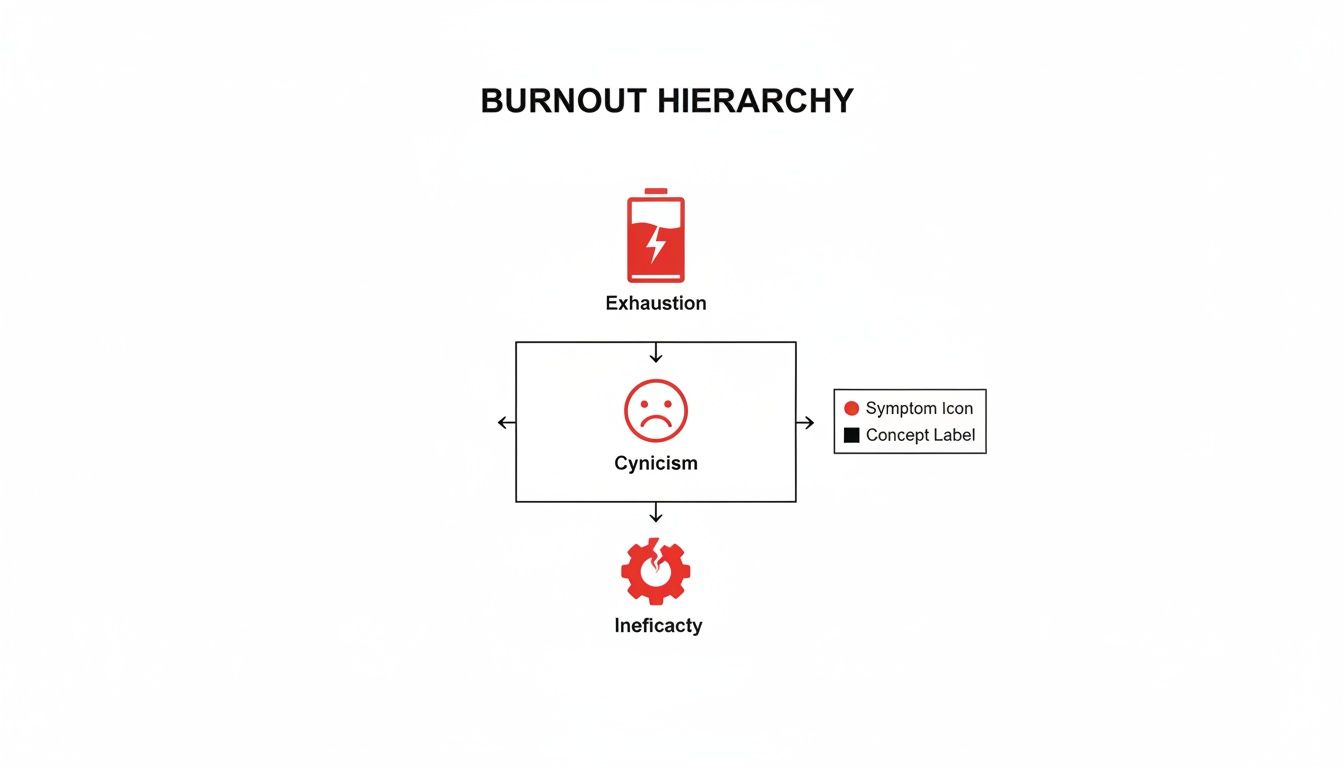
This visual shows that burnout is a progressive condition. It underscores why we need early intervention at both the organizational and personal levels before things spiral.
Pillar Three: Career and Financial Health
The final pillar recognizes that true well-being extends far beyond the clinic walls. It includes a physician's long-term career satisfaction and financial stability, two factors that are deeply intertwined with their overall mental health.
Initiatives here focus on providing transparent career development pathways, leadership training, and real mentorship opportunities. Crucially, it also includes robust financial wellness resources, like access to vetted financial planners, student loan repayment support, and retirement planning tools. For a deeper dive into how these elements create a sustainable career, you can explore our comprehensive guides on physician wellness.
A doctor worried about six figures of student debt or a stagnant career path can't be fully present or engaged at work. Supporting their long-term stability isn't just a nice perk—it's a powerful retention tool and a core component of a truly holistic wellness strategy.
The table below pulls these three pillars together, offering a clear benchmark for what a truly supportive program should look like.
The Three Pillars of an Effective Physician Wellness Program
This table breaks down the essential components of a comprehensive wellness program, separating systemic changes from individual resources.
| Pillar | Focus Area | Examples of Initiatives |
|---|---|---|
| Systemic & Organizational | Fixing the Work Environment | EHR optimization, flexible scheduling, reduced administrative burden, protected non-clinical time, scribe support. |
| Individual Well-being | Building Resilience & Providing Support | Confidential mental health services, peer support groups, mindfulness and stress management coaching, physical health programs. |
| Career & Financial Health | Ensuring Long-Term Stability | Leadership development, mentorship programs, student loan repayment assistance, access to financial advisors, transparent promotion tracks. |
By building a program on these three pillars, healthcare organizations can move beyond empty gestures and create a culture that genuinely supports the people at its heart.
Why Physician Wellness Is a Financial Imperative
For too long, the discussion around physician wellness has been stuck in the realm of "soft" benefits—things like morale, happiness, and job satisfaction. While those are obviously important, looking at it that way leads administrators to see wellness programs as a line-item expense, something optional rather than a core investment. This is a dangerous and incredibly expensive mistake.
The first step is to reframe the entire conversation. When a physician burns out, the damage isn't just emotional; it sends financial shockwaves through the entire organization. Tackling wellness isn’t just about doing the right thing. It’s a calculated business decision to protect your most valuable asset.

The Staggering Cost of Physician Turnover
The most immediate and jaw-dropping cost of burnout is physician turnover.
Replacing a single physician is a massive financial undertaking. Even conservative estimates put the cost somewhere between $500,000 and over $1 million per doctor who walks out the door. That figure accounts for everything from recruitment and onboarding to the sheer revenue lost while the position sits empty.
These aren't fuzzy numbers; they hit the balance sheet hard. A hospital system losing just a few physicians to burnout each year is bleeding millions of dollars—money that could have been put toward patient care or critical system upgrades.
A robust physician wellness program isn’t a cost center. It's an insurance policy against the multi-million dollar catastrophe of physician turnover, safeguarding both your bottom line and continuity of care.
This is why a proactive wellness strategy delivers one of the highest returns on investment a healthcare organization can make. It is always, always cheaper to keep a great physician than to find a new one.
Unpacking the Hidden Financial Drains
Turnover is just the tip of the iceberg. The financial fallout from burnout spreads in quieter, more insidious ways that steadily eat away at an organization's resources and reputation.
- Increased Medical Errors: An exhausted, cynical physician is far more likely to make a mistake. Those errors don't just harm patients; they lead to sky-high malpractice premiums and legal battles that can cost millions.
- Lower Patient Satisfaction: Patients know when their doctor is disengaged. You can see it in their eyes. This directly translates to lower HCAHPS scores, which can reduce Medicare reimbursements and tarnish a hospital's public image.
- Decreased Productivity: Burnout is a productivity killer. A doctor struggling with exhaustion sees fewer patients, is less efficient with charting, and creates bottlenecks in workflow. All of this drags down revenue.
These issues feed on each other, creating a vicious cycle. Poor wellness leads to poor financial performance, which tightens budgets and makes it even harder to fund the very programs that could fix the problem.
Wellness as a Global Economic Driver
Investing in wellness isn't some niche healthcare trend; it's part of a massive global economic movement. The Global Wellness Institute has been tracking the explosive growth of the workplace wellness market, which is part of a global wellness economy that has already blown past pre-pandemic levels.
In North America, the per-capita spending on wellness is estimated at $6,029. The message is clear: top-performing organizations everywhere recognize this as a critical investment. You can see just how big this economic shift is by exploring the projected expansion of the wellness economy.
For healthcare, the stakes are exponentially higher. When organizations build sustainable work environments and burnout-proof roles, they aren't just following a trend. They are making a strategic play for talent retention, risk management, and the long-term financial health of their institution. The data is undeniable: physician wellness programs pay for themselves many times over.
How to Measure the Real Impact of Wellness Initiatives
If you can’t measure it, you can’t improve it. That old business mantra is especially true for physician wellness programs, where proving a real, tangible return on investment is the only way to get—and keep—leadership buy-in. Gut feelings and feel-good stories just won't cut it anymore.
Organizations need hard data to show that their initiatives are actually moving the needle on burnout. That means getting past superficial metrics like program attendance. Knowing how many doctors showed up for a yoga class tells you almost nothing about its real impact.
Instead, the smart organizations are adopting validated, scientific tools designed to actually quantify well-being and distress. It's like ordering lab work for the organization itself. You wouldn't treat a patient without understanding their baseline vitals, and you can't fix burnout without a clear, data-driven picture of your physicians' collective state.
Key Instruments for Measuring Physician Well-Being
To get that clear picture, healthcare systems lean on a few gold-standard assessment tools. These aren't your typical employee satisfaction surveys; they are scientifically validated instruments built specifically to measure the unique pressures and dimensions of burnout in medicine.
Two of the most trusted tools in the field are:
- Maslach Burnout Inventory (MBI): This is the long-standing benchmark in burnout research. It digs into the three core dimensions: emotional exhaustion, depersonalization (cynicism), and a reduced sense of personal accomplishment. Its detailed insights help pinpoint exactly which parts of burnout are hitting your team the hardest.
- Well-Being Index (WBI): A much shorter, nine-question tool built for quick, confidential assessment. It delivers a validated score that reliably flags physicians at high risk of distress, making it perfect for collecting large-scale data to track trends over time.
Using tools like these shifts the conversation from guessing to knowing. The data reveals where the real pain points are, allowing leaders to target solutions—like hiring more scribes or creating flexible scheduling options—with surgical precision. If you're curious about your own standing, you can explore a similar concept with our burnout calculator for healthcare professionals.
Proving That Targeted Strategies Actually Work
Once you have a baseline, the real work begins. By administering these assessments regularly, organizations can track tangible shifts in physician well-being. This creates a powerful feedback loop that shows which programs are working and which are just wasting time and money.
For example, say a hospital implements a new scribe program to cut down on EHR busywork. Six months later, they could re-administer the WBI. A measurable drop in distress scores provides hard evidence that the initiative was a success, validating the investment and building the case for more systemic changes.
This approach turns wellness from a hopeful "nice-to-have" into a measurable science. It proves that when the right strategies are put in place, the results aren't just positive—they're quantifiable.
The scale of this data collection can be massive. One major Well-Being Index study collected over 97,000 clinician assessments in a single year, including 23,498 physician responses. This is the kind of year-over-year tracking that provides undeniable proof of what's working.
This huge dataset revealed a 3.6% increase in physicians classified as “Thriving and Okay” and a corresponding 3.6% decrease in those in the “Distressed and Struggling” categories between the mid-pandemic period and today. You can see the full story in the insights from these 23,000 physician wellness assessments. This is the kind of hard data that makes the case for prioritizing well-being impossible to ignore.
An Employer's Roadmap to Implementing a Wellness Program
Building a physician wellness program that actually works doesn’t happen by accident. It takes a deliberate, phased strategy—not just good intentions. Simply throwing a few disconnected initiatives at the wall is a recipe for wasted money and continued frustration.
A successful program is built step-by-step, where each phase informs the next. Think of it like building a house: you can't put up the walls until you've poured a solid foundation. This five-phase roadmap gives healthcare leaders a clear blueprint to ensure their efforts are targeted, impactful, and built to last.
Phase 1: Conduct a Thorough Needs Assessment
First things first: you have to listen. Before you can solve a problem, you need to understand its unique shape and texture within your organization. Guessing what your physicians need is the fastest way to build a program nobody uses.
To get this right, you need to collect both quantitative and qualitative data. This means deploying confidential, anonymous surveys to get a broad pulse on burnout rates, key stressors, and what resources your team actually wants. Validated tools like the Maslach Burnout Inventory or the Well-Being Index are perfect for establishing these baseline metrics.
But numbers alone don't paint the full picture. You have to supplement that data with confidential one-on-one interviews and small focus groups. These conversations provide the context and human stories that data can’t, revealing the true pain points hidden in daily workflows and organizational culture.
Phase 2: Secure Authentic Leadership Buy-In
Once you understand the problem, your next job is getting leadership fully on board. And I don’t just mean securing a budget. You need genuine, vocal, and visible commitment from the C-suite. Without it, even the most well-designed program will be dismissed as just another corporate initiative destined to fail.
The key is to present a compelling business case that ties physician wellness directly to the organization's bottom line. Use the data from your needs assessment, along with industry stats on the staggering cost of physician turnover—often exceeding $1 million per departing physician.
Frame this investment not as an expense, but as a critical strategy for:
- Talent Retention: Directly fighting the enormous costs of recruitment and lost revenue.
- Risk Management: Reducing the likelihood of expensive medical errors tied to burnout.
- Patient Satisfaction: Showing how supported physicians deliver better care, which directly impacts HCAHPS scores and reimbursements.
Phase 3: Design a Multi-Pillar Program
With leadership backing you, it’s time to design the program itself. The biggest mistake you can make here is focusing only on individual resilience. A truly robust program has to be built on three pillars: systemic fixes, individual support, and career health.
- Systemic Changes: Start by fixing the work environment. This could mean investing in scribe services to slash the EHR burden, protecting administrative time, or redesigning punishing on-call schedules.
- Individual Resources: Offer easy-to-access and strictly confidential mental health support, peer coaching, and practical stress-management tools. The entire focus must be on destigmatizing their use.
- Career & Financial Health: Provide resources for leadership development, mentorship, and financial wellness—think student loan counseling or retirement planning workshops.
Phase 4: Promote and Destigmatize Resources
You can build the best wellness program in the world, but it’s completely worthless if no one uses it. This is where a proactive, multi-channel communication plan becomes essential. Your campaign must relentlessly hammer home two points: confidentiality and ease of access.
Use department meetings, internal newsletters, and visible messaging from respected physician leaders to spread the word. Most importantly, leaders must walk the talk by modeling healthy behaviors and vocally supporting colleagues who ask for help. This is how you dismantle the cultural stigma that stops physicians from using the very services designed for them.
"Forcing medical students to engage with PHPs and then comply with any PHP recommendations is wrong... medical schools... have an ethical duty to advocate for greater transparency and regulation of PHPs." — J. Wesley Boyd, M.D., Ph.D.
This quote gets to the heart of the deep-seated mistrust many physicians have for mandated wellness systems. Your program has to be built on a foundation of trust and autonomy, positioning it as a genuine resource, not a punitive trap.
Phase 5: Measure, Iterate, and Improve
Finally, a wellness program is not a "set it and forget it" project. It must be a living, breathing part of the organization that continuously evolves based on feedback and data.
Use the exact same metrics from your initial needs assessment to track progress over time. Re-administer wellness surveys to see if distress scores are falling. Keep an eye on physician turnover rates and patient satisfaction scores. This data creates a powerful feedback loop, showing you what’s working and what isn’t. It allows you to refine your approach and reallocate resources for maximum impact. By learning from the data-driven approaches that successful healthcare employers are using, you can ensure your program stays relevant and truly effective.
A Clinician's Guide to Finding a Supportive Workplace
Here’s the thing: you have more power in your job search than you probably realize. While it's absolutely on organizations to build supportive environments, you have the final say in choosing a workplace that actively protects you. Making that choice is one of the smartest moves you can make for your long-term personal, professional, and financial health.
Finding a role that won’t burn you out isn’t about getting lucky. It’s about being a savvy investigator during your job search. You have to look past the shiny promises on the company website and dig for real evidence of a commitment to clinician well-being. The interview process is your chance to turn the tables—evaluate them just as critically as they’re evaluating you.

Asking the Right Questions to Uncover the Truth
Generic questions get generic answers. If you want to get a real feel for the culture, you have to ask specific, insightful questions that show how the organization actually works. Think of yourself as a journalist trying to get past the PR spin.
Instead of asking, "Do you have a wellness program?" try questions that probe for action and accountability. The goal is to see if their physician wellness programs are just for show or are actually part of their operational DNA.
Here are some pointed questions designed to get you a straight answer:
- On Scheduling and Autonomy: "How is clinician feedback used to shape scheduling policies and on-call responsibilities?"
- On Administrative Burden: "What specific tools or support staff, like scribes or AI assistants, are in place to reduce EHR and administrative tasks?"
- On Mental Health Support: "Can you describe your confidential mental health support system? How do you ensure it is truly private and free from any professional stigma?"
- On Leadership and Culture: "Could you give me an example of a time when the administration changed a policy based on direct feedback from physicians to improve well-being?"
Their answers—or their hesitation—will tell you everything.
A supportive organization will welcome these questions and give you detailed, confident answers. An organization with a superficial commitment to wellness will often fall back on vague corporate talking points. That’s a huge red flag that their program lacks real substance.
Connecting Your Career Choice to Financial Freedom
Choosing the right workplace isn't just a wellness decision; it's a profound financial one. A job that leads to burnout is a direct threat to your long-term earning potential and your path toward goals like Financial Independence, Retire Early (FIRE).
Constant stress and exhaustion can push you to take career breaks, cut back on hours prematurely, or even leave medicine altogether. Any one of those scenarios can have a devastating impact on your lifetime earnings and retirement projections.
On the flip side, a sustainable role in a supportive environment sets you up for a long, fulfilling, and financially rewarding career. It preserves the energy you need to not only excel clinically but also to explore side projects or leadership opportunities that build wealth. By consciously picking an employer that invests in you, you are making a direct investment in your own financial future. You're ensuring your career supports your life, not the other way around.
Answering Your Questions About Physician Wellness
When people talk about "physician wellness," it’s easy to be skeptical. And you should be. Let's tackle some of the most common questions and concerns that come up for both clinicians and the people leading healthcare organizations.
Are Wellness Programs Just a Way to Blame Doctors for Burnout?
This is the million-dollar question, and the answer is simple: a good program never blames the doctor.
But let’s be honest—many do. If a hospital’s big wellness initiative is just offering yoga classes or resilience training, they’re putting the burden of fixing a broken system squarely on your shoulders. That’s a huge red flag. It’s not your fault you’re burning out from crushing administrative tasks and chaotic scheduling.
A real wellness program focuses on fixing the work, not the worker. It targets the systemic issues—the EHR headaches, the endless prior authorizations, the lack of protected admin time. Individual resources are there to support you, not to serve as a substitute for meaningful organizational change.
How Can I Actually Advocate for a Better Program at My Hospital?
Trying to push for change can feel like yelling into the void, but you can get traction by speaking the language administrators understand: data and money.
First, gather your evidence. You can start by confidentially surveying your colleagues to get hard numbers on burnout rates and pinpoint the biggest stressors in your specific department. Is it the EHR? Patient load? Lack of autonomy? Get the data.
Next, you build the business case. Present your findings alongside the well-established research on the staggering cost of physician turnover, which often runs from $500,000 to over $1 million per physician who leaves. Frame a real wellness program not as an expense, but as a critical investment in keeping good doctors and protecting patient safety.
The single most important element of a successful wellness program is a genuine commitment to addressing systemic issues. This means leaders must be willing to make real operational changes, such as optimizing EHR workflows or protecting physicians’ administrative time, rather than just offering surface-level perks. Without this foundational commitment, all other efforts will ultimately fail.
Ready to find a role that prioritizes your well-being from day one? At WeekdayDoc, we connect physicians with burnout-friendly jobs that have no call and no weekends. Start your search for a sustainable career at https://www.weekdaydoc.com.