Physician Leadership Jobs: Burnout-Friendly Roles and Career
Explore physician leadership jobs that protect work-life balance. Discover roles, salaries, required skills, and how to find burnout-friendly opportunities

The most popular advice about physician leadership jobs is also the least useful: accept the promotion, work harder, and prove you can carry both clinical practice and administration. That model often turns leadership into an unpaid second job. A sustainable role should do the opposite. It should give you defined authority, protected administrative time, and a schedule that makes influence possible without consuming the personal time you were trying to protect.
For physicians, NPs, PAs, psychologists, and pharmacists, the right question isn't “How do I move into leadership?” It's “What leadership structure lets me improve care, support colleagues, and preserve a workable life?” That distinction matters because leadership quality is closely tied to workforce stability, while title inflation without schedule control can intensify burnout.
Why Physician Leadership Is Not Just a Promotion Track
Traditional career advice treats leadership as the next rung: more responsibility, more meetings, and a larger administrative portfolio layered over the same clinical workload. That approach confuses authority with sustainability. A title doesn't create influence if the organization gives you no protected time, no decision rights, and no practical way to follow through.
The evidence points to a more useful framing. In a 2025 report, 41.9% of physicians experienced at least one burnout symptom, down from 48.2% in 2023, according to coverage cited in reporting on the decline of clinical leadership. Burnout remains a workforce problem, not a personal resilience defect. The same coverage describes physicians becoming less willing to accept roles beyond clinical work, while hospital leadership commentary argues that leadership is more sustainable when it is integrated into daily work rather than stacked on top of it.
Promotion versus career redesign
A conventional administrative track may remove you from patient care, place you in recurring meetings, and make your calendar dependent on problems that arrive outside business hours. That can work for clinicians who want system-level management, but it isn't automatically a promotion for someone seeking autonomy and predictable time.
An integrated leadership model embeds management responsibilities into a defined portion of the week. You might retain clinical sessions while owning quality reviews, clinician coaching, utilization decisions, or service-line development during protected weekday blocks. A part-time medical director role with no call can be more sustainable than a nominally prestigious position that expects constant availability.
Practical rule: Treat protected time and decision rights as core compensation. A leadership title without either one is often administrative burden with better branding.
The first screening task is cultural, not financial. Ask how leaders receive feedback, how disagreements are handled, and whether clinical staff participate in decisions. The WeekdayDoc guide to assessing company culture is useful because culture determines whether your formal authority will translate into day-to-day influence.
The search intent behind the title
Many clinicians searching for physician leadership jobs aren't chasing status. They're looking for sustainable influence, schedule control, and a way to improve the system without abandoning clinical identity. That includes mid-career physicians, women physicians, and clinicians who need hybrid, part-time, or weekday-only structures.
The best role is therefore not necessarily the highest position. It's the position where the organization has matched scope, time, authority, and accountability. If those elements don't align, leadership becomes a second workload. If they do, it can become a practical intervention that improves both your career design and the working conditions of the people you lead.
Common Physician Leadership Job Titles and Responsibilities
Leadership titles can look interchangeable on a job board, but the weekly reality varies sharply. A Medical Director may spend part of the week reviewing cases, coaching clinicians, and managing quality initiatives while retaining patient-facing work. A Chief Medical Officer, by contrast, usually carries broader accountability for clinical strategy, executive communication, quality, and medical staff alignment, with less predictable clinical integration.
What the main roles usually involve
Medical Director: Often the most accessible entry point for practicing clinicians. The role may cover utilization review, quality metrics, peer review, clinician support, policy implementation, or service-line oversight. Ask whether the administrative sessions are protected and whether call is explicitly excluded.
Regional Clinical Lead: This position coordinates standards and performance across multiple sites or teams. It can offer hybrid or remote work because much of the job involves meetings, dashboards, coaching, and escalation management. Travel, early meetings, or cross-site availability can still undermine schedule control.
Quality Improvement Physician: This is usually project-centered. Responsibilities may include reviewing outcomes, facilitating improvement work, interpreting clinical data, and helping teams change workflows. It often preserves clinical identity and can suit physicians who prefer structured problems over personnel management.
Operational Clinician or Physician Advisor: These roles connect clinical judgment with utilization, documentation, throughput, and care coordination. They can be attractive to physicians who want influence without becoming a full-time executive, but the authority boundary must be clear. Advice without organizational backing creates frustration.
Chief Medical Officer: The CMO owns a wider portfolio, including clinical quality, physician engagement, regulatory priorities, and executive-level strategy. It may be a full-time administrative job, although some organizations retain a limited clinical component. Call and weekend expectations vary, so never infer them from the title.
Chief of Service or Department Chair: These roles combine professional leadership with governance, recruitment, quality, and departmental performance. They can offer substantial influence, but committee work and staffing issues may extend beyond standard hours unless the organization sets firm boundaries.
The practical distinction is clinical integration. A role that preserves patient care can maintain credibility with frontline teams, while a purely administrative position may offer broader scope but less direct connection to daily clinical work. Neither is superior. The correct choice depends on whether you want operational depth, patient-facing continuity, or system-level authority.
Use the same discipline when evaluating clinical supervision responsibilities. For psychologists and multidisciplinary leaders, resources such as PsyBA-aligned supervision tools can help clarify supervision structure, documentation, and professional accountability.
The Data Behind Leadership Quality and Physician Burnout
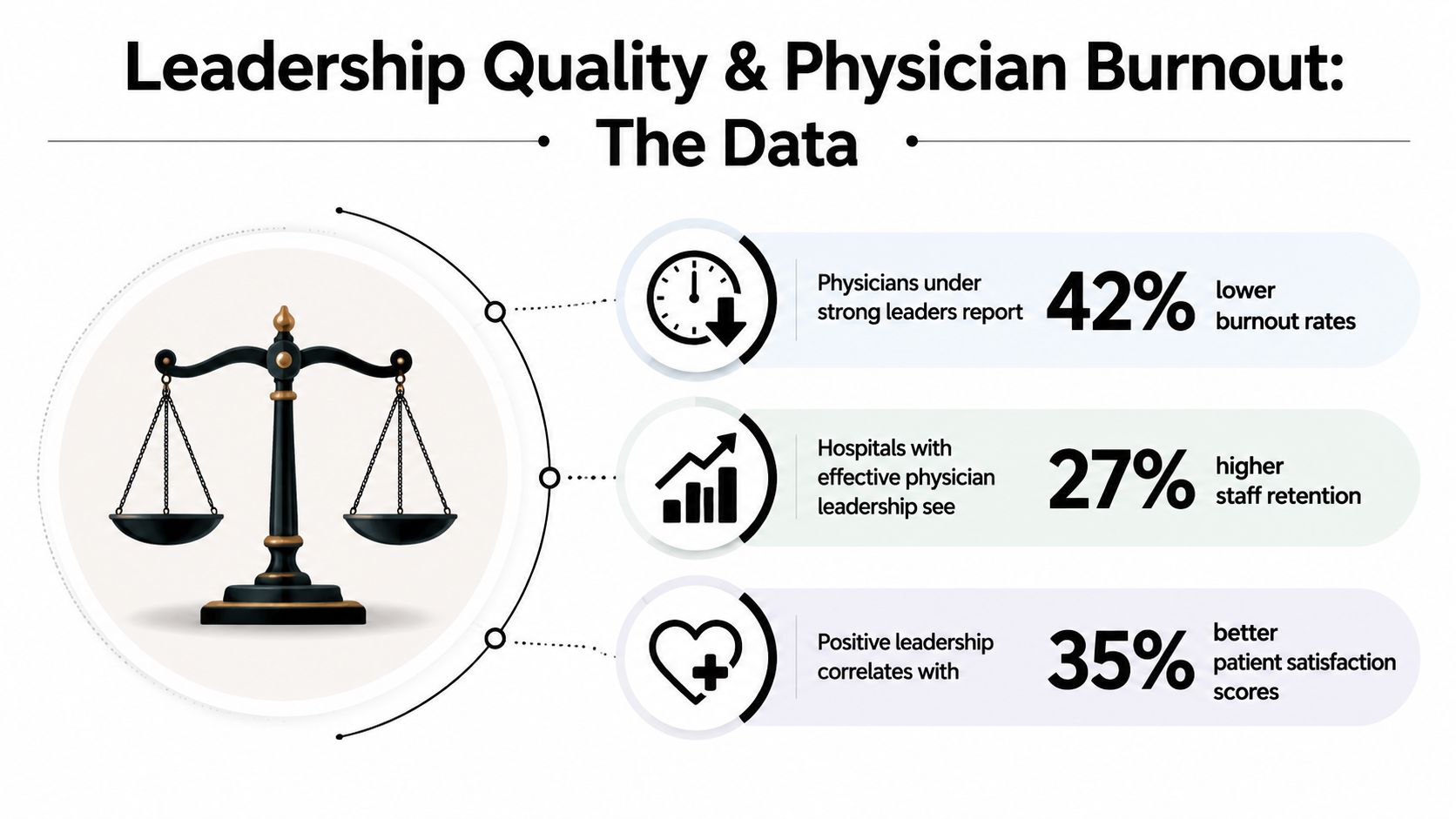
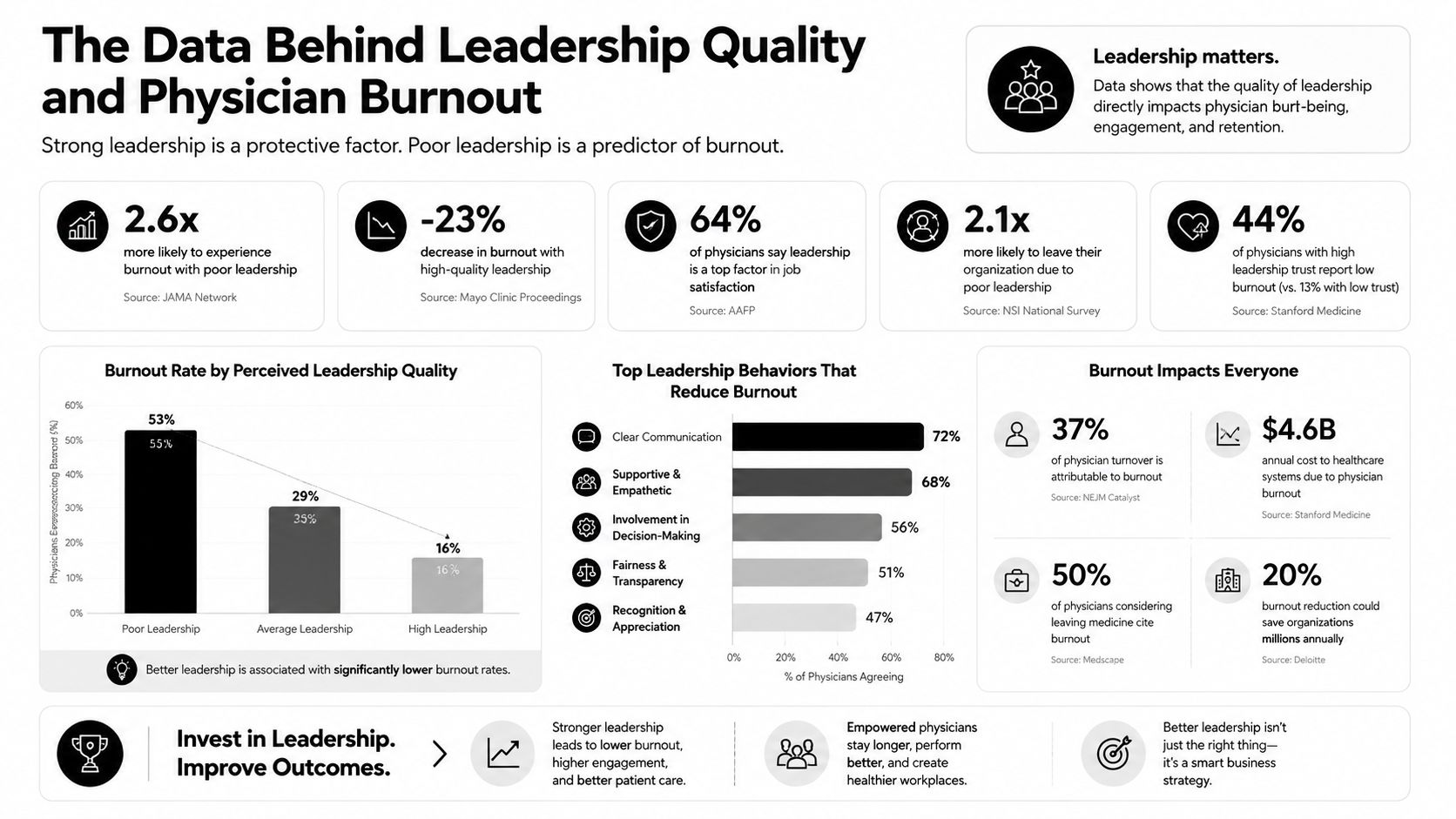
Leadership quality directly affects whether physicians burn out, stay, and remain satisfied. That matters when evaluating physician leadership jobs, because a title cannot compensate for a role that adds administrative burden without authority, protected time, or schedule control.
A multicenter physician survey found a dose-response relationship between supervisor leadership ratings and workforce outcomes. Physicians in the top tertile of leadership ratings were 48% less likely to be burned out, with an odds ratio of 0.52 and a 95% confidence interval of 0.45 to 0.61. They also reported 66% lower intent to leave, with an odds ratio of 0.34 and a 95% confidence interval of 0.26 to 0.44, according to the BMJ Open study on physician leadership and burnout. The broader physician burnout statistics resource provides useful context for interpreting these findings.
At the individual level, burnout fell from 47% in the lowest leadership-rating tertile to 18% in the highest, while intent to leave declined from 50% to 16%. Coaching, regular feedback, and participatory management therefore function as operating practices, not decorative language.
What stronger leadership changes
A separate health-system study found that each 1-point increase on a composite physician supervisor leadership score, measured on a 12 to 60 scale, was associated with a 3.3% decrease in the likelihood of burnout and a 9.0% increase in satisfaction, after adjustment for age, sex, tenure, and specialty. Department-level leadership ratings correlated with burnout prevalence at r=-0.330 and satisfaction at r=0.684, as reported in the PubMed study of physician leadership and satisfaction.
The practical conclusion is clear. Organizations should not place physicians in leadership solely to cut costs or enforce policy. Physician-led hospital systems were associated with higher quality ratings across specialties and higher inpatient days per bed, but the study found no difference in total revenue or profit margins. Leadership can improve perceived quality, throughput, and workforce stability without an immediate financial gain.
Strong physician leadership makes difficult work more workable. It does not remove constraints, but it gives clinicians a credible way to raise problems and help solve them.
For candidates, these findings should change the interview questions. Ask how leadership effectiveness is measured, how supervisors coach clinicians, and what happens when frontline feedback conflicts with an operational target. Also ask whether leadership time is protected, whether call is excluded, and whether the role can remain part-time. A participatory structure is more compatible with sustainable work than a larger title layered onto a full clinical schedule.
Credible physician leadership jobs define meeting rhythms, feedback channels, escalation paths, and protected time. Without those mechanics, the organization may be asking you to absorb dissatisfaction rather than giving you the authority and schedule structure needed to improve the work.
Comparing Leadership Formats for Schedule Control and Sustainability
Leadership format matters as much as title. Two Medical Director positions can have very different levels of autonomy, clinical work, call exposure, and availability expectations. Compare the structure before comparing the salary.
| Leadership Format | Typical Schedule | Call/Weekends | Remote Options | Burnout Risk |
|---|---|---|---|---|
| Full-time administrative | Primarily leadership and operational work, usually structured around business hours | Must be defined in the contract, may include escalation coverage | Often hybrid, depending on site and duties | Higher when availability is vague or authority is limited |
| Hybrid clinical-administrative | Clinical sessions combined with protected leadership blocks | Can be excluded, but never assume it | Often possible for meetings, review, and project work | Moderate when the two workloads are separately scheduled |
| Part-time medical directorship | A defined number of administrative sessions alongside clinical practice or another role | Frequently negotiable, with no-call structures available | Common for review, coaching, and meetings | Lower when scope matches paid time |
| Regional or system-level leadership | Multi-site oversight, recurring meetings, metrics, and strategic projects | Escalation expectations require explicit language | Often hybrid or remote, with possible travel | Variable, driven by geographic scope and decision rights |
The trade-offs that deserve attention
A full-time administrative role can provide the clearest authority and the strongest opportunity to shape operations. It also creates distance from clinical teams and can turn every unresolved issue into your problem. Hybrid work preserves clinical credibility, but it fails when organizations treat clinical sessions and administrative responsibilities as two full-time jobs.
Part-time medical directorships are often the most promising format for clinicians seeking schedule control. The trade-off is narrower influence. You may own a defined program rather than system-wide strategy, and compensation may be structured as a stipend, a fixed administrative payment, or part of a broader employment package.
Regional roles can provide autonomy and remote flexibility, particularly for clinicians comfortable with dashboards, coaching, and distributed teams. Travel and time-zone coordination can erode the weekday-only promise, so ask how often in-person attendance is required and whether after-hours escalation is part of the job.
Access for mid-career and underrepresented candidates
Leadership pathways aren't limited to physicians already sitting in executive offices. Recent reporting from an academic and leadership market report found that 86.7% of leadership hires were already in practice, while nearly half of academic executives were open to new opportunities, according to The Medicus Firm's 2025 leadership insights report. That mobility means a practicing clinician with credible operational experience can compete without first accepting an indefinite administrative apprenticeship.
Women physicians and clinicians seeking schedule autonomy should examine leadership fit, not just access. A role that offers formal authority but rewards constant availability may reproduce the same pressures that made the leadership path unattractive. Ask for the actual calendar, not the idealized job description.
Skills and Credentials That Actually Matter for Leadership Roles
Clinical excellence gets you noticed, but it doesn't prepare you for every leadership problem. Physician leadership jobs require a second operating system: financial literacy, workflow design, conflict management, quality improvement, and the ability to make decisions with incomplete information.
An MBA or MHA can help when you want formal training in finance, operations, strategy, or organizational management. It isn't a universal requirement. A focused leadership certificate, quality improvement training, or demonstrated experience leading a cross-functional project may be more relevant for a part-time Medical Director position.
Build evidence, not a credential collection
Hiring organizations usually want proof that you can translate clinical judgment into team results. Rework your CV around actions and scope:
- Show operational ownership: Name the process you improved, the stakeholders involved, and the decision you were responsible for.
- Translate committee work: A quality committee role matters more when you explain how you analyzed a problem, aligned clinicians, and implemented a change.
- Demonstrate people leadership: Include mentoring, feedback, conflict resolution, and clinician onboarding. These experiences reveal how you'll manage relationships.
- Explain clinical credibility: Keep your specialty and patient-care experience visible. Leaders lose trust when teams can't see the connection between their decisions and clinical reality.
A resource on healthcare resume skills for 2026 can help you identify transferable capabilities, but the strongest CV still uses your own examples and outcomes rather than generic leadership vocabulary.
Compensation deserves the same scrutiny as duties. The U.S. Bureau of Labor Statistics lists $117,960 as the median annual wage and $56.71 as the median hourly wage for medical and health services managers in May 2024, a broad category that can include physician leadership work, according to the BLS overview of medical and health services managers. That benchmark isn't a physician-specific offer guide. MGMA's provider compensation data includes benchmarks for medical directorship, on-call pay, academic salaries, and starting salaries, based on an industry dataset, as described by the AAMC discussion of physician compensation data.
On-call pay can materially change the package. MGMA data show daily stipends ranging from $75 to $2,400 depending on specialty, with a median of $1,000 for specialty surgeons and $150 for primary care physicians, according to MGMA's compensation data discussion. Separate the stipend from the leadership salary, and make sure availability expectations match the payment structure.
How to Transition Into a Physician Leadership Role
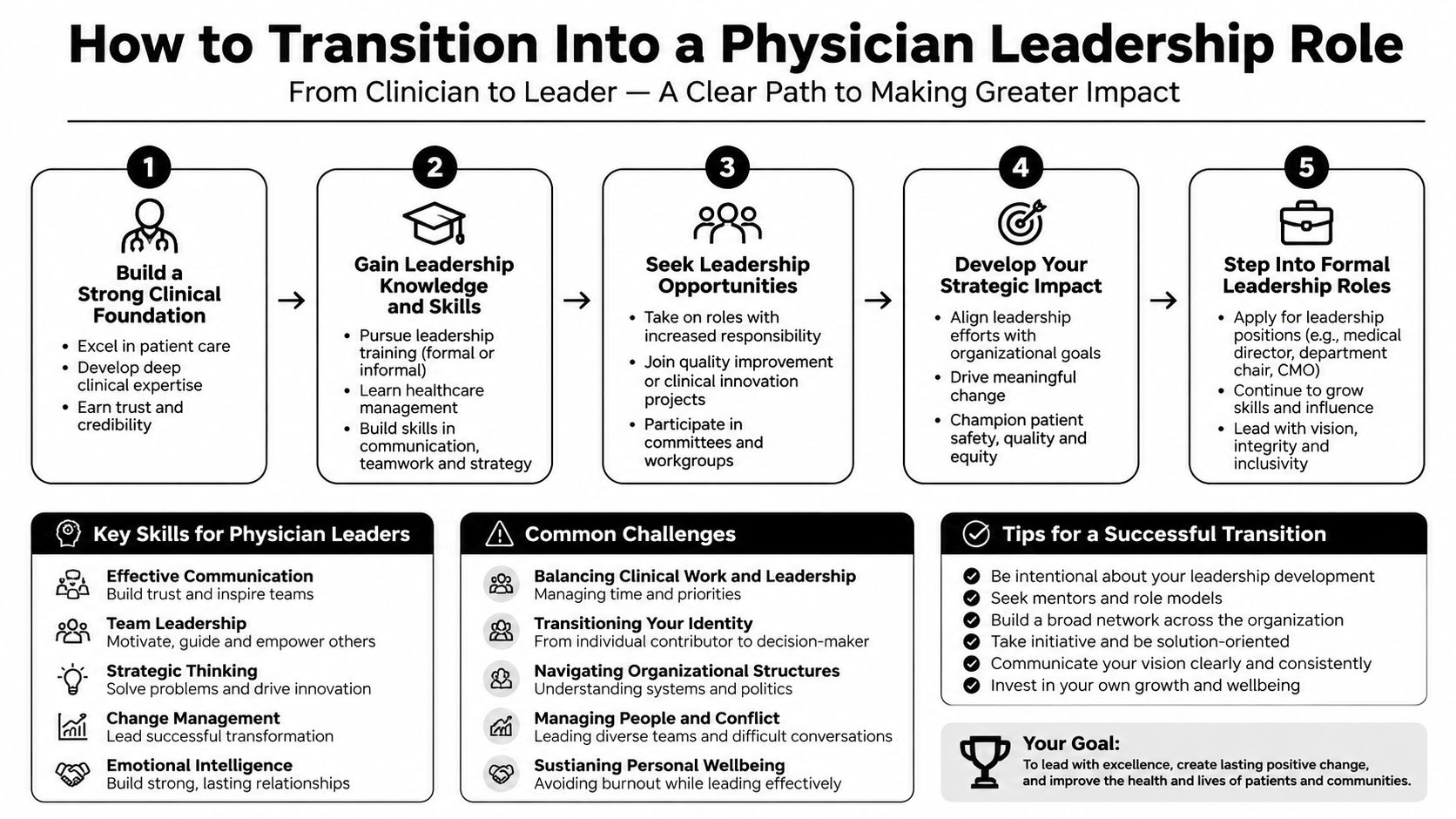
Start by treating the transition as a job-design exercise, not a title search. Decide how much clinical work you want to retain, whether you need no-call and no-weekend boundaries, how much travel you can accept, and which decisions you want to own. Those choices narrow the market in a useful way.
Build a leadership case from your current work
Your first move doesn't have to be a formal executive appointment. Lead a quality initiative, chair a multidisciplinary workgroup, mentor clinicians, participate in utilization review, or take responsibility for a service-line problem. Document the work as evidence of judgment, collaboration, and follow-through.
Then revise your CV. Replace “participated in committee” with the problem, your role, the stakeholders, and what changed. If you have managed conflict, redesigned a workflow, coached a colleague, or presented operational recommendations to executives, bring those examples forward.
Test the role before you accept it
During interviews, ask direct questions:
- Which responsibilities are administrative, and how much protected time is allocated to them?
- What decisions can I make without additional approval?
- Does the role include call, weekend coverage, overnight escalation, or informal availability?
- How will performance be evaluated?
- Who reports to me, and who can override my decisions?
- What happens when clinical priorities conflict with financial or operational targets?
- Why did the previous leader leave?
The answers reveal more than the title. Vague language about flexibility, “wearing many hats,” or being available when needed often signals unpriced work. A sustainable role should define schedule, authority, reporting lines, and escalation expectations in writing.
Before signing, run the offer through a contract scanner to identify language that deserves legal review. Use a salary calculator to compare the proposed compensation with your broader market and financial goals, then negotiate for protected administrative sessions, explicit no-call terms, defined authority boundaries, and a review process.
A leadership job should make your workload visible. If the organization can't explain when leadership happens, it will probably happen after clinical work, after dinner, and on days you thought were yours.
Where to Find Burnout-Friendly Physician Leadership Openings
Search by structure before title. On a specialized physician jobs board, filter for leadership and administrative work, then look for explicit No Call, No Weekends, remote, hybrid, and part-time markers. A posting that says “flexible” without defining availability still requires clarification.
WeekdayDoc offers curated clinical and leadership listings with schedule markers, salary information, a Burnout-Friendly Score, and state-based FIRE projections. Its market pulse data can help you benchmark an offer, while the RVU calculator provides context when leadership compensation is connected to clinical productivity.
Use a short screening checklist:
- Schedule: Are administrative hours protected and predictable?
- Call: Is call excluded in writing, including informal escalation?
- Authority: Can you make decisions that match your accountability?
- Compensation: Are leadership duties paid separately from clinical production?
- Sustainability: Does the role preserve personal time rather than reward constant availability?
A title is a poor substitute for a workable operating model. Choose the role that gives you enough authority to improve care, enough time to lead properly, and enough boundary protection to remain healthy in the work.
WeekdayDoc helps clinicians compare burnout-conscious jobs by role, specialty, work style, schedule protections, compensation data, and long-term FIRE projections. Visit WeekdayDoc to evaluate physician leadership jobs that may offer meaningful influence without call, weekends, or administrative work stacked invisibly onto clinical hours.