Medical Director Salary: Medical Director Salary in 2026:
Explore 2026 medical director salary data. Find national averages, negotiation tactics, and insights for burnout-friendly, no-call roles. Get the data you need!

A difference of more than $100,000 separates two widely cited medical director salary estimates. Salary.com's January 1, 2025 figure is $331,987, while PayScale's 2026 estimate is $230,206 in the same broad job family. That gap isn't a mistake. It's the first clue that a medical director offer has to be read like a contract, not a headline.
If you're moving out of full-time clinical work, especially because you're tired of call, weekend coverage, inbox creep, and the constant spillover into personal time, this role can look like the answer. Sometimes it is. Sometimes it's a dressed-up administrative job with physician liability attached.
The useful question isn't just "what is the average medical director salary?" It's whether a specific offer buys you a sustainable workweek, defensible compensation, and a role you can keep doing without burning out.
Understanding the Medical Director Salary Puzzle
The phrase medical director salary sounds precise. In practice, it covers very different jobs under one title. One employer means a physician executive with broad system oversight. Another means a supervising doctor for a multi-site clinic group. Another means a part-time sign-off role with intermittent chart review and policy review.
That's why salary data feels chaotic. It reflects real variation in duty mix, employer type, and compensation structure. A no-call weekday role may post a lower base than an acute-care leadership role, yet still be the stronger deal if it protects nights, weekends, and mental bandwidth.
Why the range is the point
A wide range tells you the market values different versions of this title very differently. If you want a burnout-friendly role, that's helpful. It means you shouldn't compare yourself only to the highest-paid medical director in a national dataset. You should compare offers based on time demand, legal exposure, and schedule control.
I've seen clinicians get distracted by the top-line number and miss the actual cost. A “better paying” offer can become the worse job if it includes after-hours calls from administrators, urgent policy sign-offs, weekend availability, or responsibility for sites you never physically visit.
Practical rule: If two offers are close enough financially, the one with cleaner boundaries often wins over time.
How to think like a strategist
Read the role through three lenses:
- Schedule reality: Is it weekday-only, or “mostly” weekday-only?
- Authority burden: Are you signing protocols, supervising clinicians, handling quality events, or carrying meaningful medico-legal exposure?
- Financial fit: Does the compensation support your long-term goals once you factor in taxes, retirement savings, and the value of predictable time?
For that third piece, physicians often benefit from specialist financial planning for doctors, especially when trading a traditional production model for a leadership package with more benefits and fewer clinical shifts.
The Anatomy of Medical Director Compensation
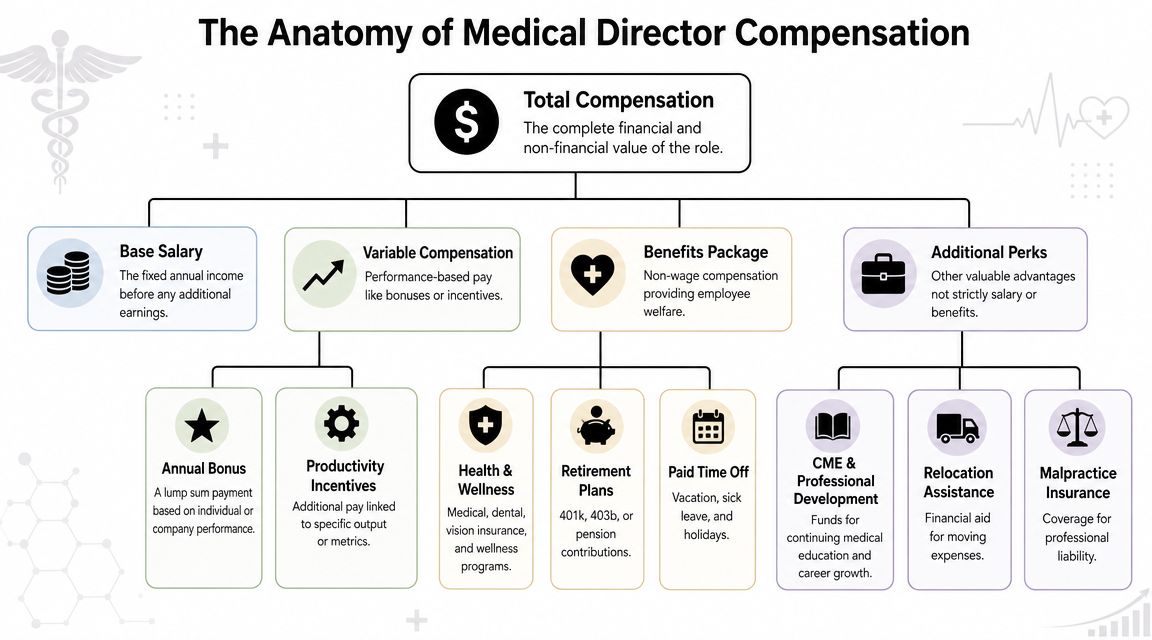
An offer letter rarely tells the whole story in one line. For a medical director, total compensation usually includes cash, protection, and convenience. All three matter.
Base pay is only the floor
A strong base matters because it's the part you can count on. But a medical director offer with a respectable base can still be thin if it expects broad oversight without enough support staff, administrative time, or indemnification.
The market for these roles is substantial. ERI estimates average U.S. medical director pay at $375,546 annually, or about $181 per hour. That matters because employers aren't paying only for your license or specialty training. They're paying for clinical judgment plus governance, risk oversight, and cross-functional leadership.
For burnout-friendly roles, that creates an interesting tension. Removing nights, weekends, and call doesn't automatically make the job cheap. If you still carry sign-off authority and quality responsibility, the role can remain expensive because the liability and decision burden stay with you.
Variable pay needs scrutiny
Bonus language deserves slow reading.
Some arrangements include annual bonuses tied to departmental targets, quality metrics, retention goals, or broader company performance. Those can be reasonable. But if the formula is vague, you should assume the upside is less dependable than the recruiter suggests.
A practical way to review variable pay:
- Ask what triggers payment: Individual metrics, organization metrics, or board discretion.
- Check the timeline: Quarterly and annual bonus structures behave differently for cash flow.
- Read the definitions: “Quality,” “growth,” and “performance” need objective wording.
- Watch for hidden workload: A bonus may require extra meetings, utilization reviews, or cross-site troubleshooting.
Benefits can change the value of the job
For clinicians seeking relief from high-intensity practice, non-cash benefits often determine whether the role is sustainable.
A useful checklist includes:
| Compensation element | What to clarify |
|---|---|
| PTO | Is time off actually protected, or are you still expected to monitor issues? |
| Malpractice coverage | Does the employer cover it fully, and what happens at separation? |
| CME support | Are licensing, CME, and travel funded or out of pocket? |
| Retirement plan | Is there employer contribution, and when does vesting begin? |
| Remote flexibility | Can protocol review, meetings, and documentation happen from home? |
A weekday schedule loses value fast if your “off” time is still filled with sign-offs, texts, and unresolved operational questions.
Long-term incentives and perks
In some sectors, especially venture-backed care models, digital health, payer organizations, or startup environments, part of the package may come as equity or other long-term incentives. Treat those as upside, not guaranteed salary.
Relocation support, licensing reimbursement, a dedicated administrative assistant, and protected calendar blocks for director work can also be valuable. They don't always look dramatic on paper, but they can make the difference between a manageable role and one that eats into evenings.
Key Factors That Drive Medical Director Pay
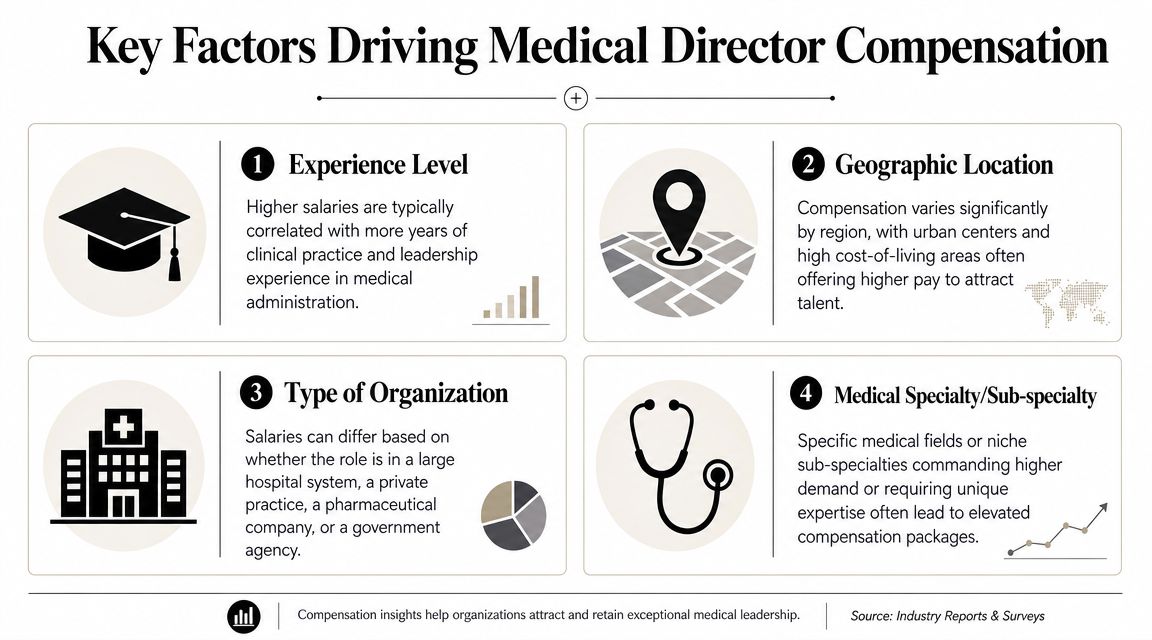
Two jobs can share the same title and have little in common beyond the words “medical director.” Pay reflects that.
Geography still matters
Location isn't just about cost of living. It changes candidate supply, employer urgency, and what kinds of organizations are hiring.
Indeed reports an average medical director salary of $249,652 per year in Dallas-Fort Worth, with that figure sitting 12% above the national average in its system. In the same broader region, the listed nearby city figures rise sharply, including Lubbock at $464,678 and Corpus Christi at $394,039.
That tells you something important. Even within one state or regional labor market, compensation can shift dramatically. If a role is tied to a hard-to-fill site, a smaller city, or a niche service line, salary may rise to offset recruiting difficulty.
Employer type changes the package
A hospital system, health plan, digital health company, med spa platform, and multi-site clinic group don't buy the same kind of leadership.
Some organizations pay for broad institutional leadership. Others pay for regulated oversight and physician availability. A payer may emphasize utilization review, policy interpretation, and peer discussions. A clinic platform may emphasize protocols, supervision, quality review, and escalation handling.
Those settings feel different day to day. One may be meeting-heavy but predictable. Another may look light on paper and then produce a steady stream of low-grade interruptions.
Scope beats title
Whenever I review a medical director role, I care more about scope than prestige.
Ask about:
- Who reports to you: Direct reports, informal influence, or no people management at all
- How many sites or programs you oversee: Single location versus multi-site complexity
- What must be signed by you: Protocols, charts, incident reviews, audits, credentialing
- What happens when something goes wrong: Do issues route to you after hours
A narrow supervisory role with clear processes may be burnout-friendly. A broad “oversight” role with vague responsibility often isn't.
Schedule design has real value
A weekday-only role deserves a different lens than a traditional leadership job with constant availability.
Here's the trade-off in plain terms:
| Role feature | Usually supports sustainability | Usually raises burnout risk |
|---|---|---|
| Call expectations | No call, no backup call | Informal “just in case” access |
| Work pattern | Fixed weekday blocks | Unscheduled escalation work |
| Weekend demands | None unless preplanned | Routine weekend reviews |
| Remote option | Administrative work can be done off-site | Frequent physical presence with no flexibility |
If the employer says “no call” but still expects immediate responses during nights or weekends, the role isn't truly no call.
Decoding National and Specialty Salary Data
A single national average can swing by more than $100,000 depending on the dataset. That gap is large enough to change whether an offer looks fair, mediocre, or underpriced.
Clinicians run into this problem constantly. One salary site places medical director pay in the low $200,000s. Another places it well into the $300,000s, as noted earlier. Both figures can be directionally useful. Neither is enough to price a specific role, especially if you are screening for a weekday, no-call job that protects recovery time.
The difference usually comes from how the numbers were collected. Employer-reported surveys often skew higher than self-reported submissions. Some sources focus on base salary. Others fold in bonus, incentive pay, or broader executive titles that do not match a physician medical director role. Titles create noise too. A medical director in a health plan, hospital service line, multisite clinic group, or digital health company may have very different pay bands for very different workloads.
That is why I treat national data as a starting range, not a target.
A better approach is triangulation. Pull a few broad market references, then narrow the range based on the actual job in front of you. If you need a baseline for comparison with non-leadership physician roles, WeekdayDoc's physician salary guide helps frame what you may be trading away in clinical income, flexibility, or both.
Then pressure-test the role against the details that affect real compensation:
- Employer model: Health systems, payers, private equity-backed groups, startups, and FQHCs often pay differently for the same title.
- Clinical carryover: A role with ongoing patient care should be compared differently from a fully administrative post.
- Bonus realism: Ask how often the bonus was paid in the past two years, and what had to happen for it to pay out.
- Schedule value: A true weekday schedule with protected evenings can justify accepting less base pay than a higher-paying role with constant interruptions.
- Promotion path: Some jobs are priced lower because they are stepping-stones to regional or enterprise leadership. Others are underpaid.
Specialty data helps, but only in narrow ways. If the position depends heavily on your board certification, procedure background, utilization management experience, or regulatory oversight in a niche service line, specialty comparisons can sharpen the range. They still will not tell you whether the job is burnout-friendly.
That requires different questions. How much of your week is consumed by meetings that could have been emails? How often does “administrative oversight” turn into same-day crisis management? Who handles first-line operational problems before they get to you? A pulmonary critical care physician taking a medical director post in post-acute care should not assume specialty prestige alone will translate into better effective hourly pay.
I also recommend reading outside medicine if negotiation is not already part of your skill set. This salary guide for high-achieving women leaders is useful because it focuses on how offers are structured, where employers leave room, and how to ask for terms that support a sustainable career instead of a flashy number.
The practical takeaway is simple. Use national and specialty salary data to set guardrails. Price the actual job by scope, time burden, and how reliably it protects your off-hours. That is how you tell the difference between a well-paid leadership role and an expensive way to stay burned out.
How to Analyze and Negotiate a Burnout-Friendly Offer
A burnout-friendly medical director role usually wins or loses in the details. The salary number gets attention first. The schedule architecture decides whether the job is livable.
Compare offers by burden, not just pay
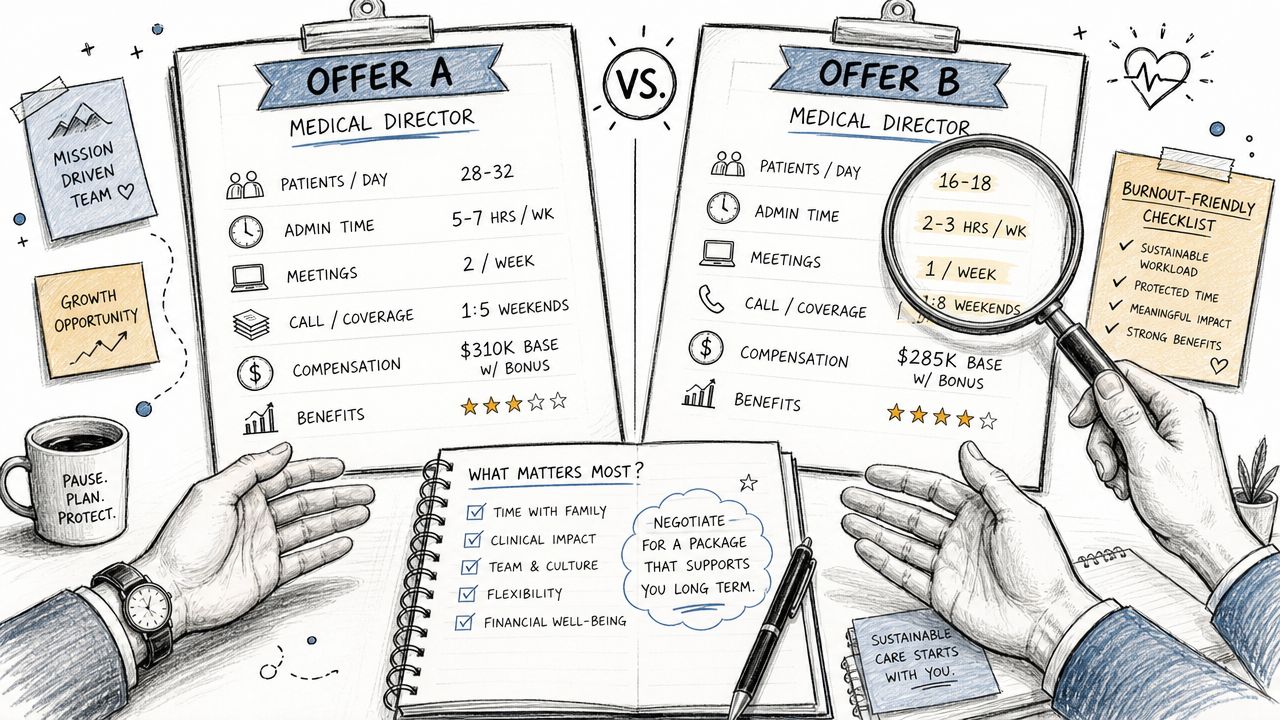
Take two common scenarios.
Offer A pays more on paper. It includes broad oversight, multi-site responsibility, frequent urgent reviews, and an expectation that you'll stay reachable after hours even if the contract avoids the word “call.”
Offer B pays less in base compensation. It offers a weekday schedule, remote administrative blocks, cleaner escalation pathways, and clearly limited responsibility outside scheduled hours.
A lot of clinicians instinctively lean toward Offer A because medicine trains us to optimize for the highest visible number. That can be a mistake. If Offer B gives you protected evenings, fewer interruptions, and a role you can sustain for years, its true value may be higher.
Look for the hidden cost centers
A lower-burnout job isn't automatically a better job. But there are specific features that raise or lower its real value.
Use this filter:
- Boundary quality: Are nights and weekends effectively protected?
- Administrative support: Who handles scheduling, follow-up, policy routing, and documentation prep?
- Decision density: How many high-stakes calls does the role place on your desk each week?
- Legal clarity: Are your duties and liability boundaries written cleanly?
- Exit risk: What happens if the organization grows and gradually expands your remit?
Holt Law notes that compensation should follow documented responsibilities, with examples ranging from about $500 to $1,500 per month for minimal start-up involvement and from $5,000 to $10,000 or more per month for active clinical roles. That's useful because it reinforces a central negotiation principle. You are not negotiating a title. You are negotiating compensation for defined work.
A better way to negotiate
You don't need to frame every request as “I want more money.” In leadership hiring, the strongest negotiation often sounds like scope management.
Try language like this:
“I'm interested in the role because the weekday structure fits the way I want to practice long term. For the compensation to match the position, I'd want the agreement to clearly define after-hours expectations, the number of sites covered, and what administrative support is included.”
Or this:
“If the compensation is fixed at this level, I'd want the duties limited to the responsibilities listed in the agreement, with any additional site coverage or recurring chart review handled through a separate amendment.”
Those are mature asks. They signal that you understand both workload and compliance.
For clinicians who want sharper salary negotiation language, this salary guide for high-achieving women leaders is a useful complement because it focuses on framing, positioning, and asking without apologizing.
Review the contract before you negotiate the final number
A medical director agreement can look harmless until you read the duty language. Before finalizing terms, review the physician employment agreement checklist at WeekdayDoc so you can spot vague supervision clauses, undefined availability expectations, and broad indemnity concerns.
Here's a short educational overview that pairs well with that review:
Practical negotiation points that often work
Different asks solve different problems. Don't bundle everything into salary.
Consider negotiating for:
- A narrower duty statement if the role touches multiple sites or service lines
- Protected remote admin time for chart review, meetings, and protocol work
- Written response-time expectations so “no call” stays no call
- Malpractice and tail clarity before you sign
- Periodic compensation review if the employer expects likely scope expansion
The cleanest burnout-friendly offer is one where your time, authority, and compensation all match on paper.
Use WeekdayDoc Tools to Find Your Ideal Role
Finding a reasonable medical director salary is easier than finding a reasonable medical director lifestyle. Those are different searches.
A lot of job boards make you infer the schedule from vague wording like “flexible,” “leadership opportunity,” or “dynamic environment.” That wastes time. If your priority is protecting evenings and weekends, you need tools that screen for those conditions up front.
Filter for the role you actually want
A practical search starts with essential criteria:
- No call
- No weekends
- Remote or hybrid administrative work
- Clear compensation visibility
- Role-specific fit by specialty or license type
Instead of reading dozens of listings manually, use tools that let you sort by schedule structure first and title second. That approach is much more efficient for clinicians who are leaving acute-care intensity and don't want to backslide into a leadership job with disguised availability demands.
Use compensation tools with context
Salary calculators are most useful when they connect compensation to how you live, not just what you earn. State taxes, work pattern, and long-term savings goals matter a lot when you're choosing between a higher-stress role and a lower-friction one.
One practical option is WeekdayDoc's Salary & FIRE Calculator, which lets clinicians model compensation in the context of location and financial independence planning. That kind of tool is especially helpful when a lower base salary may still support your goals because the job is more sustainable and keeps your life intact.
Match the offer to the life you want
The best medical director role for many clinicians isn't the one with the flashiest salary figure. It's the one you can still respect a year later.
A useful search process asks:
- Would I still want this job if the title were less impressive?
- Would I accept this schedule if the salary were unchanged?
- Does this role reduce burnout, or only rearrange it?
Those questions save people from signing up for polished versions of the same old problem.
Frequently Asked Questions About Medical Director Pay
How should a part-time medical director be paid
For part-time arrangements, the cleanest setup is usually a fixed monthly stipend or an hourly rate with a cap. That only works if the duties, expected hours, and response times are written down.
Medical director work is rarely pure output-based labor. It often includes policy review, supervision, compliance oversight, meeting time, and intermittent physician availability. Pay should match those administrative responsibilities and stay separate from referrals, procedures, or business generation.
What compensation structure raises legal concern
Docuhealth explains that compliant medical director compensation should be fixed, predictable, and not tied to revenue or patient volume, with common structures including flat monthly fees or capped hourly rates such as $250 to $500 per hour. Payment must correspond to documented administrative work. Volume-based compensation is a major red flag.
This comes up more often than many physicians expect. If an employer offers a percentage of collections, per-procedure pay, or bonus language tied to growth, pause and get the agreement reviewed by a healthcare attorney before signing.
If your medical director pay rises because the business bills more, ask how that arrangement would hold up under scrutiny.
Is a lower-paying no-call job ever the better deal
Yes.
A lower base can be the better offer if it removes call, protects weekends, limits inbox spillover, and narrows liability exposure. For many physicians leaving high-intensity clinical work, those features are not perks. They are part of compensation.
I would value a weekday-only role very differently from a role that pays more but expects evening availability "as needed." The extra money loses appeal fast if it keeps following you home.
A job you can sustain for years often beats one that pays more but burns through your attention, sleep, and patience within a year.
What should be written into the agreement
The agreement should define duties, reporting lines, time commitment, site coverage, meeting expectations, malpractice responsibility, and what counts as after-hours work.
It should also state how new responsibilities trigger a review of pay and schedule. That matters when a group adds sites, expands service lines, hires more clinicians, or increases chart review volume. Without that language, role creep tends to become unpaid labor.
How do I know whether the stipend matches the work
Start with the task list. Count recurring duties, not just the title.
A stipend can sound fair until you add up committee meetings, onboarding, policy updates, chart review, quality work, incident follow-up, and the time spent being available for operational questions. In leadership roles, "quick questions" are often where the unpaid hours accumulate.
Ask these questions before you agree to a number:
- How many hours per month does this take in a normal month?
- Which tasks require my signature, direct review, or formal approval?
- How many clinicians, sites, or service lines fall under my supervision?
- What work is expected outside scheduled hours?
- How is extra work documented and paid?
If the employer cannot define the work, the stipend is not defined either.
Does “remote” reduce the burden enough to justify lower pay
Sometimes.
Remote work cuts commuting and can make a leadership role much more livable. It can also hide a messy job. A remote medical director may still carry heavy sign-off duties, nonstop messages, and responsibility that spills into nights and weekends.
The better question is whether the role is contained. A contained job has clear hours, clear authority, and clear limits on unscheduled access.
Should I prioritize salary or lifestyle in negotiation
Prioritize what will be hardest to fix later.
Base pay can sometimes be revisited after six or twelve months. Constant availability is much harder to roll back once the organization gets used to having it. If burnout is the reason you are considering a medical director role, protect schedule boundaries first, then negotiate compensation around that structure.
That usually leads to a better long-term deal than taking more money for a vague role with open-ended access.
If you're looking for a medical director role that respects evenings, weekends, and personal time, WeekdayDoc is built for that search. You can filter for no-call and no-weekend roles, review compensation details, and compare opportunities with burnout-conscious criteria before you spend time on interviews.