A quick look at physician burnout statistics: Trends, causes, and solutions
Explore physician burnout statistics by specialty and career stage. Learn what the data means for your practice and how to build a sustainable medical career.

The latest numbers on physician burnout tell a complicated story. While rates thankfully dipped to 54% in early 2025 after peaking at a staggering 60% the year before, the hard truth is that more than half of all doctors are still burned out. This isn't just a temporary slump; it's a chronic, systemic problem that threatens patient care, drives talented clinicians out of medicine, and destabilizes the entire healthcare workforce.
The Reality of Physician Burnout in Numbers

To really get a handle on the burnout crisis, you have to look at the raw numbers. This is more than just a buzzword tossed around in hospital breakrooms; it's a measurable phenomenon with very real consequences. These statistics aren't abstract figures—they represent our colleagues, our mentors, and our friends who are struggling under the daily weight of the profession.
This data is also a critical tool for making smart career moves. Whether you're a resident trying to pick a specialty or an attending physician thinking about a job change, understanding the landscape helps you see the risks and find the opportunities.
Before diving deep, let's look at the most important numbers at a glance.
Key Physician Burnout Statistics At a Glance
This table offers a quick snapshot of the core statistics that define the current state of physician burnout.
| Metric | Statistic | Source Highlight |
|---|---|---|
| Current Burnout Rate | 54% of physicians | The Physicians Foundation, 2025 |
| Peak Burnout Rate | 60% in 2024 | The Physicians Foundation, 2025 |
| Mental Health Stigma | 73% of docs acknowledge stigma | The Physicians Foundation, 2025 |
| Fear of Consequences | 38% fear professional reprisal for seeking help | The Physicians Foundation, 2025 |
These figures set the stage, showing a workforce that is slowly recovering but still facing immense pressure and cultural barriers to well-being.
A Snapshot of the Current Climate
Recent findings paint a picture of a healthcare system still under enormous strain. That modest drop in burnout is a good sign, sure, but it comes after years of escalating stress that hit a boiling point during the pandemic.
A 2025 survey from The Physicians Foundation drives this home. It notes that even with the six-point drop, anxiety and stress levels are still sky-high. This tells us that while the immediate, acute pressures might have eased up a bit, the underlying systemic problems haven't gone anywhere.
That same survey dug up a few other crucial insights:
- Mental Health Stigma is Still a Problem: More than 73% of physicians admit there's a stigma around mental health in medicine. That’s better than it used to be, but it's still a huge barrier.
- Fear of Speaking Up: A shocking 38% of doctors are afraid of professional blowback—think licensure or credentialing issues—if they were to seek help for their mental health.
- A Gender Gap in Support: Female doctors are stepping up more often to support their peers. 40% report checking in on colleagues they’re worried about, compared to just 25% of their male counterparts.
Putting the Data Into Perspective
These numbers tell the story of a profession at a critical turning point. Burnout isn't an individual failing; it's a direct reflection of broken systems, crushing administrative burdens, and a culture that has long celebrated resilience to the point of self-destruction.
Think of it this way: if a certain model of car kept breaking down, you wouldn't just blame the drivers. You'd look at the engine, the manufacturing line, and the roads it's being driven on.
Burnout is the symptom, but the system is the disease. The statistics are our diagnostic tool, pointing to the parts of medicine that need urgent care themselves.
By digging into these trends, you can make more sense of your own experiences and start advocating for better, healthier places to work. The numbers also show just how vital it is to have tools that can measure and manage these risks. To see how your own feelings stack up against these national trends, you can use WeekdayDoc’s Burnout Index for a personalized gut check.
This guide will keep breaking down the data—by specialty, career stage, and root cause—to give you the clarity and confidence to steer your own career in medicine.
What Burnout Actually Feels Like
The word "burnout" is thrown around a lot. But what does it actually feel like when you’re living it day in and day out?
It’s not just having a bad week or feeling stressed. Burnout is a specific, corrosive psychological state that fundamentally rewires how you experience your work, your patients, and your life. It’s defined by three core symptoms.
Understanding these components is key. It helps turn abstract physician burnout statistics into something tangible and recognizable—in your colleagues, and more importantly, in yourself.
The Three Core Dimensions of Burnout
Burnout isn't one single feeling. It's a toxic triad of symptoms that create a vicious cycle, pulling you deeper. The three dimensions are emotional exhaustion, depersonalization, and a diminished sense of personal accomplishment.
- Emotional Exhaustion: The profound feeling of being emotionally overextended and drained. The tank is just empty.
- Depersonalization (or Cynicism): A detached, indifferent, or cynical attitude toward your job and the patients you care for.
- Reduced Sense of Accomplishment: The nagging belief that your work doesn't matter, that you're ineffective, and that you aren't making a real difference.
Let's break down what these actually feel like in the real world.
Emotional Exhaustion: The Empty Tank
Think of your emotional reserves as your phone's battery. On a good day, it charges to 100% overnight and lasts until you plug it in again.
Emotional exhaustion is what happens when that battery is permanently damaged. No matter what you do to "recharge"—sleep, take a vacation, see friends—it never gets above 10%. You start every single shift running on fumes, where even the smallest task feels like a monumental effort. This isn't just being tired; it's a deep, soul-crushing fatigue that rest never seems to touch.
Depersonalization: Watching Your Life on Mute
Depersonalization is a defense mechanism that has gone horribly wrong. It’s when you start to emotionally wall yourself off from your work, treating patients more like checklist items than human beings.
It feels like you’re watching your own life as a movie. You see yourself going through the motions—rounding, charting, talking to families—but you’re not really there. The sound is off. This emotional distance might start as a way to cope with the daily grind, but it eventually curdles into cynicism and a loss of empathy, chipping away at the very reason you went into medicine.
Burnout makes you feel like you are running on a treadmill. You are putting in a tremendous amount of effort, but you feel like you're not getting anywhere meaningful.
A Reduced Sense of Accomplishment
This is the feeling of professional futility. After all the long hours, the sacrifices, and the incredible effort, you’re left feeling like none of it makes a difference.
It’s the sense that you’re just spinning your wheels. Imagine sprinting on a treadmill. You’re sweating, your heart is pounding, you're giving it everything you’ve got. But when you finally look up, you haven't moved an inch. That feeling of ineffectiveness is incredibly demoralizing and crushes the sense of purpose that drew you to this career in the first place.
If any of this sounds painfully familiar, it might be helpful to get a clearer picture of where you stand. Our free physician burnout calculator provides a quick, confidential assessment based on these core dimensions.
Tracing the Roots of the Burnout Crisis
Physician burnout didn't just appear with the pandemic. While COVID-19 certainly poured gasoline on the fire, the embers had been smoldering for well over a decade. To really understand today's physician burnout statistics, we have to look back and trace the trends that got us here.
This long-term view is critical. It shows that the systemic issues driving doctors out of medicine—things like crushing administrative burdens, less and less autonomy, and flat-out unsustainable workloads—were entrenched long before 2020. The pandemic was an accelerant, not the starting point.
Knowing this history gives us crucial context. Even though recent data shows a slight dip in burnout rates, the foundation of our healthcare system is still under immense stress. This makes proactive career management and a clear-eyed view of your workplace reality more important than ever.
The Pre-Pandemic Baseline
Even before most of us had heard of a coronavirus, a huge chunk of the physician workforce was already struggling. Back in 2011, studies revealed that 45.5% of physicians reported at least one symptom of burnout. That number tells a story: nearly half the profession was already in distress.
This wasn't a minor complaint. It was a clear signal that the demands of modern medicine were overwhelming its workforce. The "death by a thousand clicks" from electronic health records (EHRs) and mountains of bureaucratic tasks were already taking their toll, chipping away at the time doctors could actually spend with patients.
Think of it like a slow leak in a tire. The car was still running, but the pressure was steadily dropping, leaving the whole system fragile and vulnerable to a major shock. And that shock was just around the corner.
The Pandemic Breaking Point
The COVID-19 pandemic was the massive, system-wide stress test that exposed every single one of those cracks. The pressure on physicians became immense and unrelenting, pushing burnout to levels we'd never seen before. Longitudinal studies tracking thousands of doctors captured this dramatic spike with alarming clarity.
In 2021, at the peak of the crisis, the U.S. physician burnout rate shot up to an all-time high of 62.8%. This figure, a massive jump from a pre-pandemic low of 38.2%, was a tipping point. The majority of the physician workforce was officially burned out. Now, as the immediate pressures have eased, recent data from 2023-2024 shows the rate has fallen back to 45.2%—almost exactly where it was before the pandemic. You can dive deeper into these trends with the comprehensive data published by Stanford Medicine.
This data makes one thing painfully clear: while the acute phase of the pandemic is over, the burnout rate has simply reset to its old, unacceptable baseline. The systemic problems are still firmly in place.
This infographic breaks down the core stages of burnout that these statistics are actually measuring.
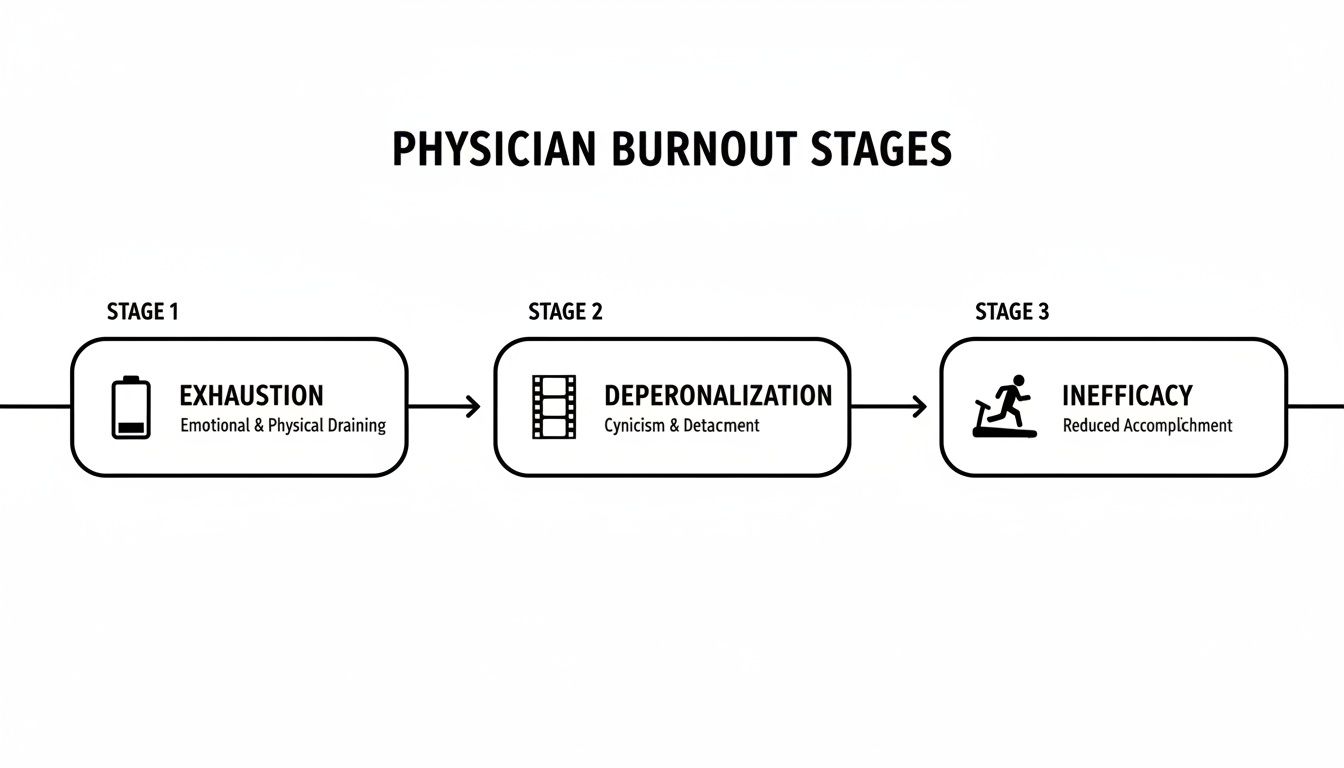
You can see how it’s a progression—starting with simple exhaustion and spiraling into a profound sense of inefficacy that systematically dismantles a physician's connection to their work.
An Ongoing Systemic Challenge
The historical data paints a clear picture. Burnout isn't a one-time event; it's a chronic condition of the medical profession, one that fluctuates with outside pressures but is always there.
The return to pre-pandemic burnout levels isn't a victory; it's a stark reminder that the "normal" we returned to was already a crisis in progress.
Physicians are still far more likely to experience burnout than people in other professions, which points to a problem baked into the structure and culture of medicine itself. The data consistently shows that doctors have worse work-life integration than the general workforce. Acknowledging this history is the first step toward building a more sustainable future for clinicians.
How Burnout Varies Across Medical Specialties
While physician burnout is a crisis across the board, it doesn’t hit every field of medicine with the same force. The day-to-day grind, the emotional weight, and the unique pressures of each specialty create vastly different risk profiles.
Knowing where the landmines are is crucial for your career, whether you’re a med student trying to pick a path or a practicing doctor wondering if the grass is greener elsewhere.
The physician burnout statistics paint a pretty clear picture. Frontline fields—the ones defined by high-stakes decisions, brutal administrative loads, and relentless patient interactions—consistently report the highest levels of exhaustion. This isn’t because the doctors are any less resilient; it's a direct result of the broken systems they're forced to operate in.
The Frontline Fields Feeling the Most Strain
Some specialties are always at the top of the burnout charts, and frankly, it’s no surprise. Fields like emergency medicine, internal medicine, and family medicine form the bedrock of our healthcare system, but they also carry a crushing weight.
Emergency medicine is often the poster child for burnout, with rates climbing as high as 63% to 65%. The constant whiplash of context-switching, the chaotic pace, and the steady diet of trauma create an environment that’s incredibly tough to endure year after year. There’s simply no time to decompress between crises, which just torches your emotional reserves.
Internal medicine and pediatrics aren't far behind, with burnout rates hovering around 60%. These doctors juggle huge patient loads and the immense cognitive burden of managing complex, chronic diseases. The paperwork alone can feel like a second full-time job.
Burnout isn’t randomly distributed. It concentrates in specialties where the gap between the mission of care and the reality of the work is widest—often due to overwhelming administrative tasks and systemic inefficiencies.
A Closer Look at Primary Care
Primary care is the backbone of public health, yet it's a field in deep trouble. Family medicine and general internal medicine physicians face a perfect storm of pressures that fuel burnout rates as high as 60%. They’re drowning in massive patient panels, battling endless insurance bureaucracy, and serving as the first line of defense for a dizzying array of complex medical and social problems.
This unrelenting strain has created a dangerous trend. Primary care physicians are burning out faster than their specialist colleagues, with rates jumping from 46.2% in 2018 to 57.6% in 2022. This isn’t just a U.S. problem; it’s a global one, driven by the same culprits of administrative overload and a nonexistent work-life balance. The crisis has gotten so bad that both the AMA and the Surgeon General are now pushing for major interventions. You can dig into the specifics in this comprehensive study on primary care burnout.
Physician Burnout Rates by Medical Specialty
A comparative look at burnout prevalence across different medical specialties, highlighting the most and least affected fields.
Seeing the numbers laid out side-by-side really drives the point home. While no specialty gets a free pass, the massive variation shows just how much a physician’s work environment shapes their well-being.
| Medical Specialty | Reported Burnout Rate (%) | Key Contributing Factors |
|---|---|---|
| Emergency Medicine | ~65% | High-stakes decisions, unpredictable workload, exposure to trauma |
| Internal Medicine | ~60% | High patient volume, complex case management, administrative burden |
| Pediatrics | ~59% | Emotionally demanding cases, high parental communication needs |
| Obstetrics/Gynecology | ~58% | Irregular hours, on-call demands, high-risk patient situations |
| Family Medicine | ~50-60% | Heavy administrative load, large patient panels, insurance hurdles |
This isn't just a table of numbers; it's a story about the real-world impact of a career choice. It helps explain why your specialty can make or break your long-term satisfaction.
For any doctor thinking about a change, these statistics are a powerful reminder to look beyond the clinical work. You have to evaluate the entire ecosystem of a job, because that’s what will ultimately determine if you thrive or just survive.
The Systemic Problems Driving Physician Burnout
To get why more than half of all doctors are burning out, we have to look past the individual physician and zoom out to the environment they're forced to work in. This isn't about a lack of personal resilience. Physician burnout is the predictable, inevitable outcome of a deeply broken healthcare system.
Those alarming physician burnout statistics aren't just numbers; they're the final readout from a machine that has been grinding its workforce into the ground for decades.
Imagine trying to do your job on a painfully slow computer, with half your team missing, while spending most of your day on redundant paperwork that has nothing to do with your actual role. For countless doctors, that’s not an exaggeration—it’s just another Tuesday. The problem isn't the physician; it's the toxic work environment.
Until healthcare organizations take real ownership of these systemic issues, burnout will remain a core feature of practicing medicine.
The Crushing Weight of Administrative Tasks
Physicians often call it "death by a thousand clicks." They went to medical school to take care of people, not to become glorified data-entry clerks. But today, a staggering amount of their time is eaten up by administrative tasks that add zero value to patient care.
We're talking about wrestling with clunky Electronic Health Record (EHR) systems, fighting insurance companies for prior authorizations, and drowning in documentation. These tasks aren't just time-consuming—they're soul-crushing. They create friction at every turn, pulling doctors away from the meaningful, hands-on work that drew them to medicine in the first place.
A huge source of frustration for doctors is the widening gap between their professional values and the demands of their employers. When clinicians feel like their expertise is ignored and their concerns are dismissed, a sense of being undervalued quickly poisons the well.
Erosion of Autonomy and Control
It's not just the paperwork. There's a growing sense among doctors that they're losing control over their own work. More and more, clinical decisions are being dictated by administrators, insurance protocols, and rigid, one-size-fits-all institutional policies.
This slow erosion of clinical autonomy cuts to the very core of what it means to be a physician.
When an experienced specialist is micromanaged by a non-clinical administrator, it breeds resentment and cynicism. This lack of control—over their schedule, their patient load, and even their own medical judgment—is a massive contributor to the feeling of powerlessness that fuels burnout. It’s also why supportive leadership that trusts its doctors is one of the biggest protective factors against it.
Unsustainable Workloads and Staffing Shortages
The math is simple and brutal: too many patients, and not enough doctors, nurses, or support staff to care for them. Chronic understaffing puts an impossible load on the clinicians left behind, forcing them to do far more with far less.
This isn’t just about working long hours. It's about the relentless intensity of the work. When there’s no time to think, no time to connect with patients, and certainly no time to decompress between appointments, burnout is almost guaranteed. This kicks off a vicious cycle:
- Overwhelming Workloads: Physicians are stretched thin, managing patient panels and schedules that are simply not feasible.
- Increased Burnout: The constant pressure leads directly to exhaustion, cynicism, and a feeling of detachment.
- Higher Turnover: Burned-out doctors cut back their hours, look for a new job, or just leave medicine entirely.
- Worsening Shortages: As the workforce shrinks, it puts even more pressure on those who remain, starting the cycle all over again.
This is a structural failure, plain and simple. Focusing on personal coping strategies while ignoring the system is like teaching someone to swim in a tsunami. The only real solution is to fix the broken systems that created the crisis in the first place.
Using Data to Build a Better Medical Career

Knowing the physician burnout statistics is one thing. Actually using them to build a better life is something else entirely. This data isn't just for researchers or hospital administrators—it’s a powerful tool you can use to vet potential jobs and design a career that actively protects your well-being.
Moving from being a statistic to becoming a strategist requires a new mindset. Instead of passively accepting a job description at face value, you can use this data to ask smarter, more targeted questions during interviews. It's about taking control and aligning your career with what you actually need to find fulfillment and stay in medicine for the long haul.
Think of this section as your personal career playbook, turning national trends into your next move.
Vetting Jobs Through a Burnout Lens
When you’re looking at a new role, your goal is to uncover the day-to-day reality hiding behind the polished interview pitch. The data is clear: factors like administrative load, call schedules, and workplace culture are the real drivers of burnout. So, that's where you need to focus.
It’s like running a differential diagnosis on a potential employer. You need to gather the right data points to confirm or rule out a toxic work environment before you sign a contract.
Here are the critical questions to ask, inspired directly by the pain points revealed in the burnout data:
- On Call and Weekends: "What is the typical call frequency for this role, and what are the expectations for weekend coverage?"
- On Administrative Burden: "Can you describe the level of support for administrative tasks like EHR charting, prior authorizations, and scheduling? Is there scribe support?"
- On Workplace Culture: "How does leadership gather and act on feedback from physicians about workload and systemic issues?"
The answers to these questions will tell you far more about the job than the salary ever could.
Introducing a Practical Solution for Your Job Search
Trying to navigate the job market with these new criteria can feel overwhelming. That’s where tools designed specifically for burnout-conscious clinicians become essential. Instead of sifting through thousands of generic job listings, you need a platform that gets what you’re really looking for.
WeekdayDoc was created to directly address the systemic drivers of burnout. It’s a job platform that filters opportunities based on the factors that truly matter for long-term career sustainability.
Burnout often feels like a loss of control. A strategic job search is about reclaiming that control, using data to find an environment where you can thrive, not just survive.
The platform puts the insights from burnout statistics into practice, turning them into searchable features. This approach helps you move from defense to offense in managing your career. It gives you a clear, data-driven checklist to evaluate jobs based on burnout risk factors right from the start. This way, you can see which roles align with a healthier work-life structure before you even apply.
How WeekdayDoc Aligns with the Data
The features on WeekdayDoc aren't arbitrary; they are direct responses to the evidence. Each tool is designed to counteract a specific pressure point identified in physician burnout research.
Here’s a breakdown of how it works:
- "No Call" & "No Weekends" Filters: These are the most straightforward tools for reclaiming your personal time. They immediately screen out roles with schedules known to accelerate exhaustion.
- Proprietary 'Burnout-Friendly Score': Every single listing is assessed for factors that either contribute to or protect against burnout. This gives you a quick, data-informed snapshot of a role’s potential impact on your well-being.
- Salary & FIRE Calculator: Financial stress is a huge, often overlooked, contributor to burnout. This tool helps you evaluate offers not just on the base salary, but on their potential to help you reach financial independence—giving you more career autonomy in the long run.
Using these tools lets you actively seek out jobs that respect your time and value your well-being. This is especially important for physicians looking at non-traditional career paths. You can see what's possible by exploring different part-time physician jobs that prioritize balance.
Ultimately, it’s about making your next career move a conscious step toward a more sustainable and fulfilling practice of medicine.
Common Questions About Physician Burnout, Answered
Let's be honest: navigating the research on physician burnout can feel like one more administrative task you don't have time for. To make it easier, here are straightforward answers to some of the most pressing questions doctors have.
My goal here is to cut through the noise and give you the essential information you need to understand what's really going on.
How Does Burnout Actually Affect Patient Care?
The link between a doctor's well-being and patient safety is direct and deeply concerning. When physicians are running on empty, they are far more likely to make medical errors. In fact, multiple studies have shown that clinicians struggling with burnout are roughly twice as likely to be involved in a patient safety incident compared to their colleagues who aren't burned out.
This isn't just a rounding error. Some researchers argue that the "epidemic of physician burnout" may be responsible for more medical errors than unsafe healthcare settings—which themselves are linked to thousands of preventable deaths every year. It’s a systemic problem that directly impacts the quality of care patients receive.
Does Burnout Hit Certain Generations Harder?
Yes, the data shows burnout isn't an equal-opportunity problem. It often hits early-career physicians with surprising force. You might think burnout is a long-term attrition issue, but medical residents report burnout rates right around 60%, which is shockingly similar to their much more experienced senior colleagues.
This tells us something important: burnout isn't just the result of a long, grinding career. It's a condition that takes root from the very beginning of medical training, fueled by brutal hours and a culture that often values endurance over well-being.
On top of that, younger physicians with less than ten years in practice have seen some of the biggest jumps in burnout recently. This suggests the current healthcare environment is especially punishing for those just trying to find their footing.
What’s the Difference Between Burnout and Disengagement?
It's a subtle but important distinction. While the two often go hand-in-hand, they are not the same thing. Burnout is the emotional, physical, and mental exhaustion you feel from being chronically overextended by the work itself. Disengagement is more about your connection—or lack thereof—to the organization you work for.
Here’s a simpler way to think about it:
- Burnout is the deep exhaustion from the relentless demands of the job.
- Disengagement is that feeling of being disconnected from leadership, having no say in decisions, and feeling like your employer just doesn't have your back.
The two are definitely linked. A burned-out physician is seven times more likely to be disengaged. But it's also possible to be completely burned out yet still feel deeply committed to the mission of helping patients. That nuance really highlights just how complex this problem is.
Ready to stop being a statistic and start building a more sustainable career? The job you’re looking for might be just a click away. Find burnout-friendly roles that respect your time and well-being on WeekdayDoc at https://www.weekdaydoc.com.