A Clinician's Guide to Preventing Burnout in Healthcare
Discover how to start preventing burnout in healthcare with our guide. Get actionable strategies for clinicians to build resilience and find fulfilling roles.

Tackling burnout in healthcare isn't about telling clinicians to just "be more resilient." That approach is broken. Real prevention means attacking the problem from two sides: building individual resilience and fixing the broken systems that are causing the exhaustion in the first place—from crushing EMR work to unsustainable schedules.
The Real Story Behind Healthcare Burnout
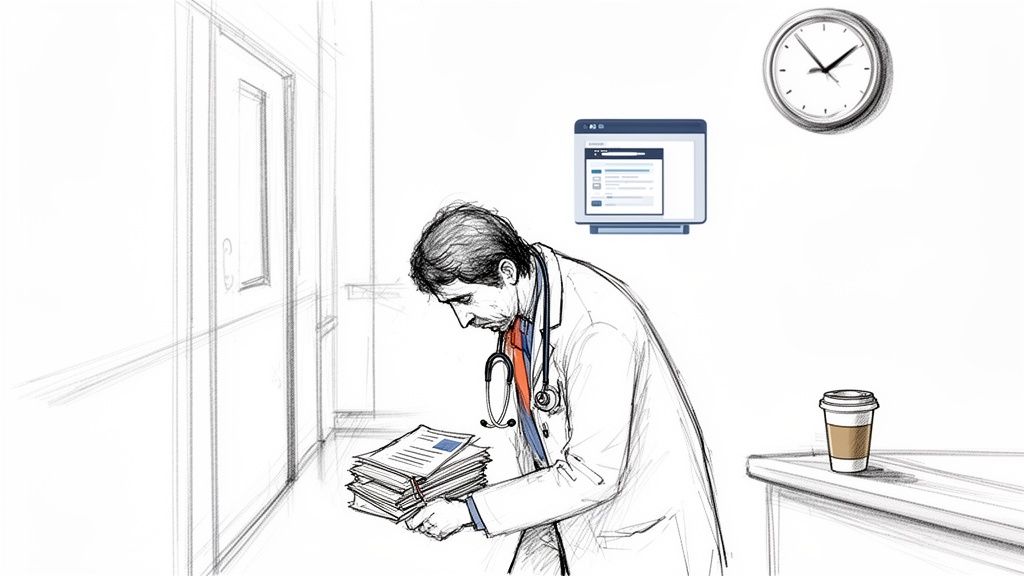
Let's be real. The burnout crisis is far more than a buzzword. For millions of us, it's the daily reality—a slow-burning fire fueled by systemic problems that have been ignored for far too long. The conversation gets stuck on abstract data, but the true cost is measured in the well-being of the people in our hospitals and clinics.
The numbers are grim. Burnout among U.S. healthcare workers jumped from 30.4% in 2018 to nearly 40% by 2022. It’s even worse in primary care, where burnout rates skyrocketed from 46.2% to a staggering 57.6% in the same timeframe.
Put simply, two out of every five U.S. healthcare professionals (40%) now feel their job is completely unsustainable. The top culprits? Understaffing and administrative overload. No surprise there.
Beyond The Numbers: What Burnout Feels Like
Statistics just confirm what we already know from the trenches. This isn't about a lack of personal grit. It's about working in an environment where well-being is nearly impossible.
Does any of this sound familiar?
- Spending more time fighting with a clunky EHR than actually talking to your patients, feeling more like a data-entry clerk than a doctor.
- Picking up another 12-hour shift because the unit is dangerously short-staffed, without a minute to even eat a proper meal.
- Feeling that constant pressure to see more patients in less time, knowing you're sacrificing quality for quantity and feeling the moral injury that comes with it.
This is the ground-level reality of burnout. It’s that feeling of being pulled in a million directions by tasks that have nothing to do with why you went into medicine. And the "just push through it" culture only makes it worse, creating a silent epidemic where asking for help feels like admitting defeat.
The real problem is a deep mismatch between the demands of the job and the resources we're given to meet them. When you feel like you can't provide the care you were trained to give, frustration and cynicism are the natural result.
From Subtle Symptoms To Full-Blown Crisis
Burnout doesn't happen overnight. It starts with subtle warning signs—the "check engine" light of your well-being—that are easy to ignore. Over time, these escalate into major system failures that can derail your career and your health.
Recognizing these early signs in yourself and your colleagues is the first, most critical step.
Early Warning Signs of Clinician Burnout
| Symptom Category | Subtle Early Signs (The 'Check Engine' Light) | Overt Late-Stage Signs (The 'Engine Failure') |
|---|---|---|
| Emotional State | Feeling irritable, anxious, or a bit more cynical than usual. A general sense of dread about going to work. | Pervasive emotional exhaustion. Feeling numb, detached, or unable to experience joy. |
| Work Performance | Procrastinating on charts. Small mistakes. Finding it harder to concentrate on complex cases. | Significant drop in quality of care. Increased medical errors. Apathy toward patient outcomes. |
| Professional Attitude | Starting to resent patient demands or colleagues' requests. Feeling underappreciated. | Overt cynicism and depersonalization. Treating patients and colleagues as objects or tasks. |
| Physical Health | Persistent fatigue, trouble sleeping, frequent headaches, or new GI issues. | Chronic insomnia, significant weight change, hypertension, or developing a substance use issue. |
| Personal Life | Withdrawing from friends and family. Losing interest in hobbies you used to love. | Total social isolation. Relationship conflicts. Feeling disconnected from your own life. |
Seeing your own experience in this table can be a powerful wake-up call. It validates that what you're feeling is real and shared by countless others. It’s the direct result of a work environment that has become unsustainable.
By acknowledging these connections, we can finally shift the narrative. Preventing burnout is not just your problem to solve alone. It’s a collective responsibility that requires change at every level.
Wondering where you fall on the spectrum? Taking a moment to assess your personal burnout level with our Burnout Index can give you a clear, objective starting point. From there, this guide will walk you through actionable solutions for individuals, teams, and entire organizations.
Building Your Personal Burnout Prevention Toolkit
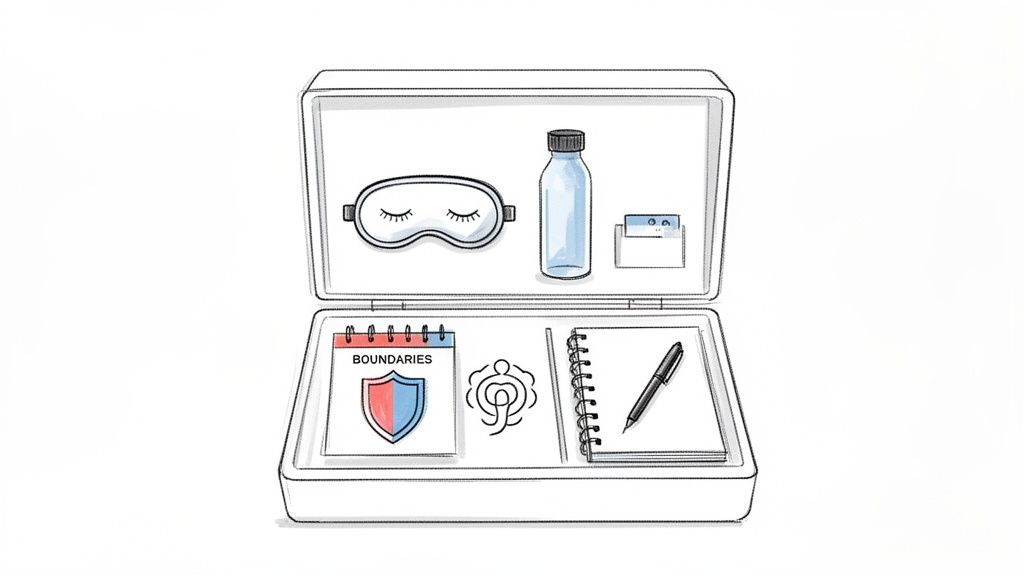
Let's be clear: a broken system is the real root of burnout. But you can’t always wait for your organization to fix things while you’re drowning on the front lines.
Building your own personal toolkit of resilience tactics is about self-preservation. These are the practical, in-the-moment strategies that help you reclaim a sense of control and protect your mental energy.
Think of it as strengthening your personal defenses. These actions won’t fix understaffing or a clunky EHR, but they create a critical buffer against the daily onslaught of clinical stressors. Understanding these personal strategies for well-being to prevent burnout is the first step toward taking some of your power back.
Master Your Mindset with Cognitive Reframing
How you interpret stressful events directly dictates how much they drain you. Cognitive reframing is a powerful clinical skill you can apply to your own mindset, shifting your perspective from a place of stress to one of control.
This isn't about toxic positivity. It’s about realistic reappraisal.
For instance, when a patient interaction goes south, the burnout-fueled thought is, "This is impossible, I'm failing." A reframe sounds more like: "This is a challenging clinical situation, and I have the skills to manage it. What's one concrete step I can take right now?" This small shift moves the narrative from personal failure to professional problem-solving, putting you back in the driver's seat.
Protect Your Time with Firm Boundaries
Boundaries are the most critical tool in your burnout prevention kit. In a healthcare culture that relentlessly asks for more, learning to say "no" isn't selfish—it's a non-negotiable act of self-preservation.
Start by setting hard rules for yourself:
- The Decompression Ritual: Create a distinct routine that signals the end of your workday. This could be changing out of your scrubs the minute you get home, listening to a specific non-medical podcast on your commute, or taking a five-minute walk before you walk through your front door.
- The "No" Script: Have a polite but firm script ready for requests for extra shifts or tasks you simply don't have the capacity for. Something like, "Thank you for the offer, but I'm unable to take that on at this time," is professional and requires no further explanation.
- Digital Disconnection: Turn off all work-related notifications on your personal phone after hours. Your time off needs to be truly off.
Setting boundaries is not about building walls. It's about creating the space to recharge so you can show up to your next shift as the best version of yourself—focused, compassionate, and effective.
Prioritize Non-Negotiable Self-Care
Self-care for clinicians isn't about bubble baths or spa days. It’s about the foundational health practices that are the first to get sacrificed during a tough stretch. Treat them like non-negotiable patient appointments in your schedule.
Sleep is a clinical necessity. Aim for 7-9 hours of quality sleep per night. We all know that chronic sleep deprivation impairs cognitive function, decision-making, and emotional regulation—all essential for providing safe patient care.
Nutrition fuels your performance. It’s all too easy to survive a 12-hour shift on caffeine and vending machine snacks. Instead, try to pack nutrient-dense meals and snacks that provide sustained energy, like protein and complex carbs. Hydration is just as crucial for maintaining focus and staving off fatigue.
Taking a moment to honestly assess how your current habits affect your energy can be a powerful motivator. If you want to see where you stand, our burnout calculator can offer some valuable personal insights.
Fostering a Healthier Team Environment
Let's be clear: individual resilience isn't enough. Preventing burnout can't be a solo mission, and telling clinicians to just be "more resilient" is a recipe for failure. Real, lasting change happens at the team level. A supportive micro-culture is one of the most powerful buffers against the systemic pressures that drive exhaustion.
And no, I'm not talking about another team-building pizza party. This is about fundamentally redesigning how a team actually works, communicates, and backs each other up. When a department takes ownership of its environment, it can create a pocket of sanity that protects clinicians from the daily grind.
Rethink Your Team’s Schedule and Workflow
Look, constant fatigue isn't a mystery. It’s a direct result of broken schedules and workflows that were never designed for the current reality of healthcare. The good news is that smart teams are ditching the old models and finding creative ways to build rest and focus directly into the workday.
Here are a few flexible scheduling models that actually combat exhaustion:
- Staggered Start Times: Why does the entire team need to arrive at 7 a.m. for a chaotic morning pile-up? Staggering start times by 30-60 minutes can smooth out patient flow, crush those morning bottlenecks, and give your team a calmer start to their day.
- Protected Admin Blocks: This is non-negotiable. Block off specific, uninterrupted time for charting and admin tasks. When everyone on the team knows that 1 p.m. to 2 p.m. is a "no-fly zone" for interruptions, clinicians can finally get on top of their EHR work without it spilling into their evenings.
Redesigning the workflow is just as critical. The administrative burden is a notorious burnout driver. Some studies show physicians spend nearly two hours on EHR tasks for every one hour of direct patient care. That's an unsustainable ratio.
A team that proactively offloads administrative tasks from its clinicians is a team that is actively preventing burnout. It's about using every team member to the top of their license and abilities.
Think about it in a primary care clinic. Medical Assistants (MAs) can be trained to handle pre-visit planning, room patients, and queue up orders. This frees the physician or NP to focus entirely on the diagnosis and treatment plan during the encounter itself. It dramatically cuts down on cognitive load. Another game-changer? Medical scribes—whether in-person or virtual—can almost completely wipe out the burden of real-time documentation.
Create a Culture of Psychological Safety
A healthy team is a team where it’s safe to be human. The technical term is psychological safety, which is just a fancy way of saying it's a shared belief that you won't get punished or humiliated for speaking up with ideas, questions, concerns, or mistakes. In medicine, it also means it’s safe to admit you're struggling.
When someone can actually say, "I'm totally overwhelmed today," or "I could use a second set of eyes on this case," it changes everything. The culture shifts from one of silent suffering to one of collective support. This is a powerful antidote to the isolation that so often goes hand-in-hand with burnout.
A Quick Audit for Team Leaders
As a team lead, you can start taking the pulse of your own environment today. Sit down with your team and ask these tough but necessary questions to find opportunities for quick wins:
- Workload: Is the work distributed fairly, or do the same few people consistently get slammed?
- Meetings: Are our meetings actually useful, or are they just another source of fatigue and wasted time?
- Communication: Do people feel comfortable saying they're at capacity? Is there an actual, clear process for asking for help?
- Mistakes: When a mistake happens, is the first reaction to find someone to blame, or is it to figure out how to fix the system?
- Time Off: Can people genuinely disconnect when they're on PTO, or is there an unspoken expectation to check emails and answer messages?
Just tackling one of these areas can create a huge ripple effect. For example, creating a simple hand-off system so everyone gets a real, uninterrupted lunch break can reduce afternoon fatigue and improve patient safety. Building this kind of supportive environment is one of the most direct and powerful ways to fight burnout right where it starts—on the front lines.
Driving Organizational Change for Clinician Well-Being
While individual resilience tactics and team-level tweaks are helpful, they’re ultimately just treating the symptoms. The only way to truly solve the burnout crisis is with systemic change, driven from the very top of the organization. Leaders and administrators hold the power to either perpetuate the problem or dismantle the structures that cause it.
This isn’t just about morale. It’s a strategic business imperative with staggering financial consequences. U.S. workplace stress is projected to contribute to $190 billion in yearly healthcare costs, while burnout-related productivity losses hit $322 billion globally.
With a potential 55% of American healthcare workers thinking about leaving their jobs because of burnout, we're facing a self-perpetuating cycle of understaffing and exhaustion that threatens the entire system.
It’s time to shift from reactive "wellness" programs to proactive, structural prevention. That’s the only path forward.
Commit to High-Impact Policy Changes
Surface-level fixes won't move the needle. Real change requires bold, structural commitments that address the root causes of clinician distress head-on. This is where leadership must be decisive and invest in their most valuable asset: their people.
Here are the key policy areas to focus on immediately:
- Enforce Safe Staffing Ratios: Understaffing is arguably the number one driver of burnout. Committing to and enforcing safe staffing ratios isn't just a budget line item; it's a direct investment in patient safety and clinician well-being.
- Demand Better EHR Usability: Clinicians are drowning in administrative work, and clunky Electronic Health Records are a huge part of the problem. Organizations must use their leverage to demand more intuitive, efficient EHRs that cut down on the "pajama time" spent charting after hours.
- Provide Truly Confidential Mental Health Support: Far too many clinicians fear professional backlash for seeking mental health care. Organizations must champion support programs that are truly confidential, easy to access, and completely free from stigma.
Effective change can also come from streamlining operations. For example, addressing revenue cycle management challenges can significantly reduce the administrative headaches that get pushed down to clinical staff.
The goal is to move from a mindset that treats clinicians as a resource to be consumed to one that sees them as a vital asset to be protected. This shift is fundamental to building a resilient healthcare system.
This infographic breaks down how organizational interventions in scheduling, workflows, and psychological safety create a powerful defense against burnout.
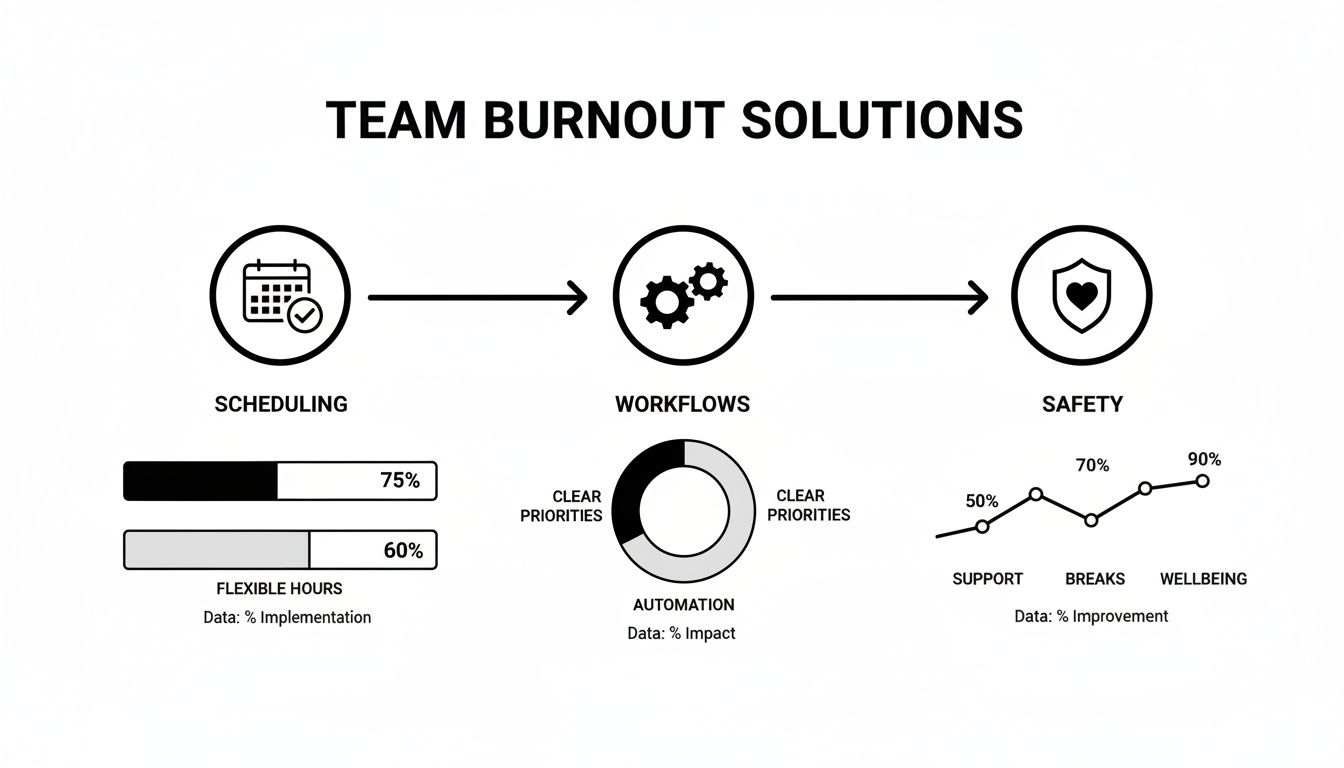
When you look at these three areas together, it’s clear how interconnected improvements can fortify your entire organization against clinician exhaustion.
Measure What Matters: Tracking Burnout and Well-Being
You can't fix what you don't measure. To make real progress, healthcare organizations have to stop relying on anecdotes and start tracking well-being as a core business metric. This means implementing specific Key Performance Indicators (KPIs) and using validated tools to get an honest look at the problem.
The Maslach Burnout Inventory (MBI) is the gold standard, but simpler, frequent pulse surveys can also be incredibly effective. The key is consistency. Tracking these metrics over time shows you which interventions are actually working and where you need to focus your efforts.
Here's what a sample dashboard might look like for a leadership team serious about tackling burnout.
Organizational Burnout Prevention KPI Dashboard
| Metric | How to Measure | Target Goal (Example) |
|---|---|---|
| Voluntary Turnover | (Clinicians Who Left / Avg. # of Clinicians) x 100 | Decrease by 15% year-over-year |
| Burnout Index Score | Administer a validated survey (e.g., Mini Z) quarterly | Achieve a 10% improvement in scores within 12 months |
| EHR "Pajama Time" | Track time spent in EHR outside of scheduled work hours | Reduce after-hours charting by 30 minutes/clinician/week |
| PTO Utilization Rate | (PTO Days Taken / PTO Days Accrued) x 100 | Ensure at least 85% of accrued PTO is used annually |
| Support Access | Track anonymous use of EAP or mental health services | Increase utilization by 20% via destigmatization |
By tying wellness initiatives to concrete data, leaders can make a powerful business case for continued investment. It reframes clinician well-being from a "soft" perk into a hard-nosed strategy for improving patient outcomes, slashing turnover costs, and ensuring the long-term stability of the organization.
How to Find a Burnout-Resistant Healthcare Job
Sometimes, the most effective burnout prevention strategy isn't another resilience workshop—it's a change of scenery. If your work environment is fundamentally broken, no amount of individual effort can fix a systemic problem.
Fortunately, the job market is finally waking up. Roles designed for physician well-being and a sustainable career are no longer a myth. Finding a burnout-resistant job is about strategically redesigning your career around the life you actually want to live, not just escaping your current role.
This isn't about leaving medicine. It’s about finding a better way to practice it. Let’s walk through how to find roles that genuinely prioritize your well-being, whether you’re an MD, DO, NP, PA, or psychologist looking for remote, hybrid, or part-time work.
Define Your Non-Negotiables
Before you even glance at a job board, you need to get brutally honest about what you need. A vague desire for “better balance” is too fuzzy to be useful. It’s time to create a concrete blueprint for your ideal job.
Ask yourself:
- What are my absolute deal-breakers? Is taking call completely off the table? Are weekends non-negotiable? What tasks drain you the most? Be specific and unapologetic.
- What does my ideal schedule look like? Do you need a predictable 9-to-5, or would a flexible, part-time schedule be a better fit for your life?
- What work environment helps me thrive? Do you want the full autonomy of a remote role, the camaraderie of an in-person clinic, or a hybrid mix?
Think of this as your personal job filter. These aren’t just preferences; they are essential requirements for your long-term career health.
Use Modern Tools to Filter for Balance
Forget the old way of scrolling through endless, generic job listings. That’s a fast track to more frustration. Today’s best job platforms are built to help clinicians find sustainable roles, but you have to know how to use their filters to your advantage.
On platforms like WeekdayDoc, which are designed to screen for burnout-friendly jobs, be aggressive with your search criteria. Don't just search for your specialty. Immediately apply filters for “No Call” and “No Weekends.” This one move instantly eliminates the majority of roles built on the old, burnout-inducing model.
Look past the filters and dig into the job descriptions themselves for clues.
A job posting that explicitly mentions "protected admin time" or "flexible scheduling" is waving a green flag. It tells you the organization actually understands the root causes of burnout and is trying to build a better system.
If a job description is vague about the schedule or on-call duties, treat it as a yellow flag. An organization that values its clinicians is transparent about these critical details.
Look Beyond the Job Description
A promising job description is a good start, but it's not the whole story. You need to verify that the culture matches the marketing copy. The interview is your chance to turn the tables and interview them.
Come prepared with pointed questions that get to the heart of their culture:
- “Can you describe the policy on protected administrative time for your clinicians?”
- “What is the average daily patient panel for a clinician in this role?”
- “How does the team cover for a colleague who needs to take unplanned time off?”
Their answers—and just as importantly, how they react to being asked—will reveal whether they truly support clinician well-being or just pay it lip service. A team that welcomes these questions is a team that likely has a culture of psychological safety.
Explore the Growing World of Non-Traditional Roles
Feeling stuck in the traditional clinical grind? It’s time to look beyond the hospital walls. The demand for clinical expertise is exploding in non-traditional settings, opening up a world of burnout-resistant career paths.
Consider some of these alternatives:
- Telehealth: Offers unmatched flexibility, zero commute, and highly predictable hours. Platforms are actively hiring across primary care, mental health, and dozens of specialties.
- Urgent Care: While often fast-paced, many urgent care centers run on fixed shifts with no call duties, creating a hard stop between your work and home life.
- Specialized Niches: Roles in utilization management, clinical documentation improvement (CDI), or medical writing let you leverage your hard-earned clinical knowledge in a lower-stress, non-patient-facing setting.
These jobs offer a real opportunity to keep using your skills without sacrificing your personal life. For anyone looking to explore these options, our guide on finding flexible remote healthcare jobs provides a much deeper dive into the opportunities available right now.
Finding a job that protects you from burnout is an active process. It takes self-reflection, a smart search strategy, and the courage to demand a work environment that respects your time and your health.
Frequently Asked Questions About Preventing Burnout
When you're deep in the trenches of clinical work, the idea of "preventing burnout" can feel like just another impossible task on your to-do list. These are the real, practical questions I hear from colleagues who are trying to find a way forward.
How Can I Tell If It’s Burnout or Just Stress?
It’s a critical distinction. Stress feels like you're drowning in responsibility, but you still believe you can get your head above water. There's a sense of urgency, of over-engagement.
Burnout is the opposite. It’s marked by disengagement and a deep sense of emotional exhaustion. The urgency is gone, replaced by a feeling of helplessness or being emotionally spent. You don't feel like you're drowning anymore—you just feel empty.
The real red flag for burnout is cynicism. It’s that moment you start seeing patients as diagnoses or tasks, not people. This depersonalization is what separates the chronic stress we all face from true, career-ending burnout.
I’m Too Exhausted to Add More to My Plate. Where Do I Start?
This is probably the most common—and valid—concern I hear. When you’re already running on fumes, adding a new "wellness" habit is the last thing you need. So don't. The best place to start is with an act of subtraction.
The single most powerful first step is often boundary setting. Before you try to meditate or exercise more, focus on protecting your time and energy.
- Say "no" to one non-essential thing this week. It could be an extra shift, a committee you don't care about, or a task you know a colleague can handle.
- Set a hard stop time for your day. When your shift ends, you're done. No more "just one more chart" from home. This is non-negotiable.
- Kill your work notifications. Turn off work-related alerts on your personal phone. A simple digital firewall is one of the most effective ways to reclaim your private life.
Start with one small, protective boundary. It will create the space you need to even consider anything else.
Will My Organization Actually Listen If I Voice Concerns?
It's a legitimate fear. The key is to frame your concerns not as personal complaints, but as operational problems with tangible solutions. Leadership responds to data and efficiency.
Instead of saying, "The EHR is destroying my well-being," try a data-driven approach: "I've noticed our current prescription refill workflow takes an average of eight clicks and five minutes per patient. If we could get that down, we could each save nearly an hour a day and reduce the risk of medication errors."
This approach reframes you as a problem-solver invested in patient safety and system efficiency, not just an employee who is struggling. You’re offering a solution, not just a complaint, which makes it far more likely you’ll be heard.
Finding a role that respects your well-being shouldn't be a struggle. At WeekdayDoc, we curate burnout-friendly jobs that fit your life—with no call and no weekends. Explore our listings with proprietary Burnout-Friendly Scores and start building a sustainable career today at https://www.weekdaydoc.com.