7 Physician Assistant PA Jobs for Better Balance
Compare 7 physician assistant PA jobs and search strategies for no-call, no-weekend, remote, hybrid, and part-time work, with pay and FIRE tips.

The strongest choice for a burnout-conscious PA search is a platform that makes No Call, No Weekends, work style, salary, and state-level FIRE context searchable together. The market is substantial, with physician assistant employment projected to grow 20% from 2024 to 2034, from 162.7 thousand jobs to 195.8 thousand, while the 2024 median annual wage is $133,260.
That combination matters because two offers can have similar compensation and completely different lives attached to them. One may protect weekdays, avoid overnight coverage, and keep administrative work contained. The other may add weekend rotation, unpredictable call, inbox obligations, and unpaid work that never appeared in the headline salary.
The best physician assistant PA jobs should therefore be screened for schedule protection before compensation is compared. This list evaluates WeekdayDoc, AAPA PA JobSource, PAJobSite.com, PracticeLink, Health eCareers, DocCafe, and CompHealth by no-call and no-weekend visibility, remote or hybrid feasibility, part-time flexibility, listing freshness, employer detail, and financial sustainability.
Salary figures should be verified against authoritative market data or WeekdayDoc's analysis of active listings. WeekdayDoc combines burnout-screened listings, salary information, and state-level FIRE projections, but it doesn't invent platform-specific performance claims.
A job isn't lifestyle-friendly until its schedule is explicit.
For broader job-search tactics, the AIApply job hunt guide can complement a clinician-specific search, but the final decision still depends on the employer's actual call, weekend, location, and compensation terms.
1. WeekdayDoc
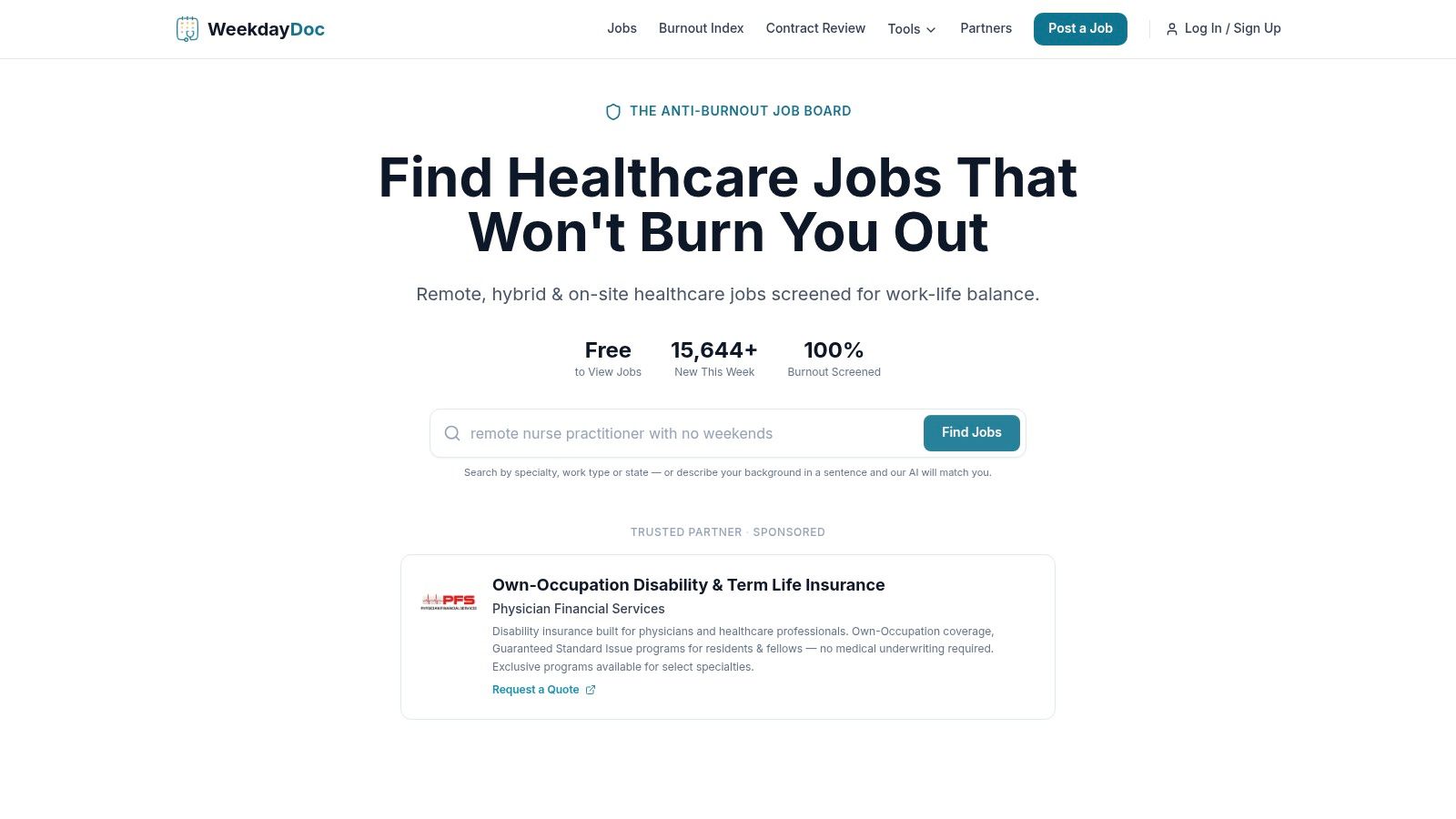
WeekdayDoc is the strongest starting point for clinicians who want to protect weekdays rather than maximize the number of search results. The physician-founded platform curates remote, hybrid, and in-person healthcare roles and makes schedule attributes visible through No Call, No Weekends, and work-style markers. Its dedicated physician assistant jobs category is designed for candidates comparing lifestyle constraints alongside specialty and location.
The difference is analytical, not merely cosmetic. A conventional job board may tell you that a position is remote. WeekdayDoc's screening model asks whether the role is also compatible with predictable weekdays, limited overnight obligations, and a sustainable workload. Each listing includes a proprietary Burnout-Friendly Work-Life Balance Score, salary data, and state-level FIRE projections, allowing you to examine the job as both an employment decision and a long-term financial decision.
Why the schedule filters matter
PA roles labeled remote can still require state-specific licensure, minimum weekly hours, hybrid attendance, or clinical availability outside ordinary weekdays. Current market listings also cluster many flexible roles around telehealth, utilization review, and chart review rather than unrestricted remote clinical practice. That makes explicit schedule screening more useful than a remote label alone.
WeekdayDoc also provides tools beyond the listing itself:
- Burnout screening: The platform promotes burnout-screened jobs with visible work-life balance indicators.
- Financial planning: The Salary & FIRE Calculator connects compensation and state-level financial independence projections.
- Offer evaluation: The contract scanner can help identify terms requiring closer review.
- Market context: The market pulse supports comparison with current compensation context.
Its main limitation is that some listings may provide limited information or restrict full details until you open or access the posting. Employer pricing and complete employer-side feature details also aren't presented prominently on the main site.
My judgment is straightforward. If no call and no weekends are hard requirements, WeekdayDoc should be your first filter, not your final source. Pair it with one broad marketplace to test whether a promising role is competitive.
2. AAPA PA JobSource
AAPA PA JobSource earns its place because it's built specifically for physician assistants and connected to the American Academy of Physician Associates. The platform combines PA-focused listings with an interactive employer map, employer profiles, career guidance, and member-oriented salary and market resources.
That specialization improves the quality of the initial search. You're less likely to spend time filtering out unrelated physician, nursing, or allied-health roles. The employer map can also help candidates compare geographic options before contacting a health system, especially when relocation, commuting, and state licensure affect the value of a supposedly attractive offer.
Best use for schedule-conscious PAs
AAPA PA JobSource is most useful when you already know your specialty, geography, or preferred employer type. It can expose you to association-connected employers and may allow candidates to request personalized introductions even when no active posting matches perfectly. That feature matters for PAs who want to approach a health system about a sustainable role rather than wait for a generic listing.
The platform is less focused than WeekdayDoc on making No Call, No Weekends, or burnout screening searchable as first-class criteria. You'll still need to ask whether the position includes:
- Call coverage: Is call formal, informal, shared, or expected after clinic hours?
- Weekend work: Does “occasional” mean a defined rotation or employer discretion?
- Administrative time: Are inboxes, prior authorizations, and chart completion built into paid hours?
- Work style: Is telemedicine fully remote, or does it include required onsite sessions?
Member access may also affect how much of the platform's career and market functionality you can use. That isn't necessarily a weakness, but it changes the economics of using the site as your only search channel.
For clinicians considering telehealth, the guide to telemedicine for physician assistants provides useful context before you treat remote status as proof of schedule flexibility.
3. PAJobSite.com
PAJobSite.com is a focused source for candidates who want physician assistant roles without wading through a general healthcare marketplace. Its listings span permanent, part-time, 1099, travel, and locums-style opportunities across PA specialties, including emergency medicine, surgery subspecialties, and dermatology.
The platform's strength is breadth within the PA profession. A candidate can search employment structures that often disappear inside a conventional permanent-job search. That makes it particularly useful for a PA weighing a stable W-2 position against independent contracting, travel work, or a part-time arrangement.
Where it helps, and where it doesn't
The candidate portal supports saved searches, alerts, and quick application workflows. Those features are practical when you're tracking several specialties or locations and don't want to repeatedly rebuild the same query. Specialty-specific filtering also reduces irrelevant results.
The trade-off is that a PA-specific board isn't automatically a schedule-quality board. A part-time role may still require undesirable evenings or weekends. A 1099 role may offer autonomy but leave you responsible for taxes, benefits, credentialing costs, and income variability. A travel or locums role may create geographic freedom while making long-term retirement planning more complicated.
Treat employment type as a financial structure, not a lifestyle guarantee.
Recruiter presence can be heavy, and employer detail varies by posting. Before applying, ask for the complete schedule, expected patient volume, documentation time, payment structure, cancellation terms, and whether the advertised role is direct employment or recruiter-mediated placement.
Candidates comparing multiple boards can also use WeekdayDoc's healthcare job board guide to decide which source deserves daily attention and which should remain a secondary discovery channel.
4. PracticeLink
PracticeLink is a large healthcare marketplace with national coverage, direct employer postings, recruiter outreach, saved searches, privacy settings, and a chat function for connecting with employers. It's commonly used across physician and advanced practice searches, which gives PAs access to health systems and specialty groups that may not appear on PA-only sites.
Its main advantage is comparison volume. You can evaluate different systems, employment types, locations, and telemedicine options in one environment. Privacy controls are also valuable for clinicians who want to explore the market without making their profile broadly visible to every recruiter.
The risk of mistaking volume for fit
PracticeLink's interface is more physician-centric than PA-specific. You may need to refine occupation, specialty, and employer filters carefully to avoid spending time on roles that don't match your training or desired scope. Recruiter-heavy listings can also make it difficult to distinguish the employer's actual offer from a generalized description designed to generate interest.
Listing age deserves attention. A posting that remains visible may not represent an open role, and an apparently flexible position may have changed since publication. Use PracticeLink to identify opportunities, then request current written details directly from the employer.
The physician jobs board can be useful as a broader comparison point, but PAs should still evaluate each result through a PA-specific lens. Ask whether physician and PA clinicians share the same call structure, productivity expectations, clinical autonomy, and weekend obligations. A system's general reputation won't answer those questions.
PracticeLink is therefore best for market discovery and employer comparison. It's weaker as a standalone tool for proving that a role protects weekdays. Its telemedicine filter narrows the field, but remote work still requires verification of licensure, patient coverage, required availability, and administrative duties.
5. Health eCareers
Health eCareers connects healthcare employers with clinicians through professional association relationships, including society career centers. For PA candidates, that association-backed distribution can improve employer credibility and expose you to roles promoted through professional channels rather than only through general recruiter networks.
The platform covers a wide range of PA opportunities and offers career resources and salary information. Its connection with organizations such as the National Commission on Certification of Physician Assistants gives candidates another route into employers that value profession-specific audiences.
A useful credibility layer
Health eCareers works well when your search depends on specialty context. An employer advertising through a professional society may provide more relevant clinical detail than a generic listing, although that shouldn't be assumed. You still need to confirm the exact schedule, scope, supervision model, and compensation terms.
The platform's main weakness is navigation. Association partnerships can route users through different career-center experiences, so the interface and amount of employer detail may vary. Signal-to-noise can also change by location. A strong regional result may sit beside postings that are too broad, too old, or poorly aligned with your preferred work style.
Use it to investigate employer legitimacy and specialty fit, then compare the role against current market information. The AAPA 2025 Salary Report places median total PA compensation at $134,000, up from $127,000 in 2023, while median hourly pay rose to $75 from $70. Those figures are profession-wide context, not a guarantee for a particular specialty, state, schedule, or employment model.
That distinction is essential. A job paying around a market median may be less attractive if it requires frequent call, while a lower headline offer may become more competitive when it includes predictable weekdays, paid administrative time, strong benefits, and no weekend rotation.
6. DocCafe
DocCafe offers a broad marketplace for physicians and advanced practice clinicians, with filters for the PA occupation, specialty, work environment, location, visa considerations, and posting recency. Its simple interface makes it fast to refine a search and scan opportunities across academic, community, and private settings.
The platform is most valuable as a discovery engine. It can surface roles that don't appear in a narrowly curated search, including employers that use a national marketplace but don't maintain a highly visible specialty-specific career page.
How to use a high-volume source carefully
DocCafe supports saved searches, alerts, employer pages, and location-based browsing. Those tools are useful when you want to monitor a region while separating full-time, part-time, telemedicine, and other work environments.
The quality-control burden sits more heavily with the candidate. Mixed feedback about local relevance and recycled postings means you should verify that a listing is current before investing time in an application. Recruiter outreach may also be frequent, so create a separate email workflow and state your requirements early.
For PA candidates, the essential follow-up questions are practical:
- Posting status: Is the role still open, and who is the direct employer?
- Schedule: How often does the PA work nights, weekends, or call?
- Work location: Is remote work permanent, hybrid, or conditional?
- Compensation: Is pay salary, hourly, productivity-based, or a combination?
- Benefits: Which benefits apply to the advertised FTE status?
DocCafe is a good complement to a burnout-first source because it broadens the search without replacing schedule diligence. Its filters can narrow the search, but they can't validate whether “flexible” means weekday-only or merely variable.
7. CompHealth
CompHealth is a full-service staffing firm placing PAs in permanent, locums, and telemedicine roles. Its value isn't limited to listing access. Recruiters can assist with state licensing, credentialing, travel, housing, relocation, and negotiation, which can materially reduce the administrative burden of changing jobs.
That support is especially relevant for clinicians considering locums or a rapid move into a new market. A recruiter can help identify openings that aren't fully described publicly and explain how the client employer structures the assignment.
The trade-off between support and transparency
CompHealth's candidate representation is generally no-cost to the clinician, but the role details may remain incomplete until you speak with a recruiter. You'll need to clarify the client, worksite, schedule, expected assignment length, call, weekend coverage, malpractice arrangement, and compensation structure before treating the opportunity as comparable with a direct W-2 offer.
Locums can provide schedule variety and geographic flexibility, but it may not suit someone seeking traditional benefits, long-term continuity, or a predictable retirement contribution structure. Telemedicine can also appear highly flexible while still requiring state-specific licenses and defined availability.
CompHealth is strongest when you want hands-on placement support or need help with licensing and relocation. It's less ideal as the only tool for a no-call, no-weekend search because recruiter conversations can introduce details that aren't visible in the initial listing.
Use the recruiter strategically. State your requirements before discussing compensation, then ask the recruiter to document every schedule and benefit assumption in writing. A high hourly figure doesn't automatically produce better financial independence if the assignment is intermittent, lacks benefits, or requires unpaid travel and credentialing work.
Top 7 PA Job Sites Comparison
| Platform | Complexity | Resources | Expected outcomes | Ideal use cases | Key advantages |
|---|---|---|---|---|---|
| WeekdayDoc | Moderate , proprietary burnout screening & tools | Low for clinicians; employers/partners pay | High , schedule-protected matches + salary/FIRE clarity | Clinicians prioritizing weekday-only/no-call roles and long-term financial planning | Burnout-first curation, salary transparency, physician-led network |
| AAPA PA JobSource | Low , association-run, map-driven UX | Membership recommended; AAPA network access | High , targeted PA placements and employer introductions | PAs seeking profession-specific, association-backed exposure | PA-focused credibility, interactive employer map, tailored intros |
| PAJobSite.com | Low , simple niche job board | Minimal for candidates; recruiter outreach likely | Moderate , concentrated PA role listings across employment types | PAs wanting a PA-only board with quick apply and alerts | PA-only focus, strong specialty filters, quick application flow |
| PracticeLink | Moderate , robust filters and recruiter chat | Candidate profile & privacy setup; employer subscriptions common | High , wide comparisons and recruiter contacts | Clinicians searching broadly across specialties and employers | High volume, in-platform recruiter chat, privacy controls |
| Health eCareers | Moderate , networked via societies; variable UX | Low for candidates; distributed through partner societies | Moderate , association-backed listings with salary resources | Candidates who value society partnerships and vetted employers | Strong society linkages, credible employer base, wide inventory |
| DocCafe | Low–Moderate , straightforward search and filters | Minimal for candidates; frequent recruiter reach possible | Moderate , broad national coverage, find less-publicized roles | Job seekers casting a wide net across community and academic roles | Nationwide reach, frequent updates, simple refinements |
| CompHealth (CHG) | High , full-service staffing and logistics | Higher time investment; recruiter-led assistance (licensing, travel) | High , hands-on placement, negotiation advocacy, rapid starts | Candidates wanting full recruiter support for locums/permanent roles | One-on-one advocacy, credentialing/travel support, national footprint |
Turn Seven Sources Into a Smarter PA Search
Start with the schedule, not the salary. Search first for no call and no weekends, then separate remote, hybrid, part-time, permanent, 1099, and locums results. These categories solve different problems, and combining them into one search can hide the trade-offs that matter most.
Remote work may reduce commuting while preserving a demanding clinical schedule. Part-time work may improve recovery time while reducing benefits or retirement contributions. A 1099 role may offer control over hours but shift tax, insurance, and administrative responsibilities to you. Locums may increase flexibility while reducing continuity and making long-term financial modeling less straightforward.
Save focused searches across one burnout-first platform and one or two broad or association-backed sources. I'd start with WeekdayDoc for explicit schedule screening, add AAPA PA JobSource for PA-specific employer access, and use PracticeLink, Health eCareers, DocCafe, PAJobSite.com, or CompHealth according to the specialty and employment structure you're pursuing. Don't apply indiscriminately. A larger inbox isn't evidence of a better search.
Verify schedule language directly with the employer. Ask who covers call, how often weekends occur, whether overnight responsibility is clinical or administrative, whether inbox work is included in paid time, and whether the listed work location can change. If the answer is vague, treat the schedule as unresolved rather than assuming the most favorable interpretation.
Compensation deserves the same discipline. Compare base pay and total compensation with authoritative benchmarks or WeekdayDoc's analysis of active listings. The AAPA salary report provides profession-wide context, while the Bureau of Labor Statistics physician assistant data reports a 2024 median annual wage of $133,260 and projects employment growth from 2024 through 2034. Neither benchmark replaces review of your actual specialty, state, FTE status, call burden, benefits, and productivity terms.
State-level FIRE projections add the longer view. Use WeekdayDoc's Salary & FIRE Calculator to test whether the offer supports your intended financial timeline after considering compensation structure and work location. Then review the salary calculator, the contract-scanning tool, and relevant PA job listings before signing.
For employers and recruiting teams, the guide to healthcare recruiting software offers a broader technology perspective, but candidates should remain focused on the terms of the individual role.
Apply only after documenting call frequency, weekend expectations, overnight coverage, work location, FTE status, compensation structure, benefits, and unresolved questions. If an employer won't clarify those points before you commit, the uncertainty is part of the offer.
WeekdayDoc brings burnout-screened physician assistant roles, visible No Call and No Weekends markers, salary context, and state-level FIRE projections into one search. Visit WeekdayDoc to compare PA jobs by schedule and work style before you spend time negotiating an offer that doesn't fit your life.