Discover Top Opportunities: jobs remote healthcare for flexible careers
Explore jobs remote healthcare and find roles that fit your lifestyle with tips to evaluate, apply, and secure the right position.

The hunt for remote healthcare jobs isn't just a trend; it's a full-blown movement. Clinicians everywhere are looking for sustainable careers that don’t force them to choose between their well-being and their profession.
This massive shift is forging a new standard: roles designed from the ground up to prevent burnout. It’s driven by two powerful forces—practitioners demanding better, and telehealth technology finally catching up.
This guide isn't about just finding any remote job. It's about being strategic and finding a position that actually makes your life better.
The Shift to Sustainable Remote Healthcare Careers
For decades, the traditional healthcare career felt like a raw deal. You got professional fulfillment, but you traded your personal life for it. Brutal schedules, crushing admin work, and being chained to your pager were just part of the job description.
But something big is happening. A powerful current is reshaping what clinicians can—and should—expect from their work. The rise of remote healthcare isn't just about convenience. It’s a fundamental redesign of how we can deliver great patient care without breaking the people who provide it.
This whole movement is a direct response to the burnout epidemic that has pushed too many talented people to their absolute limit. Clinicians are finally saying "enough." We're no longer accepting exhaustion as a prerequisite for a career in medicine. Instead, we're actively seeking roles that honor our expertise while giving us room to build a life outside the clinic walls.
Reclaiming Your Time and Well-Being
The real magic of remote healthcare is its potential to restore balance. When you eliminate the daily commute, gain more control over your schedule, and shed the burden of overnight call, you get a real shot at a healthier life.
This isn't about working less. It's about working smarter in an environment that values your focus and your sanity.
Think about these benefits, which are quickly becoming the new normal:
- Protected Administrative Time: More and more roles are building in dedicated hours for charting and follow-ups. This is the antidote to the dreaded "pajama time EMR" that steals your evenings.
- Flexible Scheduling Models: Four-day workweeks and asynchronous tasks (like chart reviews) are no longer a fantasy. They let you fit your work around your life, not the other way around.
- Geographic Freedom: As long as you're licensed appropriately, working remotely opens up a world of possibilities. You could live somewhere with a lower cost of living or finally move closer to family.
The goal here is to stop playing defense in a reactive career, constantly putting out fires. It's time to build a proactive one, where your job actively supports your long-term financial and personal goals. This is about finding work that energizes you instead of drains you.
This guide will give you the tools and the mindset to navigate this new world. We'll walk through how to find, vet, and land an opportunity that truly delivers on the promise of a sustainable career.
To get a baseline, you can start by assessing your own situation with our guide on the clinician burnout index. Let's start the journey toward a more fulfilling professional life.
Exploring Your Options in Remote Clinical Roles
Before you can find the right remote healthcare job, you have to know what's actually out there. The landscape of jobs remote healthcare has exploded beyond simple video calls, offering a whole spectrum of work styles for different personalities and clinical strengths. For a lot of clinicians, the biggest choice is how much—or how little—direct patient interaction they want.
This decision point is a huge fork in the road, especially if you're feeling the strain from a traditional clinical role. The flowchart below maps out a common thought process: are you content, or is burnout pushing you to find something more sustainable?
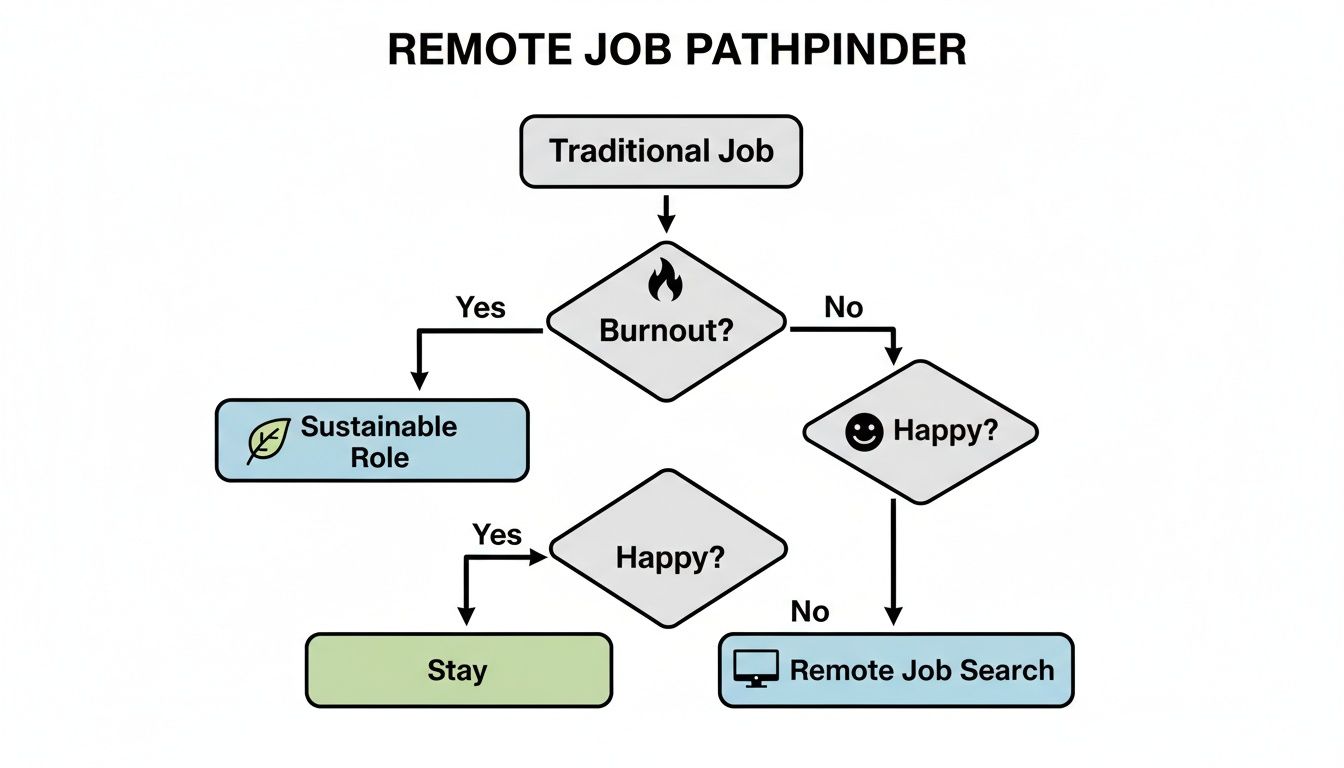
As you can see, recognizing burnout is often the first real step toward making a change. It forces you to get intentional about your job search.
With that in mind, let's break down the most common remote clinical roles available to MDs, DOs, NPs, and PAs.
Comparing Common Remote Healthcare Roles
To give you a clearer picture, I've put together a quick comparison of the most popular remote roles. This table highlights what you'd be doing day-to-day and which specialties tend to fit best.
| Remote Role | Primary Responsibilities | Common Specialties | Work Style (Live Video, Chart Review, etc.) |
|---|---|---|---|
| Virtual Primary Care | Manages a patient panel for check-ups, chronic conditions, and non-emergent acute issues. | Family Medicine, Internal Medicine, Pediatrics | Synchronous (Live Video/Phone) |
| Telepsychiatry | Conducts therapy sessions and medication management. | Psychiatry, Psychology, Mental Health Counseling | Synchronous (Live Video/Phone) |
| Remote Specialty Consult | Provides expert opinions to other providers or directly to patients in underserved areas. | Dermatology, Neurology, Cardiology, Radiology, Endocrinology | Both Synchronous and Asynchronous |
| Chart Review | Reviews patient charts for insurance companies, legal firms, or medical groups to ensure accuracy/compliance. | Most specialties, particularly Internal & Family Medicine | Asynchronous (Independent Chart Review) |
| Utilization Management | Reviews treatment requests to determine medical necessity based on health plan and clinical guidelines. | Most specialties; strong general medical knowledge is key. | Asynchronous (Independent Case Review) |
Each of these paths offers a different way to leverage your clinical expertise from home. The right choice really comes down to your personal work style and career goals.
Synchronous Roles: Real-Time Patient Care
Synchronous roles are all about real-time, live interactions. Think of it as a virtual version of an in-person visit. These jobs are perfect for clinicians who genuinely enjoy direct patient connection and dialogue.
- Virtual Primary Care: You'll manage a patient panel, handling everything from routine physicals and chronic disease follow-ups to urgent (but not emergent) concerns. It’s a role that really sharpens your diagnostic skills, since you have to work without a hands-on physical exam.
- Telepsychiatry: This involves conducting therapy sessions and managing medications entirely over video. The field has seen incredible growth because the virtual format often reduces stigma and makes care accessible for patients who might otherwise go without.
- Remote Specialty Consults: Specialists in fields like dermatology, neurology, or cardiology are in high demand. You might provide an expert opinion to a primary care provider in a rural area or consult directly with patients.
Much of this is made possible by huge leaps in technology. If you want a primer on how it all works behind the scenes, you can read up on the fundamentals of telemedicine to get a handle on the core concepts.
Asynchronous Roles: Deep-Focus, Non-Facing Work
If the thought of back-to-back video calls makes you tired, asynchronous roles are a fantastic alternative. These jobs involve focused, independent work without the pressure of live interactions and often come with incredible schedule flexibility.
Asynchronous work is a game-changer for reclaiming your personal time. It lets you complete tasks on your own schedule, effectively breaking the chains of the traditional 9-to-5 and eliminating meeting fatigue.
Here are a couple of the most common asynchronous jobs:
- Chart Review: This is exactly what it sounds like. You’ll review patient charts for insurance companies, medical groups, or legal firms to check for things like accuracy, compliance, or medical necessity.
- Utilization Management (UM): In a UM role, you're the one who reviews treatment requests to decide if they're medically necessary under a patient's health plan. It requires a sharp, analytical mind and a rock-solid understanding of evidence-based guidelines.
The growth in remote healthcare isn't slowing down. Recent data shows that a whopping 80% of these types of positions now offer remote or hybrid options—a massive jump from just a few years ago.
For a deeper dive into these opportunities, our guide on telehealth jobs breaks down even more specific examples.
How to Find High-Quality Remote Healthcare Jobs
If you've ever tried finding a good remote healthcare job on one of those massive, generic job boards, you know it feels like searching for a needle in a haystack. The sheer volume is overwhelming, and they just aren't built to highlight the details that actually matter to clinicians—like call schedules, weekend shifts, or the dreaded administrative burden.
There’s a much smarter way. Instead of wasting hours sifting through thousands of irrelevant listings, focus your energy on platforms built specifically for people like you. This is how you cut through the noise and find the roles that genuinely respect your time and expertise.
Start With Niche Job Boards for Clinicians
Your best first move is always a specialized job platform. Think of them as curated environments where the employers are already looking for clinicians who prioritize work-life balance. Right from the start, the job descriptions tend to be more transparent about expectations.
On these sites, you can often filter for exactly what you need. This is a game-changer.
- No Call Requirements: Instantly get rid of roles that will bleed into your evenings and personal time.
- No Weekends or Overnights: Lock in a schedule that actually feels like a normal workweek.
- Specific Work Styles: Dial in your search for synchronous (live video) or asynchronous (chart review) work.
The demand for healthcare professionals is surging—one report noted a 30% jump by early fall, blowing past other sectors. This is largely driven by an aging population and chronic staffing shortages, turning healthcare into a hot spot for job seekers, especially for the kind of flexible roles you’ll find on a platform like WeekdayDoc. You can read more about this healthcare employment shift here.
Here's a look at the WeekdayDoc homepage. Notice how the most important filters are right at the top, not buried three clicks deep.
This isn't an accident. The entire search is built around clinician well-being, with clear toggles for "No Call" and "No Weekends" baked into the primary interface. That's the power of a niche platform.
Master Your Search on the Big Platforms
While niche sites are the ideal starting point, you don't have to completely abandon larger platforms like LinkedIn or Doximity. The secret is to get surgical with your search terms. Just typing in "remote physician" will drown you in thousands of results, but a strategic query can uncover some real gems.
Think like a recruiter. What specific, action-oriented phrases would they use in a job description for a role designed around work-life balance? Shifting your mindset this way can completely change the quality of your search results.
Try combining your specialty with phrases that signal flexibility. For example:
- "Remote Psychiatrist four day week"
- "Telemedicine Family Medicine no call"
- "Utilization Management flexible schedule"
- "Asynchronous Chart Review PA"
This technique essentially forces the search algorithm to find postings that explicitly mention the work-life balance features you’re looking for. It's a powerful way to make a giant platform feel much smaller and more targeted, helping you pinpoint those high-quality jobs remote healthcare that would otherwise get lost in the shuffle.
Using Data to Compare Remote Job Opportunities
Let's be honest: job descriptions are just marketing. They’re designed to sell you on a role, often painting a picture that’s far rosier than reality. To really understand how a job will impact your life, you have to look past the fluffy language and dig into the hard data.
This is where the job search has finally started to get smarter for clinicians. Vague promises of "work-life balance" just don't cut it anymore. Instead, you can now use objective metrics to compare jobs remote healthcare apples-to-apples, almost like you’re reviewing a patient’s lab results. You're looking for specific values that tell the real story.
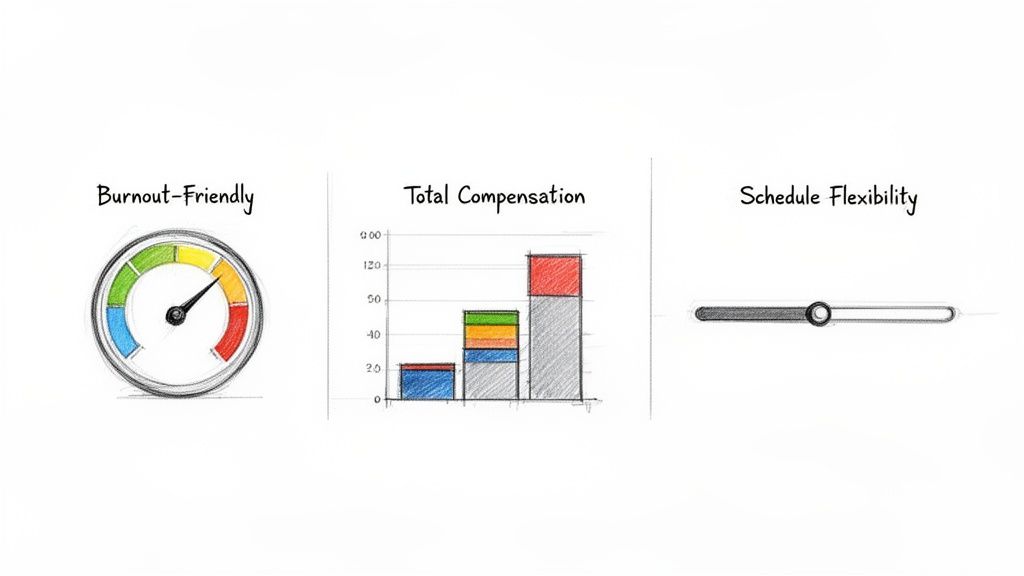
This shift from a gut feeling to a strategic, data-driven evaluation is critical. It’s how you make sure your next career move actually aligns with your well-being and your financial goals.
Interpreting a Burnout-Friendly Score
One of the most powerful tools to emerge is the Burnout-Friendly Score. This isn't just some arbitrary number. It’s a composite score, calculated from the key job factors that research shows directly contribute to clinician stress.
Think of it as an at-a-glance assessment of a role's sustainability. A high score tells you the job has built-in protective factors against burnout.
So, what goes into it?
- Schedule Demands: Does it require nights, weekends, or on-call shifts? A predictable, Monday-to-Friday, 9-to-5 schedule will always score higher.
- Administrative Burden: Does the role include protected admin time? This is a massive factor in preventing the "pajama time EMR" that steals your personal life back.
- Work Style: An asynchronous chart review job inherently offers more autonomy and flexibility than back-to-back synchronous video calls, and the score reflects that.
The Burnout-Friendly Score is your first line of defense. By filtering for jobs with a high score, you're immediately weeding out the roles likely to replicate the very problems you’re trying to escape.
Analyzing the Complete Financial Picture
Salary matters, of course, but it’s just one part of the financial equation. Modern job platforms often show an estimated salary range, which is a great starting point. But a truly clear view requires looking at total compensation.
This means factoring in the dollar value of benefits like health insurance, retirement contributions, and even tech stipends. A job with a slightly lower base salary but phenomenal benefits can easily be the smarter long-term financial choice.
For example, a $200,000 salary with a $20,000 401(k) match and premium-free family health coverage is far more valuable than a flat $210,000 salary with a high-deductible plan and no retirement match.
You can take this analysis even further. Tools like our job offer analyzer let you plug in the numbers from different offers to compare them side-by-side. By focusing on the full financial picture, you can see which opportunity will actually get you closer to your goals, without sacrificing your well-being to get there.
How to Interview and Negotiate for Real Flexibility
The job description is the advertisement, but the interview is where you get to look under the hood. This is your single best opportunity to see if a company’s promise of a balanced remote healthcare job is the real deal—or just good marketing.
To do this, you have to move beyond generic questions. You need targeted, insightful questions that reveal what the day-to-day reality of the role actually looks like.
Your goal is to get specifics on patient volume, how much control you have over your schedule, and what’s expected after hours. Vague answers are a major red flag. If a hiring manager can't give you a straight answer on patient-per-hour benchmarks, it’s a good sign the workload is unpredictable and potentially crushing.
Asking the Right Questions to Uncover the Truth
Go into every conversation with a list of non-negotiable questions. Frame them positively, focusing on understanding the workflow and culture rather than sounding demanding.
Here are a few powerful questions I’ve found get right to the point:
- "Could you walk me through a typical day for a clinician in this role?" This open-ended question is great because it gets them talking. You'll hear details about meeting schedules, patient loads, and whether there's any built-in administrative time.
- "How is patient scheduling managed?" This tells you everything about your autonomy. Can you block your own schedule for breaks or admin time, or is it automatically filled by an algorithm?
- "What are the expectations for after-hours communication or charting?" This directly exposes whether the company respects your personal time. A great answer is, "We expect work to be completed during work hours." Anything else is a warning.
- "What metrics are used to measure success in this position?" This uncovers what they truly value. Is it patient satisfaction and quality of care, or just pure volume and speed?
Remember, the interview is a two-way street. You are interviewing them just as much as they are interviewing you. Asking these detailed questions with confidence shows you’re a serious professional who knows what a sustainable workload looks like.
Negotiating Beyond the Salary
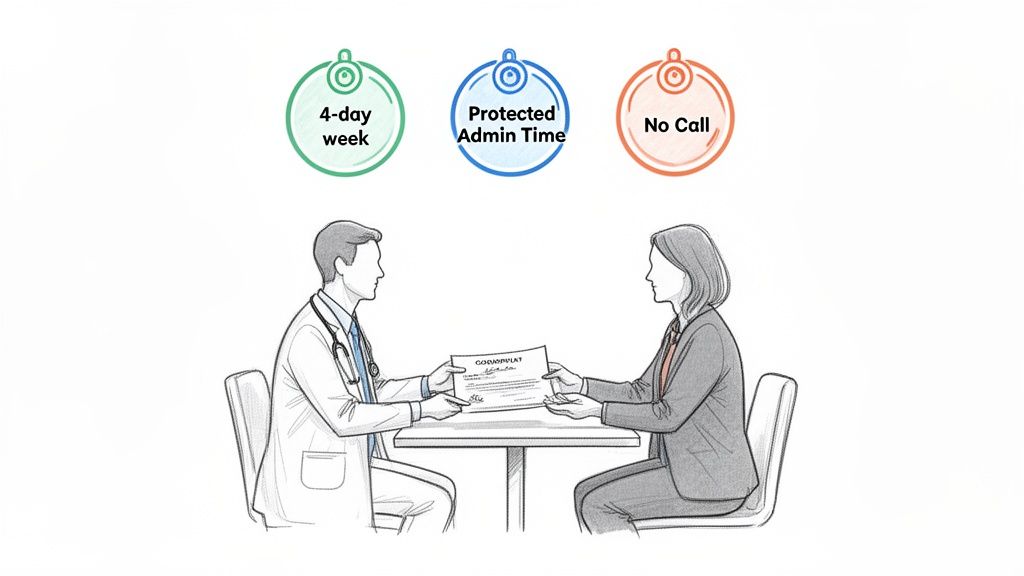
Once you have an offer, the negotiation begins—and it’s not just about the money. For many of us seeking jobs remote healthcare, the real value is in negotiating the conditions of the work itself. This is where you can lock in the flexibility that actually prevents burnout.
Don’t forget, you have more leverage than you might think. The global healthcare workforce is in a crisis. There’s a projected shortage of 4.5 million nurses by 2030, driven largely by an aging workforce and burnout. You can dig into the numbers in these global healthcare workforce projections.
What does this mean for you? Skilled clinicians are in high demand for sustainable remote roles. Don’t be afraid to advocate for what you need.
How to Frame Your Asks
When you negotiate, tie your requests back to quality and efficiency. Frame them as mutually beneficial arrangements that will allow you to perform at your best. This isn't about being demanding; it's about being a better clinician.
Consider these negotiation points:
- Protected Administrative Time: "To ensure I can provide thorough, high-quality documentation, I'd like to secure four hours of protected administrative time per week in my contract."
- A Four-Day Workweek: "I've found I'm most focused and productive working a condensed schedule. I'd like to discuss a four-day, 10-hour-per-day workweek."
- A Firm 'No Call' Policy: "To maintain long-term sustainability in this role, it's important for me that the 'no call' policy is explicitly stated in my employment agreement."
By clearly articulating your needs and linking them to professional performance, you shift the conversation from simple requests to strategic planning. This is how you secure the working conditions that ensure the job you accept actually delivers on its promise.
Common Questions About Remote Healthcare Jobs
Making the leap into remote healthcare can feel like a huge step, and it's totally normal to have questions. This isn't just a change of scenery; it's a different way of working with its own set of rules and realities. Getting clear, direct answers is the best way to move forward with confidence.
We've pulled together the most common questions we hear from clinicians just like you. The goal here is to cut through the noise and give you the practical info you need.
Are Remote Healthcare Jobs As Stable As In-Person Roles?
This is probably the biggest question on everyone's mind. The short answer? Yes, high-quality remote roles are often just as stable—sometimes even more so—than their in-person counterparts.
Telehealth isn't a temporary trend that's going away. It's now a permanent, and rapidly growing, fixture in our healthcare system. This shift is being driven by powerful forces like massive patient demand and chronic provider shortages that aren't going away anytime soon.
Many of these jobs are full-time, W-2 positions with great benefits, offered by established health systems and well-funded digital health companies. The key is to vet the employer. You want to look for organizations with a sustainable business model and a clear, long-term commitment to their virtual care programs.
How Can I Make My Resume Stand Out for Remote Work?
Your clinical skills are the foundation, but a remote role requires you to prove you can thrive without someone looking over your shoulder. Your resume needs to scream digital fluency and self-sufficiency.
Here’s how to do it:
- Show Your Tech Savvy: Don't just list the EMRs or telehealth platforms you've used. Be specific. Mention how you used them to improve patient care or streamline your workflow.
- Highlight Your Independence: Soft skills are critical for remote success. Sprinkle in keywords like "independent problem-solving," "time management," and "clear written communication." Frame your experience to show you're a self-starter.
- Quantify Everything: Numbers speak louder than words. Instead of saying you have virtual care experience, prove it. "Successfully managed a virtual patient panel of over 200 individuals" is way more impactful than "Provided virtual care."
Think of your resume as a showcase of your ability to be a self-sufficient, high-performing clinician. Every bullet point should reinforce your readiness to excel without direct, in-person supervision. This proactive framing can set you apart from other candidates.
What Kind of Home Office Setup Is Required?
You don't need a high-tech command center, but a few things are absolutely non-negotiable.
The essentials are a reliable, high-speed internet connection, a modern computer with a decent webcam, and—most importantly—a private, quiet workspace that ensures HIPAA compliance. This means a room with a door you can close, where conversations can't be overheard. No exceptions.
Many employers get this and are willing to help. It's pretty common for companies to offer a technology stipend or just ship you a company-owned laptop with all the necessary security software pre-installed. Always ask about their tech requirements and what they provide during the interview process so there are no surprises down the line.
Can I Work a Remote Clinical Job From Any State?
This is a critical detail that trips a lot of people up. For any role that involves direct patient care, you must be licensed in the state where the patient is physically located during the appointment. This is a hard-and-fast legal requirement.
Some employers will specifically hire clinicians who already hold multiple state licenses, which can be a huge advantage. Others might be willing to sponsor you to get licensed in other states where they have high patient demand.
Interstate compacts are your best friend here, as they can make this process way easier:
- The Interstate Medical Licensure Compact (IMLC) for physicians.
- The Nurse Licensure Compact (NLC) for nurses.
These agreements streamline the licensing process across all the member states. On the other hand, non-clinical roles like utilization management or chart review often have much more geographic flexibility, since you aren't technically practicing medicine across state lines. Always double-check the licensure requirements in the job description before you hit apply.
Finding a role that fits your life shouldn't be a struggle. WeekdayDoc is dedicated to curating burnout-friendly remote healthcare jobs that respect your time and expertise. Explore our listings and use powerful filters to find your perfect fit at https://www.weekdaydoc.com.