How to Pay Off Medical School Debt: A Clinician's Playbook
Learn how to pay off medical school debt with a step-by-step playbook covering IDR, PSLF, refinancing, budgeting, and FIRE modeling for clinicians.

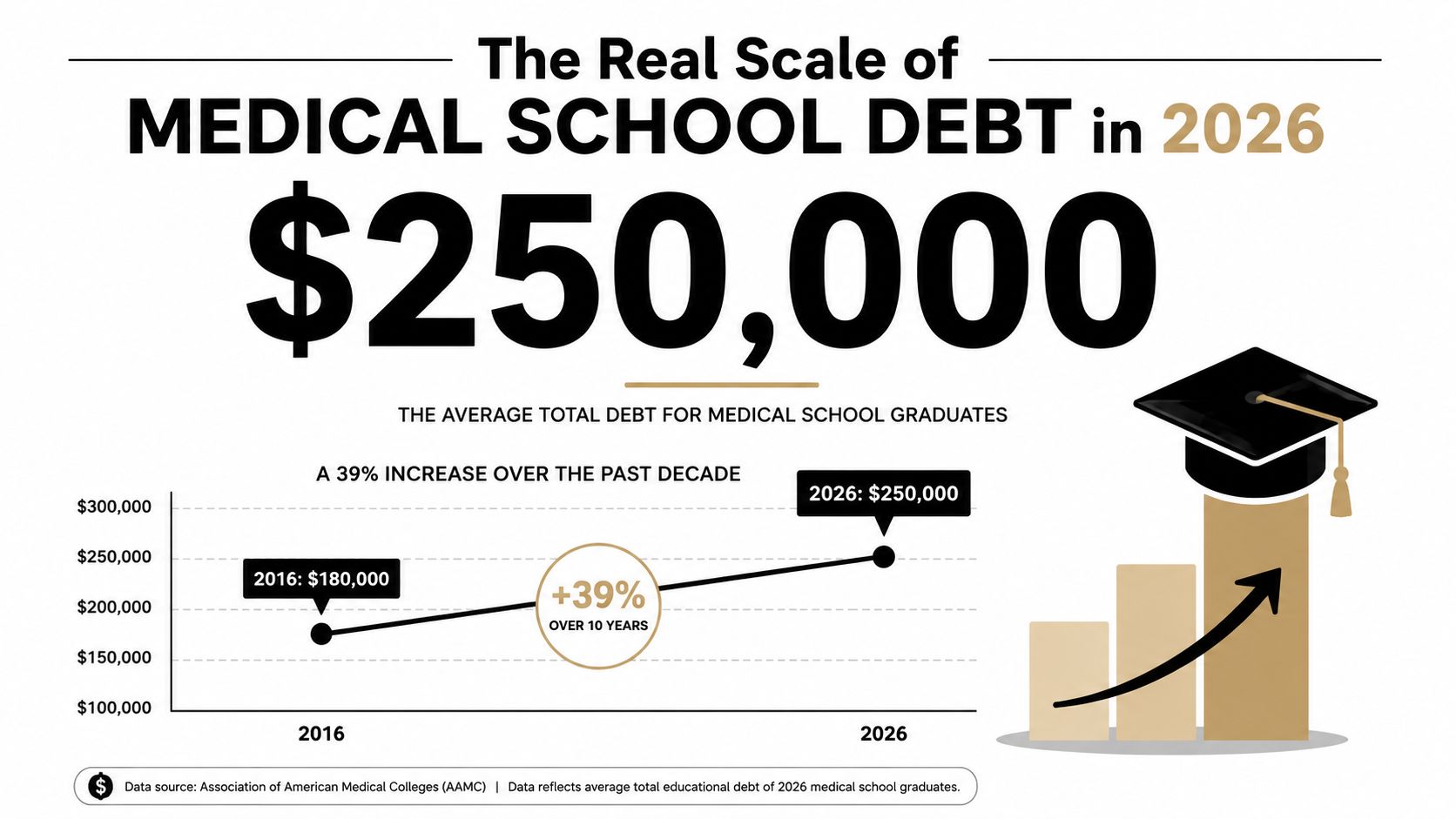
The number that should stop you cold is $216,659, the average medical school debt balance in 2025 (EducationData). That isn't a “tight budget” problem, it's a career-design problem, because the federal system still assumes a 10-year repayment timeline that a lot of physicians can't comfortably absorb while building a life, a practice, and a retirement plan.
If you're carrying this kind of balance, the wrong question is, “How do I cut coffee and make a bigger payment?” The right question is, “Which job structure, repayment path, and timing fit my income curve, my employer type, and my tolerance for risk?”
The Real Scale of Medical School Debt in 2026
The cleanest way to think about how to pay off medical school debt is to stop treating it like a personal failing and start treating it like a balance sheet problem with career consequences. The debt is large enough that the repayment plan has to match your training stage, your employer, and your specialty, not just your willingness to “be disciplined” (EducationData).
The historical trend is the point. In 2016, 76% of graduating medical students had educational debt, and the median burden was $190,000. By 2019, the median debt had risen to $200,000, and the AAMC later reported a median debt of $215,000 for the class of 2025 plus a median 4-year cost of attendance of $297,745 at public schools and $408,150 at private schools for the class of 2026 (EducationData). That climb explains why a neat, standard payoff plan keeps failing in real life.
Practical rule: if the loan balance is six figures, repayment is no longer a side project. It's part of your job selection.
The timeline mismatch is obvious once you look at physician expectations. In one physician survey, 41% expected to pay off debt in the next five years, but 30% expected it to take more than 10 years (EducationData). That spread tells you two things. First, repayment speed varies wildly. Second, a lot of doctors are making decisions inside a financial fog instead of a plan.
The psychological mistake is thinking the size of the balance means you're behind. You're not. You're just dealing with a debt structure that demands a different playbook than a consumer loan. If you accept that, the emotional weight drops fast, because the task becomes engineering, not shame.
WeekdayDoc's average med student debt resource is worth a look if you want to compare debt burden with job style before you make your next move.
Taking Inventory of Your Loan Portfolio
Before you decide anything, you need a complete map of the debt. Too many clinicians guess at their loan mix, then accidentally refinance the wrong loans or miss forgiveness eligibility. That's how smart people end up paying extra for years.
Pull the federal side first
Start with the National Student Loan Data System, then match every federal loan to its servicer and interest rate. Separate Direct Subsidized, Direct Unsubsidized, Grad PLUS, and any old Perkins loans if you still have them. Federal loans matter because they're the ones that can stay inside repayment programs like PSLF and income-driven repayment, while private loans live by different rules.
Then list your private loans separately. Don't lump them together with federal debt in your head or in your spreadsheet. A private loan may look similar on a monthly bill, but its flexibility is often much worse, and refinancing it can permanently change your options.
A usable spreadsheet only needs a few columns:
- Loan name
- Federal or private
- Original balance
- Current balance
- Interest rate
- Servicer
- Repayment eligibility
- Refinance candidate, yes or no
If you can't answer those questions from memory, you're not ready to pick a repayment strategy.
Classify by decision, not by label
The label on the loan is less important than what it lets you do. Federal loans can preserve access to PSLF or income-driven repayment. Private loans usually push you toward refinancing or aggressive payoff. Once you've sorted the portfolio, the next question becomes simple: which loans deserve flexibility, and which ones should disappear as quickly as possible?
Keep the federal loans federal until you're sure you're not using forgiveness. Refinance only after you know what you're giving up.
This inventory step is boring, but it's the highest-return administrative hour you'll spend. It keeps you from making a permanent decision with partial information.
Choosing Between PSLF, IDR, and Refinancing
The three paths solve different problems, and treating them like interchangeable products is how doctors waste money. Your loan choice should match your employer, your schedule, and your odds of staying in the same kind of job long enough to benefit from it.
Here's the clean split. PSLF fits borrowers who can stay in qualifying employment and keep qualifying federal loans long enough to finish the program. IDR without forgiveness is a cash-flow tool for people who need breathing room or want to keep their options open. Refinancing fits borrowers who are ready to give up federal protections and focus on paying the balance down fast.
PSLF has hard mechanics. It forgives the remaining balance after 10 years or 120 monthly payments, but only if the borrower works full time for a qualifying employer, keeps qualifying federal loans, and makes the payments under an income-driven repayment plan (Locum Story). If you do not fit that structure, PSLF is not your plan.
The repayment rule in the medical literature is straightforward, and it should guide the decision. PSLF borrowers should choose the lowest-payment plan, while non-PSLF borrowers should choose the plan that minimizes interest and then repay as fast as possible (PMC). That is the default rule for doctors who want a decision, not a debate.
| Criteria | PSLF Path | IDR Without Forgiveness | Refinance and Accelerate |
|---|---|---|---|
| Main goal | Forgiveness | Cash-flow control | Fast payoff |
| Monthly payment | Usually lowest qualifying payment | Lower than standard, depending on income | Often higher if you shorten term |
| Total interest | Can matter less if forgiven | Can stay high if balance remains | Usually lower than staying on federal terms |
| Career flexibility | Tied to qualifying employer | More flexible | Highest flexibility, but no federal protection |
| Best fit | Nonprofit, public service, qualifying full-time roles | Volatile income, uncertain career stage, some nontraditional paths | Stable high income, no forgiveness plan |
The mistake is refinancing too early because the rate looks better. If you still might take nonprofit work, part-time work, or a move that changes your employer type, you are trading away flexibility for a number on paper. WeekdayDoc's student loan repayment options guide is a useful comparison tool when you are matching repayment choices to actual job structures.
Accelerating Payoff Through Income and Employer Leverage
Once the path is set, speed comes from margin. Margin is the gap between what you bring in and what your life costs. The more margin you create, the faster the balance shrinks.
Earn more without redesigning your whole life
Moonlighting and locums work can make a real dent if your schedule can handle it. Telehealth side work can help too, especially for clinicians whose core job leaves room for a few focused hours outside clinic days. The point isn't to work yourself into the ground. The point is to convert spare capacity into principal reduction.
Employer negotiation matters just as much. Signing bonuses, student loan repayment assistance, and even the structure of the offer can change the payoff timeline more than a small rate difference ever will. If you're comparing two jobs, look past base pay and ask what the employer is really subsidizing.
If you want a quick benchmark for compensation across specialties, highest paying doctor specialties gives you a broader market frame before you negotiate.
Use extra cash with intent
Extra payments should hit the highest-interest debt first unless you're committed to a forgiveness strategy. That sounds obvious, but plenty of people scatter bonus money across accounts and then wonder why the balance barely moves. Pick a method, automate it, and stop revisiting the decision every month.
Employer retirement matches deserve a separate place in the decision. You don't skip free match dollars just to prove you hate debt. Fund the match if the plan fits your cash flow, then direct the remaining surplus toward the loan target you chose.
The fastest payoff plans are usually built from three levers, higher income, lower fixed costs, and a clear payment order. If one lever is missing, the others have to work harder.
A higher-paying job with worse hours can still be the wrong answer if it burns you out and forces a career reset. The best repayment plan is the one you can stick with long enough to finish it.
When the Standard Advice Fails Nontraditional Career Paths
A lot of student loan advice assumes you're a full-time, high-income attending in a metro job with stable hours and no surprises. That's fine if that's your life. It's wrong for plenty of other clinicians.
Part-time physicians, locum tenens clinicians, rural hires, and lower-paid specialties often care more about cash flow than a quick refinance. If your income is variable or your schedule is built around burnout avoidance, the federal system may be more useful than people admit. That includes IDR, employer assistance, and, in some cases, forgiveness tracks that reward staying in a qualifying structure for the long haul.
Don't let “refinance right away” become a reflex
Refinancing can be smart, but only when it doesn't destroy flexibility you'll need. A lower rate doesn't help if you end up taking a nonqualifying job, cutting hours, or moving into locums because the original career path stopped fitting your life.
That's why nontraditional clinicians should think in terms of runway. If you expect a long tail on repayment, then cash-flow management matters as much as rate reduction. Tax treatment matters too, because the way you handle forgiven or lingering balances can affect your real bottom line over many years.
For a role that fits this mindset, the strategic guide for cardiac hiring is a useful look at locum tenens structure and what it can mean for schedule and mobility. The larger lesson applies beyond cardiology. A clinician who values no call, weekday-only work, or geographic freedom should not optimize like a lockstep hospitalist.
Match repayment to the life you actually want
If your career plan includes part-time work, family flexibility, or a slower pace later on, don't force a payoff schedule that assumes relentless full-time income forever. That's how people end up resenting both the debt and the job. A repayment plan should support your career design, not fight it.
Some clinicians really do need a longer runway. That's not failure. That's just a different employment reality.
Modeling Your Payoff Timeline Against FIRE Goals
A loan payoff plan gets more honest when you put it next to your retirement target. Debt repayment and FIRE aren't separate games. They compete for the same dollars and the same energy.
Take two fictional clinicians with the same starting debt. One takes a traditional high-hour hospital role with a bigger paycheck and more pressure. The other takes a weekday-only, no-call job with steadier hours and less income. The first path can crush debt faster, but it can also increase burnout risk and reduce how long the clinician wants to stay in the game. The second path may stretch repayment, but it may preserve enough consistency to keep saving and keep working.
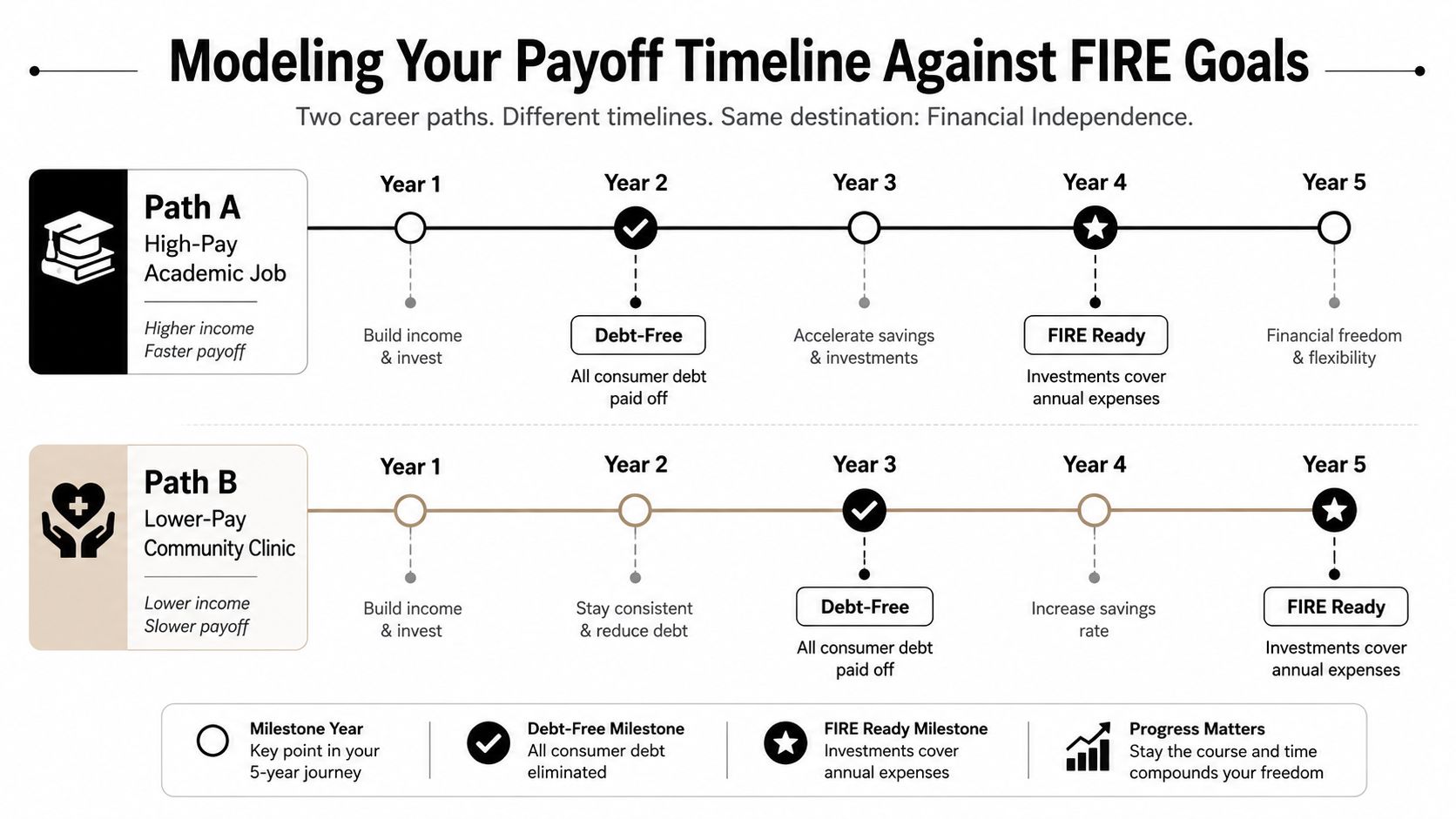
The smart move is to model both the debt date and the retirement date before you accept the offer. If one job gets you debt-free sooner but leaves you exhausted and underinvested, the total outcome may be worse. If another role delays payoff a little but keeps your savings rate intact, your long-term net worth can move faster than your gut expects.
That's where a proper calculator helps. Use WeekdayDoc's Financial Independence, Retire Early calculator alongside a salary model, then compare the timeline against your actual life preferences. Don't choose based on title prestige or a rough annual number. Choose based on where the job puts you five years from now.
The deepest trade-off is hidden in burnout. A clinician who burns out and takes a hard step down in pay loses more than income. They lose momentum. A slightly lower-paying but sustainable role can protect both debt payoff and investing consistency, which drives wealth over time.
Building Your Personal Repayment Decision Framework
The right repayment plan starts with your career structure, not your loan balance. Residents should keep federal flexibility, stay on the lowest payment allowed by the rules, and avoid choices that close doors too early. New attendings should decide whether the first job after training is a bridge to forgiveness, a setup for aggressive payoff, or a good time to refinance and finish the debt.
Established physicians need to stop pretending one answer fits everyone. If you are in a stable high-income role and you do not need federal protection, I would favor the cleanest path to getting the debt gone. If you are in nonprofit or public-service work, the lowest-payment qualifying strategy usually makes more sense. The repayment plan should follow the job, not the other way around.
Use the job itself as the filter. No-call, weekday-only, and locums-heavy roles can change how much cash flow you can direct toward debt and how much flexibility you keep for savings. That is why repayment is a career-design problem, not just a math exercise. If you want a broader consumer-law perspective on student loan handling, the manage student loan debt guide is a useful place to review repayment mechanics and borrower protections.
Then make the plan mechanical. Set automatic payments, automate extra transfers if you are paying faster, and put recertification and refinance review dates on your calendar before life gets busy. Revisit the plan every year, and also after any major job change, fellowship decision, or shift into a different call schedule.
WeekdayDoc helps clinicians compare jobs with burnout-friendly filters, salary data, and FIRE projections by state. Use that kind of framework to screen offers before you sign, then confirm that the repayment setup still fits after you see the actual work schedule, not the interview version.