
Student Loan Repayment Options: A Clinician's 2026 Guide
Explore student loan repayment options for physicians, NPs, and PAs. This guide covers PSLF, IDR, and refinancing strategies for high-income clinicians in 2026.
You're signing a contract, finally seeing attending-level income, and still staring at a student loan balance that feels disconnected from the life you thought higher earnings would buy. That tension is where most clinicians make bad repayment choices. They optimize for the monthly payment, not the total outcome.
I see the same mistake across physicians, NPs, PAs, psychologists, and pharmacists. A hospital-employed doctor assumes forgiveness is always smarter. A private practice PA stays in a federal plan long after the math stopped working. A psychologist takes a lower-paying nonprofit role for PSLF without fully checking whether the employer, loan type, and repayment plan all line up. The problem usually isn't effort. It's that most student loan repayment options are presented as a menu, when they should be treated like a career decision.
For clinicians, the right plan depends less on the loan itself and more on your job path, income trajectory, family size, tolerance for paperwork, and whether you want flexibility or speed. A resident heading into academic medicine should think differently than a dermatologist joining a high-income private group. A pharmacist at a government facility has a different set of incentives than an NP moving between telehealth and outpatient roles.
This is the framework I use. Start with one question: are you buying forgiveness, or are you buying freedom from the debt? Those are not the same strategy, and trying to blend them usually leads to wasted years.
The Clinician's Dilemma with Six-Figure Student Debt
The hardest point in repayment isn't usually when income is lowest. It's when income rises and your options become expensive in different ways.
A new attending may have enough cash flow to attack debt aggressively, but not enough certainty about job stability, family plans, or practice setting to lock into the obvious move. A mid-career NP or psychologist may be earning well, yet still carrying a large federal balance while considering a job switch for better hours. On paper, that looks manageable. In practice, it creates pressure from every direction at once.
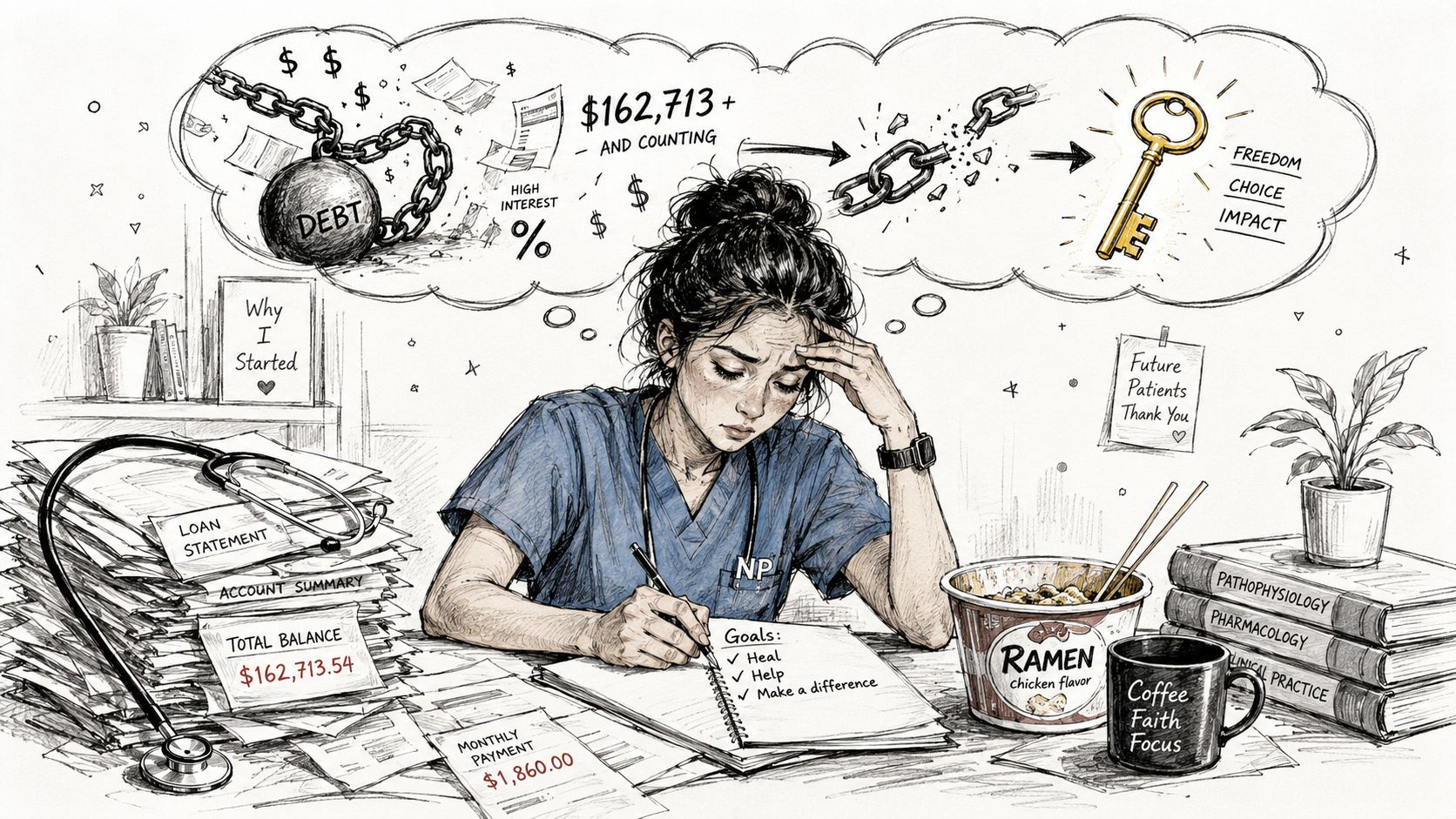
Why clinician debt feels different
Clinician debt behaves differently because clinician income behaves differently. Your earnings often start low in training, then jump sharply, then may change again based on partnership tracks, RVU-heavy compensation, schedule reductions, relocation, or a move into burnout-friendly work.
That's why generic debt advice fails. It assumes a stable salary and a simple choice between lower payments and faster payoff. Most clinicians don't live in that world.
Practical rule: Don't choose a repayment plan based on what feels affordable this year if you already know your income will look very different in the next few years.
There's also a professional trade-off that borrower guides often miss. The repayment strategy can distort job decisions. A clinician may stay in a poor-fit nonprofit role just to preserve PSLF eligibility, or delay refinancing because federal protections feel comforting even after they stop creating real financial value.
What actually matters
When I evaluate student loan repayment options for high-income clinicians, I focus on five questions:
- Employer path: Is your job likely to remain in government or nonprofit employment long enough for PSLF to be realistic?
- Income curve: Are you still in a low-earning phase, or have you crossed into income where federal IDR payments stop being an advantage?
- Loan purpose: Are you trying to maximize forgiveness, minimize interest, or preserve flexibility during a transition?
- Operational discipline: Will you handle annual certifications, recertifications, and plan tracking correctly?
- Lifestyle goals: Does your repayment plan support the schedule and work-life balance you want, or trap you in a job you already want to leave?
That's the decision. The debt isn't just a balance. It's a constraint on your career design.
Navigating the 2026 Federal Repayment Landscape
A hospital-employed physician with $320,000 in federal loans can look at a lower IDR payment and assume the federal route is automatically safer. In practice, the harder question is whether that lower payment is buying progress toward forgiveness or just allowing the balance to sit in place while interest keeps building.
The federal repayment system appears to be getting simpler on paper. The strategy for clinicians is still not simple, because a simpler menu does not remove the trade-off between flexibility and total cost.
Under changes scheduled for July 1, 2026, the Department of Education is expected to center repayment around two main options, the Repayment Assistance Plan, or RAP, and a Tiered Standard plan. RAP is expected to tie monthly payments to income. That will help some borrowers preserve cash flow. It can also create a debt-idling problem for high-income clinicians if the required payment stays below accruing interest for too long.
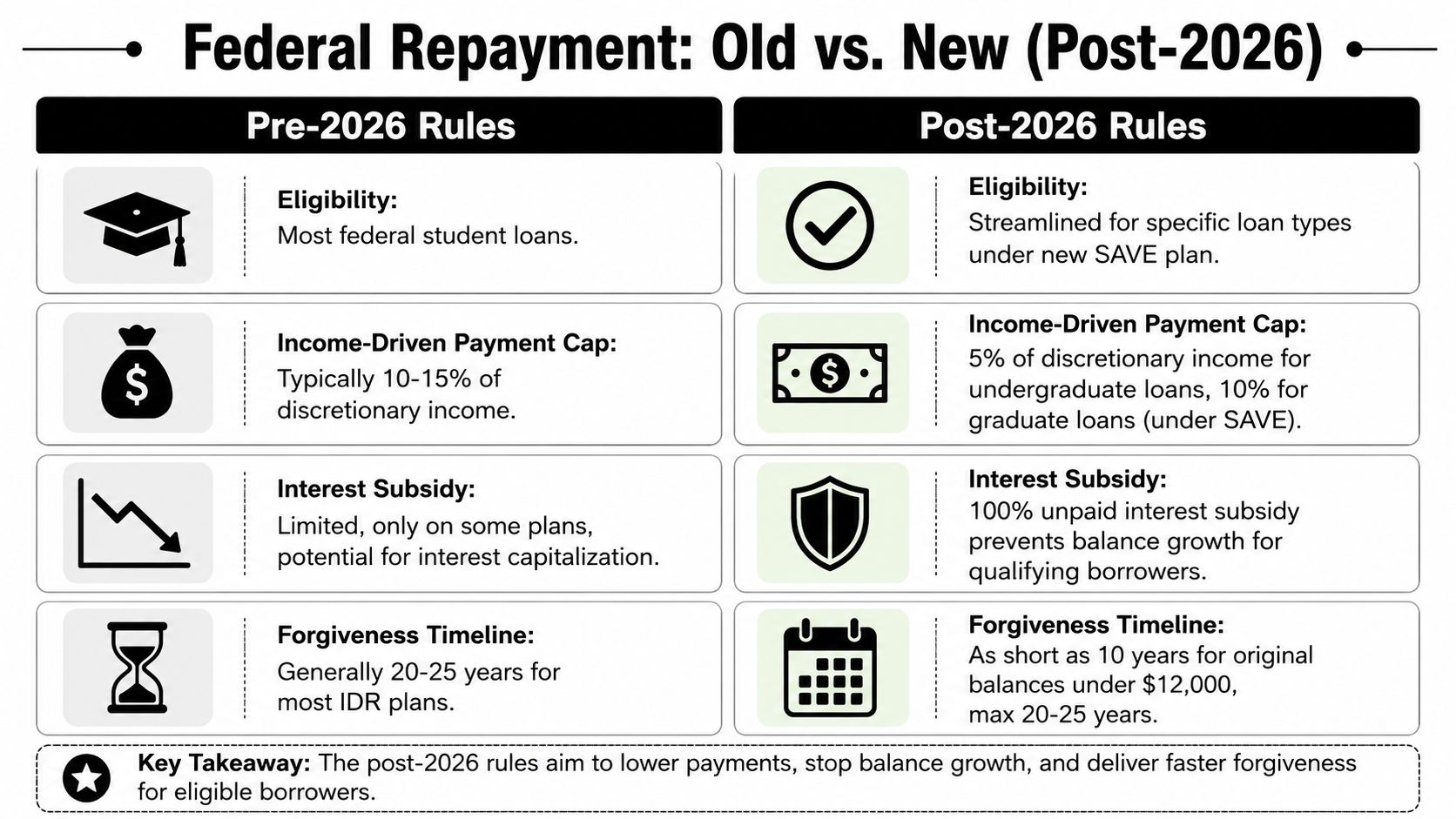
The two tracks that matter
For physicians, dentists, and other advanced clinicians, the comparison is straightforward.
| Plan | Best fit | Main trade-off |
|---|---|---|
| RAP | Borrowers who may use PSLF, need payment flexibility during training or early practice, or want to keep federal protections during a career transition | Lower required payments can mean slower principal reduction and more interest cost |
| Tiered Standard | Borrowers who expect stable earnings and want a defined federal payoff structure without income recertification | Higher required payments and less room to adjust if income falls or priorities change |
RAP deserves a close look if your career path still points toward nonprofit or government employment. The Tiered Standard option is often cleaner for borrowers who want structure but are not ready to refinance yet. Neither is automatically the best long-term answer for an attending with strong income and no realistic forgiveness path.
This is the mistake I see often. A clinician stays in a federal plan because the payment feels manageable, then reaches peak earning years with a balance that has barely moved. If you are unclear on why balances can grow or stall even while you make every required payment, this explanation of how student loan interest actually accrues over time is worth reviewing before you choose a plan based on monthly affordability alone.
Legacy borrowers still need a transition plan
Borrowers with older federal loans may not need to change plans right away. Some existing borrowers are expected to have a transition window rather than an immediate forced switch. The practical issue is not whether you can wait. It is whether waiting helps your actual plan.
A resident heading to private practice may benefit from using a federal plan briefly, then refinancing once income stabilizes and federal forgiveness is off the table. A specialist committed to an academic medical center may do the opposite and keep the federal structure intact because the forgiveness value is still real.
A federal repayment plan should earn its place in your financial plan by creating a measurable benefit, not by feeling familiar.
There is also a compensation issue many clinicians miss during contract review. If an employer offers student loan assistance, educational assistance, or a repayment benefit, check the tax treatment before you assign it full value. Allied Tax Advisors' latest tax alert is a useful reference when you are reviewing whether that benefit is tax-advantaged or just marketed well.
Federal plans still matter for three reasons. They preserve access to forgiveness programs, they can reduce required payments during lower-income years, and they offer more flexibility during career uncertainty. For a high-income clinician who is unlikely to use those features, keeping federal loans can become expensive drift rather than strategy.
Decoding Income-Driven Repayment Plans
A new attending signs an income-driven plan during residency, keeps the payment low for a few more years, then looks up and finds the balance barely moved despite years of automatic drafts. That outcome is common in medicine. The payment felt manageable, but the strategy was never matched to the physician's earning path.
Income-driven repayment can be useful. It can also become expensive debt idling. For high-income clinicians, that usually happens when required payments stay below accruing interest for too long and the borrower keeps the federal loans without a clear forgiveness target.
PAYE, RAP, and the real cost of a low required payment
PAYE has historically been one of the more workable IDR options for physicians because the formula is relatively straightforward and the repayment term is shorter than some newer structures. PracticeMatch's overview of physician student loan repayment options describes PAYE as a plan tied to discretionary income, generally with a 20-year repayment horizon for eligible borrowers and a hardship-based entry requirement.
RAP changes the trade-off. If the current framework takes effect as described, monthly payments would be based on adjusted gross income, include a minimum payment, and incorporate dependent-based reductions, with forgiveness coming on a longer timeline. CNBC's summary of the proposed RAP structure outlines those features.
For a resident, that can preserve cash flow. For a cardiologist, orthopedic surgeon, anesthesiologist, or dermatologist with a rapid income step-up, it can create a different problem. The required payment may stay lower than what the borrower could reasonably afford, while interest continues to accrue and the balance makes little real progress.
That is the part many physicians miss.
What clinicians usually miss
A low payment only helps if it serves a larger objective. The two legitimate objectives are usually short-term cash flow protection during training or lower-paid early practice, and maximizing federal forgiveness value through programs like PSLF.
Without one of those goals, IDR can waste money. The borrower keeps federal protections, but pays for them through slower amortization, more interest, and years of administrative complexity. If you want to review why balances can stay stubbornly high even when payments are current, this explanation of whether student loan interest compounds helps clarify what is happening inside the loan.
The right question is not whether the payment fits this year's budget. The right question is whether the plan reduces total lifetime cost given your expected physician income and career setting.
The PSLF versus refinancing decision sharpens with these considerations. If you are building toward forgiveness, a lower IDR payment can be rational because the remaining balance may never need to be repaid. If you are headed for high, stable private-practice income with no credible forgiveness path, the same low payment can leave the debt sitting in place while interest does the work.
When IDR is actually useful
IDR plans usually make sense in a narrow set of physician-specific situations:
- Residency and fellowship: Cash flow is tight, income is temporarily low, and preserving federal options has value.
- A defined PSLF path: You work for a qualifying employer and are treating repayment as part of a forgiveness strategy.
- Income volatility or household planning issues: Variable compensation, a spouse's income, and dependents can materially change the payment calculation.
They are much weaker for clinicians with strong private-practice earnings and no realistic path to federal forgiveness. In that setting, the practical comparison is no longer "lower payment versus higher payment." It is "forgiveness strategy versus full repayment strategy." Once that is clear, many physicians find that staying in IDR is not flexibility. It is delay.
The Public Service Loan Forgiveness Strategy
A hospitalist five years into practice can make every payment on time and still be on the wrong repayment path if the employer is ineligible, the loans are not set up correctly, or certification slips for a year. PSLF can produce a large tax-free benefit for clinicians with high federal balances, but it only works when the employment and repayment details hold up under review.
The program's early approval record was poor, largely because borrowers had the wrong loan type, the wrong repayment plan, or incomplete documentation. A useful summary of that history, along with more recent forgiveness totals, appears in Saving for College's PSLF statistics summary.
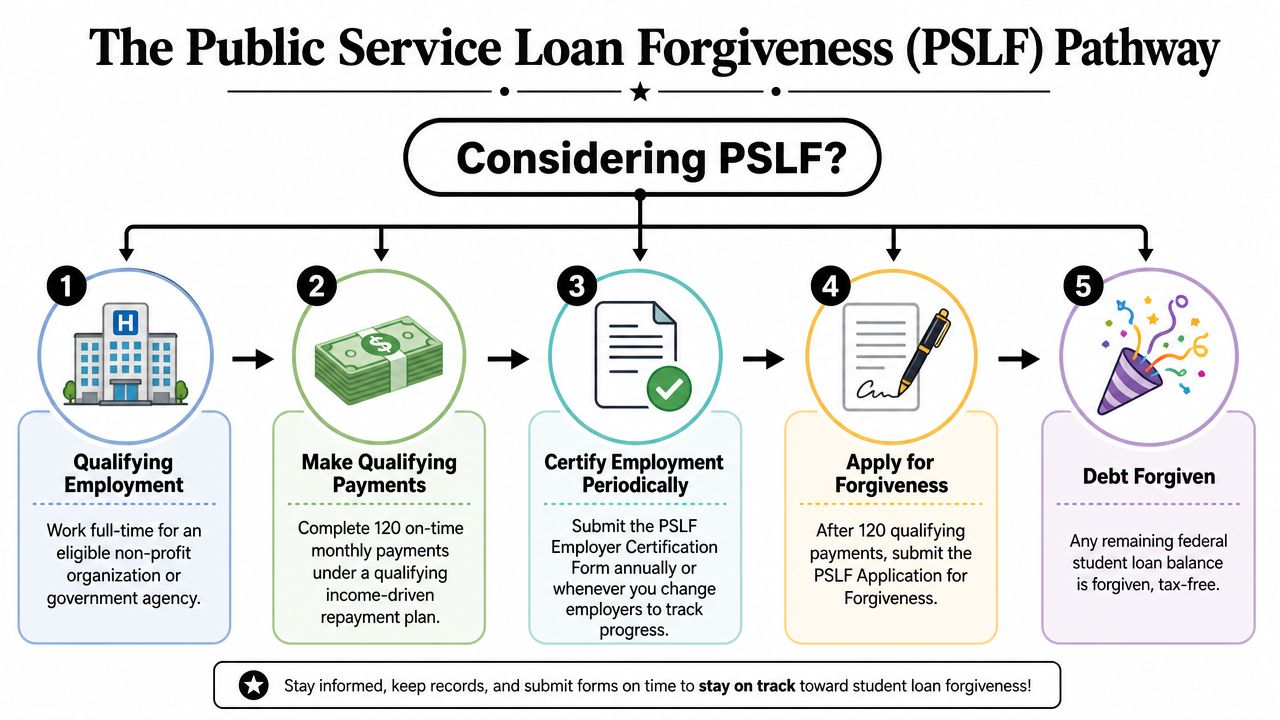
PSLF is tied to your career path
For an employed physician at a nonprofit system, VA facility, academic center, county hospital, or other qualifying employer, PSLF changes the math. The goal is no longer rapid balance reduction. The goal is to minimize total out-of-pocket cost while preserving a clean path to forgiveness after 120 qualifying payments.
That trade-off matters because high-income clinicians can drift into debt idling if they use an IDR plan without a real forgiveness outcome at the end. Under PSLF, a low required payment may be rational even if the balance grows, because the remaining amount can be forgiven tax-free. Without PSLF, the same pattern can leave a physician making substantial payments for years while the principal barely moves.
Here's a concise walkthrough of the process:
What actually makes PSLF work
Three things decide whether PSLF is a strong strategy or an expensive assumption:
- Eligible employment: The employer must be a qualifying government or nonprofit entity. The hospital brand alone is not enough. The actual payroll entity controls eligibility.
- Correct loan and repayment setup: You need eligible federal direct loans and qualifying monthly payments under an approved structure.
- Documentation discipline: Employment certification, payment tracking, and records of servicer communication should be treated as part of the plan, not an afterthought.
I have seen physicians lose time because they assumed a nonprofit logo meant qualifying employment, or because they changed jobs and did not recertify promptly. Those are avoidable errors, but only if PSLF is handled like a compliance process.
If you are weighing a nonprofit contract against a higher-paying private option, review this breakdown of physician loan forgiveness pathways. The repayment strategy only works if the job structure supports it.
Who should lean toward PSLF
PSLF usually deserves serious consideration when these points are all true:
- You expect to remain in qualifying employment long enough to reach forgiveness.
- Your federal loan balance is large relative to your current payment obligation.
- You are willing to manage yearly paperwork and verify progress yourself.
- The value of forgiveness is likely to outweigh the income and flexibility you would give up in a for-profit role.
The last point is where many physicians need a more honest comparison. A private practice offer may come with much higher pay, equity potential, or better control over schedule and location. PSLF can still win, but only if the projected forgiveness benefit is larger than what you are giving up to stay employed in a qualifying setting.
That is the core strategy question. It is not just whether PSLF is available. It is whether PSLF beats aggressive repayment after accounting for compensation, taxes, job mobility, and the risk of carrying a large balance for another decade.
When to Choose Private Refinancing Over Federal Plans
An attending in private practice can earn enough to make a large monthly IDR payment and still watch the balance barely move. That is the refinancing decision in plain terms.
For high-income clinicians who are not on a real forgiveness path, federal repayment can turn into expensive delay. The usual reason is not confusion about the rules. It is staying in a federal plan out of habit, even after the math has changed.
The debt idling problem
Debt idling happens when your required payment is high enough to hurt cash flow but not high enough to retire principal at a reasonable pace. I see this most often with physicians whose income has risen sharply after training. They remain in an income-driven plan they started as residents, then discover years later that they have been servicing interest and extending payoff time rather than reducing debt efficiently.
That risk has been discussed outside physician finance as well. In American Progress's analysis of repayment models, analysts describe scenarios where higher-income borrowers can face large required payments without meaningful progress toward payoff. For a physician in a for-profit job, that is a bad middle ground. You keep the federal balance, give up years of compounding opportunity cost, and may still end up paying the loans in full.
Federal flexibility has value. It just does not have the same value for every borrower.
The clinicians who should seriously consider refinancing
Private refinancing usually deserves a hard review when several of these are true:
- You work in private practice or another for-profit setting: There is no realistic PSLF path attached to your current job.
- Your income is high and durable: You can handle a fixed payment even if bonuses fluctuate.
- You want a defined payoff date: The goal is to eliminate debt, not carry it for another decade.
- You have cash reserves: Losing access to federal forbearance and IDR flexibility will not create immediate strain.
- Your federal rate is materially above current refinance offers: The spread is large enough to change total interest cost, not just monthly payment.
The trade-off is straightforward. Refinancing can lower the rate and shorten the repayment timeline, but it permanently removes federal options. That includes future forgiveness programs, income-based payment formulas, and certain hardship protections. A physician who may cut back clinically, switch employers, or return to nonprofit work should be cautious.
What tends to make refinancing a mistake
Refinancing is often premature early in practice. A new attending may plan to stay in private practice, then take a nonprofit academic role two years later. Another may expect stable income, then reduce hours after a child, a health issue, or a spouse relocation. Once the loans are private, those federal escape routes are gone.
That is why I frame this as a career-stability decision as much as a rate decision.
| If this is true | Federal plans often fit better | Refinancing often fits better |
|---|---|---|
| You may pursue PSLF later | Yes | No |
| Your income may fall or become unpredictable | Yes | Usually no |
| Your income is high, stable, and likely to stay that way | Sometimes | Often yes |
| You want payment flexibility during a transition | Yes | Usually no |
| You want the fastest clean payoff at the lowest likely interest cost | Rarely | Often yes |
For a high-income clinician with no credible forgiveness path, keeping federal loans is sometimes the more expensive choice. If the debt is idling, refinancing is not giving up value. It is choosing a faster, cleaner exit.
Targeted Forgiveness and State Loan Repayment Programs
A physician can miss a strong repayment opportunity by focusing only on two choices: PSLF or refinancing. State and service-based programs can change the math, especially for clinicians considering rural practice, FQHC work, correctional medicine, public psychiatry, or other shortage-area roles.
These programs are narrower than federal repayment plans and usually require more paperwork. That is the trade-off. In return, they can deliver direct loan support that reduces the pressure to keep federal loans on an income-driven plan while the balance barely moves.
One example worth knowing
The Physician Education Loan Repayment Program (PELRP) is one of the clearer examples. The PELRP program overview describes a four-year award structure for physicians who commit to full-time service in underserved communities.
For the right clinician, that changes job economics fast. A role with slightly lower base pay can still produce better after-tax, after-debt results if it includes meaningful loan repayment assistance. I tell physicians to evaluate these offers as part compensation, part debt strategy.
Where high-income clinicians get this wrong
The common mistake is treating these programs as side benefits instead of decision-shaping terms. That is how debt idling starts. A physician stays in federal repayment without a realistic forgiveness path, makes required payments, watches interest keep accumulating, and ignores a state or employer program that could have reduced principal directly.
Three categories deserve a close look each time you review an offer:
- State repayment programs: Often tied to shortage areas, public service, or specialty need.
- Employer loan assistance: Hospitals, health systems, and large groups sometimes build loan support into the package, even when the salary is not the highest offer.
- Specialty or location-based incentives: Primary care, psychiatry, behavioral health, and certain public-sector roles are more likely to carry targeted repayment benefits.
State rules vary widely, so verify details at the program level before you count on any benefit. If you are comparing offers in Georgia, review Georgia student loan forgiveness eligibility as a starting point, then confirm the current terms with the sponsoring agency or employer.
This work is not glamorous. It is financially important.
A targeted repayment benefit can justify taking a job you already wanted. It should not push you into a role that is a poor clinical or lifestyle fit. The best use of these programs is strategic. Pair them with a practice setting you can realistically stay in, then fit the debt plan around that choice. For clinicians trying to balance debt payoff with broader wealth building, this guide on financial independence for physicians helps frame the bigger decision.
Building Your Personal Repayment Strategy
Most repayment mistakes happen because clinicians choose a plan before choosing a lane. The lane comes first. Your debt strategy should fit your job design, not fight it.
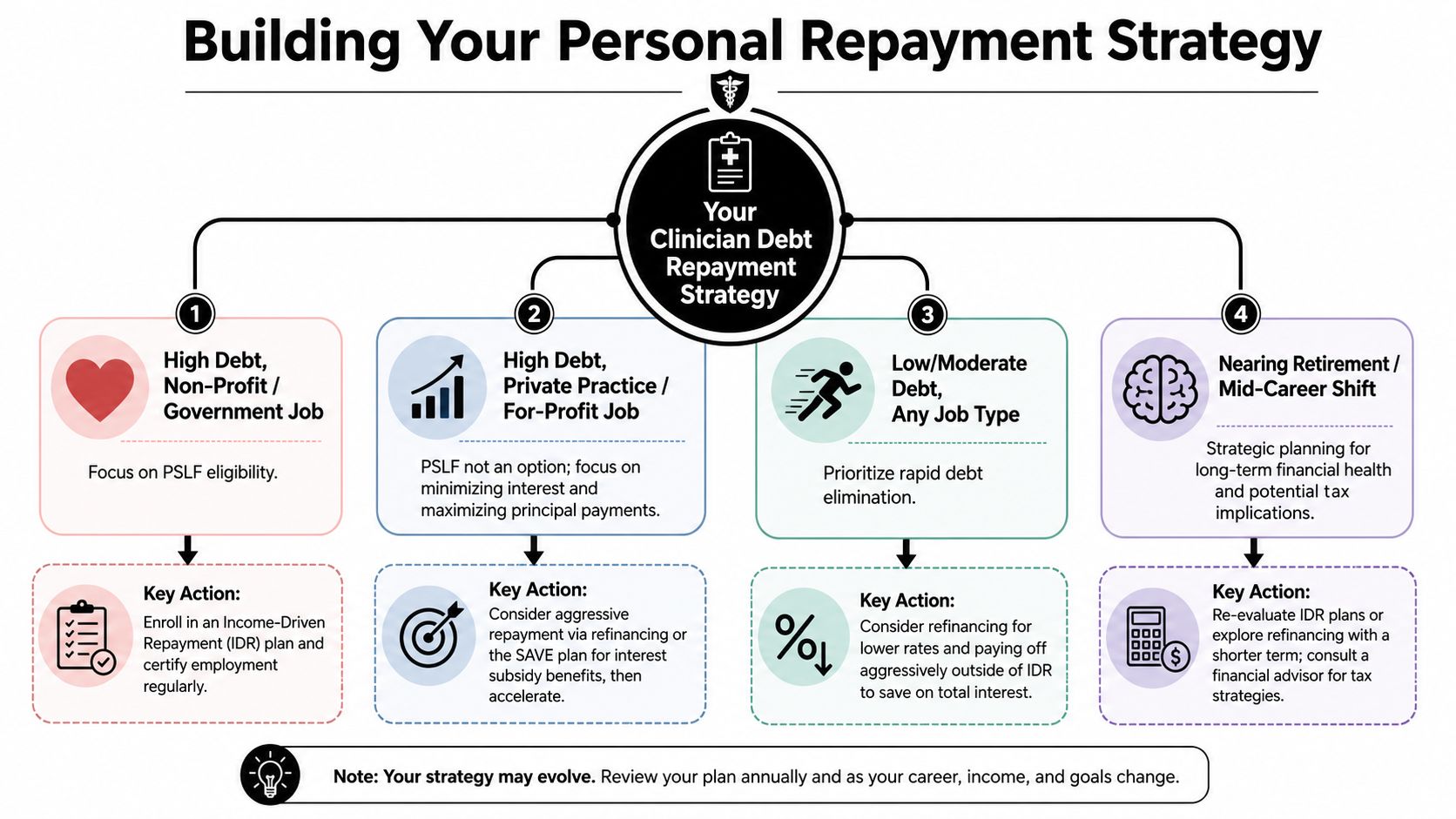
Four clinician profiles
Here's how I'd frame the decision for common scenarios.
Resident or fellow planning ahead
If you expect academic medicine, a VA role, county employment, or another nonprofit path, preserve federal flexibility. Keep records clean. Don't refinance early just because your current payment feels annoying.
Your useful work right now is operational, not heroic. Document your loans, understand your employer path, and avoid accidental moves that close off forgiveness before you've made a real career decision.
New attending at a nonprofit hospital
This is the classic PSLF candidate, but only if the employment structure is eligible and likely to remain stable. You need to check the employing entity, not just the hospital brand.
If the role also supports your quality of life, job search and debt strategy finally line up. For clinicians comparing no-call or weekday-focused roles, WeekdayDoc lets users filter clinician jobs by role and work style while reviewing salary context and financial tools. That matters when your repayment plan depends on staying in a role you can tolerate.
PA, pharmacist, or physician in private practice
If PSLF is off the table and your income is solid, stop romanticizing federal repayment. Run the math on aggressive payoff versus years of high IDR payments. In many private settings, the cleanest plan is to refinance and eliminate the balance on purpose.
This is especially true when your contract offers strong compensation but little long-term reason to preserve federal flexibility.
The job decision and the debt decision are linked
A mid-career clinician changing jobs should review more than salary. Look at schedule control, burnout risk, employer type, and whether the role supports the repayment strategy you want.
Use this checklist:
- If the role is nonprofit or government: Verify whether forgiveness is realistically part of the total compensation picture.
- If the role is for-profit: Treat loan repayment like a cash-flow problem and prioritize interest control.
- If you're balancing family and reduced hours: Favor flexibility over rigid payoff promises.
- If you're later in career: Reassess whether carrying federal debt still serves any purpose.
For state-specific questions, especially when evaluating public-service or legal-eligibility angles, this guide on Georgia student loan forgiveness eligibility is a practical example of the kind of local screening resource worth checking.
Build the plan around your real life
The right strategy should survive a job change, a schedule cut, parental leave, relocation, or a shift away from call-heavy work. If your repayment plan only works under perfect assumptions, it isn't a strong plan.
That's also why broader financial planning matters. If you're trying to align debt repayment with career flexibility and long-term wealth, this guide on how to achieve financial independence is a useful lens. Student loans don't exist in isolation. They compete with every other goal you have.
Choose the path you can execute cleanly. For some clinicians, that's a decade of disciplined PSLF. For others, it's a fast refinance and aggressive payoff. The expensive move is drifting between both.
If you're comparing jobs and trying to make the loan math fit the life you want, WeekdayDoc can help you evaluate burnout-friendly clinician roles alongside salary context and long-term financial planning. That makes it easier to judge whether a position supports PSLF, faster payoff, or the flexibility to change course.