Does Student Loan Interest Compound: What Clinicians Must
Does student loan interest compound? Understand simple vs. capitalized interest for federal & private loans. Get tips for clinicians to save thousands.
Most student loans do not compound in the strict mathematical sense. All federal student loans, which make up roughly 92% of outstanding U.S. student debt, use simple daily interest, but capitalization can still make your balance grow in a way that feels like compounding.
That distinction matters more for clinicians than for almost anyone else. A long runway of medical school, residency, fellowship, lower-earning training years, and delayed wealth building creates the exact conditions where unpaid interest turns into new principal. If you're a physician, NP, PA, psychologist, or pharmacist trying to balance debt payoff against job choice, family time, or FIRE, the question isn't just whether student loan interest compounds. Ultimately, the question is whether your repayment path triggers balance growth at the worst possible stage of your career.
The Answer Is No But The Reality Is Yes
For a physician, dentist, pharmacist, PA, NP, or psychologist with a long training path, the practical answer is straightforward. Your loan balance can grow in a way that feels like compounding, even when the loan itself uses simple interest.
The distinction matters most during residency and fellowship, when income is low, required payments may not cover accruing interest, and major transitions can push unpaid interest into principal. Once that happens, future interest is charged on a larger balance. That is the mechanism that changes outcomes.
For clinicians, this is not a technical footnote. It is a cash flow problem, a career flexibility problem, and in many cases a life design problem. A larger balance at the end of training can force a new attending toward the highest-paying contract instead of the better-fit job, delay refinancing, or push FIRE several years further out.
Clinical diagnosis: During training, the main risk is not textbook compounding. The main risk is capitalization after months or years of unpaid interest accrual.
I have seen this show up repeatedly with high-income professionals. Two residents can borrow similar amounts and train for the same number of years, yet finish with very different balances. The difference usually comes from how they handled forbearance, income-driven repayment, interest-only payments, and refinancing timing, not from the original debt alone.
That is why clinicians should treat the question carefully. If your balance grows through residency, fellowship, and early attending transitions, the math may look like compounding from your bank account's point of view. And your financial plan has to respond to that practical effect, not just the formal definition.
Accrual vs Capitalization vs Compounding
Clinicians do better with precise definitions here, because each mechanic affects repayment decisions differently during a long training path.
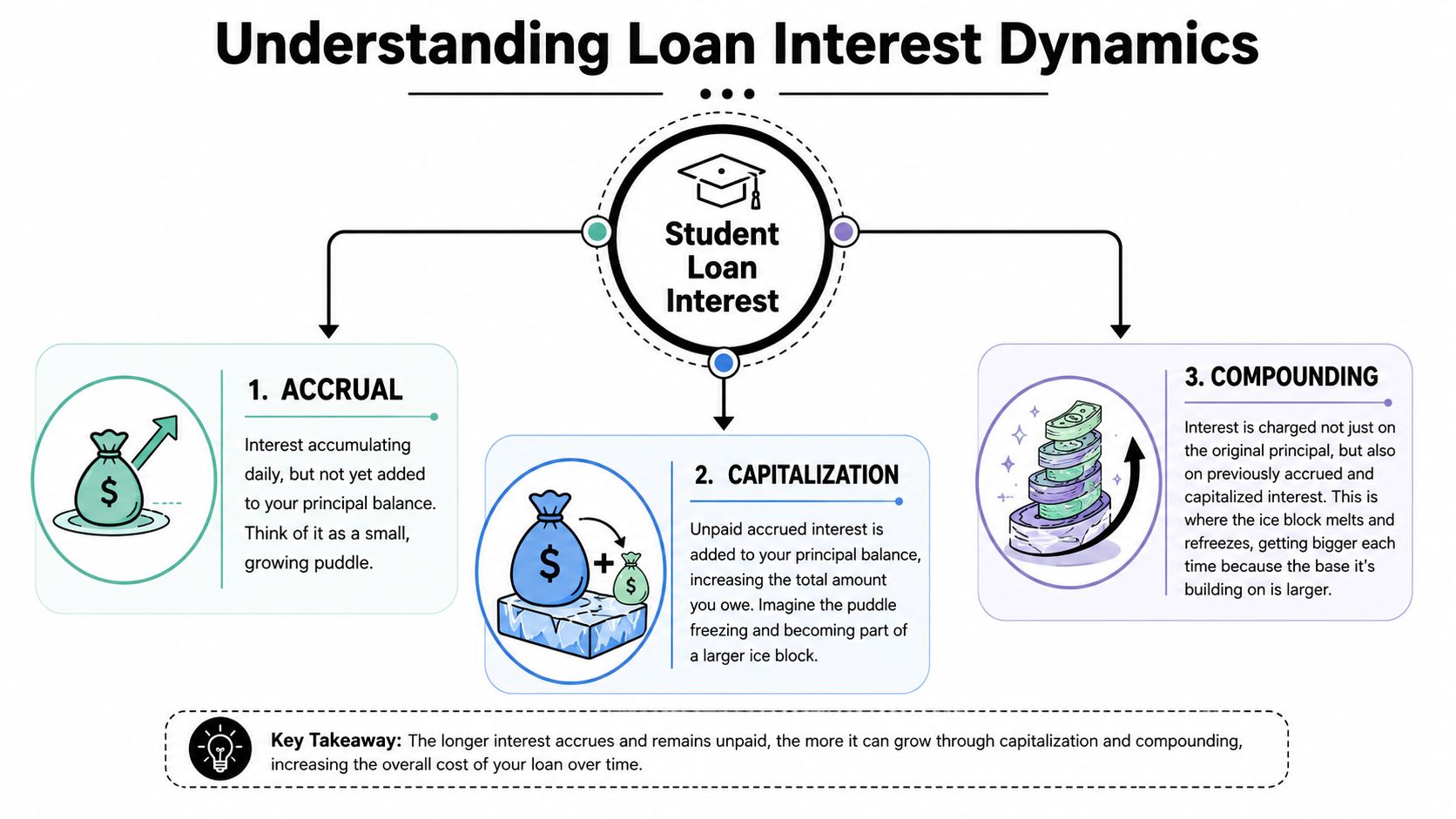
Accrual means interest is building, but principal has not changed
Accrual is the day-by-day growth of unpaid interest. On a simple-interest student loan, that interest is calculated from the current principal balance.
Accrual: interest accumulates over time, but it is still separate from principal until a capitalization event occurs.
That distinction matters in residency. A PGY-2 on an income-driven plan may have a required payment that does not fully cover monthly interest. The balance can look worse each month even though the loan has not yet converted that unpaid interest into new principal.
Capitalization raises the amount future interest is based on
Capitalization happens when unpaid accrued interest is added to principal. After that, future interest is calculated on the higher balance.
Capitalization: unpaid interest becomes part of the loan principal, increasing the base used for future interest charges.
This is the point that changes outcomes for physicians, dentists, and other high-earning clinicians. A few years of unpaid interest during residency and fellowship can sit in a separate bucket for a while. Once a trigger pushes that amount into principal, the cost of carrying the loan rises for the rest of repayment unless you move aggressively to pay it down or refinance.
That is why two attendings with the same original debt can leave training with very different balances. One used a repayment plan that limited damage and avoided unnecessary capitalization events. The other stacked up unpaid interest through forbearance or plan changes and started attending life with a much larger principal.
Common clinician pressure points include:
- The end of school, grace, or certain training-related pauses: unpaid interest may be capitalized.
- Deferment or forbearance: interest can accrue for months, then be added to principal depending on the loan and program rules.
- Repayment plan changes or consolidation: some transitions can convert outstanding interest into principal.
Compounding is a separate formula
True compounding means the loan's standard interest calculation already charges interest on prior interest. That is different from simple accrual followed by occasional capitalization.
Many federal borrowers use the word "compound" because the balance keeps rising. In strict terms, federal student loans use simple daily interest, and the larger cost usually comes from capitalization events, not ongoing compound interest by formula. Some private loans are different, which is why contract terms matter.
Here is the practical breakdown:
| Term | What happens | Why clinicians should care |
|---|---|---|
| Accrual | Interest builds over time | Low training payments may not keep up, which increases unpaid interest |
| Capitalization | Unpaid interest is added to principal | A resident can finish training with a much larger base balance |
| Compounding | Interest is charged on prior interest by formula | Some private loan contracts can grow faster than expected |
For high-income professionals, this is not just vocabulary. It is a timing problem. If you plan to pursue FIRE, cut back clinically, or choose a lower-paying attending role with better hours, avoiding capitalization during training preserves more flexibility later.
How Federal and Private Loans Handle Interest
Federal and private student loans can produce very different outcomes during a long medical training path, even when the starting balance looks similar.
For clinicians, that difference matters most in residency and fellowship. Low required payments, repeated status changes, and years of delayed full repayment create the conditions for balance growth. The interest formula is only part of the story. The contract rules and program rules determine how expensive those years become.
Federal loans follow a standard framework
Federal student loans, including Direct Unsubsidized and Grad PLUS, use simple daily interest. Interest accrues on the principal balance. It does not continuously compound as the standard formula.
That standardization helps. A resident with mostly federal debt can usually model the loan behavior with reasonable accuracy, especially if the repayment plan is clear from the start.
The catch is not the math. It is the timing.
Federal loans come with repayment programs that can keep payments low during training, but unpaid interest can still build in the background. For a physician who spends three to seven years in residency and fellowship, that accumulated interest can become a larger problem than the stated rate itself. The loan may be simple-interest on paper and still become far more expensive after capitalization events.
Private loans require a closer read
Private loans are less uniform. Many use simple interest, but some contracts allow interest treatment that is harsher than what borrowers expect from federal loans. The promissory note controls the answer, not the lender's marketing summary.
This is a common blind spot for clinicians with a mixed debt stack. A borrower may have federal loans from medical school and private loans from a post-bacc program, relocation costs, board exam expenses, or undergraduate borrowing. Those loans may not behave the same way during deferment, forbearance, or school-related status changes.
A fixed rate does not automatically mean a predictable cost.
Private lenders may also offer fewer safety valves if training runs longer than expected or if an attending decides to cut income for family time, part-time practice, or an early path toward financial independence. That trade-off matters just as much as rate.
Review private student loans the same way you review a physician employment agreement. Rate matters, but so do capitalization terms, deferment rules, cosigner release terms, and what happens if your career path changes.
Federal vs Private Student Loan Interest Rules
| Feature | Federal Loans (e.g., Direct, Grad PLUS) | Private Loans |
|---|---|---|
| Base interest structure | Simple daily interest | Varies by lender |
| True compounding | No, not as the standard formula | Possible in some products |
| Capitalization risk | Yes, after certain repayment events | Yes, depends on contract terms |
| Repayment flexibility | Broad federal program options | Lender-specific |
| Need to read the note closely | Moderate | High |
For high-income professionals, the practical distinction is straightforward. Federal debt usually creates problems through unpaid interest and capitalization during training. Private debt can do that too, but it can also carry less favorable contract mechanics from the start.
That is why refinancing after training should never be framed as a rate-only decision. The right move depends on your specialty, training length, PSLF eligibility, expected attending income, and whether your larger goal is rapid payoff, earlier work optionality, or a lower-stress career setup.
The Capitalization Triggers Every Clinician Must Know
Capitalization usually hits at the worst possible time for a clinician. Not because the rules are hidden, but because the trigger shows up during a transition when your attention is on training, licensing, a new baby, a cross-country move, or the first real attending contract.
For physicians, the biggest risk window is long training. A three-year residency is one thing. Add fellowship, research time, or a chief year, and unpaid interest can sit on the sidelines for years before it gets added to principal. Once that happens, the balance starts generating interest on a larger base. That can delay payoff, weaken your refinancing options, and make part-time work or an early path to financial independence harder to afford.
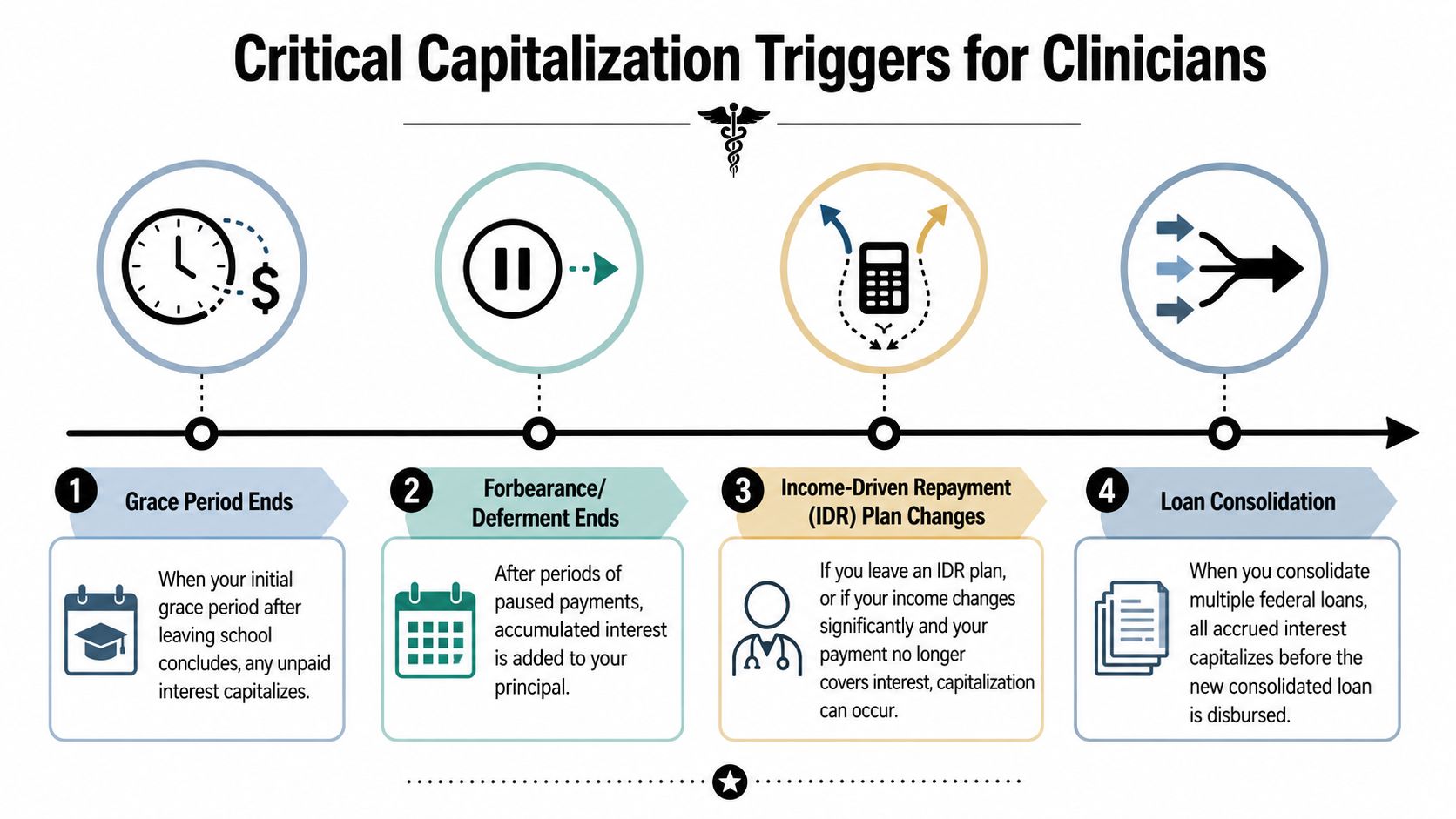
Four moments deserve special attention
The grace period ends
After school, interest that built up during the grace period can be added to principal. That often happens before a new doctor has finished relocating, credentialing, or setting up a residency budget. A small balance increase here can follow you for years.A forbearance or deferment ends
This is a common mistake during residency and fellowship. The payment pause feels useful in the moment, especially on a resident salary. But interest keeps accruing, and the bill can show up later as a larger principal balance. For clinicians with six figures of debt, repeated pauses are rarely harmless.You leave or switch repayment plans
Low payments can preserve cash flow during training. They can also leave unpaid interest behind. If you later switch plans, fail to recertify income on time, or exit a repayment structure that had kept that interest separate, capitalization can follow. The result is not just a higher balance on paper. It raises the cost of carrying the loan into your attending years.You consolidate
Consolidation can be the right move. It may simplify servicers, align loans for a federal strategy, or clean up older loan types. But accrued interest can be folded into the new principal. For a clinician pursuing PSLF, that trade-off may be acceptable. For a high-income specialist planning aggressive payoff after training, it may be an expensive convenience.
One date missed can cost more than one payment missed.
Why clinicians feel this more than other borrowers
Many professionals see income rise quickly after school. Physicians often do not. The gap between graduation and full earning power can stretch across residency, fellowship, and the early attending years when retirement savings, a home purchase, childcare, and insurance costs all start competing for cash flow.
That is why capitalization matters beyond loan math. A larger balance can push an attending to keep moonlighting longer, delay dropping to 0.8 FTE, or postpone a move to a lower-stress practice setting. For borrowers targeting FIRE, work optionality, or more family time, those extra years of interest are not abstract. They reduce flexibility.
The practical move is to treat every transition date as a financial decision point. Before a grace period ends, before requesting forbearance, before consolidating, and before changing repayment plans, check whether unpaid interest will capitalize and decide if the short-term relief is worth the long-term cost.
A Tale of Two Residents A Worked Example
A resident can finish training with the same degree, the same specialty trajectory, and a very different loan balance. Capitalization is often the reason.
Suppose two physicians each leave school with $50,000 at 6% in federal loans. Their incomes during residency are similar. Their stress level is similar. What changes is how they handle the interest that builds during training.

Dr. Passive
Dr. Passive does what many trainees do. He keeps cash available for rent, board fees, licensing, moving costs, and basic survival. During residency and fellowship, required payments do not fully cover accruing interest.
That unpaid interest sits in the background for years. Then a repayment change or another capitalization event hits, and the balance jumps. Interest is now charged on a larger principal.
Using the same example discussed earlier, a $50,000 loan at 6% can end up above $60,000 over time once unpaid interest is capitalized, even without meaningful progress on principal. For a clinician with a long training path, that larger starting balance can shape the first five attending years more than people expect.
A bigger loan balance does not just mean a bigger monthly payment. It can mean delaying a home purchase, postponing part-time work, or feeling forced to take the highest-paying job instead of the better-fit job.
Dr. Proactive
Dr. Proactive also has a resident budget. She is not trying to eliminate the debt during training. She is trying to stop avoidable balance growth.
That usually means choosing from a short list of practical moves:
- Cover some or all monthly interest when cash flow allows
- Use income-driven repayment strategically instead of defaulting to forbearance
- Pay down accrued interest before a known capitalization event, if a transition is coming
- Save aggressive payoff for attending years, when income supports it
This is the key trade-off. Every dollar sent to loans during residency is a dollar that cannot go to an emergency fund, relocation costs, or retirement matching. But every dollar of unpaid interest that later capitalizes becomes harder to eliminate because it starts generating interest of its own.
For high-income professionals, that trade-off deserves precision. A future surgeon, anesthesiologist, or dermatologist planning rapid payoff after training should usually care more about preventing capitalization than about making arbitrary small principal payments. A borrower pursuing PSLF may accept some balance growth if it supports forgiveness. The right move depends on the endgame.
A resident does not need a heroic repayment plan. A resident needs to avoid expensive mistakes that follow them into attending life.
The difference that matters
Both physicians worked through the same brutal training years. One reaches attending income with less drag.
That creates options. The physician with the lower capitalized balance can refinance more aggressively, hit FIRE targets sooner, cut back to 0.8 FTE earlier, or choose a practice setting with better hours and less call pressure.
The lesson isn't that every trainee should send every spare dollar to loans. The lesson is that long training periods magnify capitalization, and small preventive choices during residency can protect far more flexibility later.
Strategies to Minimize Interest and Accelerate Payoff
A good loan strategy for a clinician is built around timing. Residency and fellowship are usually the years when interest grows fastest relative to income. Attending years are when you finally have the cash flow to change the trajectory. The mistake is treating those phases the same.
The practical objective is simple: keep accrued interest from turning into a larger principal balance whenever possible, then use attending income with intention.
Pay interest during training if the numbers work
For many residents and fellows, the highest-return payment is not an aggressive principal attack. It is covering some or all of the monthly interest before a capitalization event hits.
That does not mean living like a monk or skipping a needed emergency fund. A PGY-2 with thin cash reserves should not send every extra dollar to servicers while carrying credit card risk or unstable housing costs. But a trainee with moonlighting income, a working spouse, or a modest cash cushion can often prevent expensive balance growth with small, targeted payments.
Good times to consider this move:
- During grace periods, if unpaid interest is building and cash flow is available
- During fellowship, especially in long training tracks where several years of accrual can stack up
- Before changing repayment plans or leaving a period of reduced payments, if accrued interest is sitting on the loan
For physicians with long training, this matters more than it does for many other borrowers. A three-year residency is one thing. A seven-year residency plus fellowship creates enough time for unpaid interest to materially change what your first attending years feel like.
Do not refinance federal loans too early
Refinancing can improve the math fast for the right borrower. A lower rate, shorter term, and cleaner payoff plan often work well once attending income is stable.
The price is loss of federal protections. That includes income-driven options and forgiveness paths tied to federal loans. For a clinician who may work at a nonprofit hospital, academic center, VA system, or large tax-exempt employer, giving that up too early can close off a valuable path.
Use a stricter filter than "the rate looks better."
| Situation | Usually stronger move |
|---|---|
| Clear PSLF path or strong chance of nonprofit employment | Keep federal loans |
| Private practice or employed private-sector role with stable income and no need for federal safeguards | Run a refinance analysis |
| Burnout risk, uncertain specialty fit, possible job change, or desire for part-time flexibility | Delay refinancing until the career path is clearer |
I see this often with physicians chasing FIRE or a lower-clinical-load career. They assume refinancing immediately is always the disciplined move. It is only disciplined if it matches the actual career plan.
Choose a payoff method you will still follow after a brutal month
High-income borrowers usually save more with an avalanche approach. Target the highest-rate loan first and keep minimum payments on the rest. That is usually the cleanest way to reduce total interest.
Behavior still matters. A borrower with one small private loan at a moderate rate may benefit from clearing it for focus and administrative simplicity, then switching to avalanche. The best plan survives post-call fatigue, a new contract, childcare costs, and the first tax bill that comes in higher than expected.
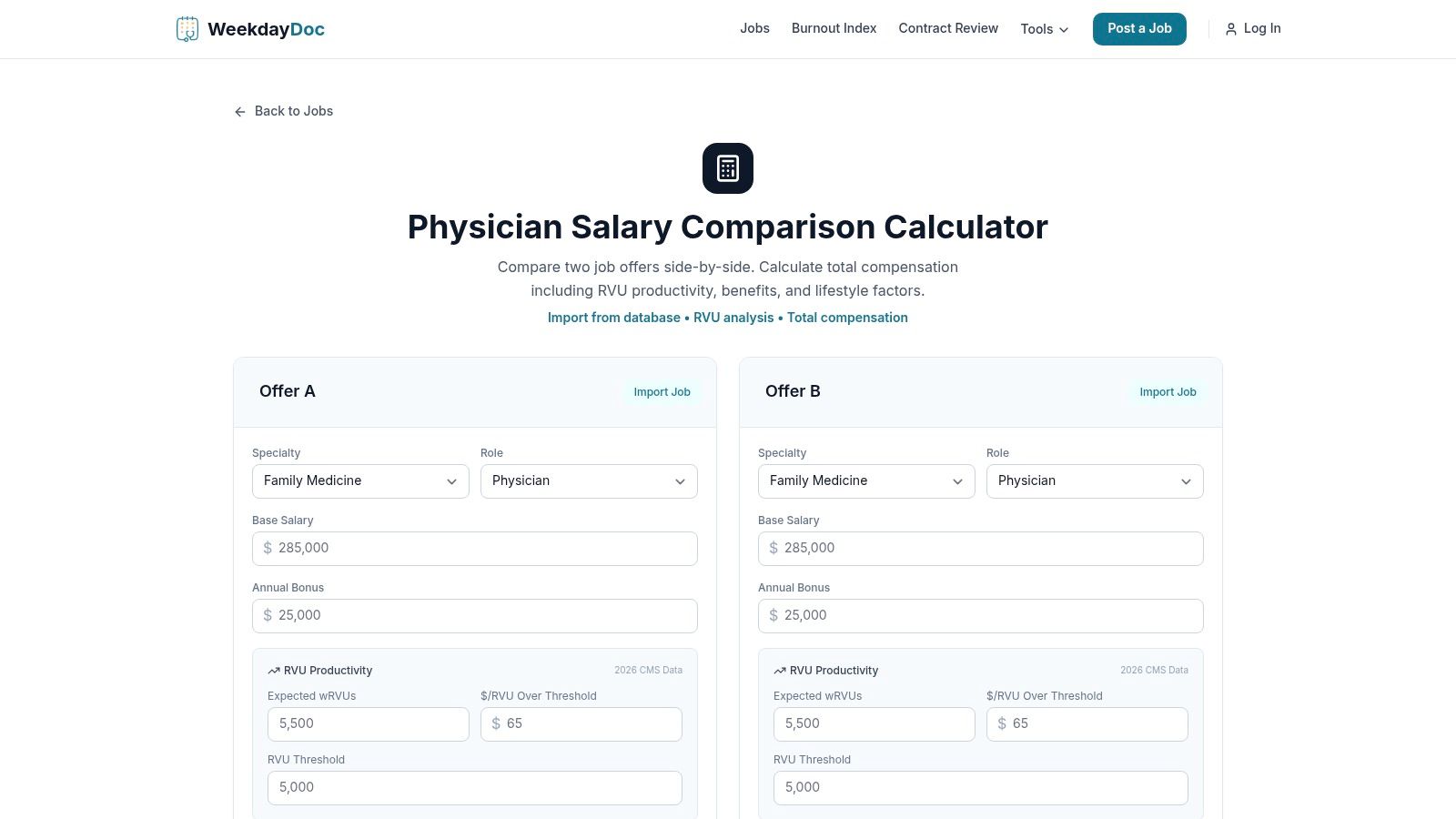
To model how debt payoff interacts with take-home income and long-term planning, use a structured tool such as the Salary & FIRE Calculator, the RVU Calculator, or the Contract Scanner. If you're comparing offers with different compensation structures, the Market Pulse salary pages can help estimate how much room you have for principal reduction.
A short explainer on repayment trade-offs is worth watching before you lock yourself into a path:
Use the first attending income jump on purpose
Early attending cash flow disappears quickly. Sign-on bonuses get absorbed by relocation, delayed lifestyle upgrades, insurance, furniture, taxes, and the understandable urge to breathe after training.
Assign that money before it lands.
For most high-income clinicians, the first major income jump has three rational uses:
- Build liquidity if cash reserves are weak
- Pay off accrued interest or clean up a capitalization risk
- Attack principal aggressively once the loan structure is settled
The order matters. A physician with no emergency buffer should not empty a signing bonus into loans and then reach for a credit card after a cross-country move. A physician who is committed to private practice and rapid payoff should not drift through the first 12 months making minimum payments while the new salary gets absorbed into lifestyle inflation.
For broader career-finance thinking, clinicians often benefit from reading practical guides on physician contract red flags, then comparing that against their debt plan. The loan strategy has to fit the work schedule, employer type, and income ceiling you are choosing.
A strong repayment plan is not the one that looks toughest on paper. It is the one that protects flexibility during training, limits avoidable capitalization, and lets attending income buy back time, autonomy, and options.
Connecting Loan Strategy to Career and Life Design
A well-run student loan plan buys more than lower interest cost. It buys freedom.
When you keep capitalization under control, you reduce the odds that debt forces your hand later. That can mean saying yes to a nonprofit role that fits PSLF. It can mean taking a weekday-only job with less stress. It can mean reducing clinical volume sooner because your fixed financial burden is lower.
The point of debt strategy isn't to win a spreadsheet contest. It's to create room for a better clinical career and a better life outside work.
Clinicians often frame repayment as an isolated problem. It isn't. Loan structure affects how aggressively you need to negotiate salary, whether you can tolerate a lower-RVU position, how quickly you can build taxable investments, and whether FIRE remains realistic on your chosen timeline.
If you're asking whether student loan interest compounds, you're asking the right question. Just stop one step too early if you end there. The sharper question is whether your repayment path allows avoidable interest to become principal during the years when your career is still taking shape.
Control that, and you gain options. Ignore it, and the loan starts shaping your choices for you.
If you're looking for a role that supports both debt payoff and sanity, explore WeekdayDoc. The platform helps physicians, NPs, PAs, psychologists, and other clinicians find burnout-friendly jobs with clear schedule expectations, including remote, hybrid, and no-call options, so your financial plan and your work-life plan can point in the same direction.