Neuro Nurse Practitioner Salary: Your 2026 Guide
Explore the 2026 neuro nurse practitioner salary range, key pay drivers, and negotiation tips for finding a sustainable, high-paying role without the burnout.

Neuro nurse practitioners earn an average base salary of $106,339 in 2026, with specialty-specific averages of $114,398, a typical range of $81,000 to $145,000, and experience-based progression from about $100,000 at entry level to $125,000 with 10 to 20 years in practice. That makes the neuro nurse practitioner salary strong enough to support serious financial goals, but only if you build your career in a way that protects your time, your energy, and your ability to stay in the field.
A lot of salary articles stop at the headline number. That’s rarely the question clinicians have. Most of us want to know whether neurology can pay well enough to justify the complexity, and whether we can earn that income without getting trapped in a role built around call, weekends, and constant inbox spillover.
Neurology can be a good lane for that. The specialty rewards pattern recognition, continuity, and deep clinical expertise. It can also create very different lifestyles depending on whether you work in inpatient stroke, outpatient subspecialty clinic, academic medicine, or telehealth. The paycheck matters. The structure around the paycheck matters just as much.
Understanding the Neuro NP Salary Landscape in 2026
A six-figure income can still produce a poor long-term outcome if the job keeps taking back your evenings, weekends, and recovery time. That is the core salary question in neurology.
Neuro NP pay in 2026 remains strong enough to support aggressive debt payoff, retirement contributions, and a realistic path toward financial independence. The more useful question is how much of that income you keep, in both money and energy, after call burden, inbox work, and schedule volatility are factored in.
I have seen clinicians accept a higher offer, then realize six months later that the extra pay was covering chronic after-hours charting, weekend coverage, and a pace they could not maintain. A slightly lower salary in a weekday outpatient role can outperform that setup over five years because it lowers burnout risk and keeps your earning years intact.
That is why salary should be viewed as part of a career design problem, not just a compensation number. If you are comparing offers, run the numbers through a salary calculator for nurse practitioners and physicians and estimate what your hourly reality looks like once unpaid time, commuting, and benefit costs are included.
Why the headline number falls short
Neurology is not one job. It is a group of roles with very different demands.
An outpatient epilepsy or headache position may offer predictable clinic hours, cleaner boundaries, and enough consistency to support side investing, family life, or part-time consulting. An inpatient stroke or hospital-based neuro role may pay more, but that premium often comes with call, weekend rotation, discharge pressure, and less control over your day.
Those trade-offs matter more than many clinicians expect. Salary on paper does not capture the hidden tax of message volume, refill work, late add-ons, or the mental load of staying half-on after hours.
Use three practical filters when judging any neuro NP offer:
- After-hours workload: Count charting, patient messages, refill management, and call expectations.
- Schedule control: Stable weekday hours usually create more usable life than rotating shifts or unpredictable service coverage.
- Sustainability: The better-paying role only wins if you can still do it well in three to five years.
Practical rule: A strong neuro NP job pays well enough to build wealth and leaves enough margin to keep practicing without constant depletion.
Where salary fits into a sustainable career
Neurology can support a solid financial plan because compensation is usually high enough to create a savings gap between what you earn and what you spend. That gap is what funds debt reduction, retirement accounts, brokerage investing, and eventually more freedom in how you practice.
For clinicians thinking about FIRE, the best move is often choosing the role that protects consistency. Consistent work beats short bursts of high pay followed by exhaustion, reduced hours, or a full specialty exit. In practice, that may mean choosing no-call outpatient neurology, telehealth follow-up work, or a subspecialty clinic with cleaner boundaries instead of the highest posted number.
The neuro nurse practitioner salary matters. Career durability matters just as much.
Deconstructing the Average Neuro NP Salary
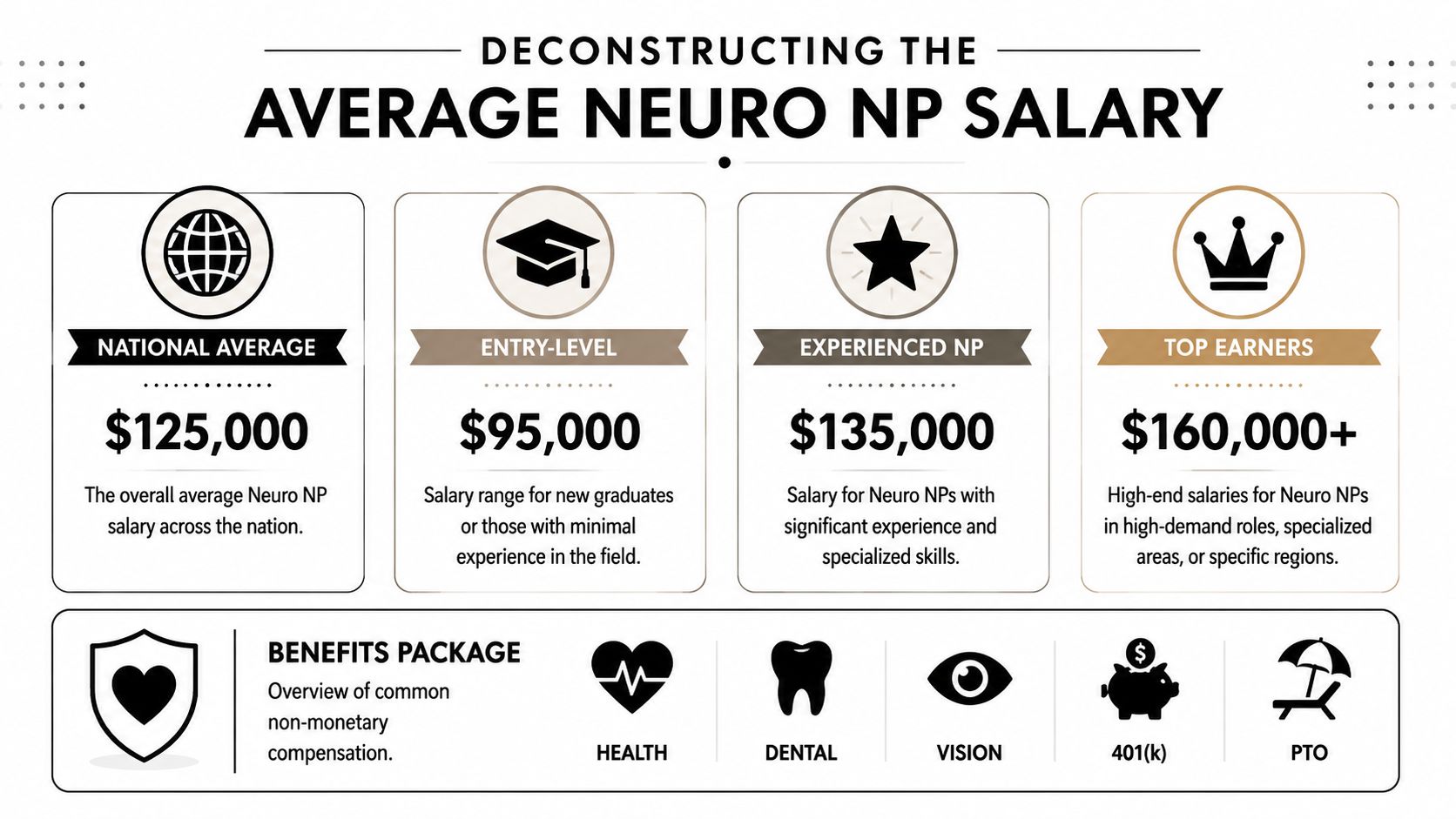
A spread from roughly $81,000 to $145,000 is wide enough to make any single “average” salary less useful than it first appears. For neuro NPs, the number matters less than the job sitting underneath it.
As noted earlier, reported figures place average base pay around $106,339, with neurology-specific compensation data also showing $114,398 in practice-level reporting. Entry-level compensation clusters near $100,000, while clinicians with about 10 to 20 years of experience report earnings closer to $125,000.
What an average actually means
Average salary is a reference point, not a target rate and not a verdict on whether an offer is fair.
In neurology, that number blends together new graduates, seasoned subspecialty clinicians, academic roles, hospital-based jobs, outpatient clinics, and markets with very different payer mixes. It also ignores how the work is structured. A $120,000 offer with clean follow-up templates, protected admin time, and no call can be financially stronger over five years than a higher-paying job that burns through your evenings and pushes you toward early exit.
Use the average as a screening tool. Then examine the job on its own terms.
| Salary view | What it tells you |
|---|---|
| Average base salary | A midpoint you can use for first-pass market comparison |
| Low end of range | Offers tied to weaker markets, less experience, or less favorable job design |
| High end of range | Roles that reflect stronger demand, harder-to-find expertise, or expensive metro areas |
| Experience progression | How compensation tends to rise as you become easier to hire and harder to replace |
That framework prevents two common mistakes. Clinicians sometimes reject a reasonable offer because it sits below the headline average. Others accept a higher number without accounting for call, refill volume, inbox burden, or poor retirement benefits.
Base salary is not the whole package
Base pay is only one part of the compensation math. The contract also determines how much of your time stays your own.
For a neuro NP, total compensation usually includes retirement match, CME funds, PTO, licensing support, productivity pay, schedule control, and paid or unpaid administrative work. Those details directly affect your hourly reality. They also affect whether you can keep investing steadily, avoid cutting back later, and build enough financial margin to have choices.
I would generally take a slightly lower salary for a role with protected charting time, realistic patient volume, and no routine after-hours spillover. That trade-off often produces a better effective hourly rate and a career you can sustain long enough to reach real financial independence.
If you want to compare offers in a way that includes both income and long-term planning, use a tool built for side-by-side modeling such as the salary and FIRE calculator for clinicians.
Geography can distort the average
Location can push salary up fast. It can also erase the gain just as fast.
Reported high-pay markets include Bellevue, Washington at $161,838, Brooklyn, New York at $148,982, and New York City at $147,530, as noted earlier in the article. Those numbers get attention, but they do not settle the underlying question. Higher housing costs, longer commutes, heavier clinical demand, and less control over your day can narrow or wipe out the advantage.
A better lens is income after lifestyle costs. Ask what remains after housing, taxes, childcare, commuting, and the energy required to do the job well. That is the number that determines whether a role supports debt payoff, investing, and enough personal time to stay in neurology for the long haul.
Key Drivers That Increase Your Earning Potential
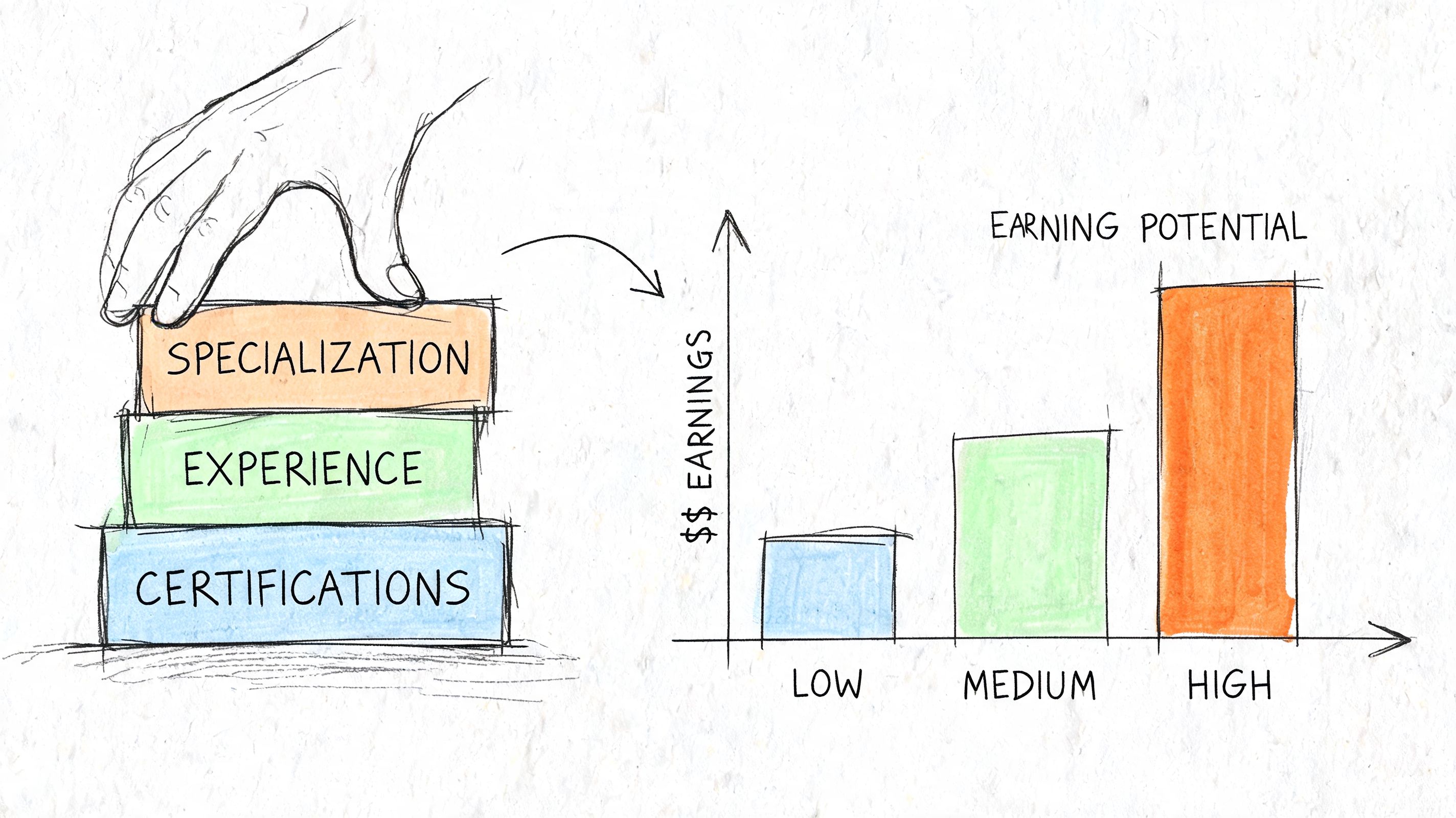
Not every neuro NP has the same earning power. Salary changes when you bring a harder-to-replace skill set, when you work in a market that pays a premium, and when your experience lowers the amount of supervision or training an employer has to provide.
Across major reporting platforms, neurology-specific positions average $114,398, while broader acute care NP roles range from $118,480 to $131,925, with the specialty showing a market position just below some broader acute care benchmarks. The reported annual compensation range across major databases is $118,480 to $131,925, and the $145,000 ceiling reflects about 37% growth potential above entry-level baselines, according to Indeed salary data for neurology nurse practitioner roles.
Experience still moves the needle
This is the simplest driver, and it’s still the most important. Employers pay more when they believe you can handle diagnostic ambiguity, manage follow-up independently, and keep clinic moving without constant escalation.
Early in your career, your negotiating power is usually narrower. Once you’ve built a track record in a neurology service line, your value becomes easier to defend. You’re no longer just filling a seat. You’re reducing ramp-up time, lowering supervision drag, and carrying continuity.
Geography can help, but it can also trap you
Geographic premiums are real, but they’re not free money. Higher-paying metro areas often come with higher housing costs, longer commutes, and more aggressive pace expectations. If your goal is lifestyle plus wealth building, don’t assume the highest nominal pay wins.
A lower-cost area with a stable outpatient role may leave you with more discretionary cash and less fatigue than a bigger urban salary attached to a brutal schedule.
Specialized focus creates bargaining power
Not all neurology experience is interchangeable. Employers often place more value on clinicians who can step into a defined niche and start contributing quickly. In practice, that may mean experience in areas such as:
- Epilepsy and seizure care. Follow-up-heavy practices value clinicians who can manage medication adjustment and longitudinal monitoring.
- Headache medicine. High-volume outpatient services often need NPs who can work efficiently without sacrificing visit quality.
- Movement disorders or memory care. These clinics rely on nuanced assessment and continuity, which makes experienced clinicians harder to replace.
- Stroke and inpatient neurology. Acute settings can pay more, but they often demand more in schedule intensity.
Market signal: The more specific your neurology skill set, the easier it is to argue that you’re not comparable to a general NP applicant pool.
Credentials matter when they prove usability
Certifications don’t create value by themselves. They help when they make an employer more confident that you can function at a higher level, teach others, or grow into a subspecialty lane with less onboarding friction.
That’s also why some clinicians benefit from postgraduate specialty training or a focused transition role before taking a permanent position. The salary may not peak immediately, but your negotiating position often improves once you have a clean narrative around what you do well and where you add value.
How Work Setting Shapes Your Salary and Lifestyle
Work setting changes almost everything about a neuro nurse practitioner salary. Two offers with similar compensation can produce completely different lives depending on patient flow, call structure, autonomy, and how much hidden work follows you home.

If you’re exploring settings broadly, the WeekdayDoc guide to where nurse practitioners work is a practical overview of how role design changes from one environment to another. In neurology, those differences get very pronounced.
Academic and hospital-based roles
Academic centers and large health systems usually offer name recognition, subspecialty exposure, and a clear operational structure. They can be excellent places to build neuro-specific depth. They can also come with heavier bureaucracy, more committees, and more pressure to absorb uncompensated tasks.
Hospital-based neurology often pays for complexity. The trade-off is obvious. Coverage demands are usually harder, inpatient flow is less predictable, and call or weekend obligations are more likely to appear somewhere in the job design.
Private practice and outpatient specialty clinics
Outpatient private practice can be the best fit for clinicians who want a cleaner workweek. In the right clinic, you get focused patient populations, fewer overnight disruptions, and more control over the rhythm of the day.
The downside is that these jobs vary widely. Some practices run efficient schedules with clear support staff and realistic message management. Others offload refill volume, prior authorizations, and endless inbox cleanup onto the NP.
A private practice offer deserves close inspection in these areas:
- Template design. A manageable schedule matters more than a glossy salary quote.
- Support staff. Good MAs, RNs, and prior auth support protect your time.
- Message burden. Portal work can turn a weekday job into an evening job.
- Call expectations. “Minimal call” often still means call.
Telehealth and burnout-friendly arrangements
Telehealth has opened another lane for neurology-adjacent and follow-up-heavy care, especially in settings built around continuity rather than acute procedural demand. These roles can be attractive for clinicians who want schedule stability, geographic flexibility, and fewer workplace interruptions.
That said, remote work isn’t automatically easier. A poorly run telehealth role can pack the day too tightly, monitor productivity aggressively, and create a different kind of fatigue. The good versions usually have clear visit types, realistic scheduling, and explicit boundaries around after-hours work.
If a role advertises flexibility but won’t define patient volume, message expectations, or schedule control, that flexibility may not be real.
For many clinicians, the best compensation-to-lifestyle ratio comes from a focused outpatient or remote role with no call, no weekends, and enough clinical variety to stay engaged. It may not be the highest gross salary available, but it often wins on career durability.
Effectively Negotiating Your Salary and Benefits
Most neuro NPs under-negotiate because they focus too narrowly on the salary line. Employers know that. They’ll often protect the base while leaving room in other parts of the package that matter just as much.

A stronger negotiation starts before the offer arrives. You need a short, credible case for why your training, setting fit, and neurology skill set reduce risk for the employer and improve continuity for patients.
Build your case before you counter
Don’t walk into negotiation saying you “feel” the offer should be higher. Show why.
Use concrete points such as your subspecialty clinic experience, your ability to manage a defined patient population, your comfort with independent follow-up, and your efficiency in documentation and care coordination. Employers respond better to replacement cost and operational value than to generic salary frustration.
Here’s the checklist I’d use:
- Define your clinical lane. Be specific about what neurologic populations you can manage well.
- Name the friction you reduce. Mention onboarding ease, continuity support, or reduced physician escalations when true.
- Clarify your schedule priorities. It’s easier to negotiate call, admin time, and visit structure before signing than after.
- Know your walk-away points. If weekends, inbox burden, or RVU pressure will burn you out, treat that as contract material, not a personal inconvenience.
Negotiate the job, not just the paycheck
A sustainable contract usually comes from negotiating several smaller items well. In practice, that may include:
- Protected admin time. This is one of the cleanest burnout reducers in outpatient neurology.
- CME funding and paid CME time. Especially important if you’re building subspecialty depth.
- Schedule boundaries. Ask how refills, patient messages, and urgent callbacks are handled.
- Call language. Verbal reassurance isn’t enough. If there’s no call, the contract should say so.
- Ramp expectations. New clinicians should ask for a sane onboarding plan.
Offer rule: If an employer says, “We’ll figure that part out later,” assume the burden may land on you.
A structured framework helps. The WeekdayDoc guide to evaluating job offers is one example of a tool that organizes compensation, schedule, and burnout risk in one decision process.
This short video is also useful if you want a practical overview before your next offer discussion:
Phrases that work better in real negotiations
You don’t need to posture. You need to be clear.
Try language like this:
- On compensation. “Based on my neurology experience and the scope of this role, I’d like to discuss whether there’s room to improve the base.”
- On admin burden. “I can support this panel more effectively if admin time is built into the schedule.”
- On call. “I want to clarify whether call is expected, how often, and whether that’s compensated.”
- On sustainability. “I’m looking for a role I can commit to long term, so schedule structure matters as much as base salary.”
That framing is professional and hard to dismiss. It also signals that you’re negotiating as a clinician who understands retention, not as someone casually asking for more money.
Using Your Salary to Build a Sustainable Career
A good neuro nurse practitioner salary should do more than cover bills. It should buy options. Options to work fewer shifts later, to leave a bad job without panic, to absorb family needs, or to move toward financial independence on your own timeline.
The biggest mistake I see is clinicians using salary growth to justify increasingly unsustainable work. More income helps, but only if some of it turns into retained flexibility. If every raise is tied to more call, more patients, and more spillover into personal time, your financial life may improve while your actual life gets worse.
Turn income into freedom
Use your salary as a planning tool. That means deciding early what the money is for.
For some neuro NPs, the first priority is debt reduction. For others, it’s building a cash buffer so they can leave a poor-fit role without feeling trapped. For clinicians thinking about FIRE, the key is consistency. A stable, burnout-resistant role often supports long-term wealth better than an intense job that pays more but shortens your runway in the profession.
Vet jobs for durability
Before you accept a role, ask whether the structure supports the life you want. The right questions aren’t complicated:
- Will this schedule still work for me in two years
- Can I do this without sacrificing evenings and weekends
- Is the compensation enough for my goals without forcing chronic overwork
- Does the employer define workload clearly
That’s where practical job-search tools can help. WeekdayDoc is a physician-founded platform that lists burnout-friendly clinician roles with salary data, FIRE projections by state, and a Burnout-Friendly Score, including filters for no-call and no-weekend jobs. For neuro NPs who care about both income and sustainability, that kind of screening is more useful than salary alone.
The true win in neurology isn't squeezing every possible dollar out of the next contract. It's building a career that pays well, stays clinically interesting, and leaves enough of you intact to enjoy the life that salary is supposed to support.
If you’re looking for neurology and other clinician roles that prioritize work-life balance, explore WeekdayDoc. It’s built for clinicians who want transparent salary details, weekday-friendly jobs, and a clearer path to financial independence without defaulting to call-heavy work.