Achieving work life balance doctor: A Path to Career Freedom
Discover work life balance doctor strategies with practical scheduling, career tips, and financial planning to prevent burnout.

If you want a better work-life balance, you have to start with a clear diagnosis of the problem. That means moving beyond just feeling "tired" and doing a frank self-audit to figure out the specific sources of your burnout.
Is it the brutal on-call schedule? The soul-crushing administrative overload? The sheer emotional weight of patient care? Nailing this down is the only way to create a plan for change that actually works.
Pinpointing the Real Causes of Your Burnout

Before you can build a sustainable career, you have to understand what's breaking the one you have now. Too many of us know we're exhausted, but we haven't stopped to really dissect the why. Is it the patient volume, the emotional drain from tough cases, or the classic "death by a thousand clicks" from the EMR?
Physician burnout isn’t just a personal failing; it's a systemic crisis. Recent data shows nearly 50% of physicians report feeling burnt out. While that's a slight dip from the pandemic-era peak of 63%, it's still a massive problem. The drivers are clear: crushing patient loads and an insane administrative burden from prior authorizations, charting, and claim denials.
This isn't about blaming yourself. It's about gathering your own data to turn that vague feeling of being overwhelmed into concrete facts you can actually do something about.
Conducting Your Personal Burnout Audit
Think of this as taking a patient history, but for your own career. The goal is to get specific. "I'm always tired" is a symptom. "I lose ten hours a week to charting after my kids are asleep" is a diagnosis.
For one full week, track your time. Be brutally honest. If you have an on-call shift or a weekend rotation, make sure you include it. Note not just the hours you work, but what you’re doing during those hours.
- Clinical Face Time: How many hours are you actually with patients?
- Admin & 'Pajama Time': Track every minute spent on charting, inbox messages, and insurance paperwork—especially after you've left the clinic.
- Commute: How much of your day is spent just getting to and from work?
- Unscheduled Interruptions: How often are you pulled away from personal time by unexpected calls, texts, or tasks?
This simple exercise can be a real eye-opener. A colleague of mine—a family doc—did this and was shocked to find that 35% of her "workday" was unpaid admin time bleeding into her evenings. That’s not a feeling; that's a quantifiable problem you can solve.
You cannot fix what you do not measure. A clear, objective baseline is the first step toward reclaiming your time and building a career that genuinely supports your well-being.
Using Tools for an Objective Baseline
Once you’ve tracked your time, using a structured tool can give you an objective score to measure your progress against. It helps quantify how severe the burnout is and pinpoints which factors are hitting you the hardest.
The WeekdayDoc Burnout Index is designed for this exact purpose. It gives you a clear score based on evidence-backed factors like workload, autonomy, and work-life conflict, giving you a real, tangible starting point.
It’s a quick, confidential way to see exactly where you stand. With this baseline, you have a powerful metric to guide your search for a role that actually fits your life.
Designing Your Ideal Medical Career and Lifestyle
Let’s be honest: true work-life balance for a doctor isn’t some mythical 50/50 split. It never has been. It’s about intentionally designing a professional life that actually fits with your personal life, not one that constantly battles it for time and energy.
So many physicians get stuck on wanting "fewer hours" without ever defining what they’d do with that time or what a better structure would look like. Let's move past that vague wish. The first real step is to take what you learned from your burnout audit and flip it into a positive, actionable vision. Stop focusing on what you want to escape and start defining what you want to build instead.
From Burnout Triggers to Career Non-Negotiables
Your burnout audit laid bare all the pain points—the pajama-clad charting sessions, the pager going off during dinner, the soul-crushing emotional toll. Now it’s time to turn those negatives into your personal blueprint for a sustainable career. This isn't just a wishlist; these are the firm, unshakeable requirements for any job you consider next.
A simple "Then vs. Now" table is a powerful way to make this concrete.
| What I Have Now (The Problem) | What I Want Instead (The Solution) |
|---|---|
| On-call every fourth night. | Absolutely no call shifts. Period. |
| Charting for 2 hours unpaid after hours. | A role with dedicated, paid admin time built in. |
| Chaotic, high-acuity inpatient setting. | A predictable outpatient or telehealth environment. |
| Working most weekends. | Weekends are completely protected for my family. |
This exercise isn't just for clarity—it builds your list of non-negotiables. These are the dealbreakers that will act as your guardrails during the job search, stopping you from accidentally walking right back into another burnout trap.
Envisioning Your Ideal Workday and Workweek
With your non-negotiables locked in, you can start painting a clearer picture of your ideal professional life. Think about the actual rhythm and structure of your days. Gaining control over your schedule is often far more impactful than just cutting total hours.
Get specific about these practical elements:
- Schedule Structure: Do you thrive on a predictable 9-to-5, or would you prefer packing your work into four 10-hour days for a three-day weekend? Maybe a three-day workweek is the real goal.
- Location Freedom: Is the daily grind of commuting and being physically present a major source of stress? A remote telehealth job could eliminate that entirely and give you true location independence.
- Pace and Intensity: Are you energized by the quick turnover of a busy clinic, or would you prefer a role that allows for longer, more thoughtful consultations? This could be the difference between a high-volume primary care role and a niche consultative practice.
For example, an ER physician exhausted by overnight shifts might define their ideal role as an urgent care position that's strictly 8 AM to 8 PM, with zero overnight duties. A surgeon might decide to leave the OR entirely for a medical device consulting role, swapping unpredictable hours for predictable, project-based work.
"I thought work-life balance was just about time... What I learned was that other things are what create balance. It is having a supportive community and a little more flexibility. The more control I have over my schedule, the better."
- Dr. Nicole Davey-Ranasinghe, Rheumatologist
Defining Your Professional Fulfillment
Here’s the thing—achieving a better work-life balance doesn't mean you have to check your professional ambition at the door. The goal is to find a role that aligns with both your lifestyle needs and your clinical passions. Your ideal career should still feel meaningful. It should still light you up.
Ask yourself what parts of medicine you actually, genuinely enjoy. Is it cracking the diagnostic puzzle? Building long-term patient relationships? The hands-on procedural work? Teaching residents?
By pinpointing these sources of professional joy, you can specifically target roles that maximize them while minimizing the soul-sucking tasks that drain you. This clarity is your most powerful tool. It’s how you build a career that not only pays the bills but also sustains your spirit for the long haul.
Finding Jobs That Genuinely Support Work-Life Balance
Once you have your personal blueprint, the job search stops feeling like an endless, frustrating scroll and becomes a targeted mission. You’re no longer looking for just any job. You’re hunting for the right job—one that honors your non-negotiables and fits the life you actually want to live.
The good news? You’re not alone in this. The demand for a better work-life balance for doctors is no longer a fringe request; it’s rapidly becoming the new standard.
In 2018, 63% of physicians fresh out of residency ranked work-life balance as their top priority. By 2022, that number had jumped to a staggering 85%. This isn't just a trend; it's a fundamental shift in what physicians expect from their careers, forcing employers to finally start offering sustainable roles. Your job is to find them.
This decision tree can help you map out that first big choice between a clinical and non-clinical path.
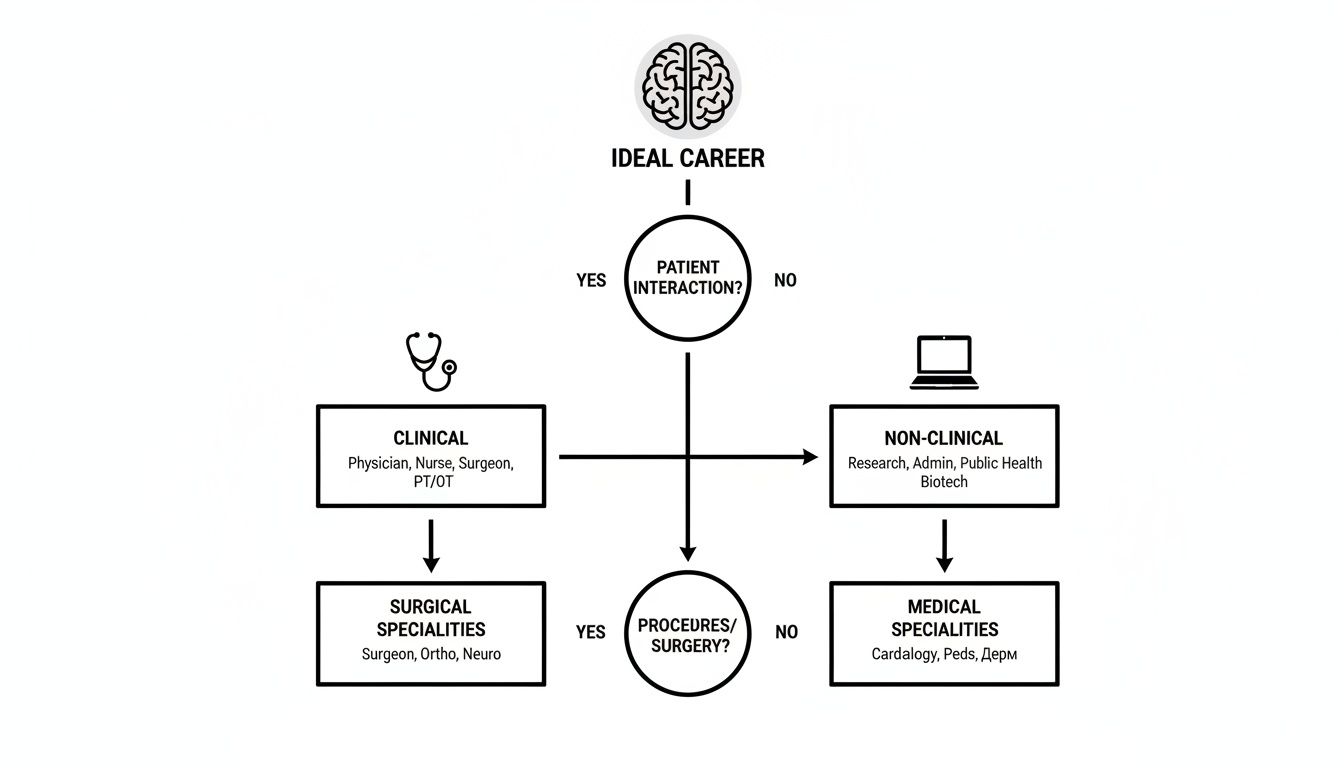
Whether you go clinical or non-clinical, the core principles of a targeted, balance-focused search stay the same.
How To Read Between the Lines of a Job Description
You have to learn to decode the language recruiters use. A job posting is essentially a sales pitch, and it’s your job to look past the marketing fluff and find the hard data about the role's real demands on your time.
This means scrutinizing every phrase for clues. Some words signal a commitment to your well-being, while others are subtle warnings of a potential burnout trap. Learning to tell the difference is a critical skill.
Decoding Job Postings for Work-Life Balance Clues
| Green Flag (Positive Indicator) | Red Flag (Warning Sign) | What It Really Means |
|---|---|---|
| "Protected administrative time" | "Efficiently manage administrative tasks" | The first acknowledges that admin work takes time and allocates it. The second puts the burden entirely on you. |
| "Clinic hours 8 am-5 pm, M-F" | "Flexible schedule" or "variable hours" | Specifics are a great sign. Vague terms often hide unpredictable, long hours or last-minute scheduling changes. |
| Provides a clear salary range | "Competitive salary and benefits" | Transparency shows respect for your time. "Competitive" is a meaningless placeholder that forces you to guess. |
| "No call, no weekends, no nights" | "Shared call" or "light call" | Unambiguous terms are what you're looking for. "Light call" could mean anything from one weekend a quarter to one night a week. |
| "Collaborative team environment" | "Ability to work independently" | This can be tricky, but "independent" sometimes signals a lack of support staff, meaning you'll be doing everything yourself. |
Spotting these patterns helps you quickly sift through dozens of listings and discard the roles that will never align with your goals.
Why Modern, Niche Job Platforms Are Better
Traditional, high-volume job boards are often black holes of vague listings posted by recruiters who don't understand clinical realities. To find roles that genuinely support a doctor's work-life balance, you need a platform built for that specific purpose.
This is where curated job sites like WeekdayDoc make all the difference. Instead of wasting hours filtering out jobs with hidden call duties or mandatory weekend rounds, you can use built-in filters that instantly zero in on roles that meet your core requirements.
You can immediately screen for things that matter, like:
- No Call
- No Weekends
- No Nights
- Part-Time Options
Using these tools lets you focus your energy on the handful of opportunities that are actually a good fit, like the predictable schedules found in many part-time physician jobs. It turns the search from a draining chore into an efficient, empowering process.
Negotiating Your Contract to Protect Your Time

After a long job hunt, it’s so tempting to just sign the first decent offer that lands in your inbox. But hold on. Your employment contract is more than just a salary figure—it's the single most powerful tool you have for building a protective wall around your personal life.
This document sets the rules of engagement for your new role. Getting the details right before you sign is critical for achieving a sustainable career. Trust me, it’s far easier to secure these protections upfront than to renegotiate them a year later when you’re already drowning.
Think of a strong contract as your first and best defense against burnout.
Moving Beyond the Salary Conversation
Compensation is obviously important, but it’s often the clauses buried deep in the fine print that make or break your daily quality of life. These are the details that determine whether you leave work on time or spend another evening finishing charts in your pajamas.
Your goal here is to eliminate ambiguity. Zero in on these critical areas that directly eat into your time:
- On-Call and Weekend Duties: Vague language like "shared call" is a huge red flag. You need specifics. How many nights a month? Is it home call or in-house? What’s the expected response time? Get it in writing.
- Patient Load and Templates: Ask about daily patient caps or RVU targets. Unrealistic productivity demands are a primary driver of unpaid "pajama time" charting.
- Guaranteed Administrative Time: This is a game-changer. Negotiate for dedicated, protected blocks of time in your weekly schedule specifically for charting, inbox management, and other non-clinical tasks.
When these terms are clearly defined, they transform from vague expectations into contractual obligations. That’s how you build a job that respects your boundaries from day one.
How to Frame Your Requests Effectively
Negotiating for time isn't about being difficult; it's about ensuring you can do your job well and safely over the long haul. Always frame your requests around patient safety, efficiency, and your long-term commitment to the practice. This shifts the conversation from what you want to what’s needed for a successful partnership.
For instance, when you're asking for protected admin time, try phrasing it like this:
"To ensure I can provide the highest quality of care and maintain timely, accurate documentation, I've found that having four hours of protected administrative time each week is essential. This allows me to manage patient follow-ups and close charts efficiently, which ultimately supports better patient outcomes and clinic workflow."
This approach shows you're thinking about the health of the practice as a whole, not just your own convenience. It positions your request as a strategic move that benefits everyone.
Practical Scripts for Common Scenarios
Walking into these conversations with a clear script can make them feel much less intimidating. Whether you’re pushing for a four-day work week or just want to clarify call duties, being prepared helps you advocate for yourself with confidence.
Here are a few examples you can adapt:
- For a Four-Day Work Week: "I am very excited about this opportunity. To ensure my long-term sustainability in this role, a compressed schedule of four 10-hour days is my ideal structure. This allows me to be fully focused during my clinical days and ensures I have adequate time for recovery, which I believe makes me a more effective and resilient physician."
- For Patient Load Caps: "Could we clarify the expected daily patient volume in the contract? My experience has shown that seeing around 18-20 patients a day allows for thorough care and proper documentation, preventing after-hours work. I want to ensure my practice here is both high-quality and sustainable."
Before you sign anything, get a second opinion. An experienced healthcare attorney can spot potential pitfalls you might miss. It’s also smart to use a tool like the WeekdayDoc Offer Analyzer. It helps you benchmark the non-clinical parts of your offer against roles that truly prioritize work-life balance, giving you the data you need to back up your requests.
Using Financial Independence to Fuel Your Freedom
Let's be honest: true professional freedom starts with financial security. When you aren't chained to the highest-paying, most demanding job just to service your loans or cover an expensive lifestyle, you gain the ultimate power of choice.
This is where smart financial planning becomes the cornerstone of a sustainable career. For a growing number of physicians, this means adopting a Financial Independence, Retire Early (FIRE) mindset. But "retire early" doesn't have to mean hanging up your stethoscope for good.
Think of it as reaching "work-on-your-own-terms" independence. It's the freedom to choose roles based on fulfillment, schedule, and personal well-being—not just financial desperation.
This isn't just a niche idea anymore. A recent Doximity poll of nearly 2,000 physicians revealed that a staggering 77% would accept (or have already accepted) lower pay for more autonomy or a better work-life balance. That number has been climbing steadily, signaling a massive shift in what doctors value. You can dig into the full details in the 2025 physician compensation report.
How a Lower-Stress Job Can Actually Speed Up Your Goals
It’s a common myth that taking a less stressful, "burnout-friendly" job means kissing your financial goals goodbye. The reality is often the exact opposite. A role with a predictable schedule—no call, no nights, no weekends—can become a powerful engine for building wealth.
Here’s why:
- Predictable Income Streams: A stable salary, free from the volatility of RVU bonuses or unpredictable overtime, makes it incredibly simple to automate your savings and investments. You know exactly what’s coming in and what can go out.
- Reduced "Lifestyle Creep": High-stress jobs often fuel "convenience spending." Think expensive takeout after a brutal shift, last-minute childcare, or pricey retail therapy to cope. A more balanced life naturally cuts down on these hidden costs.
- More Time for Financial Strategy: When you're not constantly exhausted, you have the mental bandwidth to actually manage your investments, explore a side hustle, or fine-tune your financial plan.
A lower-stress job provides the stability you need to build wealth methodically. Your income becomes a tool for freedom, not a handcuff to a draining career.
Financial independence gives you the power to say 'no' to burnout. It transforms your career from a series of obligations into a series of choices, allowing you to practice medicine on your terms.
Projecting Your Financial Future with Confidence
The biggest hurdle for many is the fear of the unknown. How will a salary change really impact your retirement timeline? Instead of guessing, you need to see the numbers for yourself.
That's why we built the WeekdayDoc Salary & FIRE Calculator. It's designed specifically for clinicians to model their financial future based on different income scenarios. You can plug in the salary from a potential burnout-friendly role and see exactly how it impacts your savings rate and your path to financial independence.
The calculator lets you visualize how other factors—like a lower cost of living in a new city or a reduced tax burden in a different state—can easily offset a nominal pay cut. It empowers you to make career decisions based on hard data, not fear.
By mapping out your financial journey, you'll see that a better work-life balance doesn't have to be a financial sacrifice. With a clear plan, a predictable schedule, and smart money habits, you can build a fulfilling career and a secure future. That's the ultimate freedom.
Common Questions About Balancing Medicine and Life
Making the leap to a career that puts your well-being first is a huge deal. It’s completely normal to feel a mix of excitement and anxiety. The path to a better work-life balance is often littered with big questions about money, career trajectory, and even your identity as a doctor.
Let’s get into some of the most common concerns that come up. Tackling these head-on will give you the clarity and confidence to build a medical career that’s actually sustainable.
Will I Have to Take a Huge Pay Cut for Better Work-Life Balance?
This is the #1 fear for most physicians, but the reality is rarely as dramatic as you might think. It’s a mistake to only look at the base salary number. You have to zoom out and see the whole financial picture.
Sure, some high-stress, high-hour specialties might have a bigger number on paper, but a burnout-friendly role often comes with its own financial perks. Many jobs in telehealth, outpatient clinics, or non-clinical fields like utilization management offer highly competitive pay. More importantly, they give you a predictable income without the volatility of RVU-based bonuses that force you to run on a hamster wheel.
You also have to factor in the hidden costs of burnout—all the money spent on takeout, last-minute childcare, and convenience services just to survive a punishing schedule.
The key is to analyze the total compensation package:
- Retirement contributions: A solid 401(k) or 403(b) match can add tens of thousands to your net worth every single year.
- Health insurance premiums: Lower out-of-pocket costs for your family's healthcare is a significant financial win.
- The value of reclaimed time: What’s an extra 10-15 hours a week with your family really worth to you? This isn't something you can put a price on.
Many physicians find that a small dip in salary is a tiny price to pay for a massive improvement in their quality of life, mental health, and long-term career satisfaction.
How Do I Switch to a Non-Clinical Role Without Direct Experience?
Your years of clinical training have given you a skill set that is incredibly valuable outside of direct patient care. The biggest mistake doctors make is thinking their expertise is trapped inside the exam room. The truth is, your skills are highly transferable.
Medical knowledge, critical thinking, and complex problem-solving are in high demand across many industries. Fields like medical writing, health tech, pharma consulting, and medical affairs are actively looking for the unique perspective only a clinician can bring. The first step is to figure out what roles actually spark your interest.
From there, it’s all about reframing your experience. Your CV shouldn't just be a laundry list of clinical duties; you need to translate it into the language of the industry you're targeting.
Instead of: "Managed a panel of 2,000 patients."
Try: "Analyzed complex patient data to develop long-term treatment strategies and improve outcomes."
Instead of: "Led grand rounds."
Try: "Presented complex medical information to diverse audiences of stakeholders."
Networking is also non-negotiable here. Find physicians on professional platforms who have already made the jump. They can give you the inside scoop on what employers are really looking for and help you nail your application.
Can a Part-Time Clinical Role Actually Be Fulfilling?
Absolutely. In fact, for many doctors, going part-time is the secret to falling back in love with medicine. As health systems face down physician shortages and burnout, they're becoming much more open to flexible and part-time schedules to keep good clinicians around.
The trick to finding fulfillment in a part-time role is aligning it with what you love most about medicine. This isn't just about doing less of the work you hate; it's about being more intentional with the clinical time you do have.
This could look like:
- Working two days a week in a niche clinic you're passionate about.
- Serving as a part-time preceptor for a local medical school.
- Focusing on a specific patient population you love treating through a telehealth platform.
Be direct and upfront about wanting a part-time schedule from the very start of your job search. This weeds out organizations that don't genuinely support flexibility and saves you from one that will constantly pressure you to pick up extra shifts. It’s the perfect way to keep your skills sharp while creating the space you need for a life outside of medicine.
What if My Employer Makes a Counteroffer?
When you hand in your resignation, getting a counteroffer can feel pretty good. It’s tempting to grab the promise of a higher salary or a new title. But you need to be extremely careful here.
Ask yourself one critical question: Why weren’t the problems that led to my burnout fixed before I decided to leave?
A counteroffer rarely solves the systemic issues—the insane workload, the toxic culture, the lack of support—that pushed you to look for a new job. More often than not, it’s a quick fix for your employer's staffing headache. If you accept, you might face resentment from colleagues and find yourself under a microscope, with management expecting even more from you because of your raise.
It's almost always better to politely say no and move on. You chose that new role for very specific reasons tied to your well-being and balance. Don't let a last-minute cash offer pull you back into the exact environment you fought so hard to escape.
Ready to find a job that truly respects your time? At WeekdayDoc, we curate burnout-friendly physician jobs that are explicitly no call, no nights, and no weekends. Start your search for a sustainable medical career today at https://www.weekdaydoc.com.