Remote Jobs Physician Assistant: Guide to remote jobs physician assistant Roles
Discover how to land remote jobs physician assistant roles, tailor your telehealth resume, and balance patient care with flexible schedules.

The search for remote jobs for a physician assistant has taken off, and it's not hard to see why. PAs are actively looking for a real alternative to the burnout factory that traditional clinical work has become for so many.
These roles aren’t just a passing trend—they represent a fundamental career shift. For many, it's a path back to a sustainable practice, better work-life balance, and a way to escape the daily grind that wears down even the most dedicated clinicians.
Why PAs Are Finally Choosing Remote Work
Let's be honest: the conversation around PA careers has changed. The relentless pace, the mountain of administrative tasks, and the sheer emotional weight of in-person roles are pushing skilled PAs to their limit.
This isn't about abandoning medicine. It's about finding a way to practice it without sacrificing your well-being. Remote work is the solution for a growing number of PAs who want to reclaim their autonomy and build a career that doesn't constantly demand a personal cost.
The appeal goes way beyond just working from home. Think about it: you get to take back control of your schedule, ditch the stressful commute, and drastically cut down on that "pajama time" spent charting after hours. This pivot allows you to be more present for your family and your life—a huge factor in preventing career fatigue.
If you feel like you're running on fumes, it’s worth taking stock of where you really stand. Our PA-specific burnout index can give you some clarity.
Learn more about where you stand by using our PA-specific burnout index.
The Data Behind the Demand
This isn't just a feeling; the numbers show a clear and growing demand for flexibility in healthcare. Remote and hybrid models are becoming standard as more PAs seek control over their work environment.
Recent data shows that about 11% of all healthcare jobs now offer remote or hybrid options. But for practitioner roles like ours, the potential is much higher—up to 43% of these positions could be done remotely or in a hybrid setup.
The bottom line? The availability of remote jobs for physician assistants is growing, giving you more opportunities than ever to find a role that actually fits your life.
Redefining Patient Care and Personal Well-Being
Working remotely often creates a better environment for patient interactions. Without the constant chaos and interruptions of a busy clinic, you can give your full attention to virtual consults, patient education, and follow-up care. The quality of that interaction can go way up.
By removing the logistical and environmental stressors of a traditional clinic, remote work allows Physician Assistants to redirect their energy toward what matters most: providing thoughtful, unhurried, and effective patient care.
This renewed focus is a win-win. It benefits the patient, and it helps restore the sense of purpose that probably drew you to medicine in the first place. It creates a positive cycle that boosts job satisfaction and lowers the risk of burnout. The goal is to build a long, fulfilling career, and for an increasing number of PAs, a remote role is exactly how they're making that happen.
How to Build a Remote-Ready PA Application
You’ve got years of incredible clinical experience under your belt. That’s a given. But does your resume actually show a remote employer that you’re ready for telehealth? To land a great remote PA job, your application needs to speak the language of virtual care.
It’s less about reinventing your experience and more about reframing it. You have to translate your hands-on skills for a world where patient care happens through a screen. You need to prove you’re not just clinically sharp, but also tech-savvy and a stellar virtual communicator.
Many PAs start this journey for one simple reason: burnout. They're looking for a more sustainable way to practice medicine, moving from overwhelmed to balanced.
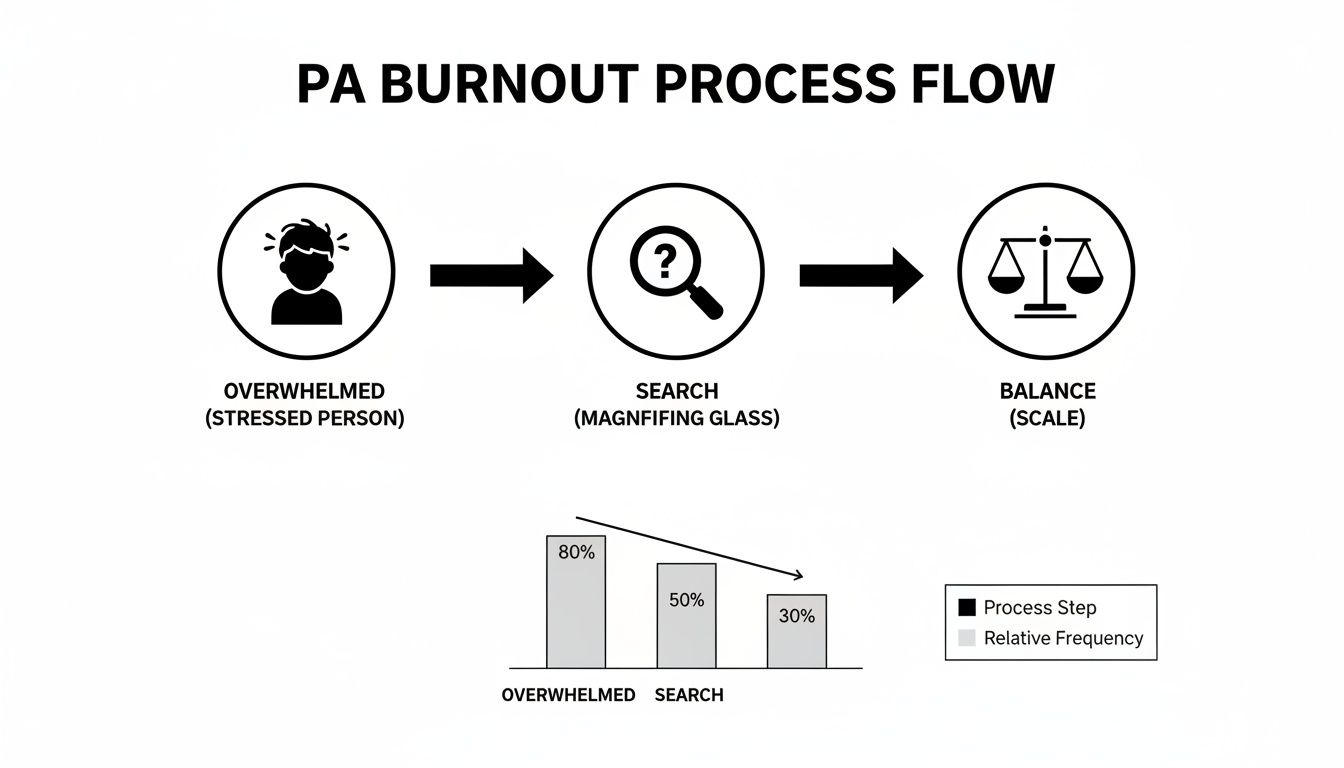
This proactive search for a better career path is exactly what building a remote-ready application is all about.
Translate Your Clinical Skills for Telehealth
Recruiters for remote PA roles are keyword hunting. Your standard clinical jargon just won't cut it. Your first move is to translate your existing skills into terms that resonate with telemedicine employers.
Think about what you already do. Triaging patients over the phone? That’s virtual patient triage. Coordinating care with specialists through the EMR messenger? You’ve got experience in digital care coordination.
Start weaving these keywords into your resume and profiles:
- Telemedicine Software Proficiency: Get specific. Name the platforms you know, like Doxy.me, Teladoc, or Epic Haiku.
- Virtual Patient Assessment: Describe your ability to conduct thorough workups via video or phone.
- Digital Health Literacy: Mention your comfort with EMRs, e-prescribing, and secure patient portals.
- Remote Patient Monitoring (RPM): If you’ve managed patients using remote devices, make sure this is highlighted. It’s a huge advantage.
These simple shifts in language signal to a hiring manager that you get it. You understand what a remote PA position actually entails.
Craft a Compelling Remote-Focused Resume
That professional summary at the top of your resume? It’s prime real estate. A generic objective is a wasted opportunity to grab a recruiter’s attention.
Let’s see what this looks like in practice.
Before (Too General):
"Dedicated and compassionate Physician Assistant with 5 years of experience in a fast-paced family medicine clinic. Seeking to leverage strong diagnostic and patient management skills to provide excellent patient care."
This is okay, but it says nothing about your interest or ability in remote work. It will get passed over.
After (Optimized for Remote):
"Compassionate Physician Assistant with 5 years of family medicine experience, now seeking a full-time remote role. Proficient in multiple telemedicine platforms and EMR systems, with a passion for using technology to improve patient access and deliver high-quality virtual care. Licensed in NY, NJ, and FL."
This is so much better. In one short paragraph, it tells the recruiter three critical things: you’re actively looking for remote work, you’re tech-proficient, and you hold multi-state licensure—a massive plus in the telehealth world.
Optimize Your Digital Professional Profiles
Your resume is just one piece of the puzzle. Recruiters will absolutely look you up online, so your LinkedIn profile and any profiles on job boards like WeekdayDoc need to tell the same story.
Platforms like WeekdayDoc are built for clinicians looking for sustainable, often remote, roles. It’s the perfect place to make your telehealth readiness crystal clear.
Here’s how to quickly optimize your profiles:
- Revamp Your Headline: On LinkedIn, switch your headline from the default "Physician Assistant at [Clinic Name]" to something more intentional, like "Physician Assistant | Telehealth Advocate | Multi-State Licensed (NY, NJ, FL)."
- Use the 'About' Section: This is your chance to explain why you want to transition to remote care. Talk about your communication skills and your ability to build patient rapport through a screen.
- Get Specific with EMRs: Don't just say you're proficient with EMRs. List the systems you’ve mastered, like Epic, Cerner, or Athenahealth. Details like this make a real difference to employers.
By creating a consistent, optimized message across your resume and online presence, you build a powerful application that puts you at the top of the list for the best remote PA jobs out there.
Finding High-Quality Remote PA Opportunities
Let’s be honest: knowing where to look is half the battle. The internet is flooded with generic job boards, and it's easy to get overwhelmed. But the best opportunities—the ones that won’t just trade clinic burnout for virtual burnout—aren't always on the biggest sites.
Your goal isn't just to find any remote jobs physician assistant position. It's to find one that actually respects your skills, your time, and your well-being. That means taking a smarter, more targeted approach instead of just blasting your resume everywhere.
The good news? The market is definitely in your favor. Physician Assistants are in the middle of a major career boom. The U.S. Bureau of Labor Statistics projects a huge 20% surge in PA employment over the next decade. That translates to thousands of new openings every year, giving you more leverage than ever to find the right fit, especially in telehealth.
Go Beyond the Generic Job Boards
You could spend all day scrolling through massive sites like Indeed or ZipRecruiter, but they cast such a wide net that the truly great roles get lost in the noise. They just aren't built to understand the nuances of clinical work.
Instead, your time is much better spent on platforms built by clinicians, for clinicians.
A perfect example is WeekdayDoc. It’s a physician-founded platform designed specifically to combat burnout by curating remote, hybrid, and even in-person roles with a laser focus on work-life balance.
So, what makes a platform like this a game-changer?
- A "Burnout-Friendly Score": Every single listing is rated for factors that contribute to a sustainable job. You get an at-a-glance idea of what you’re getting into before you even click.
- Clinician-Focused Filters: You can instantly narrow your search to find jobs with "No Call" or "No Weekends". For many PAs trying to reclaim their lives, these are absolute non-negotiables.
- Transparent Salary Data: No more guessing games. The platform provides clear salary ranges and even FIRE (Financial Independence, Retire Early) projections, so you can see how an offer impacts your long-term financial goals.
Using a niche board like this isn't just about finding a job—it's about filtering for a specific quality of life. And that’s the critical first step to finding a role you’ll actually want to keep.
The most effective job search for a remote PA isn't about applying to hundreds of listings. It's about surgically targeting the platforms where burnout-conscious employers are actively looking for clinicians like you.
Activate Your Professional Networks
Never, ever underestimate the power of your existing connections. Your professional organizations are absolute treasure troves of high-quality, often unlisted, opportunities.
The American Academy of Physician Associates (AAPA) should be your first stop. Its career center is packed with telehealth positions from vetted employers who genuinely understand the PA scope of practice. But don't just stop at the job board. Jump into the AAPA forums or specialty-specific groups. You'll connect with colleagues already in the remote world who can offer incredible insights and referrals.
LinkedIn is another beast entirely, but it's powerful if you use it right. Don't just be a passive scroller. Make sure your profile is optimized (like we talked about earlier) and start connecting with telehealth company recruiters and clinical leaders. A quick, professional message showing your interest can put you on their radar long before a job is ever posted publicly.
Try this simple, proactive strategy:
- Identify 5-10 telehealth companies you genuinely admire.
- Find their clinical hiring managers or lead PAs on LinkedIn.
- Send a connection request with a short, personalized note. Mention something specific you like about their approach to virtual care.
This is how you go from being just another applicant to a motivated candidate they remember. By combining the precision of clinician-focused job boards with active networking, you create a powerful search strategy that uncovers the best telemedicine physician assistant jobs out there.
Mastering the Virtual Interview Process
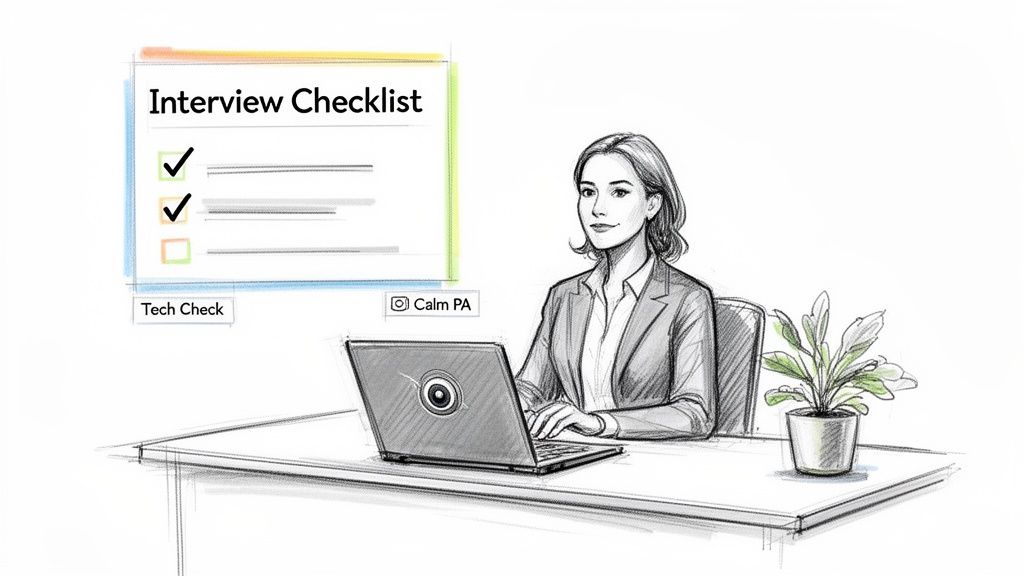
Finding a solid remote PA job comes down to two things: nailing the virtual interview and learning to spot the subtle signs of a high-burnout environment. Think of the interview as a two-way street. They’re evaluating your clinical skills, but you need to be evaluating their culture, expectations, and commitment to a sustainable workplace.
Getting this right is the key to finding a role you’ll actually thrive in for the long haul.
Setting the Stage for Success
Your clinical confidence is a given. But in a virtual interview, your tech setup and professional presentation are just as critical. The first impression happens the second your video feed connects, so don’t let a poor setup undermine your expertise.
Before the interview, do a full tech rehearsal. This is more than just checking your Wi-Fi.
- Test Your Platform: Whether it’s Zoom, Teams, or something else, download it ahead of time and do a test call with a friend. Is your audio clear? Is your video sharp?
- Frame Your Shot: Your camera needs to be at eye level. Looking down at a laptop camera isn't flattering and can make you seem disengaged. Use a stack of books to prop it up if you have to.
- Check Your Lighting: Natural light is your best friend here. Sit facing a window so the light is on your face. Never sit with a window behind you—you’ll become a silhouette.
- Curate Your Background: Keep it clean, professional, and free of distractions. A tidy bookshelf or a neutral wall works perfectly. Skip the virtual backgrounds; they can be glitchy and look unprofessional.
Handling these details beforehand means less stress on interview day, freeing you up to focus on what matters: showing them why you're the best candidate.
Answering Telehealth-Specific Questions
Virtual care demands a specific skillset, and you can bet the hiring manager will be probing for it. They need to know you can build rapport and make solid clinical calls without a physical exam. Be ready for questions that go beyond standard clinical scenarios.
To get your answers dialed in, it helps to practice the top healthcare interview questions and answers and adapt them for a telehealth context.
Expect to hear things like:
- "How do you build strong patient rapport through a screen?"
- "Describe a time you managed a complex case virtually without being able to perform a physical exam."
- "What strategies do you use to ensure patients understand and follow treatment plans in a remote setting?"
- "How do you stay organized and manage your time when working autonomously from home?"
When you answer, use the STAR method (Situation, Task, Action, Result) to give your stories structure. Pull from concrete examples, even if it’s from informal telehealth like phone triage. Explaining how you calmed an anxious parent over video and guided them to the right care decision showcases both your clinical judgment and your virtual communication skills.
Your ability to articulate a clear, confident approach to virtual patient management is what separates a good candidate from a great one. Show them you’ve already thought deeply about the nuances of remote care.
Interviewing Your Future Employer
This is arguably the most important part of the process—when the tables turn, and you start asking the questions. This is your chance to get a real look at the work environment. Asking sharp, specific questions about workload and support is your best defense against burnout.
Vague questions get vague answers. Instead of "What's the company culture like?", you need to dig deeper.
Key Questions to Ask About the Role:
- What is the expected patient load per shift or per day?
- How much dedicated, paid administrative time is blocked out for charting?
- What is the protocol for handling technologically challenged patients?
- Who covers the cost and administrative work for obtaining and maintaining multi-state licenses?
These questions get to the heart of a company's operational priorities. An employer with clear, supportive answers likely has a well-designed system that respects its clinicians' time.
Spotting Burnout Red Flags Early
Listen carefully to how they answer your questions, not just what they say. Hesitation, deflection, or overly rosy promises can be massive red flags. A job that looks great on paper can become a nightmare if the underlying structure is broken.
Use this table as a quick guide during your evaluation.
Red Flags vs Green Flags in a Remote PA Job Description
| Warning Signs (Red Flags) | Positive Indicators (Green Flags) |
|---|---|
| Vague patient load numbers. Phrases like "it varies" or "we're a fast-paced environment" can signal an overwhelming caseload. | Clearly defined patient-per-hour metrics. For example, "You'll see 3-4 patients per hour, with dedicated catch-up blocks." |
| No mention of paid administrative time. If charting isn't built into your paid hours, it becomes unpaid "pajama time." | Scheduled and protected charting time. "Each provider gets a 1-hour paid administrative block per 8-hour shift." |
| Emphasis on "flexibility" as a one-way street. They stress your need to be flexible but don't mention their support for you. | Specifics on scheduling and work-life balance. "Schedules are set 4 weeks in advance, and shift swaps are managed through an easy-to-use platform." |
| You are responsible for all multi-state licensing costs. This shifts a significant financial and admin burden onto you. | Company-paid licensing and credentialing support. "We cover all fees for the 5 state licenses required and have a dedicated team to manage the applications." |
| Unclear on-call or after-hours expectations. "We all pitch in when needed" is a recipe for poor boundaries. | Well-defined after-hours protocol. "After-hours calls are routed to a dedicated nurse triage line; on-call is voluntary and separately compensated." |
| High turnover mentioned. If the interviewer says, "we're looking to backfill a role," ask why the last person left. | Focus on retention and professional development. "We offer a $2,000 annual CME stipend and have a clear pathway for PAs interested in leadership roles." |
A job description and interview can tell you everything you need to know if you look for the right signals. Trust your gut. If something feels off, it probably is. Finding the right remote job isn’t just about landing an offer—it's about finding a sustainable, respectful role that supports your long-term career well-being.
Negotiating Your Offer for Financial Freedom
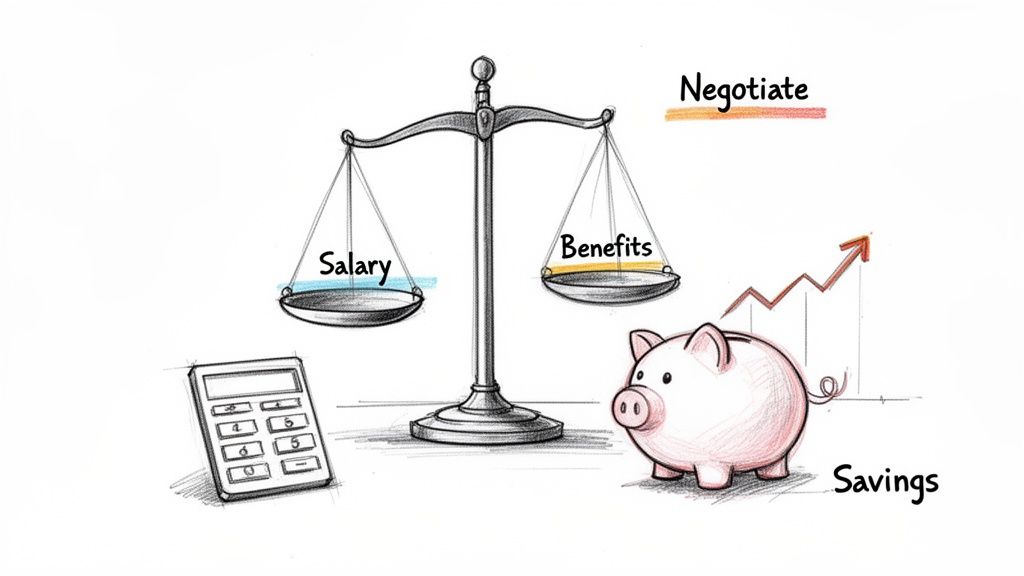
Getting that remote PA job offer feels like crossing the finish line, but there's one critical step left. This is where you advocate for your worth and make sure this career move aligns with your long-term financial goals.
The negotiation phase is your chance to turn a good offer into a great one. Understanding how to negotiate a job offer is less about confrontation and more about having a professional, data-driven conversation.
Ground Your Negotiation in Data
Walking into a salary talk without numbers is like diagnosing a patient without labs—it’s just a guess. Before you even think about a counteroffer, you need to arm yourself with hard data on what the market is paying for remote jobs physician assistant roles.
The average salary for a remote PA in the U.S. is a solid $120,212 per year. But that's just the average. The 75th percentile is hitting $135,500, and the 90th percentile pulls in $157,500. Some specialized roles can even reach $177,500. This range shows there's significant room to grow based on your experience and skillset.
Use these numbers as your anchor. If your offer comes in low, you now have the objective market data to justify a higher number. You can find up-to-date salary ranges on sites like ZipRecruiter.
Always anchor your salary request in market data, not personal need. Framing your counteroffer around industry standards makes the conversation objective and professional, increasing your chances of a successful outcome.
Articulate Your Unique Remote Value
In a telehealth role, your value proposition changes. You’re more than just a clinician; you’re an efficient, tech-literate provider who helps the company scale without adding to its physical footprint. You need to spell this out during your negotiation.
Pinpoint the skills that make you a great remote hire:
- Efficiency: Highlight your ability to manage a full patient load effectively from a home office, which cuts down on their administrative overhead.
- Expanded Access: Do you hold multiple state licenses? This is a huge asset. It means you can help them serve patients across a much wider area.
- Tech Proficiency: Mention the specific EMRs and telehealth platforms you’ve mastered. This signals you’ll need less training and can hit the ground running.
Frame your value in business terms. A simple statement like, "With my licenses in three states and experience on your EMR system, I can be fully onboarded and generating revenue within the first week," speaks volumes.
Connect Your Offer to Financial Independence
A strong salary is fantastic, but a remote role accelerates your path to financial independence (FI) in other powerful ways. It's crucial to look at the total financial picture when you negotiate.
Think about the hidden financial benefits beyond your base pay:
- No Commute: Run the numbers. How much will you save annually on gas, car maintenance, or public transit? It’s often thousands of dollars.
- Lower Work Expenses: Factor in the savings on a professional wardrobe, dry cleaning, and buying lunch every day.
- Increased Savings Rate: A higher remote salary combined with lower daily expenses frees up a significant chunk of cash. That money can go directly into your investments, supercharging your journey to FI.
This is where a little planning goes a long way. You can see exactly how an offer impacts your future using WeekdayDoc's Offer Analyzer and FIRE calculator. It lets you model different scenarios to see how a salary bump or better benefits can change your financial timeline. This turns your negotiation from a simple salary discussion into a strategic move for building long-term wealth.
Common Questions About Remote PA Jobs
Jumping into a new role always brings up a ton of practical questions. Let's be honest, moving from a hands-on clinic to a virtual one is a major shift, and the world of remote PA jobs is no exception.
We get it. You have concerns. So, let’s tackle the most common ones we hear from PAs who are thinking about making the switch. Getting straight answers will help you move forward with your eyes wide open, ready for what’s next.
What Are the Most Common Specialties for Remote PA Jobs?
While telehealth is popping up everywhere, some specialties are just a more natural fit for virtual care. Think about fields that lean heavily on consultations, follow-ups, and management that don’t absolutely require a physical exam every single time.
Right now, the biggest players are:
- Urgent Care: This is a huge one. It’s perfect for triaging common illnesses, calling in prescriptions, and telling patients whether they need to be seen in person.
- Primary Care: Great for managing chronic conditions like diabetes or hypertension, handling routine follow-ups, and making medication adjustments.
- Psychiatry and Mental Health: This field has exploded in telehealth. Virtual sessions have proven to be incredibly effective for therapy and psych management, and the demand is massive.
- Dermatology: "Store-and-forward" teledermatology is a game-changer. Patients upload images, and you can evaluate rashes, moles, and other skin conditions efficiently.
And don't forget the non-clinical side. You’ll find plenty of PAs working remotely in roles like clinical informatics, utilization review, and medical education.
How Does State Licensure Work for Telehealth Roles?
Okay, this is probably the biggest logistical headache for any remote clinician. The golden rule is simple but strict: you must be licensed in the state where the patient is physically located when you treat them.
What does that mean for you? It means many remote jobs will require you to hold multiple state licenses right off the bat, or at least be willing to get them. While the Interstate Medical Licensure Compact (IMLC) helps streamline this for physicians, the process for PAs can still be a bit clunky and varies by state.
Pro Tip: Make this a key point in your interviews. Ask potential employers who covers the cost and handles the paperwork for getting and maintaining multiple licenses. A good employer will often cover the fees and have a team to help with the admin burden. That’s a green flag.
Can I Really Maintain Good Clinical Skills in a Remote Setting?
Absolutely. But you have to be intentional about it. Think of it less as losing skills and more as sharpening different clinical muscles.
Without the crutch of a physical exam for everything, your history-taking, active listening, and critical thinking skills will become razor-sharp. Many remote PAs find they get much better at patient education and motivational interviewing because clear communication is everything.
If you're worried about losing your hands-on skills, consider a hybrid approach. I've seen many PAs successfully combine a full-time remote job with a part-time or per diem in-person gig to get the best of both worlds.
What Technology and Equipment Do I Need?
Any legitimate employer will provide the core tech. You should expect a work laptop with all the necessary encrypted software, secure EMR access, and their telehealth platform ready to go.
What’s on you is the home office. The non-negotiables usually include:
- A rock-solid, high-speed internet connection. Laggy video calls are a nightmare for everyone.
- A private, quiet workspace that is 100% HIPAA-compliant. No exceptions.
- A good quality headset with a microphone for crystal-clear audio.
Some of the better employers will offer a home office stipend to help you get set up. It’s a great perk to keep an eye out for when you're comparing offers.
Finding a remote PA job that actually fits your life is what WeekdayDoc is all about. We curate burnout-friendly positions so you can take the next step toward a more balanced career. Find your next opportunity on WeekdayDoc.