Your Guide to Finding Remote Healthcare Jobs
Discover the best remote healthcare jobs for clinicians. Our guide covers top roles, licensure, salary negotiation, and finding a career that beats burnout.

Are you staring down another 12-hour shift, wondering if there’s a better way to practice medicine? You’re not the only one. This guide is for clinicians like you who are looking for a real, sustainable solution to professional burnout—a path that’s becoming more viable every day: remote healthcare jobs.
The Enduring Rise of Remote Healthcare
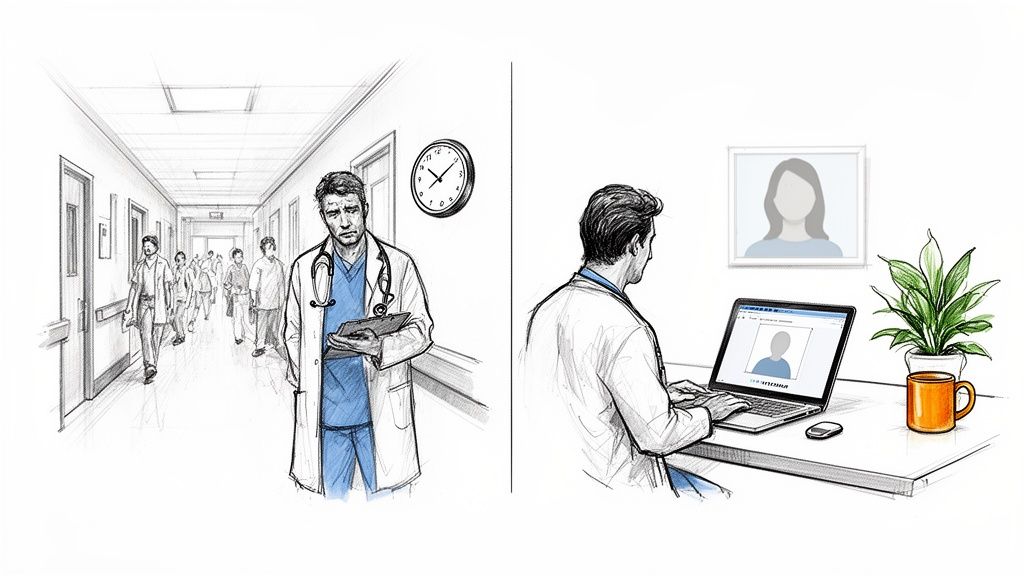
What started as a pandemic necessity has grown into a stable, permanent sector of the healthcare industry. Practicing medicine from home isn't a temporary stopgap anymore. The digital clinic is here to stay, creating legitimate, long-term career paths.
This isn't just about changing your work address. It's a fundamental shift in how we deliver clinical care, opening up opportunities that put both patient access and clinician well-being on equal footing. And the data shows this trend isn't going anywhere.
A Permanent Shift, Not a Passing Trend
The remote healthcare job market has officially stabilized and is now a fixture of modern medicine. Recent data shows that about 6% of all healthcare jobs are hybrid, with another 5% being fully remote—a massive leap from pre-pandemic numbers.
To back that up, 52% of medical groups now have between 1% and 25% of their staff working remotely at least half the time. This isn't a temporary workaround; it's a structural change in how healthcare organizations operate. You can learn more about how the new remote work economy is reshaping medicine.
This evolution beyond crisis-mode telehealth has unlocked a whole spectrum of new roles. You can now find everything from fully remote primary care gigs to hybrid specialty consultations, offering a powerful alternative to the rigid, high-pressure environments that fuel burnout.
What This Means for You
For clinicians, this all translates into one thing: options. The growth in remote jobs opens the door to a more balanced and autonomous career. It’s a tangible path toward reclaiming your time and energy, allowing you to build a professional life on your terms. You get to focus on patient care without the exhausting logistics of a traditional clinic.
The core promise of remote work in medicine is not just about changing where you work, but fundamentally improving how you work. It’s about creating a sustainable practice that serves both you and your patients for the long run.
In this guide, we'll dive into the different opportunities out there. You'll learn how to spot roles that genuinely support work-life balance, handle the practicalities of licensure, and position yourself to land a job that fits your financial and personal goals. Think of this as your roadmap to a more fulfilling career—one that puts your well-being first.
Exploring Your Options in Remote Clinical Roles
The idea of practicing medicine from home can feel a little... vague. What does a "day at the office" really look like when your patient encounters are all on a screen? It turns out, remote healthcare jobs are way more varied than just straightforward video calls. There's a whole spectrum of roles out there that cater to different skills, specialties, and temperaments.
Think of your medical license as a key. In the old model, that key opened the door to a single clinic or hospital. In the remote world, that same key can open dozens of different doors, letting you practice in ways that simply weren’t possible before. Of course, this shift isn't just about clinical skills; it's about mastering the digital side of things, too. A solid grasp of essential cybersecurity practices for healthcare providers is non-negotiable for keeping patient data safe and staying compliant.
Let's break down what these jobs actually look like, from the most common starting points to the more specialized gigs.
The Core of Remote Patient Care
For most clinicians, dipping a toe into remote work starts with roles that feel a lot like traditional outpatient medicine. These jobs are the bedrock of virtual care and are usually the easiest to transition into.
- Virtual Primary Care: This is your classic family or internal medicine practice, just done digitally. You'll manage a patient panel, handle chronic disease follow-ups, send in prescriptions, and order labs—all through a telehealth platform. The big focus here is on continuity of care.
- Remote Urgent Care: Think of this as the digital walk-in clinic for things like UTIs, rashes, or sinus infections. The pace is much faster, with a focus on quick, one-off episodes of care for patients you'll probably only see once.
- Telepsychiatry and Virtual Therapy: Mental health was an early and natural fit for telehealth. As a psychiatrist, psychologist, or therapist, you can conduct therapy sessions, manage medications, and provide consultations from a secure, private setting.
In these roles, your "webside manner" becomes every bit as important as your bedside manner. You'll be relying on slick Electronic Health Record (EHR) systems and secure messaging to manage it all.
Specialized and Niche Remote Opportunities
Once you move past the primary and urgent care models, you’ll find a growing number of specialized remote healthcare jobs that let you lean into a specific area of expertise. These roles might require some extra training or a certain background, but they offer some really unique ways to work.
The real beauty of specialized remote work is that it lets you apply deep clinical knowledge without being tied down by the logistics of a physical hospital. It’s about using your expertise in a more focused, flexible way.
Here are a few of those specialized paths:
- Teleradiology: Radiologists were some of the original pioneers of remote medicine. They’ve been interpreting X-rays, CT scans, and MRIs from off-site locations for years.
- Tele-ICU (eICU): This is a high-stakes, high-impact remote role. Intensivists work from a central command center, providing critical care support and oversight to bedside teams in multiple hospitals, often covering night shifts.
- Remote Clinical Research: Physicians and APPs can work as principal or sub-investigators on clinical trials, overseeing patient safety and data integrity without having to be physically on site.
To give you a clearer picture, this table breaks down some of the most common remote clinical roles, what they involve, and what to expect schedule-wise.
Common Remote Roles for Healthcare Clinicians
Here's a breakdown of typical remote healthcare positions, outlining key responsibilities and common requirements for each clinical role.
| Clinical Role | Common Remote Job Titles | Primary Responsibilities | Typical Schedule |
|---|---|---|---|
| Virtual Physician | Telemedicine Physician, Virtual Primary Care Doctor | Managing patient panels, chronic disease, medication refills | Scheduled shifts, often M-F business hours |
| Remote NP/PA | Telehealth Nurse Practitioner, Virtual Urgent Care PA | Treating acute conditions, patient triage, e-prescribing | Flexible shifts, including evenings or weekends |
| Telepsychiatrist | Remote Psychiatrist, Behavioral Health Clinician | Medication management, therapy, psychiatric evaluations | Scheduled appointments, often with high autonomy |
| Teleradiologist | Remote Radiologist | Interpreting diagnostic images from various modalities | Shift-based, often including nights and weekends |
Getting a handle on this spectrum of opportunities is the first step toward figuring out where you fit. As you start exploring the different types of telehealth jobs available to clinicians, think about which model plays to your clinical strengths and gives you the work-life balance you’re looking for. Whether you want the long-term relationships of primary care or the laser-focus of a specialty, there’s a good chance a remote path exists for you.
Mastering Licensure for a Borderless Career
For many clinicians dreaming of remote work, the biggest obstacle isn't their clinical skill—it's the paperwork. When you practice virtually, your career is no longer defined by the four walls of a clinic but by state lines on a map. Navigating multi-state licensure can feel like a bureaucratic nightmare, but it's the absolute key to unlocking a truly borderless career.
The golden rule is deceptively simple: you must be licensed in the state where your patient is located at the time of care. This isn't just a suggestion; it's a legal and regulatory mandate that protects both you and your patients.
The Interstate Highway for Your Credentials
In the past, getting licensed in multiple states meant drowning in redundant applications. Thankfully, things have gotten a lot easier. Interstate compacts now act like an E-ZPass for your medical credentials, creating a streamlined path for qualified clinicians to practice across state lines.
These compacts are game-changers for anyone serious about remote work:
- The Interstate Medical Licensure Compact (IMLC): An expedited pathway for physicians (MDs and DOs) to get licensed in dozens of participating states.
- The Nurse Licensure Compact (NLC): This allows nurses (RNs and LPNs/VNs) to hold one multi-state license and practice in any other compact state.
- The Psychology Interjurisdictional Compact (PSYPACT): Gives psychologists the authority to practice telepsychology across state lines in member states.
By slashing the administrative burden, these compacts make multi-state remote jobs a realistic goal, not a logistical headache. They represent a huge leap forward for virtual care.
This decision tree can help you visualize how different patient needs—acute, chronic, or mental health—steer you toward specific remote clinical pathways.
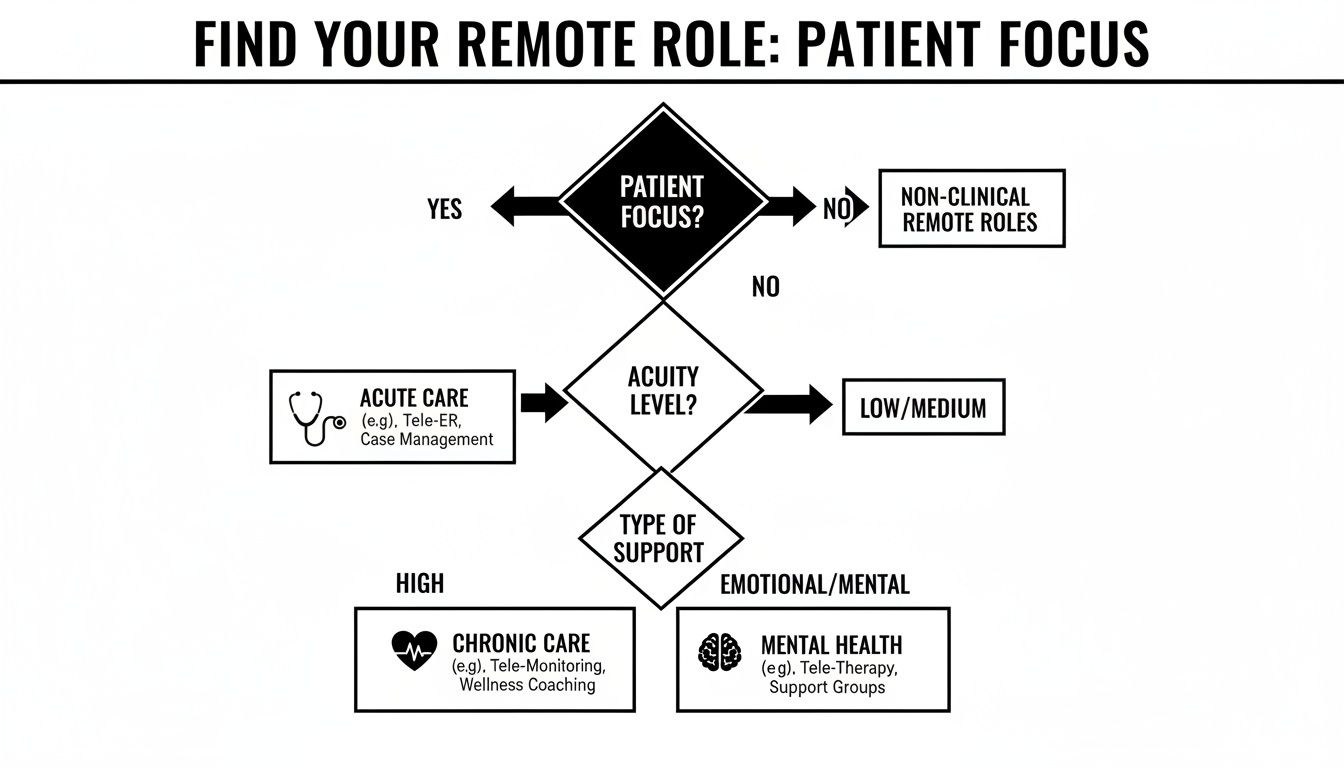
Each branch points to a distinct area of focus, helping you match your skills with the right kind of virtual practice.
Managing Your Multi-State Practice
Once you’re licensed in several states, organization is everything. Each state has its own rules for Continuing Medical Education (CME), unique renewal schedules, and specific telehealth laws. A simple spreadsheet or a licensure management tool can be your best friend, helping you track every detail so you stay compliant everywhere you practice.
Think of it this way: if you owned rental properties in different cities, you'd need to know the local landlord-tenant laws for each one. The same logic applies to your medical licenses.
A key to a successful multi-state practice is proactive compliance. Don't wait until renewal time to check state requirements. Set calendar reminders and regularly review the medical board websites for the states where you hold a license.
Protecting Your Practice Across Borders
Finally, make sure your malpractice insurance is built for a modern, remote career. A policy that covers you in one state might leave you exposed when your practice spans several. When you shop for a policy, you need to ask some very specific questions.
Key Malpractice Policy Questions:
- Does my policy explicitly cover care delivered via telehealth?
- Am I covered for practicing in all the states where I hold a license?
- Are there any loopholes or exclusions related to the patient’s location or the technology I use?
Confirming these details ensures your liability coverage is as borderless as your career. By mastering the nuances of licensure, compliance, and insurance, you can build a secure and thriving remote practice. This administrative legwork is the foundation for a sustainable, flexible career in medicine.
How Remote Work Can Reshape Your Financial Future
Let's tackle the biggest fear clinicians have when thinking about a career change: the pay cut. Does swapping a hectic clinic for a home office automatically shrink your paycheck?
Not necessarily. In fact, a strategic move into remote healthcare jobs can fundamentally reshape your entire financial picture for the better. This goes way beyond just the salary figure. It's about rethinking your entire financial life—from where your money goes to how fast you can build real wealth.
When you decouple your income from a specific, high-cost city, you unlock some seriously powerful options.
The Power of Geographic Arbitrage
Picture two cardiologists. One is in New York City, the other in a quiet town in Tennessee. Their salaries might be surprisingly similar, but their cost of living is on a different planet.
That gap is the magic of geographic arbitrage—earning a big-city salary while living somewhere much more affordable.
For clinicians, this is an absolute game-changer. Telehealth companies hire physicians, NPs, and PAs based on your license and skills, not your zip code. This means you can land a job with a company based in San Francisco or Boston while working from a place where housing, taxes, and daily life cost a fraction of the price.
- Housing: This is the big one. The difference in mortgage or rent between a major metro area and a smaller town can easily save you thousands of dollars every single month.
- Taxes: State income tax can take a massive bite out of your earnings. Living in a state with low or no income tax while working remotely is like giving yourself an instant raise.
- Daily Expenses: Everything from groceries and gas to childcare is often cheaper in lower-cost-of-living areas. It all adds up to huge annual savings.
This strategy lets your clinician-level salary go so much further, putting you on the fast track to saving, investing, and hitting your long-term goals.
Accelerating Your Path to Financial Independence
Beyond geographic arbitrage, working from home slashes many of the "hidden" costs of a traditional clinical job. The daily commute, shelling out for parking, maintaining a professional wardrobe, and buying lunch out all add up. Wiping those expenses off your budget can free up a surprising amount of cash every month.
You can funnel this extra capital, plus your savings from a lower cost of living, directly toward your financial goals. For many of us, this fits perfectly with the principles of Financial Independence, Retire Early (FIRE).
The FIRE movement isn't just about quitting work early; it's about reclaiming your time. By getting your finances in order, you can build a life where work is a choice, not a necessity—a powerful antidote to clinical burnout.
The job market is already shifting to support this. Remote job postings attract roughly 2.6 times more applicants than in-office roles, signaling a massive demand for this kind of flexibility. Big metro areas are leading the charge, with states like New York and Massachusetts reporting that 32% of their healthcare job ads are now for hybrid roles. This isn't a fluke; it's a clear opportunity for clinicians to find high-paying jobs that fit their lives. You can dive deeper into the numbers with these remote work statistics and current trends.
Here’s a look at how WeekdayDoc’s FIRE Calculator shows the impact of these changes. You can see how different savings rates and investment returns can radically change your timeline to financial independence.
The tool makes it crystal clear: even small boosts in your monthly savings—made possible by the lower costs of remote work—can shave years off your journey to financial freedom.
Ultimately, the financial upside of remote healthcare jobs is about so much more than your paycheck. It’s a practical, actionable way to design a more intentional life, crush financial stress, and achieve a level of autonomy that often feels impossible in traditional clinical practice.
Finding a Truly Burnout-Friendly Remote Job
Switching to a remote healthcare job can feel like the perfect escape from burnout. But here's the hard truth: a "remote" title doesn't guarantee a better life. Some of these jobs just trade the chaos of a clinic for a digital treadmill, creating the exact same high-pressure nightmare you were trying to leave behind.
The secret is to get smart about your job search. You have to learn to see past the shiny "work-from-home" perk and figure out if a role is actually built for a sustainable career. That means knowing the green flags that signal a healthy workplace and the red flags that scream "burnout waiting to happen."
What Genuine Work-Life Balance Actually Looks Like
A truly burnout-friendly job is built on one simple thing: respect for your time and your autonomy. These aren't just fluffy perks; they are the core structural pieces that prevent that relentless pace that grinds you down. As you read through job descriptions and sit in interviews, you need to hunt for hard evidence of these positive signs.
Green Flags to Look For:
- Protected Admin Time: Does the job description explicitly set aside time for charting and inbox management? This is huge. It shows an employer gets that clinical work is more than just face-time with patients.
- Reasonable Patient Load: The expected patient quota is spelled out and realistic. If it’s vague or the patient-per-hour number seems crazy high, that’s a massive warning sign.
- Schedule Autonomy: You have real control over your hours. Maybe you set your own appointment slots or have a flexible start and end time. This is a game-changer.
- Real Support Staff: The role comes with backup. Think virtual medical assistants, nurses, or a dedicated tech team to handle the grunt work, freeing you up to focus on patient care.
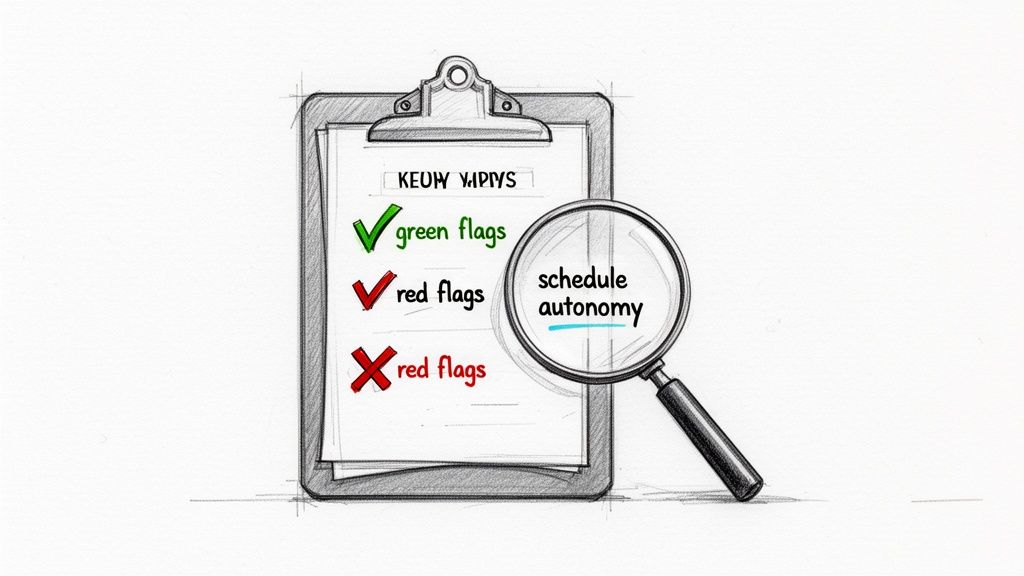
Finding roles with these features is step one. Platforms like WeekdayDoc are built for this, using a Burnout-Friendly Score to instantly show you which jobs actually prioritize your well-being. This kind of transparency lets you immediately filter out roles that clash with your goals.
Recognizing the Red Flags of Remote Burnout
Just as important as finding the good stuff is knowing how to spot the bad. A lot of remote jobs hide toxic expectations behind the promise of working from your couch. These are the red flags that suggest a culture that cares more about productivity than people, and they’re a fast track to exhaustion.
Red Flags to Avoid:
- Vague or 24/7 Call: If the on-call schedule is fuzzy or implies you’re basically always on standby, that’s a sign of zero boundaries.
- Productivity-Only Metrics: Your pay or performance is based only on the number of patients you see. This is a recipe for rushing through visits and sacrificing quality of care.
- Bring-Your-Own-Everything: The company wants you to use your personal computer, phone, and internet without offering a stipend. They're just offloading their operating costs onto you.
- High Turnover: Do a little digging. If you see on LinkedIn or other sites that clinicians are leaving the company after just a short time, it’s a major indicator of a toxic or unsustainable environment.
A job that requires you to be constantly connected isn't freedom; it's a digital leash. The best remote roles build a clear, thick wall between your work life and your personal life.
When you start looking at your job search this way, it stops being a game of luck and becomes a strategic mission. You're not just looking for any remote job. You’re pinpointing the one that offers a genuinely sustainable and fulfilling career for the long haul.
It can also help to get a baseline for where you're at right now. Using a tool like this clinician burnout calculator can give you a snapshot of your current stress levels before you even start looking.
Crafting Your Strategy to Land the Ideal Remote Role
So, you’ve found a remote healthcare job that looks like a perfect fit. Now comes the hard part: proving you're the right clinician for the role. Landing a great remote position takes more than just a polished CV. It requires a completely different strategy, one that proves you can thrive in a virtual setting.Think of your application like a diagnostic puzzle. The hiring manager is searching for concrete evidence that you have the skills to work autonomously. This means you need to reframe your clinical experience to spotlight the unique strengths required for remote work.
Highlighting Your Remote Readiness
Your clinical expertise is the baseline, but your resume needs to do more. It has to scream "remote-ready." You need to go beyond simply listing procedures you’ve performed or the number of patients you’ve seen.
Instead, zero in on skills like these:
- Technological Proficiency: Get specific. Mention the EHR systems (like Epic or Cerner), telehealth platforms, and secure messaging apps you've mastered. This tells them you won't need hand-holding with the tech stack.
- Autonomous Decision-Making: Dig up examples from your past where you managed a complex case or solved a tricky problem without needing to run down the hall for a consult. This shows you're a self-starter.
- Digital Communication: A great "webside manner" is everything. Highlight your ability to build trust and explain complicated medical information clearly through a screen. For some, investing in an accent reduction program for professionals working remotely can be a game-changer for ensuring your communication is crystal clear.
Acing the Virtual Interview
The virtual interview is often the final gatekeeper. Your success here is as much about your presence and setup as it is about what you say.
Treat it like you're setting up for a real telehealth visit. Find a quiet, well-lit space with a clean background. Always test your camera and microphone beforehand—technical difficulties are a red flag. On camera, look directly into the lens, speak with confidence, and be articulate. This isn't just a conversation; it's a live demo of how you'll interact with patients.
The virtual interview is your live-action audition for the role. Your ability to create a professional, seamless digital interaction speaks volumes about how you will care for patients remotely.
Negotiating Beyond the Salary
Getting the offer is just the beginning. When it comes to remote healthcare jobs, the negotiation should go way beyond your base salary. This is your chance to craft a total compensation package that actually supports a sustainable career.
Key Negotiation Points for Remote Roles:
- Equipment Stipend: Don't be shy. Ask for a stipend to cover a high-quality computer, extra monitor, and an ergonomic chair. Your workspace matters.
- Flexible Hours: Push for real autonomy over your schedule. True flexibility is one of the biggest perks of remote work.
- CME and Licensure Support: Make sure the company will cover the costs of keeping your licenses current and funding your continuing education.
By focusing on these practical details, you position yourself to not only land the job but to secure a role that truly fits your life. As you build your strategy, take a look through the curated, pre-vetted burnout-friendly job listings to see what the best employers are already offering.
Questions on Every Clinician's Mind
Making a career shift always brings up a ton of practical questions. For clinicians eyeing a move into remote healthcare jobs, those questions often circle back to stability, experience, and the simple logistics of practicing medicine from a home office. Let’s tackle some of the most common ones.
Are Remote Healthcare Jobs Actually Stable?
Yes, absolutely. The telehealth boom wasn’t a temporary blip; it has matured into a stable, permanent part of the healthcare industry. Think of it less as a trend and more as a fundamental shift in how care is delivered.
Many major health systems and medical groups now consistently keep 5-25% of their workforce in either remote or hybrid roles. This isn’t a cost-saving measure—it’s driven by overwhelming demand from both patients who love the convenience and clinicians who are actively looking for more balanced work. Specialties like mental health, primary care, and chronic disease management now offer secure, long-term career paths in the virtual world.
I've Only Ever Worked In-Person. How Do I Get Telehealth Experience?
Here’s the thing: you probably already have the most important skills. Most employers get it—plenty of incredible clinicians are new to telehealth. The trick is to reframe your existing experience on your resume to show you’re ready.
You don't need a certificate in "webside manner." Just highlight the skills that transfer seamlessly:
- EMR Proficiency: Your deep experience with systems like Epic or Cerner is gold. It’s the same work, just a different setting.
- Patient Communication: If you have a great bedside manner, you can have a great "webside manner." It's all about empathy and clear communication.
- Time Management: Emphasize how you work autonomously and manage a full patient load. That’s a core skill for any remote role.
Most companies will train you on their specific platforms. What they can't teach is clinical judgment and a genuine desire to connect with patients. Your willingness to learn is far more valuable than having used a specific telehealth app before.
Your clinical expertise is what matters most. The tech is just a tool. The real skill is showing you can deliver compassionate, effective care in any environment.
Can I Work Remotely From Another State or Even Another Country?
Working from a different state is pretty common, but it comes with one non-negotiable rule: you must be licensed in the state where the patient is located. This is the bedrock of telehealth compliance. Thankfully, interstate compacts like the IMLC for physicians and the NLC for nurses make managing multiple licenses much more straightforward.
Working from another country, however, is almost always a hard no for U.S.-based jobs. The legal, regulatory, and data privacy hurdles—especially around HIPAA—are just too complex. The overwhelming majority of remote U.S. healthcare jobs require you to live and work within the United States, often within a specific list of approved states.
Ready to find a job that respects your time? WeekdayDoc curates the best burnout-friendly remote and hybrid roles, complete with transparent salary data and our proprietary Burnout-Friendly Score. Start your search for a more balanced career today at https://www.weekdaydoc.com.