Your Guide to Finding Burnout-Proof PRN Hospitalist Jobs
Discover how to find, evaluate, and land high-paying PRN hospitalist jobs that protect your work-life balance. A practical guide to flexible physician careers.

If you’re feeling the grind of the traditional 7-on/7-off hospitalist schedule, you’re not alone. PRN hospitalist work offers a powerful way to take back your schedule, boost your income, and cut through the administrative noise that so often leads to burnout.
PRN, or "pro re nata" (as needed), means you work on your own terms. It's a fundamental shift away from the rigid, often exhausting, full-time models that dominate hospital medicine.
Why PRN Hospitalist Jobs Are a Strategic Career Move
Let's be honest: the standard hospitalist model can feel like being a cog in a machine. That relentless 7-on/7-off cycle is designed for hospital coverage, not clinician well-being. It can leave you drained, making it nearly impossible to have a life outside the hospital walls.
PRN work flips that script. It puts you back in the driver's seat, letting you decide when and how often you want to work. This isn't just a lifestyle perk; it's a strategic move to reclaim your career. When you step away from a full-time salaried role, you also escape most of the non-clinical drudgery—committee meetings, endless administrative tasks, and departmental politics—that chips away at professional satisfaction.
The Core Benefits of Going PRN
Working as a PRN hospitalist means you’re paid for your clinical expertise, pure and simple. And you’re often paid at a much higher hourly rate to make up for the lack of benefits that come with a salaried position.
The main advantages are clear:
- Schedule Autonomy: You pick the shifts you want. Your work finally fits your life, not the other way around.
- Higher Earning Potential: Premium hourly rates mean you can often earn more money while working fewer hours.
- Reduced Administrative Burden: Forget mandatory meetings and non-clinical duties. You get to focus on being a doctor again.
This visual gives a quick snapshot of why so many hospitalists are making the switch.
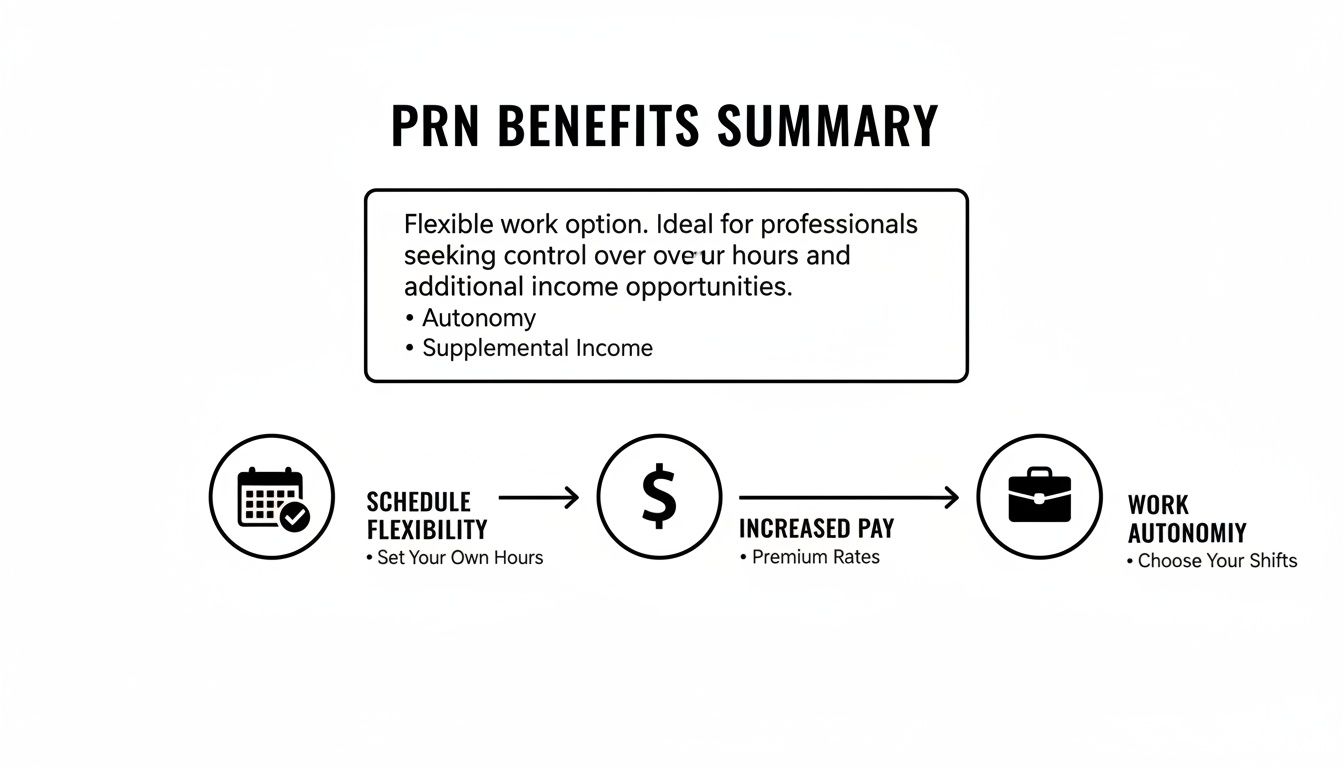
As you can see, it all comes down to gaining more control over your time, your money, and your professional life.
To give you a clearer picture, here’s how the two paths stack up side-by-side.
Full-Time Salaried vs. PRN Hospitalist: A Quick Comparison
Many clinicians weigh the stability of a full-time role against the freedom of PRN work. This table breaks down the key differences to help you decide which model aligns better with your career and life goals.
| Factor | Traditional Full-Time Hospitalist | PRN Hospitalist |
|---|---|---|
| Schedule | Fixed, often 7-on/7-off rotation | You choose which shifts to pick up |
| Pay Structure | Annual salary with benefits | Higher hourly rate, no benefits |
| Administrative Duties | Required (meetings, committees, etc.) | Minimal to none |
| Job Security | Perceived as higher; steady paycheck | Less predictable; work can fluctuate |
| Autonomy | Limited; schedule set by employer | High; complete control over when you work |
| Lifestyle | Can lead to burnout due to rigidity | Supports work-life balance and flexibility |
While a salaried role offers predictability, the PRN path provides an unmatched level of freedom that many physicians find is the key to a sustainable, long-term career in medicine.
A Market Driven by Need and Flexibility
The demand for flexible, skilled clinicians isn't going away. Hospitals are struggling to cover inpatient shifts without committing to expensive full-time hires, which has caused PRN and locum roles to explode.
In the United States, the healthcare staffing market is expected to hit around $39.4 billion in revenue by 2025. With health systems facing turnover costs that can top $50,000 per physician, building a reliable pool of PRN hospitalists has become a go-to strategy for maintaining coverage. You can explore more on the evolving healthcare staffing market and its future trends.
Key Takeaway: The rise of PRN hospitalist jobs is a direct market response to two critical issues: hospitals needing flexible staffing and clinicians demanding a more sustainable career path. This alignment creates a powerful opportunity for hospitalists ready to redefine their professional lives.
Your Search Strategy for Finding the Right PRN Opportunities

Finding high-quality PRN hospitalist jobs means looking beyond the huge, impersonal job boards. You need a targeted approach that connects you with roles that genuinely support work-life balance—not just ones that plug a hole in a hospital's schedule. The goal here is to be surgical with your search, not just reactive.
Your best bet is a strategy that blends modern tools with some good old-fashioned networking. Start by getting smarter with your online searches to filter out the noise. Instead of just typing "hospitalist jobs," use more specific search strings on sites like LinkedIn to really narrow down the results.
For example, I've had success with queries like these:
("prn hospitalist" OR "per diem hospitalist") AND "no call"("hospitalist") AND ("part time" OR "flexible schedule") NOT "nocturnist"
Using precise searches like these helps you immediately cut through thousands of irrelevant 7-on/7-off listings. You can focus on the gigs that meet your specific criteria from the very beginning.
Niche Platforms and Direct Outreach Are Your Best Friends
Let's be honest: generic job sites often don't have the filters you need to find burnout-proof roles. This is where specialized platforms like WeekdayDoc are a game-changer. They're built for clinicians who are actively seeking balance, featuring pre-vetted listings with clear tags like "No Weekends" or "No Call." It saves you the headache of trying to decipher vague job descriptions.
Don't underestimate the power of direct outreach, either. It can be surprisingly effective. Most hospital medicine groups keep an internal roster of PRN candidates long before they ever post a job publicly. Identify the Hospital Medicine Director or lead physician at the hospitals you're interested in and send them a brief, professional email.
Pro Tip: Don't just send your CV with a generic "are you hiring?" message. Frame your email around their needs. Briefly state your availability, clinical interests, and explain how you can provide reliable, high-quality coverage for their team. You're making it an easy "yes" for them to keep your info on hand.
Learning to Decode Job Descriptions
Quickly reading between the lines of a job description is a critical skill. You have to learn to look past the boilerplate hospital mission statement and zero in on the details that reveal what the job is really like.
Key things to scrutinize in a job posting:
| Section of Job Description | What to Look For | Potential Red Flag |
|---|---|---|
| Schedule & Responsibilities | Mentions of "flexible," "day shifts," or "as needed." | Vague terms like "varied shifts" or "rotational coverage." |
| Requirements | Standard board certification and state licensure. | Unusually high minimum shift requirements per month. |
| Compensation | Clear statement of the hourly rate or a competitive range. | No mention of compensation; "DOE" without a stated range. |
Pay close attention to the duties listed. If a job description for a PRN role mentions things like "departmental meetings" or "quality improvement committees," that's often a sign that it’s more like a part-time employee position with fewer benefits.
True PRN work should be focused almost entirely on clinical duties. Screening for these subtle details will save you from wasting time on PRN hospitalist jobs that won’t actually give you the autonomy and flexibility you’re looking for.
How to Evaluate Offers and Negotiate Your Contract
Getting that PRN hospitalist offer is a great feeling, but this is where the real work begins. The contract you sign will dictate your flexibility, income, and overall sanity for months or years to come. A good one protects your autonomy; a bad one can create frustrating, unexpected problems down the road.
Think of the initial offer as a starting point, not a final verdict. It’s the beginning of a professional conversation. Your goal here is to dig deeper than just the hourly rate and really understand the operational reality of the role. How are shifts really assigned? What happens when they need to cancel on you? These are the details that truly define your day-to-day experience.
Deconstructing the PRN Contract
A per-diem contract is a different beast than a standard full-time employment agreement. You need to read it with a different lens—one focused squarely on flexibility, liability, and payment security. Be on high alert for any language that could box you in, like restrictive scheduling demands that completely defeat the purpose of going PRN in the first place.
Here's what I always zoom in on first:
- Shift Cancellation Policy: This is a big one. The contract needs to spell out exactly how much notice the hospital must give before canceling your shift. If they can cancel on you last-minute without pay, that’s a major red flag that signals a lack of respect for your time.
- Malpractice Insurance: Who provides it? Is it "claims-made" or "occurrence-based"? Crucially, who pays for tail coverage if and when you leave? Getting stuck with a massive tail bill is a nasty surprise you want to avoid at all costs.
- Non-Compete and Non-Solicitation Clauses: Aggressive non-competes can cripple your ability to pick up shifts at other nearby hospitals, completely undermining the freedom you’re looking for. Make sure any geographic or time restrictions are reasonable and won’t lock you out of your local market.
A fair PRN contract is a two-way street. If the hospital wants a 60-day notice from you to terminate the agreement, it’s only fair to ask for the same notice period from them for non-renewal or major changes to your terms.
To make this process less overwhelming, it helps to use a checklist. I’ve put together a table below with the key clauses to scrutinize. For a more interactive approach, our PRN hospitalist jobs offer analyzer can walk you through the fine print and help you spot potential issues before you sign anything.
PRN Hospitalist Contract Review Checklist
Before signing any per-diem agreement, use this checklist to carefully review the terms. It highlights common areas where vague or unfavorable language can cause problems later on.
| Contract Clause | What to Look For | Red Flag Example |
|---|---|---|
| Shift Cancellation | Clear notice period (e.g., 7-14 days) and any payment for late cancellations. | "Hospital reserves the right to cancel shifts at any time based on census needs without compensation." |
| Malpractice Insurance | Specifies who provides coverage (hospital or you) and the type (occurrence vs. claims-made). | Vague language that doesn't explicitly state who is responsible for purchasing tail coverage. |
| Non-Compete Clause | Reasonable geographic radius (<15 miles) and duration (<1 year after termination). | "Clinician agrees not to work for any competing hospital system within a 50-mile radius for 2 years." |
| Scheduling & Availability | Defines minimum shift commitments and how shifts are offered/assigned. | "Clinician must provide four weekend shifts per month and be available for two major holidays." |
| Payment Terms | Clear hourly rate, overtime definitions, and invoicing/payment schedule (e.g., net 30 days). | "Payment will be processed in the next available pay cycle," without a specific timeframe. |
| Termination Clause | Mutual "without cause" termination notice (e.g., 30-60 days for both parties). | An imbalanced clause requiring 90 days' notice from you but only 14 days' notice from the hospital. |
This checklist isn't exhaustive, but it covers the most critical points that determine whether a PRN role will truly support your lifestyle or just become another source of stress.
Negotiation: Your Leverage and Compensation
Your negotiating power right now is stronger than you might think. Hospitals everywhere are dealing with major staffing shortages, which puts skilled, flexible clinicians in a fantastic position.
The World Health Organization is projecting a staggering global shortfall of 11 million health workers by 2030. Here in the U.S., hospitals could be short as many as 4 million workers by 2026. This isn't just a statistic; it's your leverage. It's the reason you can confidently ask for terms that protect your time, like weekday-only shifts or a no-call guarantee. You can explore more about the global health workforce projections to get a sense of the scale of this demand.
When it comes to your rate, do your homework. Know the going rate for hospitalists with your experience in your specific region. Pay can swing dramatically between a major academic center in a big city and a small community hospital in a rural area. Walk into that conversation armed with data, ready to explain why your skills and reliability are worth a competitive rate. Don't ever be afraid to counter an initial lowball offer with a polite, well-reasoned request that reflects your true market value.
Mastering the PRN Lifestyle with Smart Scheduling and Finances

Succeeding in PRN hospitalist jobs isn’t just about picking up shifts; it’s about intentionally designing a life you want to live. This comes down to mastering two things: your schedule and your money. Getting both right is what turns PRN work from a simple gig into a powerful engine for career longevity and financial freedom.
On the scheduling front, you have to be strategic. The real goal isn't just to work less—it's to work smarter. Many veteran PRN hospitalists swear by shift blocking, which means clustering your workdays together (think a Monday-Thursday block) to open up long stretches of personal time. It's a game-changer that allows for mini-retirements throughout the year, killing the slow-burn exhaustion that often comes with traditional physician schedules.
Proactive communication is also your best friend. Don't just wait for the scheduler to call with leftover shifts. Get ahead of it by clearly communicating your availability in predictable chunks. An email like, "I'm available for up to eight day-shifts between the 1st and 15th of next month," gives them something concrete to work with and positions you as an organized, reliable partner they'll want to call first.
Building Your Financial Foundation as a 1099 Clinician
When you go 1099 as a PRN hospitalist, you become the CEO of your personal finances. There's no automatic tax withholding and no employer benefits package, which demands a disciplined, proactive mindset. The absolute first step is getting your taxes sorted.
As an independent contractor, you're on the hook for your own income and self-employment taxes (that’s Social Security and Medicare). The IRS expects you to pay these quarterly, and if you don't, the underpayment penalties can be brutal.
Here's a simple, foolproof strategy: open a separate high-yield savings account just for taxes. The moment you get paid, automatically transfer 25-35% of that income into your tax account. This way, the money is always set aside when your quarterly payments are due.
Key Takeaway: The incredible freedom of PRN work is built on a foundation of financial discipline. If you treat your tax savings as a non-negotiable business expense from day one, you’ll avoid massive financial stress and actually get to enjoy the benefits of that higher hourly rate.
Next, you need to replicate the benefits package a W-2 employer would normally provide. This is a critical piece of your financial puzzle and should absolutely be factored into the hourly rate you're aiming for.
Essential Coverage for the PRN Hospitalist:
- Health Insurance: You'll need to find your own plan, likely through the ACA Marketplace, professional organizations, or a spouse's employer.
- Disability Insurance: This is non-negotiable. Get a true "own-occupation" policy that protects your income if you can no longer work specifically as a hospitalist.
- Life Insurance: For most physicians, term life insurance is a cost-effective way to ensure your family is protected financially.
If you're looking for a middle ground, some part-time physician jobs offer a hybrid model with more flexibility than full-time roles but still include certain benefits. It's a great option to explore if you're not ready to go full 1099.
Accelerating Your Path to Financial Independence
One of the most powerful advantages of PRN hospitalist work is its ability to supercharge your retirement savings. As a self-employed individual, you unlock access to high-contribution retirement accounts that blow most employer-sponsored 401(k)s out of the water.
A SEP IRA, for instance, lets you contribute up to 25% of your net self-employment income. A Solo 401(k) is even more powerful, allowing you to make both "employee" and "employer" contributions.
For anyone pursuing FIRE (Financial Independence, Retire Early), these accounts are essential. They allow you to save aggressively while maximizing your tax advantages. Mastering these financial tools is what truly unlocks the long-term, wealth-building potential of a PRN career.
How Burnout-Friendly Platforms Are Changing the Job Search

Let's be honest: the traditional job hunt for clinicians is broken. It's an exhausting cycle of scrolling through endless, vague listings and wasting time on roles that are a terrible fit for anyone trying to maintain a life outside of medicine. That whole process just piles more stress onto an already demanding career.
The good news? This outdated model is finally starting to change.
A new breed of specialized job platforms is popping up, built by clinicians who get it. Instead of just scraping together every job opening they can find, these sites are more like curated marketplaces. They’re designed from the ground up to prioritize transparency and your well-being.
This isn’t happening in a vacuum. It’s a direct response to the massive, system-wide burnout that's pushing clinicians to seek more sustainable careers. The demand for PRN roles that skip the brutal nights, weekends, and on-call schedules is exploding.
Don't just take my word for it. A recent Harris Poll found that a shocking 55% of U.S. healthcare workers are looking to jump ship by 2026. The top reasons? Burnout and inflexible hours. So when new platforms specifically tag roles as "No Call" or "Daytime Only" and post clear salary data, they're directly answering that call for help, as detailed in recent analyses of the healthcare workforce.
Shifting the Power with Data and Transparency
The single biggest change these new platforms bring is putting the power back where it belongs: with you, the clinician. By giving you all the critical data upfront, they let you screen opportunities efficiently and make smart decisions before you even think about applying.
This new generation of job sites offers features that were practically unheard of just a few years ago:
- Burnout-Friendly Scoring: Some platforms use algorithms to actually score a job's potential impact on your work-life balance, looking at things like call schedules, shift lengths, and patient loads.
- Transparent Salary Data: The guessing games are over. Listings come with clear hourly rates and sometimes even projections for financial goals like FIRE (Financial Independence, Retire Early).
- Direct Employer Access: Many of these sites cut out the recruiter middleman, letting you talk directly with the people who matter—the hospital hiring managers and medical directors.
This isn't just about making the search easier. It’s about setting a new standard. When salary ranges and schedule details are laid out in the open, it forces the entire market to become more competitive and clinician-focused.
Making Informed Choices with Better Tools
Ultimately, finding a PRN hospitalist role you can stick with is all about having the right information. Tools like a Burnout Index can help you take stock of where you are now and figure out what you really need from a job to protect your own well-being.
When you combine that kind of self-awareness with platforms that provide objective, transparent data, you can finally move beyond just finding another gig. You can start building a career that actually supports your life.
Wrapping Up the Details: Common PRN Hospitalist Questions
Once you've weighed the pros and cons and know what to look for in a contract, a few practical questions almost always come up. Let's tackle the final logistical hurdles that might be on your mind before you make the leap.
One of the first things physicians want to know is about the credentialing process. How long does it really take to get approved at a new hospital?
While every system is a bit different, a good rule of thumb is to budget 60 to 90 days from the day you submit your paperwork to your first shift. It can sometimes move faster, but planning for that two-to-three-month window is the safest bet to avoid any unexpected gaps in your income.
Another big question revolves around the schedule itself. How do you get enough shifts to make it worthwhile without feeling like you're constantly at the mercy of last-minute calls?
How to Get Consistent Work (and Still Protect Your Time)
The secret to a steady stream of PRN shifts is simple: be the person they want to call first. Hospitals quickly learn who is reliable, competent, and easy to work with. Once you establish that reputation, you’ll find your schedule filling up. Being proactive by giving the schedulers your availability well in advance also makes their lives easier—and makes them more likely to book you.
But reliability doesn't mean being a doormat. Protecting your time is just as crucial. It is completely reasonable—and expected—that you set firm boundaries from the start.
- Be specific about your availability. If you only want day shifts, say so. "I am available for daytime hospitalist shifts, 7a-7p," is crystal clear.
- It’s okay to say no. You are not obligated to accept every text or call. A polite, "Unfortunately, I'm not available on such short notice, but please keep me in mind for future needs," works perfectly.
The whole point of PRN work is to gain control over your schedule, not lose it. You can be a dependable clinician without being available 24/7. True sustainability comes from honoring the boundaries you set for yourself.
So, What About Benefits and Retirement?
This is a big one, especially if you're coming from a W-2 role. As a 1099 independent contractor, you're the CEO of your own career, which means you're in charge of your own benefits. This includes sourcing your own health insurance plan and setting up your retirement accounts.
While that might sound daunting, many PRN hospitalists see it as a huge plus. Instead of being stuck with a one-size-fits-all 401(k), you can open powerful retirement vehicles like a SEP IRA or a Solo 401(k). These accounts often have much higher annual contribution limits, which can put you on the fast track to financial independence.
Ready to find a PRN role that truly fits your life? WeekdayDoc is the only job board built for burnout prevention, curating hospitalist jobs with transparent pay and scheduling details. Start your search for a better PRN hospitalist job today.