Pain Management Dr Salary
Pain management dr salary - Explore pain management doctor salary ranges for 2026. See how practice type, location, and RVUs affect pay, plus tips to boost

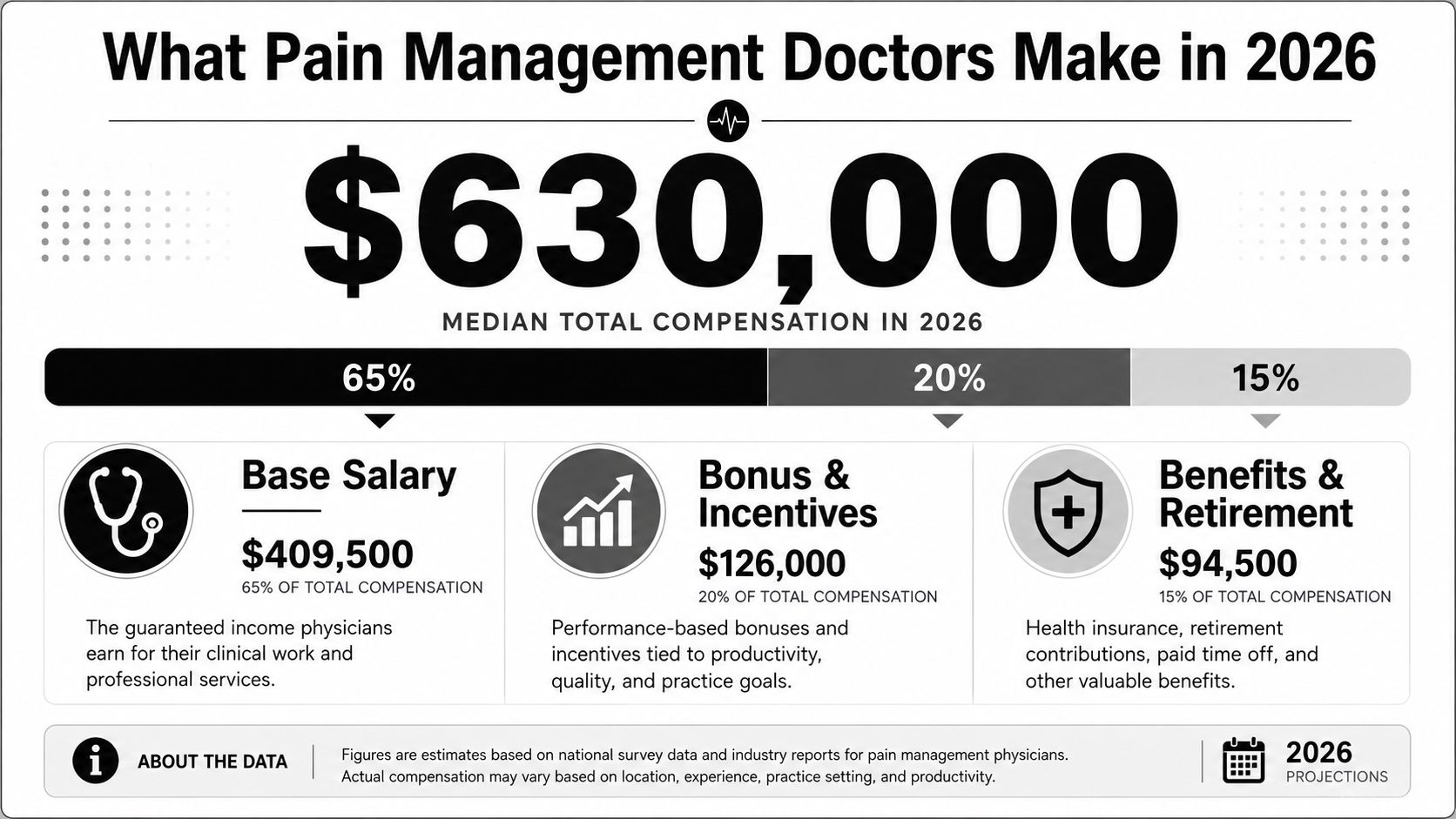
The best current answer to pain management dr salary is a $630,000 median total compensation figure from verified physician submissions, but that number hides a wide split. In practice, many employed roles land closer to $350K to $500K, while private practice with ASC ownership can push past $800K to $1M when the deal is built around ownership rather than salary alone.
That spread is the story. Pain medicine is not one market, it's several markets stacked on top of each other, and the difference between them is usually practice model, call burden, and facility ownership, not just geography or specialty label.
What Pain Management Doctors Make in 2026
$630,000 is the cleanest 2026 answer available for pain management physician pay, because it comes from a verified physician-submission dataset with 26 submissions, a 25th percentile of $465,000, and a 75th percentile of $800,000. The same dataset estimated base salary at $487,692, with 24% of respondents receiving bonuses and total compensation averaging about $266 per hour on a 46-hour work week. SalaryDr's 2026 pain management data makes one thing obvious, pain management is still a high-compensation specialty in the U.S. market, but the distribution is wide enough that a single average can mislead you.
Why the headline number is useful and dangerous
The useful part is obvious. It gives you a reality check against outdated assumptions that pain medicine is just a procedural niche with modest income. The dangerous part is that it blends together different offer types, and the gap between a straight employed salary and a physician-ownership model can be dramatic.
Practical rule: treat the median as a negotiation anchor, not a guarantee. If an offer lacks ownership upside, a bonus plan, or meaningful productivity credit, it should not be compared with a physician-reported total compensation figure as if they were the same thing.
That's why methodology matters more than people admit. Broader benchmarks can land much lower. Salary.com's benchmark for Physician - Pain Medicine reports an average of $390,057 and a typical range of $322,717 to $512,259 Salary.com benchmark data, while physician-contributed reporting at Physiciansidegigs found an average of $455,000, a median of $414,000, and a $1.2 million high end Physiciansidegigs pain management compensation data.
The right conclusion isn't that one source is right and another is wrong. The right conclusion is that pain management dr salary depends heavily on what the dataset measures, whether it includes bonuses, and whether it captures ownership-driven income that normal salary pages often miss.
WeekdayDoc's analysis of active listings reinforces that practical split, because the listings people chase usually separate into secure employed roles, flexible no-call roles, and higher-upside procedural jobs. If you want the offer to make sense, read the compensation structure before you read the headline number. For current openings, start with pain management jobs at WeekdayDoc.
Salary by Practice Model and Employment Type
The biggest mistake clinicians make is comparing pain offers as if they all live in the same market. They don't. An employed role, an academic role, a private practice role with ASC stake, and a telehealth-heavy role can all carry the same specialty label while paying for completely different work.
The compensation spread by model
The most reliable pattern in the market is that employed or academic roles are often much lower than private practice with ownership upside. Neutral and physician-reported sources describe a $350K to $500K band for many employed roles, while private interventional practices with ASC ownership can push much higher because the physician captures facility fees in addition to professional fees WeekdayDoc's market analysis of active listings. That ownership piece is often the single largest driver of total compensation.
| Practice Model | Typical Total Comp | Comp Structure | Call Burden | FIRE Potential |
|---|---|---|---|---|
| Hospital employed | Often in the lower-to-mid market band | Base salary, bonus, limited upside | Usually defined by coverage needs | Solid, but slower unless expenses stay lean |
| Academic | Often below private practice | Salary with institutional support | Can be heavier or more variable | Good stability, less upside |
| Private practice without ASC ownership | Mid to upper market band | Base plus productivity | Usually tied to volume | Strong if procedures are efficient |
| Private practice with ASC ownership | Can exceed the standard band materially | Professional fees plus facility fees | Can vary by group design | Highest upside when ownership is real |
| Telehealth or weekday-only pain roles | Lower than procedural upside, but still competitive | Salary or salary-plus-bonus | Minimal or no call | Strong for lifestyle-first clinicians |
What the ownership gap really means
Ownership changes the math because it changes what gets paid. A physician who only bills professional services is paid one way, while a physician who also owns part of the setting can participate in a second revenue stream. That's why a practice can look “expensive” on paper and still be the more valuable deal.
The practical takeaway is simple. If the offer is employed, ask whether it's pure salary, salary plus productivity, or salary plus quality incentives. If it's private practice, ask whether you're buying into any ownership interest, and if so, what income flows from it versus what stays with the group.
A clean-looking salary can be the least attractive offer if the physician gives up the right to share in downstream facility economics.
Telehealth and hybrid models sit in a different lane. They usually trade away procedural upside for predictability, lighter weekends, and less operational friction. For many clinicians, that's not a compromise, it's the point.
State by State Salary Variation and Market Opportunities
Geography still matters, but it matters less than most clinicians think once practice model is accounted for. The highest nominal salary is not always the best deal if taxes, housing, and competition eat the upside before you can save it.
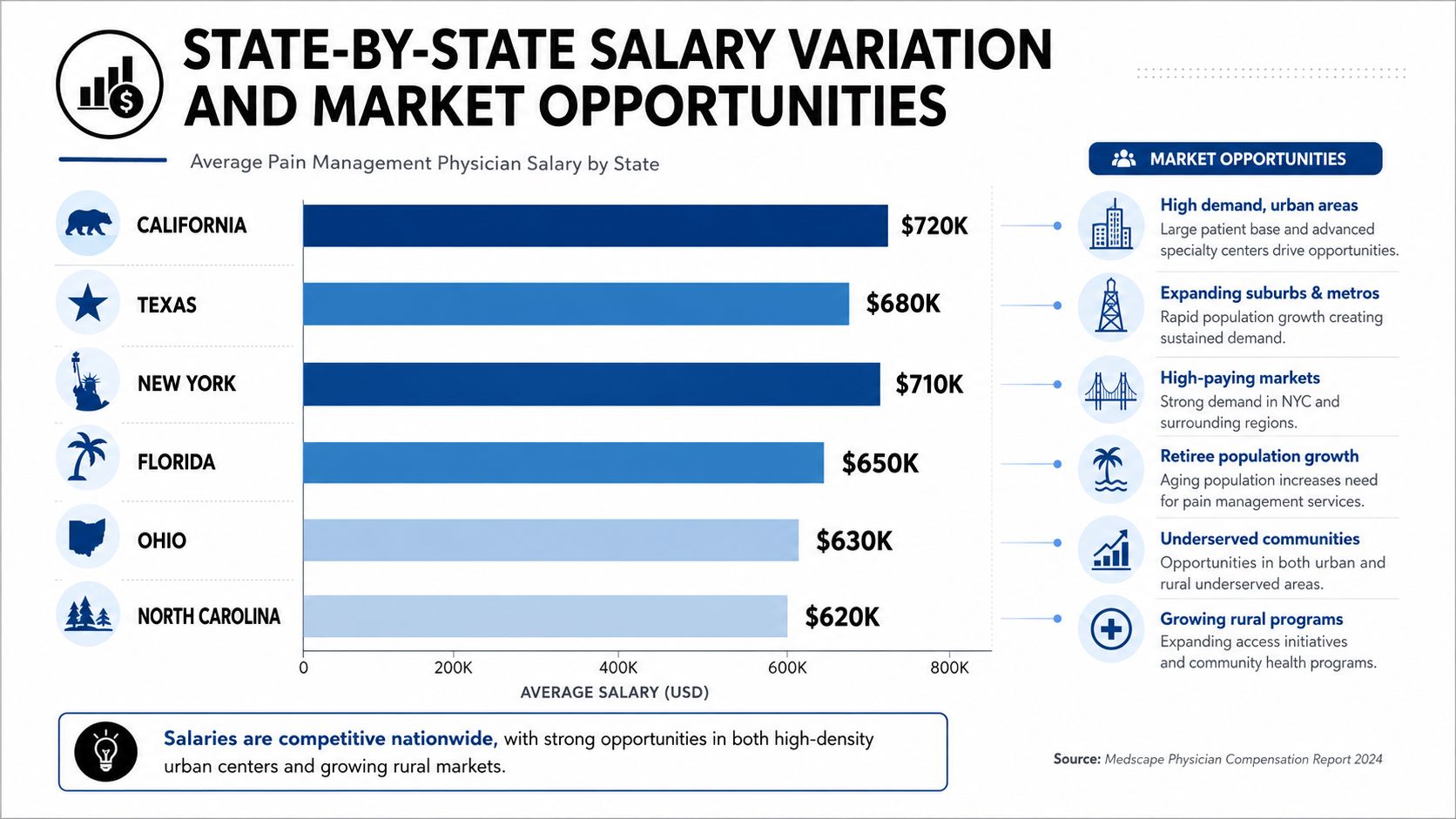
Why nominal pay can mislead you
A $450K role in a no-income-tax state can outperform a $550K role in a high-tax, high-cost market if the rest of the compensation package is stable and the schedule is sane. That's not a theory, it's basic after-tax decision-making. The market opportunity is often better in places where patient access is tight, referral demand is steady, and groups need coverage without asking for endless call.
The states that often look attractive on paper are not necessarily the same states that are easiest to live in. A clinician chasing gross pay alone can end up in a market where the salary is technically higher but the net lifestyle is worse.
What to ask before relocating
Before you move for a pain role, ask three questions.
- What kind of volume is the practice trying to fill? High demand can support stronger offers, but it can also mean heavier procedural intensity.
- What is the call expectation? No-call or minimal-call arrangements should be valued differently from traditional coverage-heavy posts.
- Where does the income come from? Salary, productivity, and ownership are not interchangeable.
That last question matters because state rankings by themselves can hide the driver of pay, which is the structure of the role. A market with lower nominal pay can still be the better wealth-building choice if it offers predictable hours, low churn, and strong savings rate compatibility.
For clinicians comparing regions, WeekdayDoc's state-based salary and FIRE pages help separate headline compensation from practical take-home value. The useful lens is not “where is the most money,” it's “where does the money survive taxes, commute friction, and burnout.”
How RVU Models Actually Drive Your Compensation
RVU pay is where pain management offers either become transparent or become impossible to trust. Once a compensation plan uses productivity, the only number that matters is whether the work credit and conversion rate line up with the schedule and procedure mix you're being asked to carry.
Understanding RVUs in pain roles matters because a base salary can look generous until the productivity threshold makes it harder to earn the full package. The same is true in reverse. A lower base with a fair RVU formula can be better than a higher base with an unreachable target.
What to inspect in an RVU offer
Start with the unit the employer is paying for. In most contracts, the system is built around work RVUs, not just time in clinic. That means the physician who does more procedures, sees more patients, or carries more complexity may generate more credit, but only if the conversion factor and thresholds are set fairly.
The key questions are straightforward.
- What is the floor? Ask whether there's a guaranteed base during ramp-up.
- What earns RVUs? Some tasks count more than others, and some ancillary work counts less than people assume.
- When does productivity start? A slow start can be acceptable if the runway is real.
- How is call handled? If call is unpaid but still blocks your schedule, that's an economic cost even if it never appears in the RVU line.
Why procedure intensity changes the math
Pain medicine is one of the specialties where procedural intensity can change compensation quickly. A physician who runs a high-volume interventional schedule can accumulate credit differently than someone in a quieter consult-heavy setting. That is why two doctors with the same title can land at very different income levels without either one being misclassified.
The webinar-style explanation below is useful if you're new to these mechanics.
The smartest move is to convert the offer into an expected monthly output and compare that to the guarantee. If the math only works when your schedule is packed and your procedures run at maximum pace, the contract is not as safe as it looks.
Total Compensation Beyond Base Salary
Base salary is only the first layer. In pain management, total compensation matters most, because bonuses, benefits, retirement contributions, malpractice coverage, and employer-paid expenses can change the value of an offer materially.
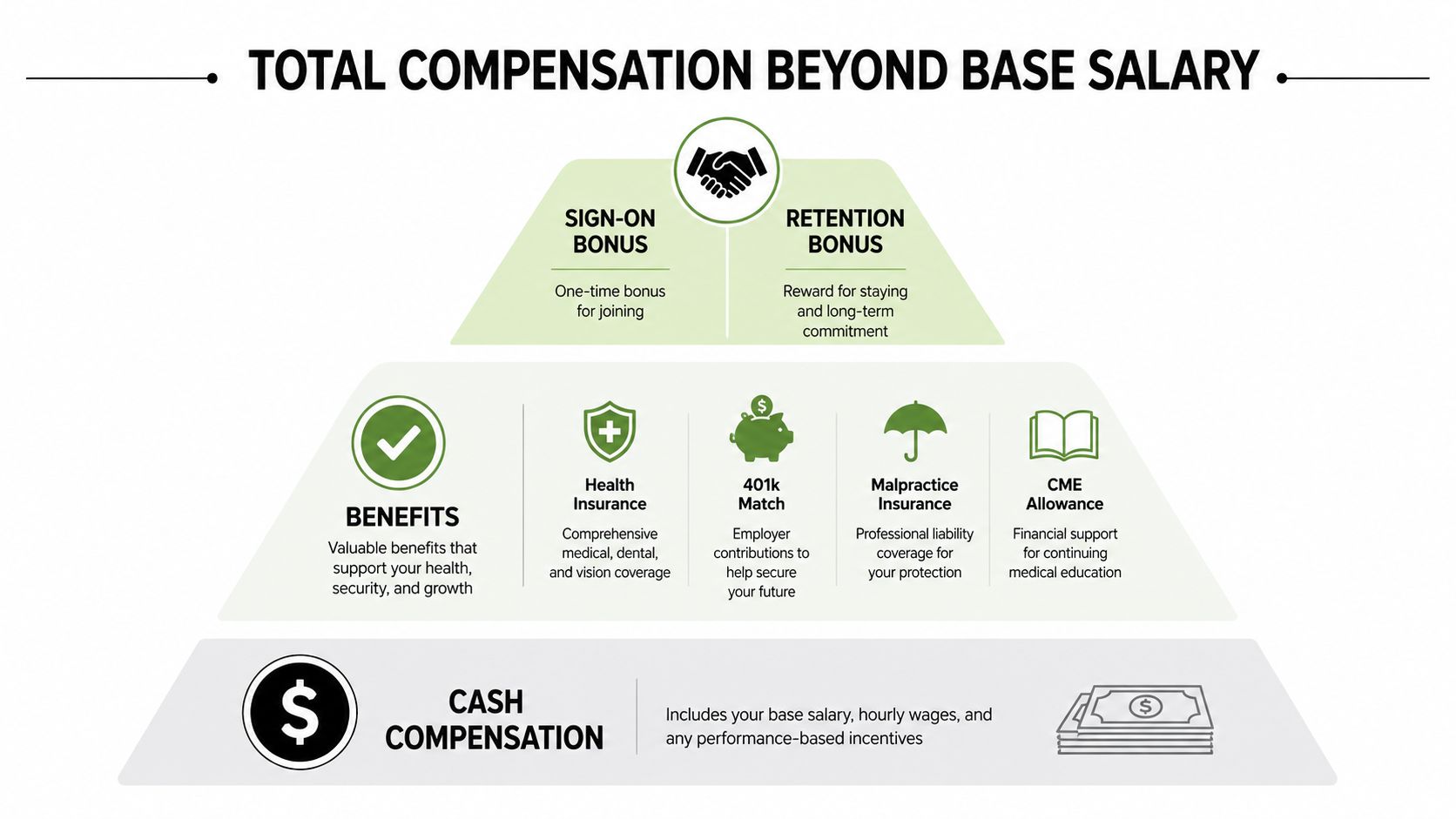
What counts beyond salary
SalaryDr's 2026 dataset estimated $487,692 in base salary, yet the reported $630,000 median total compensation was higher because some respondents received bonuses and incentive pay SalaryDr pain management salary data. That gap is the reason you should never evaluate a pain offer on base pay alone.
Benefits matter more than most physicians think. Health coverage, retirement contributions, CME support, and malpractice insurance all have real economic value, even when they don't show up as cash in your checking account. The same is true for tail coverage, which is often buried near the end of the contract but can be a major hidden cost if the employer does not pay it.
How to read the offer like an economist
Think in layers.
- Cash compensation. Base salary, bonuses, and productivity pay.
- Benefits. Insurance, retirement, CME, and malpractice.
- Ownership and exit value. Any stake in ASC or practice economics.
- Downside protection. Tail coverage, ramp-up guarantees, and floor clauses.
A $400K base with rich support can beat a $450K base with weak extras if the latter leaves you paying for coverage, retirement gaps, or malpractice tail out of pocket. That arithmetic is why total compensation is the more decision-relevant metric.
If you own part of the practice, benefit structure gets even more important. For practice owners, a resource like PEO benefits for practice owners can help frame how benefit design affects cost control and physician retention. It won't tell you whether a role is worth taking, but it will remind you that compensation is a system, not a single line item.
The Lifestyle to Income Tradeoff in Pain Medicine
The old story says you either take the hard call-heavy job and get paid, or you choose sanity and leave money behind. The current market is narrower than that. The tradeoff is not between money and comfort, it's between different forms of compensation, with some roles preserving much more income than clinicians expect.
What no call actually costs
Recent staffing data for permanent interventional pain jobs showed a 12-month average of $728,000, with a range of $450,000 to $1.0 million AMN Healthcare interventional pain jobs. That tells you procedural, full-time interventional work can still pay at a very high level, even when roles are permanent rather than purely locums-style.
But the other side of the market matters just as much. Physician-reported and job-board sources also show much lower compensation in employed, academic, and more lifestyle-protected settings, often landing in the $350K to $500K band. That spread is real, but it is not as wide as people often assume once they exclude the ultra-high-intensity outliers.
Why burnout-friendly roles are not necessarily low paid
The misconception is that no-call or weekday-only work automatically means weak pay. That's not what the market shows. Weekday-heavy, lower-intensity pain roles can still produce strong compensation, especially when the clinician accepts less procedural volume in exchange for predictability and lower emotional load.
This matters for clinicians who care about FIRE but do not want a life organized around the hospital pager. A stable $450K role with clean hours can compound very well if the savings rate is strong and burnout stays low enough to remain in the job. A nominally larger role can lose that advantage if the schedule drains the physician into leaving early or changing jobs often.
The highest earning path is not always the best wealth path. Retention, stamina, and spending control matter just as much as gross pay.
For psychologists, PAs, NPs, and physicians comparing roles, the point is the same. Do not assume that a lower-call arrangement means a lifestyle tax so large that FIRE disappears. In pain medicine, the schedule adjustment often costs less than people fear, and in some cases it preserves more net wealth than the “better” paying but far more punishing option.
Negotiating Your Pain Management Offer and Planning for FIRE
Negotiation in pain medicine should focus on four levers: the RVU floor, the call arrangement, any path to ASC ownership, and whether tail coverage is employer-paid. Each one changes the value of the offer in a different way, and any one of them can matter more than a small swing in base salary.
What to push on before you sign
A good contract conversation is specific.
- Ask for ramp protection. If productivity is part of pay, the early months should not punish you before panel growth catches up.
- Clarify call compensation. Unpaid call can erase the value of a higher base.
- Separate salary from ownership. If ASC access exists, ask what the economics are.
- Confirm tail coverage in writing. If the employer wants flexibility, the downside cost should not sit entirely with you.
For a deeper framework on long-term wealth building, WeekdayDoc's guide to achieving financial independence is a useful companion because it ties compensation structure to savings rate, not just annual income. The same logic applies in pain medicine, where two similar salaries can lead to very different net outcomes once taxes, call burden, and savings capacity are included.
The time value calculation guide is also relevant here, because the contract choice you make now affects both annual cash flow and the future value of the income you keep.
Comparing paths over time
A clinician comparing an employed no-call role, an interventional private practice role, and an academic role should not ask only what pays more this year. The better question is which structure lets you keep earning without burning out or taking on hidden costs. That difference separates temporary income from durable wealth.
| Career Path | Work Style | Income Shape | Wealth-Building Profile |
|---|---|---|---|
| Employed no-call | Predictable, lower intensity | Often steadier, with less upside | Strong if savings stay consistent |
| Interventional private practice | Procedural, higher intensity | Higher ceiling, more volatility | Very strong if ownership is real |
| Academic | Structured, mission-driven | Usually lower upside | Solid stability, slower accumulation |
The lifestyle-to-income tradeoff is measurable. A no-call role may preserve less gross pay than a high-volume interventional practice, but it can also preserve time, energy, and continuity, which matter when the goal is to stay in the same seat long enough for compounding to work.
That is the core FIRE question in pain medicine. A clinician who can save aggressively in a durable, lower-stress role may end up ahead of a higher earner who chases a larger headline number but cannot keep the schedule, the pace, or the expense profile under control.
If you want the cleanest possible next step, look at live listings, compare compensation structure line by line, and run the numbers against your own spending and savings goals. The best offer is the one you can keep long enough for compounding to do its work.
WeekdayDoc curates pain management roles with no-call, no-weekend, remote, hybrid, and in-person options, and each listing shows salary data alongside burnout-friendly filters. If you are weighing a pain management offer against your lifestyle and FIRE goals, visit WeekdayDoc to compare roles with the compensation details that matter.