Non Compete Clauses: Enforceability and Negotiation
Navigate non compete clauses with confidence. Learn enforceability rules, state laws for physicians, negotiation tactics, and alternatives to protect your
About 30 million American workers are bound by non-compete clauses, according to the FTC's rulemaking record, which also cites a 2014 survey with 11,505 responses that found 18% of respondents working under one in the FTC record. In medicine, that matters more than most clinicians realize. A bad non-compete doesn't just follow you after you leave. It changes how trapped you feel while you're still in the job.
If you're a physician, NP, PA, psychologist, or pharmacist trying to move into a lower-burnout role, non compete clauses deserve the same attention you give compensation, call, and termination language. Some are enforceable. Some are sloppy enough to fall apart in court. A lot sit in the middle and work mainly because they scare people into staying put.
That last group is the one I see most often. The contract may be legally shaky, but it still does its job if you assume you can't leave town, can't switch systems, or can't take the outpatient role that would finally give you your evenings back.
Why Non Compete Clauses Matter for Clinicians
The FTC's estimate is the right place to start because it kills the myth that non compete clauses are rare executive-only terms. The agency says roughly one in five American workers, or about 30 million people, is bound by one, and the broader federal record places prevalence in that same range.

Healthcare isn't some special island outside that reality. Kaiser Family Foundation's review notes that the AMA estimates non-competes affect 37% to 45% of physicians, while legal treatment still depends heavily on state law and employment structure in KFF's physician-focused overview. If you're employed by a hospital system, private equity-backed platform, large multispecialty group, or regional practice, read the clause line by line and assume it matters until proven otherwise.
Burnout changes the stakes
For clinicians, non compete clauses aren't just a legal nuisance. They are a burnout accelerant.
A restrictive covenant hits hardest when you need to leave quickly. Maybe the call burden is worse than promised. Maybe productivity targets keep creeping up. Maybe the culture is toxic and you're done. If the nearest comparable job sits inside the restricted radius, the clause can pressure you to stay longer than you should, relocate your family, or accept a worse role just to keep income flowing.
That is why I tell clinicians to read the non-compete as a lifestyle term, not just a lawyer term.
- Geography controls your options: A radius restriction can wipe out the outpatient practice, telehealth group, or academic role you want.
- Timing controls your power: A long restriction can force a gap between jobs right when you need continuity.
- Definitions control the trap: If “competitive services” means anything remotely clinical, the clause is doing too much.
Most clinicians do not lose mobility because a judge ruled against them. They lose mobility because they assume the contract cannot be challenged.
If you have not already, read this restrictive covenant overview for clinicians. Then read your own contract with the same attention, because that language shapes your exit options.
Enforceable and intimidating are not the same thing
A clause can be frightening without being strong. Employers know that. Some contracts are drafted for court. Others are drafted for deterrence.
The practical question is simple: if you resign, in your state, in your specialty, with your practice pattern, is anyone likely to enforce it successfully?
That is the question worth answering before you sign.
How Courts Evaluate Non Compete Enforceability
Most courts in common-law jurisdictions start with reasonableness. The employer has to show a legitimate protectable interest, and the restraint has to be no broader than necessary in scope, geography, and duration as summarized in this legal review of non-compete doctrine.
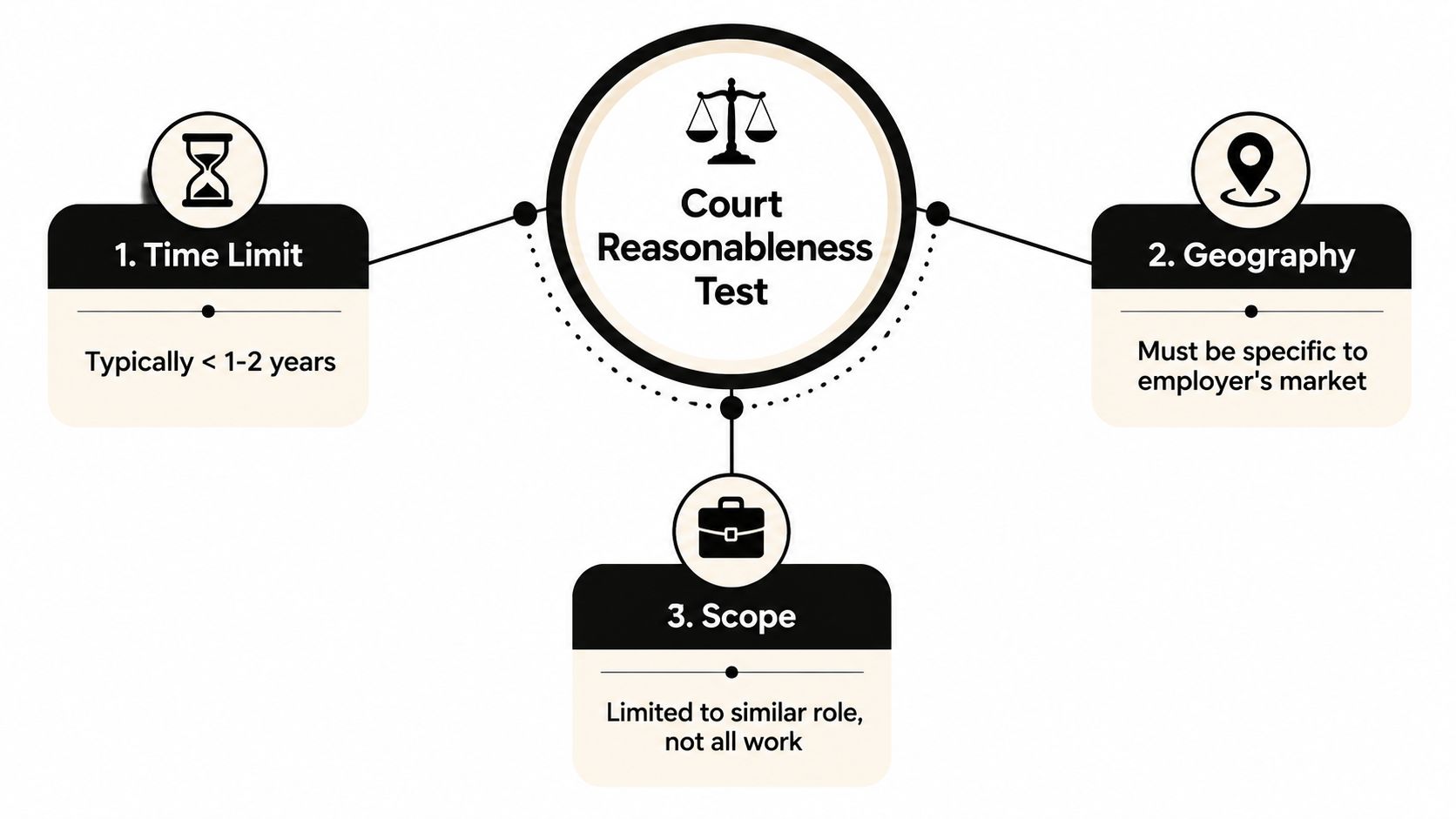
That sounds abstract. It is not. Courts look for a real business interest and then compare the contract language against that interest. If the restriction goes wider than the employer's actual need, judges notice.
The three questions that matter
What is the employer protecting?
A real answer sounds like goodwill, referral relationships, trade secrets, or confidential business information. A weak answer sounds like “we do not want you to leave.”How wide is the restriction?
Scope matters. Geography matters. The same mileage limit can look very different depending on where you practice.How long does it last?
Duration has to line up with the employer's actual interest. If a group needs time to stabilize patient relationships after a departure, it should say so and draft to that concern.
Why physician facts matter
A 50-mile restriction in a rural market may function very differently than a 50-mile restriction in Chicago. The map is not the issue by itself. The issue is what that map does to your ability to work.
A primary care physician with broad community practice options may face a very different analysis than a subspecialist whose referral network and patient base are concentrated in one health system. The same goes for an employed hospitalist versus an outpatient psychiatrist with a local panel.
Practical rule: Focus on whether the clause would block your real labor market, not just your current employer. If it would, start from the assumption that the wording is too broad and make the employer justify every word.
The FTC's own materials also matter here. The agency describes non-competes as restraints that can be unlawful when they go beyond what is needed to protect goodwill, trade secrets, or confidential information, especially when less restrictive tools like NDAs or non-solicits would do the job in the FTC workshop materials.
Here's a useful overview of the legal framework in plain English:
Sloppy drafting can sink the whole clause
Overbroad language creates real problems. Some courts will not rescue a badly written clause. Others may sever invalid pieces if they can do that without changing the core function of the restriction under the same reasonableness framework described in the legal review.
That is why details matter. If your contract bans work for any “competing business” across every service line of a large health system, you are not looking at precision. You are looking at overreach.
If you want to pressure-test the wording before you sign, use a contract scanner built for physician agreements.
State-by-State Enforceability for Physicians
Physician non-competes are fragmented. That's the honest answer. The FTC announced a rule in April 2024 to ban noncompetes, which shows how seriously federal regulators view labor mobility in the OECD summary of current policy developments. But in real disputes, state law still does most of the work.
For clinicians, the right question isn't “Are non-competes legal in America?” It's “What happens in the state where I'll practice, in my role, under this specific contract?”
Three buckets that actually help
Some states ban or heavily restrict physician non-competes. Others allow them with conditions, such as special requirements around patient access or buyout structure. A third group generally applies the standard reasonableness test and leaves the fight to facts, drafting, and local precedent.
That means you can't treat every contract the same, even if the language looks familiar.
| State | Enforceability Status | Key Restrictions or Requirements |
|---|---|---|
| California | Heavily restricted | Broad hostility to post-employment non-competes |
| North Dakota | Heavily restricted | Broad limits on non-compete enforcement |
| Oklahoma | Heavily restricted | Strong limits on post-employment restraints |
| Texas | Allowed with conditions | Physician agreements may require state-specific protections, including close review of any buyout structure |
| Florida | Generally enforced if reasonable | Courts often focus closely on drafting, legitimate business interests, and scope |
| New York | Fact-specific | Traditional reasonableness analysis often drives the outcome |
| Illinois | Fact-specific | Enforceability turns on scope, duration, and protectable interest |
| Pennsylvania | Fact-specific | Courts often examine patient relationships and business necessity |
This table is a triage tool, not legal advice. State rules shift. Some states treat physicians differently from other employees. Some carve out nonprofit settings, some don't, and some focus less on whether a clause exists than on whether an employer will spend the money and time to enforce it.
The operational question clinicians should ask
Ask yourself four things:
- Where is the practice site? If you cover multiple clinics, the contract shouldn't pretend every company location is your market.
- What kind of medicine are you doing? A telehealth-heavy role raises different scope questions than a brick-and-mortar specialty clinic.
- Who is the employer? A nonprofit hospital, PE-backed group, or local practice may have very different enforcement habits.
- What happens if you resign without drama? Some employers threaten. Some negotiate. Some sue.
A lot of clinicians waste energy asking whether a clause is theoretically valid. I'd rather know whether it's likely to matter in the world.
If you want a quick first pass before paying counsel, use a contract screening tool that flags restrictive covenant issues. One option is WeekdayDoc's physician contract scanner, which reviews terms like radius and duration so you can spot problems before you start negotiating.
A non-compete that looks routine on paper can be career-blocking in one county and mostly noise in another.
Alternatives That Protect Employers Without Restricting You
Employers have real interests here. I'm not anti-employer on this point. I'm anti-lazy drafting.
If the concern is patient continuity, referral preservation, confidential information, or staff poaching, employers have narrower tools that do the job without freezing your career. That matters because the FTC defines a non-compete by what it does after employment ends. It blocks a worker from seeking or accepting work elsewhere, or from operating a business, after the relationship ends in the FTC's noncompete rule page.
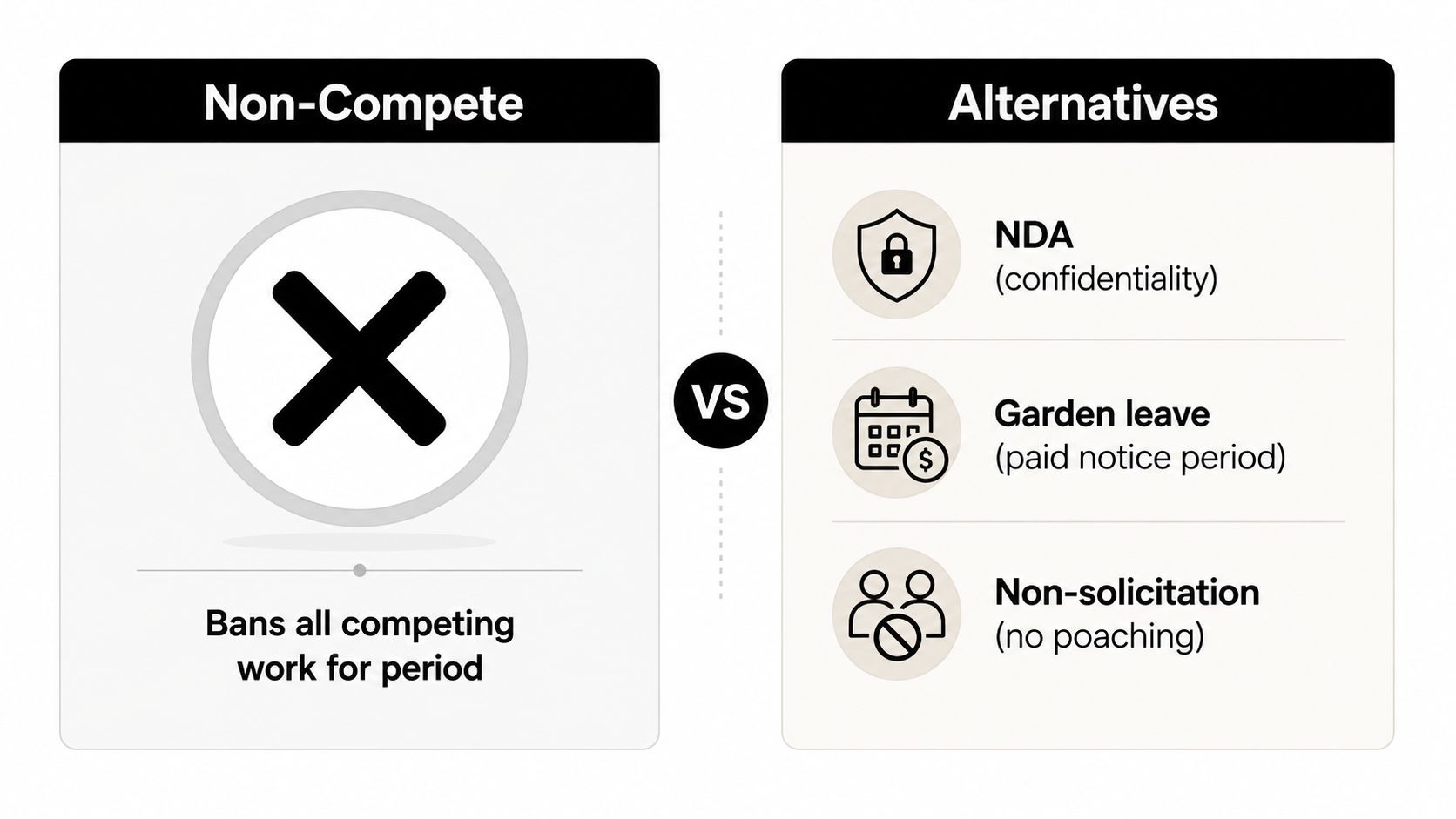
Better tools for legitimate problems
- Non-solicitation clauses: These target patient or employee poaching. That is usually far more defensible than a blanket ban on practicing medicine nearby.
- Confidentiality agreements or NDAs: If the group is worried about payer strategy, compensation formulas, marketing plans, or proprietary workflows, protect that information directly.
- Garden leave provisions: If the employer wants transition time, a paid notice period is cleaner than an unpaid block on your livelihood.
Three helpful buckets
For clinicians, the practical question is simple: what problem is the employer trying to solve, and can that problem be handled without blocking your next job? A non-compete is the bluntest tool in the drawer. A confidentiality clause, a non-solicit, or garden leave usually fits the actual risk more closely.
Mobility is often lost not because a judge rules against a clinician, but because the clause is written broadly enough to scare people away from testing it. That is especially true in burnout-friendly roles, where the goal is usually a cleaner schedule, a narrower scope, or a different practice setting rather than a full exit from medicine.
What to propose instead
You do not need to walk into negotiations saying, “Delete this and trust me.” Give the employer a substitute.
Try language along these lines:
“I'm comfortable with a confidentiality clause covering nonpublic business information and patient-related obligations required by law. I'm also open to a specific non-solicit. I'm not comfortable with a broad post-employment restriction on practicing within the region.”
Or this:
“If the concern is transition planning, I'd rather use a notice requirement or paid garden-leave structure than a non-compete that prevents me from working.”
Use this contract negotiation guide to frame the conversation before you send a redline. That approach does two things. First, it shows you are not being difficult. Second, it forces the employer to name its real concern.
How to tell when the non-compete is just a retention device
Listen carefully when you push back. If the employer talks specifically about patient handoff, confidential strategy, or team stability, there may be room for a narrower clause. If the answer is vague, or if they say everyone signs the same thing, you are probably dealing with a retention tool dressed up as IP protection.
That is when I get more skeptical. The narrower the actual risk, the narrower the language should be.
Contract Language to Avoid and How to Negotiate It
Most bad non-compete clauses announce themselves. They're broad, vague, and written as if every departure is a betrayal.
What you want is boring specificity. If the clause is dramatic, sprawling, or impossible to map onto your actual job, it's probably too aggressive.
Language that should trigger pushback
Look for wording like this:
“Any competing business”
That's too broad if your employer is a giant system with multiple service lines. Your restriction should tie to your actual specialty and clinical function.“Within any area served by the employer”
That's a trap. “Served by” can mean anything from one clinic to a sprawling referral footprint.“Directly or indirectly engaged”
This can sweep in consulting, telehealth, admin work, moonlighting, or ownership interests you never intended to restrict.“For two years following termination for any reason”
If the employer terminates you without cause, a blanket restriction is especially hard to justify in negotiation.
Redline the clause to your real practice
Here's the direction I usually push:
| Problem term | Better approach |
|---|---|
| Geography tied to every employer site | Limit geography to the specific site or sites where you regularly practice |
| Scope covering all services | Limit scope to direct patient care in your specialty or subspecialty |
| Restriction triggered by any separation | Carve out employer termination without cause, contract nonrenewal, or material breach |
| No escape hatch | Add a buyout, waiver option, or automatic sunset under defined conditions |
Ask for the clause to track where you worked, what you did, and what the employer needs to protect. Anything beyond that is excess.
Scripts that work better than chest-thumping
You don't need to posture. Use clean, professional language.
Say this in the first pass:
“I'm excited about the role, but the restrictive covenant is broader than my clinical footprint. I'd like to narrow the geography to my primary practice location and limit the scope to my specialty.”
If they resist, try this:
“I'm willing to protect confidential information and patient relationships. I'm not willing to sign a term that could block me from practicing in the community if the role ends unexpectedly.”
Use your position early. Before signing, you still have it. After signing, your position usually drops to whatever state law will rescue.
For a broader approach to the rest of the offer, including termination, compensation structure, and call language, review this employment contract negotiation guide for clinicians.
Connecting Non Competes to Burnout Prevention
A non-compete by itself is manageable in some jobs. A non-compete paired with bad schedule control is where things get ugly.
If a contract also includes heavy call, rigid productivity demands, weak exit rights, and slow payment terms, the restrictive covenant stops being an isolated legal clause. It becomes part of a system designed to make leaving expensive, stressful, and logistically hard.
Read the whole trap, not one paragraph
I'd never evaluate a non-compete in isolation. Put it next to these terms:
- Termination without cause: If you can't leave on reasonable notice, the non-compete gets more dangerous.
- Call and coverage obligations: If your personal time is already under pressure, reduced mobility matters more.
- Productivity compensation: If your income depends on unstable volume, you need cleaner exit options.
- Exclusive service language: If the employer controls all your clinical work, post-employment restrictions hit harder.
Why burnout-conscious clinicians should care earlier
This matters most before the job turns sour. Burned-out clinicians often negotiate too late, after they've already accepted the premise that they have to endure the role for another year because moving is “complicated.”
It's not just complicated. Sometimes it's contractually engineered to feel impossible.
If you're targeting no-call, weekday-heavy, remote, hybrid, or low-friction outpatient work, mobility is part of your wellness strategy. So is compensation transparency. So is knowing whether a better role exists in your state or specialty. WeekdayDoc's analysis of active listings can help with that market scan, and its market pulse data hub plus tools like the RVU calculator and Salary Calculator Pro are useful for comparing whether staying put makes financial sense.
The safest non-compete is the one that never matters because the job is well-designed. The second safest is the one you narrowed before signing.
You should also review roles that are built around schedule control in the first place, such as burnout-friendly physician jobs, and compare them against your current deal structure rather than your current stress level. Those are not the same thing.
Your Non Compete Evaluation Checklist
A contract review doesn't need to be mystical. Use a checklist and stay disciplined.
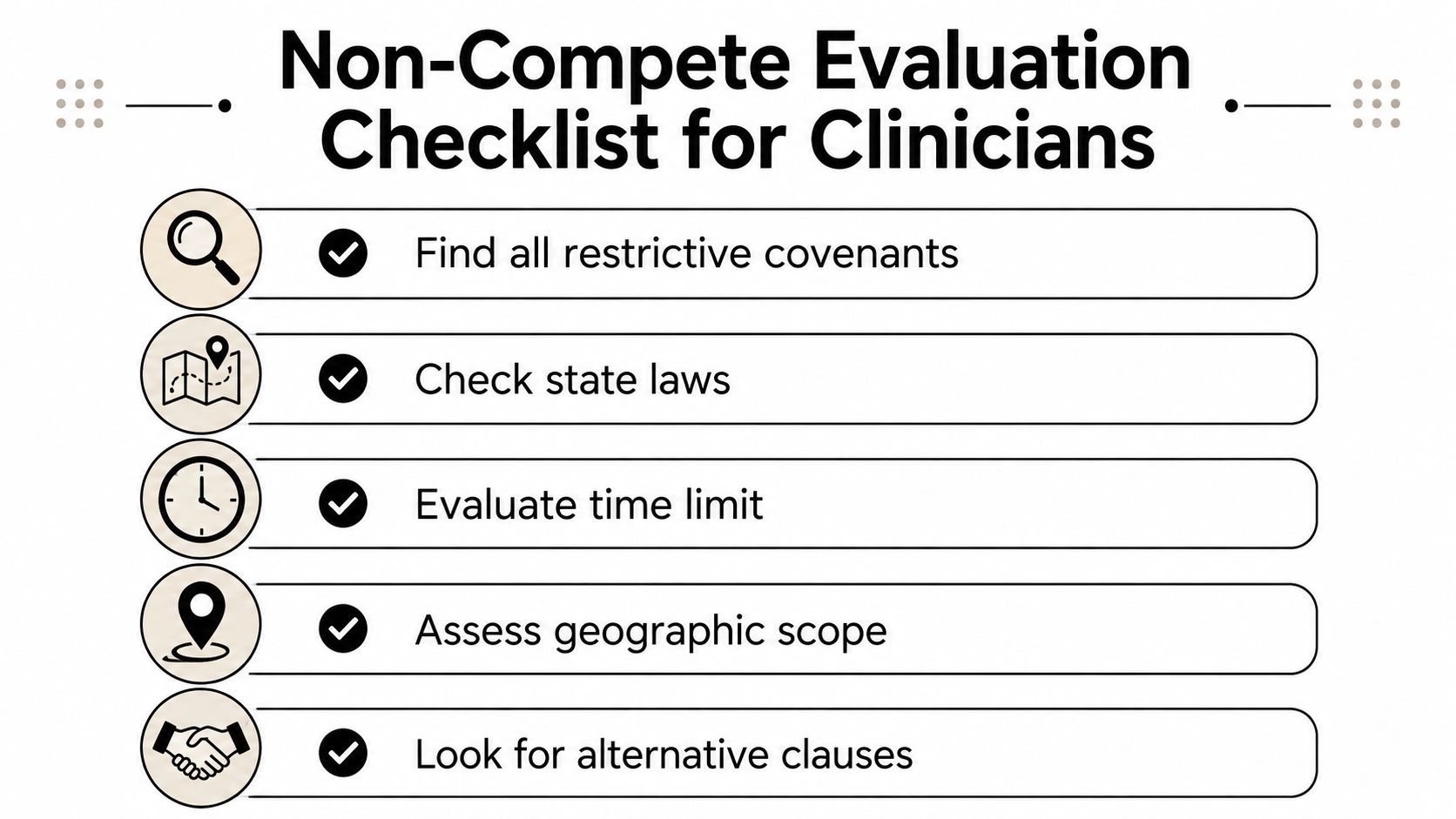
Five steps before you sign
Find every restrictive covenant
Don't stop at the paragraph labeled “non-compete.” Look for non-solicits, confidentiality clauses, exclusivity language, moonlighting restrictions, and post-termination cooperation terms.Map the geography to your real life
Pull up the practice locations. Then ask whether the restricted area wipes out the employers you'd realistically consider next.Check the duration against your career plans
Ask how long you could tolerate being blocked from local work if the relationship ends badly. If the answer is “not long,” negotiate now.Look up state-specific physician treatment
Don't assume your state treats doctors like every other worker. It may not.Ask what problem the employer is solving
If they can't answer clearly, the clause is probably doing more than it should.
Red flags that deserve legal review
- The clause covers every office owned by a large system
- The definition of competition includes work outside your specialty
- There's no carve-out for employer termination without cause
- The contract stacks a non-compete on top of a broad non-solicit and NDA
- HR says “nobody changes that language”
A final reality check helps. The GAO found that two nationally representative studies estimated 18% of workers were subject to noncompetes, and one of those studies found 38% had been subject to one at some point in their careers in the GAO review. This is common enough that you shouldn't treat your clause as unusual, but you also shouldn't treat it as untouchable.
If the language is broad, ask for revisions. If the employer won't engage, get a healthcare employment lawyer in your state and make a decision with clear eyes.
If you're weighing an offer, changing jobs, or trying to escape a role that's chewing up your weekends, WeekdayDoc gives you a practical way to compare burnout-friendly jobs, compensation, and contract risk in one place. Use it to find roles that fit your life before a bad non-compete turns one difficult job into a much bigger problem.