Medical Contract Review: A Clinician's Guide
Discover how medical contract review helps you negotiate pay and terms. Get expert insights to protect your career.

You've just received an offer that looks excellent on paper. The salary is competitive, the recruiter promised no weekends, and the practice says telehealth can be part of the role. Then you notice the contract lets the employer change your duties “as needed,” calculates bonuses through an unclear productivity formula, and restricts where you can work after leaving. That isn't a paperwork problem. It's a career-design problem.
I've reviewed enough clinician offers to know which clauses change your daily life and which ones mostly create noise. A serious medical contract review evaluates three things together: schedule control, compensation predictability, and post-departure mobility. The right salary can still produce the wrong job if the agreement gives away control of your evenings, your income formula, or your ability to practice locally later.
The Real Cost of Skipping Medical Contract Review
A clinician can sign a contract that feels generous and still discover that the job is structurally different from the offer. The schedule may be described in friendly recruiting language, while the agreement gives the practice broad discretion over hours, duties, call, coverage, or location. The compensation section may advertise a strong base, then tie future increases to productivity assumptions that don't fit part-time work, virtual care, or a smaller panel.
That combination creates a familiar sequence. The clinician accepts the position, the practice loses staff, coverage needs increase, and the “flexible” schedule becomes a moving target. Meanwhile, the bonus remains difficult to reach because the formula depends on volume, staffing, billing practices, payer mix, or quality measures outside the clinician's control. If the contract also contains a broad restrictive covenant, leaving may mean finding work outside the community rather than just changing employers.
The practical test: If the job's best feature exists only in a conversation, you don't have that feature yet. You have a promise that needs contract language.
The problem isn't limited to physicians. NPs, PAs, psychologists, and pharmacists can all face vague duties, repayment obligations, discretionary compensation, and restrictive post-employment terms. A weekday-only role can become less appealing when “weekday-only” appears nowhere in the agreement, or when the employer can assign additional coverage through a general duties clause.
Contract oversight is routine, but inconsistent
Payer-contract review illustrates why operational discipline matters. In an August 2023 MGMA Stat poll of 389 applicable responses, 58% of medical group leaders reviewed payer contracts annually, nearly 10% reviewed them multiple times per year, 17% didn't review contracts regularly, and 16% selected other schedules according to MGMA's payer-contract review reference. The same summary described review cycles tied to renewal dates, three-year intervals, or other schedules, showing that organizations don't follow one uniform approach.
The lesson for an individual clinician is straightforward. Employers already understand that contract terms affect economics, but their review practices and priorities vary. You need your own process before signature, not after a schedule changes or a bonus disappears.
A strong review asks six questions:
- Can the employer change my schedule or duties unilaterally?
- Can I predict pay under realistic volume and staffing conditions?
- Who pays malpractice tail coverage if I leave?
- What happens to bonuses, relocation money, and benefits at termination?
- Can I continue practicing in the community afterward?
- Does the written agreement match the lifestyle I was recruited to accept?
Those questions turn contract review into a financial and personal decision. Legal enforceability matters, but so does the number of weekends you'll work, the predictability of your income, and whether the role preserves your next move.
A Clause-by-Clause Walkthrough of the Physician Contract
Start with extraction, not interpretation. Read the agreement line by line and create a separate list of every business term, including terms mentioned in the offer letter, email, job description, or compensation plan. Then compare that list against the contract and mark every promise that isn't written clearly.
Compensation and duties come first
Read the base salary, bonus formula, wRVU conversion language, quality metrics, payment timing, and reconciliation provisions together. A bonus can look attractive while the threshold, rate, measurement period, or employer-controlled data makes it difficult to earn. Also check whether the practice can change the compensation plan without your written consent.
The schedule and duties section deserves equal attention. Phrases such as “as assigned,” “as needed,” “at the employer's discretion,” or “other duties consistent with the position” can give the practice room to expand your workload. Vague employer-discretion language around schedules and duties creates especially serious downstream risk because it may let the organization change expectations unilaterally, as explained in the AAFP guide to physician employment-contract red flags.
Write down the clinical hours, location, patient volume assumptions, administrative work, supervision obligations, telehealth expectations, and call structure. If the contract says the employer can modify these terms, negotiate a limit.
Call, leave, insurance, and exit terms
Call language should specify frequency, sharing arrangements, response expectations, and whether call is restricted or unrestricted. Restricted on-call generally requires remaining on the premises, while unrestricted on-call allows the physician to be offsite but reachable by phone or pager, distinctions identified in Faegre Drinker's physician services agreement materials. Nights, weekends, holidays, and on-call status should appear as separate deal terms, not as assumptions.
Paid time off and CME provisions should identify accrual, approval, carryover, reimbursement limits, and what happens to unused time at separation. Malpractice language must identify the policy type, limits, claims-made obligations, and responsibility for tail coverage.
Finally, read termination, restrictive covenant, non-solicitation, confidentiality, non-disparagement, and dispute-resolution provisions. Confirm notice periods, with-cause triggers, without-cause rights, cure periods, bonus repayment, venue, arbitration, and fee responsibility.
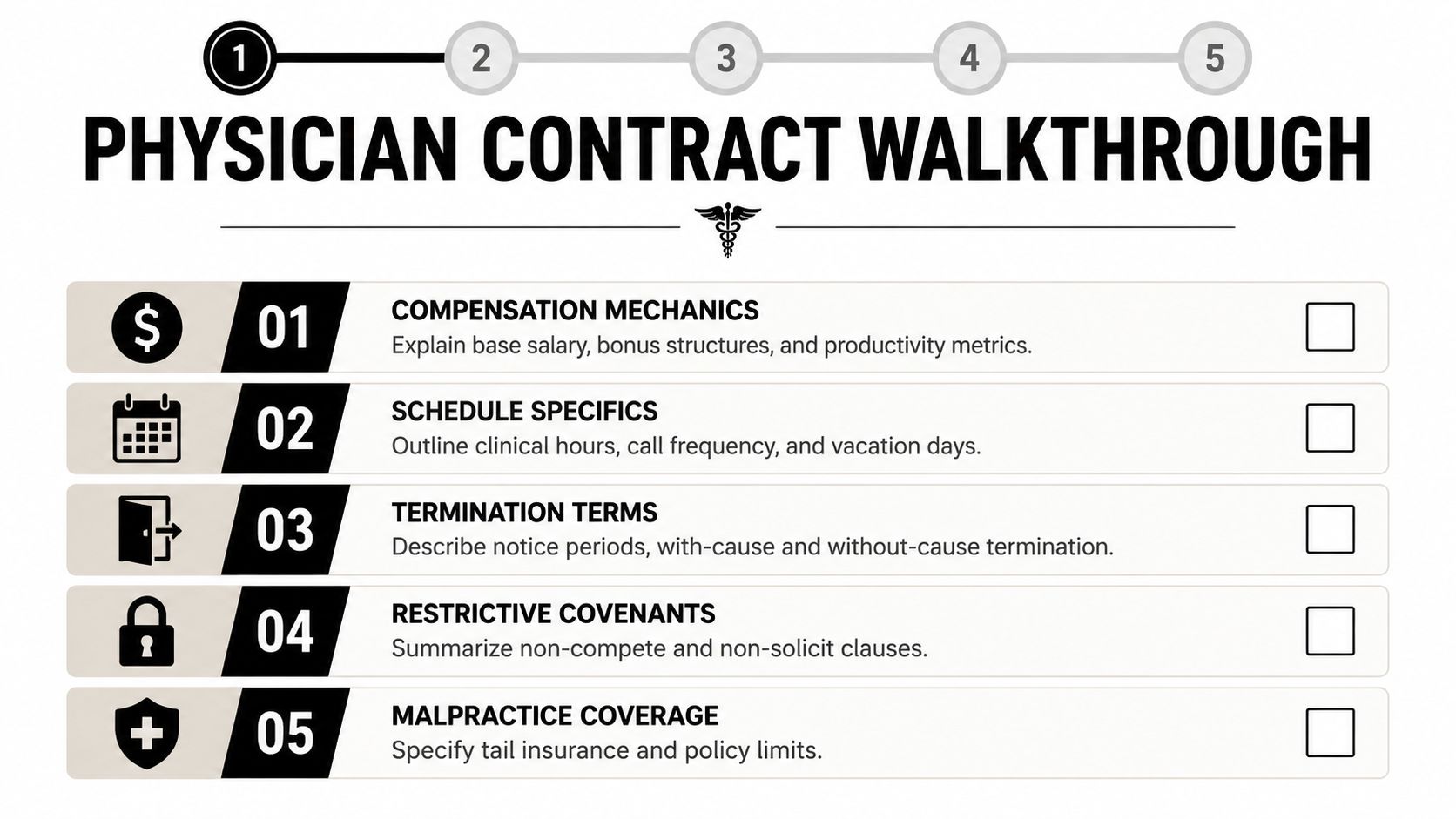
Verbal assurances don't fix missing language. If the recruiter says “you'll never work weekends,” ask for that limit in the contract or an incorporated schedule policy. If the medical director promises virtual visits will receive full productivity credit, require the formula in writing. The final agreement controls your practical options, so treat every unwritten material promise as unresolved.
How to Read the Compensation Section Beyond Base Salary
The headline salary is only the starting point. The economic question is whether the formula pays you predictably when volume, staffing, patient mix, and work location differ from the employer's assumptions.
Model the formula, not the promise
Look for the exact wRVU definition, threshold, conversion factor, measurement period, reconciliation method, and treatment of unpaid or denied claims. Ask whether the employer can change the fee schedule, coding methodology, or productivity plan during the contract term. A “productivity opportunity” means little if the threshold assumes a patient volume you can't reach with the assigned schedule.
Quality bonuses require the same scrutiny. Identify the metric, data source, baseline, weighting, payment date, and your ability to influence the result. “Quality” or “patient satisfaction” language without a defined formula gives the employer substantial discretion.
Sign-on and relocation payments also need a repayment schedule. Determine whether the amount declines over time, whether repayment is triggered by resignation, termination without cause, disability, practice closure, or a change in duties, and whether the employer can withhold earned wages or bonuses.
Test flexible work under adverse conditions
Part-time and telehealth arrangements expose weak contracts quickly. A contract may promise a reduced schedule but retain full-time productivity expectations. It may permit remote work while leaving wRVU credit, licensing support, technology requirements, documentation time, and patient attribution undefined.
Ask the employer to answer these questions in writing:
- Virtual-care credit: Do telehealth services receive the same productivity treatment as comparable in-person services?
- Pro-rated targets: Are wRVU and quality thresholds reduced in proportion to the agreed clinical effort?
- Panel changes: What happens if patient volume falls because of staffing, referral patterns, payer mix, or scheduling capacity?
- Administrative time: Is inbox, care coordination, supervision, and documentation time included in the schedule?
- Plan changes: Can the employer revise rates or targets without mutual written agreement?
Recent physician-pay reporting describes a shift toward compensation with more strings attached, while base salaries have been rising about 2% to 4% annually, compared with roughly 5% to 6% in earlier years, according to the AMA's analysis of physician pay structures. That shift makes formula review more important than salary comparison alone.
Use the WeekdayDoc RVU calculator to pressure-test the productivity assumptions, then ask the employer to reconcile your model with its written plan. If the employer won't explain how virtual, part-time, or reduced-volume work affects pay, assume the risk sits with you.
Non-Compete Rules in 2026 and What They Mean for Your Offer
A restrictive covenant can turn a good offer into a mobility trap. Before you compare salary, determine whether the clause could limit your next practice, increase your commute, or force you to accept more call and weekend work because nearby alternatives are off-limits.
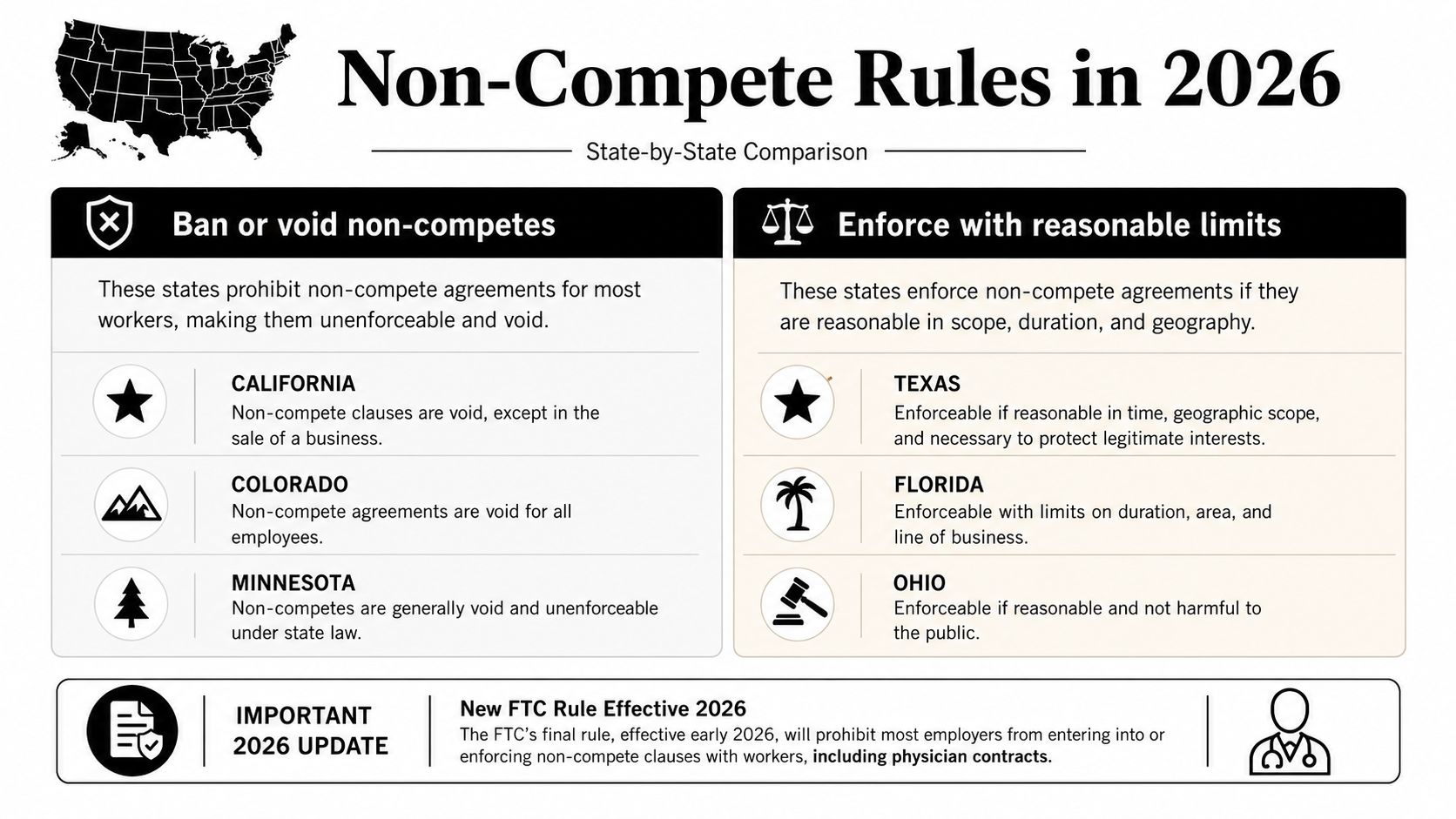
Non-compete rules depend on state law, contract language, and the employer's local reach. The ACC's state-by-state restrictive-covenant summary reported that physician non-compete rules were governed by statute in 31 states and the District of Columbia, while 19 states relied on common law. Its 2022 summary listed California, Colorado, Massachusetts, New Hampshire, and Rhode Island among jurisdictions that did not allow physician non-competes, and New York, Texas, and Florida among states that allowed them with restrictions.
The rules have continued to change. Arkansas and Wyoming joined Massachusetts and New Hampshire in banning physician restrictive covenants. Oregon voided many physician and health care provider non-competes, while Indiana prohibited hospitals and hospital systems from entering new physician non-competes for covered agreements entered into on or after July 1, 2025, as described in the AMA's physician non-compete update.
Read beyond the radius
A small geographic radius can still block local practice if the employer controls the dominant facilities, referral channels, or patient population. Assess the actual market, not only the mileage printed in the contract. A restriction that forces a long commute can also erase the schedule control that made the offer attractive.
Review these terms line by line:
- Duration: How long does the restriction last?
- Trigger: Does it apply after voluntary resignation, termination for cause, termination without cause, disability, or a practice sale?
- Buyout: Can you purchase release, and is the amount realistic?
- Scope: Does it cover clinical practice, telehealth, ownership, consulting, or all healthcare work?
- Related restrictions: Could non-solicitation or confidentiality language create a backdoor limitation?
Recent state changes show why a national answer is inadequate. Arkansas and Wyoming enacted full bans, Oregon voided many healthcare non-competes, Maryland limited them for physicians earning under $350,000, Pennsylvania capped enforceability at one year and tied it to voluntary departure, and Texas limited physician non-competes to one year, five miles, and buyouts no greater than annual salary, according to recent reporting on physician non-compete changes.
Use a clear decision rule. Treat the clause as a deal-breaker if it prevents practice in the community you need, particularly when the employer can terminate you without cause. Negotiate if the duration, geography, scope, and trigger can be narrowed. If you accept it, price the lost mobility into the offer and obtain state-specific legal advice before signing. A small salary premium does not justify losing several realistic next options.
Use WeekdayDoc's guide to non-compete clauses to organize your questions, then rely on qualified counsel to assess enforceability in your jurisdiction.
Negotiation Playbook With Phrases That Work
Sign the contract before you have the leverage to change its terms. Negotiate while the employer still wants your commitment, and focus on clauses that control your schedule, weekend and call exposure, and ability to work after departure. Choose the two or three clauses with the greatest effect on your life, explain the business reason, and propose replacement language.

Start with the lifestyle constraint that makes the offer attractive. For a weekday-only role, request:
Schedule protection: “The clinician's regular clinical schedule will be limited to Monday through Friday, with no weekend, overnight, or on-call responsibilities unless the clinician agrees in writing.”
For flexible work, define how telehealth affects pay:
Telehealth credit: “Covered telehealth services will receive the same wRVU credit and compensation treatment as the corresponding covered in-person services.”
For call, replace “shared as needed” with a measurable limit:
Call cap: “The clinician's call obligation will not exceed the agreed schedule, and any additional coverage requires the clinician's prior written consent.”
If the employer requires a restrictive covenant, narrow its duration, geography, scope, and trigger:
Limited restriction: “Any post-employment restriction will apply only to the specific practice location, for the shortest enforceable period, and will not apply following termination without cause, disability, or employer breach.”
These are starting points, not universal legal language. Counsel should adapt them to state law and the rest of the agreement.
A letter of intent can clarify salary, schedule, call, location, and restrictive-covenant expectations before the full contract. It can also reduce flexibility if you sign provisions described as binding. Ask which terms are binding, set a defined reconsideration window, and state that the final agreement controls over informal recruiting statements.
The AMA's account of physician contract negotiation cites an attorney-reported average compensation increase of about $25,000 after review. Treat that as one reported benchmark, not a promised result. Anchor your request in documented comparisons of compensation, schedule, call, and restrictions against the work you will perform.
A short video can help you prepare for the conversation, but general education cannot replace review of your agreement.
When to Pay for a Lawyer and When a Tool Is Enough
Not every offer needs a full attorney-led negotiation. A relatively straightforward employment agreement with clear salary, defined hours, limited call, ordinary benefits, and no meaningful restrictive covenant may be suitable for self-review plus a contract-diagnostics tool.
Use the WeekdayDoc contract scanner to identify issues worth escalating. A tool is useful for organizing a long agreement, spotting missing terms, comparing provisions against your priorities, and creating a focused question list. It can't replace state-specific legal judgment on enforceability, partnership rights, equity, tax treatment, or malpractice exposure.
Attorney pricing varies by scope. A physician contract guide reports that standard attorney review typically costs $500 to $2,000, while review with negotiation support often costs $2,000 to $5,000, according to the American College of Surgeons physician employment-contract resource. The same guide reports an average of $43,000 in negotiated improvements for physicians who obtain professional review, but that figure isn't a guarantee for your offer.
Pay for counsel when the contract includes a non-compete, partnership or equity track, complex bonus mechanics, a substantial repayment obligation, unusual malpractice terms, multi-state practice, or a termination provision that could strand you. Ask for a fixed fee, a written list of deliverables, the number of revision rounds included, and whether negotiation calls cost extra.
The efficient approach is often layered. Extract the business terms yourself, run a diagnostic review, compare compensation assumptions, then pay an attorney to answer the narrow legal questions that could change your decision.
Tying the Review to a Burnout-Friendly Career Decision
A contract can set your weekly life for years. Before signing, compare its promises with the schedule you can sustain, the call burden you will accept, and your options after leaving.
Use this checklist:
- Schedule control: Are clinical hours, work locations, administrative duties, and schedule-change rights written clearly?
- Weekend and call exposure: Are nights, weekends, holidays, and backup coverage capped or excluded?
- Flexible-work economics: Does the agreement define remote work, telehealth credit, technology duties, and pro-rated productivity?
- Compensation predictability: Can you model pay using realistic panel size, staffing, payer mix, and volume?
- Post-departure mobility: Is the non-compete narrow, state-compliant, and limited after termination without cause?
- Malpractice protection: Does the contract identify policy type, limits, and tail responsibility?
- Exit cost: What happens to bonuses, relocation payments, unused leave, benefits, and earned compensation when you leave?
Offer-stage terms deserve the same attention as the final agreement. Physician contract diagnostics have found that letters of intent appear in a minority of agreements, and those early documents can shape later obligations. Preserve every important term from the offer stage. Confirm that the final contract does not change schedule expectations, call coverage, compensation assumptions, or departure rights.
WeekdayDoc lists remote, hybrid, and in-person clinician opportunities with explicit No Call and No Weekends markers, salary information, burnout-focused job details, a market-pulse page, and tools for compensation and contract screening. Use those resources to compare the lifestyle and economics of an offer before committing.

A sustainable career requires written protection for your time, understandable pay, and the ability to leave without unreasonable restrictions. Read the agreement against the life you want, then negotiate the clauses that control schedule, call exposure, and post-departure mobility.
Visit WeekdayDoc to compare burnout-conscious clinician roles, review salary and work-style details, and pressure-test your offer with contract and compensation tools before signing. Start with the schedule you want, then make the written agreement support it.