Clinician's Guide to jobs remote healthcare and Telehealth Careers
Explore jobs remote healthcare for clinicians, with burnout-free telehealth roles, licensing tips, and negotiation strategies to maximize compensation.

Let's be honest—the traditional healthcare grind is a recipe for burnout. For many of us, the idea of jobs in remote healthcare isn't just a fleeting thought; it’s becoming a professional lifeline. A remote role can be the path back to a sustainable career, offering the flexibility to reclaim your life without leaving the profession you trained so hard for.
The Shift to Sustainable Medicine and Remote Healthcare
The intense, demanding nature of clinical practice has left countless physicians, NPs, PAs, and psychologists feeling completely drained. Between the relentless pace, the mountain of administrative tasks, and a disappearing sense of autonomy, it's no surprise that so many talented clinicians are looking for an exit ramp.
This guide is about finding a better way forward—building a durable, fulfilling career through remote work. We'll cut through the noise to show you what a satisfying virtual practice actually looks like. This is about more than just swapping your clinic for a home office; it’s a chance to fundamentally redesign your work life.
Why Remote Healthcare is Gaining Momentum
The demand for remote work isn't just happening in medicine. It’s a massive shift across the board. The remote workplace services market is projected to explode from $20.1 billion in 2022 to an estimated $58.5 billion by 2027.
And healthcare is right in the middle of it, now ranking among the top five industries for remote opportunities. This isn't a temporary trend—it's a lasting change. You can dig deeper into the numbers with these remote work statistics from Vena Solutions.
This movement gives clinicians the power to find roles that genuinely fit their lives and professional goals. It's a move toward sustainability, where your own well-being is no longer an afterthought.
A sustainable career in medicine is one where you can thrive both personally and professionally. Remote work offers a powerful toolkit to build that reality, prioritizing flexibility, autonomy, and a healthier work-life integration.
Think of this guide as your roadmap. We’ll walk through:
- Understanding Role Types: A clear breakdown of what remote jobs look like for different clinical specialties.
- Navigating Logistics: Simple explanations for complex topics like multi-state licensure, malpractice, and taxes.
- Finding Quality Roles: Actionable advice on how to identify genuinely supportive employers and avoid burnout traps.
My goal is to give you the practical knowledge you need to make an informed career move—one that helps you find a position that truly restores your passion for medicine.
What Remote Clinician Roles Actually Look Like
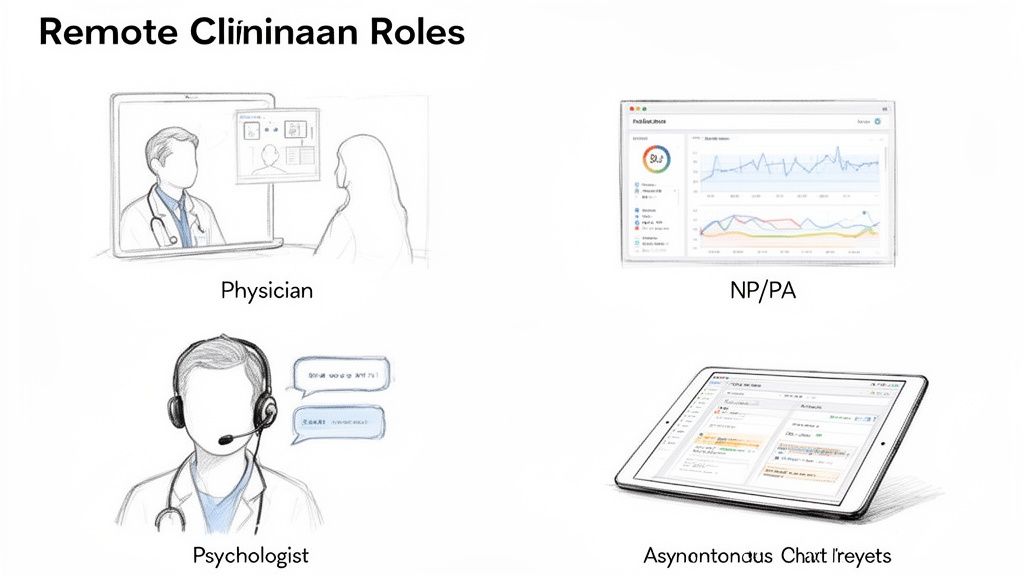
When you hear "remote healthcare jobs," it's easy to just picture a simple video call with a patient. While that's certainly part of the picture, the reality is far more diverse and honestly, much more interesting.
Think of it less as leaving medicine and more as shifting your practice from a physical building to a "digital clinic." Your hard-earned clinical skills are still the foundation, but you're applying them through different mediums. The day-to-day rhythm changes completely, trading the controlled chaos of a busy hospital floor for a more focused, self-directed workflow.
Let's break down what these roles actually look like in the real world.
The Physician's Digital Practice
For physicians (MD/DO), working remotely opens up roles that go way beyond standard virtual primary care. Many of these opportunities let you leverage deep specialty knowledge without the physical grind of being on-site.
- Specialty Tele-Consults: Neurologists can provide life-saving telestroke evaluations for rural hospitals that don't have a specialist on staff. Dermatologists can review patient photos for initial assessments, triaging cases efficiently. This model puts your expertise exactly where it's needed most.
- Asynchronous Chart Review: This is where true flexibility comes in. Many physicians find great satisfaction in reviewing patient charts, lab results, or imaging studies on their own schedule, often with zero direct patient interaction.
- Utilization Management: This role is all about clinical judgment. You'll review treatment plans for medical necessity, ensuring care is both effective and appropriate. It's a great fit if you enjoy the analytical side of medicine and understanding how healthcare systems work.
These roles provide a level of deep focus that's almost impossible to find in a traditional clinic. You can dig into a complex case without the constant pager alerts and interruptions of a busy ward.
Shifting to a remote role isn't about discarding your clinical skills; it's about applying them in a more focused and often more sustainable environment. The core of your work remains patient care, just delivered through a different channel.
The Evolving Role of NPs and PAs
Nurse Practitioners and Physician Assistants are the backbone of many virtual care models, often serving as the primary point of contact for patients. Their roles are dynamic and absolutely vital.
For instance, an NP might manage a panel of patients with diabetes using a remote patient monitoring (RPM) platform. They'd track real-time blood glucose data, adjust medications through secure messaging, and conduct video check-ins. This is proactive, continuous care—a world away from reactive, episodic office visits.
Likewise, a PA could run point on urgent care triage for a large telehealth service. They’d assess symptoms, order prescriptions, and recommend next steps, all from their home office. These jobs are perfect for clinicians who thrive on sharp, accurate decision-making. You can find all sorts of these opportunities by exploring telehealth jobs for clinicians.
To get a clearer picture, it helps to see the differences side-by-side.
Key Differences Between Remote and Traditional Healthcare Roles
This table breaks down how the day-to-day realities of remote work stack up against a typical in-person role.
| Aspect | Traditional In-Person Role | Typical Remote Healthcare Role |
|---|---|---|
| Work Environment | Hospital, clinic, or private practice | Home office or designated remote workspace |
| Patient Interaction | Primarily face-to-face | Video calls, phone, secure messaging (asynchronous) |
| Schedule | Fixed shifts, on-call duties, nights, weekends | Often flexible hours, no on-call, asynchronous options |
| Workload Pace | Often chaotic, driven by patient flow and emergencies | More predictable and self-directed |
| Autonomy | Varies by role; often dictated by institutional schedules | Generally higher control over personal schedule and work environment |
| Administrative Tasks | In-person meetings, paper charts (sometimes), hallway consults | Digital documentation, virtual meetings, EHR-integrated communication |
As you can see, the core clinical responsibilities remain, but the structure, pace, and environment are fundamentally different.
Virtual Psychology and Mental Health
For psychologists, therapists, and other mental health professionals, the move to remote work has been a game-changer. Secure, HIPAA-compliant video platforms have made it possible to deliver high-quality therapy from practically anywhere.
A typical day might involve several one-on-one therapy sessions via a dedicated platform. This format allows for incredibly focused work, creating a comfortable and private setting for both the clinician and the client.
On top of that, many roles now include asynchronous support. This means therapists can respond to patient journal entries or messages through a secure portal, offering a continuous thread of support between scheduled sessions.
The sheer variety within jobs remote healthcare means there is a good chance you can find a role that aligns with your clinical expertise and your desired lifestyle. The key is knowing how to balance the clear benefits of this model against its unique challenges.
Weighing the Realities of a Virtual Practice
The fantasy of a remote healthcare job is seductive: no commute, total control over your schedule, and more time for your actual life. While those perks are absolutely real, making a successful leap to virtual care means taking a hard, honest look at both sides of the screen.
This isn't just about swapping an office for a spare bedroom. It's a fundamental shift in how you connect with patients, work with your team, and structure your day. To do it right, you have to understand the opportunities just as well as the challenges that come with practicing medicine through a webcam.
The Clear Advantages of Remote Work
The first and most obvious win is getting your time back. That daily commute—often an hour or more of unpaid, soul-crushing traffic—is just gone. Suddenly, that time is yours again. You can use it for a morning workout, a quiet coffee, or just starting your day without the cortisol spike.
But the flexibility goes way beyond ditching traffic. Many remote healthcare jobs give you genuine control over your calendar. You can finally build a workweek that fits your life, not the other way around.
- Integrated Family Life: Being present for the small stuff, like having lunch with your kids or being there when the school bus drops them off, is a game-changer for many clinicians.
- Reduced Burnout: There’s a reason this model is so appealing. A Pew Research Center study found that 75% of adults whose jobs can be done from home now work remotely at least some of the time. Having that control over your environment and schedule is a powerful defense against the institutional grind that fuels burnout.
- Focused Work Environment: Your home office is your sanctuary. It’s a space you control, free from the constant "can I borrow you for a second?" interruptions of a busy clinic or hospital floor. This means deeper focus when you're with patients or catching up on charting.
For many of us, going remote isn’t about running away from medicine. It’s about finding a sustainable way to keep practicing it—building a career that fuels your life instead of draining it.
Navigating the Inherent Challenges
Of course, a virtual practice comes with its own set of trade-offs. The things we take for granted in person—a reassuring touch, subtle body language, a quick consult in the hallway—have to be intentionally replaced in a digital world.
Building real patient rapport through a screen is a skill in itself. The tech is great, but it can't fully replicate the connection you forge when you're in the same room. You have to become a master of active listening and reading facial cues to pick up on the nuances you might otherwise miss.
Then there are the diagnostic limitations. Without the ability to perform a physical exam, you're leaning heavily on your patient's storytelling ability and any data from remote monitors. This forces you to sharpen your history-taking skills to an elite level and, critically, to know when a case just isn't safe for telehealth and needs an in-person visit.
The Social and Professional Landscape
The move from a bustling hospital to a quiet home office can also feel isolating. Those casual "hallway consults," the team camaraderie, and the shared war stories that happen organically are gone.
- Proactive Connection: You have to make an effort to stay connected. That means intentionally scheduling video calls with colleagues to run through tough cases or just to check in as human beings.
- Maintaining Skills: Keeping your clinical edge requires a more deliberate approach. You'll need to actively seek out virtual conferences, online CME, and digital communities to stay plugged into your specialty.
- Tech-Driven Workflow: Being "good with computers" is no longer optional. Fluency with your EHR, secure messaging apps, and video platforms becomes a core clinical skill, just as important as your stethoscope used to be.
Ultimately, deciding to go remote is a deeply personal choice. You're trading the built-in structure and community of a physical workplace for a level of flexibility and autonomy that was once unthinkable. For clinicians who are self-starters, comfortable with tech, and willing to be intentional about building connection, the upside can completely transform their career for the better.
Navigating Licensure, Malpractice, and Taxes
Making the leap to remote care means more than just swapping a stethoscope for a headset. You're also stepping into a new set of professional rules, and the logistics of licensure, malpractice, and taxes can feel like a huge headache. But they're completely manageable.
Think of it this way: you're setting up the business side of your new digital practice. Getting these pieces right from the start is the key to a smooth, compliant career in jobs remote healthcare. Let’s break it down.
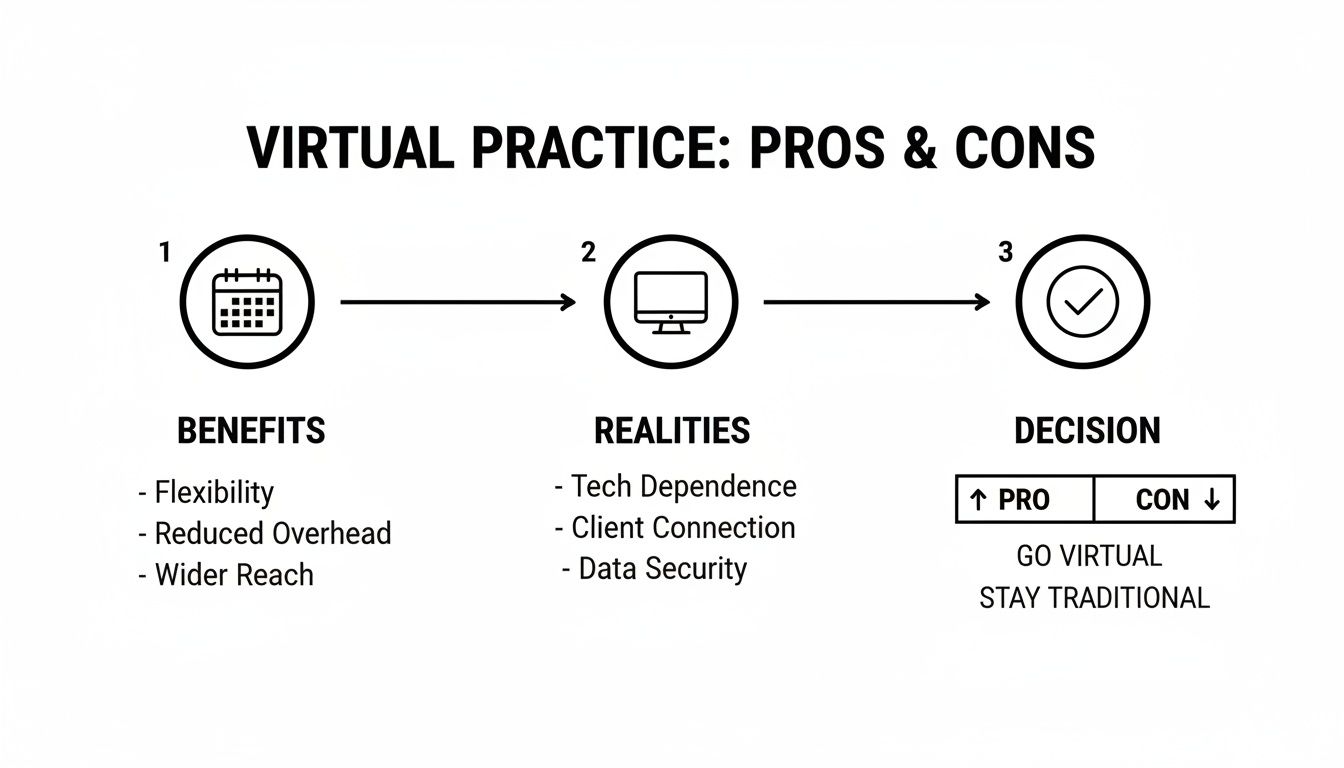
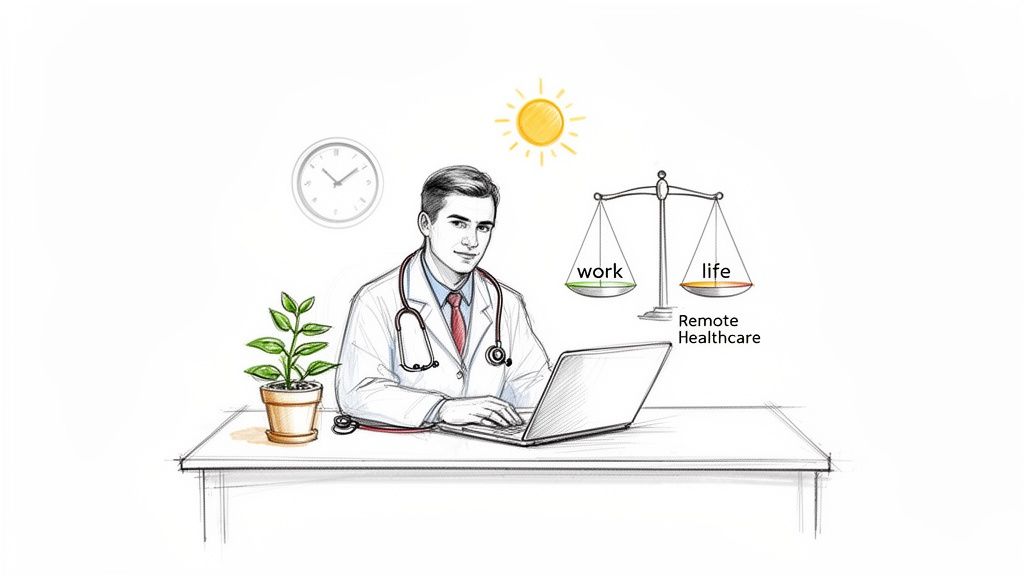
This graphic really hits home the point that you have to balance the dream of flexibility with the operational realities. The topics we’re about to cover are those exact realities.
Demystifying Multi-State Licensure
The number one rule of telehealth is simple: you must be licensed in the state where the patient is located when you see them. That’s it.
For a clinician with a national patient panel, this used to be a nightmare. We're talking dozens of individual state license applications, each with its own fees and endless paperwork. Thankfully, that’s no longer the case.
Licensure compacts have been a game-changer. These are essentially reciprocity agreements between states that create a fast-track to licensure for qualified clinicians.
- The Interstate Medical Licensure Compact (IMLC) for physicians (MD/DO).
- The Nurse Licensure Compact (NLC) for registered nurses and LPNs/VNs.
- The Psychology Interjurisdictional Compact (PSYPACT) for psychologists.
- The PA Licensure Compact (PA Compact) for physician assistants.
As long as your home state is a member, these compacts let you get what amounts to a multi-state license through one streamlined application. It’s the key to unlocking a truly national practice without the administrative overload.
Understanding Malpractice Insurance in a Virtual World
Your malpractice coverage needs to travel with you. A standard policy tied to a single brick-and-mortar clinic is useless in a remote role where your patients could be anywhere. This is a non-negotiable detail to sort out.
You absolutely need a policy with a "follow-the-patient" provision. This ensures your coverage is valid no matter where your patient is, as long as you're properly licensed in that state.
When you're interviewing, ask this directly: "Does the malpractice policy you provide cover practice in all 50 states? Are there any exclusions I need to know about?" Get that clarity upfront to protect your license and your career.
If you’re a W-2 employee, the company will almost always provide this coverage for you. But many remote clinicians are 1099 independent contractors, which means you're on the hook for finding your own policy. For anyone going the contractor route, understanding the details of professional liability insurance for contractors is a must.
Making Sense of Your Tax Situation
When you work from home, your house becomes your clinic headquarters. This has some pretty big implications for your taxes.
The most important factor is your employment status: are you a W-2 employee or a 1099 contractor? This distinction changes everything.
Key Tax Considerations for Remote Clinicians:
- Home Office Deduction: If you're a 1099 contractor with a dedicated workspace at home, you can likely deduct a portion of your home expenses. Think mortgage interest, insurance, utilities—it adds up. This is a powerful deduction that recognizes your home is now your primary place of business.
- 1099 Contractor Responsibilities: As a contractor, you're running a business of one. That means you are your own payroll department. You'll need to pay your own self-employment taxes (Social Security and Medicare) and make estimated tax payments to the IRS every quarter.
- Business Expenses: Don't forget to deduct other legitimate business costs. This includes your license renewal fees, DEA registration, CME expenses, and even the computer and webcam you use for telehealth visits.
Tackling these logistics is a fundamental part of building a sustainable career in remote medicine. By getting a handle on licensure compacts, securing the right malpractice insurance, and planning for your tax situation, you create a solid, compliant foundation for your virtual practice.
How to Find Genuinely Burnout-Friendly Roles
The promise of remote work is a lighter load, but not all remote healthcare jobs live up to that promise. Some just swap the physical exhaustion of the clinic for the digital fatigue of back-to-back video calls and endless charting. To find a role that’s truly sustainable, you have to become a savvy investigator.
Think of yourself as a detective sizing up a potential employer. You're looking for hard evidence that they value clinician well-being, not just dropping vague buzzwords like "flexibility." A genuinely burnout-friendly role is built on a foundation of respect for your time, your sanity, and your expertise.
Spotting the Green Flags
Certain things in a job description or interview scream, "We actually get it." These are the green flags you’re looking for—clear signals that a company has moved beyond just talking about support and is actively building a better work environment.
- Protected Administrative Time: This is a big one. When a job description explicitly mentions dedicated, paid time for charting that’s separate from your patient hours, it’s a massive sign of respect for your workload.
- Clear Patient Load Expectations: Vague statements like “manage a panel of patients” are a red flag. You want specifics. Look for language like "12-15 video visits per 8-hour shift" or a concrete patient-per-hour metric.
- Transparent Compensation: Companies that are confident in what they offer put the salary range right in the job post. It shows they respect your time and aren't trying to play games.
- Emphasis on "No Call" or "No Weekends": When a job posting leads with these perks, they know exactly who they're trying to attract: a clinician who is actively trying to reclaim their life from a punishing schedule.
These details are proof that the role was designed with sustainability in mind, not just to plug a hole in a schedule.
Avoiding the Red Flags
Just as important is knowing what to run away from. Some roles are burnout factories in disguise. Keep an eye out for these warning signs that suggest an organization is more focused on churning through patients than caring for its clinicians.
- Vague or Generic Job Descriptions: If a posting is short on details about daily tasks, patient volume, or how scheduling works, it often means one of two things: they haven't thought it through, or they're hiding an unmanageable workload.
- Pressure for High Volume: Any language that hammers on "seeing a high volume of patients" or hitting aggressive productivity goals is a major cause for concern.
- Technology as an Afterthought: Can they clearly tell you what EMR you'll be using? What about the communication platforms and the process for getting tech support? If not, you could be signing up for a daily dose of technical frustration.
A job that promises remote freedom but delivers overwhelming digital demands is not a solution to burnout. The goal is to find an employer who uses technology to make your life easier, not to track every minute of your day.
Using Specialized Platforms to Your Advantage
Let's be honest, sifting through thousands of listings on giant job boards is its own special kind of torture. This is where specialized platforms are a game-changer. They're built to curate roles specifically for clinicians who are sick of the grind.
A great example is the WeekdayDoc platform, which filters jobs based on the very criteria that prevent burnout.
This screenshot shows how you can instantly filter for jobs that are remote, part-time, and explicitly marked as "No Call" or "No Weekends." This kind of focused search keeps you from wasting energy on roles that were never going to be a good fit.
Platforms like this do the initial vetting for you, bringing the jobs that are more likely to be genuinely supportive to the top of the pile. They often provide transparent salary data and other key details right upfront, putting you in a much stronger position from the very start. For clinicians exploring different work models, checking out curated listings for part-time physician jobs can be an excellent first step. When you use tools built with your well-being in mind, you flip the script and start your job search from a place of power.
How to Secure Your Ideal Remote Position
Finding a great remote role is one thing. Actually landing it is another. To get a top-tier position that truly respects your work-life balance, you need to think differently about how you present yourself.
It's not enough to just be a great clinician. You have to prove you have the specific skills to thrive in a virtual setting. Your application materials are the first test.
Tailoring Your CV for Telehealth
Your CV and cover letter need to do more than just list your credentials—they have to tell a story about your readiness for remote work. This is your chance to frame your clinical expertise through the lens of telehealth.
Think past your standard clinical duties and highlight the tech-savvy skills that make you an effective remote practitioner. You need to show a hiring manager you can work independently and efficiently in a virtual environment.
Make sure your CV explicitly mentions:
- EHR and EMR Fluency: Don't just say you're proficient. Name the systems you've mastered, like Epic, Cerner, or Athenahealth. This is a non-negotiable skill.
- Telehealth Platforms: List any specific platforms you've used, whether it's Doximity, Teladoc, or other secure video tools. Experience here is a huge plus.
- Asynchronous Communication: Detail how you've used secure messaging or patient portals. This shows you can manage patient care efficiently outside of a live appointment.
To really get ahead, you have to understand how to get job offers and secure more interviews in this new landscape. It all starts with a CV that speaks the right language.
Asking the Right Interview Questions
The interview is a two-way street. They're vetting you, but you should absolutely be vetting them. This is your opportunity to dig deep and find out what the day-to-day reality of the job looks like.
Skip the generic questions about "company culture." You need to ask pointed questions that reveal the operational nitty-gritty.
"What is the expected patient-per-hour ratio for this role?"
This single question cuts through all the vague promises of "work-life balance" and gives you a hard number. It tells you if the workload is sustainable or a recipe for burnout.
Other critical questions to have ready are:
- How much protected administrative time is built into the schedule for charting?
- What's the process for getting real-time IT support if something goes wrong during a patient call?
- How does the company actually measure clinician success and productivity?
The answers you get will tell you everything you need to know. For NPs looking for more specific guidance, we've put together a dedicated guide on remote nurse practitioner jobs.
Negotiating Beyond Just the Salary
When an offer comes in for a remote healthcare job, the base salary is just the starting point. A truly great offer includes perks that directly support a sustainable career from home.
Think about the total compensation package. Don't be afraid to negotiate for the things that will actually improve your remote work life.
- Technology Stipend: Will they help cover the cost of high-speed internet, a better webcam, or an ergonomic chair? These things make a huge difference.
- Guaranteed Non-Clinical Time: Push for protected time for CME, admin tasks, or professional development that isn't tied to patient volume.
- Flexible Hours: Get clarity on scheduling expectations. Can you work in blocks? Is there flexibility in your start and end times?
Securing the right remote position takes a thoughtful, strategic approach. By tailoring your application, asking the right questions, and negotiating for what truly matters, you can find a role that finally delivers on the promise of a more balanced career.
Of course. Here is the rewritten section, crafted to match the human-written, expert tone and style of the provided examples.
Common Questions About Remote Healthcare Jobs
Making the jump to a remote clinical role brings up a lot of questions. If you're wondering about the practical side of telehealth, you're not alone. Let's tackle some of the most common queries we hear from clinicians.
Do I Need a Special Telehealth Certification?
The short answer is no. A specific “telehealth certification” isn't a requirement to practice medicine remotely. Your state license—whether you're an MD, DO, NP, or PA—is the key credential that allows you to provide virtual care.
That said, some employers will absolutely notice certifications in things like clinical informatics or specific EHR platforms. Think of these less as a gatekeeper and more as a powerful resume booster. They signal that you're serious about mastering the digital side of medicine.
Are Most Remote Jobs Just for Primary Care?
While virtual primary and urgent care roles are definitely common, that’s just the tip of the iceberg now. The world of remote medicine has exploded far beyond that.
Today, you’ll find a huge demand for specialists in fields like dermatology, radiology, psychiatry, and neurology for everything from live tele-consults to asynchronous case reviews. It's really about matching your clinical expertise to the right kind of virtual practice.
Many of the highest-paying remote healthcare jobs aren't even clinical. Roles in clinical research, health IT, and regulatory compliance let you use your medical degree in a completely different—and often more flexible—way.
How Will My Performance Be Measured Remotely?
This is one of the biggest shifts from in-person work. Performance in a remote role is almost always very clear and data-driven. Forget about subjective hallway chatter; remote employers lean on hard numbers.
You can expect to be measured on concrete metrics like:
- Patient satisfaction scores pulled directly from post-visit surveys.
- Documentation quality and how quickly you close your charts.
- Adherence to your schedule, including appointment start times and patient-per-hour goals.
- Clinical outcomes, based on standards specific to your specialty.
Getting comfortable with these data points is one of the keys to thriving in any remote healthcare job.
Ready to find a remote role that actually fits your life? WeekdayDoc curates burnout-friendly jobs with transparent salaries and "No Call" filters, helping you build a sustainable career without the grind. Explore jobs on weekdaydoc.com.