Physician Burnout by Specialty A Data-Driven Survival Guide
Explore a data-driven guide on physician burnout by specialty. Understand the core drivers and discover sustainable career paths with better work-life balance.

Let's be clear: physician burnout isn't a one-size-fits-all problem. The crisis looks completely different depending on your specialty. Fields like emergency medicine are notorious for emotional exhaustion, while others, like dermatology, tend to offer a more sustainable career. Understanding where your specialty falls on this spectrum is the first step to finding a job that actually fits your life.
Decoding Burnout Rates by Medical Specialty
The day-to-day reality—and the stress that comes with it—varies wildly from one medical field to another. Some specialties are a constant grind of high-stakes emergencies and unpredictable schedules. Others offer more control and predictability. Acknowledging these core differences is essential if you're trying to map out your career or just find a healthier way to practice medicine.
The data tells a pretty stark story. According to the 2024 Medscape Physician Burnout & Depression Report, emergency medicine continues to lead the pack, with an incredible 63% of doctors reporting burnout symptoms. While that's a slight drop from 65% in 2023, it's still an alarmingly high number that speaks volumes about the relentless pressure on the front lines. You can dig into the full specialty rankings and their drivers for a more detailed look.
Physician Burnout Rates At a Glance: Top 5 Most Impacted Specialties
To give you a quick snapshot, here are the specialties currently getting hit the hardest. This isn't just about the numbers; it's about seeing the "why" behind the burnout in each field.
| Medical Specialty | Reported Burnout Rate | Primary Driver |
|---|---|---|
| Emergency Medicine | 63% | High-acuity decisions, unpredictable patient volume, shift work |
| Oncology | 53% | High emotional burden, difficult patient prognoses, complex care |
| OB-GYN | 53% | Long hours, on-call liability, emotionally charged patient care |
| Pulmonology | 51% | Managing chronic and critical illness, high patient mortality |
| Family Medicine | 50% | Heavy administrative workload, high patient volume, time pressure |
Looking at this table, it's clear that the drivers of burnout are unique to each specialty. What pushes an ER doc to the edge is very different from what exhausts a family medicine physician.
These statistics are more than just numbers—they represent the lived experiences of thousands of physicians. The significant gap between the highest and lowest burnout rates underscores a critical truth: your specialty choice profoundly impacts your long-term career satisfaction and well-being.
Take a closer look at why these differences exist. An emergency physician is navigating chaos and constant crisis. A family medicine doctor, on the other hand, is often drowning in administrative tasks and spending hours on EHR documentation long after the last patient has gone home—that dreaded "pajama time."
By understanding the specific risk factors tied to your field, you can make smarter, more intentional career moves. Whether you're a med student picking a residency, a resident considering a fellowship, or an attending physician looking for a change, this context is your best tool for building a career that doesn't burn you out.
Comparing High-Stress and High-Satisfaction Specialties
The raw numbers on burnout only tell part of the story. To really get what's happening, you have to look past the percentages and into the day-to-day grind that defines a medical career.
What is it that makes one specialty a high-risk zone for emotional exhaustion while another offers a more sustainable path? It all comes down to the work environment, the emotional toll, and the level of control you have over your own life. By digging into these differences, we can move from just naming the problem to actually understanding its roots.
This infographic lays out the burnout rates for the top three hardest-hit specialties, showing just how intense the challenge is on the front lines.
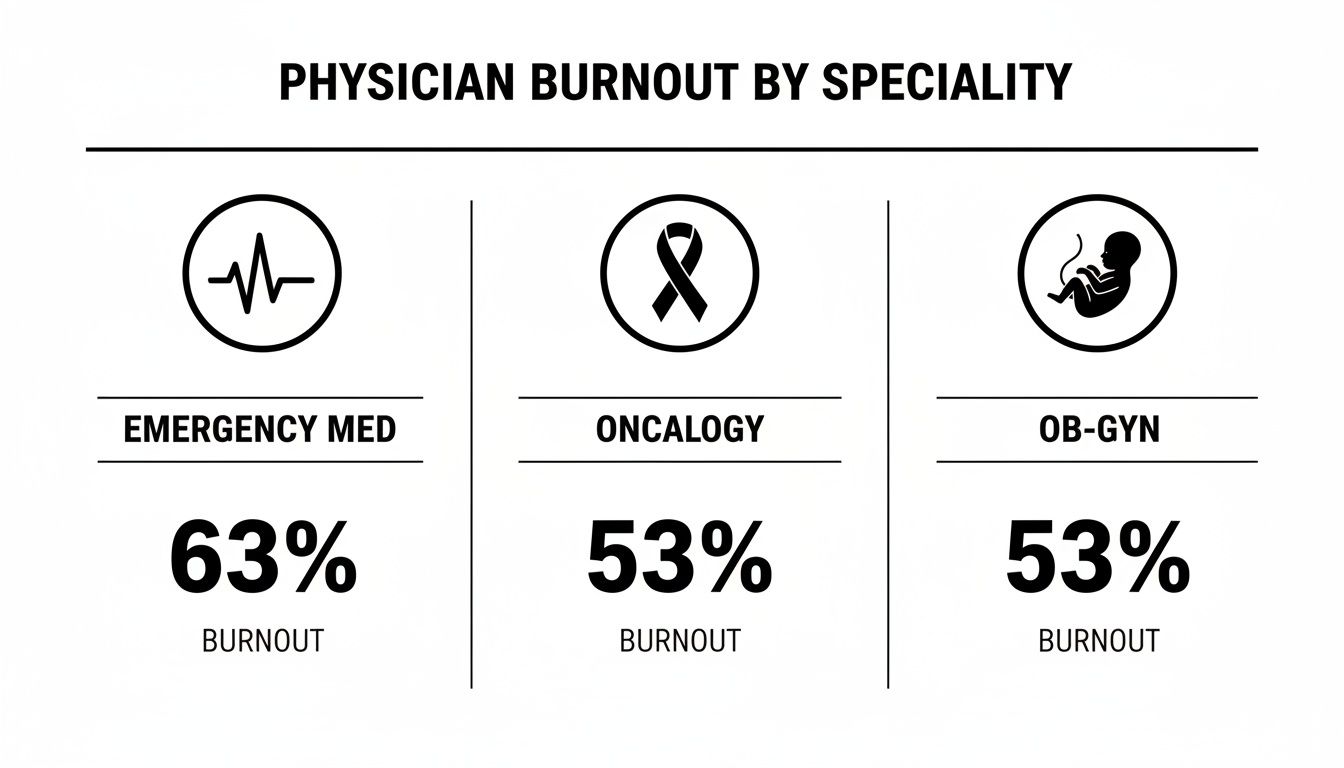
The data is stark. Emergency Medicine leads the pack at a staggering 63%, with Oncology and OB-GYN not far behind. It’s a clear sign of the unique and severe pressures these doctors face every single day.
The Epicenter of High-Stress Medicine
Fields like Emergency Medicine and Oncology are always at the top of burnout lists, and it's no mystery why. These specialties are built on high stakes, intense emotional labor, and a near-constant state of unpredictability.
In the ER, physicians work in organized chaos. They're hit with a relentless stream of critical cases, forcing them to make life-or-death calls with incomplete information and crushing time pressure. The shift work destroys sleep patterns, and the lack of patient continuity can leave you with a lingering sense of unresolved responsibility.
Oncology carries a different but equally immense emotional weight. Oncologists form deep, long-term bonds with patients and their families, only to navigate the profound grief of terminal illness. The emotional cost of delivering devastating news and managing brutal treatment side effects is a daily reality.
“The fundamental difference in high-burnout specialties is the lack of control. Whether it’s control over your schedule, patient outcomes, or administrative demands, its absence is a direct line to emotional exhaustion and depersonalization.”
This constant exposure to trauma and suffering, piled on top of systemic pressures, creates the perfect storm for burnout.
Exploring Fields with Higher Career Satisfaction
On the flip side, specialties like Dermatology and Ophthalmology consistently report lower burnout and higher career satisfaction. This isn't because the work is less important, but because the job itself is structured in a fundamentally different way.
These fields simply offer a greater degree of control and predictability.
Take Dermatology, for example. It’s mostly an outpatient specialty, which means:
- Predictable Hours: You’re usually working standard business hours with few, if any, on-call duties.
- Procedural Autonomy: Many dermatologists perform minor procedures right in the office, which adds a satisfying, hands-on element to their work.
- Positive Patient Outcomes: A lot of skin conditions are treatable and curable. Seeing tangible, positive results for your patients is a powerful antidote to burnout.
Ophthalmology is similar. It's a highly procedural field where surgeons can literally restore someone's sight—an incredibly rewarding outcome. The work is usually done in a controlled, outpatient setting, which avoids the chaos you find in hospital-based specialties.
A Head-to-Head Comparison
Let's break down these differences side-by-side to see how they impact a physician's well-being. The contrast between high-burnout and lower-burnout fields becomes crystal clear when you compare them across the factors that truly matter for career longevity.
Specialty Comparison: Work Environment and Burnout Drivers
| Factor | Emergency Medicine (High Burnout) | Oncology (High Burnout) | Dermatology (Lower Burnout) | Ophthalmology (Lower Burnout) |
|---|---|---|---|---|
| Work Environment | Unpredictable, high-acuity, hospital-based | Emotionally intense, clinic and hospital mix | Structured, outpatient clinic-based | Controlled, procedural, outpatient surgical centers |
| Schedule Control | Low; shift work, nights, weekends | Moderate; demanding but more predictable than EM | High; typically standard business hours | High; scheduled surgeries and clinic days |
| Emotional Demand | High; constant exposure to trauma | Extremely High; deep patient bonds, end-of-life care | Low to Moderate; focus on treatable conditions | Moderate; high-stakes surgery but often positive outcomes |
| Administrative Load | High; rapid documentation in chaotic setting | Very High; complex insurance, prior authorizations | Moderate; manageable in a private practice setting | Moderate; often supported by robust practice staff |
| Patient Outcomes | Varied; frequent negative outcomes | Challenging; high rates of mortality and morbidity | Generally Positive; many conditions are curable | Overwhelmingly Positive; restoration of vision |
This table makes it obvious: physician burnout by specialty is not random. It’s directly linked to the daily structure, emotional context, and level of control a doctor has.
For instance, the administrative burden in Oncology is particularly crushing. It's no surprise Oncology shares the spotlight for severe burnout at 53%, tying with OB-GYN. Oncologists grapple with the soul-crushing weight of terminal diagnoses, managing chemo side effects, and watching patients lose their battles. This daily emotional toll also contributes to oncologists leading in depression at 15%. You can explore more specialty-specific burnout and depression rates to see the full picture.
Ultimately, finding a sustainable path in medicine means understanding these nuances. The physician drawn to the immediate, life-saving action of the ER faces a completely different set of challenges than one who thrives on the long-term, relationship-based care in Oncology. Recognizing which work environment fits your own needs is the first step toward building a career that isn't just successful, but one that you can actually sustain for the long haul.
Analyzing the Core Drivers of Burnout
Knowing which specialties have the highest burnout rates is a good start, but it doesn't tell the whole story. To really understand the crisis of physician burnout by specialty, we have to get granular and look at the daily realities that chip away at our well-being and love for the job.
These aren't abstract problems. They're the concrete, day-in, day-out stressors that define a physician's work life.

When we break down the unique frustrations in different fields—from the paperwork hell in primary care to the heavy emotional toll in oncology—we can start to pinpoint exactly what we need to get away from in our next role. This is how you find a job that’s actually sustainable.
The Crushing Weight of Administrative Tasks in Primary Care
For most primary care docs, especially in Family Medicine, the enemy isn't the patient visit. It's the mountain of administrative nonsense that comes with it. This is the "work after work" that fuels the burnout fire.
What does this look like in practice?
- Endless EHR Documentation: The EHR was supposed to make our lives easier, but it's become a click-box nightmare. We spend hours documenting, often long after the last patient has gone home.
- Prior Authorizations: It’s a soul-crushing, time-wasting battle with insurance companies to get patients the care they need. It adds zero clinical value and drains our energy.
- Inbox Management: The constant stream of patient messages, lab results, and administrative pings creates a digital assembly line that’s never off. It’s impossible to ever feel truly disconnected.
This administrative slog is what leads to "pajama time"—those hours we spend late at night, catching up on charts instead of living our lives. That steady erosion of personal time is a massive driver of dissatisfaction. A 2024 AMA survey pegged family medicine burnout at 46.4%. It's an improvement from 51%, but it’s still far too high, with 48.8% reporting significant job stress.
Physical and Emotional Drain in Demanding Specialties
Move into procedural and high-acuity specialties, and you'll find a different set of burnout drivers, but they're just as potent. Here, it's the sheer physical, mental, and emotional load that creates a high-stakes environment that’s tough to sustain year after year.
Take General Surgery. The strain comes from all sides. Grueling hours are the norm, and unpredictable on-call duties mean your personal life is always on standby. The work itself is physically exhausting, demanding hours of intense focus while on your feet.
In many high-intensity fields, the real problem is the toxic mix of high stakes and low control. Surgeons are responsible for life-or-death outcomes but are often powerless against chaotic schedules and hospital inefficiencies that only add stress.
Then you have emotionally heavy fields like Oncology and Pediatrics, where burnout comes from a different place: compassion fatigue. Physicians in these specialties build deep relationships with patients and families who are going through the unthinkable. The psychological weight of managing severe illness, delivering bad news, and guiding families through end-of-life care is immense.
This deep dive into what's actually causing burnout is more than just an academic exercise—it’s a practical tool for you. When you understand the root causes of your own frustration, you can finally make targeted changes. By identifying which stressors hit you hardest, you can start looking for roles designed to protect you from them. That’s the first step toward building a medical career that lasts.
You can dig deeper into this topic in our comprehensive physician burnout index.
How to Find a Burnout-Proof Medical Career
Knowing what causes burnout is one thing. Actually doing something about it is a whole different ballgame. The good news is you absolutely can build a more sustainable career by getting strategic about your next move. It starts with flipping the switch on your job search—from passively browsing to actively hunting for a role that protects your well-being.
This means you have to look past the generic job boards and get laser-focused on what really matters for a long-term, burnout-proof career. First step? Define your personal "non-negotiables." These are the hard boundaries you’re no longer willing to cross.
Define Your Non-Negotiables
Before you even glance at a single job listing, sit down and identify the specific stressors you need to eliminate from your professional life. This isn't just a wish list. It's about setting firm, protective boundaries for your time, energy, and sanity.
Your list of non-negotiables might include things like:
- No On-Call Duties: Completely cutting the cord that tethers you to work after hours.
- No Weekends or Holidays: Making sure your personal time is truly yours.
- A Hard Stop Time: Getting a commitment from an employer that "pajama time" with your EMR is off the table.
- Flexible or Reduced Hours: Finding a role that actually fits into your life, not the other way around.
Once you have this list, you have a powerful filter for your job search. This clarity lets you instantly discard roles that don’t meet your core needs, saving you a ton of time and preventing you from accidentally walking into another unsustainable job.
Leverage Specialized Job Platforms
Let's be honest, the big, generic job sites just aren't designed to understand the nuances of physician burnout by specialty. They're clunky and usually lack the specific filters needed to find jobs that prioritize work-life balance. This is where a specialized platform like WeekdayDoc becomes an indispensable tool.
Platforms built for burnout-conscious doctors let you search with precision. Instead of drowning in hundreds of irrelevant listings, you can specifically look for roles explicitly tagged as "No Call" or "No Weekends."
Here’s what that looks like in practice—a simple way to filter jobs to find a better balance.
This screenshot shows how quickly you can narrow the field to opportunities that actually align with your non-negotiables. It makes the whole process faster and far more effective.
Put It All Together: A Real-World Scenario
Let's walk through a quick example. Dr. Chen, a pediatrician, is fried. She still loves her specialty, but the constant, unpredictable on-call shifts and working every other weekend have left her completely drained and with no time for her own family.
Instead of burning out of medicine entirely, she decides to find a better way to practice.
Dr. Chen's Action Plan:
- Defines Non-Negotiables: Her top two priorities are a predictable, weekday-only schedule and zero on-call duties. Period.
- Uses a Specialized Platform: She logs onto WeekdayDoc and filters for outpatient pediatric jobs that are explicitly "No Call" and "No Weekends."
- Evaluates Opportunities: She finds several listings for part-time physician jobs that meet her criteria. To dig deeper, she compares each clinic's proprietary Burnout-Friendly Score to get a better sense of their work environments.
- Finds the Right Fit: Dr. Chen ends up accepting a position at a great outpatient clinic offering a four-day workweek and a strict policy against after-hours charting.
By taking this strategic approach, Dr. Chen didn't just find a new job—she redesigned her career within the specialty she loves. This is about moving from a reactive state of burnout to proactively building a professional life that actually works for you.
Aligning Your Career with Financial Wellness
Let’s be honest: burnout isn’t just about long hours and emotional exhaustion. It’s often chained to immense financial pressure. With a mountain of student debt and the quiet expectation of a high-income lifestyle, many physicians feel trapped. You know the job is unsustainable, but walking away feels like financial suicide.
This is a huge reason why so many doctors stay put in toxic roles. But a growing number are starting to see a different path, adopting principles from the Financial Independence, Retire Early (FIRE) movement. The goal isn’t always to hang up the white coat at 40; it’s about building enough financial freedom to practice medicine on your terms. It’s about having the power to leave a bad situation without facing financial ruin.
The Financial Cost of a High-Stress Specialty
A high-burnout job doesn't just drain you emotionally—it can actively sabotage your financial health. When you're constantly stressed, you're more likely to make poor financial choices. Think impulse buys to cope with a bad day or simply being too exhausted to even think about retirement planning.
This creates a brutal cycle. The very job that's burning you out is also preventing you from building the financial cushion you need to escape it.
That’s why a strategic career change is one of the most powerful financial moves you can make. Opting for a role with better hours and less stress isn't just self-care. It’s a deliberate strategy to protect your financial future, giving you the mental bandwidth to manage your money, invest wisely, and build a life that doesn’t depend on your next paycheck.
Modeling Your Financial Future
It's crucial to understand exactly how a career shift would impact your bottom line. How would a four-day workweek change your retirement timeline? Can you still hit your financial goals in a role that pays less but offers more sustainability? These aren’t questions you can just guess at. You need real numbers.
This is where physician-specific tools become incredibly valuable. You need to model different income and savings scenarios to see a clear path to financial independence.

When you can actually visualize your financial future, abstract goals suddenly feel real and achievable. It shows that even with a potential pay cut, a job that prevents burnout can still lead to long-term security—often with a much higher quality of life along the way.
By mapping out these scenarios, you can see how a less stressful job might let you work longer and more happily, ultimately creating a more secure retirement. To get started, you can plug your own numbers into a comprehensive physician salary and FIRE calculator and explore your options.
Finding a sustainable career is one of the most effective financial planning strategies a physician can adopt. It protects your earning potential over the long term by preventing the kind of severe burnout that forces you out of medicine entirely.
Ultimately, aligning your career with your financial wellness is about recognizing that your well-being is your most valuable asset. Protecting it isn't a step back—it’s a strategic investment in a longer, healthier, and more prosperous career. The right role lets you find fulfillment in your work while building a secure foundation for your future.
Of course. Here is the rewritten section, crafted to sound like an experienced human expert and match the provided style examples.
Your Questions About Physician Burnout, Answered
If you’re looking into physician burnout by specialty, you probably have a lot of questions. Whether you're weighing a career pivot or just trying to find a more sustainable way to practice, getting clear answers is the first step. Here’s a straightforward look at the questions we hear most often from doctors just like you.
Which Medical Specialties Have the Lowest Burnout Rates?
The specialties that consistently report the lowest burnout rates are the ones with predictable schedules and a high degree of professional autonomy. Think Dermatology, Ophthalmology, and Plastic Surgery.
These fields tend to be more outpatient-focused, with fewer on-call demands and a lighter administrative load. That combination makes a huge difference in achieving real work-life integration. Of course, workplace culture is still a massive factor, and no specialty is completely burnout-proof.
The real differentiator in these less stressful fields is often structural. When you have more control over your daily schedule and environment, you have a powerful shield against emotional exhaustion.
How Can I Reduce Burnout Without Leaving My Specialty?
One of the most effective ways to reclaim your career is to change your practice environment, not your specialty. You don't have to start over to find a role that works for you.
For example, a hospitalist could move to an outpatient clinic. A surgeon could transition into a position with more academic or administrative duties and less call. We built WeekdayDoc for this exact reason—to help you filter for jobs in your field that are explicitly "No Call" or "No Weekends." It helps you find a position that fits your life, not the other way around.
The goal isn't to abandon your hard-earned expertise. It's about finding a setting where you can use your skills without sacrificing your well-being in the process.
Are Telehealth Jobs a Good Solution for Physician Burnout?
For many physicians, yes. Telehealth can slash burnout by getting rid of the commute, offering serious schedule flexibility, and creating a less hectic work environment. It's been a game-changer for specialties like Psychiatry, Family Medicine, and many consulting roles where a physical exam isn't always necessary.
But it's not a magic bullet. It’s important to watch out for new stressors like digital fatigue or feeling professionally isolated. Not every remote job is created equal. Using a tool like the WeekdayDoc Burnout-Friendly Score can help you vet a telehealth position to see if it truly aligns with what you need for a sustainable career.
What Is the First Step if I Am Experiencing Severe Burnout?
If you're dealing with severe burnout, your first and most important step is to get support. That could mean talking to a mental health professional, a trusted mentor, or a physician wellness program at your organization. Reaching out is a sign of strength.
At the same time, you can start exploring your options. Taking action is one of the best ways to regain a sense of control and hope.
- Define what a sustainable career looks like for you. Is it fewer hours? Less paperwork? No on-call shifts? Get specific.
- Research alternatives. Start looking at roles that match your new criteria. Even taking small, concrete steps can feel incredibly empowering.
- Set small boundaries now. While you plan your next move, find little ways to protect your time and energy in your current job.
Taking these initial steps can put you back in the driver's seat and show you there's a clear path forward.
Ready to find a job that respects your time and well-being? WeekdayDoc curates burnout-friendly roles with no call, no weekends, and clear work-life boundaries. Start your search for a sustainable medical career today.