Finding Healthcare Remote Jobs That Actually Beat Burnout
Explore the world of healthcare remote jobs. This guide helps clinicians find flexible roles, combat burnout, and build a sustainable career in telehealth.

If you're a clinician, you know the grind. The long hours, the administrative black hole, and the feeling that you’re running on fumes. For years, that was just the price of admission. But something fundamental is changing, and it’s being driven by the rise of remote healthcare jobs.
This isn't some fleeting trend. It's a deliberate pivot away from the burnout machine of traditional in-person medicine.
The Great Clinical Migration: Why We're Going Remote
Let’s be honest. The old model is broken. Countless physicians, PAs, and NPs are actively walking away from the chaos of hospital wards and overbooked clinics. They aren't just looking for a new job; they're redesigning their careers for sustainability and, frankly, for sanity.
They're trading unpredictable shifts and soul-crushing commutes for the control and flexibility that remote work provides. It's a strategic move to reclaim the passion for medicine that got buried under a mountain of paperwork.
What's Driving the Move?
It goes way beyond just working from home. For most clinicians, the shift is about getting back to what matters. Here are the big drivers:
- Real Autonomy: Imagine setting your own schedule and controlling your environment. No more fighting for a parking spot or dealing with a soul-crushing commute. That time and mental energy get handed right back to you.
- Less Bureaucracy: Many remote roles, like utilization review or medical communications, cut the administrative bloat. You get to use your clinical expertise without drowning in EMR tasks.
- A Lifeline for Mental Health: Stepping out of a high-pressure, emotionally draining environment has a direct impact on your well-being. It's one of the most powerful tools we have to fight burnout, anxiety, and depression.
And the market is responding. In just one year, the remote healthcare job market saw a staggering 49% jump in vetted job listings, with 424,778 new roles opening up on a single major platform. This explosion has cemented healthcare as a top-five industry for remote work, proving these opportunities are here for the good. You can see more data on the top companies for remote work in 2026.
For clinicians, going remote isn’t about escaping medicine. It’s about building a career that’s sustainable enough to stay in it for the long haul.
Making this transition successful means knowing the landscape. As technology becomes the new exam room, understanding the tools that make it all work is key. A solid primer like this Video Conferencing for Healthcare: a Complete Guide can be incredibly helpful. But just as important is finding the right roles—the ones that are genuinely burnout-friendly and align with your financial goals.
Exploring the Landscape of Remote Clinician Roles
When clinicians think about “remote healthcare jobs,” the first thing that usually pops into mind is a telehealth video call. And while direct patient care is a huge piece of the remote world, it’s really just the tip of the iceberg. The reality is a whole universe of opportunities where your hard-earned clinical expertise is the key—unlocking roles you might never have even considered.
Thinking remote work is just "telemedicine" is like thinking a hospital is just the emergency room. It completely misses the vast, complex system working behind the scenes. Let's map out this landscape, starting with the familiar patient-facing roles and moving into the equally vital non-clinical paths that are reshaping how medicine works.
This is all about moving from high-stress, in-person roles to more sustainable ways of practicing medicine.
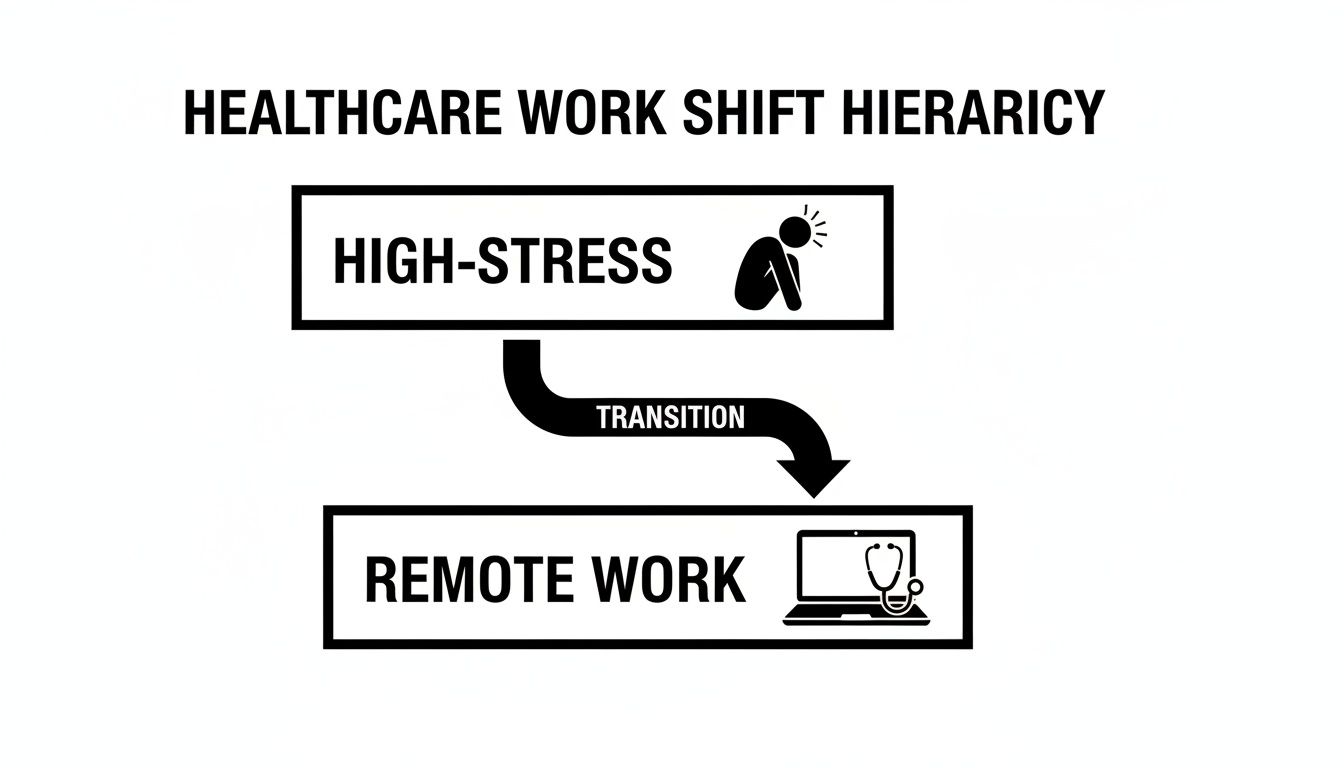
It's a clear pathway from burnout to balance. Think of it as a strategic career evolution, not just a change of scenery.
Direct Patient-Facing Telehealth Roles
This is the most visible slice of the remote healthcare world. These jobs involve either real-time (synchronous) or store-and-forward (asynchronous) interactions directly with patients. Technology simply bridges the gap, delivering care wherever it’s most convenient.
A few common examples include:
- Urgent Care Telemedicine: You're the virtual front line, managing acute but non-emergent issues like colds, rashes, and minor infections. A typical day is a series of quick, focused video consults, which allows for high efficiency.
- Primary Care Follow-ups: This is all about continuity of care for patients with chronic conditions like hypertension or diabetes. You might review labs, tweak medications, and provide lifestyle coaching—all from your home office.
- Specialty Consults: Specialists are in high demand. A remote neurologist might review a tough case for a rural PCP, or a dermatologist could diagnose a skin condition using high-resolution photos.
- Telepsychiatry and Virtual Therapy: This is one of the fastest-growing areas, period. The demand for accessible mental health services has kicked off a massive surge in opportunities. If this sounds like you, our guide on finding remote psychiatry jobs dives much deeper.
The World of Non-Clinical Remote Work
Beyond direct patient care, there's a massive—and often overlooked—sector where your clinical judgment is indispensable. These non-clinical roles are perfect for clinicians who want to step away from the front lines but still have a major impact on patient outcomes and the system itself. They usually come with more predictable schedules and a lot less emotional drain.
Key Insight: Non-clinical remote roles let you use your medical expertise in a different way. You shift from treating one patient at a time to influencing the systems that govern care for thousands.
Let's break down some of the most common non-clinical paths.
Utilization Management and Medical Review
In this field, you're the expert reviewer. Insurance companies, hospital systems, and review organizations hire clinicians to make sure requested medical services are appropriate, necessary, and evidence-based.
A day in the life might look like this:
- Review a case file for a patient needing an elective spinal fusion.
- Check the clinical notes against established guidelines (like InterQual or MCG).
- Make a determination on medical necessity, sometimes hopping on a call with the treating physician to discuss the case.
This work is analytical, detail-oriented, and plays a huge role in managing healthcare quality and costs.
Clinical Informatics and Health Tech
If you're fascinated by the intersection of medicine and technology, this could be your calling. Clinical informaticists work to optimize EHR systems, develop clinical decision support tools, and make sure technology actually helps clinicians instead of getting in the way.
You could end up working for a hospital system to fix its EHR workflow or for a health tech startup designing a new patient app. Your clinical background is the critical bridge between the coders and the end-users on the hospital floor.
Medical Writing and Communications
Your ability to understand and translate complex medical information is an incredibly valuable skill. Pharma, biotech, and medical device companies need clinicians to create all kinds of content.
This could mean:
- Writing clinical trial protocols and reports.
- Creating educational materials for patients or other providers.
- Developing content for medical journals or company websites.
This path is perfect if you excel at clear, precise communication and enjoy teaching. It's a role that truly blends your scientific knowledge with the art of storytelling.
To help you see the bigger picture, here’s a quick summary of how these roles break down.
Types of Remote Healthcare Jobs for Clinicians
This table outlines the common remote roles, what they typically involve, and which clinician types are a good fit.
| Job Category | Primary Responsibilities | Common Clinician Roles (MD/DO, NP/PA, Psych) |
|---|---|---|
| Direct Patient Care (Telehealth) | Conducting virtual consultations, diagnosing and treating acute/chronic conditions, providing therapy. | MD/DO (Urgent Care, Specialty), NP/PA (Primary Care), Psych (Therapy, Med Management) |
| Utilization Management (UM) | Reviewing medical necessity of procedures and treatments against clinical guidelines. | MD/DO, NP/PA, Psych |
| Clinical Informatics | Optimizing EHR systems, developing clinical decision support tools, bridging IT and clinical teams. | MD/DO, NP/PA |
| Medical Writing | Creating clinical trial documents, educational materials, and scientific communications. | MD/DO, PharmD, PhD |
| Pharmaceutical/Biotech | Serving as a Medical Science Liaison (MSL), providing clinical input on drug development. | MD/DO, PharmD, PhD |
As you can see, "remote work" in healthcare is far more than a single job type. It's a diverse field with room for almost any clinical background, offering a real alternative to the traditional, high-burnout career path.
How Remote Work Solesses Clinician Burnout
Clinician burnout isn’t just a buzzword. It's a full-blown crisis, fed by a system that demands too much, buries us in administrative tasks, and strips away our autonomy. For many of us, the traditional clinic or hospital floor has become an exhausting treadmill we can't get off.
Healthcare remote jobs offer a way out. They're not about changing the medicine we practice, but about fundamentally redesigning how we practice it.
This shift is all about taking back control. Instead of being chained to rigid hospital schedules and the chaotic flow of a packed waiting room, remote work hands the reins back to you. It lets you swap that frantic energy for the focused calm of your own space, allowing you to be a clinician on your own terms.
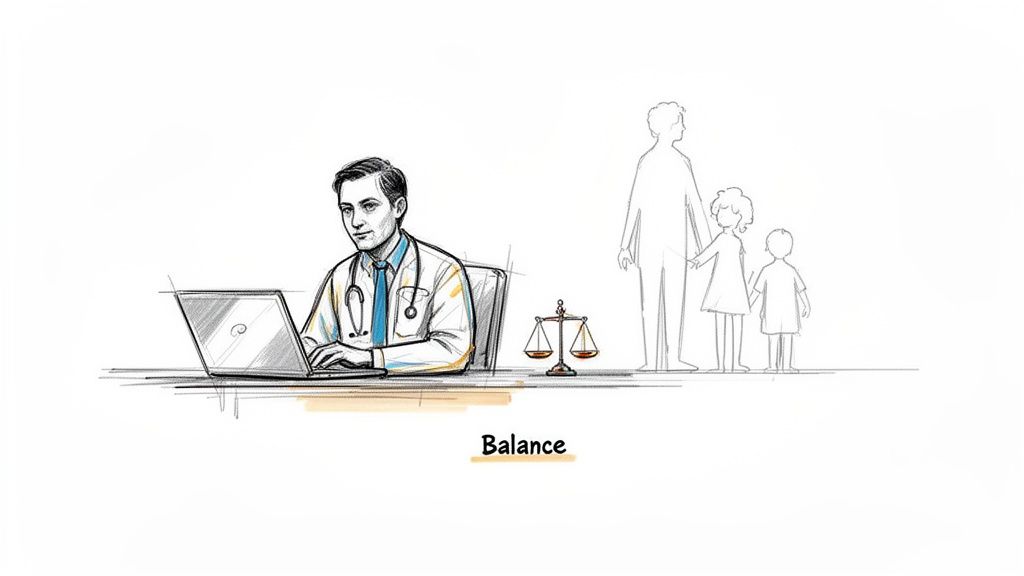
This change directly attacks the root causes of burnout, offering real solutions to problems that once felt impossible to fix. And the benefits go way beyond just ditching the commute.
Reclaiming Your Time and Autonomy
One of the first things to go in a traditional clinical career is your personal time. Inflexible schedules, unexpected late shifts, and the constant hum of on-call duties demolish any semblance of work-life balance. Remote roles are built differently.
- Flexible Scheduling: Many remote jobs, particularly in areas like utilization management or medical writing, are asynchronous. This means you structure your day around your life—not the other way around.
- Elimination of "Wasted" Time: Think about all the hours you lose just commuting, walking between hospital wings, or navigating institutional red tape. That time is now yours to reinvest in family, hobbies, or simply catching your breath.
- Control Over Your Environment: You get to create a workspace that actually works for you, free from the constant interruptions and noise of a busy clinical setting.
This freedom is a game-changer for your mental well-being. It restores the sense of agency that high-pressure environments so often crush. If you're feeling the strain, you can explore your personal burnout level with our quick assessment tool.
Reducing Administrative and Emotional Burden
Beyond just scheduling, remote work often rebalances the nature of the job itself. Many non-clinical remote roles let you use your hard-earned expertise without the most draining parts of patient-facing care.
Think about it: a physician in utilization review spends their day applying deep clinical knowledge to complex cases, but without the emotional toll of delivering bad news or managing difficult patient encounters. A medical writer uses their expertise to educate others, but without the endless hours of EMR charting.
Key Takeaway: Remote work isn't an escape from medicine. It’s a strategic career pivot that lets you apply your skills in a more sustainable, less draining way.
This model is becoming a critical fix for a global workforce crisis. The healthcare industry has a massive retention problem, with a projected shortage of nurses and a staggering 40% of UK general practitioners planning to quit in the next five years. By offering flexibility, employers can earn loyalty and keep good clinicians in the field. Remote employees are simply more likely to stay. You can discover more insights about the 2026 global health care outlook on deloitte.com to learn more about these trends.
Ultimately, remote work gives clinicians the breathing room to reconnect with why they went into medicine in the first place. By removing the systemic stressors that drive burnout, it carves out a path to a longer, healthier, and more fulfilling career.
How to Find and Vet Burnout-Friendly Remote Jobs
Let's be honest: not all remote healthcare jobs are created equal. Some are the real deal—life-changing roles that give you back your nights and weekends. Others are just burnout factories that have swapped a physical office for a virtual one.
The trick is learning how to tell them apart before you're stuck in another toxic environment. Finding a truly burnout-friendly position isn't about endlessly scrolling through generic job boards. It’s about becoming a detective, learning to read between the lines of a job description, and knowing exactly what to ask.
Start with Smarter Search Tools
Your search for a sustainable remote role starts with the right tools. Huge, generic job sites are a mess, flooded with listings that bury the details you actually care about. You need a platform built for clinicians, like WeekdayDoc, that lets you filter out the noise from the get-go.
This is what a smarter search looks like. You can immediately kill the endless scrolling by filtering for roles with "No Call" or "No Weekends".
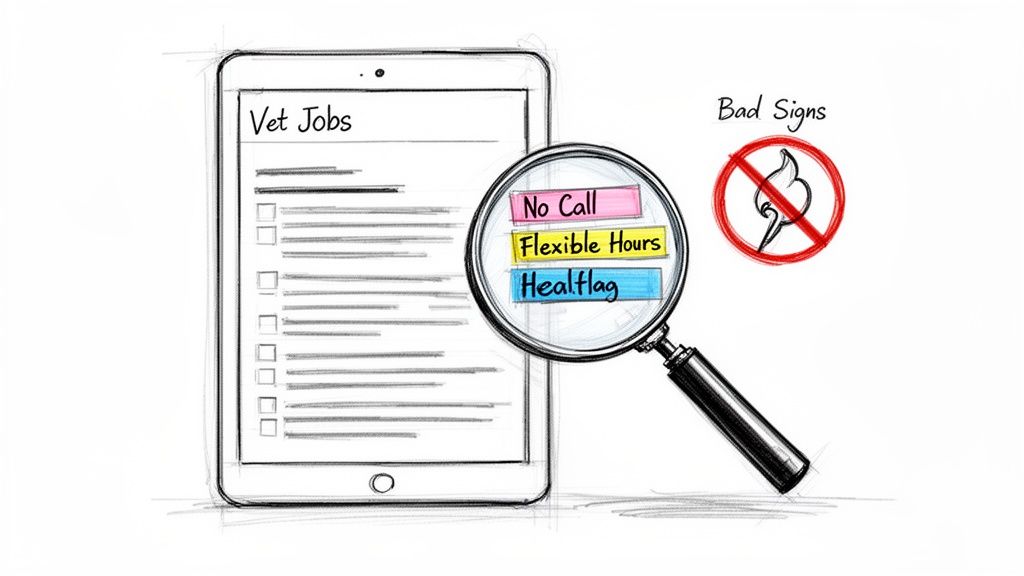
Using filters like these saves you from wasting hours on jobs that were never going to fit your life. As the tech gets better, new platforms are even using AI solutions for job matching to help connect clinicians with the right opportunities faster.
Decode the Job Description for Red Flags
Once you've got a shortlist, it's time to put on your detective hat and dissect the job descriptions. They're packed with clues about company culture and what the day-to-day will really feel like. Ignore the fluffy perks and focus on the language they use to describe the actual work.
Common Red Flags to Watch For:
- Vague Productivity Metrics: Spot phrases like "thrive in a fast-paced environment" or "handle a high volume of cases"? That’s often code for unrealistic patient loads and constant pressure.
- Undefined Work Hours: If a remote posting is cagey about work hours, it could be a sign of an "always-on" culture where your personal time is never truly protected.
- Overly Broad Responsibilities: See a laundry list of duties that sounds like three jobs rolled into one? It probably is. This screams "understaffed," meaning you'll be picking up the slack.
On the flip side, green flags are just as telling. Look for clear language about work-life boundaries, mentions of asynchronous work, and specifics on team support.
Ask the Right Questions During the Interview
The interview is your best chance to vet them right back. This is where you dig deeper than the polished job description and get a feel for the reality of the role. You need to ask direct questions that force them to give you a real answer, not just corporate-speak.
Don't ask, "Is there a good work-life balance here?" Of course, they'll say yes. Instead, ask, "How do you protect your team's personal time and prevent after-hours work?" The first question gets a platitude. The second requires a specific, tactical answer.
Essential Questions to Ask:
- About Productivity: "What are the specific productivity expectations, and how were they determined? How is success actually measured in this role?"
- About Team Culture: "What's the communication style like here? What tools do you use, and what are the expectations for response times—especially after hours?"
- About Clinician Autonomy: "How much control do clinicians have over their daily schedules and patient templates?"
- About Onboarding and Support: "What does the onboarding process look like for a new remote clinician? What kind of ongoing support is there when you're not physically in the same building?"
By combining smart search filters with a critical eye for job descriptions and targeted interview questions, you can cut through the noise. This is how you find a remote healthcare job that truly supports a sustainable, fulfilling career—not just another version of the same old burnout.
Mastering Your Application and Salary Negotiation
Landing a great remote role takes a different strategy than what you're probably used to. For healthcare remote jobs, hiring managers are looking for more than just clinical skill. They’re really trying to figure out if you have the discipline and tech-savviness to succeed on your own, away from a structured clinical environment.
Your application is your first and only chance to prove you can do both. It’s not enough to just list your clinical history; you need to translate your in-person expertise for a digital world.
Rebuilding Your CV for a Remote World
Your standard clinical CV is not going to cut it here. You have to reframe your entire experience through the lens of remote work. Don't just list what you did—showcase how you did it, emphasizing the skills that prove you're a self-starter.
Here are the key competencies to hammer home:
- Digital Communication: Did you use EHR messaging systems, patient portals, or telehealth platforms? Mention them. Show you’re comfortable communicating virtually.
- Tech Proficiency: Name the specific EMR/EHR systems you've mastered, like Epic or Cerner. If you've ever used tools like Asana or Trello for projects, that’s a huge plus.
- Self-Discipline and Autonomy: This is huge. Use real examples that show you can manage a patient panel or a project with little to no hand-holding. Phrases like “independently managed a caseload of X” or “solely responsible for Y project” speak volumes.
Pro Tip: I recommend creating a specific "Remote Work Competencies" section right at the top of your CV. This tells the hiring manager immediately that you get what this job is about and you’re ready for it.
Knowing Your Worth: Research and Benchmarking
Once you get their attention, the conversation will turn to money. This is where it gets tricky. Pay for remote clinical roles is all over the map and rarely follows the predictable models of in-person jobs. Geography, the type of work (telehealth vs. utilization management), and pay structure (hourly vs. salary) all create massive variability.
Going in blind is the fastest way to get low-balled. You absolutely have to do your homework.
The competition is real. While only about 10% of job postings are fully remote, they attract 2.6 times more applicants than on-site jobs. And with 65% of clinicians wanting to work from home full-time, you can bet you’re up against a lot of people. Vena Solutions has some great data on this. Knowing your market value isn't just an advantage; it's a necessity.
This is exactly why we built the WeekdayDoc Salary & FIRE Calculator. It cuts through the noise and gives you a data-backed salary range to anchor your entire negotiation.
How to Confidently Negotiate Your Offer
Negotiating isn't about being aggressive. It's about professionally communicating your value with solid data to back it up. When you have your benchmark research, you can walk into that conversation with confidence.
Here’s a simple, non-confrontational script I’ve seen work wonders after an initial offer comes in:
"Thank you so much for the offer. I'm incredibly excited about this opportunity. Based on my research for similar remote roles with my specialty and experience, I was expecting a base salary closer to the [Your Researched Range] range. Is there any flexibility to discuss how we might bridge that gap?"
This approach frames it as a collaborative problem to solve, not a demand. It shows you’re a professional who has done their homework. For clinicians also exploring different work models, understanding your value is just as critical when looking at options in our guide to part-time physician jobs.
The goal is to land a compensation package that truly reflects your expertise and helps you hit your financial goals. By tailoring your application and grounding your salary talks in data, you show them you're not just a great clinician—you're a strategic professional ready to thrive in the world of remote care.
Your Top Questions About Remote Healthcare Jobs, Answered
Making the jump to a remote career feels like a big step, and it's natural to have questions about everything from salary to staying connected. If you’re thinking about remote healthcare jobs, you're definitely not the only one wondering how it all works in practice.
Let’s clear up some of the most common concerns clinicians have and give you the straightforward answers you need to move forward with confidence.
Does Working Remotely Mean a Pay Cut for Clinicians?
Not always. While the pay structure for remote healthcare jobs can look different from a traditional hospital gig, many telehealth and specialty roles are highly competitive. The trick is to look at the whole financial picture, not just the base salary.
Remote work wipes out a ton of hidden expenses. Forget about commuting costs, a separate work wardrobe, and buying lunch out every day. When you add up those savings and factor in the massive value of getting your life back, the total compensation package often ends up being way more appealing than it first seems. Do your homework, research specific roles, and use salary calculators to know your actual market value.
Key Insight: Total compensation is more than just your salary. The financial perks of working remotely—like saving thousands on gas, car maintenance, and other daily costs—add up fast. This often makes the real take-home value of a remote job much higher than a similar in-person role.
How Can I Maintain My Clinical Skills and Network Remotely?
Staying sharp and connected from a home office just requires being a bit more deliberate. You don't have the luxury of hallway consults or bumping into colleagues in the breakroom. But that doesn't mean your skills or network have to suffer.
Many remote jobs, particularly in telehealth, are all about direct patient care over video, which keeps your diagnostic and decision-making skills in constant use. For non-clinical roles, it’s about proactively seeking out engagement.
To keep your skills fresh and avoid feeling isolated, you can:
- Jump into Virtual CMEs: Actively seek out webinars, online conferences, and digital courses relevant to your specialty.
- Join Online Professional Groups: Physician-only forums or specialty-specific groups on social media are goldmines for discussing tough cases and connecting with peers.
- Schedule Quick Check-ins: Be intentional about setting up virtual coffee chats or quick calls with colleagues. It's the new "hallway conversation."
Think of it as trading spontaneous interactions for a more curated—but just as valuable—digital strategy for staying connected.
What Technology and Home Office Setup Do I Need?
Your setup is your foundation for success. The absolute must-haves are a reliable high-speed internet connection, a decent computer with a good webcam and microphone, and a private, quiet space to work. That last one isn't just for focus—it's essential for patient privacy and staying HIPAA compliant.
Most legitimate employers will provide a work laptop already loaded with the security software and EMR access you'll need. Many also offer a stipend to help you buy things like an ergonomic chair or an extra monitor.
Common Home Office Essentials:
- An ergonomic chair to save your back during long shifts.
- An external monitor to reduce eye strain and make your workflow smoother.
- A high-quality headset for crystal-clear audio on patient calls and team meetings.
Always ask a potential employer what equipment they provide versus what you're expected to have. Getting this sorted out early ensures you’re ready to hit the ground running from day one.
Is It Possible to Achieve Real Work-Life Balance Remotely?
Yes, absolutely. But it all comes down to one thing: your ability to set and defend firm boundaries. The incredible flexibility of working from home can easily turn into an "always on" culture if you're not careful. When your office is just a few steps from your living room, the lines can get blurry, fast.
Real work-life balance is an active choice. It means setting clear start and end times for your day, taking actual breaks away from your computer, and creating a real separation from work when you clock out. That might mean literally closing the office door or shutting down your work computer and putting it out of sight for the evening.
It’s all about using the freedom of remote work to design a schedule that fits your life, not letting your job seep into every free moment. That discipline is what makes a remote career sustainable and truly rewarding.
Ready to find a remote healthcare job that actually respects your time? At WeekdayDoc, we curate burnout-friendly roles with no call, no nights, and no weekends. Start your search for a sustainable career today at https://www.weekdaydoc.com.