Expert Witness Work: A Clinician's Playbook for Starters
Learn how to start expert witness work as a clinician with our practical playbook. Build credibility and earn income in 2026.
The expert witness market is no longer a side note in clinical careers. One industry summary places it at $1.2 billion in 2022, with the U.S. at $780 million, or 65% of global share, and projects 5.3% CAGR from 2023 to 2030 expert witness industry statistics. That scale matters because it tells physicians, NPs, PAs, psychologists, and pharmacists that expert witness work is a real professional-services lane with pricing power, not an occasional favor for an attorney.
For clinicians, the best version of this work is rarely the loudest one. The sustainable version fits inside a full practice, stays inside your real scope, and doesn't turn every case into a referendum on your neutrality. That means thinking like a careful specialist, not a volume hunter.
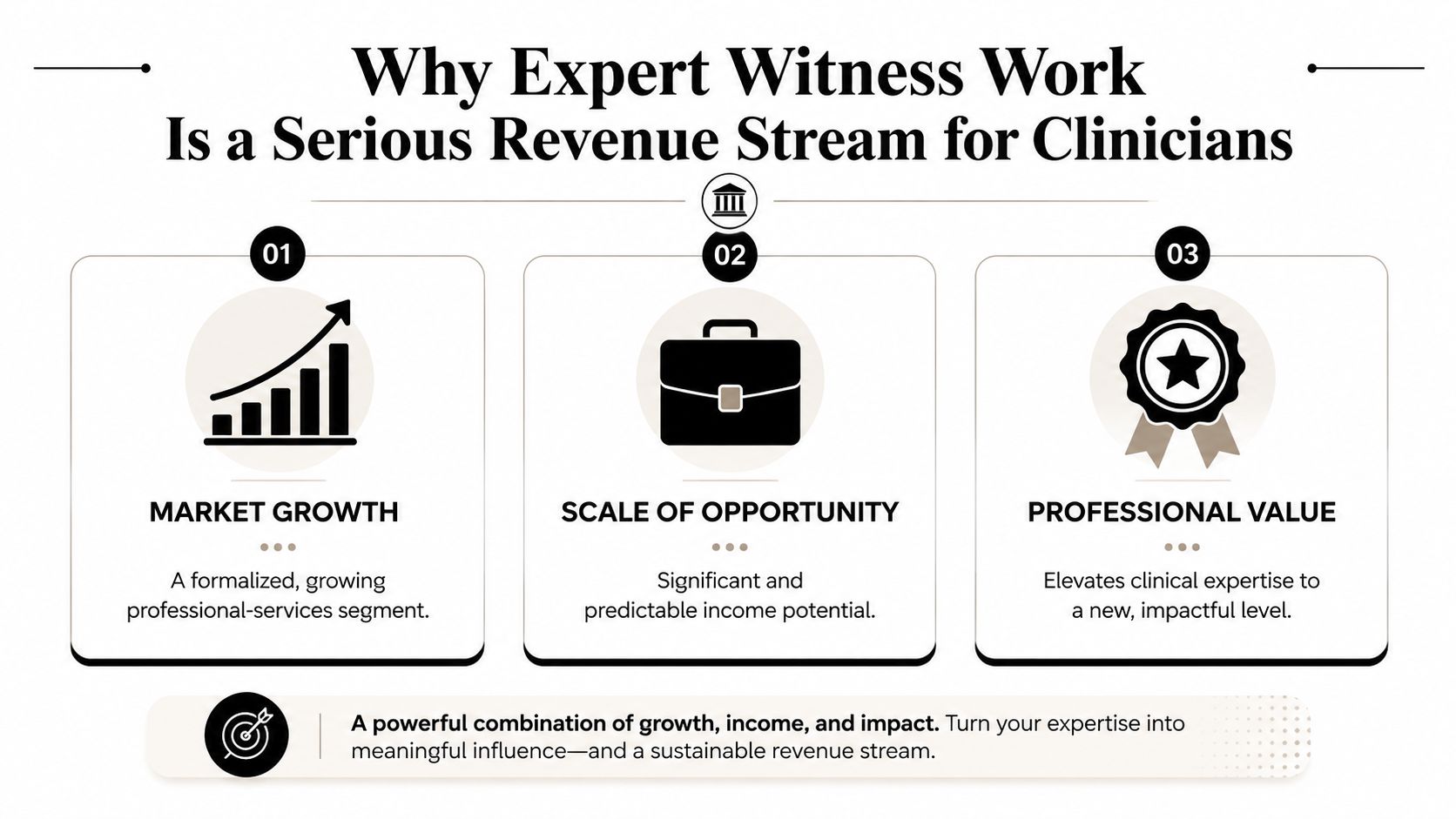
Why Expert Witness Work Is a Serious Revenue Stream for Clinicians
The market data already tells you this isn't a casual sideline. A recent industry summary reports $1.2 billion in global value in 2022, with the U.S. accounting for $780 million and 65% of global share market summary. It also projects continued growth at 5.3% CAGR from 2023 to 2030 same source. That combination of concentration and growth is exactly what you'd expect in a mature professional niche where legal systems keep paying for specialized judgment.
The fee side confirms the same pattern. A separate 2026 survey shows the average hourly rate has risen to $465, up from $451 in 2024 fee survey. That's not a random bump. It reflects a market where experience, defensible methodology, and courtroom readiness command real pricing power.
Why active clinicians are valued
Attorneys don't just buy credentials. They buy a clinician's ability to explain what happened in real practice, in real systems, with real constraints. An active practice often helps because it keeps testimony grounded in current standards, current workflows, and the way care gets delivered.
That doesn't mean every working clinician is automatically a strong expert. It means the market rewards people who can do three things at once. They need to hold up under cross-examination, stay current in their specialty, and write in a way that a judge can follow without translation.
Practical rule: If your clinical work and your testimony don't fit together cleanly, the market will eventually penalize that mismatch.
What the labor market looks like from the inside
The expert witness field has also become more standardized as a labor market. In one survey, 41% of expert witnesses reported working full time in expert witness work, 47% part time, and 9% were retired survey data. The same survey found that expert witness work accounted for 56% of respondents' workload, up from 37% in 2003 and 45% in 2011 survey data. That kind of shift shows a recurring professional role, not a one-off courtroom appearance.
The billing model is just as telling. Another longitudinal report found 98% of expert witnesses are paid at least partly on an hourly basis, 57% spend 10 to 49 hours on each engagement, and 34% charge more than $400 per hour survey data. In practice, that means the market favors people who can scope work well, document time, and avoid the chaos that comes from treating every matter like a blank check.
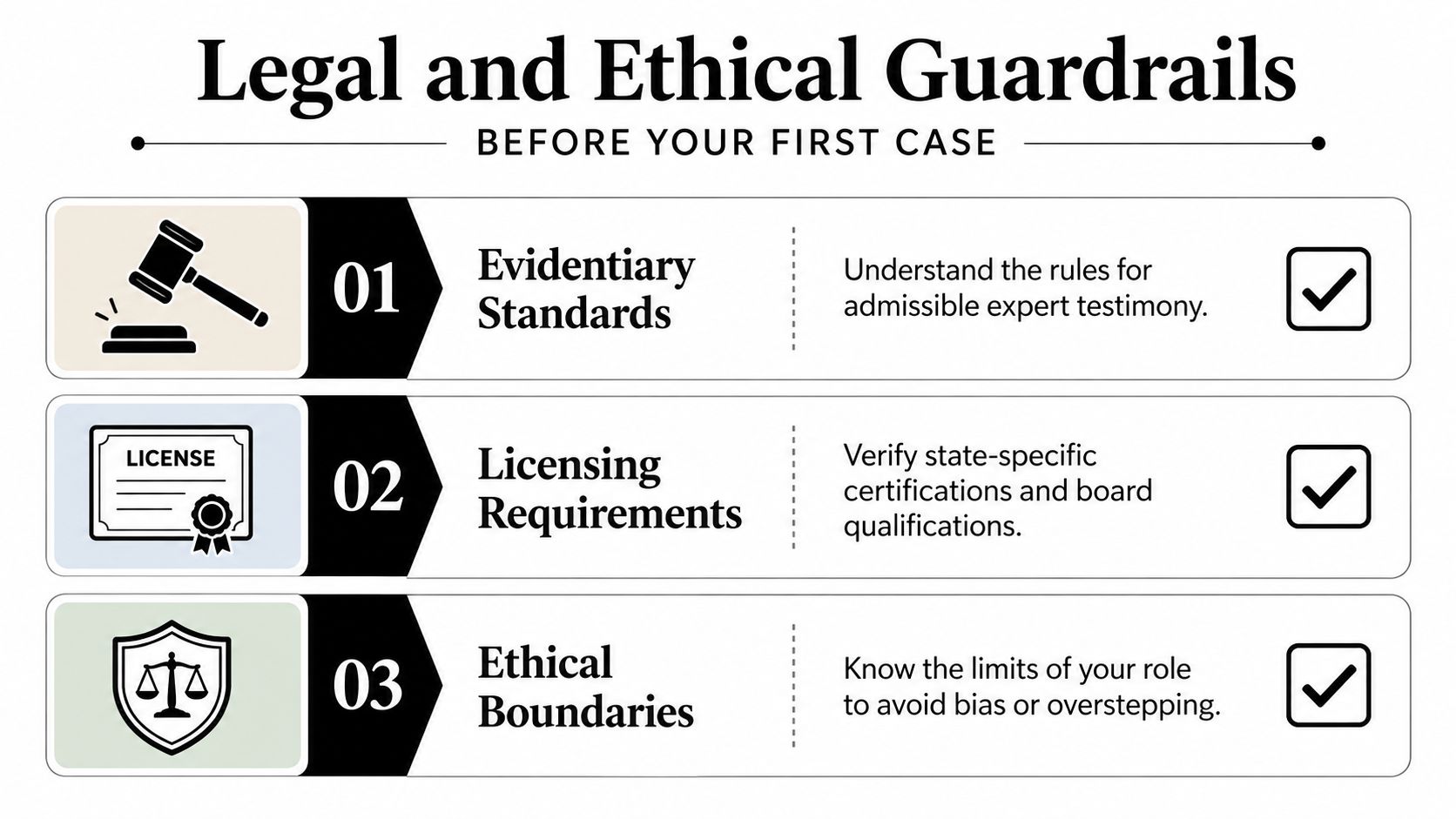
Legal and Ethical Guardrails Before Your First Case
Federal court starts with a basic threshold. Under Rule 702, an expert needs enough knowledge, skill, experience, training, or education to help the trier of fact, and the testimony has to be relevant and reliable Rule 702. The American Bar Association also notes that qualification is tested through voir dire before the witness can testify ABA reference in Rule 702 context. That's why your first screening question should be simple. Is this within your specialty, or just adjacent to it?
Start with scope, then check the venue
Licensing rules vary sharply in medical malpractice matters. One national snapshot from the Federation of State Medical Boards found 27 states require expert witnesses to be licensed, 19 of those allow licensure in any state, 22 states plus Guam do not require licensure, and one state plus the District of Columbia, Puerto Rico, and the Virgin Islands have no statutory requirements for expert witnesses FSMB snapshot. That variation means you can't rely on a single national habit. You have to check the forum, the specialty, and the witness rule before you say yes.
For physicians, StatPearls says the safer posture is to testify only within genuine expertise and to hold a current, valid, unrestricted medical license in the state of practice, be board certified by an ABMS- or AOA-recognized board, and be actively engaged in clinical practice in the relevant specialty StatPearls. Even when a state doesn't require every one of those items, juries and judges still notice them.
The ethics issue is just as important as the licensing issue. Expert-witness ethics guidance emphasizes staying within your specialty, disclosing compensation-related communications, and not drifting into opinions you can't defend. The biggest mistake I see is not bad intent, it's overreach. A good case can become a weak one if the report wanders outside the witness's competence.
Reliability beats confidence
Courts do care about challenges to independence and impartiality. Under the Canadian WBLI framework, independence challenges succeeded 22.6% of the time before WBLI and 25.8% after, while impartiality challenges succeeded 42.9% before and 40.9% after legal study. In U.S. financial expert practice, PwC's Daubert study found lack of reliability was the main reason for exclusions, with courts most often citing insufficient data or methods not generally accepted same study source.
That's why the most defensible move is to build a written reliability file from the start. Keep the facts you relied on, the steps you took, why each variable matters, and how the opinion would change if a key assumption changed. A polished voice won't save a sloppy method.
A useful benchmark for reporting mechanics comes from Canada's Federal Courts Rules, which require an expert report to include the issues addressed, qualifications, a current CV, facts and assumptions, a summary of opinions, points of agreement and disagreement if applicable, reasons for each opinion, supporting literature, and a summary of methodology Federal Courts Rules. That is a strong template even when you're practicing in the U.S.
Before you accept any case, it also helps to review the language in your broader professional contracts, because unclear independence language can create avoidable risk later. A practical place to start is a careful read of employment contract review guidance for clinicians, especially if you already work in a practice with restrictive side-work policies.
Building a Marketable Expert Profile Without Inviting Bias Attacks
A marketable expert profile isn't a brag sheet. It's a document that tells attorneys, and later the court, exactly why you're useful and exactly where your boundaries are. That distinction matters because the same things that make you easy to hire can also make you easy to attack if they look inconsistent or opportunistic.
Build for credibility first
Start with a CV that reads like a litigation document, not a faculty brochure. Lead with the specialty, clinical role, board status, teaching, publications, and the kinds of questions you answer. If you've testified before, list the subject matter carefully and consistently. Don't pad the record with areas that sound impressive but fall outside your core opinion territory.
The ethical angle matters here. One AMA ethics discussion notes that bias is a central attack point, and expert-witness guidance stresses staying within one's specialty and avoiding opinions outside that scope AMA ethics discussion. The practical consequence is simple. Narrower can be stronger if the niche is real and defensible.
Use visibility without advertising a vulnerability
A visible expert profile helps attorneys find you, but public visibility also creates a record opposing counsel can mine. Prior publications, speaking dates, prior case comments, and even wording on your website can become part of a consistency check. That doesn't mean hide. It means keep your public story aligned with your testimony history.
One recent ABA resource emphasizes researching prior case opinions, publications, and prior challenges before retention because experts are now evaluated against a broader record of testimony and consistency across matters ABA material. That same logic applies in reverse. If you publish or post publicly, assume someone will compare those words to your report.
A polished professional image helps, but it doesn't have to be extravagant. If you need a current headshot for your site, your bio page, or attorney-facing materials, a practical resource on affordable professional headshots online can be useful without turning your profile into marketing theater.
The safest expert profiles are clear, narrow, and boring in the best possible way.
Position for consistency, not volume
A lot of clinicians think more cases automatically mean a stronger market position. That's not how bias challenges work. If your case mix makes you look too aligned with one side, or if your compensation structure starts to look like advocacy, opposing counsel will frame that as a credibility problem.
Good positioning looks like consistency across matters, a defined specialty lane, and transparency about how you handle retention, fees, and methodology. It also looks like saying no to cases that are technically adjacent but strategically risky. In expert work, restraint can be a competitive advantage.
Setting Fees and Structuring Your Expert Witness Business
The cleanest fee structure is the one you can explain in one sentence without apologizing. The market already leans that way. 98% of experts are paid at least partly on an hourly basis survey data, which tells you that time-based billing is still the default way to keep the arrangement understandable and defensible.
Price the work by phase, not by wishful thinking
Expert work has different labor blocks. Records review, report writing, deposition prep, deposition time, and trial time are not the same activity, and they shouldn't be treated that way in your contract. The best structure is usually an hourly rate with a retainer and clear scope language, because it lets you protect time without creating the impression that your compensation depends on a result.
Another useful benchmark from the survey data is that 57% of expert witnesses spend 10 to 49 hours on each engagement, and 34% charge more than $400 per hour survey data. That doesn't tell you what to charge, but it does tell you the market expects serious work to require meaningful time. If a matter looks small and easy, it still needs the same discipline.
| Expert Witness Fee Structure Benchmarks | Service Type | Typical Rate Range | Common Engagement Hours |
|---|---|---|---|
| Records review and initial screening | Review | Time-based, set in advance | Usually a limited block of hours |
| Written report preparation | Drafting | Time-based, set in advance | Often part of a multi-hour engagement |
| Deposition preparation and testimony | Live testimony work | Time-based, set in advance | Can extend beyond the initial review |
| Trial support | Court appearance and consult time | Time-based, set in advance | Depends on the schedule and case complexity |
That table reflects how the work is typically packaged in practice, not a universal rate card. Your own rate should match your specialty, your demand, and the amount of interruption the work creates.
Put the business terms in writing
A good engagement letter should make three things obvious. What work you're doing, what you're not doing, and how you get paid. It should also spell out how retainers work, when invoices go out, and what happens if the attorney cancels on short notice.
If you're using a contractor setup for expert work, review the tax and classification implications carefully. A practical reference on independent contractor status is useful because the way you structure the relationship affects more than cash flow. It can affect deductions, liability, and how clearly the work is separated from your clinical role.
Practical rule: Don't let the contract become a hidden debate about payment later. Put the scope, timeline, and stop-work triggers in writing before the first record review.
Keep the admin boring
Invoice fast, track expenses cleanly, and preserve every draft, note, and calculation. If you're going to form an entity for tax or liability reasons, do it for operational clarity, not because you think a shell entity fixes weak methodology. It doesn't.
The strongest expert businesses are built on predictable billing, documented work, and a clear refusal to let payment terms blur into advocacy. That's what keeps the practice sustainable.
Preparing for Depositions and Trial Testimony
The easiest way to lose credibility is to sound confident about a method you can't defend. The better path is more modest. Start with the record, identify the exact question, and build an opinion that can survive a hostile read of your own notes.
Build the opinion as if it will be challenged
A defensible workflow starts with the evidentiary question, then the candidate variables, then the analysis. A methodological critique from CMU describes the process as observing the raw association, measuring candidate confounders, and using multiple regression to see whether the association remains after control, while warning that results can change materially with variable selection and sample size method critique. That's a reminder to pre-specify controls, explain why each one belongs, and document what you did before anyone starts asking hostile questions.
What does that look like in practice? You don't wait until deposition week to discover your assumptions. You write them down when you form the opinion. You keep a record of the literature, the data sources, the limitations, and any changes in the case record that might alter your conclusion.
The federal reporting standard in Canada is useful as a checklist because it requires the issues addressed, qualifications, CV, facts and assumptions, summary of opinions, reasons, supporting literature, and methodology Federal Courts Rules. That level of structure makes cross-examination much harder to derail.
Practice for the questions that matter
The deposition isn't where you invent the opinion. It's where you defend the one you already built. That means you need to rehearse how you answer pressure questions about scope, data selection, competing interpretations, and what you would say if a key assumption changed.
For written preparation, it helps to look at transcript layout samples and best practices so you can organize your own notes and testimony prep in a way that makes review easier. Clean formatting doesn't make testimony stronger on its own, but it does make weak spots easier to find before someone else finds them first.
A lot of experts get tripped up by language. “Statistically significant” is not the same thing as clinically meaningful, legally persuasive, or methodologically sound. If you can't explain exactly why the conclusion follows from the record, the opposing lawyer will make that gap the center of the deposition.
Practical rule: When a question feels loaded, answer the underlying methodological issue, not the lawyer's framing.
Keep the reliability file current
If new records arrive, update the file. If your qualifications change, update the file. If you discover a material limitation in the data, update the file. The Federal Courts Rules require experts to report material changes affecting qualifications, opinions, or data without delay Federal Courts Rules, and that habit is useful even where the exact rule differs.
The point isn't to be flashy. It's to be consistent. A witness who can show a disciplined process usually looks more credible than one who sounds certain but can't show the work.
Managing Workload and Protecting Your Clinical Practice
Expert witness work can eat nights and weekends fast. That's the hidden cost most clinicians underestimate, because the calendar burden doesn't show up until you're juggling charting, calls, and deposition prep in the same week. If you want this to stay sustainable, you have to manage it like a second practice, not a hobby.
Set capacity before you set ambition
The most reliable boundary is a hard cap on concurrent matters. If you already know your clinical schedule is tight, don't accept a new case just because the attorney sounds urgent. Urgency is not the same as priority, and it's rarely a reason to skip your own workload math.
Batching helps. Keep one block for record review, one for writing, and one for calls or deposition prep. That prevents the constant context switching that makes expert work bleed into every part of the week.
Use a short decision filter before you accept anything:
- Scope fit: Does the case sit squarely inside your real expertise?
- Time fit: Can you complete the work without sacrificing clinical quality or personal time?
- Neutrality fit: Does the fee structure or client mix create an avoidable bias problem?
- Documentation fit: Can you preserve the record cleanly from the start?
Protect the practice you already have
If you're still actively practicing, keep your malpractice and coverage questions aligned with the extra work. A practical starting point is physician malpractice insurance guidance, because expert work can raise questions about how your coverage interacts with consulting, testimony, and outside clinical obligations.
The goal is not to maximize case count. The goal is to build a portfolio that leaves you sharper, not drained. That means declining cases that are too far outside your specialty, too compressed on timeline, or too messy from a bias standpoint.
A sustainable expert practice usually looks unglamorous from the outside. Fewer matters, cleaner files, predictable billing, and a calendar that still leaves room for patient care and real life. That's the version that lasts.
If you're deciding whether expert witness work belongs in your career, WeekdayDoc can help you compare it against roles that better protect your time, income, and energy. Explore WeekdayDoc for burnout-conscious opportunities, salary context, and tools that help you choose work that fits the life you're trying to build.