Clinical Psychology Job Market: A 2026 Field Guide
Explore the 2026 clinical psychology job market, from BLS demand and salary ranges to telehealth growth, licensure, and burnout-friendly role signals.

The headline is attractive: clinical and counseling psychologists held 71,730 U.S. jobs in May 2023, with a median annual wage of $96,100 and a mean wage of $106,600, according to the reported May 2023 labor-market data. But those figures don't answer the question most clinicians face: can you find a role in the location, setting, schedule, and compensation structure you can sustain?
The clinical psychology job market is better understood as a supply-demand mismatch problem. Aggregate employment is growing, yet openings remain uneven by state, employer budget, credential status, reimbursement environment, and work design. For physicians, NPs, PAs, pharmacists, and psychologists comparing career options, the practical issue isn't whether demand exists. It's whether a specific employer has funded a durable role without hiding call, weekend coverage, or documentation overload behind an appealing salary.
What the 2026 Clinical Psychology Job Market Looks Like
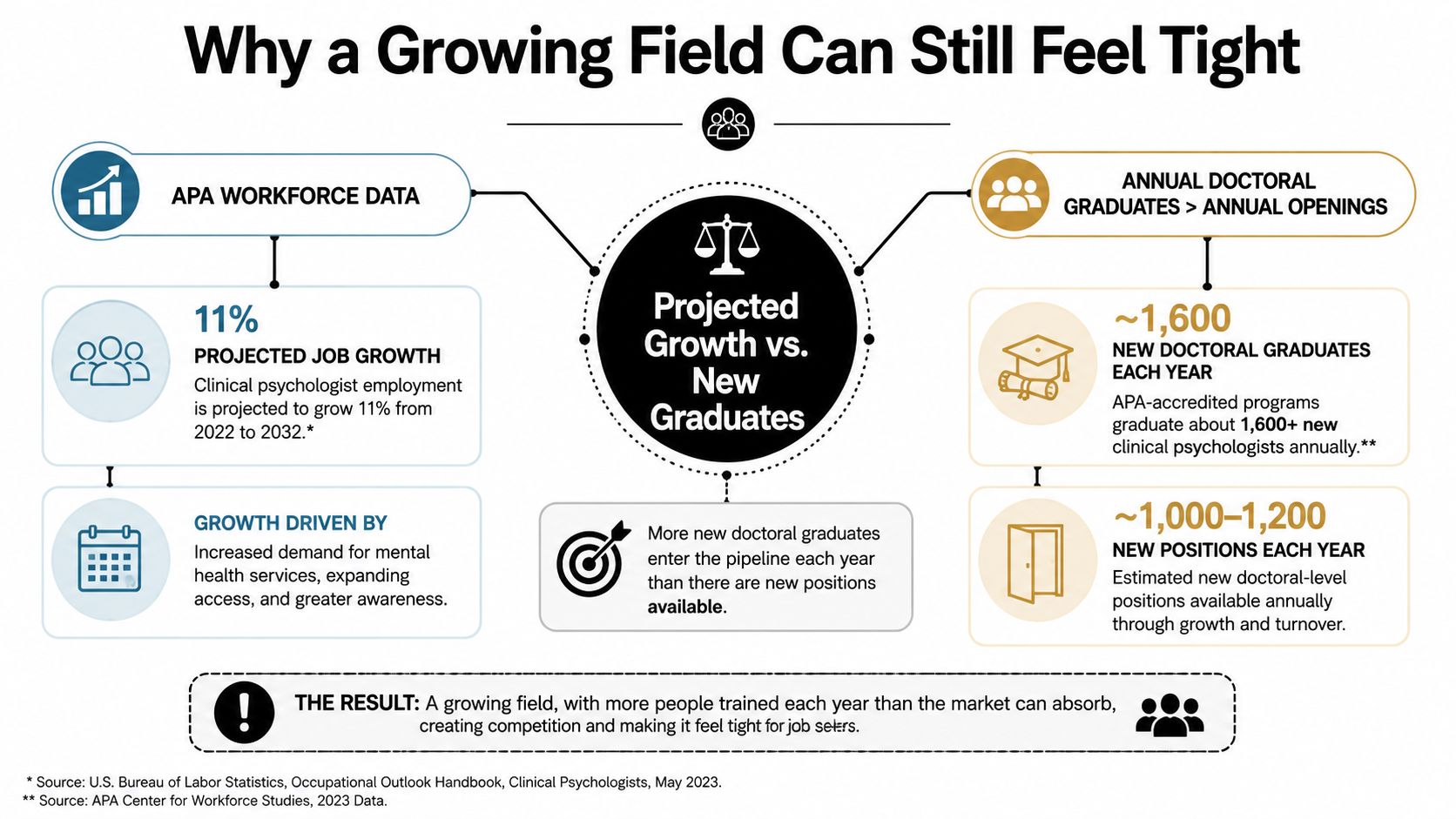
The U.S. Bureau of Labor Statistics projected 11% employment growth for clinical and counseling psychologists from 2022 to 2032, with approximately 4,100 average annual openings over that period. The BLS described this growth as much faster than average in its mental-health employment outlook. The projection signals demand, but it does not show how many roles a candidate can access in a preferred location, setting, or schedule.
Annual openings represent several labor-market mechanisms:
- Net-new growth, as organizations expand services or create funded positions.
- Replacement demand, when clinicians retire, leave the occupation, or change settings.
- Internal movement, when an employer fills a vacancy through transfer, promotion, or an existing trainee pipeline.
The headline percentage combines these categories. Employment can grow while many openings replace departing clinicians rather than expand capacity. That distinction matters for applicants competing for funded positions in attractive metropolitan areas, academic systems, or public employers.
The wage median has the same limitation. The $96,100 median is an occupational aggregate, not a guaranteed entry offer. It combines early-career clinicians, established practitioners, late-career psychologists, and adjacent clinical, counseling, and school pathways. The reported 25th to 75th percentile range is $66,050 to $129,020, while the top-end annual wage is $168,870, showing substantial variation across roles and settings (CareerExplorer labor-market data).
BLS headline numbers versus practical meaning
| BLS Headline | What It Shows |
|---|---|
| 11% projected growth | The occupation is expanding, combining new roles with replacement openings. |
| 4,100 annual openings | Vacancies can reflect exits and turnover, not only newly funded positions. |
| $96,100 median wage | A broad midpoint that does not reveal credential stage, employer model, geography, or schedule burden. |
| $66,050 to $129,020 percentile range | Compensation differs materially across the occupational distribution. |
| 71,730 jobs in May 2023 | The market has scale, but national volume does not guarantee local access. |
The practical conclusion is direct: growth establishes opportunity, while mismatch determines access. Evaluate the funded position, hiring geography, license timeline, and work architecture before treating an occupation-wide projection as a personal employment forecast. A role with no call, no weekends, and a strong Burnout-Friendly Score may be more usable than a higher headline salary with hidden coverage and documentation demands.
Why a Growing Field Can Still Feel Tight
A growing occupation can still feel crowded when credentialed clinicians and funded positions do not align. APA workforce modeling projects baseline psychologist demand to rise 6% from 2015 to 2030, while baseline supply rises 13% to 107,410 full-time-equivalent psychologists. The APA supply-demand analysis also describes shortfalls under unmet-need scenarios and uneven distribution across regions.
Those figures describe different constraints. Supply may grow faster than baseline demand nationally while communities remain underserved, because clinicians do not distribute themselves evenly and employers do not fund positions in proportion to clinical need. A candidate can face strong competition in one metro area while a public system elsewhere struggles to recruit.
The practical question is whether clinical need has become a payable position. Employer budgets, reimbursement rates, Medicaid enforcement, staffing models, and credentialing rules determine whether demand becomes a job posting. Prevalence alone does not create a funded role.
The geographic problem
The APA projections identify the South as a deficit region by 2030, including Texas, California, South Carolina, Louisiana, and Ohio. A projected deficit does not mean every employer in those states offers easy hiring or better compensation. It indicates that unmet demand may be more structurally visible, which can improve a candidate's position when the employer has an approved budget and a workable credentialing process.
Canada's national outlook labels clinical psychology as facing a strong risk of labor shortage from 2024 to 2033, while the United States projects broad psychologist growth and recurring annual openings. The comparison points to a narrower conclusion: shortage conditions are local and institutional, not universal. Competition can remain intense for a desirable funded post even while another system cannot fill comparable roles.
The UK provides the same warning. BBC reporting in August 2026 described an NHS workforce with 200 more clinical psychologists than the previous year and growth of 15% over five years, yet also reported a clinician with 10 years of training who could not find an NHS psychologist job (BBC reporting on NHS clinical psychology hiring). Training growth does not automatically create accessible jobs when commissioning and funded-post structures lag behind the pipeline.
For job seekers, the mismatch makes schedule and workload signals useful. WeekdayDoc's No Call, No Weekends, and Burnout-Friendly Score can be treated as screening variables, not proof of an easy role. Compare them with the funded service line, credentialing requirements, crisis coverage, and documentation load before judging an offer.
Where Clinical Psychologists Work
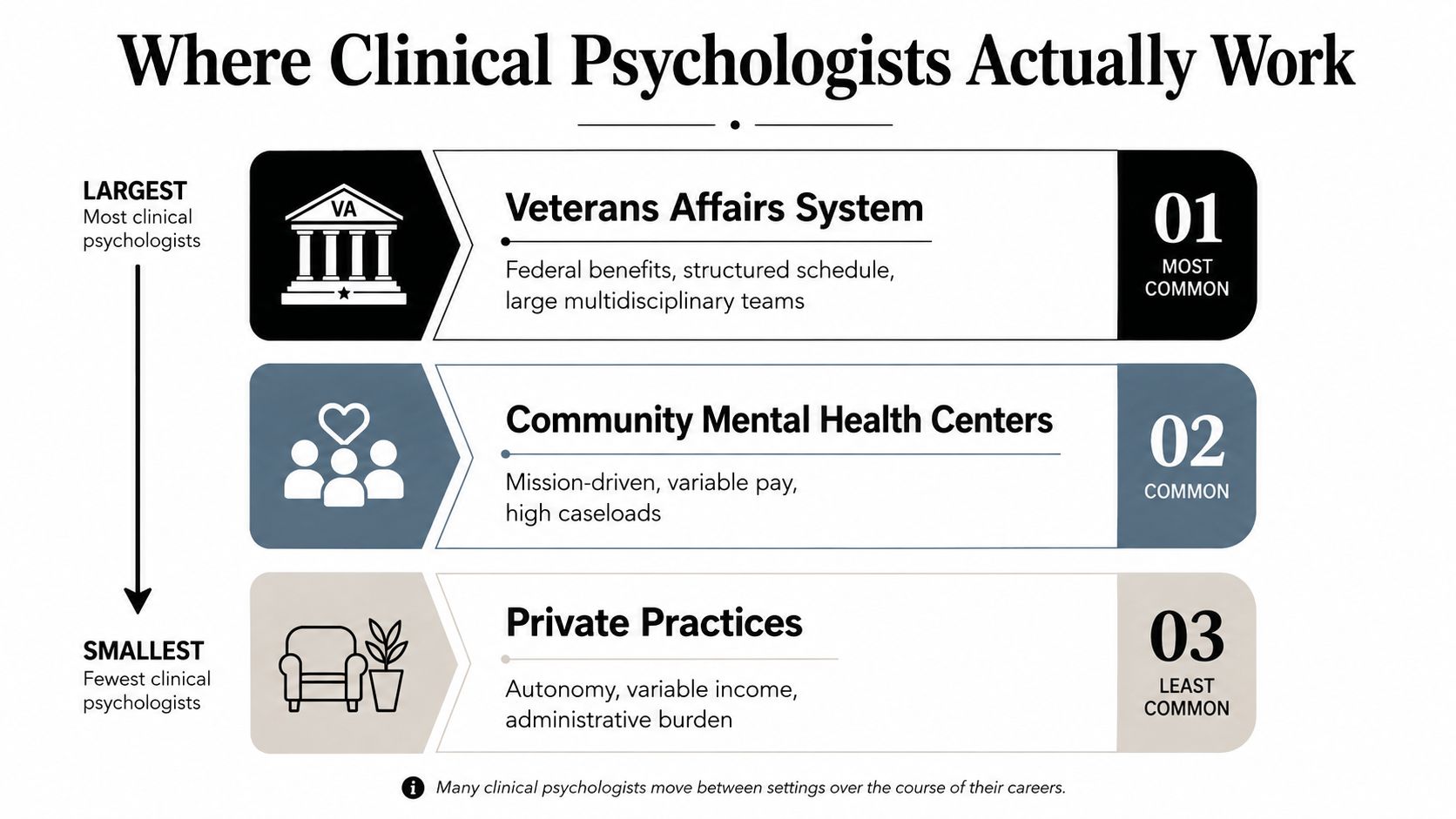
Employer setting often determines more than a psychologist's title. It shapes caseload design, administrative workload, schedule predictability, supervision, and whether an outpatient role still includes crisis duties. For job seekers comparing offers, the setting is a supply-demand signal: organizations with persistent access needs may offer openings while also transferring workload risk to clinicians.
Federal and institutional employers
The Veterans Affairs system offers federal benefits, defined procedures, multidisciplinary teams, and, in many ambulatory roles, more predictable hours than acute-care environments. The tradeoffs can include productivity targets, panel management, standardized workflows, and extensive administrative requirements. No Call is more plausible in some ambulatory positions than in inpatient or crisis programs, while No Weekends depends on the facility and service line.
Academic medical centers and general hospitals place psychologists alongside psychiatrists, physicians, nurses, social workers, and rehabilitation teams. These settings can fit clinicians seeking assessment, consultation, research, or complex-care exposure. Roles connected to inpatient or emergency services may include on-call coverage, weekend rotations, emergency evaluations, and heavy documentation.
Community, private, and remote models
Community mental health centers serve patients facing substantial access barriers and often operate under tight staffing conditions. Common risks include variable pay, high caseloads, crisis exposure, and limited recovery time between visits. Candidates should ask whether caseloads are capped, documentation time is protected, and a separate crisis team handles emergencies.
Group practices and PPO-oriented models may provide greater specialization and a higher earning ceiling. That control can depend on evening availability, weekend blocks, referral volume, collections, and compensation based on completed sessions rather than reserved time. A role with no formal call obligation can still create pressure through cancellations, unpaid administration, or volume targets.
Fully remote platforms can broaden geographic reach through PSYPACT participation, but they do not remove state-by-state licensure, privacy, emergency-response, or documentation duties. Remote work may eliminate commuting and facility-based call while adding asynchronous messages, platform procedures, and cross-state credentialing tasks.
Schools and university counseling centers often follow academic calendars and may provide stronger No Weekends conditions. Pay bands can be lower than those in private clinical roles, and crisis response during the academic day can remain intense. Solo practice offers the greatest schedule control, but the psychologist assumes responsibility for referrals, billing, compliance, cancellations, benefits, and revenue volatility.
Patient presentation also affects demand and workload. Clinicians explaining why patients avoid or fear interpersonal settings can use why social situations trigger anxiety as a patient-facing psychoeducation resource.
| Setting | Typical No Call Exposure | Typical No Weekends Exposure | Burnout Signals |
|---|---|---|---|
| VA ambulatory care | Often more structured, verify crisis coverage | Often possible, verify facility policy | Productivity pressure, large panels |
| Hospital or academic center | Varies sharply by service line | May include rotations | Inpatient urgency, on-call expectations |
| Community mental health | Less predictable | Program-dependent | High caseloads, crisis intensity |
| Group practice | Usually no formal call | Evening or weekend access may be expected | Session volume, unpaid admin |
| Telehealth platform | Often no traditional call | Often flexible, verify message duties | Documentation backlog, 1099 risk |
| Schools and universities | Usually daytime coverage | Often aligned with academic schedules | Crisis concentration, seasonal workload |
| Solo practice | Clinician-defined | Clinician-defined | Business risk, isolation, cancellations |
Salary Ranges and the Telehealth Premium
Clinical psychology pay spans a wide distribution, so a median alone can mislead job seekers. May 2023 figures reported a 25th percentile wage of $66,050, a median of $96,100, a mean of $106,600, a 75th percentile of $129,020, and a top-end annual wage of $168,870 (clinical psychologist wage distribution). These values describe variation across the field, not a standard offer for every licensed psychologist.
A later summary reported a $99,110 median annual wage for psychologists in May 2025, with overall psychologist employment projected to grow 6% from 2025 to 2035 and approximately 11,300 annual openings over that decade (BLS psychologist outlook and wage summary). The category includes roles beyond clinical psychology, so the figure should not be treated as a precise quote for a specialty, setting, or employer.
The telehealth premium is a compensation mechanism, not a guaranteed pay increase. Remote delivery can widen an employer's recruiting pool, reduce facility costs, and connect clinicians with shortage areas. Those advantages may instead accrue to the platform. Standardized rates, contractor classification, unpaid administrative tasks, and productivity formulas based on completed sessions can reduce effective hourly pay.
A remote offer should therefore be evaluated through its complete labor model. Calculate paid clinical time alongside documentation, messaging, cancellations, supervision, and required meetings. Then account for license coverage, reimbursement, payer mix, benefits, taxes, and whether the employer or clinician absorbs compliance and billing work. Advertised ranges may also differ from worker-reported earnings on platforms such as Glassdoor, making the compensation formula more informative than the headline amount.
PSYPACT may increase geographic flexibility for eligible psychologists in participating jurisdictions, but it does not replace state authority or employer credentialing. License eligibility and cross-state coverage still shape the reachable labor market.
For current remote opportunities, review telehealth mental health jobs together with contract terms and license requirements.
| Variable | Hospital or Health System | Group Practice | Telehealth Platform | Private Practice |
|---|---|---|---|---|
| Pay structure | Salary, benefits, or productivity blend | Salary, split, or collections model | Per-session, contract, or platform formula | Collections after expenses |
| Geographic reach | Facility and license dependent | Practice footprint dependent | Multi-state eligibility may help | License-defined |
| Administrative burden | EHR and institutional requirements | Shared or clinician-specific | Platform plus asynchronous work | Fully clinician-owned |
| Schedule control | Role-specific | Moderate, often referral-driven | Often flexible, contract-dependent | Highest control |
| Main compensation risk | Productivity targets | Volume and split terms | Contractor status and unpaid work | Cancellations, overhead, marketing |
Licensure, Supervised Hours, and the Credentialing Timeline
A clinical psychology job search is governed by credentialing before it is shaped by job applications. The usual sequence includes doctoral completion, the EPPP examination, and supervised experience before independent practice. Each jurisdiction sets its own order and crediting rules, so assuming one state's pathway transfers directly to another can delay practice and weaken salary negotiations.
Nevada requires two years of supervised, documented experience, with each year including at least 1,750 hours, under Nevada's psychologist licensure rule. Requirements differ across jurisdictions, with total supervised hours ranging from roughly 1,000 to 4,000. Some states also require at least half of those hours to involve direct clinical services, as summarized in state-by-state psychologist licensing procedures.
Three checkpoints that control time to practice
Doctoral completion: Check whether the PhD or PsyD program meets the licensing authority's standards in each intended practice state. APA recognition and regional accreditation can affect how boards assess education, internship, and training.
EPPP preparation and examination: The national examination is one requirement within a larger review. Passing it does not replace jurisdiction-specific documentation, background checks, supervised hours, or application processing.
Supervised experience: Confirm whether practicum and internship hours qualify, whether postdoctoral supervision is required, and who must document the work. Direct-service requirements can determine how quickly hours advance licensure.
PSYPACT can expand interstate practice options for eligible psychologists, but compact participation does not replace a home-state license or state-specific rules. The multi-state medical license resource offers a useful mobility framework, while psychologists must verify requirements for their own profession and jurisdictions.
Practical rule: Evaluate supervised hours as part of the job offer. A lower-paying position that provides qualifying supervision may shorten the path to independent practice more effectively than a higher-paying role that delays credential completion.
Debt, relocation flexibility, and early-career pay are tied to this schedule. A delayed license can postpone independent billing, restrict available roles, and reduce the value of remote work that requires multiple active credentials. Candidates opening a practice should review this guide for new practice owners before treating credentialing as routine administration.
Burnout-Friendly Roles and the FIRE Connection
A psychologist's compensation includes more than the figure on the offer letter. Call coverage, weekend rotations, caseload caps, and documentation burden determine how many hours must be sold to produce that income. They also affect whether the clinician stays long enough to receive raises, retirement contributions, and broader professional options.
A weekday-only outpatient role can generate less gross pay than a high-volume or crisis-facing position while producing more usable income per hour. The relevant comparison is annual compensation divided by direct care, documentation, commuting, after-hours messaging, and required availability. This is a labor-market calculation, not financial advice.
Role architecture as hidden compensation
The WeekdayDoc Burnout-Friendly Score gives candidates a way to assess job design alongside salary. A position with No Call, No Weekends, protected documentation time, manageable caseload expectations, and clear PTO terms may offer greater career durability than a higher-paying role with unpredictable coverage.
School psychology, outpatient telepsychiatry, VA ambulatory care, and some correctional mental health positions may perform better on call and weekend dimensions. The job label does not settle the question. School crisis duties, correctional security restrictions, VA productivity requirements, and high telehealth message volume can still create substantial strain.
The FIRE connection is a time-value calculation. If burnout forces an early departure, the cost includes lost wages, benefits, retirement contributions, clinical momentum, and the expense of moving into another field. A lower-intensity role can therefore outperform a higher-paying one on risk-adjusted lifetime earnings if it allows the psychologist to work consistently for longer.
Evaluate each offer across four measures:
- Effective hourly compensation: Count documentation, meetings, required availability, and unpaid administrative work.
- Career length: Assess whether the schedule can remain workable through changes in health, family obligations, and professional priorities.
- Savings capacity: Compare stable take-home pay and benefits with variable contractor income and business expenses.
- Option value: A flexible role may preserve time for supervision, assessment specialization, teaching, or a later private practice.
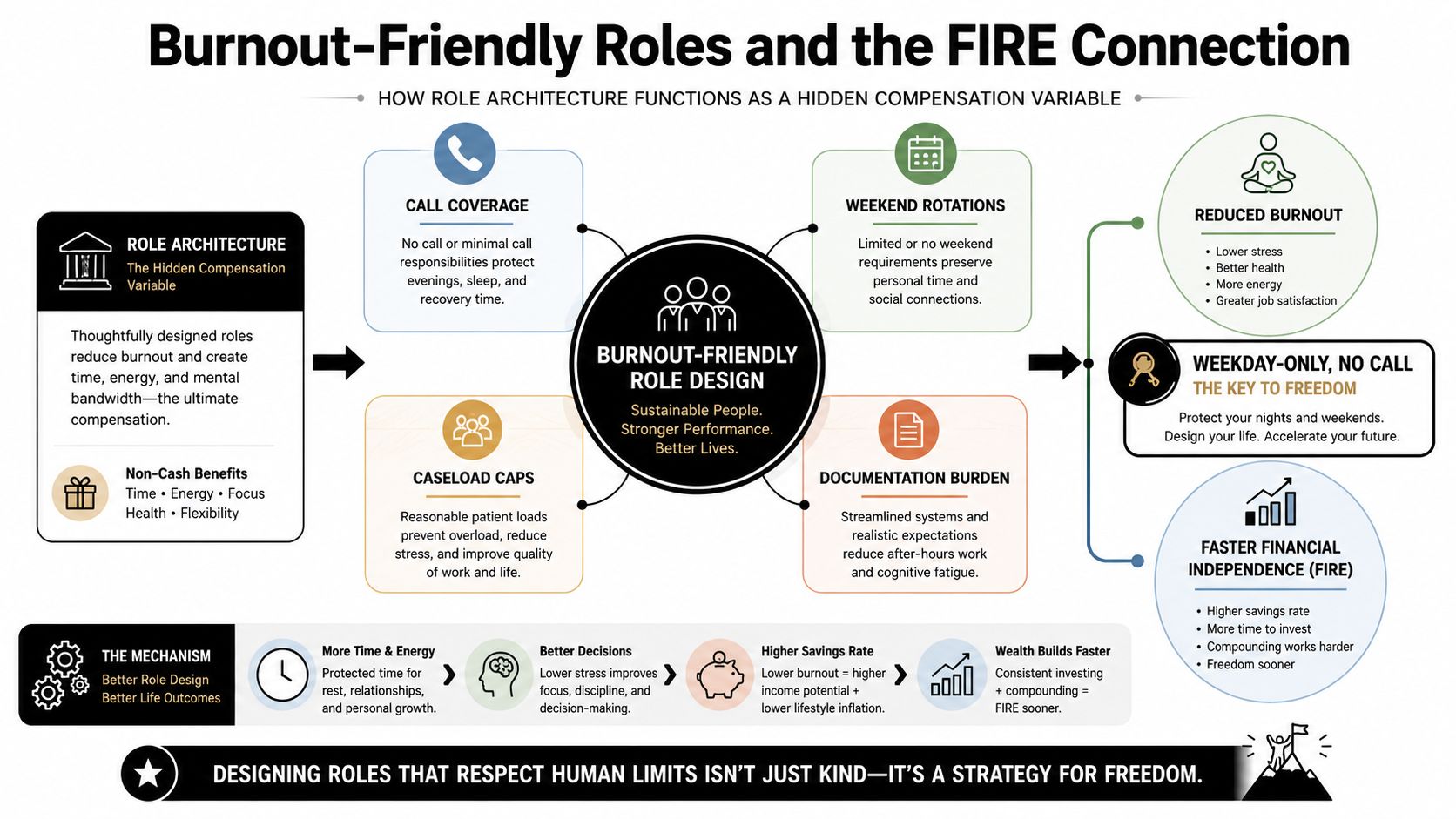
The useful comparison is sustainable earnings versus fragile earnings. Protecting evenings and weekends can support consistent clinical output, preserve recovery time, and lower the chance that a psychologist must interrupt earning years to recover from the job. That schedule value belongs in the opportunity assessment, even when it does not appear in the posted salary.
Evaluating Opportunities With a No Call, No Weekends Lens
A schedule should pass an operational screen before an application takes your time. Terms such as “outpatient,” “flexible,” and “work-life balance” describe intent, not workload. Ask who handles after-hours crises, when documentation is completed, and whether weekend access is optional.
Use three signals:
- No Call: No routine after-hours crisis coverage, pager duty, or expectation to answer urgent messages outside scheduled hours.
- No Weekends: No Saturday, Sunday, or holiday rotation, including coverage labeled “occasional.”
- Burnout-Friendly Score: A combined assessment of caseload limits, protected documentation time, PTO, turnover, supervision, and schedule predictability.
Test each signal against the posting, interview, and current-clinician experience. Job ads may state exclusions or hide them behind vague language. Managers can clarify formal policy and informal expectations. Current clinicians can reveal whether staffing shortages change the schedule in practice.
Verification checklist
- Call policy: Who handles urgent patient issues after hours, and what happens when that person is unavailable?
- Weekend policy: Is coverage required for holidays, crisis programs, inpatient consultation, or message triage?
- Caseload: What is the current average, the expected maximum, and the process for controlling new referrals?
- Documentation: Is note time protected, or must notes be completed after the final appointment?
- Supervision: Does the role provide documented supervision that advances licensure?
- Turnover: Why did the previous clinician leave? Review Glassdoor commentary or APA community discussions as signals, not definitive evidence.
- Compensation formula: Are meetings, cancellations, messages, and care coordination paid?
Ask for the schedule in writing. “Rare call” can become a rotating obligation after a staffing shortage.
Clinicians seeking explicitly screened roles can review No Call psychologist jobs. The purpose is not to accept a label uncritically, but to establish questions for comparing offers. A weekday-only schedule has value when it protects recovery, supports consistent clinical work, and reduces the risk of leaving prematurely. Include that value alongside salary, benefits, and workload when judging whether an opportunity is sustainable.
Negotiation Tactics and a Final Decision Checklist
Negotiation should test whether the advertised role matches its operating conditions. Use the BLS wage distribution as a broad reference point, then adjust expectations for license status, specialty, setting, geography, benefits, and schedule burden. A national median is context, not a personal floor.
Calculate an hourly floor that includes appointments, notes, meetings, commuting, required availability, and unpaid messages. Ask questions that make workload and coverage visible:
- Who handles after-hours crises?
- Are weekends or holidays mandatory?
- What happens when referrals exceed the stated caseload target?
- Is documentation time protected?
- Are cancellations, meetings, and care coordination compensated?
- Does supervision count toward the target state's requirements?
- Is the role W-2 or 1099, and who pays for benefits, liability coverage, credentialing, and continuing education?
Negotiate the terms that protect the schedule
A signing incentive can reflect recruitment difficulty, but it does not correct an unsustainable schedule. Request clear terms for CME funding, qualifying supervision, PTO, retirement contributions, telehealth flexibility, administrative time, and productivity expectations. PSYPACT mobility may improve a remote-first candidate's position when an employer needs coverage across eligible jurisdictions. Verify the compact rules and the employer's credentialing process before treating that mobility as a benefit.
| Signal Category | Lever to Negotiate | Typical Acceptance |
|---|---|---|
| No Call | Written exclusion from after-hours coverage, crisis pager, and message triage | Must be explicit in the offer or policy |
| No Weekends | No Saturday, Sunday, or holiday rotation | Confirm with the hiring manager and current staff |
| Burnout-Friendly Score | Caseload cap, protected notes, PTO, supervision, and turnover transparency | Negotiate as a package, not a single perk |
| Compensation | Base pay, productivity formula, cancellation policy, and benefits | Compare total value, not headline salary |
| Mobility | Telehealth across eligible jurisdictions and credentialing support | Depends on licensure and employer policy |
| Professional development | CME, supervision, assessment training, and conference support | Often easier to secure than base-pay changes |
Model total compensation over three years, including benefits, unpaid labor, expected schedule, licensure support, and the cost of changing jobs. Set a personal threshold for No Call, No Weekends, and a credible Burnout-Friendly Score. A role that fails one signal may still work if compensation, workload controls, and supervision offset the cost. Walk away when coverage demands exceed your sustainable capacity, even if the title or salary is attractive.
WeekdayDoc lists psychologist and clinical psychologist roles with schedule details, salary information, and signals such as No Call and No Weekends. WeekdayDoc can support comparisons based on hours, credential mobility, and longer-term career economics.