A Guide to Careers for Nurse Practitioners
Explore modern careers for nurse practitioners. Find burnout-friendly roles in telehealth and specialty clinics that support a healthy work-life balance.

The world of nurse practitioner careers is no longer confined to the hospital floor. Forget the old script of grueling shifts and unpredictable call schedules. Today, NPs are finding incredible roles in settings that range from fully remote telehealth to specialized outpatient clinics—all designed for a more sustainable, "burnout-friendly" career. This shift gives you the power to align your professional skills with your personal life, not the other way around.
Exploring the Modern Landscape of NP Careers
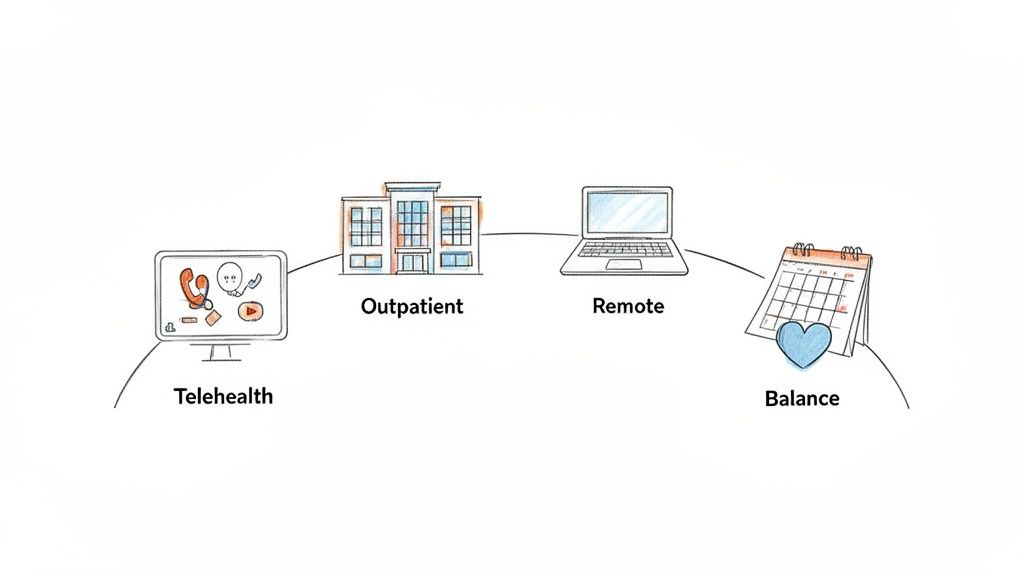
The career path for a nurse practitioner used to feel like a single-lane road. Now, it's more like a sprawling map with countless destinations, offering flexibility and specialization that were once hard to imagine. The explosive demand for advanced practice providers has carved out a wealth of opportunities far from the high-stress, unpredictable grind of inpatient hospital work.
Think of the traditional hospital job as the central hub of a wheel. It’s essential, no doubt, but it often comes with a steep price: relentless on-call duties, weekend shifts, and a pace that practically guarantees burnout. The modern NP landscape, however, looks more like a network of specialized clinics and platforms. Each one—whether it’s a telehealth startup, a dermatology practice, or a corporate wellness center—offers a unique environment built for specific patient needs and, just as importantly, clinician well-being.
A Growing Field of Opportunity
This isn't just a feeling; the numbers back it up. The demand for NPs is absolutely surging, creating a job market overflowing with potential. Between 2010 and 2017, the number of licensed NPs in the U.S. more than doubled. Looking ahead, projections show that NP jobs are set to grow by an incredible 46% between 2023 and 2033, making it the fastest-growing healthcare role out there.
That translates to over 135,000 new positions, cementing the NP as one of the most in-demand professionals in any field. You can dig into the full employment projections to see just how massive this trend is.
This explosive growth completely changes the power dynamic for NPs on the job hunt. With demand far outpacing supply in many areas, you have more leverage than ever to find a role that truly fits your life.
Finding Your Place in the New Ecosystem
This guide is your roadmap to navigating these new opportunities. We’re going to look beyond the conventional hospital track to explore roles that champion work-life balance and long-term career satisfaction. Our focus is squarely on finding sustainable, "burnout-friendly" careers that let you thrive both in and out of the clinic.
You'll discover how to find and land jobs that offer:
- Predictable Schedules: Say goodbye to chaotic shifts and hello to roles with standard business hours.
- No On-Call Duties: Get your evenings back without the constant stress of being on standby.
- No Required Weekends: Protect your weekends for family, rest, and whatever recharges you.
- Specialized Focus: Dive deep into a clinical area you're truly passionate about, from mental health to medical aesthetics.
Ultimately, our goal is to give you the tools and knowledge to build a fulfilling and financially rewarding career that you can sustain for the long haul.
To start, let's break down the most common work models you'll encounter. This table offers a quick comparison to help you see where you might fit best.
At a Glance Comparing Modern Nurse Practitioner Career Paths
| Work Setting | Typical Schedule | Patient Interaction Style | Best For |
|---|---|---|---|
| Outpatient Clinic | Mon-Fri, 9-to-5 | In-person, scheduled appointments | NPs who want direct patient contact, predictable hours, and no call/weekends. |
| Telehealth (Full-Time) | Flexible; often Mon-Fri | Virtual (video/phone), high volume | NPs seeking maximum flexibility, work-from-home, and a tech-focused role. |
| Hybrid Model | 2-3 days in-clinic, 2-3 days remote | Mix of in-person and virtual | NPs who want the best of both worlds: patient connection and remote flexibility. |
| Hospital-Based | Varies; often includes shifts, nights, weekends, on-call | High-acuity, in-person, fast-paced | NPs who thrive in high-stakes environments and prefer inpatient care. |
Each of these paths offers a distinct set of trade-offs. The key is knowing what you value most—is it autonomy, face-to-face interaction, or a clear boundary between work and home? Understanding these differences is the first step toward finding a role that truly works for you.
Why Nurse Practitioner Roles Consistently Rank as Top Jobs
When a career path keeps showing up at the top of every "best jobs" list, you have to ask what’s behind the hype. For nurse practitioners, it’s not just one thing. It's a powerful mix of professional autonomy, soaring demand, serious earning potential, and a deep sense of purpose.
That unique blend makes being an NP more than just a job—it’s a strategic move toward a well-rounded, fulfilling life. The accolades are impossible to miss, and this isn't some fleeting trend. It's a direct reflection of a profession that truly delivers.
The Data Behind the Recognition
Heavy hitters like U.S. News & World Report have consistently put the NP role in the spotlight. It's grabbed the No. 1 spot for Best Job, Best Health Care Job, and Best STEM Job, and was even named the single best job in America for 2025. These rankings aren’t arbitrary; they’re based on hard data for salary, job satisfaction, and future growth—all areas where NPs are crushing it.
The numbers tell the real story. In May 2023, the median annual salary for advanced practice nurses, including NPs, was around $129,480. Even better, the Bureau of Labor Statistics projects a jaw-dropping 38% job growth for NPs between 2022 and 2032. That's a rate they classify as "much faster than average."
This creates a rock-solid job market where your skills aren't just needed; they're in high demand. You can dig into more details about why NPs are a top-ranked profession on aanp.org.
A high salary paired with rapid job growth creates an incredibly powerful foundation. For an NP, this isn’t just about making a comfortable living—it’s about having the financial stability and career options to build a life on your own terms.
This potent combination of high pay and massive opportunity is what makes the NP role a perfect vehicle for hitting ambitious financial goals.
A Strategic Path to Financial Independence
Look past the impressive salary figures for a moment, and you'll see an even bigger opportunity: the path to Financial Independence, Retire Early (FIRE). The whole idea behind the FIRE movement is to build enough wealth to live off your investments, giving you the freedom to work because you want to, not because you have to.
Your NP salary isn't just income; it's a powerful wealth-building tool. A high savings rate, which is much more achievable with a strong NP salary, can shave years—or even decades—off your timeline to financial independence. For instance, an NP making $130,000 who manages to save 30% of their income is on a completely different trajectory than someone in a field with lower earning potential.
This is where getting strategic pays off. By consciously choosing jobs in lower-cost-of-living states or leveraging high-paying specialties, you can seriously accelerate your progress. A few smart moves include:
- Maximizing Retirement Accounts: The baseline move. Fully funding your 401(k) or 403(b) is non-negotiable.
- Exploring Locum Tenens: These short-term, high-paying gigs can give your income a massive short-term boost.
- Choosing Tax-Advantaged States: Living in a state with no income tax can literally add thousands of dollars back into your savings account each year.
Using Tools to Map Your Financial Future
Visualizing this journey is easier than you think. Tools like a Salary & FIRE Calculator can turn abstract financial goals into a concrete, actionable plan. You just plug in your salary, savings rate, and target retirement age, and you can instantly see how different career choices affect your long-term wealth.
You could, for example, compare how a $140,000 outpatient psychiatry role in Texas (a no-income-tax state) speeds up your FIRE timeline versus a $125,000 job in a high-tax state. These calculators empower you to make data-driven decisions, turning your career into a deliberate strategy for achieving both professional fulfillment and lasting financial freedom. The consistent high ranking of NP roles isn’t just about job security; it’s about the life it allows you to design.
Finding Your Niche in Burnout-Friendly Specialties
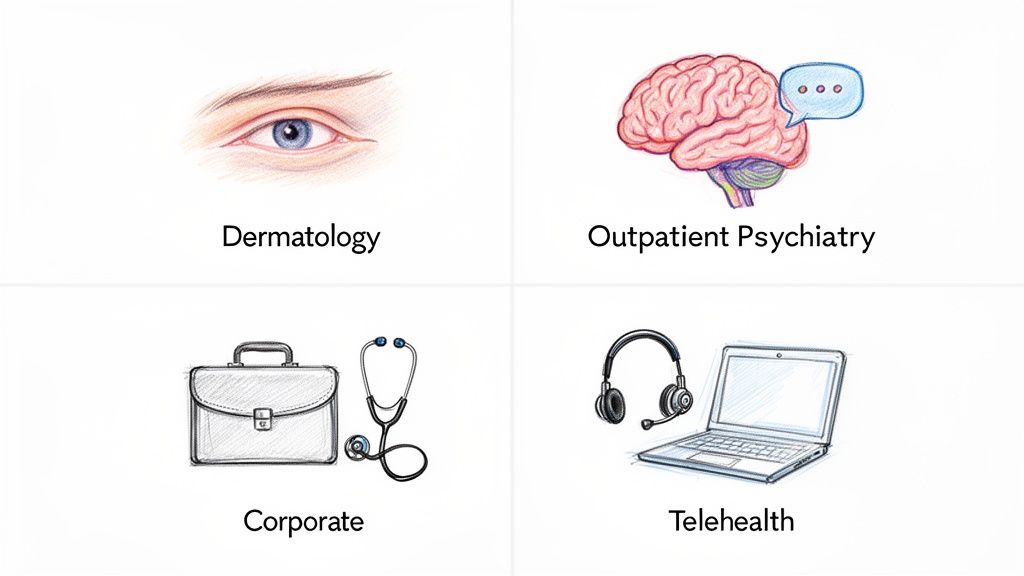
Let's be honest: not all NP careers are created equal. Some specialties throw you into high-stakes, unpredictable environments day after day. But a growing number of fields offer a structured, sustainable pace that actively prevents burnout. These niches prove you can build a deeply satisfying clinical career without sacrificing your own well-being.
Think of choosing your specialty like picking the right tool for the job. You wouldn't use a sledgehammer for delicate work. If your goal is a long, happy career, you need a role that’s actually designed for it. The trick is finding a clinical area where patient needs align with predictable schedules, lower acuity cases, and a hard stop at the end of the day.
This means zeroing in on specialties where true emergencies are rare, appointments are scheduled weeks in advance, and on-call duties are a thing of the past. Let's dig into a few of these burnout-friendly paths.
Dermatology: A Focus on Procedures and Predictability
Dermatology is a classic example of a burnout-resistant field. The work is a fantastic blend of medical, surgical, and cosmetic care, but it almost always happens in a controlled outpatient clinic. Your days are built around a pre-set schedule of appointments, which completely sidesteps the chaos of an ED or inpatient floor.
A typical day for a dermatology NP might involve:
- Patient Consultations: Diagnosing and managing common conditions like acne, eczema, and psoriasis.
- Minor Procedures: Performing routine skin biopsies, cryotherapy, and excisions of benign lesions.
- Cancer Screenings: Conducting thorough skin checks—a vital and incredibly rewarding part of the job.
Because of how the work is structured, your schedule is rock-solid. Patients book their visits in advance and procedures are planned, creating a stable Monday-to-Friday workflow. You can finally say goodbye to the stress of weekend or evening shifts.
Outpatient Psychiatry: Bridging the Mental Health Gap
The demand for mental health care is staggering, and outpatient psychiatry is a powerful way for NPs to make a real difference in a structured setting. Unlike inpatient psych units, the outpatient world runs on scheduled therapy sessions and medication management appointments.
This setup allows you to build genuine, long-term relationships with patients as you guide them through their mental health journeys. The work—diagnostic evaluations, prescribing and managing meds, providing supportive therapy—is deeply meaningful. But it's also contained within standard business hours, allowing you to fully log off and recharge when you head home.
Choosing a specialty like outpatient psychiatry or dermatology isn't about dodging challenges. It’s about picking challenges that are manageable and predictable. It’s a strategic move to control your work environment instead of letting it control you.
Corporate Wellness and Specialized Telehealth
Beyond the traditional clinic walls, new models of care are popping up that are practically tailor-made for NPs seeking balance. These roles use your clinical expertise in unique, low-stress environments.
- Corporate Wellness: Many large companies now hire NPs to run on-site clinics, offering employees easy access to primary care, health coaching, and wellness screenings. It’s the definition of a 9-to-5 job, where your patient panel is literally the company's workforce.
- Specialized Telehealth: Virtual care has blown the doors open for niche services perfect for remote work. Imagine specializing in asynchronous dermatology (reviewing patient photos on your own time) or providing virtual consults for specific conditions like migraines or allergies. These roles offer incredible flexibility and control over your schedule.
Understanding your own tolerance for stress is the first step to finding the right path. To get a better sense of where you stand, you can use tools like the WeekdayDoc Burnout Index to assess your current risk and pinpoint the factors that matter most for your long-term sanity. By matching your clinical interests with a work model that actually supports your mental health, you can design a career that’s both impactful and sustainable for years to come.
The Rise of Outpatient and Telehealth Opportunities
Healthcare is making a fundamental move away from the old-school, hospital-centric model. The future is a more spread-out, accessible network of care, and nurse practitioners are perfectly positioned to lead the charge in the booming outpatient and telehealth sectors.
Think of the traditional healthcare system as a single, giant mainframe computer—the hospital. Everything ran through one central hub. It was powerful, sure, but also slow, expensive, and often a pain for patients to access. Today, that system is breaking apart into something that looks more like the internet: a distributed network of smaller, nimbler nodes. Outpatient clinics and telehealth platforms are those nodes, bringing care directly to people where they live.
This isn't just a fleeting trend. It’s a deep, structural shift driven by the soaring demand for care that’s both affordable and convenient. For NPs, this new landscape is creating sustainable, rewarding careers for nurse practitioners that simply didn't exist a decade ago.
Why Outpatient and Telehealth Are Perfect for NPs
This migration to outpatient and virtual care is happening for one big reason: the growing physician shortage has created massive gaps in patient access, especially in primary care. Health systems and digital health startups are looking to nurse practitioners to fill that void.
The numbers tell the story. While the employment of primary care physicians stayed relatively flat between 2012 and 2022, the NP workforce grew dramatically. With a projected shortfall of up to 48,000 primary care physicians by 2034, NPs are no longer just supporting the system—they are the system. You can dig into more of the data on the NP job outlook and its drivers on purdueglobal.edu.
This shift means NPs can finally work at the absolute top of their license. You’re not just an extra set of hands; you’re leading care teams and managing your own patient panels with real autonomy. Your skills are central to the entire model.
Beyond the clinical autonomy, this new ecosystem offers some serious operational perks that make these roles sustainable and a godsend for NPs desperate for better work-life balance.
- Structured Schedules: Most of these jobs run on standard business hours. No more night shifts, no more chaotic on-call schedules.
- Predictable Workflows: Patient visits are almost always scheduled appointments, which means you can control the pace of your day.
- Less Admin Crap: Modern clinics and telehealth platforms are built on streamlined tech for charting and communication, slashing the time you spend on bureaucratic nonsense.
The Telehealth Explosion
The explosion in virtual care has completely rewritten the rules for what a clinical career can be. For nurse practitioners, telehealth unlocks a level of flexibility that was once unthinkable. You're no longer chained to a single clinic in a single city—you have access to a national job market.
This virtual-first model is a natural fit for a huge range of specialties, from mental health and dermatology to urgent care and chronic disease management. For NPs who are serious about integrating their work and life, exploring the different remote nurse practitioner jobs can be a total game-changer.
Whether it’s in a bustling specialty clinic or from a home office, these new environments are where healthcare is headed. They give NPs a real shot at building a career that’s not just professionally fulfilling but personally sustainable for the long run.
How to Find and Evaluate Burnout-Friendly NP Jobs
Knowing a world of sustainable careers for nurse practitioners exists is one thing. Actually finding and landing one of those jobs? That’s the real challenge. It takes a completely different strategy—one that swaps endless scrolling on massive job boards for a targeted, investigative approach.
Think of it less like a job hunt and more like a culture audit. You’re not just looking for a vacancy; you’re searching for concrete evidence of a healthy work environment, firm boundaries, and genuine respect for your time. It’s about learning to spot the green flags that signal a great fit and the red flags that are just burnout waiting to happen.
This decision tree can help you map out that first crucial choice many NPs face when they decide to step away from the grind of traditional clinical roles.
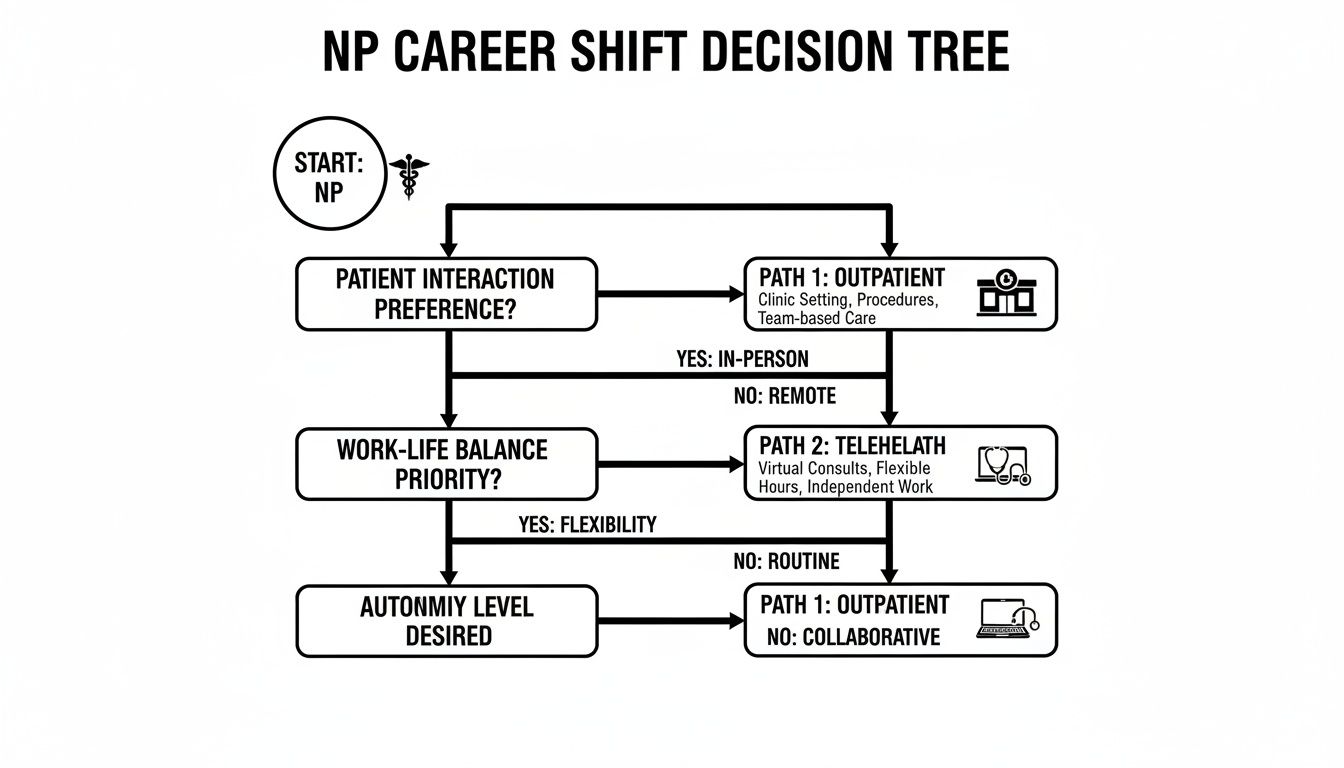
As you can see, two main paths immediately offer a significant break from high-stress, inpatient settings: outpatient clinics and telehealth.
Using Specialized Platforms for a Smarter Search
Searching for a burnout-proof job on a huge, generic site is like trying to find a needle in a haystack—if the haystack were also on fire. You'll waste countless hours sifting through listings for inpatient gigs with the same grueling schedules you're trying to escape. The solution is to go where the good jobs are: platforms built specifically for clinicians who value their well-being.
Sites like WeekdayDoc are designed to cut through the noise. They let you filter for the exact criteria that define a sustainable career.
- Filter for "No Call" and "No Weekends": This is your non-negotiable first step. It instantly weeds out jobs that are designed to bleed into your personal life.
- Look for Clear Work Models: Hone in on terms like "outpatient," "telehealth," or "remote" to find roles in settings known for saner schedules.
- Use Objective Scoring: Some platforms offer a "Burnout-Friendly Score" for each job, giving you an at-a-glance signal of a role’s sustainability before you even click.
This focused strategy saves you a massive amount of time and energy. It also ensures every role you seriously consider has already met a baseline standard for work-life balance. This is especially helpful when looking into the many part-time nurse practitioner jobs that offer even greater flexibility.
Reading Between the Lines of a Job Description
A job description is part marketing pitch, part treasure map. It’s full of clues about the company culture and what they really expect from you. Learning to decode these documents is a crucial skill.
Green Flags to Look For:
- Specific Hours Mentioned: Language like "Monday–Friday, 9 AM to 5 PM" is a fantastic sign of predictability.
- Emphasis on Team Collaboration: Talk of a "supportive team" or "collaborative environment" often points to a culture that doesn’t leave its clinicians isolated.
- Focus on Patient Outcomes: A description centered on quality of care over patient volume is a huge positive.
Red Flags to Avoid:
- Vague Schedule Information: Phrases like "flexible schedule" or "varied hours" can be code for "your schedule is whatever we need it to be."
- Overemphasis on "Fast-Paced Environment": This is often a euphemism for being perpetually understaffed and overworked.
- "Wearing Many Hats": This is a classic warning that the role is poorly defined and you’ll be doing the work of three people for the price of one.
Asking the Right Questions in an Interview
Once you’ve made it to the interview, the tables turn. Now it's your chance to evaluate them. This is where you dig in and confirm if the job is as good on the inside as it looked on paper.
Your interview is a two-way street. You are interviewing them just as much as they are interviewing you. Don't be afraid to ask direct, insightful questions to protect your future well-being.
Show up with a list of questions designed to get past the polished answers and uncover the daily reality of the role.
Essential Interview Questions to Ask:
- "What is the expected patient load per day for an NP in this role?"
- "Can you describe the on-call and weekend coverage policy, if any exists?"
- "How does the organization actively support clinicians in preventing burnout?"
- "What does a typical daily schedule look like from start to finish?"
- "What has the turnover rate for NPs been in this department over the last two years?"
Their answers—and just as importantly, their tone and willingness to answer—will tell you everything. An employer genuinely committed to a healthy work culture will welcome these questions with transparent, confident responses. One who gets defensive or offers vague platitudes is waving a giant red flag.
Combine a targeted search with sharp evaluation skills, and you can confidently find an NP role that doesn't force you to choose between your career and your life.
Building a Career That Lasts—Beyond the Bedside
Your career as a nurse practitioner is a marathon, not a sprint. The real goal is building a professional life that feels just as rewarding on year fifteen as it did on day one.
This means looking past the traditional, often grueling, path and getting strategic about your future. Today’s landscape of careers for nurse practitioners gives you more power than ever to do just that.
You can actually design a career that fits your life, instead of forcing your life to fit your career. Real success isn't just about being a great clinician; it's a careful mix of professional satisfaction, personal well-being, and long-term financial freedom. It’s about finding a role in outpatient psychiatry, dermatology, or telehealth that fuels your passion without burning you out.
How to Design Your Future, Intentionally
This requires a different mindset. Instead of just taking the first job that comes along, you can use specialized tools and smarter search strategies to find roles that meet your exact needs. By actively filtering for positions with no on-call duties or no required weekends, you reclaim your schedule and protect your most valuable asset: your time.
True career sustainability comes from making intentional choices. It’s about using your high-value skills to land a role that respects your boundaries and supports your long-term goals—both inside and outside the clinic.
Think of your career less like a fixed path and more like a dynamic asset you're actively managing. Every choice you make—from the specialty you pick to the work environment you choose—is an investment in your future self. For instance, plugging a job offer into a Salary & FIRE Calculator can turn a simple number into a clear roadmap for your financial independence.
This is the new reality for nurse practitioners. The high demand for your expertise gives you the leverage to find employers who actually care about a healthy work culture. By asking the right questions and looking at opportunities with a critical eye, you can build a fulfilling, sustainable career that serves you for decades.
The opportunities are out there. You just need the right map to find them.
Your Top Questions About NP Careers, Answered
As you map out your career as a nurse practitioner, a lot of questions come up. Whether you're just starting or you're a veteran NP looking for a better way to work, getting straight answers is key to building a career that actually fits your life.
Let's cut through the noise and tackle the most common questions NPs have about finding the right path.
What Is the Fastest Growing NP Specialty?
While the whole field is booming, the demand for Psychiatric Mental Health Nurse Practitioners (PMHNPs) is off the charts. There’s a massive nationwide shortage of mental health providers, creating a huge need for NPs who can handle diagnostics, therapy, and medication management—especially in outpatient and telehealth settings.
What’s great about this specialty is that it naturally aligns with a more balanced work model. The vast majority of PMHNP jobs are in scheduled, outpatient clinics. That means predictable hours and no on-call are pretty much the standard, not the exception.
Can a Nurse Practitioner Specialize in Dermatology?
Absolutely. Dermatology is a fantastic and rewarding specialty for NPs. It offers a great mix of medical, cosmetic, and procedural work, all within a controlled, outpatient environment. If you're looking for a career with a predictable schedule—without the constant high-stress emergencies of other fields—this is a path worth exploring.
Breaking into dermatology as an NP usually involves a few key steps:
- First, become a board-certified NP, typically as a Family Nurse Practitioner (FNP).
- Next, get real-world clinical experience in a dermatology practice, either as an RN or an NP.
- Finally, consider extra training or a post-master’s certificate to really hone your skills.
This path sets you up for a career built around procedures, patient education, and long-term relationships, all while sticking to a standard Monday-to-Friday workweek.
What Are the Highest Paying Nurse Practitioner Careers?
Money isn't everything, but it definitely matters. While your salary will always depend on your location and years of experience, some of the top-paying NP roles are in specialties that require a specific skillset or are in critically short supply.
The highest-paid nurse practitioners often blend procedural skills with high patient demand. You'll find that specialties like cardiology, dermatology, and emergency medicine frequently pull in top-tier salaries, often pushing past $150,000 a year in major cities.
It's also worth noting that nurse anesthetists (CRNAs), who are also Advanced Practice Registered Nurses (APRNs), consistently rank among the highest earners in the entire nursing profession. Choosing a high-paying specialty can be a powerful move for your financial health, especially if you're aiming for something like Financial Independence, Retire Early (FIRE).
How Can I Find a Job With No On-Call or Weekend Requirements?
Finding a job that respects your time off means you have to get strategic. Forget endlessly scrolling through generic job boards; you need to focus on platforms built for clinicians who are serious about work-life balance.
The most direct route is to use search filters for "No Call" and "No Weekends." This immediately cuts out the roles that don't fit what you’re looking for. Also, keep an eye out for keywords in the job description like "outpatient," "telehealth," "remote," and "clinic hours"—these are all good signs. And when you get to the interview, don't be shy. Ask direct questions about on-call duties and scheduling expectations.
Ready to find a role that fits your life? WeekdayDoc curates the best burnout-friendly jobs, so you can stop searching and start thriving. Explore verified opportunities with no call and no weekends at https://www.weekdaydoc.com.