What Is Tail Coverage Malpractice Insurance for Clinicians
Learn what is tail coverage malpractice insurance, when you need it, and how to negotiate it. A clinician's guide to protecting your career during job changes.
Of all the confusing parts of a physician's employment contract, malpractice insurance is easily the most misunderstood—and the most dangerous if you get it wrong.
Specifically, we need to talk about tail coverage. Getting this one detail right can be the difference between a secure financial future and a career-ending lawsuit years after you’ve left a job.
What Is Tail Coverage in Simple Terms?
Think of tail coverage as an extended warranty for your clinical work. It’s a special insurance rider that protects you from malpractice claims filed after you’ve already left an employer or practice.
It doesn't cover new mistakes. Instead, it covers incidents that happened while you were employed and insured, but the claim itself wasn't filed until much later. This is a critical shield for your personal assets.
This protection is only necessary when you have a “claims-made” malpractice policy, which is the most common type of insurance employers provide.
Why This Dangerous Coverage Gap Exists
A claims-made policy is like a gym membership. It only works if your membership is active when you use the gym. For this insurance, that means two things must be true for you to be covered:
- The incident must have happened while your policy was active.
- The claim must be filed while your policy is still active.
The moment you leave your job, retire, or switch insurance providers, that "membership" is canceled. Your protection for all your past work vanishes. A claim filed the day after you leave for an appointment you had last year is now your personal financial problem.
A physician retires after a 30-year career, only to be hit with a lawsuit two years later for a complication from a procedure performed back in 2015. Without tail coverage, they face footing the bill for all legal defense costs and any potential settlement—a sum that can easily soar into hundreds of thousands of dollars.
This isn’t a rare scenario. Industry data shows that claims-made policies are used by 70-80% of U.S. physicians. This makes understanding what tail coverage is a non-negotiable part of managing your career.
You can learn more about why tail coverage is essential for protecting yourself from devastating late-filed claims. It’s the single most important safety net between your professional past and your financial future.
Before we dive deeper, it helps to see how these policies stack up.
Quick Guide to Malpractice Policy Types
This table breaks down the fundamental differences between the three main malpractice insurance concepts to provide immediate clarity.
| Policy Type | How It Works | Do I Need Tail Coverage? |
|---|---|---|
| Claims-Made | Covers you only if the policy is active when the incident occurs AND when the claim is filed. | Yes. You need tail to cover claims filed after you leave. |
| Occurrence | Covers any incident that happened during the policy period, regardless of when the claim is filed. | No. The original policy protects you forever for that time period. |
| Tail Coverage | An add-on to a claims-made policy that extends the reporting period for claims after you leave. | This is the solution. It closes the gap left by a claims-made policy. |
As you can see, the risk is tied directly to which type of policy you have. While an "occurrence" policy is simpler and doesn't require tail, it's also more expensive and far less common. For most clinicians, navigating the world of claims-made insurance is the reality.
Claims-Made vs. Occurrence Policies: What's the Real Difference?
To really get what tail coverage is and why it matters so much, we first have to break down the two main types of professional liability policies. Honestly, their differences are the entire reason tail coverage even exists.
An occurrence policy is the more straightforward of the two. Think of it as buying permanent protection for a specific slice of time. It covers any incident that happened while your policy was active, no matter when the claim gets filed—even if it's years after you've retired. It's the "set-it-and-forget-it" option.
A claims-made policy, on the other hand, works more like a subscription. It only covers you if both the incident and the claim happen while the policy is active. The second that policy lapses, your protection for all your past work evaporates, leaving a massive, dangerous gap in your coverage.
This is where tail coverage comes in, acting as the critical bridge when you leave a job with a claims-made policy.
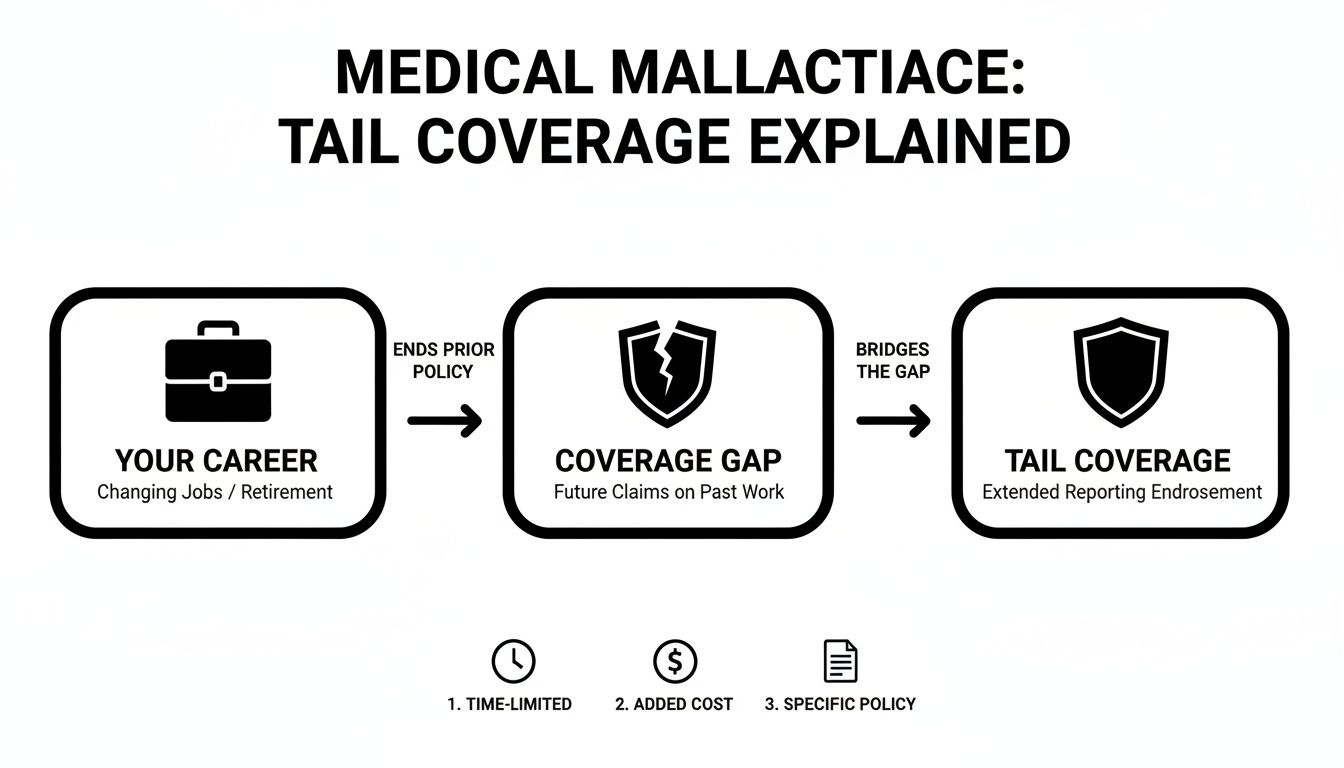
As you can see, tail is the essential safety net that restores your protection for past work after your main claims-made policy is gone.
The Financial Trade-Off
So, why would anyone sign up for a claims-made policy if it creates this huge liability down the road?
It all comes down to cost. Claims-made policies have much lower initial premiums—often by 30-40%—because the insurance company's risk is confined to the active policy term. Occurrence policies, which saddle the insurer with a lifelong risk, are way more expensive upfront.
What this really means is that while you save money year to year, you're slowly building up a future financial obligation. This difference becomes even more critical when you consider the legal deadlines for filing a lawsuit, known as the medical malpractice statute of limitations. These deadlines can stretch for years, long after your claims-made policy has expired.
The Bottom Line: A claims-made policy is cheaper now because it kicks a huge cost—the price of tail coverage—down the road. An occurrence policy makes you pre-pay for that lifetime protection through higher annual premiums.
What This Means for You in the Real World
This isn't just insurance jargon; it has massive, real-world consequences for clinicians. Around 90% of private practices use claims-made policies to keep their overhead low. That means the vast majority of employed physicians, PAs, and NPs will eventually have to deal with buying tail coverage.
Failing to secure it when you change jobs or retire can be financially devastating. With defense costs for malpractice suits averaging $120,000 before a verdict is even reached, going without coverage is a risk no one can afford to take. Your personal assets—your home, your savings, your future—are all on the line.
The entire point of tail coverage is to close this exact gap, shielding you from claims tied to work you did years ago.
When Do You Absolutely Need Tail Coverage
Understanding tail coverage becomes non-negotiable at a few key moments in your career. While your claims-made policy is active, you're covered. The real risk emerges the second that policy ends, creating a dangerous gap that leaves all your past patient care exposed.
Think of it as a tripwire. Certain career changes—leaving a job, retiring, switching practices—are predictable events. Crossing one without a plan for tail coverage means you are personally on the hook for claims filed for patients you treated months or even years ago.
Common Career Triggers for Tail Coverage
Any time your current claims-made policy is terminated—and your next insurer doesn't pick up your "prior acts"—you absolutely must get your own tail coverage. This happens in a few common situations:
- Leaving a Job: The moment you resign from a medical group or hospital, your employer's malpractice policy for you is canceled.
- Retiring from Medicine: When you hang up your white coat for good, your active policy ends. Without tail, your entire career's worth of work is vulnerable to future claims.
- Switching Insurance Carriers: If your practice changes its insurance provider and the new policy lacks "nose" coverage for your past work, you need tail to bridge the gap.
- Moving to Part-Time Work: Scaling back your hours can sometimes mean changing employers or policy status, triggering the need for tail on your previous full-time coverage.
Key Insight: The common thread here is the termination of a claims-made policy. The reason it ends doesn't matter. Whether you're moving on to a better opportunity, retiring, or your practice changes insurers, the coverage gap is created all the same. Tail is the only thing that closes it.
Real-World Scenarios and Your Risk
Let's walk through how this plays out for different clinicians.
Scenario 1: The Physician Changing Jobs Dr. Evans, a pediatrician, is leaving her private practice to join a large hospital system. The private practice had her on a claims-made policy. Her new hospital job is self-insured and, critically, will not cover her "prior acts" from the old practice.
If a malpractice claim is filed next year related to a patient she saw at her old job, she would be completely unprotected without tail coverage. The new employer's policy won't help, and the old one is gone.
Scenario 2: The Nurse Practitioner Retiring An NP who has spent 25 years at an outpatient clinic decides to retire. Her employer's claims-made policy will be canceled on her last day. To protect her personal savings and retirement assets from a potential lawsuit, buying a tail policy is essential.
This is a critical step for any clinician planning for retirement or looking into more flexible work, like locum tenens physician jobs, which come with their own unique malpractice considerations.
How Much Does Tail Coverage Cost and Who Pays
Let's talk about the price tag. For many clinicians changing jobs, the cost of tail coverage comes as a huge shock. This isn't a small administrative fee—it’s a major one-time investment in your future financial security.
Knowing the cost and who's expected to pay is non-negotiable when you're evaluating a job offer or planning your next career move.
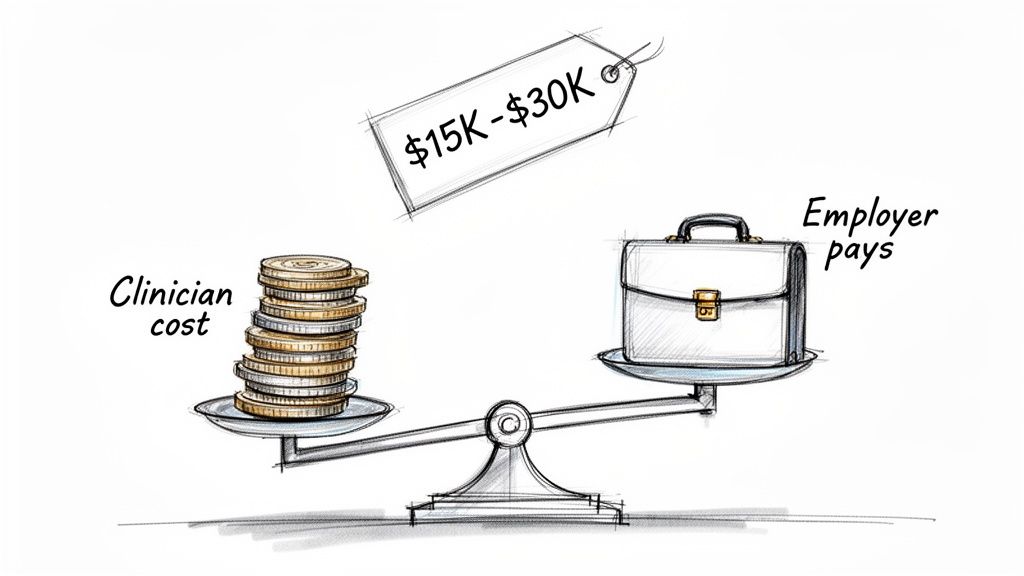
As a rule of thumb, expect your tail coverage policy to cost between 150% and 300% of your final annual premium. This is paid as a single, lump-sum amount.
For example, if your annual malpractice premium was $10,000, you’re likely looking at a tail coverage quote between $15,000 and $30,000. This one-time payment buys you that critical extended reporting period, protecting you from any claims filed down the road for care you provided under the old policy.
The Standard Cost Formula
So, why the wide price range? Insurance carriers don't just pull a number out of thin air. They calculate your specific quote based on a few key risk factors:
- Your Specialty: High-risk fields like surgery or obstetrics come with higher annual premiums, which means the tail policy will also be more expensive.
- Years of Coverage: The longer you worked at the practice under the claims-made policy, the larger the window of potential "prior acts." This increases the insurer's potential risk and, in turn, your cost.
- Your Claims History: A clean record helps. A history of malpractice claims, on the other hand, can drive up the price of your tail coverage.
- State Regulations: The legal landscape in your state, particularly the statute of limitations for malpractice, also plays a significant role in the calculation.
The numbers can be eye-opening. Some data shows tail premiums reaching 200-300% of the expiring annual rate. A primary care physician with a $20,000 annual premium might get a tail bill for $40,000 to $60,000. Neurosurgeons could see quotes north of $300,000.
However, some insurers offer valuable perks. Certain carriers, for instance, will provide free lifetime tail coverage to clinicians who stay with them for a set period (like 10 years) and then retire. You can discover more insights about these carrier policies on MAG Mutual to see how they factor into long-term financial planning.
Who Is Responsible for Paying
This is the million-dollar question, and the answer is almost always buried in the fine print of your employment contract. Figuring out who foots this bill is one of the most important negotiation points you'll face.
It typically breaks down into one of three scenarios:
- The Employer Pays: This is the ideal outcome. Many employers, especially larger hospital systems, will cover the cost of tail as a retention tool, often after you've worked there for two to five years.
- The Clinician Pays: Unfortunately, this is the most common arrangement. If your contract says you're on the hook for tail, you need to be financially prepared to pay the entire sum out of pocket when you leave.
- The Cost is Shared: Some contracts use a vesting schedule. For example, an employer might agree to pay 50% of the tail cost after two years of service, 75% after three, and 100% after four years.
The bottom line is simple: you have to understand this financial obligation before you sign an employment agreement. Getting this clear from day one gives you the power to negotiate better terms and avoid a massive, unexpected bill when it's time to pursue your next opportunity.
Negotiating Tail Coverage in Your Employment Contract
Let's be blunt: who pays for tail coverage is one of the most critical—and potentially costly—details in your employment contract. Thinking of it as a non-negotiable term is a huge mistake.
You need to view employer-paid tail coverage as a core part of your compensation package, right alongside your salary and PTO.
The absolute worst time to figure out who's responsible for this six-figure expense is when you’re handing in your resignation. The best time? Before you ever sign on the dotted line. This simple shift in timing turns a massive potential liability into a negotiated benefit that protects you from day one.
Proactive Negotiation Strategies
When an offer with a claims-made policy lands in your inbox, your negotiation leverage is at its peak. Don't just accept the default assumption that you'll be footing the bill. It's time to get creative and propose arrangements that protect your financial future.
Here are a few powerful tactics that actually work:
- Tie it to your tenure: Propose a clause where the employer agrees to cover 100% of the tail cost if you stay for a set period, like two or three years. It’s a fair trade for your commitment.
- Create a vesting schedule: Suggest a shared-cost model that rewards loyalty over time. For example, the employer pays 50% of the cost after two years, 75% after three, and 100% after four.
- Cover specific termination scenarios: At a minimum, get it in writing that the employer will cover tail if they terminate your contract without cause. This protects you from being fired and then handed a massive bill.
By framing your request around loyalty and a reasonable service commitment, you position employer-paid tail as a smart retention tool, not just another expense for them. This approach dramatically improves your odds of getting a "yes."
Spotting Contractual Red Flags
A good contract should feel balanced, protecting both you and the employer. But some agreements are written to push all the risk onto the clinician. When you're reviewing the professional liability section, be on high alert for vague or completely one-sided language.
Keep an eye out for these classic red-flag phrases:
- "Clinician is solely responsible for all costs associated with an extended reporting endorsement."
- "Upon termination for any reason, the clinician will purchase tail coverage."
- "Maintenance of tail coverage is required for a period of no less than the state's statute of limitations."
If you see language like this, it’s a clear signal to negotiate—firmly. An experienced set of eyes can make all the difference here. Tools like a physician contract scanner can quickly flag these problematic clauses for you.
Securing a fair deal on tail coverage isn't just about money; it’s a masterclass in advocating for yourself and building a financially secure career.
A Step-by-Step Guide to Securing Your Tail Coverage
Once you’ve given notice at a job with a claims-made policy, the clock starts ticking. Protecting yourself from past clinical work is now your responsibility, and the process is extremely time-sensitive. Acting decisively is the only way to avoid a dangerous—and potentially career-ending—gap in your liability coverage.
This process might feel overwhelming, but it doesn't have to be. Following a clear plan ensures you can transition to your next career chapter without leaving your past work exposed to future claims.
Your Action Plan for Obtaining Coverage
Think of this as your essential checklist from the moment you decide to leave. Missing a single step can have massive financial consequences down the road.
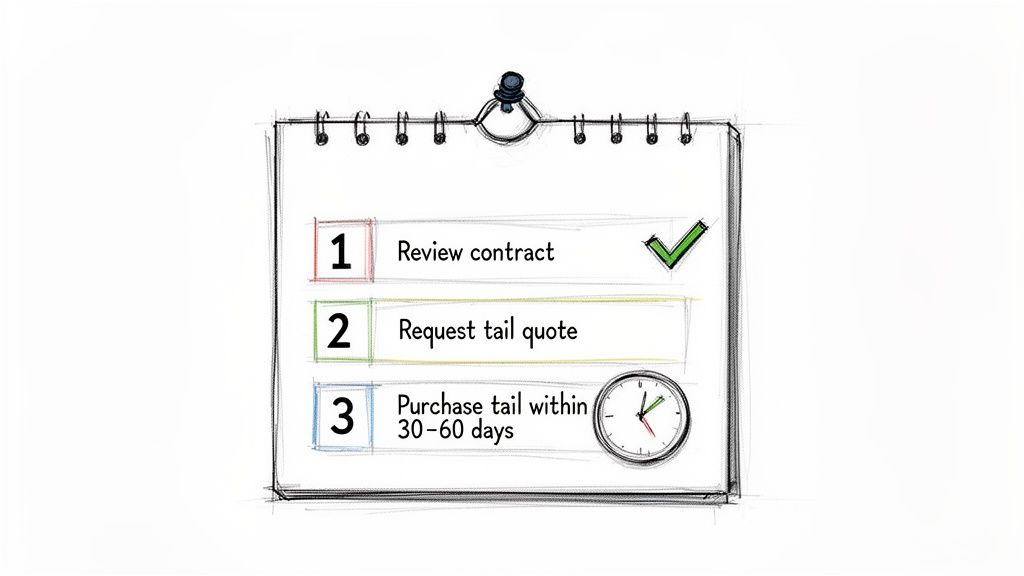
Review Your Employment Contract Immediately: Before you do anything else, pull out your employment agreement. You need to locate the sections on termination and professional liability to confirm who is on the hook for the cost of tail coverage—you or your employer.
Notify Your Insurance Carrier: As soon as you submit your resignation, contact the malpractice insurance carrier. Let them know your final day of employment and formally request a quote for an "extended reporting endorsement," which is the official term for tail coverage.
Act Within the Purchase Window: This is the most critical step. Insurers give you a very strict, non-negotiable window to buy your tail policy—often just 30 to 60 days after your last day. If you miss this deadline, the offer is almost always gone for good.
You cannot afford to procrastinate on this. The purchase window is non-negotiable for nearly every carrier. Set multiple calendar reminders and treat this deadline with the urgency it deserves.
- Evaluate the Quote and Secure Your Policy: When the quote arrives, review it carefully. Make sure the coverage limits and the policy duration align with your specialty’s risk profile and the statute of limitations for malpractice in your state. Once you’ve confirmed the details, complete the purchase to lock in your protection.
Following these steps methodically demystifies what can otherwise feel like a bureaucratic nightmare. For a deeper dive into other career transition topics, check out the other clinician-focused articles in our guides for physicians.
Your Top Questions About Tail Coverage, Answered
Let's be honest, malpractice insurance can feel like a maze of legalese. When it comes to tail coverage, a few key questions always come up during a career transition.
Here are the straight answers you need to protect yourself.
How Long Do I Have to Buy Tail Coverage?
This is critical: you have a very small, non-negotiable window to act. Most insurance carriers give you just 30 to 60 days after your claims-made policy ends to purchase a tail policy.
Miss that deadline, and the offer is almost always gone for good. This can leave you with a permanent and unfixable gap in your liability protection.
What Happens if I Don’t Buy Tail Coverage?
Skipping tail coverage is a massive financial gamble. It means you are personally on the hook for the entire cost of any malpractice claim filed against you for care you provided at your old job.
This includes every dollar of legal defense, settlements, and court judgments. These costs can easily climb into the hundreds of thousands of dollars, putting your personal assets—your home, your savings, your future—directly at risk.
The decision to skip tail coverage is a gamble against your entire financial future. With defense costs alone averaging well over $100,000, it's a risk almost never worth taking.
What Is the Difference Between Tail and Nose Coverage?
Both cover gaps when you switch jobs, but they work from opposite ends of your employment timeline.
Tail Coverage: Think of it as looking backward. It extends the reporting window on your old policy, covering you for claims filed after you’ve already left.
Nose Coverage: This looks forward from the past. It's an add-on to your new policy that makes it retroactive, covering work you did before starting the new job. It's also called "prior acts" coverage.
Nose coverage is much less common. But if a new employer offers it and it fully covers your prior practice, you might not need to buy your own tail policy.
How Long Should My Tail Coverage Last?
At a bare minimum, your tail coverage needs to last as long as the medical malpractice statute of limitations in the state where you practiced. This law sets the deadline for how long a patient has to sue.
Because these timelines vary widely by state and can be extended for situations like cases involving minors, most clinicians choose an unlimited or "lifetime" tail policy. It offers the most complete peace of mind.
Looking for a job that values your well-being and offers transparent benefits? WeekdayDoc curates burnout-friendly roles with clear work-life boundaries, helping you find a sustainable career without the usual burnout. Explore flexible, no-call, and no-weekend opportunities at https://www.weekdaydoc.com.