Remote Nurse Educator Jobs: Compare The Real Workload
Use WeekdayDoc to compare remote nurse educator jobs by live teaching, curriculum work, travel, meetings, clinical requirements, pay, and schedule fit.

Remote nurse educator jobs share a work setting, but they demand entirely different workloads. Searching this title returns online academic faculty roles, hospital staff-development positions, digital-health quality reviewers, and pharmaceutical clinical trainers, each expecting a unique mix of live instruction, curriculum building, travel, and clinical practice.
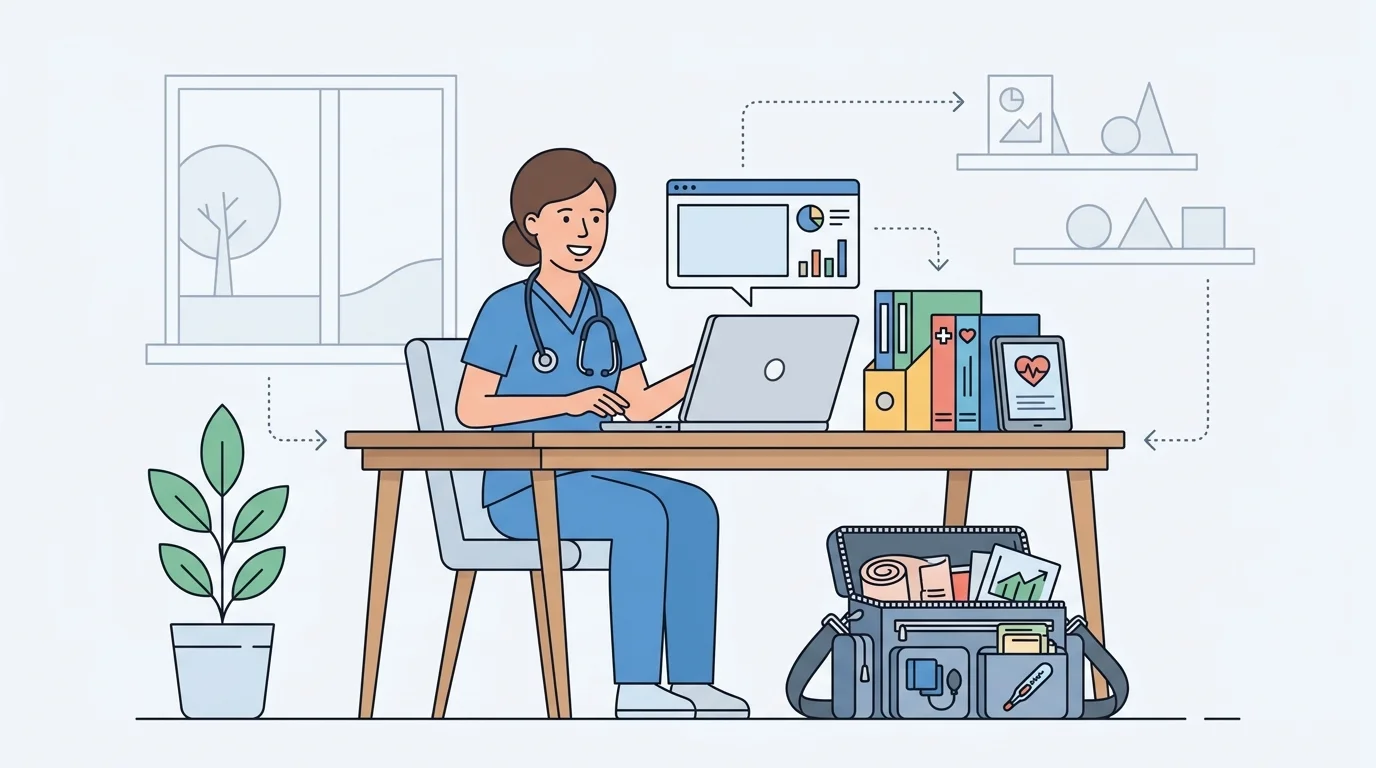
What Remote Nurse Educator Jobs Include
One Title, Several Role Lanes
A single job search pulls in positions with wildly different daily realities. Online academic faculty manage grading, discussions, and student advising, whereas health-system clinical educators design onboarding pathways, validate staff competencies, and run virtual workshops. Digital-health provider educators train new telehealth clinicians while auditing clinical documentation. Pharmaceutical or medical-device educators focus on teaching healthcare professionals about new treatments, which often involves cross-functional support for commercial or medical affairs teams. Finally, remote or hybrid clinical faculty oversee local student practicums and simulation labs from a home office while meeting local facility requirements.
The U.S. Department of Labor’s O*NET profile for postsecondary nursing instructors lists common tasks including lecturing, grading, supervising clinical work, preparing course materials, revising curricula, advising students, and sometimes maintaining an active clinical practice. This broad scope means moving from bedside care to education calls for careful role-by-role review.
Why Remote Is A Location Label
Working from a home office does not guarantee you can set your own hours, because the word "remote" only describes where your desk sits. The label offers no promises about travel frequency, live teaching loads, weekend requirements, or time zone flexibility. Some employers even use the label for roles requiring 30% territory travel or weekly regional campus visits.
Start With The Six-Factor Comparison
A practical comparison helps you evaluate these roles before signing a contract. WeekdayDoc helps healthcare professionals compare clinical jobs by standardizing the details that impact your schedule. Our platform applies a 0-to-10 work-life score to listings, making call coverage, weekend requirements, schedule flexibility, and administrative burden highly visible. Instead of guessing how many hours you might spend on Zoom or an airplane, you can use WeekdayDoc to filter roles by their actual operational demands.
These six workload factors give you a practical way to compare an offer.
| Workload Factor | What To Measure | Hidden Red Flags |
|---|---|---|
| Live Teaching | Synchronous classes, webinars, workshops, orientation sessions | Mandatory camera-on meetings overlapping with recorded module production |
| Curriculum | Course design, exam writing, LMS management, grading | Full course redesigns expected on top of a full-time teaching schedule |
| Travel | Overnight trips, local campus visits, territory coverage | Unpaid travel time or vague "as needed" territory requirements |
| Meetings | Committee work, documentation review, commercial support | Unpaid student messaging or immediate after-hours response expectations |
| Clinical | Active bedside practice, competency validation, licensure | Complex telehealth regulations applied across multiple state lines |
| Compensation | Salaried, hourly, per-course, or contractor pay bases | Unpaid grading and office hours masking a lower effective hourly rate |

Compare Live Teaching And Presentation Load
Synchronous, Asynchronous, Or Recorded
Instruction delivery dictates your daily flexibility. Fully asynchronous courses allow you to log in, grade assignments, and moderate discussion boards on your own schedule, whereas synchronous instruction ties you to a webcam for fixed classes, webinars, orientation cohorts, or simulation debriefs.
Online teaching can still involve other faculty responsibilities. According to the Bureau of Labor Statistics, some postsecondary teachers provide online instruction exclusively or alongside live instruction, while postsecondary teaching can involve evening or weekend courses, office hours, and academic or administrative committee service. The BLS describes postsecondary teachers’ schedules as generally flexible.
Questions That Expose The Weekly Load
You can uncover the true teaching burden by asking recruiters specific questions about the calendar. Find out how many live sessions occur weekly and whether camera-on participation is mandatory for all meetings. It also helps to know the maximum learner group size, who handles student questions outside of class hours, and whether evenings or weekends are built into the standard contract.
The O*NET context update labels the Work Context data for postsecondary nursing instructors “Incumbent (2019).”
Signals Of A Livable Teaching Schedule
A livable role provides schedules in advance, fixed teaching windows, paid preparation time, and compensated office hours. The employer caps class sizes to prevent grading from consuming your weekends. Watch out for roles that combine a heavy synchronous teaching schedule with aggressive requirements for producing recorded video content on your own time.
Compare Curriculum, Grading, And Course Administration
Delivering Content Versus Owning The Course
Delivering an established course takes a fraction of the time required to build one. Academic faculty positions frequently involve exam writing, discussion moderation, student advising, and learning-outcome reviews. Conversely, health-system staff-development roles often focus on building onboarding pathways, competency checklists, workflow demonstrations, and standard operating procedures from scratch.
Digital-health positions combine educational instruction with quality assurance. Everlywell’s 2026 contractor posting, for instance, pairs interdisciplinary provider-network onboarding and workshops with ongoing clinical documentation reviews.
Count Assessment, LMS, And Learner Support
Ask the hiring manager who writes the exams and updates the competencies, and clarify how often courses undergo mandatory revisions. It also helps to know who manages the learning management system. Some universities provide instructional designers, teaching assistants, or administrative coordinators to handle backend software tasks, while others expect the nurse educator to edit video, format slides, analyze assessment data, and compile accreditation reports independently.
Look For Protected Preparation Time
A sustainable schedule includes defined course ownership and protected curriculum-development blocks on your calendar. If an employer expects you to redesign a specialty nursing curriculum, that project requires dedicated, non-teaching hours. When grading, office hours, and video editing fall outside the paid structure of a per-course contract, your effective hourly pay drops sharply.
Compare Travel, Time Zones, And In-Person Work
Fully Remote, Remote-Hybrid, Or Field-Based
Employers use the remote label loosely, so the location deserves an explicit definition. Fully home-based roles keep you at your desk, while remote roles with periodic campus visits require occasional travel for faculty retreats or student evaluations. Remote-hybrid roles often involve local clinical duties, simulation lab supervision, or competency sign-offs, and territory educator roles keep you on the road visiting clinics, hospitals, or client sites within a specific region.
Current job postings show these differing travel burdens. Humana’s remote nationwide Clinical Care Nurse Educator listing details occasional travel alongside specific home-office technology requirements. In contrast, Group Health Cooperative’s remote Staff Development Educator posting lists a virtual schedule but mandates 25% to 35% travel. St. Charles labels an RN Clinical Educator role remote/hybrid while explicitly requiring travel to multiple Central Oregon healthcare locations.
Turn Vague Travel Language Into A Number
The phrase "occasional travel" is too vague to assess on its own. The offer should state the exact percentage of work time spent traveling, the geographic area covered, and the expected number of overnight trips per month. Clarify whether the employer pays for travel time in addition to reimbursing mileage, lodging, and meals.
Contrast these roles with positions that are explicitly field-based. Nightingale College’s 2026 clinical instructor posting serves as a helpful baseline, because it clearly states the position is not remote and involves on-the-ground clinical education at local healthcare facilities. If a recruiter hesitates to define your local field duties, assume the travel burden is high.
Confirm The Workday And Home-Office Rules
A national remote job still operates on a clock, so identify which time zone controls your workday. A virtual role anchored to Eastern time will dictate very early mornings if you live in California. Group Health Cooperative’s posting, for example, strictly enforces a Monday through Friday, 8:30 a.m. to 5:00 p.m. Central time schedule, regardless of where the educator lives.
Compare Meetings, Response Expectations, And Admin Load
Map The Calendar Beyond Teaching
Meetings and administrative duties consume hours outside the virtual classroom. Ask about recurring appointments with nursing leadership, faculty committees, quality assurance teams, or clinical managers. Pharma and medical-device educators regularly coordinate with sales, medical affairs, and commercial teams, meaning one-on-one mentoring, documentation reviews, and reporting deadlines will materially change the shape of your workday.
Identify Metrics And Availability Rules
Find out how quickly the employer expects you to respond to emails, chat messages, or learner questions. Determine whether your availability extends into the evening to support night-shift staff or working students.
The role’s success measures matter as well. Academic roles track student completion, competency validation, and learner satisfaction. Health-system roles prioritize onboarding time and clinical documentation accuracy, while pharma and device roles focus on product utilization, commercial goals, and account growth.
Use WeekdayDoc To Surface The Hidden Load
Evaluating this administrative burden by reading a job description is difficult. The WeekdayDoc platform standardizes this research by pairing standard work-life factors with educator-specific details. You can view time-zone coverage requirements, estimated learner loads, travel percentages, and response expectations directly on the listing. This helps you find the most operationally livable role instead of chasing the highest salary figure. If you are comparing remote utilization review nurse jobs alongside educator roles, having standardized schedule metrics prevents you from stepping into a high-burnout environment.
Compare Clinical Requirements, Licensure, And Credentials
Active Practice And Specialty Expectations
Teaching nursing and practicing nursing involve different compliance rules. Start by checking whether the role requires current bedside hours, competency validation in a facility, or direct patient care. While O*NET lists maintaining clinical practice as a potential task for postsecondary instructors, many remote didactic roles omit active bedside shifts entirely.
MSN, Terminal Degrees, And CNE
Qualifications vary by institution. A doctoral degree is common for university faculty, but a master’s degree suffices for many community colleges and health-system roles. Grand Canyon University requires an MSN for its Med-Surg faculty role, whereas Simmons requires a terminal degree, five years of clinical experience, and prior teaching experience for its director-level clinical education position.
The Certified Nurse Educator credential represents academic excellence, but it is not universally required. The National League for Nursing 2026 candidate handbook outlines two main eligibility pathways: one requires a graduate degree with a nursing-education emphasis or nine graduate-level education credits, while the other allows a non-education graduate nursing degree paired with at least two years of recent employment in an academic nursing program. The CNE is a targeted academic certification, and corporate or digital-health training jobs do not universally require it.
When State Licensure Applies
Licensure becomes complicated when education roles include patient care, telehealth triage, or clinical advice. The National Council of State Boards of Nursing’s Nurse Licensure Compact guidance states that the patient’s location determines where practice occurs. A multistate license covers telehealth practice across compact states, but treating a patient in a noncompact state requires a single-state license.
Telehealth compliance rules do not automatically apply to teaching-only academic work. The employer’s specific compliance process clarifies whether you need a license in the state where the university is headquartered, where the students live, or where clinical practicums occur. Simmons, for example, requires an unencumbered Massachusetts RN license, plus an APRN license for any in-person campus teaching.

Compare Pay And Vet The Offer
Use Salary Benchmarks Carefully
National wage data provides context, but it does not represent a guaranteed remote salary. In May 2025, the Bureau of Labor Statistics reported an $80,250 median annual wage for postsecondary nursing instructors and teachers, with a projected 17% employment growth for the occupation from 2025 to 2035 adding 16,500 jobs. A separate BLS table reports an $86,410 mean annual wage for the same timeframe.
These metrics blend distinct roles together. Neither figure isolates remote work, private-sector corporate roles, territory travel, or independent contractor status, and self-employed consulting educators are excluded entirely from these BLS wage metrics.
Employer postings from 2026 demonstrate the actual market spread based on specialty and sector:
- Grand Canyon University (Online Faculty): $83,000 to $95,500 annually. Requires an MSN, fixed daytime Arizona hours, and online teaching.
- Group Health Cooperative (Staff Development): $85,000 to $100,000 annually. Requires a virtual schedule with 25% to 35% travel.
- Humana (Clinical Care Educator): $86,300 to $118,700 annually. Features 40-hour weeks, occasional travel, and bonus eligibility.
- Simmons (Director of Clinical Education): $92,958 to $118,209 annually. Demands a terminal degree, periodic Boston travel, and a 12-month contract.
- Servier (Oncology Educator): $141,000 to $165,000 annually. This is a commercial, specialty-focused role engaging healthcare providers, combined with incentive eligibility.
- St. Charles (RN Clinical Educator): $53.25 to $79.88 hourly. This is a remote/hybrid role requiring travel to multiple local facilities.
Specialty expertise, leadership duties, sales incentives, advanced degrees, and travel expectations dictate these differences. Hourly, salaried, and per-course compensation models do not compare cleanly without calculating the total hours required.
Compare Total Compensation With Total Work
An offer should make clear which hours generate a paycheck. If you accept a per-course academic contract, confirm whether the university pays you for preparation time, grading, office hours, and mandatory faculty meetings.
The benefits package also matters, including paid leave, retirement contributions, tuition assistance, and certification reimbursement. For a role that includes a bonus, request the exact formula used to calculate the payout. For academic roles, the offer should also state whether the employer guarantees a specific course load and whether the contract requires you to teach summer terms.
Search Broad Titles And Ask Better Questions
You can find these roles by expanding your job-search vocabulary. Search for clinical education specialist, nursing professional-development educator, healthcare instructional designer, and staff development educator. If you are comparing non-clinical options, reading about remote healthcare data analyst jobs can help you weigh alternative corporate roles.
Set your job alerts on WeekdayDoc to capture these variations. Once you find a match, use our AI contract scanner to check for restrictive non-competes, tail coverage gaps, or payback clauses hidden in the PDF.
Before signing anything, run through this final offer checklist:
- Is the role fully home-based or hybrid?
- What is the exact travel percentage?
- Which time zone dictates the daily schedule?
- Are evenings or weekends required for live teaching?
- What is the expected learner load or course cap?
- Are active clinical practice hours mandated?
- Are preparation, grading, and travel time fully paid?
Frequently Asked Questions
What does a remote nurse educator do? Responsibilities depend heavily on the employer. You might teach nursing students, develop corporate training curriculums, run hospital onboarding programs, review clinical documentation, or educate physicians on new medical devices.
Do I need an MSN to get hired? Academic universities frequently require a Master of Science in Nursing or a terminal degree. However, health systems, digital-health companies, and medical device manufacturers often hire educators based on deep clinical specialty experience and a BSN.
Can I work part time? Part-time postsecondary teaching is very common. The key distinction is between a part-time W-2 employee with benefits and an adjunct 1099 contractor paid per course without benefits.
Do I need multiple state licenses? For teaching nursing students, the applicable requirements generally depend on the employer and location. If your educator role involves telehealth triage, direct patient care, or giving specific clinical advice across state lines, you will need to comply with NCSBN compact rules and individual state board requirements.
The best remote nurse educator role clearly defines your live teaching schedule, curriculum expectations, travel burden, and total compensation. Create a free account on WeekdayDoc today to compare actual work-life scores, view transparent schedule expectations, and evaluate the real workload before you apply.